Tag: Impact Investing

The Next 25 Years – Big Picture Thinking

By Amy Domini, founder, Domini Impact Investments

>> Back to July 2017

“Never doubt that a small group of thoughtful committed citizens can change the world: indeed it’s the only thing that ever has.” – Margaret Mead
Responsible investing momentum is strong. For me, and for many of my generation, the future is clear: we are well on our way towards the installation of a vitally important system-level force for good, one that will protect future generations, indeed the planet itself. We have laid the groundwork for a financial system which functions globally to protect people and the planet. It is the realization of a misty dream for me. My purpose in advocating what I called ethical investing, going back nearly 40 years now, was to build a large enough investor presence that demanded a clean and dignified future for all — that such a future would be guaranteed.

We know that universal human dignity and ecological sustainability are not guaranteed. We have recently seen this, during the holocausts brought about by Nazis killing 12 million, the Cultural Revolution killing over 40 million, Stalin’s various gulags and purges killing 12 million, King Leopold II’s rape of the Congo killing 10 million, and so on through the centuries. And it isn’t only disregard for people. In 1985 we discovered a vortex of plastic trash in the Pacific. Yet we did nothing and that vortex is now somewhere between the size of Texas and the United States. In 1896 Svante Arrhenius wrote that burning coal was adding CO2 to the atmosphere and thereby raising the planet’s temperature; we did nothing. We know that God Almighty has not stepped in to prevent such things. We know that a single nation or even a coalition of nations cannot do so. Some sort of planet-wide, pre-existing, powerful and coordinated entity must be found, and must be convinced, to assert sanity. Finance is such an entity, and finance is increasingly populated by investors who give a damn.

“We must continue to stand together to demand that the search for monetary profits not come at the detriment of universal human dignity nor the undermining of ecological sustainability.”

The tide has turned; investors who care about the impact of business-as-usual on the well-being of others now number over 26 percent of global assets under management. These investors use at least one tool in the responsible investor’s toolbox, and in Europe and Australia/New Zealand, over half of funds are so managed. Additionally, one key component to slow investor growth in the adoption of a 100 percent responsibly managed portfolio has been lack of product in key allocation strategies. This is a rapidly fading problem. We now see new products produced at a dizzying rate. Long-short strategies, forest portfolios, hedge funds, private equity – in short we now see plenty of product to build the fully committed portfolio. Soon the partially committed investor will be fully engaged, and the impact will be exponential.

Review the tools in the responsible investor’s toolbox, and it becomes obvious how much impact the field has already had and how much more it will accomplish once sheer numbers gradually integrate their values into the global financial system. First, and probably most undervalued, we apply standards to what we purchase. To understand the impact, consider voting. Whether you vote or not has no impact on most election results. When 50 percent of us vote for companies with corporate responsibility values embedded into their very DNA, markets respond, disclosure increases, stakeholder partnerships become routine and yes, investors feel good.

If you believe that the global financial system has any impact at all on people and the planet, there is no better way to positively affect that dynamic than by applying standards. I began by saying that the application of standards is probably least undervalued. However, the on-going superior performance of what was launched as the Domini 400 Social Index and is now the MSCI KLD 400 Social Index has reduced the risk that standard-setting is abandoned. Within the field we understand why the outperformance: the application of stakeholder standards highlights the quality of management teams and reduces the number of companies run by behind-the-curve individuals.

Our second tool is direct engagement with corporations, governments, NGOs and the public to support and protect programs and policies that fit into our twin goals: universal human dignity and ecological sustainability. Our primary successes come through shareholder dialogue. Shareholders are uniquely capable of bringing non-profit voices into communication with management in an effort to make things better. It may seem like a small thing to label pesticide soaked plants at Home Depot or to gain assurance of better sourcing practices at The Gap, but when you stitch together the quilt of such initiatives spanning the past 35 years or so, with the founding of Interfaith Center on Corporate Responsibility, the core premise of using finance to build a better future is clearly working successfully, one campaign at a time.

Our third tool is direct support for under-capitalized efforts that raise a population or a technology or a premise to the point of being conventionally capitalized. American-based responsible investors have focused their efforts primarily on community development financial institutions, viewing venture capital into new technologies as a part of the first (apply standards) category. However as Europe and the rest of the world used cooperatively based energy or fair trade vehicles more, we have followed suit. Our third leg is now expanded but remains true to its core value of addressing capital vacuums in order to improve lives and extend planetary health.

I have stated that we have entered the systems-level impact our field needs, but there are risks. We must not succumb to a lack of cohesiveness. I ask my investors to buy into only one premise. Do they believe that finance has a role to play in keeping the planet clean and people healthy (in the fullest sense of the word)? If so, then I do not particularly care whether the portfolio they invest in is the one I would have built. Any portfolio that seeks to achieve that goal is influencing the system. To put it another way, a fund that cares only about animal wellness might never get to be a powerhouse in the world of protecting animals, but will add to the number of investors who give-a-darn about the world around them. I count that fund as important to me.

A second risk to our field is the constant tinkering with vocabulary. I’ll continue with a personal issue, but do so with trepidation. It is not that I attempt to stop popular phraseology; rather I mean only to say words have meaning and we have too many words. At present ESG (environmental, social and governance) is a widely used phrase. I avoid it. Governance, or investors’ role, was always represented in my stakeholder model. Twenty-five years ago we were already integrating governance standards into corporate evaluations at KLD Research & Analytics. Who decided to raise investor concerns to the level of people and the planet? Why? I’d rather that investors took their lumps along with suppliers and consumers (other stakeholders). But I do not trash-talk about ESG being a sell-out in my marketing literature. Nonetheless, I see much marketing literature that asserts that ESG is better than and definitively not that old-fashioned Socially Responsible Investing stuff. The field spends far too much time attempting to find a niche when it should be attempting to find a commonality. To this end, the coalescing of the Global Sustainable Investment Alliance, which unites the work done in America, Europe, Australia, Canada, the UK and the Netherlands, and reaches out to Japan, Africa and Latin America, marks a remarkably important step forward, one that is, to my mind, crucial.

During the next 25 years our field will succeed in our efforts to grow into a powerful force for good. We are influential enough today to have shaped an entirely different dialogue between investors and corporations from the one I was born into. Our challenge is to use that influence aggressively, consistently and collegially. We must continue to stand together to demand that the search for monetary profits not come at the detriment of universal human dignity nor the undermining of ecological sustainability. The planet counts on us to do so.


Article by Amy L. Domini, CFA. She is widely recognized as the leading voice for socially responsible investing. Her passion for the field has led her to create three businesses and to write several books. She has been awarded acknowledgements of these efforts, including: Time magazine named her to the Time 100 list of the world’s most influential people in 2005. That year she also received a citation from President Bill Clinton for her work with the United Nations Foundation. In 2008, Ms. Domini was named to Directorship magazine’s Directorship 100, the magazine’s listing of the most influential people on corporate governance. In 2014, she was awarded the Founders Award by New Yorkers Against Gun Violence for her advertising campaign (which ran in The Nation), urging investors to divest guns from their portfolios.She is the founder of Domini Impact Investments (www.domini.com), a mutual fund company with $1.6 billion in assets under management.

Ms. Domini is also founder of The Sustainability Group, which manages private client assets in Boston, MA. She has served on a number of boards, including the National Association of Community Development Loan Funds (now Opportunity Finance Network), an organization whose members work to create funds for grassroots economic development loans; and the Interfaith Center on Corporate Responsibility, the major coordinator of involved shareholders who file proxy resolutions. She is a member of the Boston Security Analysts Society. Ms. Domini holds a B.A. in international and comparative studies from Boston University, and holds the Chartered Financial Analyst designation. In 2006, she was awarded an honorary Doctor of Business Administration degree from Northeastern University College of Law. Yale University’s Berkeley Divinity School presented Ms. Domini with an honorary doctorate in 2007. Ms. Domini is the author of Socially Responsible Investing: Making a Difference and Making Money (Dearborn Trade, 2001) and The Challenges of Wealth (Dow Jones Irwin, 1988), and a coauthor of Investing for Good (Harper Collins, 1993), The Social Investment Almanac (Henry Holt, 1992), and Ethical Investing (Addison-Wesley, 1984). She contributes regularly to Optimist magazine and GreenMoney Journal. She lives in Cambridge, MA with her husband, Mike Thornton.


Featured Articles, Impact Investing, Sustainable Business

Responsible Investing – Principles, Pillars and Progress

By John Streur, president and CEO, Calvert Research and Management

>> Back to July 2017

The responsible investing movement that we have started and shaped has reached the end of the beginning, with a broad and strong foundation that will evolve to provide the superstructure of our society’s continuing struggle to address and solve its greatest challenges. Our efforts are working, and we are being joined in our mission by more investors worldwide every day.

The United Nations Principles for Responsible Investment – of which Calvert was a founder – now counts 1,700 large investors and more than $70 trillion in assets. This movement, unique because it was begun by investors, not Wall Street, is born from innovators, enthusiastic about the ability to create positive change and unwilling to wait for government officials or corporate leaders to set the pace.

The future of the movement will be guided by all of us who want a healthy environment, a just and inclusive society, and hundreds of other common-sense improvements to make the world a better place while producing competitive investment results. It is a privilege for me as CEO of Calvert Research and Management to write about the future of a movement that rightly belongs to you, the people.

The Role of Responsible Investing

Responsible investing (RI) is the underlying force shifting corporate strategy and behavior throughout the world by emphasizing environmental sustainability, equality and inclusiveness. Today, the markets are connecting stock and bond prices to corporate performance on these matters, and consumers are increasingly making their purchasing decisions with these factors in mind.

Modern concerns, like climate change, equality, diversity, and health and well-being, will continue to be major issues RI addresses in the coming decades. In addition, society will have to wrestle with changing demographics, an aging society, and changes in the meaning of work, thanks to increased automation that will allow robots to replicate and replace jobs currently being done by humans. Fortunately, the platform we are building today portends the adoption occurring in the markets and in business that will allow us to navigate these waters and storms.

RI offers the opportunity for many different types of investors to make a contribution toward positive change, from those seeking to screen out and avoid companies related to a single issue all the way to those who embrace an effort to adopt a comprehensive approach to assure positive impact is maximized. This is a major draw because no matter how much we desire strong investment performance, making the world a better place is also just the right thing to do.

In short, RI is the best way to influence the markets by bringing these forces together. What do we all have in common, and what does the future hold for our work?

Principles and Pillars

All of us are working toward the achievement of a set of global norms, either held individually or promulgated worldwide, to help our investments promote a more sustainable world and to serve as a powerful check and balance upon any misguided government official or corporation. We look to inclusive organizations, like the United Nations Sustainable Development Goals (SDGs) and other multilaterals to help set the standards.

In pursuit of that achievement, in 2015, Calvert produced the Calvert Principles for Responsible Investing to guide our work. Later that same year, the United Nations Sustainable Development Goals were ratified and Pope Frances introduced the Vatican’s latest encyclical. If you are focused on one or a limited set of issues, check out these principles and you will see that you fit into the overall effort.

Four major pillars of RI help us implement this framework in a way that considers both traditional portfolio evaluation standards and its environmental and societal impacts:

•  Performance – Our first responsibility is to seek strong portfolio returns.

•  Research – We evaluate all material ESG factors that influence a company’s business results — moving beyond negative, values-based screens.

•  Engagement – As shareholders, we actively engage company management to help drive performance.

•  Impact – We believe the impact of your investments should be material and measurable.

These pillars are the essential processes we all must use to meet our responsibilities as investors, as key participants in our global, democratic capitalist system.

Contemporary Results, Optimistic Future

The operation of the Responsible Investing system was on display earlier this year and gives insight into what the future holds.

In May, shareholders of Exxon Mobil voted by a 62% majority against the management of the company to support a climate change proposal that asks for Exxon to provide robust disclosure of the risks it faces related to climate change. Occidental Petroleum’s shareholders approved a similar proposal earlier that month. On June 1, United States President Donald Trump announced his intention to withdraw the U.S. from the Paris Climate Accord and by the following day dozens of CEOs of U.S.-based companies from General Electric to Apple Computer had stated their intentions to maintain their commitments to reducing their carbon footprints and meeting the commitments implied by the Paris Accord.

This was another illustration that the role of the corporation in society is extremely powerful and important in shaping our societal and environmental future, essentially the quality of life for ourselves and future generations. The movement that you helped start now matters to the majority of investors and is robust enough to act as a check and balance on the most powerful institutions in the world. Actions taken by investors and corporations in these days of uncertain government support for ESG issues that we hold dear are positive signs that we will continue to be able to drive positive change in the future.

As responsible investors, we must continue to monitor corporate behavior and inspire progress. Even in a political climate that isn’t always supportive of ESG goals, we have shown the ability to take the baton and lead, and will continue to do so over the next 25 years.

A More Robust Information System

A key piece of this effort is the information system being built to support the four pillars, which, again, is being built by you, the people, and not the United States government or Wall Street. The system has two big pieces: the structural information about corporations’ policies, procedures and ESG performance goals, and the emerging and powerful set of information about what is happening throughout the world day-to-day in terms of corporate behavior. The first part of the system is what companies are saying about themselves, the second part of the system is new and emerging – it is what you and hundreds of millions of others are observing and reporting about corporate behavior.

The Sustainability Accounting Standards Board (SASB) is a nonprofit started by an individual with tremendous vision and drive. This is the place to look to understand the current and future state of corporate sustainability disclosure, the information we are all asking companies to provide so we can further our in-depth research. Ultimately, all companies will provide relevant information. The Exxon Mobil vote should be the notification to every company that the majority of investors will take action if management does not move expeditiously to provide the disclosure. Calvert is pleased to have been a founding member of the SASB Investor Advisory Group, along with a dozen other large investors representing over $20 trillion in invested assets.

Data science is the place to look to understand the second, emerging part of the system, the continuous stream of information now coming into advanced models designed to provide insight into how companies are actually performing day to day. This involves taking in information from a vast number of sources, being able to assess the credibility and bias of the sources, create a score for the relevance and meaning of the information being created, and attach that to specific companies and the securities they have issued. It is very interesting and exciting work because we are ultimately bringing on a very important set of information: The first set discussed is what the companies are saying about themselves; this newer second set is what everyone else is saying about the companies.

Expanding the Universe

The principles and pillars, combined with new information systems, are allowing us to apply RI to some traditional asset classes previously not heavily covered, like municipal bonds (critical for the redesign of our cities and infrastructure for a sustainable future), fixed-income securities broadly, small companies, private companies and emerging markets. This, in turn, is facilitating the development of new types of securities, like green bonds. And, of course, many investment firms never before involved in RI have thrown their hats in the ring with new products.

We can see that the future entails markets working to understand the evolution of global norms and to determine how any company is performing relative to those norms in order to determine how much any company or its securities are worth. Responsible investors have performed a vital role in helping markets to price ESG performance into valuations, and to engage with companies to create better disclosure and corporate performance. This is a dynamic system of principles, the four pillars and progress. While the specific issues that are being focused on (climate change, greater equality, etc.) change based on what is needed, it is a durable and adoptable system of improvement.

The future involves much greater transparency, useful information from the “global crowd” and faster progress – which is exactly what we need. We are often asked if all investing will become RI. The answer seems to be that all investors will be impacted by RI and many will play some role, but it seems far off until all investors actively embrace RI. However, you are standing at the vanguard of a dynamic movement that will be far larger and more robust 25 years from now, and of a society that will benefit immensely from the actions that you are taking to promote positive change.


Article by John Streur, President and Chief Executive Officer of Calvert Research and Management (www.calvert.com), an investment management firm that specializes in responsible and sustainable investing across global capital markets. Calvert serves all types of investors through its family of mutual funds and separate accounts. Mr. Streur is also President and a Trustee/Director of the Calvert Funds and a Director of Calvert Foundation and member of its Risk Oversight Committee.

Since joining Calvert as CEO in 2015, Mr. Streur has restructured Calvert with focus on investment research and emphasis on environmental, social and governance factors integrated with investment decisions. He has guided the creation of the Calvert Principles for Responsible Investing and the Calvert Research System, as well as the development of the Calvert Responsible Investment Index Funds.

Mr. Streur began to focus his energy exclusively on responsible and sustainable investing in 2012, as President, Director and Principal of Portfolio 21, a boutique investment management firm specializing in global environmental investing. Previously, he spent 20 years at Managers Investment Group LLC (and its predecessor), a firm he co-founded and where he served as President, CEO and Chair of the Investment Committee. He was also President and Trustee of the firm’s fund family, Managers Funds and Managers AMG Funds. Managers Investment Group LLC grew to over $30 billion in assets under management and offered investment strategies across global equity, debt and derivative markets. Mr. Streur has managed socially responsible investments at the request of institutional clients, including public funds, religious institutions, and college and university endowments since 1991.

Mr. Streur is a founding member of the Investor Advisory Group for the Sustainable Accounting Standards Board (SASB), a group of leading asset owners and asset managers committed to improving the quality and comparability of sustainability related disclosure by corporations for use by investors. He is currently a Director on the Board of the Environmental Media Association, whose mission is to motivate the entertainment industry to educate the public about environmental issues and sustainability through all forms of media. He is a graduate of the University of Wisconsin; Bachelor of Science, College of Agriculture and Life Sciences. 

The views expressed are those of John Streur and are current only through the date stated. These views are subject to change at any time based upon market or other conditions, and Calvert disclaims any responsibility to update such views. These views may not be relied upon as investment advice and, because investment decisions for Calvert are based on many factors, may not be relied upon as an indication of trading intent. Past performance is no guarantee of future results.

Calvert Research and Management is registered as an investment adviser with the U.S. Securities Exchange Commission.

Energy & Climate, Featured Articles, Impact Investing, Sustainable Business

The Future of SRI

By Matthew Patsky, Chief Executive Officer, Trillium Asset Management

>> Back to July 2017

Eight years ago I received the call asking me to consider joining Trillium Asset Management as CEO. Since that time, we have seen more interest than ever in the field of sustainable investing from a wide variety of institutions, mainstream money managers, and families often driven by women and millennials, bringing assets over to impact. But we are also keenly aware that since the election, the new Administration is actively working to dismantle many of the key policy initiatives we have advocated over the last 35 years. So we are at an interesting crossroad. Looking out over the horizon, I see six emerging trends that I believe shed light on the future of sustainable investing.
•  CEO Accountability
•  Companies taking a stand on policy
•  Higher expectations for money managers
•  Higher votes for ESG proposals
•  Greater attacks on shareholder rights
•  Need for measuring impact of advocacy and policy

CEO Accountability

Historically many corporate CEOs led by decree with a certain imperiousness that shaped the thinking of the board and shareholders. As shareholders are increasingly influenced by a broader set of factors than a simple quarterly earnings announcement — understanding the long-term impact of key ESG issues, we expect the balance of power to shift. We believe shareholders will be leading the way, that the board will be more attentive to shareholder demands, and that ultimately CEOs will understand that they work on behalf of shareholders and other constituents who care about long-term sustainability. The successful CEO of the future will not be exclusively focused on short-term quarterly earnings but will have predominate interest in building long-term sustainable business models.

Companies Taking a Stand on Policy

For years Trillium has asked companies to be more transparent on involvement in industry associations, such as the Business Roundtable. These organizations have often advocated public positions that are in opposition to many of the core values espoused by these corporate members on climate change, gender diversity, and executive compensation. Some of these companies have responded by resigning from groups such as ALEC, or at the very least were transparent about their involvement. Now, in the face of the ever-growing threat from certain Trump-era policies, we find that these companies are taking a more active stand on policy issues; as in support of the Paris Climate Agreement. In fact over 1,500 business and investors signed a recent letter from CERES in support of reducing carbon emissions and adopting sound climate policies. Going forward there will be more pressure on companies to advocate for more progressive policies in support of the environmental, social, and governance (ESG) issues that matter. Silence will be viewed as complicity rather than neutrality.

Higher Expectations for Investment Firms Waving the Sustainability Flag

We have seen large money managers like State Street, Blackrock, and Pimco jump into the field of sustainable investing. Joining the Principles for Responsible Investment (PRI) is an easy first step. Gaining access to sustainability research for portfolio managers and analysts is another common early step. Reexamining proxy voting policies is often next. The 2016 US SIF Trends Report now shows that 1 out of 5 dollars invested in the U.S. follows some kind of ESG consideration[1]. However, US SIF also found that many of the larger managers do not communicate clear ESG criteria or use the criteria across all pools of assets at the firm[2]. Just this year we have seen Blackrock pledge to start supporting more ESG related shareholder proposals (in part in response to a shareholder proposal filed by Trillium). Managers who market themselves in this space will have an increasing expectation that they are going beyond proxy voting, and engaging more fully in shareholder advocacy and public policy initiatives.

Higher Votes for Shareholder Proposals

Just last month, 62 percent of Exxon shareholders supported a shareholder resolution filed by the New York State Common Retirement Fund and the Church of England calling on the company to explain how its business will be impacted by global efforts to mitigate climate change. Resolutions at Occidental Petroleum and PPL Corporation related to climate change also received majority votes this year, as did a proposal at Pioneer Natural Resources on creating an annual sustainability report. Trillium’s resolution during May of last year at J.B. Hunt received a 54.7 percent vote. Often, these strong results translate into significant changes. The fact that such large numbers of mainstream investors are supporting ESG shareholder proposals demonstrates that we are at a tipping point.

Greater Attacks on Shareholder Rights

As we see more success from efforts to engage companies through shareholder engagement, and stronger voting results, we expect to see more attacks on our rights as shareholders. Recently, we saw the Financial CHOICE Act pass in the U.S. House of Representatives, which among other things would require that shareholders own one percent of a company before they could file a shareholder proposal. We will work hard in coalition with other investors, such as US SIF, to fight this. But we believe that we need to clearly communicate the importance of this right to policymakers; to raise material ESG issues with companies and other investors. In fact, a shareholder proposal this year at Exxon asking for the company to restrict “precatory” proposals in the future only received a 1.6 percent vote of support. Clearly this right is something that shareholders value and should be protected.

Need for Measuring Impact of Advocacy and Policy

While impact measurements for private investments have improved, we have not yet seen a similar evolution for public equity investments. The range of policy work and shareholder engagement done by firms in this space is truly impressive and groundbreaking. It is difficult to communicate clearly to investors that they should expect both a “social return on investment” alongside a “financial return on investment.” We need to create a common framework to understand, prioritize, and measure the change we want to make. Individual resolutions at companies will continue to be important. But we expect that creating policy incentives that drive improvement in key ESG issues across industries will be more important. We are involved in some nascent efforts in this direction and hope they will bear fruit.

Conclusion

Today, we see more companies and investors integrating ESG issues into either their operations and/or investment approach. In the next 35 years, we believe the field of sustainable investing will move further into the mainstream market with the majority of investment dollars focused on generating long-term value. As we move towards this, we must harness the energy from reinvigorated investors, companies, and local policy makers who are standing up for the ideals we espouse but we must also help engage those who are entering our ranks and looking to take a stand. As we look to the future, we should recognize the current time as a critical turning point where a new consensus is forming that will transform the way investors and companies lead on the critical issues facing our planet. At Trillium, we look forward to being in the vanguard of this movement. We and our critical allies in the field have an extremely important role to play in demonstrating how a robust approach to advocacy and policy must be utilized in order to ensure a sustainable future.


Article by Matthew Patsky, CFA, Chief Executive Officer, Trillium Asset Management (www.trilliuminvest.com). He leads Trillium’s Sustainable Opportunities strategy and has over three decades of experience in investment research. In 1994, he became the first sell side analyst in the U.S. to publish on the topic of socially responsible investment.

Article Notes:

[1] http://www.ussif.org/blog_home.asp?Display=75

[2] http://www.ussif.org/files/Publications/UnlockingESGIntegration.pdf

DISCLOSURE: The views expressed are subject to change based on market or other conditions and are not a forecast of future events or a guarantee of future results. These views are not investment advice nor a recommendation to buy or sell any of the securities mentioned. It should not be assumed that investments in such securities have been or will be profitable. The author selected the specific securities to illustrate views expressed and they do not represent all of the securities purchased, sold or recommended.

Energy & Climate, Featured Articles, Impact Investing, Sustainable Business

New Report on Opportunities for Impact Investing in Employee Ownership

> Back to July 2017


With income inequality in the United States at record high levels, employee ownership is increasingly being lauded as a potential solution to spreading wealth more broadly. Most recently, research from the National Center for Employee Ownership released in May 2017 shows that employee owners have a household net worth that is 92 percent higher than non-employee owners. They also make 33 percent higher wages, and are far less likely to be laid off.

But employee ownership requires new investment in order to get to scale. A new report by Mary Ann Beyster, president and trustee of the Foundation for Enterprise Development (FED), published by the Fifty by Fifty initiative of The Democracy Collaborative, examines the investing landscape for potential opportunities in employee ownership. The report, “Impact Investing and Employee Ownership,” released recently, reports on the results from six months of research, showing that the opportunities for impact investors to support employee ownership are limited, but that an investing infrastructure is beginning to emerge across asset classes. Among the key leading opportunities for investment are community development financial institutions (CDFIs), private equity funds, and one mutual fund.

“Employee-owned companies ground wealth locally, stabilize communities, and offer impact investors a direct way to benefit their own communities,” Ms Beyster said. “We found that what is needed is more awareness of the benefits of employee ownership and more attention to building the needed investment infrastructure.”

Among the leading investment opportunities highlighted in the report are:

CDFIs: Among roughly 800 community development financial institutions nationwide, the study found six that focus on financing employee ownership:

  • Capital Impact Partners in Washington, DC;
  • Commonwealth Revolving Loan Fund run by the Ohio Employee Ownership Center in Kent, OH;
  • Cooperative Fund of New England, which loans to cooperatives throughout New England;
  • Local Enterprise Assistance Fund in Brookline, MA;
  • Shared Capital Cooperative in Minneapolis;
  • The Working World in New York City.

Private Equity: The study also found two private equity funds focused on financing mid-market firms (revenues of $15 million up to $350 million) that are employee-owned or are transitioning into employee ownership. These two funds are:

  • Mosaic Capital Partners in Charlotte, NC, which has a $165 million fund;
  • Long Point Capital, with offices in Royal Oak, MI, and New York City, which has $550 million assets under management.

Particularly noteworthy about these two investment options – appropriate primarily for institutional and high net worth investors – are that market-rate private equity returns are likely available. A similar fund is in formation by American Working Capital, headquartered in Chicago.

Mutual Fund: Among mutual funds – open to even small investors – no option with an explicit focus on employee ownership was found. But the study did discover one fund, Parnassus Endeavor Fund, which invests in 26 companies identified as great places to work, where Beyster’s research found that all of the companies on the list have some kind of broad-based employee ownership.The fund has returned 32.46 percent over the past year and 15.39 percent over the past three years. It was named in 2016 by US News and World Report as the No. 2 fund among Large Growth stocks, in its annual ranking of mutual funds.

Bank: There is one bank dedicated to supporting cooperatives of all kinds, which has lent to worker-owned cooperatives and employee stock ownership plan companies for decades; it is National Cooperative Bank. Investors can open a variety of accounts with this bank, with FDIC insurance; these include checking, savings, IRAs, and certificates of deposits.


About Mary Ann Beyster

Mary Ann Beyster is president and trustee of the Foundation for Enterprise Development (FED), a private, nonprofit operating foundation established in 1986 to advance entrepreneurship and science and technology innovation through broad-based ownership.

About The Democracy Collaborative

The Democracy Collaborative (http://democracycollaborative.org) is dedicated to developing new ways to build community wealth and stronger local economies, including through networks like Fifty by Fifty (fiftybyfifty.org), a collaboration driving towards fifty million employee owners in the US by 2050.

Contact Person

Erin Kesler / Phone (202) 559-1473 x133

Email Erin ekesler@democracycollaborative.org

Additional Articles, Impact Investing, Sustainable Business

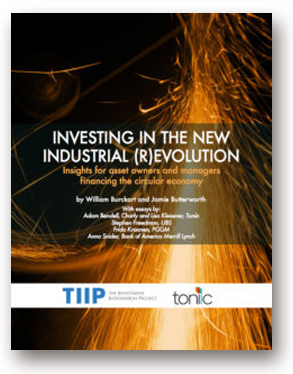
Investing in the New Industrial (R)evolution: Insights for asset owners and managers financing the circular economy

A report published June by The Investment Integration Project (TIIP) examines the opportunities, challenges, and breakthroughs needed for investors to finance the circular economy. Written by William Burckart (TIIP) and Jamie Butterworth (Circularity Capital), Investing in the New Industrial (R)evolution: Insights for asset owners and managers financing the circular economy details how investors and corporations are incorporating global issues related to the health, food, and energy systems, as well as others, into their investment and production design processes, respectively.
The report includes essays by practitioners that are helping to bridge the divide between financial markets and the circular economy, including Adam Bendell and Lisa and Charly Kleissner (Toniic), Stephen Freedman (UBS), Frido Kraanen (PGGM), and Anna Snider (BoA ML).

Key findings of the research include:

  • Corporations are increasingly realizing that the linear “take-make-dispose” approach to manufacturing is inefficient and unsustainable, and that a shift towards a circular approach (focusing on renewable energy, reuse of what would previously be considered waste products, and the sharing economy) is necessary, inevitable, and a superior source of value creation.
  • Demand by investors is growing for investment products that simultaneously provide financial returns and address social and environmental challenges on a global scale-what TIIP calls “systems-level investing”.
  • Challenges to developing and financing circular opportunities include materials complexity, transition and development costs, cash flow pattern changes, the purpose and nature of contracts, and legal considerations. Investors can utilize a number of key investment activities-investment beliefs statements, security selection and portfolio construction, engagement, targeted investment programs and manager selection-to develop an investment policy or special targeted investment program that prioritizes the circular economy.
  • Examples of investing in the circular economy exist across assets classes (public equities, private equities, fixed income, real estate, venture capital, and real assets).
  • Opportunities and resources can be found for collaboration and accelerating investing in the circular economy.

>> Download the full report from The Investment Integration Project (TIIP)

Additional Articles, Impact Investing, Sustainable Business

Benefit Chicago Fund Announces First Round of Impact Investments

>> Back to July 2017

The for-profit subsidiary of a West Side nonprofit that provides transitional jobs for the formerly incarcerated in its production of local honey and honey-infused skincare products; a company that employs adults with autism founded by the father of an affected child; a collaborative created to renew a corridor that was once the heart of entertainment and shopping on Chicago’s south and southwest side – these are three of the beneficiaries of the first loans to be made by the impact investment fund established for Benefit Chicago.

A collaboration of The Chicago Community Trust, the John D. and Catherine T. MacArthur Foundation, and Calvert Foundation, Benefit Chicago was created to expand the pool of loans and investments available to mission-directed for- and nonprofit entities, which, due to the communities or populations they serve, often find it difficult to access capital from commercial sources.

Benefit Chicago Executive Director William Towns today announced loans totaling $12 million to six Chicago area organizations: AutonomyWorks, Chicago Neighborhood Initiatives (CNI), Garfield Produce Company, IFF, the Southwest Corridor Collaborative of LISC Chicago, and Sweet Beginnings, the for-profit subsidiary of the North Lawndale Employment Network.

“We are excited by the diversity of the borrowers and the initiatives they submitted for financing,” Towns said. “Some are established, well-known organizations; others relatively new, but all represent the opportunities for and commitment to development in every part of Chicago and to the well-being of residents.” Towns stressed that the announcement today is just the first of many loans to come over the next months. “We’ve already received more than 80 applications. While not all can or will be financed, they underscore the creativity and energy of organizations throughout the region.”

“The loans announced today confirm recent research and our own experience,” said Julia Stasch, President of the MacArthur Foundation. “Our region benefits from the great diversity of organizations that generate jobs and provide essential services and from the broad range of individual and institutional investors eager to help facilitate their growth and ensure their success.”

“The history of our three organizations is rooted in connecting financial resources to the causes and places people care about,” said Terry Mazany, President and CEO of The Chicago Community Trust. “Through Benefit Chicago, we’ve combined forces to help bring needed financial capital to organizations that are poised to innovate, expand, and grow. Investors in donor advised funds at The Chicago Community Trust are among those who are eager to help our neighborhoods and their residents thrive.”

Towns went on to describe the distinctive way the initiative works. “Through the investment fund created by the MacArthur Foundation, we benefit from individuals with significant experience investing in Chicago’s rich and diverse community of nonprofits. Through the Trust, we tap into deep concern for the vitality of the Chicago region and Chicago’s generous philanthropic community. And, Calvert Foundation’s Community Investment Note makes it easy for investors—large and small—to put their money to work for the benefit of the city that they love.”

Through Calvert Foundation, Towns explains, individuals, corporations, and institutions are able to buy Community Investment Notes that support making impact investments in Chicago. MacArthur has committed $50 million of its own assets to the fund, and The Chicago Community Trust has purchased a $15 million Community Investment Note. Individual and institutional investors have purchased an additional $12 million in Notes, with other potential investors eager to see the kinds of investments the fund will make.

“Through our Community Investment Note, investors of all stripes have been able to participate in making impact investments in Chicago,” said Calvert Foundation President and CEO Jennifer Pryce. “From individuals investing only $20 online, to institutional investors placing $2 million with us, ours investors have expressed strong interest in supporting Chicago. We think this can serve as a model for impact investing in other cities.”

Towns stressed that, while many applications remain in the Benefit Chicago pipeline, the application and lending processes are ongoing, and new applications are encouraged. With guidance from a Community Advisory Council, Benefit Chicago representatives will also engage in strategic outreach to identify potential borrowers in specific communities or sectors. All applicants must meet eligibility requirements that include serving a community of need, providing metrics for measurable outcomes, and demonstrating the ability to repay the loan or provide a return of capital, as well as other standard loan terms. The loans announced today are expected to be documented and closed within the next few weeks.

Towns said that while Benefit Chicago has already raised $77 million of the anticipated $100 million fund, he encourages investors and donors, large and small, to learn about the opportunities to invest. “Whatever the size, all are expressions of a commitment to Chicago, our neighborhoods, and our people,” Towns said.

Individuals, institutions, or organizations interested in purchasing Notes, or organizations interested in applying for financing should visit www.BenefitChi.org . Benefit Chicago accepts investments and loan applications on an on-going basis.

More about the Borrowers

AutonomyWorks is a for-profit social enterprise that provides meaningful employment for adults with autism. The organization contracts with national and international marketing organizations that need detail- and task-oriented employees to effectively support their digital and online marketing efforts. The $600,000 loan will be used to expand marketing and training activities to increase the number of people hired

CNI is a Community Development Corporation (CDC) and certified Community Development Financial Institution (CDFI) that engages in comprehensive revitalization work in Chicago’s economically challenged neighborhoods. CNI is best known for its multifaceted redevelopment efforts in the Pullman community. Proceeds from the $2 million loan will be used in part to facilitate the completion of the 111th Street Retail Gateway in Pullman, which is currently under construction.

Garfield Produce Company is an indoor, vertical hydroponic vegetable farm that creates sustainable local employment and generates wealth in disinvested neighborhoods through the production and sale of high quality fresh produce year-round. Garfield Produce will use its $500,000 loan to expand production capacity and hire additional employees.

IFF is a mission-driven lender, real estate consultant, and developer, which finances a variety of nonprofit sponsored community facilities projects that range from affordable housing and schools to community centers and commercial buildings. The $5 million loan will help finance a variety of projects, including a children’s theatre in the Near West Side neighborhood, a child care and family services facility in Humboldt Park, and a youth sports and education facility in Bronzeville.

LISC Chicago is a leading national community development intermediary, raising funds that are invested through community-based organizations throughout Chicago. LISC Chicago will use the $3.5 million loan to support the Southwest Corridor Collaborative (SWCC), a new community partnership focused on revitalizing the 63rd Street corridor from Cottage Grove Avenue to Pulaski Road and on Halsted from 63rd through 79th Street.

Sweet Beginnings, a wholly owned for-profit subsidiary of the North Lawndale Employment Network, uses the production of beelove™ – a line of honey-based products – to provide job training to community residents who, due to former incarceration or other circumstances, have found it difficult to procure gainful employment. The $500,000 loan will be used to expand production and sales, which will make it possible to increase the number of individuals served and their length of employment.


Find additional information about these borrowers at www.BenefitChi.org

Additional Articles, Food & Farming, Impact Investing, Sustainable Business

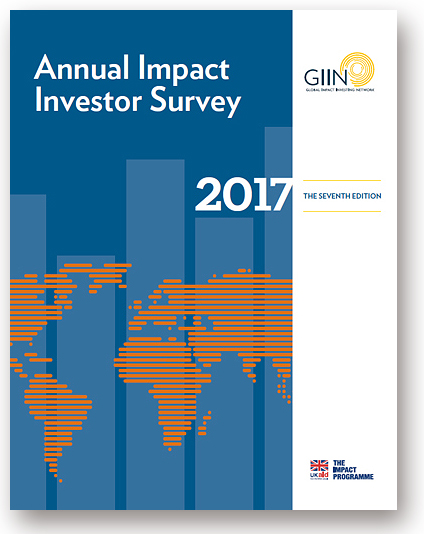
The Global Impact Investing Network (GIIN) 2017 Annual Impact Investor Survey

>> Back to July 2017

The Global Impact Investing Network (GIIN) 2017 Annual Impact Investor Survey is now available. The survey is based on an analysis of the activities of 209 of the world’s leading impact investing organizations, including fund managers, foundations, banks, development finance institutions, family offices, pension funds, and insurance companies. Survey respondents collectively manage nearly USD $114 billion in impact assets, a figure which serves as the best-available “floor” for the size of the impact investing market.
In its seventh edition, this state of the market report presents investors’ perspectives on key issues important to the impact investing industry, as well as analysis of their investment activity, asset allocations by geography, sector, and investment instrument, impact measurement practice, and performance. For the first time, the GIIN also examined investor perspectives on current market topics, such as market segmentation, the role of below-market-rate capital in impact investing, the entry of large-scale financial firms into the market, and impact investing in public equities. New topics also include investors’ commitment to the UN Sustainable Development Goals.

The report was produced with support from the U.K. Government through the Department for International Development’s Impact Programme, as well as support from the John D. and Catherine T. MacArthur Foundation.

Download the full report here
thegiin.org/knowledge/publication/annualsurvey2017

Additional Articles, Impact Investing

SOIL–Slow Opportunities for Investing Locally

By Woody Tasch, Founder, Slow Money

(Reader Favorite from June 2017)

I often refer to Slow Money as “the CSA of investing.” As with community-supported agriculture, our efforts revolve around informal, direct relationships and shared risk. Slow Money funding is flowing in a variety of ways in dozens of communities across the United States (and a few in Canada and France) — peer-to-peer lending, investment clubs, angel networks and pitch fests at public events large and small.

This year, we’re launching Slow Opportunities for Investing Locally—SOIL, a non-profit investment club, in the Boulder, CO area (as well as holding the SOIL 2017 Conference this October, details below).

This isn’t investing in the traditional sense. We’re using charitable donations and 0% loans to fund the next generation of diversified, organic farms and the small food enterprises that bring their produce to the local market. We’re building a permanent, member-controlled funding resource. This is investing that leaves the returns in, for the benefit of future generations.

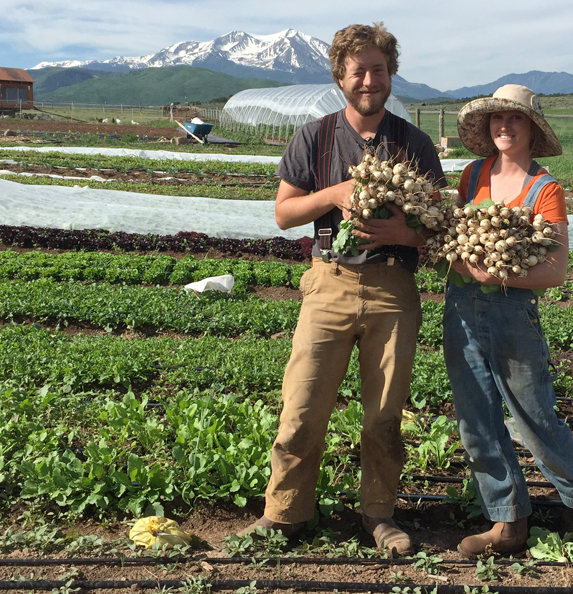
Two-Roots-Farm_2

Two Roots Farm, a start-up micro-farm in Carbondale, CO received $7,500 for drip irrigation and a walk-in cooler.

There are many social and environmental reasons why we are doing this. Climate Change. Nutrition. Community. There are also financial reasons. If we are going to do what needs to be done in the soil, then we are going to need to put aside some of our money in new ways.

This is what has been driving Slow Money activities around the country. Since 2010, more than $57 million has flowed through our networks to 632 small food enterprises: Cheese makers, artisan bakers, heirloom seed companies, compost purveyors, small diversified organic farms (F.A.R.M.s,*too), grass-fed beef producers, goat dairies, yogurt companies, farm-to-table restaurants, probiotic pickleteers, community kitchens, regional grain mills, local distributors, inner city cooperatives and more.

Here in Colorado, hundreds of individuals have attended regional events or committed capital to Slow Money projects, including four investment clubs, resulting in the flow of $3.3 million to 36 local food deals. In 2015, we started our first non-profit investment club, 2Forks Club in Carbondale, CO, and based on its success, we are now starting SOIL on Colorado’s Front Range.

* F.A.R.M., in Boone, NC, is a café that allows customers to pay whatever they can afford: Food for All Regardless of Means. There is a network of such “one world cafes” around the country, some 70 or so strong. Denver’s SAME Café (So All May Eat) is one. We haven’t yet funded one of these cafés, but I hope we will soon.

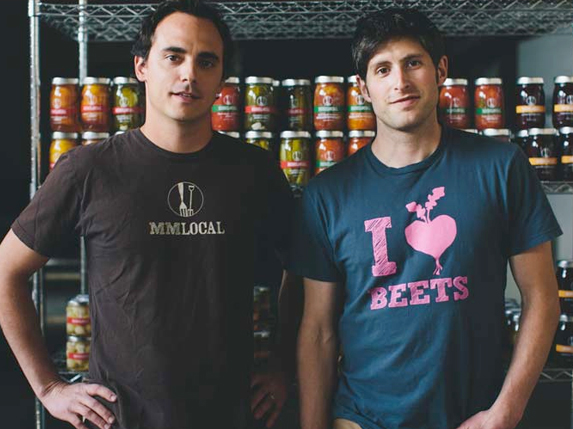
Local Soil - GreenMoney Journal

MM Local received a $100,000, 0% loan to assist in structuring their next round of financing.

Here’s how it works.

You become a member of SOIL with a tax-deductible donation of $100 or more. Then, members make 0% loans to local farmers and food entrepreneurs, by majority vote—one member, one vote, no matter what the size of your donation. When loans are repaid, funds are recycled into new loans.

We’ve been utilizing this model for the past two years over in the Roaring Fork Valley, where 33 individuals have contributed a total of $206,000, in amounts ranging from $100 to $80,000, to the 2Forks Club (named for the Roaring Fork River and the north fork of the Gunnison River). Seven loans have been made to date, with more in the pipeline.

“I’ve been farming for 20 years,” says 2Forks member Brook Le Van, “And I’ve never seen anything this heartening in the way it connects people and supports the local food system. Especially in the current climate, with so much divisiveness and uncertainty, this is just what we all need.”

Here in Boulder, SOIL is starting off with $75,000 from a dozen founding members. I am joined on our launch committee by Brian Coppom (Executive Director, Boulder County Farmers’ Market) and Amy Divine (Member, Women Donors Network). Helping us is a Kitchen Cabinet that includes a healthy handful of local folks with experience in food and finance. We’d like to think that given population and geographical factors on the Front Range, we’ll be able to achieve more scale than our sister group in the mountains,and that, over time, if enough of us keep at it, we can grow SOIL into a significant, community resource for funding local food systems, in Boulder and beyond.

Zephyros Farm - GreenMoney Journal

Zephyros Farm, a ten-year-old, four acre diversified organic farm in Paonia and the first certified organic flower producer in Colorado, received $23,500 to purchase a used refrigerated truck.

The spirit behind SOIL is reflected in the Slow Money Principles, which start with “We must bring our money back down to earth” and ends with:

Paul Newman said, “In life, we need to be more like the farmer who puts back into the soil what he takes out.” Recognizing the wisdom of these words, let us ask:

What would the world be like if we invested 50% of our assets within 50 miles of where we live?
What if there were a new generation of companies that gave away 50% of their profits?
What if there were 50 percent more organic matter in our soil 50 years from now?

Such questions point in a fundamentally new direction, although the actions we are taking—making small loans to farmers—are in many ways quite simple. This balance between big questions and small actions is central to the change we are seeking and the community we are building.

Here’s another question, along with the partial answer that arises from slow money conversations:

Q. We’re giving our money to people we don’t know very well, to invest in things they don’t understand very well, halfway around the world in places that most of us will never visit: Does this sound like the recipe for a healthy future?

A. Put our money to work in things that we understand, near where we live, starting with food.

It just may be that, led by farmers’ markets and community supported agriculture and crowd funding and a few pioneering funds around the country, small food enterprises and local investing will mature over time as an asset class that produces predictable, risk-adjusted financial returns.

Or, it just may be that if we really want to nurture the slow, the small and the local, we’ll just have to find the gumption to go slow, small and local with our money — using not only our consumer dollars, but our investment and philanthropy dollars, as well. We may just need to splice into our 20th century investment notions the principles of carrying capacity, care of the commons, sense of place, soil fertility, diversity and nonviolence.

Or…if that all sounds a bit much…we can just roll our sleeves up, do what we can locally, enjoy getting together once in awhile, celebrate a little conviviality with our neighbors, break bread and make 0% loans to local farmers and food entrepreneurs, for the good of all.

In this time of fake news and fake food, it’s nice to have something real to do with our money.

Poudre Valley Farms - GreenMoney Journal

Slow Money investors have provided $275,000 to Poudre Valley Farms in Ft. Collins, CO pioneering a new model for community ownership of organic farmland.


Article by Woody Tasch, the Founder and Chairman of the Slow Money Institute and author of “Inquiries into the Nature of Slow Money: Investing as if Food, Farms, and Fertility Mattered”, Chelsea Green. Woody is widely renowned as a thought leader in patient capital, mission-related investing and community development venture capital. He is former Chairman and CEO of Investor’s Circle (IC), one of the oldest angel networks in the country, and former treasurer of the Jessie Smith Noyes Foundation.


The Slow Money SOIL 2017 Conference

People are waking up to the importance of the soil. Soil fertility is vital for human health, resilient communities and strategies for combating climate change. But most people don’t talk about soil and money in the same breath.

October 16-17 in Boulder, Colorado, we’re bringing together a group of renowned speakers to explore the relationship between the actual soil and the soil of a restorative economy.Day One will include a full day of presentations, discussions, and productive collaboration, followed by a special evening program. Speakers include Daphne Miller, David Montgomery, Winona LaDuke, Bill McKibben (via video conference), Fred Kirschenmann and many more! Day Two is an opportunity for up to 125 people to focus on SOIL —Slow Opportunities for Investing Locally—our new Colorado initiative. We’ll explore the state of the local food system and what success would look like for this new program. The day will culminate with members of SOIL selecting one or more farmers/food entrepreneurs to receive 0% loans.

Additional Articles, Food & Farming, Impact Investing, Sustainable Business

Trillium Launches New White Paper on Investing in Sustainable Food and Agriculture across Asset Classes

>> Back to June 2017

A group of investors has released a new white paper, Impact Investing in Sustainable Food and Agriculture across Asset Classes: Financing Resilient Value Chains through Total Portfolio Activation. The paper was prepared by Croatan Institute with the guidance and close collaboration of Iroquois Valley Farms, Maine Organic Farmers and Gardeners Association (MOFGA), Organic Agriculture Revitalization Strategy (OARS), Root Capital, RSF Social Finance, and Trillium Asset Management. [See their websites below]

A December 2016 survey conducted by the Global Impact Investing Network found that impact investment assets allocated to the food and agriculture sector had a compound annual growth rate of 32.5 percent since 2013.[3] Using the Total Portfolio Activation approach, the paper provides a framework to help investors expand the scope of investing in sustainable food systems across common portfolio asset classes such as cash, public equities, and fixed income, as well as alternative asset classes such as private equity, venture capital, and real assets. It is the first of its kind to structure a total portfolio approach thematically around sustainable food and agriculture.

“We know that we have a responsibility to align our investments with our values and to put those investments to work to build a more sustainable food system,” said Matthew Patsky, CEO of Trillium Asset Management. “The paper serves as a guide for sustainable and responsible impact investors looking to leverage their investments and broaden their impact across agricultural value chains.”

“Whether your focus is on redeveloping the resilience of local foods systems or fostering sustainable approaches to agriculture at a more global scale, impact investors have a critical role to play in financing links across the value chain,” said Joshua Humphreys, President of Croatan Institute, Senior Strategist of OARS, and a co-author of the study.“As this research shows, impact investment opportunities in this rapidly evolving field now extend across asset classes, and Total Portfolio Activation provides a useful framework for investors to understand those opportunities and re-allocate their portfolios to seize them.”

“By providing mission-driven enterprises across food and agriculture with access to capital, we are able to improve the infrastructure of local food systems while generating greater positive social and environmental impact,” said Kate Danaher, Senior Manager of Social Enterprise Lending and Integrated Capital at RSF Social Finance.

“This paper demonstrates how organizations such as Root Capital can help to address the market failures that have left agricultural businesses around the world chronically under-resourced,” said Rachel Serotta, Director of Investor Relations at Root Capital. “When we provide these businesses with essential capital and financial management training, they become engines of impact in their communities: family incomes rise, food security improves, women get their share, ecosystems thrive, and young people have the opportunity to lead.”


Important Disclosure:
The information provided in this material should not be considered a recommendation to buy or sell the securities mentioned. It should not be assumed that investments in such securities has been or will be profitable. To the extent a specific security is mentioned, it was selected by the authors on an objective basis to illustrate views expressed in the commentary and it does not represent all of the securities purchased, sold, or recommended for advisory clients. The information contained herein has been prepared from sources believed reliable but is not guaranteed as to its timeliness or accuracy,and is not a complete summary or statement of all available data. This piece is for informational purposes and should not be construed as a research report.

Contact:
Caroline White, Communications Manager, Trillium Asset Management
Article Note:
[1] Abhilash Mudaliar, Aliana Pineiro, and Rachel Bass, “Impact Investing Trends: Evidence of a Growing Industry,” Global Impact Investing Network, December 2016.

Websites:

Croatan Institute – croataninstitute.org
Iroquois Valley Farms – iroquoisvalleyfarms.com
Maine Organic Farmers & Gardeners Assn – www.mofga.org
Organic Agriculture Revitalization Strategy (OARS) – www.croataninstitute.org/sustainable-rural-development-projects/project/organic-agriculture-revitalization-strategy
Root Capital – www.rootcapital.org
RSF Social Finance – rsfsocialfinance.org
Trillium Asset Management – trilliuminvest.com

Additional Articles, Food & Farming, Impact Investing

‘Drawdown’ and Global Warming’s Hopeful New Math

By Joel Makower, chairman & executive editor, GreenBiz Group

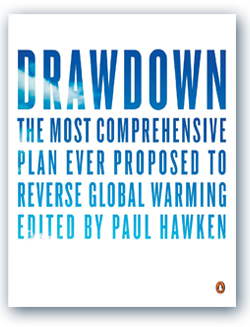
"DrawDown" - GreenMoneyJournal.comApril 18, 2017 marked the publication of an ambitious new book with the audacious goal of showing how to reverse the warming of the planet through a myriad of innovations, many of them led by business for profit.

“Drawdown: The Most Comprehensive Plan Ever Proposed to Reverse Global Warming” (Penguin Books, Drawdown), was edited by the author and entrepreneur Paul Hawken along with a self-described “coalition” of research fellows, writers and advisors. (Full disclosure: I played a very small unpaid role in reviewing parts of the manuscript, and am included among the 120 or so advisors listed in the book. More details at www.drawdown.org/advisors)

The book contains 80 solutions — “techniques and practices” — that are ready today, and 20 additional “coming attractions” — innovations just over the horizon — that collectively can draw down atmospheric concentrations of greenhouse gases in order to solve, not just slow,climate change by avoiding emissions or sequestering carbon dioxide already in the atmosphere.

Hawken is quick to point out that the book’s seemingly brash subtitle is a bit tongue in cheek: this is the only “comprehensive plan ever proposed to reverse global warming,” he said. But the larger point is not lost. The book, along with an accompanying website (www.drawdown.org), may be the first to provide the insight and inspiration, backed by empirical research and data, that could enable companies, governments and citizens to attack the climate problem in a holistic and aggressive way. Moreover, many, if not most, of the solutions can be undertaken with little or no new laws or policy, and can be financed profitably by companies and capital markets.

At minimum, “Drawdown” is likely the most hopeful thing you’ll ever read about our ability to take on global warming.

Two and a half years ago, as the project got under way, I provided some context for Project Drawdown [1], the nonprofit created by Hawken to produce the book. While its roots date to the early 2000s, the project’s inspiration came in large measure from a 2012 Rolling Stone article by activist Bill McKibben, “Global Warming’s Terrifying New Math” — “three simple numbers that add up to global catastrophe,” as McKibben put it. His article offered a sobering arithmetical analysis underscoring “our almost-but-not-quite-finally hopeless” global predicament.[2] That article led Hawken to ask, “Why aren’t we doing the math on the solutions?” as he told me in 2014.

The new book aims to do just that: provide the metrics for the solutions needed to solve the climate crisis.

The 80 solutions that make up the bulk of the book are grouped into seven buckets: energy; food; women and girls; building and cities; land use; transport; and materials. To qualify for inclusion, a solution must have proven to reduce energy use through efficiency, material reduction or resource productivity; replace existing energy sources with renewable energy; or sequester carbon in soils, plants or kelp through regenerative farming, grazing, ocean and forest practices.

Each solution is ranked by cost-effectiveness, speed to implementation and societal benefit. Also included for each is its projected savings in greenhouse gas emissions by 2050, and the solution’s total financial cost — the amount of money needed to purchase, install and operate it over 30 years — and its net cost or benefit — how much money would be required to implement the solution compared to the cost of repeating business as usual.

“Drawdown’s” aggregate bottom line is shockingly affordable: When you total up the
net first costs and subtract the net operating costs for all 80 solutions, the net operating savings add up to $74 trillion over 30 years.

Cold Calculations

Consider refrigerant management, the book’s No. 1 solution. Hydrofluorocarbons, or HFCs — the chemicals used in refrigerators, supermarket cold cases and air conditioning systems — have up to 9,000 times greater greenhouse gas warming potential per molecule than carbon dioxide,depending on their exact chemical composition. Ironically, these chemicals were tapped in the 1990s to replace chlorofluorocarbons, which were found to deplete the planet’s protective ozone layer.

Last fall, a global deal was forged by nearly 200 countries to phase out HFCs by the late 2020s, but the chemicals will persist in kitchens and condensing unit for decades. Ninety percent of their climate emissions happen when fridges and AC units are disposed of at the end of their useful lives.[3]

On the other hand, creating refrigerant recovery “has immense mitigation potential,” said the “Drawdown” authors. After being carefully removed and stored, refrigerants can be purified for reuse or transformed into other chemicals that do not cause warming, they explain: “The latter process, formally called destruction, is the one way to reduce emissions definitively. It is costly and technical, but it needs to become standard practice.”

The book models the adoption of practices to avoid leaks from refrigerants and destroy them at end of life. Over 30 years, it calculates that 87 percent of refrigerants can be contained, avoiding emissions equivalent to 89.7 gigatons of carbon dioxide.

However, this is not one of the book’s more profitable activities. “Although some revenue can be generated from resale of recovered refrigerant gases, the costs to establish and operate recovery, destruction and leak avoidance outweigh the financial benefit — meaning that refrigerant management, as modeled, could incur a net cost of $903 billion by 2050.”

That’s a far cry from the No. 2 solution, onshore wind energy, not exactly a new technology, but one ripe for scaling; it already is cost-competitive with fossil-fuel energy in some areas, and continued cost reductions soon will make wind the least expensive source of installed electricity capacity.

“Drawdown” calculates that an increase in onshore wind from 2.9 percent of world electricity use to 21.6 percent could reduce emissions by 84.6 gigatons of carbon dioxide and create a net savings of $7.4 trillion from business as usual by 2050.

Adding offshore wind energy could save 14.1 more gigatons of greenhouse gases and generate $275 billion in additional net savings.

Falling Shibboleths

In the run-up to the book’s official launch, I recently asked Hawken how the solutions presented in “Drawdown” differ from what he and his team expected to find.

“We had our biases,” he admitted. “We all do. We had solar and wind right up there. We had ranked managed grazing very high from just reading the anecdotal literature. We didn’t have food as high as we found that to be. We had EVs much higher than they turned out tobe. We probably had pretty much the same list that most people come up with: solar; wind; don’t cut trees; don’t eat so much meat; and electric cars.”

“It may seem logical”, said Hawken, but it wasn’t to be. “The only one of those that made it to the top seven solutions was wind.” One solution never made it onto the final list at all: biofuels. “They don’t actually have any net contribution whatsoever, and that surprised us,” said Hawken. “It’s a shibboleth that fell for us.”

I asked Hawken to reflect on what had changed during the roughly three years between the project’s launch and the book’s publication.

“I think the big shift for us was on the economic side,” he said. “During that time, we might have crossed some threshold where the profit that could be made from the solutions now is greater than the profit being made from the problems.”

Regenerative agriculture is another area of significant progress. “You’re seeing some literally good-old-boy farmers from Saskatchewan right down through Texas and into White Oak farm in Georgia (www.whiteoakpastures.com) — thousands and thousands and thousands of acres. Their costs are going down. Their productivity is going up. Their vet bills are 10 percent of what they were. The yields have increased. The inputs have disappeared. These guys are buying more land from farmers who ruined their land and are going out of business. And they’re practicing regenerative agriculture in different and sundry ways.”

Women’s Work

Still another area that yielded surprises for the “Drawdown” team were solutions involving women and girls. As the book’s authors explain:

Due to existing inequalities, women and girls are disproportionately vulnerable to its impacts, from disease to natural disaster. At the same time, women and girls are pivotal to addressing global warming successfully — and to humanity’s overall resilience. As you will see here, suppression and marginalization along gender lines actually hurt everyone, while equity is good for all. These solutions show that enhancing the rights and well-being of women and girls could improve the future of life on this planet.

With world population mushrooming to a projected 9.7 billion by mid-century, food production will need to rise, said the authors, alongside reduced food waste and dietary shifts. Growing more food on the same amount of land cannot be done without attending to smallholders, many of whom are women, whose farming needs have been much overlooked.


Read Joel’s Full article
www.greenbiz.com/article/drawdown-and-global-warmings-hopeful-new-math

Article Note
[1] www.greenbiz.com/blog/2014/10/22/inside-paul-hawkens-audacious-plan-drawdown-climate-change
[2] www.rollingstone.com/politics/news/global-warmings-terrifying-new-math-20120719
[3] https://www.greenbiz.com/article/its-time-bid-adieu-hfcs

Additional Articles, Energy & Climate, Food & Farming, Impact Investing, Sustainable Business

Signup to receive GreenMoney's monthly eJournal

Privacy Policy
Copyright © GreenMoney Journal 2025

Website design & development by BrandNature

Global Events Calendar

View All Events

april

21aprAll Day232026 Sustainable Packaging Coalition: SPC Impact – Nashville

27aprAll Day30Women Deliver 2026 Conference (WD2026) – Melbourne

X