Tag: Impact Investing

Young, Radical, and Candid: How Millennials will Remake Socially Responsible Investing
Pat+Zevin_Additionalby Pat Miguel Tomaino, Associate Director of Socially Responsible Investing, Zevin Asset Management


Marketers are obsessed with attracting Millennials, and their pitches can look downright desperate. Domino’s invites young customers to order a large cheese with a pizza emoji. According to Bloomberg, net sales at Banana Republic dropped 10 percent even after it partnered with the popular Instagram account “Hot Dudes Reading.”

The investment industry seems equally flummoxed. Confronted with low financial literacy among the generation now aged 18 to 35, wealth managers are turning to smartphone apps that “game-ify” the process of getting an investment account. And still, 80 percent of Millennials are avoiding the stock market.

“Cynical Do-gooders”

Why should they play along? Unlike Generation X, American millennials have known war nearly their entire lives. They felt the brunt of the financial crisis when their parents lost jobs and homes. Now millennials are told that the economy has recovered — despite massive student debt, increasing inequality, and extortionate housing costs in the cities where the jobs are.

Considering what they’ve gone through, one would forgive young Americans for being cynical. But that’s not the whole story.

After the storm, millennials want to live their convictions and improve the world they’ve inherited. As a (borderline) millennial myself, I’ll take the liberty to say that Harvard Business Review editor Walter Frick was probably right when he dubbed members of my generation “cynical do-gooders,” suspicious of institutions but still insistent that those institutions (like public companies) can and should do better.

Advocating for a Radical Generation

Socially responsible investing (SRI) is one area of financial management that makes sense for millennials. According to Morgan Stanley, 84 percent of Millennials considering investment are interested in socially responsible options. However, ethical wealth managers need to evolve to serve this generation.

A “do no harm” approach of screening bad companies out of an equity strategy probably won’t be enough. The millennial clients I meet in my work as an analyst and shareholder advocate at Zevin Asset Management want a healthy investment return. They also want to work with institutions that see the world as it is (in political, economic, and climatological turmoil) and partner with them to fight an unacceptable status quo.

Ethical investors can begin to meet that need by re-committing to shareholder advocacy — pushing the companies in our clients’ portfolios to address critical environmental and social issues.

Shareholder advocacy is a proven technique, but it too must change to reflect the millennials’ story — not as a marketing exercise, but as the only way to serve a generation radicalized by war, economic anxiety, and political betrayal.

Learning from Millennial Movements

In the coming years, I expect that socially responsible investing will be remade by millennials in two major ways. First, it will become more critical of our economic system and even more willing to confront the companies and tycoons that run it.

According to a 2016 Harvard study, 51 percent of young Americans do not “support capitalism.” Of course, investment advice won’t dismantle an unfair and destructive economic system. But the right adviser can help young investors challenge the public companies at the heart of the old order.

As one of our young clients told me recently: “I initially thought of socially responsible investing as a way to simply avoid funding (and profiting from) corporations that do work I find awful or immoral — things like war, pollution, [and] mass incarceration… But I’ve come to be inspired by the process of using shareholder proposals and other active ways that we can leverage investment to put pressure on corporations to make specific changes.”

Our firm uses constructive dialogue and shareholder proposals to push companies to respect people and planet. This comes out of a longstanding ethical commitment and our belief that, by addressing climate risks and listening to local communities, companies can possibly avoid big losses.

That’s a great start, but Millennials will want to push harder. According to a 2014 CNBC survey, fully 40 percent of Millennials report that the corporate sector is a “source of fear.” A generation that is so wary of capitalism wants to hold companies accountable for their role in social ills like low wages, environmental injustice, human rights violations, and political corruption.

Investment managers can answer by working on challenging issues at the intersection of investment risk and structural injustice. We can raise concerns that relate to both the investment case for a specific stock and the wider social impact of that company or sector.

That is why, among other priorities, Zevin Asset Management has engaged with firms about: hiring policies that contribute to mass incarceration by excluding people with criminal records, the corporate role in the policy fight over raising the minimum wage, and companies’ controversial support for the American Legislative Exchange Council (ALEC) and other lobbying groups that stifle climate action and voting rights at the state level.


Speaking Clearly About Wealth and Responsibility

The second way that millennials will influence socially responsible investing is by sharpening our words and our values.

Unlike their parents and grandparents, who clung to a polite taboo against “money talk,” millennials want to speak about money and everything that goes with it: debt, job loss, envy, reparations, inequality, wealth, who’s got it, who wants it, poverty, privilege, and the fundamental unfairness of the initial distribution.

In politics, we see this openness in the Fight for 15 and new discussion of a universal basic income, along with frank talk about student loan debt and the way in which institutional racism and redlining have excluded generations of Black Americans from economic opportunity.

There is a similar spirit among the more fortunate millennials considering socially responsible investing. Another young client told me that, in his generation, people with privilege “have started to see that inequality is their problem; they perpetuate it and benefit from it and they have a responsibility to deal with it.”

The SRI sector can show millennials that investing in the public markets need not merely reinforce their privilege. Shareholder advocacy, for example, is a way to highlight the privileges of stock ownership (among them, access to managers and corporate boards) and use that power toward genuine social change.

Wealth managers have to change to hold millennials’ attention, but the good news is they can forget about the apps, tweets, and gimmicks. While everyone else markets to millennials, millennials will re-make socially responsible investing for the next generation.


Article by Pat Miguel Tomaino, Associate Director of Socially Responsible Investing, Zevin Asset Management.

Pat leads Zevin’s corporate engagement program, analyzing portfolio companies and pushing them to address critical environmental, social, and governance risks. To that end, Pat dialogues with executives, builds coalitions with NGOs and peer firms, and files shareholder proposals on behalf of our clients. He also identifies emerging sustainability issues and oversees proxy voting. For several years, Pat was a Senior Analyst on the responsible investment team of F&C Asset Management, where he led the U.K. firm’s work in Latin America and Canada. He has held research roles for several progressive groups, including Senator Elizabeth Warren’s 2012 campaign and the Service Employees International Union (SEIU). Pat recently completed a fellowship as a public radio producer for WBUR’s Open Source with Christopher Lydon. A graduate of Harvard College, Pat is interested in racial justice, economic inequality, and labor rights in the U.S. and overseas.
Additional Articles, Impact Investing

TONIIC T100: Launch Report and New Directory

Offering New Insights and Resources from the Frontier of Impact Investing

Toniic Institute, the global action community for impact investors, recently released T100: Launch “Insights from the Frontier of Impact Investing,” in a presentation at the GIIN Investor Forum 2016 in Amsterdam. It is the first report in a longitudinal study of impact investing portfolios of Toniic members, starting with 51 portfolios. The data analyzed reveals that 100% values alignment can be achieved today in the investment portfolios of high net worth individuals, foundations, and family offices, including those portfolios seeking market-rate returns. The inaugural T100 report relies on private portfolio data shared by Toniic 100% Impact Network members, ranging in size from less than US$2 million to more than $100 million, with combined capital of more than $1.65 billion. The T100: Launch report is available for download at- www.toniic.com/T100

As part of the T100 project, Toniic also announced the launch of the Toniic Diirectory, a publicly accessible, peer-sourced catalog of more than 1,000 impact investments made by its members, upon which the T100 findings are based.  The directory is searchable by impact categories, impact themes, asset classes, management structure, liquidity profile, and impact geography, and is available for review at- www.toniic.com/T100 The T100: Launch report offers insights from the frontier of impact investing – from those investors who have committed to go “all in” to impact-alignment across all asset classes in a diversified portfolio. It reaches the following conclusions:

• 100% alignment of one’s investment capital and values is possible today.

• Alignment is for everyone. Geography is no barrier, nor are particular causes or themes.

• Investors have found investments they consider impactful across all asset classes.

• Measurable impact can be generated by a wide range of portfolio asset sizes, liquidity objectives, and investor types while also achieving market-based financial returns.

• On average the portfolios are 64% deployed with impact and 33% have already reached 90% or greater impact.

“As a trusted third party, we can aggregate information through the T100 Project, and help investors learn from what’s happening on the frontier of impact investing,” said Toniic CEO Adam Bendell. “With these initial findings, the T100 Launch report begins to unravel certain myths about the potential for impact investing. We see now that impact returns can come alongside financial returns, and that one can achieve positive impact in virtually every asset class, not just in early stage private equity.” The T100: Launch report is the first in an upcoming series of reports to be issued by Toniic as part of the T100 project, based on data drawn from the increasing scope of the Toniic Diirectory. This will provide a newfound perspective into the efficacy of value-aligned impact investments in yielding positive financial returns alongside targeted positive impact.

To contribute to the Toniic Diirectory, investors will be able to utilize the accompanying Toniic Impact Portfolio Tool, which enables them to see relationships between asset classes and impact in their own portfolio of investments, and contribute to the demonstrative power of sharing actual investments in the Diirectory. Over time, the Diirectory will grow with new investment data, serving as a living resource for impact investors. Significant industry players, including the Tides Foundation and ImpactAssets, have already agreed to add their investment information into upcoming versions of the Directory. “This report and its underlying data is the starting point of a multi-year longitudinal study to follow 100 portfolios over multiple years,” said Dr. Charly Kleissner, co-founder of Toniic and the 100% Impact Network. “We believe the results of these efforts will make an important contribution to developing the new financial system, a system that will have positive impact at its core.”


About Toniic and T100  Toniic is the global action community for impact investors. Toniic’s 160 members represent more than 360 impact investors from 22 countries who share a vision of a global financial system creating positive social and environmental impact. Toniic’s mission is to empower impact investors. More than half of Toniic members are also members of the Toniic 100% Impact Network, each of whom have committed to move an entire investment portfolio from less than $2 million to more than $300 million into 100% impact investments. This represents a total commitment of close to $4 billion. The T100 Project is a longitudinal study of the portfolios of some of those investors. It reveals new insights about the various paths towards and feasibility of 100% impact investing. The T100 project includes periodic reports, issue briefs, videos and podcasts, and the Toniic Diirectory, a peer-sourced directory of over 1,000 impact investments across all asset classes. For more information, visit www.toniic.com/T100 or write us at T100@toniic.com

Additional Articles, Impact Investing

Is Your Mutual Fund Company Taking Climate Change Seriously?

By Rob Berridge, Director of Shareholder Engagement, Ceres

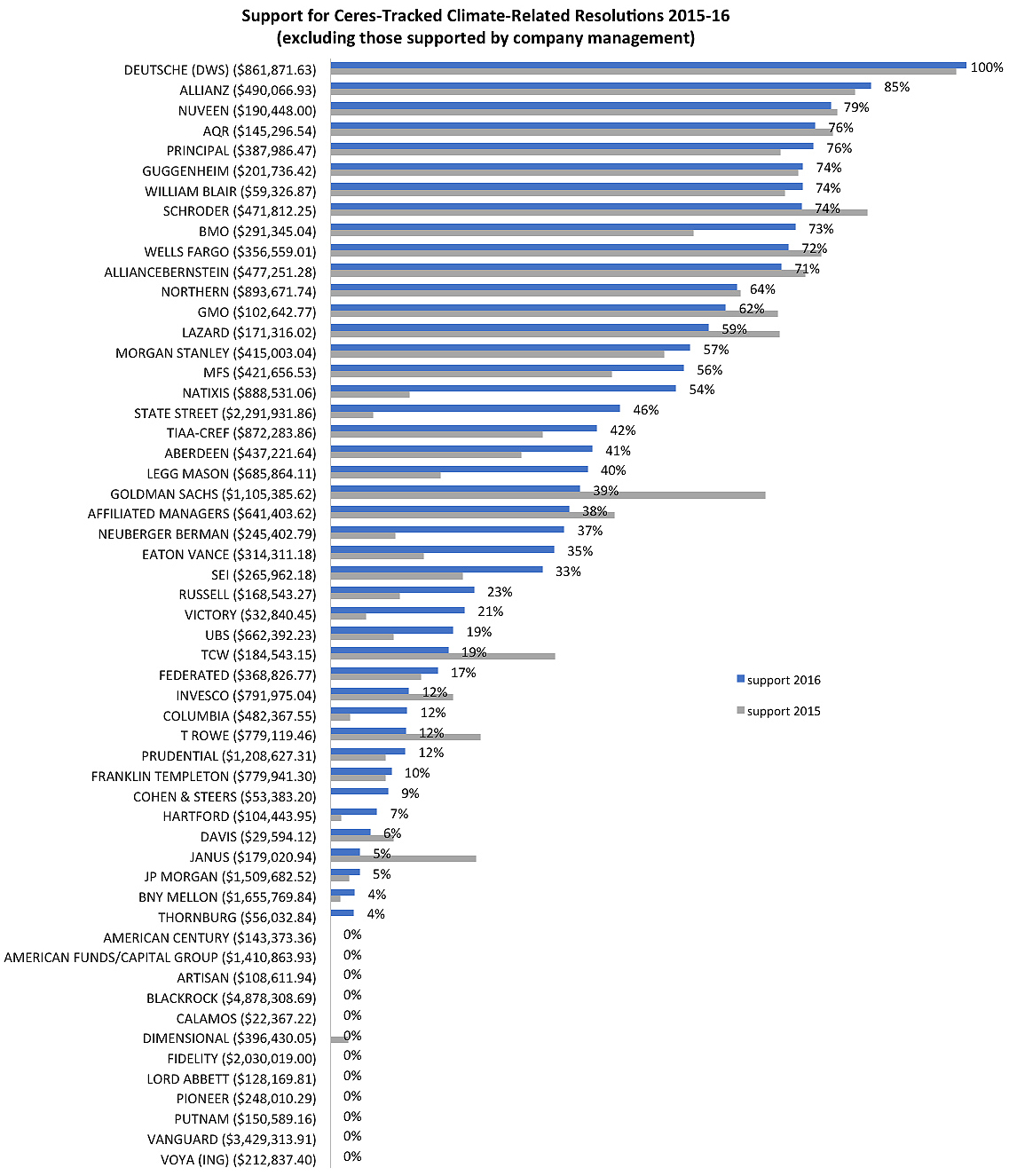
Examining how the nation’s largest mutual fund companies voted on climate-related shareholder resolutions in 2015 and 2016. The results are revealing.

The vast majority of climate scientists (97 percent) believe climate change is real, but what about your mutual fund company? We examined how the nation’s largest mutual fund companies voted on climate-related shareholder resolutions in 2015 and 2016. The results are revealing.

While the great majority of mutual fund companies voted in favor of many climate-related resolutions (as shown on the chart below), a number of the largest firms failed to support any of the resolutions, including big-name players such as American Funds, BlackRock, Dimensional, Fidelity, Pioneer, Putnam, and Vanguard. These firms collectively manage trillions of dollars in assets, and their support of climate resolutions could contribute to majority votes for some resolutions – resulting in enormous pressure on companies to disclose their plans for addressing wide-ranging climate-related risks.

Let’s review why institutional investors file these resolutions and why companies should be disclosing and addressing climate-related risks. First, climate change creates profound risks for many companies and the global economy, and these risks need to be disclosed by companies, as a task force (chaired by Michael Bloomberg) of the Financial Stability Board of the G20 summarizes here – https://www.fsb-tcfd.org/publications/recommendations-report

Second, virtually every country in the world has agreed to reduce climate-warming pollution significantly via the Paris Climate Agreement that formally entered into force in November. The transition to clean energy that is already well underway threatens conventional business models of fossil fuel producers like ExxonMobil and creates a substantial risk of stranded assets and devaluation. Simply put, the business case for companies to disclose and act on climate risks – whether from extreme weather and other physical risks, or carbon-reducing regulatory risks – is powerful.

So why would a mutual fund company vote against nearly every shareholder resolution asking companies to disclose their risks and strategies for dealing with these powerful trends?

Here we Explore Three Possible Explanations – none of them are good:

1) The fund firm’s leaders don’t believe climate change is real or are ideologically opposed to admitting it’s real. If your mutual fund company falls in this category, you have a problem because the firm’s leaders are either not paying attention, or they are letting incorrect information guide their investment decisions and ownership practices. Either way, you should probably run for the exit.

2) They accept the science of climate change, but see few material risks or implications for businesses in their portfolios. This explanation may seem similar to the first, but there is a difference here that may be tripping up these firms. Vanguard’s proxy voting policies state that Vanguard funds should abstain from voting on “philosophical” social issues because they are the purview of company management, unless they have a significant impact on the valuation of the business; and based on Vanguard’s voting record, it seems they believe climate change has no significant financial impact on companies.

Unfortunately, this logic is both deeply flawed and shortsighted. Yes, climate change is clearly a moral and political issue, but it is also a critical business issue. Coal producers, oil companies and other fossil fuel businesses face wide-ranging climate risks – regulatory risks, transitional/competitive risks and reputational risks, among them. Businesses across nearly all sectors are increasingly exposed to risks of supply chain and workforce disruptions, infrastructure damage, rising resource costs, shifting demand, brand damage, and stronger regulations intended to protect people and the planet for both today and the future. Vanguard has a legal duty to vote in the best interests of its clients, and in our opinion, they are violating that duty by failing to recognize these risks as demonstrated by their failure to vote for a single climate-related resolution tracked by our study. If Vanguard believes climate change is not a business issue simply because it’s also a moral issue, you have to wonder about their judgment.

3) The fund firm managers believe private dialogue with companies is a more effective strategy than proxy voting. While it is true that face-to-face discussions initiated by major investors can have a strong influence on companies, it does not remove the fiduciary duty to vote proxies conscientiously on important bottom-line issues. If you believe the company should do what the resolution asks, and you vote against it (or similar requests) year after year while engaging in dialogue about it, then you send a mixed message. Proxy votes by major shareholders can be very effective in moving companies to action.

In addition, many institutional investors engage with companies on resolutions while also voting for them. Voting arguably adds teeth to the negotiations. And mutual fund companies generally keep their dialogues with companies strictly confidential, so there is no way for investors to understand their approach or any possible results.

CERES_chart_additional.4

Now the Big Kicker

Vanguard and many other mutual fund firms and investment managers – including American Funds, BlackRock, Dimensional, Fidelity and Lord Abbett – that fail to support climate resolutions have publicly stated that environmental and social issues can be material financially. They are all members of the UN’s Principles for Responsible Investment and have publicly pledged to adhere to six principles (https://www.unpri.org/about/the-six-principles). Principle 3 specifically reads: “We will seek appropriate disclosure on environmental, social and governance (ESG) issues by the entities in which we invest.” Many of the resolutions Vanguard and others vote against request this disclosure. And BlackRock and BNY Mellon have publicly issued noteworthy papers and letters to companies on the significant investment implications of climate change.

This proxy voting inconsistency has led investors to file resolutions on the issue with mutual fund companies and investment managers. As Timothy Smith, Senior Vice President of Walden Asset Management, explained: “The proxy voting records on climate change of investment firms and mutual funds are under increasing scrutiny by investors and clients. As a result, investors have filed a resolution with 5 investment firms urging them to review their proxy voting policies and record, as some vote against virtually every social and environmental shareholder resolution.”

Smith continues: “It is troubling to see BlackRock, JP Morgan, BNY Mellon and others routinely vote against important shareholder resolutions seeking reasonable disclosure and goals to manage climate change. How is this consistent with their fiduciary duty to protect their clients interests?”

Customers who are concerned by these poor voting practices should contact their mutual fund companies and suggest that they vote for reasonable climate-related resolutions. Resolutions filed during the 2011 – 2017 proxy seasons are available at www.ceres.org/resolutions , and more are expected to be filed in the coming months for the 2017 season. Much is at stake, in part because an increasing number of these resolutions are receiving strong support (in the 30-40 percent range), and giant mutual fund companies can help push these votes above 50 percent, sending a powerful message to companies that stronger climate risk disclosure and action are an imperative.


Article by Rob Berridge, Director of Shareholder Engagement at Ceres (www.ceres.org), where he works with investors and companies on climate change, sustainability and governance issues, as well as various projects for the Investor Network on Climate Risk.

Source: CERES

**** The direct link to the chart can be found here: https://www.ceres.org/press/mutual-funds-chart-larger-size-jpg/image_view_fullscreen

Additional Articles, Energy & Climate, Impact Investing

A New Fund Seeks Both Financial and Social Returns

By Andrew Ross Sorkin, The New York Times

“There is a lazy mindedness that we afford the do-gooders.”

That was Bono, the musician turned activist turned investor, lamenting the pitfalls of what has become an increasingly fashionable form of financing: social impact investing.

Just about every big Wall Street firm and big-time philanthropist has recently tried to get in on what’s often called double bottom line investing. The idea is that an investment isn’t just intended to score a high return; perhaps more important, it is supposed to make a significant difference in an area that had been considered un-investable. Goldman Sachs, for example, created social impact bonds to reduce the recidivism rate for adolescent offenders at the Rikers Island correctional facility in New York City.

Most of these efforts have had mixed results; either investors lost money, or the social impact was negligible or nonexistent.

It has become, as Bono told me, “a lot of bad deals done by good people.”

Now, a group of high-profile executives and investors are putting together perhaps the most ambitious social impact fund. Called Rise, the $2 billion fund is being developed by William E. McGlashan Jr., a partner at the private equity firm TPG, who more resembles a Buddhist monk than a cigar-chomping banker in pinstripes. He left his home in San Francisco in 2013 and moved his family to India for a year so he could be closer to the firm’s investments in Asia.

Mr. McGlashan has long overseen TPG Growth, a fund he started that was an early investor in the sharing economy, with stakes in Uber and Airbnb, as well other technology successes like Spotify. His first fund had an annualized rate of return — the metric that private equity firms use to measure themselves — of 20 percent; the second fund’s return was 45 percent.

But his investments in businesses like Apollo Tower, a cellphone tower company in Myanmar, are the model for the new effort. Since Mr. McGlashan began backing Apollo in 2014, before Myanmar emerged from military control, the company’s value has more than doubled. More important, Myanmar went from nearly 0 percent cellphone penetration to 70 percent, accounting for more than 5 percent growth in G.D.P. It helped to increase transparency in a country known for tight control of its information, helping the nation take steps toward democracy.

The new fund, which will be part of TPG, will be the first large test case for this type of investing. It has an all-star cast of board members, all of whom are investors. Among them are Bono; Jeff Skoll, the first employee of eBay, who now runs Participant Media and is a major philanthropist (“You only need so much for you and your family,” he told me); Laurene Powell Jobs, the philanthropist investor; Richard Branson; Reid Hoffman, a founder of LinkedIn; Mellody Hobson, president of Ariel Investments; Lynne Benioff, a philanthropist; Mo Ibrahim, perhaps the most influential investor in Africa; and Pierre Omidyar, the founder of eBay and a backer of First Look Media.

Others have tried to build social impact funds at a much smaller scale. Rise does away with benchmarks manufactured after the fact and has created a series of strict metrics by which to measure social impact. And an outside auditor has been brought in to keep it honest.

And the investors involved don’t consider this charity — pension funds and sovereign wealth funds are expected to be among the biggest investors. At least two large pension funds and one sovereign wealth fund have committed nine figure sums, according to people briefed on the investments, which have yet to be made public.

“The reality is that no matter which side of the aisle you’re on, and no matter where your framework is, if I can build a great business that’s profitable and successful and, oh, by the way, here’s the impact and the multiple of impact that’s created through that business’s successes, I think that’s good for everybody,” Mr. McGlashan told me.

The new fund is expected to invest about half of its money domestically in areas like health care, education and clean energy technologies. The other half will be invested in emerging markets in sectors like microlending and other financial services, housing and education.

“We’re not in the business of charity here,” Mr. McGlashan said. “We’re going to make money and build profitable successful businesses and create a top performing fund. But in the process, what we’ve committed to is that we will not do a deal where there’s less than a two and a half times multiple of impact,” suggesting a meaningful social impact that can be measured.

The problem with most of these kinds of funds is what Mr. McGlashan calls “greenwashing,” a euphemism for lying, which some in philanthropy feel is rampant among socially conscious investors. Everyone wants to claim some form of success using a shifting mix of metrics aimed at demonstrating how the fund worked.

“None of this makes sense unless you can actually define what ‘impact’ means,” he said. “It can’t be religion; it has to be quantitative. It has to be something that a third-party view would validate.”

Bono put it this way: “I asked them to hang a sign in their office saying, ‘Warm Fuzzy Feelings Not Welcome Here,’ because we need them to be tough-minded. We need some intellectual rigor, and you’ve got to get these metrics right.”

Mr. McGlashan, often in concert with Mr. Skoll, spent the past year working with Bridgespan Group, a consulting firm that has long worked for philanthropists — including the Bill & Melinda Gates Foundation — to come up with a rigorous set of metrics with which to measure performance.

If it works, Mr. McGlashan hopes to one day change the fee structure of funds like this so the investors are paid based on social impact, not necessarily just on financial performance. For the first Rise fund, Mr. McGlashan’s group, which will include most of TPG Growth’s professional staff, will be paid on financial performance, which is likely to make his job harder, not easier. He needs to find good investments, but his board and investors will also be focusing on whether the fund also delivers on its social impact promise.

Mr. Skoll said he expected to know whether the fund would be successful in relatively short order. “We’ll have a good idea within two years,” he said.

Bridgespan’s metrics for Rise could become a model for other investment firms if they prove successful, especially in a global political climate that is rethinking its capitalistic system.

“Capitalism is going up on trial, and I think that it’s clear that putting profit before people is a nonsustainable business model,” Bono said. “I think giving those two equal time is the way forward, and I think that in the present climate, we need to rethink, reimagine what it is. It’s not that capitalism is immoral; it’s amoral. And it’s a better servant than master.”

He added: “We have to be a bit modest about where we are with Rise and be actually a bit tough on ourselves. I’d be more comfortable speaking about this in a year’s time or two year’s time as we go along.”

Let’s plan on that.

Additional Articles, Impact Investing, Sustainable Business

Whole Foods Market’s Top 10 Trends for 2017

New condiments, functional beverages and natural foods

Recently, Whole Foods Market’s (NASDAQ: WFM) global buyers and experts announced the trends to watch in 2017. Wellness tonics, products from byproducts and purple foods are just a few top predictions according to the trend-spotters, who share more than 100 years of combined experience in sourcing products and tracking consumer preferences.

Whole Foods Market’s top 10 trends for 2017 include:

Wellness tonics. The new year will usher in a new wave of tonics, tinctures and wellness drinks that go far beyond the fresh-pressed juice craze. The year’s hottest picks will draw on beneficial botanicals and have roots in alternative medicine and global traditions. Buzzed-about ingredients include kava, Tulsi/holy basil, turmeric, apple cider vinegar, medicinal mushrooms (like reishi and chaga), and adaptogenic herbs (maca and ashwagandha). Kor Organic Raw Shots, Suja Drinking Vinegars and Temple Turmeric Elixirs are just a few products leading the trend.

Products from byproducts. Whether it’s leftover whey from strained Greek yogurt or spent grains from beer, food producers are finding innovative—and delicious—ways to give byproducts new life. Eco-Olea is using water from its olive oil production as the base for a household cleaner line, condiment brand Sir Kensington’s is repurposing leftover liquid from cooking chickpeas in a vegan mayo, and Atlanta Fresh and White Moustache are using leftover whey from yogurt production to create probiotic drinks.

Coconut everything. Move over coconut oil and coconut water—coconut flour tortillas, coconut sugar aminos and more unexpected coconut-based products are on the rise. Virtually every component of this versatile fruit-nut-seed (coconuts qualify for all three!) is being used in new applications. The sap is turned into coconut sugar as an alternative to refined sweeteners, the oil is used in a growing list of natural beauty products, and the white flesh of the coconut is now in flours, tortillas, chips, ice creams, butters and more. New picks like coconut flour paleo wraps, 365 Everyday Value Fair Trade coconut chips and Pacifica Blushious Coconut & Rose Infused Cheek Color demonstrate coconut’s growing range.

Japanese food, beyond sushi. Japanese-inspired eating is on the rise, and it doesn’t look anything like a sushi roll. Long-celebrated condiments with roots in Japanese cuisine, like ponzu, miso, mirin, sesame oil and plum vinegar, are making their way from restaurant menus to mainstream American pantries. Seaweed is a rising star as shoppers seek more varieties of the savory greens, including fresh and dried kelp, wakame, dulse and nori, while farmhouse staples like Japanese-style pickles will continue to gain popularity. The trend will also impact breakfast and dessert, as shoppers experiment with savory breakfast bowl combinations and a growing number of mochi flavors like green tea and matcha, black sesame, pickled plum, yuzu citrus and Azuki bean. This is playing out in products like 365 Everyday Value Sweet Sabi mustard, Republic of Tea’s new Super Green Tea Matcha blends and recipes like Coconut Mochi Cakes.

Creative condiments. From traditional global recipes to brand new ingredients, interesting condiments are taking center stage. Once rare and unfamiliar sauces and dips are showing up on menus and store shelves. Look for black sesame tahini, habanero jam, ghee, Pomegranate Molasses, black garlic purée, date syrup, plum jam with chia seeds, beet salsa, Mexican hot chocolate spreads, sambal oelek or piri piri sauce, Mina Harissa and Frontera Adobo Sauces (Ancho, Chipotle and Guajillo varieties).

Rethinking pasta. Today’s pastas are influenced less by Italian grandmothers and more by popular plant-based and clean-eating movements. Alternative grain noodles made from quinoa, lentils and chickpeas (which also happen to be gluten-free) are quickly becoming favorites, while grain-free options like spiralized veggies and kelp noodles are also on the rise. That said, more traditional fresh-milled and seasonal pastas are having a moment too, which means pasta is cruising into new territories with something for everyone.

Purple power. Richly colored purple foods are popping up everywhere: purple cauliflower, black rice, purple asparagus, elderberries, acai, purple sweet potatoes, purple corn and cereal. The power of purple goes beyond the vibrant color and often indicates nutrient density and antioxidants. Back to the Roots Purple Corn Cereal, Jackson’s Honest Purple Heirloom Potato Chips, Que Pasa Purple Corn Tortilla Chips, Love Beets and Stokes Purple Sweet Potatoes are all examples of this fast-growing trend.

On-the-go beauty. “Athleisure” is not just a fashion trend; the style is now being reflected in natural beauty products, too. With multitasking ingredients and simple applications, natural beauty brands are blurring the line between skincare and makeup products, and simplifying routines by eliminating the need for special brushes or tools. Trending products include Mineral Fusion 3-in-1 Color Stick, Well People Universalist Multi-Stick and Spectrum Essentials Organic Coconut Oil Packet.

Flexitarian. In 2017, consumers will embrace a new, personalized version of healthy eating that’s less rigid than typical vegan, paleo, gluten-free and other “special diets” that have gone mainstream. For instance, eating vegan before 6 p.m., or eating paleo five days a week, or gluten-free whenever possible, allows consumers more flexibility. Instead of a strict identity aligned with one diet, shoppers embrace the “flexitarian” approach to making conscious choices about what, when, and how much to eat. Growing demand for products like 365 Everyday Value Riced Cauliflower (used for clean-eating favorites like gluten-free pizza crusts), Epic Bison Apple Cider Bone Broth and Forager Cashew Yogurt point to growth in this clean-eating category.

Mindful meal prep. People aren’t just asking themselves what they’d like to eat, but also how meals can stretch their dollar, reduce food waste, save time and be healthier. Trends to watch include the “make some/buy some,” approach, like using pre-cooked ingredients from the hot bar to jumpstart dinner, or preparing a main dish from scratch and using frozen or store-bought ingredients as sides. Fresh oven-ready meal kits and vegetable medleys are also on the upswing as shoppers continue to crave healthier options that require less time. Whole Foods Market’s Freshly Made video series highlights the kinds of recipes and ingredients shoppers are seeking.

This year’s predictions came from Whole Foods Market’s experts and industry leaders, who source items and lead trends across the retailer’s cheese, grocery, meat, seafood, prepared foods, produce and personal care departments, and spot trends for the retailer’s more than 465 stores.

Source: New Hope

Additional Articles, Food & Farming, Impact Investing

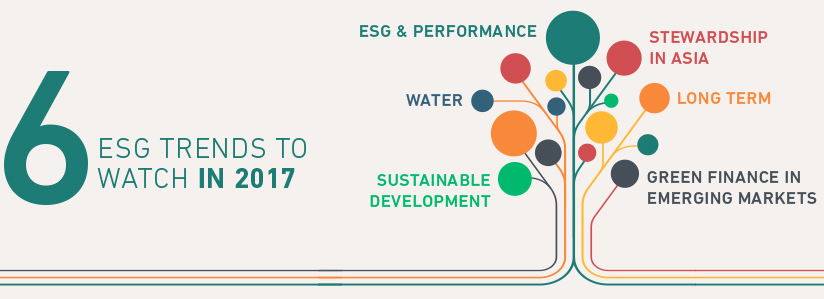
ESG in 2017: A Fundamental Rethink?
6 Trends to Watch

By Linda-Eling Lee, Global Head of ESG Research, MSCI

This year may ring the bell on a fundamental rethink for investors. Underlying all the major trends we identified for 2017 is a strategic decision point – do we change the way we think about investing, or is this business as usual in a new order?

In either case, one thing seems certain – focusing on policy shifts alone would be shortsighted. Policy is an outcome, forged by forces that unfold over more than one election cycle and reflect deeper technological, socio-demographic and energy trends that are reshuffling the social order and the investment landscape. This year, we need to think big – how will major trends affect the capital markets for the next decade?

Here are the biggest ESG forces affecting institutional investors over the long haul.

870x310_Blogpage_6ESGTrends


KEY 2017 TRENDS

1. Owning the Long Game

In 2017, some of the world’s largest investors may differentiate themselves by gearing toward the long view as globalization and technological advancements have strained social cohesion and fanned populist sentiment.

2. The Shift from Regulatory to Physical Risk

Focus on policy uncertainty around climate change in the wake of the U.S. election is misplaced. In 2017, we believe investors will turn their attention to mitigating exposure to the physical risks from global warming, especially as water is becoming scarcer in regions from the Middle East to the U.S.

3. Choosing Stewardship in Asian Capital Markets

Rapid adoption of codes that promote engagement between companies in Asia and investors is challenging the conventional wisdom that Asia lags global peers in corporate governance. In 2017, the real work starts, with investors facing a choice between proclaiming the importance of corporate governance without actually supporting improvements in companies’ practices to influencing companies’ behavior and pushing for change that stewardship brings.

4. ESG Investing as a Precision Tool

Research that points to ESG factors as a performance indicator continues to grow. In 2017, institutional investors may seek to integrate ESG signals across asset classes, markets and factor exposures.

5. Going for Goal with a New Performance Language

The U.N.’s Sustainable Development Goals are becoming a de facto framework for bringing together investors, companies, governments and citizens with an aim of protecting the planet, ending poverty and promoting peace and prosperity. In 2017, we see the increased adoption of corporate disclosures targeting these goals as a boost for institutions that aim to broaden their sustainable investment programs.

6. Green Shoots in China and India’s Sustainable Finance

The surge of innovation in sustainable development projects and initiatives in China, India and other emerging markets has been greeted with equal parts optimism and skepticism by institutional investors. In 2017, domestic and global standards will likely converge as companies in these markets deepen their understanding of standards required to attract foreign capital.

Download the complete MSCI ESG Trends 2017 Report here- https://www.msci.com/www/research-paper/2017-esg-trends-to-watch/0556816956


Article by Linda-Eling Lee, Global Head of ESG Research, MSCI. The author thanks Matt Moscardi for his contributions to this blog post.

Source: MSCI

Additional Articles, Impact Investing, Sustainable Business

US SIF Statement on Updated ERISA Guidance on Shareholder Rights

On December 29, 2016, the Department of Labor (DOL) rescinded Interpretive Bulletin 2008-2 relating to the Exercise of Shareholder Rights and replaced it with Interpretive Bulletin 2016-01 (www.dol.gov/newsroom/releases/ebsa/ebsa20161228) which reinstates the language of Interpretive Bulletin 94-2 with some modifications. US SIF supports this change as IB 2008-2 was not only inconsistent with prior guidance, but may have discouraged ERISA plan fiduciaries from exercising their shareholder rights. Today’s guidance appropriately notes the positive role fiduciaries play through the exercise of shareholder rights. Additionally, this guidance also reinforces the language of IB 2015-1 [1] on economically targeted investments which clarified that environmental, social and governance (ESG) impacts can be intrinsic to the market value of an investment.

Lisa Woll, CEO of US SIF: The Forum for Sustainable and Responsible Investment noted that “Fiduciaries have been engaging portfolio companies on environmental and social matters in a productive fashion for years. Institutional investors are increasingly engaging companies on ESG issues to address risks and opportunities. The US SIF Foundation’s 2016 Report on US Sustainable, Responsible and Impact Investing Trends (www.ussif.org/trends) found that 225 institutional investors or money managers with combined assets of $2.56 trillion filed or co-filed shareholder resolutions on environmental, social and governance issues at publicly traded companies from 2014 through 2016. We believe shareholder engagement is consistent with the fiduciary duties of prudence and the goal of increasing long-term risk-adjusted returns. We commend the Department of Labor for its leadership on this issue.”

Key points made in the new guidance and in the DOL news release include:

• The DOL reinforced the legitimacy and importance of investors’ engagement with their portfolio holdings noting that IB 2008-2 is out of step with important domestic and international trends in investment management. The guidance removes perceived impediments to the prudent management of plans’ rights as shareholders and encourages fiduciaries to manage those rights in the best interest of plan participants and beneficiaries.

• The updated guidance clarifies how a plan may consider ESG issues in proxy voting and other shareholder engagement activities.

• In its comments, the DOL recognizes the pervasiveness of US publicly-traded stocks in ERISA plan investment portfolios, both direct holdings and through pooled investment funds, including index funds and that this is another factor that contributes to the importance of proxy voting and shareholder engagement practices.

• The DOL noted that if there is a problem identified with a portfolio company’s management, selling the stock and finding a replacement investment may not be a prudent solution for a plan fiduciary. Often, engagement with the company is the prudent course of action.

• Issues appropriate for shareholder engagement include governance structures and practices, the nature of long-term business plans including plans on climate change preparedness and sustainability, the corporation’s workforce practices, and policies and practices to address environmental or social factors that have an impact on shareholder value, among other issues.

• Companies themselves are seeking more engagement as a way of understanding and responding to their shareholders’ views. There have also been market events that were catalysts for the growth of shareholder engagement. The financial crisis of 2008, for example, exposed some of the pitfalls of shareholder inattention to corporate governance and highlighted the merits of shareholders taking a more engaged role with the companies.


Article Note:

[1] https://www.federalregister.gov/documents/2015/10/26/2015-27146/interpretive-bulletin-relating-to-the-fiduciary-standard-under-erisa-in-considering-economically

Additional Articles, Impact Investing

Strong Growth in Sustainable and Responsible Investment across Europe

The 7th edition of the biennial Eurosif Market Study reveals double-digit growth for sustainable and responsible investment (SRI). The growth ranges from 30% for stewardship (Engagement & Voting) to 385% for Impact Investment. SRI is growing faster than the broad European investment market with retail investors returning to the market (up 549% since 2013).

At the launch event for its 2016 SRI Study in Brussels, Eurosif revealed the evolution of Sustainable and Responsible Investment strategies across the European member states. For the first time, the Study features endorsements from academia, scientific committees, investors and regulators; highlighting the extent to which SRI has become one of the major tools for financing the shift to a more sustainable economy.


Key Highlights

Sustainability Themed investments more than double their growth

Sustainability Themed investments grew by 146%, with the most assets under management in France at €43 billion. An indicator that investors are increasingly looking at climate sensitive topics like energy efficiency and renewable energy.

Exclusions still dominate

Exclusions are still the most popular SRI approach with over €10 trillion of assets under management, showing a 48% increase. Leading countries are Switzerland, with €2.5 trillion and the UK and Germany with almost €1.8 trillion. This is in line with a wave of divestments that has been fuelled by the climate change debate.

Norms-based screening remains a popular strategy

Norms-based screening has now become the second most significant SRI approach with over €5 trillion Assets under Management and a growth rate of 40%. France dominates with €2.6 trillion.

Impact Investing and Green Bonds continue their rapid growth

Impact Investing is the fastest growing SRI strategy up to 385% with €98 billion, from only €20 billion in 2013. The Netherlands leads with over €40 billion. This growth is supported by the significant rise in Green Bonds.

Policy Tailwinds

Across all the surveyed member states, there has been a positive response to the EU legislative agenda on enhanced transparency and corporate governance which aligns with long term sustainable investment. Examples include Spain and Italy where there have been policy developments which have driven a greater awareness of SRI across those markets. The pension fund disclosure requirements in Spain and the industry engagement with government in Italy on SRI have been important developments which have contributed to the growth in those countries.

Commenting on the survey, Flavia Micilotta, Executive Director of Eurosif, noted that: “The findings of this year’s Study are a clear reflection of the growing investor interest in SRI. In addition, the results support the heightened focus on sustainable and green finance that isincreasingly shaping the agenda of EU regulators.”

Will Oulton, President of Eurosif, added: “The Eurosif market study continues to be the key barometer of the development of the pan European SRI Market. The growth remains encouraging and reflects the increasing interest in sustainable investment in this dynamic market which should be noted by Europe’s capital market policy makers.”


Media Contacts:
Flavia Micilotta
Executive Director
flavia.micilotta@eurosif.org
Direct Line: + 32(0)27432948

Sophie Rasbash

Communication Executive: sophie.rasbash@eurosif.org
Direct Line: +32(0)2743 29 47

About Eurosif:
Eurosif (www.eurosif.org) is the leading pan-European sustainable and responsible investment (SRI) membership organisation whose mission is to promote sustainability through European financial markets. Eurosif works as a partnership of Europe-based national Sustainable Investment Forums (SIFs) – whose member organisations are drawn from the sustainable investment industry value chain. These members include institutional investors, asset managers, financial services, index providers and ESG research and analysis firms totalling over €1 trillion assets. Eurosif’s indirect European network spans across over 500 Europe-based organisations. Eurosif is also a founding member of the Global Sustainable Investment Alliance, (www.gsi-alliance.org) the alliance of the largest SIFs around the world. The main activities of Eurosif are public policy, research and creating platforms for nurturing sustainable investing best practices.

Additional Articles, Impact Investing

Major SRI Drivers and Trends from the SRI Trends Report

In recent years, numerous trends have shaped the evolution and growth of SRI within US financial markets:

• Money managers increasingly are incorporating ESG factors into their investment analysis and portfolio construction, driven by the demand for ESG investing products from institutional and individual investors and by the mission and values of their management firms. Of the managers that responded to an information request about reasons for incorporating ESG, the highest percentage, 85 percent, cited client demand as a motivation.

• However, 114 money managers reported little to no detail for ESG assets worth $5.38 trillion, much of it identified through their PRI Transparency Reports. These managers did not provide information on the specific products that were subject to ESG criteria and generally divulged few if any details on the specific ESG criteria incorporated.

• Of the money managers that responded to a question in the US SIF Foundation survey about their ESG incorporation strategies, 62 percent reported that they use some combination of negative screening, positive screening and ESG integration within their funds. More than half reported using strategies of impact investing and nearly half used sustainability themed investing as a strategy. The incorporation strategy that affected the highest number of assets, $1.51 trillion, was ESG integration. (See the glossary of ESG incorporation terms below.)

• Climate change remains the most significant overall environmental factor in terms of assets, affecting $1.42 trillion in money manager assets and $2.15 trillion in institutional investor assets — more than three times the amounts affected in 2014. Fossil fuel restrictions or divestment policies applied to $152 billion in money manager assets and $144 billion in institutional investor assets at the beginning of 2016.

• Moreover, shareholders concerned about climate risk filed 93 resolutions specifically on the subject in 2016 and negotiated a number of commitments from the target companies to report on strategic planning around climate change or to reduce their greenhouse gas emissions.

• When it comes to specific ESG criteria, conflict risk analysis, including the exclusion of companies doing business in countries with repressive regimes or state sponsors of terrorism, holds the most weight for money managers, with $1.54 trillion in assets affected, and it remains the top ESG factor institutions incorporate into their investments, affecting $2.75 trillion.

• An issue tracked for the first time this year was transparency and anti-corruption: money managers reported $725 billion in assets taking this criterion into account, while institutional investors reported $528 billion.

• The emerging trend of gender lens investing, tracked separately for the first time this year, was identified as affecting the management of nearly $132 billion in money manager assets, and $397 billion in institutional investor assets.

Community investing institution assets jumped 89 percent, from $64 billion to nearly $122 billion. This growth was led by a particularly large increase in the assets of community development credit unions, which more than doubled since 2014.

• As shown by the number of proposals filed each year, disclosure and management of corporate political spending and lobbying is the greatest single ESG concern raised by shareholders, with 377 proposals filed on this subject from 2014 through August 2016. Many of the targets of these proposals are companies that support organizations that deny climate change science and undertake lobbying against regulations to curb greenhouse gas emissions.

• Investors filed 350 proposals at US companies from 2014 through 2016 to facilitate shareholders’ ability to nominate directors to corporate boards. As a result of the strong investor support for these “proxy access” proposals, the share of S&P 500 companies establishing proxy access measures over this period grew from 1 to 40 percent.

ESG Incorporation Strategies and Terms

POSITIVE/BEST-IN-CLASS: Investment in sectors, companies or projects selected for positive ESG performance relative to industry peers. This also includes avoiding companies that do not meet certain ESG performance thresholds.

NEGATIVE/EXCLUSIONARY: The exclusion from a fund or plan of certain sectors or companies involved in activities or industries deemed unacceptable or controversial.

ESG INTEGRATION: The systematic and explicit inclusion by investment managers of ESG risks and opportunities into financial analysis.

IMPACT INVESTING: Investment in companies, organizations and funds, often in private markets, with the intention to generate social and environmental impact alongside a financial return, which can range from below market to market rate.

SUSTAINABILITY THEMED INVESTING: The selection of assets specifically related to sustainability in single- or multi-themed funds.

For additional Trends Report findings and information please visit www.ussif.org/trends


Energy & Climate, Featured Articles, Impact Investing, Sustainable Business

US Sustainable, Responsible and Impact Investing Trends 2016 (Executive Summary)

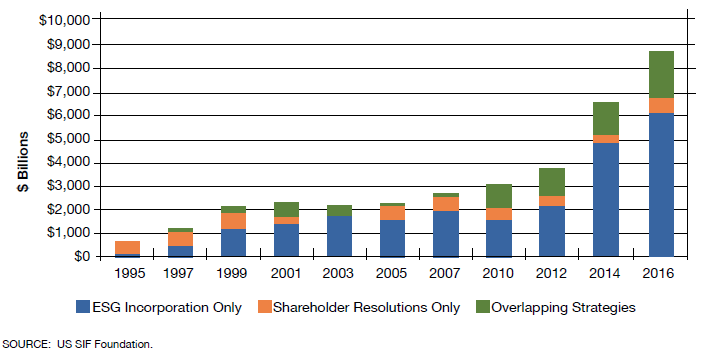
US sustainable, responsible and impact (SRI) investing continues to expand. The total US-domiciled assets under management using SRI strategies grew from $6.57 trillion at the start of 2014 to $8.72 trillion at the start of 2016, an increase of 33 percent, as shown in Figure A. These assets now account for more than one out of every five dollars under professional management in the United States.

The individuals, institutions, investment companies, money managers and financial institutions that practice SRI investing seek to achieve long-term competitive financial returns. Some investors embrace SRI strategies to manage risk and fulfill fiduciary duties; many also seek to help contribute to advancements in social, environmental and governance practices. SRI investing strategies can be applied across asset classes to promote stronger corporate social responsibility, build long-term value for companies and their stakeholders, and foster businesses or introduce products that will yield community and environmental benefits.

Through a survey and research undertaken in 2016, the US SIF Foundation identified:

• $8.10 trillion in US-domiciled assets at the beginning of 2016 held by 477 institutional investors, 300 money managers and 1,043 community investment institutions that apply various environmental, social and governance (ESG) criteria in their investment analysis and portfolio selection, and

• $2.56 trillion in US-domiciled assets at the beginning of 2016 held by 225 institutional investors or money managers that filed or co-filed shareholder resolutions on ESG issues at publicly traded companies from 2014 through 2016.

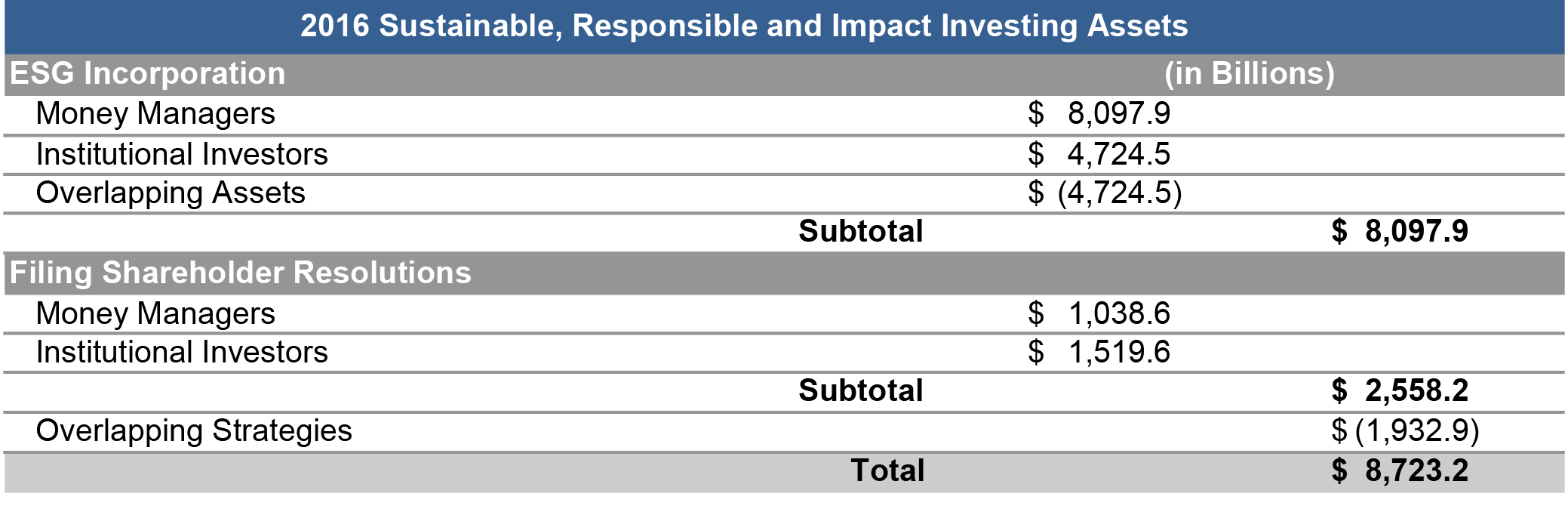
After eliminating double counting for assets involved in both strategies and for assets managed by money managers on behalf of institutional investors, the overall total of SRI assets at the beginning of 2016 was $8.72 trillion, as shown in Figure C. Throughout the report, the terms sustainable, responsible and impact investing, sustainable investing, responsible investing, impact investing and SRI are used interchangeably to describe these investment practices.

Fig.A_1995 to 2016

The assets engaged in sustainable, responsible and impact investing practices at the start of 2016 represent nearly 22 percent of the $40.3 trillion in total assets under management tracked by Cerulli Associates. From 1995, when the US SIF Foundation first measured the size of the US sustainable and responsible investing market, to 2016, the SRI universe has increased nearly 14-fold, a compound annual growth rate of 13.25 percent.

ESG Incorporation Highlights

The total assets that are managed with ESG factors explicitly incorporated into investment analysis and decision making are valued at $8.10 trillion. Of this total, $8.10 trillion were identified as managed by money managers or community investing institutions, while $4.72 trillion were identified as owned or administered by institutional investors. (The value of the institutional investors’ ESG assets we identified separately was slightly lower than the institutional portion of the overall tally of money managers’ ESG assets under management.)

ESG Incorporation by Money Managers and Investment Vehicles

The US SIF Foundation identified 300 money managers and 1,043 community investing institutions that incorporate ESG issues into their investment decision making. The dollar value of their combined ESG assets is 1.7 times the corresponding figure for 2014, when money managers and community investing institutions held $4.8 trillion in ESG assets under management.

The significant growth in these ESG assets reflects several factors. These include growing market penetration of SRI products, the development of new products that incorporate ESG criteria and the incorporation of ESG criteria by numerous large asset managers across wider portions of their holdings. Furthermore, the past two years have seen new disclosure on the part of numerous institutional investors and asset managers on how they are implementing the Principles for Responsible Investment (PRI), a global framework for taking ESG considerations into account in investment analysis, decision making and active ownership strategies.

The broad outlines of the ESG issues incorporated by money managers are as follows:

• Environmental investment factors apply to $7.79 trillion in assets under management. Climate change criteria shape the investment of $1.42 trillion in assets under management, a more than fivefold increase since 2014. Clean technology is a consideration incorporated by money managers with $354 billion in assets under management.

• Social criteria, which include criteria related to issues such as conflict risk, equal employment opportunity and diversity, and labor and human rights, apply to $7.78 trillion in assets under management.

• Governance issues apply to $7.70 trillion in assets under management, a twofold increase since 2014.

• Product-specific criteria, such as restrictions on investment in tobacco and alcohol, apply to $1.97 trillion in assets.

The number of funds incorporating ESG criteria has grown 12 percent over the last two years. These funds, which exclude separate account vehicles, and other money manager ESG assets that are not associated with a dedicated fund or other type of investment vehicle, and community investing institutions, now number 1,002 and represent $2.60 trillion, as shown in Figure B.

Fig B_Investment Funds Incorporating ESG 1995_2016
SOURCE: US SIF Foundation. NOTE: ESG funds include mutual funds, variable annuity funds, closed-end funds, exchange-traded funds, alternative investment funds and other pooled products, but exclude separate accounts, Other/Not Listed, and community investing institutions. From 1995-2012, separate account assets were included in this data series, but have been excluded since 2014, in order to focus exclusively on commingled investment products.


REGISTERED INVESTMENT COMPANIES:

Among the universe of investment vehicles that incorporate ESG factors into investment management, 519 registered investment companies, including mutual funds, variable annuity funds, exchange-traded funds (ETFs) and closed-end funds, account for $1.74 trillion in ESG assets.

ALTERNATIVE INVESTMENT VEHICLES:

The US SIF Foundation identified 413 alternative investment vehicles—private equity and venture capital funds, responsible property funds and hedge funds—engaged in sustainable and responsible investment strategies, with a combined total of $206 billion in assets under management. They include a number of private equity funds focused on themes such as clean technology and social enterprise, and property funds focused on green building and smart growth.

OTHER INVESTMENT VEHICLES:

• Other Pooled Products: The research team identified 70 other pooled products (typically commingled portfolios managed primarily for institutional investors and high-net-worth individuals) with nearly $652 billion in assets that were invested according to ESG criteria.

• Unspecified Vehicles and Separate Accounts: Among 114 managers researched, $5.38 trillion in assets were identified incorporating ESG factors into investment management in separate accounts or investment vehicles classified as “Other/Not Listed.”

• Community Investing Institutions: A total of 1,043 community investing institutions (CIIs), including community development banks, credit unions, loan funds and venture capital funds, collectively manage nearly $122 billion in assets. CIIs have an explicit mission of serving low- and moderate income communities and individuals.

ESG Incorporation by Institutional Investors

With $4.72 trillion of ESG assets, a 17 percent increase since the start of 2014, institutional investors play a substantial role in the SRI universe documented in this report. These asset owners include public funds, corporations, educational institutions, foundations, faith-based investors, healthcare funds, labor union pension funds, nonprofits and family offices.

The leading ESG criteria that institutional investors consider are restrictions on investing in companies doing business in regions with conflict risk (particularly in countries with repressive regimes or sponsoring terrorism). Investment policies on conflict risk apply to $2.75 trillion in assets, about the same as in 2014. In second place, in asset-weighted terms, is consideration of climate change and carbon emissions; this applies to $2.15 trillion in assets, compared with just $551 billion in 2014. Institutions report that they apply unspecified general environmental, social and governance criteria to more than $1.2 trillion in assets. While tobacco-related restrictions grew in asset-weighted terms, they dropped from third to ninth place among the leading ESG criteria incorporated by institutional investors.

Investor Advocacy Highlights

A wide array of institutional investors—including public funds, religious investors, labor funds, foundations and endowments—and money managers file or co-file shareholder resolutions at US companies on ESG issues, and hundreds of these proposals come to votes each year. From 2014 to 2016, 176 institutional investors and 49 investment management firms with total assets of $2.56 trillion filed or co-filed resolutions. The number of institutions and managers actively involved in filing shareholder resolutions has remained relatively stable over the past four years.

The proportion of shareholder proposals on social and environmental issues that receive high levels of support has been on the rise. Since 2013, approximately 30 percent of these proposals received support from 30 percent or more of the shares voted. From 2007 through 2009, only 17 percent of proposals cleared this threshold.

Money managers and institutional investors are pursuing engagement strategies on ESG issues in addition to filing shareholder resolutions at publicly traded companies. Fifty-seven institutional asset owners reported that they engaged in dialogue with companies on ESG issues, as did 61 asset managers.

Fig C_SRI Assets 2016
SOURCE: US SIF Foundation. NOTE: ESG Incorporation includes community investing institutions (CIIs). US SIF Foundation identified over $5.1 trillion in the institutional portion of Money Managers’ ESG assets under management, so the Institutional Investors’ ESG assets identified separately are removed to control for the potential inflationary effects of double counting. For more details, see Chapter V: Methodology.

For additional Trends Report findings and information please visit www.ussif.org/trends

Featured Articles, Impact Investing

Signup to receive GreenMoney's monthly eJournal

Privacy Policy
Copyright © GreenMoney Journal 2025

Website design & development by BrandNature

Global Events Calendar

View All Events

april

21aprAll Day232026 Sustainable Packaging Coalition: SPC Impact – Nashville

27aprAll Day30Women Deliver 2026 Conference (WD2026) – Melbourne

X