Tag: Impact Investing

Global Sustainable Investment Alliance Releases Biennial Global Sustainable Investment Review 2016, now totaling $23 trillion
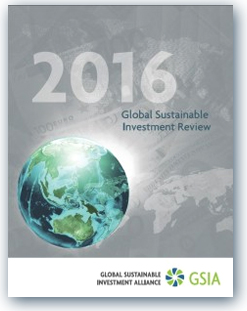
Global Sustain Invest Review

>> Back to June 2017

In Late March, the Global Sustainable Investment Alliance (GSIA) released its biennial Global Sustainable Investment Review 2016, showing that global sustainable investment assets reached $22.89 trillion at the start of 2016, a 25% increase from 2014.

The Global Sustainable Investment Review brings together the results from regional market studies by the sustainable investment forums from Europe, the United States, Canada, and Australia and New Zealand. Market information on Japan was provided by JSIF—Japan Sustainable Investment Forum; data on Asia ex Japan was provided by the Principles for Responsible Investment. GSIA leaders Flavia Micilotta, Executive Director of Eurosif: The European Sustainable Investment Forum; Lisa Woll, CEO of US SIF: The Forum for Sustainable and Responsible Investment; Meg Voorhes, Research Director at US SIF: The Forum for Sustainable and Responsible Investment; and Simon O’Connor, CEO of Responsible Investment Association Australasia (RIAA), held a media web conference on Monday, March 27 to discuss report findings.

In nearly every market represented in the report, sustainable investing grew in both absolute and relative terms since the beginning of 2014. Europe accounts for over half the global SRI assets (53%), and the United States for 38%. The fastest growing region is Japan—due in part to an expanded survey that provided information for the first time on the sustainable investing activities of numerous institutional asset owners—followed by Australia/New Zealand.

The largest sustainable investment strategy globally is negative/ exclusionary screening ($15.02 trillion), followed by ESG integration ($10.37 trillion) and corporate engagement/shareholder action ($8.37 trillion). Negative screening is the largest strategy in Europe, while ESG integration leads in the United States, Canada, Australia/New Zealand and Asia ex Japan. Japan’s primary sustainable investment strategy is corporate engagement and shareholder action. The fastest growing strategy, although also the smallest in absolute dollar terms, was impact/community investing.

Several GSIA members reported that the consideration of fiduciary duty was an important driver for sustainable investing, along with client demand.

While institutional investors still dominate the SRI market, with pension funds often comprising the largest percentage of institutional SRI assets, interest by retail investors is growing. The relative proportion of retail SRI investments in Canada, Europe and the United States increased from 13% in 2014 to 26% at the start of 2016. Over a third of SRI assets in the United States were retail.

Growing global concern over climate change has resulted in rising interest in green finance, including climate-aligned bonds. In fact, the growing interest in green bonds over the last two years has shifted the average SRI asset allocation. In 2016 in Canada and Europe, most SRI assets were in bonds (64%) followed by equities (33%). This is a flip from 2014 when 50% of assets were in equities and only 40% in bonds. China is another important contributor to the rise in green bonds as China is now the world’s largest issuer of climate-aligned bonds, with $220 billion in issuances according to the Climate Bonds Initiative.


To download the full Report please visit
http://www.ussif.org/files/Publications/GSIA_Review2016.pdf

Report Highlights

At the start of 2016, global sustainable, responsible and impact (SRI) investment assets reached $22.89 trillion, a 25% increase from 2014. Europe accounts for over half of these assets (53%), while the United States accounts for 38%.
In nearly every market represented in the report, sustainable investing has grown in both absolute and relative terms since the beginning of 2014.
The largest sustainable investment strategy globally is negative/ exclusionary screening, affecting $15.02 trillion in assets, followed by ESG integration, applied to $10.37 trillion in assets.
Growing global concern over climate change has resulted in rising interest in green finance, including climate-aligned bonds.
Fiduciary duty and client demand are key growth drivers for sustainable investing.

About the Global Sustainable Investment Review

Now in its third edition, the biennial Global Sustainable Investment Review is the only report presenting results from Europe, the United States, Canada, Asia, Japan, and Australia and New Zealand. The report draws on in-depth regional and national reports from GSIA members—Eurosif, Responsible Investment Association Australasia, RIA Canada and US SIF—as well as data and insights from the Principles for Responsible Investment, JSIF (Japan), LatinSIF and the African Investing for Impact Barometer. Together, these resources provide data points, insights, analysis and examples of the shape of sustainable investing worldwide.

The Global Sustainable Investment Review 2016 was made possible through the generosity of the report sponsor, Bloomberg.

About The Global Sustainable Investment Alliance  The Global Sustainable Investment Alliance (GSIA) is a collaboration of membership-based sustainable investment organizations around the world. It includes US SIF, UK SIF, Eurosif, RIA Canada, VBDO (Netherlands) and the Responsible Investment Association Australasia (RIAA). The GSIA’s mission is to deepen and expand the practice of sustainable, responsible and impact investing through intentional international collaboration. Our vision is a world where sustainable investment is integrated into financial systems and the investment chain and where all regions of the world have coverage by vigorous membership based institutions that represent and advance the sustainable investment community.

For more information visit – www.gsi-alliance.org
Additional Articles, Impact Investing, Sustainable Business

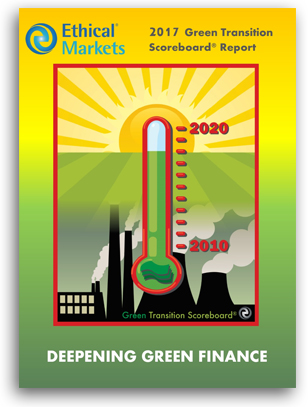
2017 Green Transition Scoreboard® Tracks Private Green Investments At $8.1 Trillion

Green Transitions Scoreboard - GreenMoneyJournal.com>> Back to June 2017

In late April 2017, the latest Green Transition Scoreboard® (GTS) found that, despite Trump’s anti-green policies, private green investments now total more than $8.1 trillion USD ($8,133,456,730,370).

Published annually since 2009, the GTS is a global measure of private green investment in five green sectors: 1) Renewable Energy, 2) Efficiency, 3) Life Systems (water, waste, recycling, community investing, e-learning and fintech), 4) Green Construction, and 5) Green Corporate R&D. Government investments have been omitted wherever possible and technological criteria are strictly applied.

The aggregated total is tracked by Ethical Markets Media, Certified B Corporation’s, team of experts and global advisory board, led by CEO Dr. Hazel Henderson, futurist/author and former US government science policy advisor.

Henderson said “The green economy is growing faster than anyone realizes. We knew that this good news on the progress of the global green transition couldn’t be fully covered by mainstream financial media and news programs whose advertising is still from fossilized sectors.”

GTS co-author Tim Nash, The Sustainable Economist, adds “Although the USA is expected to fall behind due to federal policies that put obsolete industries like coal ahead of thriving green sectors, large corporations are stepping up to invest billions in more efficient technologies.”

The full 2017 GTS report titled “Deepening Green Finance” can be downloaded free here: 2017 Green Transition Scoreboard.

Cities and states worldwide are now leading, energized by former New York City Mayor Michael Bloomberg and many others. The UNEP Inquiry on Design of a Sustainable Financial System is successfully engaging conventional financial markets. Co-director Dr. Simon Zadek welcomed the release of the GTS report,

“With a changed political landscape, the case for green finance has to be strengthened, so your work is very important and has to be widely used.”

The GTS report traces private money shifting from incumbent fossilized sectors to emerging green opportunities. Financial firms are being forced to innovate as pressure grows from all side. Activist ethical investors and divestment campaigns are getting louder. New pressure from above is driven by the National Development Commitments (NDCs) signed by 194 governments under the UN COP 21 and 22 climate accords and Sustainable Development Goals (SDGs). Pressure is also coming from below with the rise of Silicon Valley’s Fintech100, including crowdfunding, peer-to-peer lending, and reward currencies like SolarCoin.


For further information please contact:

Dr. Hazel Henderson hazel.henderson@ethicalmarkets.com
+1 (904) 829-3140

Tim Nash, MSLS
nash@sustainableeconomist.com
+1 (416) 821-9179

LaRae Long
gogreen@ethicalmarkets.com
+1 (904) 826-1381

About Ethical Markets, Certified B Corporation

Founded in 2004 with a mission to reform markets and metrics while helping accelerate the global transition from fossil-fueled early industrialism to cleaner, healthier, inclusive, knowledge-richer green societies everywhere. Its “Ethical Markets” TV series is distributed globally to colleges and libraries by www.films.com or free at www.ethicalmarkets.tv. This global network of networks connects ethical investors, asset managers,green entrepreneurs, NGO leaders and academics. It sponsors the EthicMark®Awards for Advertising that Uplifts the Human Spirit and Society, with nominations for its 2017 Awards now open at www.ethicmark.org, where past winning campaigns can also be viewed. A full list of information services is at www.ethicalmarkets.com.

Additional Articles, Energy & Climate, Food & Farming, Impact Investing, Sustainable Business

SOCAP announces the Good Capital Project – the Next Step in Bringing Impact Investment into the Mainstream

Social Capital Markets (SOCAP) is in the vanguard of the emerging global impact economy – convening ideas and capital to catalyze world change. We are a network of investors, entrepreneurs, and social impact leaders addressing the world’s toughest challenges through market-based solutions. For more than ten years, we have been the leading convener of people, businesses, and non-profits at the intersection of money and meaning. We proudly announce the Good Capital Project (GCP), an integral step in evolving impact investment from an emerging industry into mainstream practice. The Good Capital Project, through a new design thinking process, will convene all constituents to drive greater collaboration and accelerate capital flows into purpose driven investments.

The UN Sustainable Development Goals, ESG Metrics, SRI principles, corporate social responsibility, impact investing and philanthropy have provided principles, driven investment and improved corporate governance and sustainability. While each of these valuable approaches are critical threads, a weaving of these threads is required to strengthen and mainstream the industry. The Good Capital Project leverages expertise from the financial, design, academic, non-profit, governmental and impact communities to contribute best practices from existing initiatives to the design of the new fabric of a purpose driven impact economy.

The Good Capital Project will develop new tools, resources and frameworks to leverage the financial services community as a force for positive impact. Their mission: “Aligning the global capital markets with the human needs of tomorrow.”

Learning from the successes and failures of local, regional, and global capital deployment, the GCP will create beneficial opportunities for both the financial sector and broader global community The financial markets need to be prepared for the seismic shift in investor demographics that demand greater alignment of their portfolios with their values. The GCP will focus on generating innovative and sustainable solutions to align the capital markets with the human needs of tomorrow. The financial markets must be a catalyst for good in the years ahead.

The Good Capital Project launches June 19th in New York City at Convene. It will include a gathering of select senior-level attendees to kick-off the industry-wide collaborative effort and form the foundation of the project.

The GCP’s initial output will be unveiled in San Francisco at the 10th anniversary of SOCAP’s flagship conference this October, followed by a series of multi-media content to highlight the project’s successes and milestones. This ambition is a shared goal that only collaboration can help realize.


For more information the launch event in NYC and the GCP go to: www.goodcapitalproject.com.

Also see the The Why Good Capital Series – a series of interviews with impact leaders about why the Good Capital Project is needed in this moment as well as the invaluable insights each subject has into our industry.

Additional Articles, Impact Investing, Sustainable Business

Community Capital Management Joins United Nations-Supported Principles for Responsible Investment

Community Capital Management, Inc. (CCM), a leading fixed income impact investing manager, announced recently that it has become a signatory to the United Nations-Supported Principles for Responsible Investment (UN PRI), enhancing its 18-year commitment to incorporating environmental, social, and governance (ESG) criteria into its investment philosophy and processes.

The UN PRI is internationally recognized as the world’s leading proponent of responsible investments. The principles, which are voluntary, aim to provide a framework for integrating ESG considerations into investment decision-making and ownership practices.

CCM manages $2.3 billion and is a pioneer in managing fixed income impact investing and fossil fuel free portfolios. CCM incorporates the environmental and social aspects of ESG investing into its investment philosophy by proactively seeking market-rate bonds that positively contribute to economic and sustainable impact.

“Becoming a signatory to the UN PRI demonstrates the alignment of our impact investment goals with those of the global impact community,” said David Sand, chief investment strategist at CCM. “As one of the largest U.S.-based fixed income impact investing managers, we are excited to participate in this globally recognized community, expanding our many commitments to partnerships with like-minded impact investing organizations.”

“We are very pleased to welcome Community Capital Management as a new signatory,” said PRI managing director Fiona Reynolds. “Their excellent track record of looking at the material risks around ESG issues and the impact these have on the investment decision making process makes them a natural fit for the PRI.”


About Community Capital Management, Inc.
Community Capital Management, Inc. is an investment adviser registered with the Securities and Exchange Commission. Headquartered in Fort Lauderdale, Florida with offices in Charlotte, North Carolina and Boston, Massachusetts, the firm was founded in 1998 and currently manages over $2 billion in assets as of 12/31/16. CCM’s flagship intermediate fixed impact investing strategy is available as a separate account or via a mutual fund. Other products managed by CCM include a liquid alternative income fund and customized separate account strategies. For more information, please visit www.ccminvests.com

Community Capital Management, Inc. is an investment adviser registered with the Securities and Exchange Commission under the Investment Advisers Act of 1940. Past performance does not guarantee future results. Market conditions can vary widely over time and can result in a loss of portfolio value.

Contact: Gabriella Bastos, Community Capital Management, Inc.
(877) 272-1977

Additional Articles, Impact Investing

Building a Career in Impact Investing

By Jenn Pryce, President and CEO, Calvert Foundation

>> Back to April 2017

What do an artificial heart, the theater, and Gabon all have in common? From where you’re sitting, probably not much. For me, however, they are key facets of my life that have led me to a career in impact investing.

Years ago when I was an undergraduate, a team and I were assigned to construct an artificial heart. This heart that we built was intended to test a new piece of medical technology, a hemofoil valve. The valve, we found, held significant promise of reducing the development of fatal blood clots. The technology was pretty straightforward to me, however the questions following the test were not. Who now gets access to this valve? Only those who can pay the price? Only those who are younger, healthier, and have a possibly longer life to live? The discussions exposed me to the world of inequality that we live in – a world in which not everyone has equal access to technology, medicine, and opportunities more broadly.

After graduation I joined the Peace Corp in search of a new adventure and greater exposure to the world. I ended up working in Gabon, where I taught math and English to middle school-aged students. I lived in a small, rural village, of about 100 people, that had no access to electricity or running water. Despite these challenges, the village was able to support and care for each other. It was clear that their survival was very much dependent on their ability to come together as a community. I was impressed by their ability to work as a group, acknowledging and being respectful of each other’s and each of their own interdependence on one another. I realized, that not just here in this small village in Gabon, but in larger, towns, cities, countries, even the whole world, we all operate, fail, and succeed as interdependent communities.

When I returned from Gabon I made the decision to focus on finance. My experiences abroad alongside my education had led me to the thinking that capital equates to power, and is a key determinant of capability for individuals, businesses, and communities. Although now I know that finance is only one piece of the pie of life, I still maintain the important role that it plays.

For several years my career followed this track. I got my MBA from Columbia University and worked at a number of large financial institutions, including Neuberger Berman and Morgan Stanley. Over time, though, I felt that my job was not addressing the issues and the values that were important to me – the ones that I learned from my time in Gabon, and building that artificial heart. I didn’t know what I wanted to do next, but I knew I wanted to do something else. So I took a risk and quit my job.

At the time, I was living in New York City, and the opportunities were endless. A local theater that I was a fan of, The Public Theater, had an opening for a volunteer, and I jumped on it. The Public was special to me because of the values it held. Its founder, Joseph Papp, believed that art should be accessible to everyone, regardless of wealth – and this message very much resonated with me and my (artificial) heart.

Like many small, creative institutions, The Public found itself in some financial peril. It was upsetting to see an institution that was so impactful on the community struggle as much as it did. I didn’t understand how such an asset was being undervalued.

I did some research, and found an organization that valued the arts from a financial perspective, called Nonprofit Finance Fund (NFF). Back then, they were one of the few community development financial institutions (CDFIs) that viewed the arts as investable and valuable commodities in communities. I soon joined the NFF team and dived into the world of community investing.

At the time, the term “impact investing” had yet to be coined. CDFIs however, as established institutions, had been working to provide credit and financial services to underserved markets and communities since the early 1990s. I found that the work that NFF was doing, and other CDFIs, was incredibly valuable – in one way, because they were driving capital to much needed community services, but in another way, because they were also receiving interest from the loans they were making.

Elsewhere in the world, other investors and financial institutions were recognizing this type of double-bottom line opportunity. An opportunity that soon merited its own name – impact investing – and its own space in the investing world.

Through my work at NFF, I came across Calvert Foundation, who had invested in NFF and several other CDFIs. Calvert Foundation, through the Community Investment Note, provided investors the opportunity to actually invest in CDFIs, and benefit from both the financial and social returns that they generated.

The opportunity to work with the investors that were financing CDFI work, and to help grow the amount of investment that was going into CDFI work, was very appealing to me. I later joined Calvert Foundation, only to build my way up to become CEO.

Today I spend a lot of my time explaining what impact investing is and why it is so important. When I meet with a prospective investor, I think back to the artificial heart, and explain how impact investing provides increased opportunities to those who are often underserved. When I’m speaking at an event with large financial institutions, I think about the village in Gabon, and remind the audience that it is only by working together that we can leverage the impact of our investments. When I’m making decisions on the types of organizations we invest in, I think of The Public Theater, and tell my team that it is our mission to finance organizations that are actively making a positive difference in their communities.

Other people, in their own ways, have come to the similar conclusions that I have made from my collected experiences. I have the benefit of working with these people every day, on the Calvert Foundation team, and with the thousands of people who have chosen to invest with us. The Community Investment Note is now more accessible than ever before, available online or through brokerage firms, starting from $20. Anyone who cares about equality, community, opportunity, and finance as a force for good, can make a difference with their investments.

The capital raised through the Note goes to support community organizations, like The Public Theater, and many others sectors such as health, education, small business, affordable housing, sustainable agriculture, and climate change solutions. In my time at Calvert Foundation, we’ve also launched new initiatives that focus our investments on important issues, such as support services for the aging and gender equality.

In the past few years it has been particularly exciting to see our women’s empowerment initiative, Women Investing in Women (WIN-WIN), grow in popularity. This issue that has always been important to me, has also become incredibly important to investors. Now it is proven that investing in women and girls can generate sustainable returns, in the economy and in society. Working in impact investing has enabled me to sit at the forefront of this shift in perspective, and help drive it forward. Today we have raised over $30 million in investments targeted at WIN-WIN, and we continue to move that capital to organizations empowering women and girls around the world.

It has been quite the journey so far, and I know it is far from over. The lessons I’ve learned have taught me that as you grow and establish values in life, they do not have to be sacrificed in the work that you do or in the ways you spend and allocate your money. That is precisely what impact investing is all about, and it is something that we can all be a part of.


Article by Jennifer Pryce, who brings nearly 20 years of finance and community development work to her role as the President and CEO of Calvert Foundation (www.calvertfoundation.org).

Since arriving at Calvert Foundation in 2009, Jenn has risen from the position of U.S. Portfolio Manager to Vice President of Strategic Initiatives, then Chief Strategy Officer and now President and CEO. In her role as Chief Strategy Officer, she led the organization’s Strategic Initiatives team and its work on raising capital, developing new products and initiatives and marketing and communications. Jenn has also overseen Calvert Foundation’s wholly owned Community Investment Partners subsidiary, which offers fund and asset management services for institutional clients.

Jenn’s teams have anchored their work around the development of initiatives that combine a social issue with the power of impact investing, such as the Women Investing in Women Initiative (WIN-WIN). WIN-WIN was launched by the Strategic Initiatives team under Jenn’s leadership.

Prior to Calvert Foundation, Jenn worked with Nonprofit Finance Fund as the Director of the Washington Metro Area office. She has also held positions at Wall Street firms, working at Neuberger & Berman as an equity research analyst and Morgan Stanley’s London office in the Investment Banking division. She was a Peace Corps Volunteer in Gabon, Africa and also worked at the Public Theater in New York City.

Jennifer received a Bachelor of Science in Mechanical Engineering from Union College and a MBA from Columbia University. She serves on the Boards of Hitachi Foundation and Impact Assets.

Featured Articles, Impact Investing, Sustainable Business

Proxy Season 2017 to Highlight Big Gaps Between Investor Expectations and New Administration Goals

Post-Election Proxy Season Sees Big Boost in Requests on Diversity and Equal Pay, But Climate Change and Corporate Political Transparency Still Top the Agenda

With a new administration in the White House and major national policy shifts underway, shareholder proponents are focused on preserving key gains they have won in their shareholder resolutions this spring. Investors will consider a near-record number of proposals filed on environmental, social and sustainable governance (ESG) issues for consideration at corporate annual meetings. Proxy Preview 2017, released in early March by As You Sow, the Sustainable Investments Institute (Si2), and Proxy Impact, lists the specific shareholder resolutions filed this year and lays out major themes, including corporate political influence, climate change and economic inequality.

Available online at www.proxypreview.org – the report concludes:

• Political Spending: As government responsibility for key issues like health care and environmental protection is being kicked from Washington to state capitols, shareholders want companies to disclose what they spend to influence government at all levels — before and after elections in lobbying. Close to 100 resolutions ask about both subjects, with more on lobbying.

• Climate Change and Energy: Big investors remain focused on climate risk and how their companies will respond, and they want companies to say more about their strategies, including efforts to curb methane leaks. This critical issue is also woven throughout upcoming annual meeting agendas with other resolutions on sustainability reporting, executive compensation and board oversight and composition (separately covered in the report).

• Gender Diversity and Equal Pay: Resolutions seek equal employment opportunity — and pay equity — for women, minorities and others on the bottom rungs at leading U.S. companies, with a surge in some 40 proposals which emphasize the financial sector. Shareholders also continue to press for a variety of non-discrimination policies that already are de rigueur in corporate America.

As You Sow CEO Andrew Behar said: “The key is in the markets. Coal is not going to make a comeback from magical thinking when renewables offer a cheaper, cleaner way to produce electricity. Investors looking at corporate underperformance are still going to look at egregiously high CEO pay with skepticism because they want returns. And corporate sustainability leaders are not interested in becoming laggards. The best managers will continue to work with shareholders to make progress on ESG issues.”

Michael Passoff, CEO, Proxy Impact and co-author of Proxy Preview 2017, said: “Despite the divisive political climate, shareholders still expect their companies to focus on sustainable business practices. The Trump Administration may not believe in climate change, but it is happening and shareholders want to know how their company is preparing for it. Congress’ deregulation of environmental and safety safeguards does nothing to actually eliminate those risks to the public or investors, and will inevitably result in more risky behavior by some companies.”

Heidi Welsh, executive director of Si2 and co-author of Proxy Preview 2017, said: “The big focus on lobbying continues, with investors asking for more disclosure of state corporate influence spending. Since companies voluntarily disclose almost nothing about this spending and major public policy change is coming in the states, these are key questions of broad public interest.”

Other key Proxy Preview 2017 report findings include the following:

• Shareholders have filed far more resolutions in 2017 concerned solely with environmental and social issues at U.S. companies than at this point last year — a total of 430, up from 370 in 2015.

• A total of 341 pending shareholder resolutions are covered in this report, alongside 41 omitted after challenge at the SEC and 61 withdrawn by proponents — often after company accords. The SEC still has to decide on 52 challenged proposals and more omissions are likely.

• Nearly 30 proposals either ask companies to adopt board diversity policies or to report on them — the highest number of the decade. Small-cap Midwestern industrial companies are a new set of targets for the UAW Retirees’ Medical Benefits Trust, a longtime proponent of board diversity.

• New this year are resolutions about indigenous peoples’ rights, inspired by the controversial Dakota Access Pipeline (DAPL) that was cancelled by President Obama and now about to start operating given President Trump’s approval of the project. New resolutions at banks ask about their related project finance policies; at oil and gas companies, proponents want more information about projects on indigenous peoples’ lands. All the banks have SEC challenges that have yet to be decided.


About the Report Authors:

As You Sow is a nonprofit organization that promotes environmental and social corporate responsibility through shareholder advocacy, coalition building, and innovative legal strategies. www.asyousow.org

Proxy Impact provides proxy voting and shareholder engagement services that promote sustainable and responsible business practices. www.proxyimpact.com

The Sustainable Investments Institute (Si2) provides impartial analysis to help institutions make informed, independent choices on social and environmental shareholder proposals. It also conducts related, in-depth research on key corporate sustainability topics. www.siinstitute.org

Contact: Taraneh Arhamsadr, (510) 735-8157 or tarhamsadr@asyousow.org

Additional Articles, Energy & Climate, Impact Investing, Sustainable Business

Feminist Stakeholders, DAPL and ESG Investing

By Rebecca Adamson, Founder and President, First Peoples Worldwide

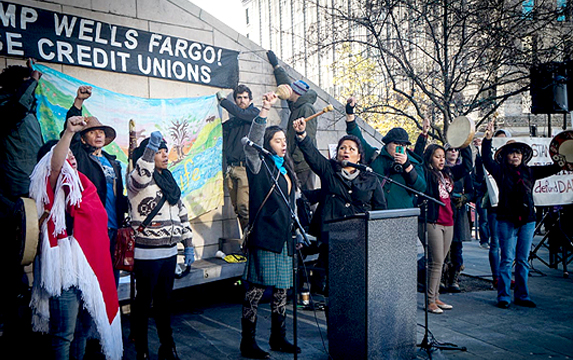
Image: Native women warriors gather in Washington, DC to protest the DAPL in Standing Rock, North Dakota.


“The fight against the Dakota Access Pipeline has implications beyond the Standing Rock Sioux Tribe. It is a fight for everyone who wants clean air, clean water, and gender equality. As governments increasingly prove incapable or unwilling to protect these things, citizens are turning to the market and the market is responding.”


Rebecca_Feature.3_inset.1The McKinsey Global Institute Report, “The Power of Parity: How Advancing Women’s Equality Can Add $12 Trillion to Global Growth” concluded that, “Gender inequality is not only a pressing moral and social issue but also a critical economic challenge. If women… do not achieve their full economic potential, the global economy will suffer.” The McKinsey Report identified three elements that are essential for achieving the full potential of gender parity: gender equality in society, economic development and a shift in attitudes. According to the Report, 95 percent of company CEOs are still male and of the 22,000 global firms that were reviewed, 60 percent failed to have any women on their boards. Facing this disparity head on the Intentional Endowments Network (IEN) held the first webinar on: “Gender Lens Investing: The Business Case, Opportunities and Action”. Gender Lens Investing is defined as “the integration of gender into investment analysis” and it makes a strong business case for more female CEOs. Panelists, Kathleen McQuiggan at Pax World and Julianne Zimmerman at Reinventure Capital, shared research on the business case for investing in women. The conclusion was that the case for gender investing has never been stronger and that companies where women are better represented in leadership simply perform better [1].
At the same time both the IEN webinar and McKinsey Report point to evidence that persistent misconceptions about women founders and leaders exist, along with significant discriminations and market inefficiencies connected to gender and race. Over the past six years researchers and experts in the tech industry have begun to consider the effects of this gender bias. Ninety percent of tech employees are men and at the senior levels it is 96 percent. Of the women entering the tech industry, 56 percent leave citing that they were pushed out by sexism and of the 6,517 companies receiving venture funding from 2011 to 2013 only 2.7 percent had women for CEOs. As such, gender lens investing is crucial for breaking through the glass ceiling in these companies but it’s not just within the rank and file of the tech industry that women face discrimination. As McKinsey points out gender parity requires a shift in attitudes and here again the tech industry offers no better place to see cultural attitudes towards women than on the Internet.

Across websites and social media everyday gender discrimination exists along a spectrum of illicit sexual surveillance, creep shots extortion, doxxing, stalking, malicious impersonation, threats and rape videos. (Catherine Buni and Soraya Chemaly; The Unsafety Net: How Social Media Turned Against Women” The Atlantic Oct 9 2014 issue). “Misogyny on Twitter, a report by Demos found that over a 6 week period more than 6 million instances of the word slut or whore were used in English on Twitter. Of these Tweets 20 percent were deemed to be threatening. Originally filed under ‘Controversial humor’ the social media companies recognize such postings can be overt efforts to silence women but, so far, the sanctity of free speech is taking precedence over freedom for women to engage in on-line communities. At the same time, “When it comes to copyright and intellectual property interests, companies are highly responsive. But violence against women frequently gets a lukewarm response until it becomes an issue of bad press.” stated Catherine Buni and Soraya Chemaly in 2014.

Feature.3_incolumn-pic.3 Roxanne White of the Yakima nation performed the “Women’s Warrior Song” in front of Seattle City Hall as part of the Seattle Action Coalition rally for the #DeFundDAPL movement. (Photo by Aly Brady)

At the annual SRI Conference on Sustainable, Responsible, Impact Investing last November, a panel was held for the very first time on “The Truth About Violence Against Women and Gender Inequality. Jamia Wilson, Executive Director Women Action and the Media (WAM), recounted how a group of women were able to elevate the on-line violence against women to “an issue of bad press.” Advertisements for Dove, iTunes, Finn Air and others were appearing on live pages with names like “I kill bitches like you,” “I Love the Rape Van”, and many others with worse titles. Thus WAM and other feminists launched a campaign directed at the advertisers asking, “Were these values a reflection of the company’s values?” The advertisers responded immediately and the social media companies followed. Pat Zerega, Senior Director of Shareholder Advocacy at Mercy Investments shared how teaming with feminist stakeholders led to using shareholder advocacy as the means for increasing corporate accountability and awareness of extractives, trucking, hotels, and other industries in the forefront of violence against women. Check out Mercy Investments groundbreaking effort: Truckers Against Trafficking (www.truckersagainsttrafficking.org)

Perhaps the extractive industries might not set out to perpetuate violence against women but it certainly is a widespread by-product of how they do business. Take the tragic scene of conflict, environmental destruction, and violence against women that is playing out under a national media spotlight at the Dakota Access Pipeline (DAPL) site in North Dakota. The Bakken region of North Dakota started experiencing its oil boom back 2010. The rapid oil development brought an influx of cash and thousands of oil workers living in ‘man camps’ with time and money on their hands. The rates for murders, aggravated assaults, and robberies have tripled and rates for sex crimes, forcible rape, prostitution, and sex trafficking have increased by 20.2 percent, according to Kathleen Finn, Scholar in Residence at the American Indian Law Clinic University of Colorado. Response by the State of North Dakota to protect the women and children from the escalating oil-induced violence has been to allocate $100,000 over a 5-year period for the victims. Response by the State of North Dakota to the company, Energy Transfer Partners, building the DAPL has been to allocate over $23 million over a 5-month period for the law enforcement, National Guard, and security forces to protect company equipment.

Rebecca-Feature_3-womenLaDonna Brave Bull Allard’s land is home to water protectors at Standing Rock

The fight against the Dakota Access Pipeline has implications beyond the Standing Rock Sioux Tribe. It is a fight for everyone who wants clean air, clean water, and gender equality. As governments increasingly prove incapable or unwilling to protect these things, citizens are turning to the market and the market is responding. Thanks to DAPL social responsibility is on every ESG investor’s radar. As of this writing, a coalition of over 150 investors representing over $1.3 Trillion in assets under management called on banks financing the Dakota Access Pipeline (DAPL) to address or support the Standing Rock Sioux Tribe’s request to reroute the pipeline and avoid their treaty territory. Lead investor Boston Common Asset Management was joined by Storebrand Asset Management and Calvert Research and Management along with CalPERS and the Comptroller of the City of New York in a statement about reputational and potential financial risks for banks with ties to DAPL [2]. The investors are concerned Banks may be implicated in conflict and controversies related to the pipeline and could face long-term brand and reputational damage resulting from consumer boycotts and possible legal liability.

Within the investment community, ESG investing (Environmental, Social and Governance) is mainstreaming at an unprecedented rate. Considerable progress quantifying environmental risks and building them into the business model has been made. For example Carbon Tracker provides “financial and regulatory analysis to ensure that the risk premium associated with fossil fuels is correctly priced.” The emergence of unburnable carbon, stranded assets, wasted capital, and fossil fuel risk premium has equipped investors with a wealth of tools to integrate environment into their decisions. Likewise, governance is also making progress evidenced by the creation of many funds and indices designed around CEO pay, board diversity, etc.

Social on the other hand has not made as much progress. While investors are able to easily assess companies based on whether women are on boards, equal pay, etc., there are few if any tools for investors to gauge how companies are addressing violence against women in their operations and supply chains. Complicit in the lack of progress is the fact that the Securities and Exchange Commission does not require corporations to report on community relations or human rights due to their perceived lack of material relevance, thus failing to disclose what could be deemed material social risks and social costs and corporate accountability to the victims [3].

But the times, they are changing. ESG investing is mainstreaming at an accelerated rate. To stay true to our original purpose – creating a better world through the market – we must create the tools, methodologies and social metrics to achieve relevance with the female half of our stakeholders.


Article by Rebecca L. Adamson, MSED 

Rebecca Adamson, an Indigenous economist, is Founder and President of First Peoples Worldwide (www.firstpeoples.org), the first US based global Indigenous Peoples NGO, which makes grants and provides technical assistance and advocacy directly to Indigenous-led development projects. Ms. Adamson has worked directly with grassroots tribal communities, both domestically and internationally, as an advocate of local tribal issues since 1970. She established the premiere US development institute, First Nations Development Institute, in 1980 and in 1997 she founded First Peoples Worldwide. Ms. Adamson’s work established the first microenterprise loan fund in the United States, the first tribal investment model, and, a national movement for reservation land reform. Her work established a new field of culturally appropriate, values-driven development, which led to legislation that established new standards of accountability regarding federal trust responsibility for Native Americans.

She currently serves on the Board of Directors for the Bay and Paul Foundations and the Calvert Social Investment Fund. As a trustee of Calvert, Rebecca partnered with the Fund to create the first Indigenous Peoples’ rights investment screen in 1999, and led the creation of the Indigenous Rights Risk Report, the first quantitative assessment of corporate risk exposure to Indigenous Peoples’ rights, in 2014. In 2015 she has established three Shareholder Advocacy Leadership Training Centers located in Guatemala, Mexico and Canada as a new strategy for Indigenous leaders in addressing extractive industry on Indigenous territories. She was appointed as an advisor to the U.S. Extractive Industries Transparency Initiative Multi-Stakeholder Group, serving from 2014 to the present. She holds a Masters in Science in Economic Development from Southern New Hampshire University (formerly New Hampshire College) in Manchester, New Hampshire, where she has taught a graduate course on Indigenous Economics within the Community Economic Development Program, and a Doctor in Humane Letters degree from Dartmouth College.

Article Notes:

[1] www.intentionalendowments.org/webinar_gender_lens_investing

[2] http://news.bostoncommonasset.com/wp-content/uploads/2017/02/Investor-Statement-to-Banks-Financing-the-Dakota-Access-Pipeline-FINAL-with-signatories-2-17-17.pdf

[3] http://accountabilityroundtable.org/wp-content/uploads/2013/10/ICAR-Knowing-and-Showing-Report5.pdf

Energy & Climate, Featured Articles, Impact Investing

A Rare Corner of Finance Where Women Dominate

By Alexandra Stevenson and Leslie Picker, The New York Times

Once a year, a small group of executives who control trillions of dollars in American companies meet for lunch in Manhattan. Among the things they discuss: pushing for greater say in how companies are run.

It is an elite gathering, but you will not see a single man in a suit in the room. The event, called the Women in Governance lunch, underscores a rare corner in finance where women dominate.

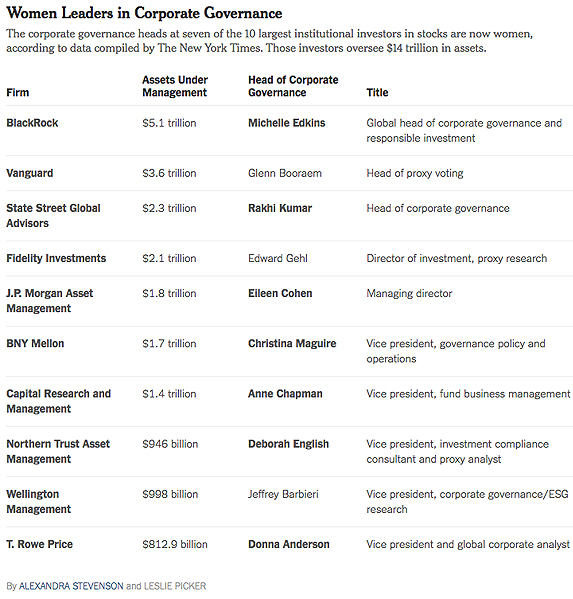
Women hold the top positions in corporate governance at many of the biggest mutual funds and pension funds — deciding which way to vote on the directors of a company board. They make decisions on behalf of teachers, government workers, doctors and most people in the United States who have a 401(k). The corporate governance heads at seven of the 10 largest institutional investors in stocks are now women, according to data compiled by The New York Times. Those investors oversee $14 trillion in assets.

Corporate governance is playing a growing role within the broader ecosystem of corporate America. Each spring, publicly traded companies hold shareholder meetings and outline business strategy for the coming year. Shareholders like BlackRock, T. Rowe Price and State Street vote on corporate strategy and issues including company board appointments and compensation.

Their votes can go a long way, given the huge stakes these institutions control in United States companies. BlackRock holds a stake greater than 5 percent in 75 of the 100 largest companies, according to data compiled by Jerry Davis, a professor at the University of Michigan Ross School of Business. State Street has more than than 5 percent of 23 of the largest companies, while Capital Group owns more than 5 percent of 20 of the biggest companies.

That power, however, is rarely wielded to confront companies. Most of the time, these huge institutional investors choose to vote with management.

And their approach contrasts sharply with that of brash activist billionaires like William A. Ackman and Daniel S. Loeb, who have made a name for themselves as corporate agitators. These investors bring about change by theatrically pounding on the front doors of companies and using the public court of opinion to bully companies into changing their strategies.

Still, the heads of corporate governance at institutional giants say they are working quietly behind the scenes to advocate for greater shareholder rights.

When Donna F. Anderson and her team at T. Rowe Price became concerned at a growing list of public companies that were creating more than one class of stock, effectively giving corporate insiders greater influence and say in the company, they used their vote to make a point. Ms. Anderson, who is the head of corporate governance, created a policy to vote against key directors at companies with dual-class share structures like that at Facebook.

Now, Ms. Anderson’s team is weighing whether to create a similar policy for gender diversity on corporate boards.

“We have an interest in seeing more women on boards because there is data that a more diverse board makes better decisions,” said Ms. Anderson, who was at Invesco before T. Rowe Price and has been working in the field of corporate governance for two decades.

Efforts by mutual funds to change the behavior of a company by using the power of a proxy vote is a fairly recent phenomenon. For decades, powerful institutional investors automatically rubber-stamped the decisions of corporate management and boards. At the same, many top executives paid little attention to the concerns of their shareholders.

“Many years ago, for every 10 letters we wrote, we generally heard back from half,” Ms. Anderson said. “Now it’s 100 percent.” Today, companies in which T. Rowe Price holds a large stake will even reach out to the firm unprompted.

The 2008 financial crisis was a turning point for shareholders, said Anne Sheehan, the director of corporate governance at California State Teachers’ Retirement System, the public pension fund.

Ms. Sheehan joined the pension fund, Calstrs, in October 2008, in the depths of the financial crisis after the collapse of Lehman Brothers. “Talk about hitting the ground running and seeing what the impact of that crisis was doing to our portfolio,” she said.

The experience was an eye-opener. “I saw it as an opportunity to make our voices known in the debate,” Ms. Sheehan said. “What were these directors doing on our behalf? How could shareholders speak up?”


NYT_Women Leaders chart


The crisis, she added, “really brought home the prevalence of the ‘Old Boys Network’ inside the board rooms of these financial firms which resulted in too much group think.”

The corporate governance team at Calstrs regularly questions companies on a range of issues including gender diversity and the pay gap between the top executives at a company and the most junior employees. Having women in positions of governance has helped bring these issues to the forefront of the discussion at companies, Ms. Sheehan said.

“It reminded me of the old adage: If you want to get something done, put a woman in charge,” she added.

At BlackRock, Michelle Edkins and her team of 30 analyze whether certain corporate directors are being paid too much and whether they have overstayed their terms. If there is a problem, they begin by opening a dialogue with the company.

Ms. Edkins, who trained as an economist in New Zealand and took her first position in corporate governance in 1997 by answering an ad in The Financial Times, said women tended to be less confrontational than men, making it easier to address a problem and try to fix it in this way.

“We don’t meet with C.E.O.s and tell them how to remedy the problem,” she said. “It’s a stylistic difference and my observation is that this constructive challenge comes more naturally to women.”

But to some critics, this approach is not yielding change fast enough.

BlackRock’s track record on voting against corporate management reveals that it is taking a slower approach to pushing for change. For example, on the issue of executive pay, during the most recent reporting period ending on June 30, BlackRock voted 96.3 percent of the time to support compensation policies across the Standard & Poor’s 500-stock index, according to Proxy Insight.

It also voted against every shareholder proposal relating to diversity, environment, governance and social concerns over the last year, according to Proxy Insight.

The record is not much better at other top institutional investors.

Nick Dawson, a co-founder of Proxy Insight, said that while investors treat issues related to environmental, social and governance policies, known in industry parlance as E.S.G., very seriously, “there is a clear preference for behind-the-scenes engagement on these issues.” “Asset managers prefer to ensure that management teams are capable of dealing with E.S.G. issues in-house, rather than by applying external pressure,” he said.

Still, BlackRock said that it voted against pay practices or compensation committee members at 10 of the 50 companies where executives were paid the most during the most recent reporting period.

In one recent case involving Mylan, the company that makes the allergy treatment EpiPen, BlackRock spent two years engaging with the board over the generous pay packages of top executives. When this did not yield a change to compensation, Ms. Edkins’ team voted against the three top-earning directors.

And other investors like the activist hedge fund Elliott Management said that it had become much easier to engage with companies.

“When an activist shows up to a situation, having these engaged, thoughtful leaders involved in the discussion helps the company and the activist get to a collaborative solution,” said Jesse Cohn, the head of United States equity activism at Elliott. This, he added, happens “well in advance of a proxy contest.”

There is concern that on the subject of gender, women are less likely to push for greater diversity. Some women in high-power corporate governance positions said that they preferred not to bring up gender as an issue in discussions with management on concern they will be perceived to have an agenda.

But some experts say there is tremendous potential for the network of women in corporate governance to make a bigger difference.

“If there is an old girls’ network so to speak with so much authority in corporate governance, this is an opportunity to create an agenda for greater diversity through a formalized means,” said Mr. Davis, at the University of Michigan.

While women like Ms. Edkins are fighting behind the scenes to bring more women onto the boards of America’s biggest companies, they are struggling with an entirely different diversity challenge of their own: the lack of men in the field of corporate governance.

“It’s counterintuitive in finance,” Ms. Edkins said. “But when we are hiring, we need to really push that diversity to make sure we have men on the slate.”


Read the full article with numerous links and photos at: www.nytimes.com/2017/01/16/business/dealbook/women-corporate-governance-shareholders.html

Additional Articles, Impact Investing

State Street Says It Will Start Voting Against Companies That Don’t Have Women Directors

By Joann S. Lublin and Sarah Krouse, The Wall Street Journal

Index-fund giant State Street Global Advisors on Tuesday March 7 began pushing big companies to put more women on their boards, initially demanding change at those firms without any female directors.

The money manager, which is a unit of State Street Corp., says it will vote against board members charged with nominating new directors if they don’t soon make strides at adding women. Firms won’t have an exact quota to be in compliance with State Street’s mandate, but must prove they attempted to improve a lack of diversity. A firm that doesn’t add women, for example, would have to prove to State Street it attempted to cast a wider net and set diversity goals.

The money manager plans to give most firms in the Russell 3000, U.K.’s FTSE 350 and Australia’s S&P/ASX 300 about a year to enact changes before voting against the reelection of heads of committees that nominate new board members.

“If someone could convince us that the absence of diversity or gender diversity is not a problem, we’re leaving that open. Will they? I doubt it,” said Ronald O’Hanley, chief executive of State Street Global Advisors.

Mr. O’Hanley said the $2.47 trillion asset manager also wants the companies it owns to identify problems with their nominating procedures that may contribute to the dearth of female board members.

As part of its push, the firm is also placing a bronze statue of a young girl leaning toward Wall Street’s iconic bronze bull.

On the eve of International Women’s Day, an asset management company (State Street Global Advisors), placed a statue of a little girl in front of Manhattan’s iconic charging bull sculpture to highlight a lack of gender diversity and equality in the workplace. The statue, by artist Kristen Visbal, is called The Fearless Girl and may remain staring defiantly at the bull for up to a month, if not longer. Reuters

Nearly a quarter of the companies in the Russell 3000 index lack a female director, while 58% of the companies in the index have less than 15% women on their boards, according to Institutional Shareholder Services. American Railcar Industries Inc., Speedway Motorsports, Inc., and Nathan’s Famous, Inc. are among the companies in that index with no female directors, according to ISS, a proxy-advisory firm.

Representatives for those firms did not respond to requests for comment.

State Street is among the largest passive managers in the world — a sector that is amassing significant governance power as investors pour billions into lower-cost index-tracking funds like exchange-traded funds. The firm manages $2.47 trillion in assets, the majority of which are in index-tracking funds.

U.S.-based mutual funds and exchange-traded funds that track indexes owned 11.6% of the S&P 500 at the end of June, up from 4.6% a decade ago, according to a Wall Street Journal analysis of data from Morningstar Inc. and S&P Global Market Intelligence.

Compared with rivals, State Street sometimes has taken more aggressive — and public — stances on certain corporate-governance matters. In recent years, for example, the firm focused on long-tenured board members.

State Street in 2015 voted against or withheld votes during the re-election of one or more board members at 380 companies globally because of tenure concerns. It estimates that 32% of those firms added at least one new director by 2016.

Now, State Street executives say research shows companies with more board women and senior female staffers perform better than rivals without them. A study MSCI released in December typifies such findings. During the past five years, U.S. companies that had at least three female directors in 2011 have financially outperformed those that had no board women in 2011, concluded the investment research firm. Its study looked at return on equity and per-share earnings for 580 such concerns between 2011 and 2016.

State Street wants companies in that U.S. index, the U.K.’s FTSE 350 and Australia’s S&P/ASX 300 to address gender diversity at the board level and throughout their employee ranks, said Rakhi Kumar, the money manager’s head of corporate governance. “It’s all about creating the pipeline to introduce diversity within organizations,” she said.

“Some companies may say you’re wrong and we agree to disagree. In those cases we have no choice but to use our vote,” she said.

Boardrooms at 76 U.S. public companies have had no female directors for the entire past decade, according to an exclusive analysis completed in December for The Wall Street Journal by governance researchers Equilar Inc.

Mr. O’Hanley plans to send letters about gender diversity this week to the heads of the more than 700 Russell 3000, FTSE 350 and S&P/ASX 300 companies with no women on their boards. State Street Global Advisors also plans to place the bronze statue on Wall Street early Tuesday morning.

The firm secured permission from the city to place it in front of the bull for one month, but would agree to leave it longer if it is well received, a spokeswoman said.

Write to Joann S. Lublin at joann.lublin@wsj.com and Sarah Krouse at sarah.krouse@wsj.com

Additional Articles, Impact Investing, Sustainable Business

Momentum Grows for Gender Lens Investing

By Patricia Farrar-Rivas, Alison Pyott, and Luisamaria Ruiz Carlile, Veris Wealth Partners

In the world of Sustainable and Impact Investing, few ideas have captured the imagination as quickly as Gender Lens Investing (“GLI”).

In just the past few years, the number of Gender Lens solutions has grown rapidly. The premise of this approach is that every investment has a gender dimension and that understanding it uncovers both overlooked opportunities and hidden risks. GLI solutions are about investing for gender balance, inclusion and equity. GL investors are betting that all of society – both women and men alike – will reap social and economic dividends from women’s equality.

Equally important is the passion this topic has generated among people interested in aligning their wealth with values. This also bodes well for the creation of new products and solutions, as we are already seeing.

Growing AUM

GLI assets under management (AUM) in public market equities and debt have grown fivefold since 2014 to $561 million as of mid-year 2016, according to an analysis by Veris Wealth Partners and Women Effect.

The accelerated growth is the result of an increased number of GLI solutions being offered by money managers, along with demand from individual and institutional investors to place capital in public market securities that directly benefit women and girls.

To be sure, the entire field of Gender Lens Investing is still in its infancy and represents just a fraction of the assets in Impact and Sustainable Investing, but the growth is very promising.

Our analysis found as of February 28, 2017, there are 16 publicly traded GLI solutions explicitly asserting a gender mandate, up from nine as of September 30, 2014. Three of the newest opportunities target non-U.S. investors, including those in Canada and select European and Asian countries.

More than half of the growth in assets under management has been in the Gender Diversity Index ETF (SHE) sponsored by State Street Global Advisors. The ETF was launched in March 2016 and was seeded with $250 million from the California State Teachers Retirement System (CalSTRS).

GLI Defined

To fully appreciate the potential of Gender Lens Investing, it’s useful to define it.

A Gender Lens investment focuses on companies and initiatives supporting: 1) women’s leadership, 2) women’s access to capital, 3) products and services beneficial to women and girls, 4) workplace equity, and 5) related shareholder engagement and policy work.

Investments that satisfy one or more of these criteria are presumed to deliver greater impact to women and girls, and ultimately society as a whole – including men and boys.

Why Gender Lens Investing Is So Powerful

The evidence supporting Gender Lens Investing continues to grow each day. Research demonstrates the compelling business case for gender inclusiveness. Consider the following:

• Fortune 500 companies with three or more corporate directors who are women (in at least four out of five years) outperformed those with zero women directors (in at least four out of five years) by 84 percent on return on sales (ROS), 60 percent on return on invested capital (ROIC), and 46 percent on return on equity (ROE). Yet, as of June 30, 2016, women held only 20.2 percent of board seats at S&P 500 companies, while 3 percent of those companies (for a total of 15) had no women at all on their boards.

• The quality of a company’s reported earnings is positively correlated with greater gender diversity in senior management.

• Microfinance institutions (MFIs) with more women clients have lower write-offs and lower credit-loss provisions, confirming the common belief that women in general are a better credit risk for MFIs.

• Venture-backed companies in Silicon Valley run by women had annual revenues that were 12 percent higher than those run by men. These companies also used an average of one-third less committed capital, and had lower failure rates than those led by men, a 2009 study found.

Success Stories

The data backs the emerging value proposition of Gender Lens Investing, as do the growing number of success stories.

There has been a notable increase in capital to women as a result of Gender Lens Investing. For example, in their 2016 impact reports, micro finance lender MicroVest stated that 62 percent of its clients were women, while agricultural investor Root Capital listed 44 percent of its clients as gender-inclusive businesses. In 2015, 53 percent of Northern California Community Loan Fund’s borrowers were women, while Coastal Enterprises, Inc. invested in 15 women-owned businesses.


Another illustrative example is American Water Works Company, a public company addressing gender equity in the utilities industry, a traditionally male dominated field. Led by women, the company is the largest American water and wastewater utility company, serving more than 15 million Americans and 1,600 communities in 45 states. Women comprise more than half of the board of directors, and 42 percent of the company’s executive officers are women. CEO Susan Story and CFO Linda Sullivan oversee more than 6,700 full-time employees and have incorporated diversity hiring goals throughout the business.

We believe there is much progress to be made in the coming years to produce deeper equity in solutions that focus on gender and race. The good news is that Gender Lens Investing is already making a real difference.


Article by Patricia Farrar-Rivas, CEO of Veris Wealth Partners (www.veriswp.com). Alison Pyott is a Partner and Luisamaria Ruiz Carlile is a Senior Wealth Manager at Veris Wealth Partners.

Featured Articles, Impact Investing, Sustainable Business

Signup to receive GreenMoney's monthly eJournal

Privacy Policy
Copyright © GreenMoney Journal 2025

Website design & development by BrandNature

Global Events Calendar

View All Events

april

21aprAll Day232026 Sustainable Packaging Coalition: SPC Impact – Nashville

27aprAll Day30Women Deliver 2026 Conference (WD2026) – Melbourne

X