Tag: Impact Investing

A Rare Corner of Finance Where Women Dominate

By Alexandra Stevenson and Leslie Picker, The New York Times

Once a year, a small group of executives who control trillions of dollars in American companies meet for lunch in Manhattan. Among the things they discuss: pushing for greater say in how companies are run.

It is an elite gathering, but you will not see a single man in a suit in the room. The event, called the Women in Governance lunch, underscores a rare corner in finance where women dominate.

Women hold the top positions in corporate governance at many of the biggest mutual funds and pension funds — deciding which way to vote on the directors of a company board. They make decisions on behalf of teachers, government workers, doctors and most people in the United States who have a 401(k). The corporate governance heads at seven of the 10 largest institutional investors in stocks are now women, according to data compiled by The New York Times. Those investors oversee $14 trillion in assets.

Corporate governance is playing a growing role within the broader ecosystem of corporate America. Each spring, publicly traded companies hold shareholder meetings and outline business strategy for the coming year. Shareholders like BlackRock, T. Rowe Price and State Street vote on corporate strategy and issues including company board appointments and compensation.

Their votes can go a long way, given the huge stakes these institutions control in United States companies. BlackRock holds a stake greater than 5 percent in 75 of the 100 largest companies, according to data compiled by Jerry Davis, a professor at the University of Michigan Ross School of Business. State Street has more than than 5 percent of 23 of the largest companies, while Capital Group owns more than 5 percent of 20 of the biggest companies.

That power, however, is rarely wielded to confront companies. Most of the time, these huge institutional investors choose to vote with management.

And their approach contrasts sharply with that of brash activist billionaires like William A. Ackman and Daniel S. Loeb, who have made a name for themselves as corporate agitators. These investors bring about change by theatrically pounding on the front doors of companies and using the public court of opinion to bully companies into changing their strategies.

Still, the heads of corporate governance at institutional giants say they are working quietly behind the scenes to advocate for greater shareholder rights.

When Donna F. Anderson and her team at T. Rowe Price became concerned at a growing list of public companies that were creating more than one class of stock, effectively giving corporate insiders greater influence and say in the company, they used their vote to make a point. Ms. Anderson, who is the head of corporate governance, created a policy to vote against key directors at companies with dual-class share structures like that at Facebook.

Now, Ms. Anderson’s team is weighing whether to create a similar policy for gender diversity on corporate boards.

“We have an interest in seeing more women on boards because there is data that a more diverse board makes better decisions,” said Ms. Anderson, who was at Invesco before T. Rowe Price and has been working in the field of corporate governance for two decades.

Efforts by mutual funds to change the behavior of a company by using the power of a proxy vote is a fairly recent phenomenon. For decades, powerful institutional investors automatically rubber-stamped the decisions of corporate management and boards. At the same, many top executives paid little attention to the concerns of their shareholders.

“Many years ago, for every 10 letters we wrote, we generally heard back from half,” Ms. Anderson said. “Now it’s 100 percent.” Today, companies in which T. Rowe Price holds a large stake will even reach out to the firm unprompted.

The 2008 financial crisis was a turning point for shareholders, said Anne Sheehan, the director of corporate governance at California State Teachers’ Retirement System, the public pension fund.

Ms. Sheehan joined the pension fund, Calstrs, in October 2008, in the depths of the financial crisis after the collapse of Lehman Brothers. “Talk about hitting the ground running and seeing what the impact of that crisis was doing to our portfolio,” she said.

The experience was an eye-opener. “I saw it as an opportunity to make our voices known in the debate,” Ms. Sheehan said. “What were these directors doing on our behalf? How could shareholders speak up?”
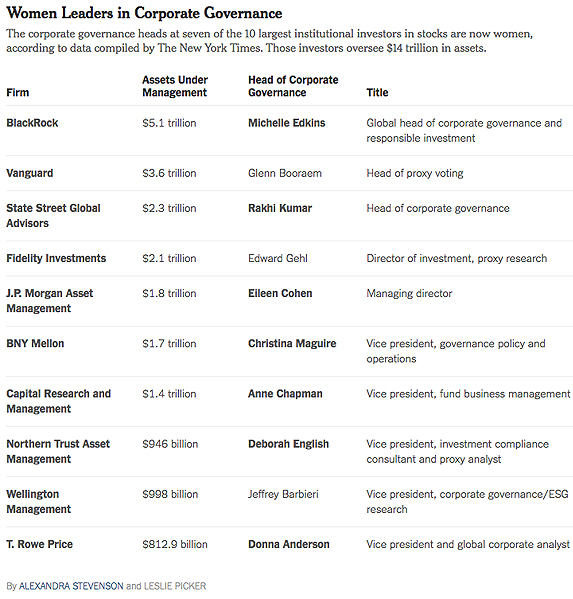
 

NYT_Women Leaders chart


The crisis, she added, “really brought home the prevalence of the ‘Old Boys Network’ inside the board rooms of these financial firms which resulted in too much group think.”

The corporate governance team at Calstrs regularly questions companies on a range of issues including gender diversity and the pay gap between the top executives at a company and the most junior employees. Having women in positions of governance has helped bring these issues to the forefront of the discussion at companies, Ms. Sheehan said.

“It reminded me of the old adage: If you want to get something done, put a woman in charge,” she added.

At BlackRock, Michelle Edkins and her team of 30 analyze whether certain corporate directors are being paid too much and whether they have overstayed their terms. If there is a problem, they begin by opening a dialogue with the company.

Ms. Edkins, who trained as an economist in New Zealand and took her first position in corporate governance in 1997 by answering an ad in The Financial Times, said women tended to be less confrontational than men, making it easier to address a problem and try to fix it in this way.

“We don’t meet with C.E.O.s and tell them how to remedy the problem,” she said. “It’s a stylistic difference and my observation is that this constructive challenge comes more naturally to women.”

But to some critics, this approach is not yielding change fast enough.

BlackRock’s track record on voting against corporate management reveals that it is taking a slower approach to pushing for change. For example, on the issue of executive pay, during the most recent reporting period ending on June 30, BlackRock voted 96.3 percent of the time to support compensation policies across the Standard & Poor’s 500-stock index, according to Proxy Insight.

It also voted against every shareholder proposal relating to diversity, environment, governance and social concerns over the last year, according to Proxy Insight.

The record is not much better at other top institutional investors.

Nick Dawson, a co-founder of Proxy Insight, said that while investors treat issues related to environmental, social and governance policies, known in industry parlance as E.S.G., very seriously, “there is a clear preference for behind-the-scenes engagement on these issues.” “Asset managers prefer to ensure that management teams are capable of dealing with E.S.G. issues in-house, rather than by applying external pressure,” he said.

Still, BlackRock said that it voted against pay practices or compensation committee members at 10 of the 50 companies where executives were paid the most during the most recent reporting period.

In one recent case involving Mylan, the company that makes the allergy treatment EpiPen, BlackRock spent two years engaging with the board over the generous pay packages of top executives. When this did not yield a change to compensation, Ms. Edkins’ team voted against the three top-earning directors.

And other investors like the activist hedge fund Elliott Management said that it had become much easier to engage with companies.

“When an activist shows up to a situation, having these engaged, thoughtful leaders involved in the discussion helps the company and the activist get to a collaborative solution,” said Jesse Cohn, the head of United States equity activism at Elliott. This, he added, happens “well in advance of a proxy contest.”

There is concern that on the subject of gender, women are less likely to push for greater diversity. Some women in high-power corporate governance positions said that they preferred not to bring up gender as an issue in discussions with management on concern they will be perceived to have an agenda.

But some experts say there is tremendous potential for the network of women in corporate governance to make a bigger difference.

“If there is an old girls’ network so to speak with so much authority in corporate governance, this is an opportunity to create an agenda for greater diversity through a formalized means,” said Mr. Davis, at the University of Michigan.

While women like Ms. Edkins are fighting behind the scenes to bring more women onto the boards of America’s biggest companies, they are struggling with an entirely different diversity challenge of their own: the lack of men in the field of corporate governance.

“It’s counterintuitive in finance,” Ms. Edkins said. “But when we are hiring, we need to really push that diversity to make sure we have men on the slate.”


Read the full article with numerous links and photos at: www.nytimes.com/2017/01/16/business/dealbook/women-corporate-governance-shareholders.html

Additional Articles, Impact Investing

State Street Says It Will Start Voting Against Companies That Don’t Have Women Directors

By Joann S. Lublin and Sarah Krouse, The Wall Street Journal

Index-fund giant State Street Global Advisors on Tuesday March 7 began pushing big companies to put more women on their boards, initially demanding change at those firms without any female directors.

The money manager, which is a unit of State Street Corp., says it will vote against board members charged with nominating new directors if they don’t soon make strides at adding women. Firms won’t have an exact quota to be in compliance with State Street’s mandate, but must prove they attempted to improve a lack of diversity. A firm that doesn’t add women, for example, would have to prove to State Street it attempted to cast a wider net and set diversity goals.

The money manager plans to give most firms in the Russell 3000, U.K.’s FTSE 350 and Australia’s S&P/ASX 300 about a year to enact changes before voting against the reelection of heads of committees that nominate new board members.

“If someone could convince us that the absence of diversity or gender diversity is not a problem, we’re leaving that open. Will they? I doubt it,” said Ronald O’Hanley, chief executive of State Street Global Advisors.

Mr. O’Hanley said the $2.47 trillion asset manager also wants the companies it owns to identify problems with their nominating procedures that may contribute to the dearth of female board members.

As part of its push, the firm is also placing a bronze statue of a young girl leaning toward Wall Street’s iconic bronze bull.

On the eve of International Women’s Day, an asset management company (State Street Global Advisors), placed a statue of a little girl in front of Manhattan’s iconic charging bull sculpture to highlight a lack of gender diversity and equality in the workplace. The statue, by artist Kristen Visbal, is called The Fearless Girl and may remain staring defiantly at the bull for up to a month, if not longer. Reuters

Nearly a quarter of the companies in the Russell 3000 index lack a female director, while 58% of the companies in the index have less than 15% women on their boards, according to Institutional Shareholder Services. American Railcar Industries Inc., Speedway Motorsports, Inc., and Nathan’s Famous, Inc. are among the companies in that index with no female directors, according to ISS, a proxy-advisory firm.

Representatives for those firms did not respond to requests for comment.

State Street is among the largest passive managers in the world — a sector that is amassing significant governance power as investors pour billions into lower-cost index-tracking funds like exchange-traded funds. The firm manages $2.47 trillion in assets, the majority of which are in index-tracking funds.

U.S.-based mutual funds and exchange-traded funds that track indexes owned 11.6% of the S&P 500 at the end of June, up from 4.6% a decade ago, according to a Wall Street Journal analysis of data from Morningstar Inc. and S&P Global Market Intelligence.

Compared with rivals, State Street sometimes has taken more aggressive — and public — stances on certain corporate-governance matters. In recent years, for example, the firm focused on long-tenured board members.

State Street in 2015 voted against or withheld votes during the re-election of one or more board members at 380 companies globally because of tenure concerns. It estimates that 32% of those firms added at least one new director by 2016.

Now, State Street executives say research shows companies with more board women and senior female staffers perform better than rivals without them. A study MSCI released in December typifies such findings. During the past five years, U.S. companies that had at least three female directors in 2011 have financially outperformed those that had no board women in 2011, concluded the investment research firm. Its study looked at return on equity and per-share earnings for 580 such concerns between 2011 and 2016.

State Street wants companies in that U.S. index, the U.K.’s FTSE 350 and Australia’s S&P/ASX 300 to address gender diversity at the board level and throughout their employee ranks, said Rakhi Kumar, the money manager’s head of corporate governance. “It’s all about creating the pipeline to introduce diversity within organizations,” she said.

“Some companies may say you’re wrong and we agree to disagree. In those cases we have no choice but to use our vote,” she said.

Boardrooms at 76 U.S. public companies have had no female directors for the entire past decade, according to an exclusive analysis completed in December for The Wall Street Journal by governance researchers Equilar Inc.

Mr. O’Hanley plans to send letters about gender diversity this week to the heads of the more than 700 Russell 3000, FTSE 350 and S&P/ASX 300 companies with no women on their boards. State Street Global Advisors also plans to place the bronze statue on Wall Street early Tuesday morning.

The firm secured permission from the city to place it in front of the bull for one month, but would agree to leave it longer if it is well received, a spokeswoman said.

Write to Joann S. Lublin at joann.lublin@wsj.com and Sarah Krouse at sarah.krouse@wsj.com

Additional Articles, Impact Investing, Sustainable Business

Top Sustainable Business Trends of 2017

By Joel Makower, Chairman and Executive Editor, GreenBiz

It’s hard to imagine a time more hopeful and horrifying for sustainable business. On the one hand are great achievements and milestones. The Paris Agreement on climate change was ratified in 2016, faster than any United Nations pact in history, a powerful affirmation of the importance the nations of the world attach to combating climate change. Companies continued to ratchet up their commitments and achievements on renewable energy, greenhouse gas emissions, sustainable supply chains, water and land stewardship, the circular economy and other aspects of a sustainable enterprise. Technology continued its inexorable march, accelerating solutions in energy, buildings, transportation, food and just about everywhere else.

And yet.

The indicators continue to be troubling. Global atmospheric concentrations of carbon dioxide are unprecedented compared with the past 800,000 years, according to the U.S. Environmental Protection Agency, even after accounting for natural fluctuations. Global temperatures continue to rise, and the 10 warmest years on record worldwide have occurred since 1998. Other metrics — on coastal flooding, heat-related deaths, wildfires, polar sea ice, biodiversity and more — continue to go in the wrong direction.

The cost to companies and economies continues to rise, too. Air pollution will cause 6 million to 9 million premature deaths annually and cost 1 percent of global GDP by 2060, according to a report [1] last year from the Organization for Economic Cooperation and Development (OCED). Meanwhile, more than 650 million people are living without access to an “improved” source of drinking water, according to The State of the World’s Water 2016 [2]. Diarrheal diseases caused by unsafe water and poor sanitation are themselves the second biggest child killer — 315,000 young lives extinguished annually worldwide.

In most regions of the world, market consequences from climate change are projected to be net-negative, stated another OECD report[3]. The macroeconomic costs from selected market impacts alone amount to between 1 and 3.3 percent of annual Gross Domestic Product by 2060. That year may sound a ways off, but it’s roughly the same time interval as the one between the end of the Vietnam War, in 1975, and today.

And that doesn’t factor in the economic consequences of the loss of natural capital, from crop pollination and pest control to biodiversity and flood protection, which companies rely on both directly and indirectly. All of which could further roil markets and the companies that operate therein.

The Paris Agreement provided hope that nearly 200 nations would work in concert toward mitigating many of those impacts. But the 2016 U.S. presidential election — and, to a lesser degree, the U.K.’s vote last year to leave the European Union — muddied the waters, promising to slow progress, perhaps significantly. As the ‘State of Green Business 2017’ report from GreenBiz and Trucost was being published, barely two weeks into the administration of President Donald Trump, there is much about future climate action and environmental protection that is unsettled and unsettling.

Companies and markets dislike uncertainty, of course, so the coming year or two may see head-snapping policy shifts as the public and private sector grapple with two seemingly unstoppable forces: the political momentum of an increasingly nationalist and protectionist world, and the wrath of a changing climate on a civilization ill-prepared to cope. Which force will dominate is anyone’s guess.

And yet.

Corporate innovation, boosted by technology’s rampant pace, is enabling radical new levels of efficiency in materials, energy, water and other resources. The Internet of Things — the interconnected world of tens of billions of objects that can talk to one another, and to us, and make real-time optimization decisions — is enabling buildings, vehicles, power grids, factories and many other things to do far more with fewer resources. Corporate clean power continues to ramp up, with prices ever dropping and efficiency steadily growing. Cities and regions are accelerating their quest to become greener and more resilient, luring corporations to relocate amid transit hubs and culture centers. All of which provide a powerful bulwark against those seeking to slow or reverse progress in sustainability.

And the leading edge of companies are embracing “net-positive” strategies, where buildings, factories and supply chains create more beneficial impacts than negative ones. Interface, the Atlanta-based carpet company and a trendsetter in sustainable business, unleashed a new set of visionary goals[4] last year, which included creating factories that function like the ecosystem they replace, providing such things as water storage and purification, carbon sequestration, nitrogen cycling, temperature cooling and wildlife habitat. The carpet company is starting this audacious journey with a single factory in Australia.

Net-positive buildings are beginning to sprout — a trend that seemed merely fanciful just a few short years ago. Today, the notion of buildings and campuses that generate more power than they use, or sequester more carbon than they emit, is within reach[5]. Meanwhile, net positive companies are on the near-term horizon.

The trend is as remarkable as it is inescapable: companies shifting from inadvertently negative impacts to deliberately positive ones.

Net-net, will the positives outweigh the negatives — in factories, economies, politics and all the rest — and do so at the scale and speed needed to address the planet’s greatest challenges? How much will proactive businesses counteract heel-dragging governments? Will market forces or ideologues rule the day?

These are among the questions to which we’ll seek answers during 2017, and likely beyond. Here, in no particular order, are 10 Trends we’ll be watching:

1) The Blockchain Supports Sustainability

2) Advanced Materials Adapt to a Circular World

3) Sustainable Development Goals (SDGS) Become a Business Strategy

4) Unlimited Water Becomes A Goal [see article on this Trend in this issue]

5) Corporate Clean Energy Grows Up

6) Environmental Performance Becomes a Fiduciary Responsibility

7) Companies Put Their Money Where Their Suppliers Are

8) Mobility Drives a New Transportation Paradigm

9) Sustainability Storytelling Adopts New Means and Memes

10) Resilience Becomes a Sustainability Strategy

See more in-depth information on all of these Trends by downloading the State of Green Business Report 2017 here- https://www.greenbiz.com/report/state-green-business-2017


Article Notes:

[1] https://www.oecd.org/env/the-economic-consequences-of-outdoor-air-pollution-9789264257474-en.htm

[2] http://www.wateraid.org/uk/what-we-do/policy-practice-and-advocacy/research-and-publications/view-publication?id=3f44e1ad-49a3-425f-a59b-b5f2c1145fd9

[3] http://www.oecd.org/environment/indicators-modelling-outlooks/the-economic-consequences-of-outdoor-air-pollution-9789264257474-en.htm

[4] https://www.greenbiz.com/article/inside-interfaces-bold-new-mission-achieve-climate-take-back

[5] https://www.greenbiz.com/article/5-companies-leading-charge-net-zero-building


Article by Joel Makower, Chairman and Executive Editor, GreenBiz www.greenbiz.com

Joel is an award-winning writer and strategist on corporate sustainability practices and clean technology who, over 25 years, has helped a wide range of companies align sustainability goals with business strategy. He is the bestselling author or co-author of more than a dozen books, including The New Grand Strategy: Restoring America’s Prosperity, Security and Sustainability in the 21st Century, and a sought-after speaker to companies and business groups around the world.

Energy & Climate, Featured Articles, Impact Investing, Sustainable Business

The Clean Money Revolution: Billionaires of Love

By Joel Solomon, author and Chair of Renewal Funds

These Times

A profound political disruption has raised the stakes for clean money. It’s a watershed moment for progressive business and investing, and a major bump in the pathway from the old economy to a new one. We must double down to ensure a just, resilient future civilization.

Our Name is on Our Money

How does it represent our values and vision? How do we invest or spend it? What does it reveal about our ethics and morals? How much blood is on it? Do we own slaves? Poison babies? Start wars?

Is it really ok to have our names on that?

Assess Yourself

In my upcoming book The Clean Money Revolution, I urge investors to make rigorous personal assessments. Foremost is: “How much is enough?”

Making money is great for those who can. It drives a robust economy, but also deserves soul-searching considerations.

Identify how much money you need to own. Then focus your ingenuity on how much good you can do. The gold standard of the future is responsible use of ego and ambition. You can make money, and be responsible.

Ask questions. Demand better, cleaner products.

Align every dollar with your values and purpose. Plenty of money can be made on reinventing the economy to be cleaner, greener, and fairer. From energy, to buildings, transportation, clean water, food and soil, opportunities abound.

When We Have Enough

Infinitely “more” is a too common, perhaps corrupt, default answer. It’s lazy and irresponsible. If “more” is our sole goal, then we can rationalize every manner of making money, and defining success, strictly through the highest financial return.

We can neglect the ethics of owning money, who and what is damaged. We forget to answer why we need excess money, how we will use it, and for what. We give ourselves a pass card on the impact our money has on people and planet.

“More” makes sense when you struggle to feed your family.

But is there a prize for making huge piles of excess money? Like many substances, it can be toxic when overly concentrated and held too closely. When it flows with wisdom and intention, it can create vast ripples of good.

What about leaving the world more livable, healthy, and just?

Your Deathbed

Think back from your deathbed. What legacy do you want to leave? Isn’t it about MORE than money?

Transitioning to clean money is inspiring, satisfying, life-enhancing. It begins with moral clarity, then identification of values, meaning, and purpose. It creates a satisfying legacy. How much is that worth?

Your Money Biography

What do you most love? What moves your spirit? What will you leave to the future?

Money is extracted energy of planet and people. The Clean Money Revolution is about, we with the privilege, using that energy for the good of the whole, for the long term.

We are Ancestors of the Future

Our greatest fortune is to serve those unseen generations. Be a billionaire of good deeds, a billionaire of love.


Article by Joel Solomon. Joel’s new book The Clean Money Revolution: Reinvesting Power, Purpose, and Capitalism, co-authored with Tyee Bridge, will be released by New Society Publishers in May 2017. Pre-sales available on Amazon at- https://www.amazon.com/Clean-Money-Revolution-Reinventing-Capitalism/dp/0865718393

Joel Solomon Chairs Renewal Funds, a $98 million mission venture capital firm in Vancouver, Canada. His lifetime of investing in over 100 early stage companies has delivered above market returns and positive change. During the late 80’s in Nashville’s declining urban core, he co-founded Village Real Estate, Core Development, and Bongo Java Cafes. As Senior Advisor to RSF Social Finance in San Francisco, he co-leads Integrated Capital Fellows to empower a new wave of social change investing. Solomon is a founding member of the Social Venture Network, Business for Social Responsibility, Tides Canada, and is Board Chair of Hollyhock. He blogs at www.JoelSolomon.org

Energy & Climate, Featured Articles, Impact Investing, Sustainable Business

On Borrowed Time: New Report Finds Banks Making Slow Progress in Fast Changing Climate

Investors find world’s top banks taking climate more seriously – but failing to institutionalize management of climate risk or opportunities at rate required

from Boston Common Asset Management

A new report examining 28 of the world’s largest banks on their management of climate-related risks concludes they are failing to align their business practices with targets to keep global temperature rises below two degrees [1]. The investor assessment comes despite praising banks for introducing measures such as climate stress testing, carbon footprinting and governance for climate risk.

The report, backed by investors with $500 billion in AUM and led by Boston Common Asset Management, is a follow up to the 2015 report “Are Banks Prepared for Climate Change?”[2] The recent analysis finds some notable progress by major banks over the last year including:

Over 70% of responding banks now undertaking carbon footprints or environmental stress tests, including banks such as Citigroup

Over 85% of responding banks disclosed financing or investment in renewable energy. For example, National Australia Bank plans to invest AUD 18 billion over seven years in energy efficiency, renewable energy, and low-emissions transport.

Over 80% have adopted more explicit oversight of climate risk at board level; and almost two-thirds have established performance goals.

• Some banks, such as Credit Suisse now revising their policies to restrict lending to the coal mining and thermal power generation sectors. Others such as Standard Chartered are developing additional assessment criteria on climate risk for energy sector clients aligned with the Paris 1.5 degrees climate scenario.

However with the Paris Agreement now entered into force, the report concludes that banks are still not doing enough to embed climate risk into their assessment of credit, or taking full advantage of the opportunities the low-carbon transition presents. Shortcomings of the banking sector include:

Over 80% of responding banks are not yet integrating the results of environmental stress testing into their business decisions.

Only 35% of banks disclosed goals for energy efficiency financing, and less than 40% have set targets for renewable energy financing.

Only 50% of banks have explicitly linked climate-strategy goals to executive compensation.

Boston Common is encouraged by the marked progress at many of the largest global banks in addressing climate change, and commend their willingness to hold in-depth discussions and advance the dialogue around climate risk. Notably, over 80% of the banks engaged have implemented substantive policy changes since the end of 2015 related to climate risk. However the core conclusion that the banking sector as a whole is not doing enough to measure and manage the material risks from carbon intensive sectors is a major concern to investors. For example, bank lending and investment to carbon intensive sectors (e.g. coal mining, extreme oil such as Arctic drilling or LNG) continues to significantly outpace green financing. In the past three years, European and North American banks have financed $786 billion to some of the most carbon intensive sectors[4].

Lauren Compere, Managing Director at Boston Common Asset Management, said: “From stress tests to strategy, bonuses to benchmarks, investors are very pleased to see the new tools, policies and programs that banks are adopting to manage climate risk. But there remains room for improvement and serious issues of integration that must be resolved. The investors behind this report call on banks to not only expand the use of tools to collect climate data – but most crucially to integrate this data into their decision making process. There is no point in having tools without putting them to effective use.”

“It makes little financial sense that bank financing of carbon intensive sectors such as coal – likely to become stranded assets, still outpaces green financing.”

The investors call on banks to take actions such as:

• Introducing goals and executive compensation linked to climate strategy;

• Expanding the use of carbon assessment tools (such as environmental stress tests) and integrating them into the decision-making process;

• Establishing explicit targets to reduce exposure to sectors vulnerable to climate change and increasing investment in renewable energy, energy efficiency, and climate adaptation; and

• Support industry collaborations (such as the Task Force on Climate-related Financial Disclosures) that increase the pace of change and use their public voice on climate action to encourage better government policy aligned with a below 2 degrees Celsius future.

Sara Nordbrand, Church of Sweden, said: “The impact of the Paris Agreement is clear – climate change is rising up the agenda and several banks are trying to grasp opportunities in line with the world’s climate goals. SEB is one example, being one of ten banks and investors launching the Positive Impact Manifesto and representing 7.6 % of the global green bonds market. At the same time all banks are grappling with how to measure and manage risks. The questions we are raising during this engagement aim to make them dive deeper and review strategies and policies in order to contribute more to the urgent transition.”

Stuart Palmer, Australian Ethical Investment, said: “This global initiative has contributed an important international voice to local investor and community scrutiny of the Australian major banks’ climate responses. Following the initial engagement, each of the banks made encouraging statements at the end of 2015 to align their businesses with the 2 degree future agreed in Paris. The ‘refreshing’ of the engagement in 2016 was again well-timed, coinciding with a focus on practical questions about whether the banks will fund specific thermal coal projects planned for Queensland – leading to some welcome indications that the answer will very likely be ‘no’.”

Banks responded and engaged: Australia and New Zealand Banking Group, Scotiabank, Barclays, BNP Paribas, Canadian Imperial Bank of Commerce (CIBC), Citigroup, Commonwealth Bank of Australia, Credit Suisse AG, Deutsche Bank AG, DNB, Fifth Third Bancorp, HSBC Holdings plc, ING Group, Intesa Sanpaolo, JPMorgan Chase, Mitsubishi UFJ, MUFG Union Bank, National Bank of Australia (NAB), Nordea Bank, PNC Financial, Orix, Royal Bank of Canada, SEB, Standard Chartered, TD Bank Group, UBS, UniCredit SpA, Westpac Banking Corporation.

Investors involved include: Boston Common Asset Management, Aequo (previously Batriente), Australian Ethical Investment, Church of Sweden, Cometa, and Ethos Foundation.

For more information – http://news.bostoncommonasset.com/on-borrowed-time


About Boston Common Asset Management Boston Common Asset Management is an experienced investment manager dedicated to the pursuit of financial return and social change. We invest over $2 billion on behalf of institutional and individual investors – exclusively offering sustainable and responsible investment options. Each of our strategies intentionally integrates in-depth research into company specific environmental, social and governance (ESG) practices. We combine this research with rigorous financial analysis to build diversified portfolios of high-quality, socially responsible companies. As shareowners, we urge our portfolio companies to improve transparency, accountability and attention to ESG issues.. We are proud to have built a strong investment record and believe we have meaningfully improved corporate practices globally through our engagement. http://bostoncommonasset.com

Article Notes:

[1] http://news.bostoncommonasset.com/wp-content/uploads/2017/01/Update-Report-On-Borrowed-Time-Banks-Climate-Change.pdf

[2] https://bostoncommonasset.com/Membership/Apps/ICCMSViewReport_Input_App.ashx?IX_OB=None&IX_mId=18&IX_RD=Y&ObjectId=731308

[3] http://www.banktrack.org/show/article/new_report_finds_banks_betting_on_climate_change

Additional Articles, Energy & Climate, Impact Investing

10 for 2017: Investment Themes in a Changing World from Sustainalytics

Research report also profiles 10 companies well-positioned to capitalize on the opportunities


Sustainalytics, a leading global provider of ESG and corporate governance research, ratings and analytics, recently released a new thematic research report titled, 10 for 2017: Investment Themes in a Changing World. The report looks at the key drivers of 10 ESG investment themes that are expected to create new risks and opportunities for investors in 2017. In addition, the report profiles 10 companies, spanning seven countries and eight industries, that are poised to take advantage of these trends. The unifying threads of the 10 investment themes include:

Rising Concerns over Data Security

The report examines the market opportunities associated with blockchain, autonomous vehicles and cybersecurity, and highlights risks related to data security and privacy. Based on Sustainalytics’ ESG research, BMW Group is well-prepared to comply with tightening regulations around self-driving cars, and Symantec, as a pureplay cybersecurity firm, is in a strong position to capitalize on the significant increase in projected cybersecurity spending.

Growing Sustainability and Market Trends

The declining cost of solar power and the consumer shift toward plant-based proteins are also featured in the report. Pacific Gas & Electric (PG&E) Company is favorably positioned on solar through its generating facilities in California and residential installation products. Danone’s historical focus on health and wellness also provides a strong platform for growth into plant-based proteins. Trends such as value-based drug pricing, energy storage and workforce diversity are also explored.

Improving Corporate Transparency

Sustainalytics’ report also assesses the increasing focus of European regulators on tax avoidance and calls for more transparent corporate tax reporting. The potential impact of US regulations around executive pay disclosure are also covered, with Noble Energy highlighted as an early discloser of its CEO to median pay ratio.

“Given changing consumer preferences, the relentless pace of technology, and more regulatory and investor calls for enhanced corporate transparency, the investment themes we outline are likely to present significant upside opportunities in the years ahead,” said Doug Morrow, associate director of Thematic Research at Sustainalytics. “From our perspective, companies that exploit these trends are in a favorable position to deliver long-term value for investors.”

Sustainalytics’ annual “10 for” thematic research series explores the environmental, social and governance related investment themes we expect to develop over the coming year.

This year’s report, 10 for 2017: Investment themes in a changing world, presents a diverse set of themes, which we believe will alter the competitive landscape for firms and create new risks and opportunities for investors. The themes range from data security in blockchain and autonomous vehicles to the consumer shift toward plant-based proteins to the declining cost of solar.

For each of the 10 themes, we describe the key drivers and identify companies that investors can use to build an investment thesis.

The 10 Investment themes

Blockchain; Tax Avoidance; Utility-Scale Solar; Workforce Diversity; Autonomous Vehicles; Executive Pay Ratios; Plant-Based Proteins; Cybersecurity; Equitable Drug Pricing; Energy Storage.


Download the Report herehttp://www.sustainalytics.com/thematic-research-reports/10-for-2017-investment-themes-for-a-changing-world

Additional Articles, Energy & Climate, Food & Farming, Impact Investing, Sustainable Business

Impact Investing Issuer Spotlight: Envest Microfinance

Interview with Jon Bishop and Laura Dreese

For the past decade, for-profit microfinance company Envest Microfinance has been striving to bridge the gap between microfinance and financial markets to make access to financial services universally available. It has tapped into support from individual and institutional investors to provide sustainable financing to the world’s economically marginalized and geographically isolated populations.

Founder and CEO Jon Bishop launched Envest Microfinance in 2006 after working in microfinance and development finance. He and Director of Operations Laura Dreese explain how the group got its start and how Envest is mobilizing money that would not otherwise be invested in microfinance.


How did Envest Microfinance get its start?

Jon Bishop: I pursued an MBA with the intent of making positive change in the world. I’m passionate about conserving the environment, and reducing poverty goes hand-in-hand with that. There is strong evidence that widespread poverty is an obstacle to creating an environmentally sustainable economy, and I wanted to be part of the effort to create a sustainable and just economy. After business school, I managed a microfinance fund that worked in Nicaragua where I witnessed first-hand the contrast between a subsidy-based approach and a market-based approach to providing global access to credit. I founded Envest with the idea of the company being a vehicle to bridge microfinance and capital markets. Ten years later, microfinance is still vastly underfunded, and the need for it is just as great, with a huge number of people left unserved. Envest operates with the vision of bringing universal access to financial services.

Laura Dreese: In college, I interned with a microfinance institution in Kenya, and, similar to Jon’s experience, the experience greatly impacted me and convinced me that microfinance could truly be a vehicle to reduce global poverty. Envest combines the social mission of microfinance with a solid business model, thus making it a sustainable business practice.

How is Envest mobilizing capital that would not otherwise be invested in microfinance?

Jon Bishop: Envest gets its lending capital primarily from individual accredited investors who want to make a difference with their money but don’t want to sacrifice financial return. There are not many microfinance investment opportunities out there that target a 5-6% return, so many of our investors who hold Envest in their portfolios would not otherwise be invested in microfinance. Additionally we recently sold the first note in our new debt offering to Pax World, and it is being held currently in the Pax Core Bond Fund. Getting mutual funds to invest in companies like Envest is tricky, because mutual funds need all of their holdings to be priced daily – something that doesn’t automatically happen to private debt. Envest and Pax worked with a third party to provide a daily price, which enabled Pax to move forward with the purchase. We hope that this example will stimulate greater mutual fund investment in high impact companies.

What are some of the highlights of what Envest Microfinance has achieved?

Jon Bishop: We lend to 13 microfinance institutions throughout the world, so there are plenty of stories to demonstrate the life-changing nature of our loans. But we’ll focus on two cases from very different parts of the world.

Envest partners with a microfinance institution called Pana Pana that lends to a group of five women in Tuapi, a fishing village north of Puerto Cabezas on the Atlantic coast of Nicaragua. Together, these women received their first loans from Pana Pana. Before having access to credit, the women were entirely dependent on their husbands who fished in the coastal waters near Tuapi and sold their fish in Puerto Cabezas. When the five women received their loans in 2014, they were able to buy the fish from their husbands and sell it in Puerto Cabezas. While in town to sell fish, the women would buy nets, lines and other fishing equipment for their husbands. The new arrangement allowed the men to spend more time fishing. It also meant that the income entered the family via the woman, which has elevated all five of them to be equal partners with their husbands. All of these women have since opened small pulperias, think mom ‘n pop shops, in their homes. This diversified their families’ incomes and reduced the families’ exposure to the vagaries of the daily catch. The increased family income has made it easier for all five families to keep their children in school, leading to a brighter future for both their children and their country, Nicaragua.

Laura Dreese: Additionally, we just embarked on a brand new partnership with a microfinance institution called Arysh Invest that works in the shantytowns surrounding Bishkek, Kyrgyzstan. After independence from the Soviet Union in the 1990s, rural residents flocked to the capital, Bishkek, to look for work, but the city was unable to absorb them all. They then settled in shantytowns surrounding Bishkek. Since the homes in these shantytowns are unofficial and are not registered with the government, the owners are not able to access government-sponsored social services, which is very damaging. Arysh lends to these families and helps them get their houses registered with the government so that the owners can access social services. This is a great example of how access to basic financial services can unlock significant gains in the global fight against poverty.

Additional Articles, Food & Farming, Impact Investing

The Behavioral Benefits of Values-based Investing

By Dr. Daniel Crosby, President of Nocturne Capital and the New York Times bestselling author of The Laws of Wealth

I am a son of the American South and a student of her often troubled history. A native Alabaman, I now live in Atlanta and only recently became aware of an instance where Coca-Cola used corporate power to do social good in the Civil Rights Era. In 1964, Dr. Martin Luther King Jr. had just been awarded the Nobel Peace Prize and the city of Atlanta was preparing a formal dinner befitting of this great honor. Invitations went out to the city’s elites but almost no one responded. Worried, Atlanta Mayor Ivan Allen expressed his concerns to Robert Woodruff, the former president of the soft drink giant and still one of the most powerful people in town. Woodruff acted swiftly and the Coca-Cola Company sent the following message to the movers and shakers of Atlanta:

“It is embarrassing for Coca-Cola to be located in a city that refuses to honor its Nobel Prize winner. We are an international business. The Coca-Cola Co. does not need Atlanta. You all need to decide whether Atlanta needs the Coca-Cola Co.”

Tickets to the dinner sold out within two hours.

This, as we commonly understand it, is the benefit of values-based investing; we invest in companies that operate in accordance with our values and it makes the world a better place. This value is well understood and undeniable, but it masks a less-recognized truism: I believe that values-based investing can actually help us make better investment decisions.

The Problem

While most investors assume that externalities like Fed moves, market volatility and (sigh) the Presidential election are the best predictors of whether or not they will reach their financial goals, the research is unequivocal you (yes, YOU) control what matters most – your behavior. Decisions like dollar cost averaging, staying the course and managing fees are far better predictors of crossing the financial finish line than the aforementioned externalities, but the unsexy nature of this truth means that it is widely ignored.

As Gary Antonacci notes:

“Over the past 30 years ending in 2013, the S&P 500 had an annual total return of 11.1 percent, while the average stock mutual fund investor earned only 3.69 percent. Around 1.4 percent of this underperformance was due to mutual fund expenses. Investors making poor timing decisions accounted for much of the remaining 6 percent of annual underperformance.”

This “behavior gap” is so meaningful that many investors are taking risk only to fail to keep up with inflation! This realization has spawned numerous books (The Laws of Wealth by Dr. Daniel Crosby is available at fine booksellers everywhere!), countless conference speeches and has resulted in two Nobel prizes to date. But for all of the attention that bad investor behavior gets, it remains fairly recalcitrant to intervention. Educators teach, advisors cajole but following fearful and greedy impulses is a hard habit to break. After all, obesity has risen dramatically since nutrition labels became commonplace in the 1990s. Even when we know we’re not acting in our best interest, being irrational can be so delicious.

The Power of Personalization

Education has tended to fall short of producing the desired behavioral results partially because it occurs on the periphery. With the exception of the much more effective, “just in time” behavioral coaching, education occurs in a cool, rational moment that has little power over a fearful mind in the throes of market volatility. Perhaps that is why there is some evidence that embedded solutions have greater potential influence. Specifically, when a portfolio is comprised of holdings that the investor finds more personally meaningful, it seems possible that this would have the impact of positively shaping behavior.

George Loewenstein had this to say about labeling investment “buckets” according to the actual life purpose they are meant to meet:

“The process of mentally bucketing money in multiple accounts is often combined with earmarking the accounts for specific goals. While it seems like an inconsequential process, earmarking can have a dramatic effect on retirement saving. Cheema and Soman (2009) found that earmarking savings in an envelope labeled with a picture of a couple’s children nearly doubled the savings rate of very low income parents.”

As the buckets of money became less abstract and more personally meaningful, behavior is changed and improved.

Consider too the experience of SEI Investments, who had clients in both goal-based (which is to say, benchmarked to their personal goals and return needs rather than something like the S&P 500) and traditional strategies at the time of the 2008 financial crisis. They found the following distinctions between the two crowds:

Of those in a single, traditional investment portfolio:

• 50 percent chose to fully liquidate their portfolios or at least their equity portfolios, including many high net worth clients who had no immediate need for cash.

• 10 percent made significant changes in their equity allocation, reducing it by 25 percent or more.

Of those clients in a personally meaningful goals-based investment strategy:

• 75 percent made no changes.

• 20 percent decided to increase the size of their immediate needs pool but left their longer-term assets fully invested.

SEI’s key finding? “Goals-based investors are less likely to panic and make ill-informed changes to their portfolios.” It is intuitive philosophically that a personalized approach would reduce panic, but seeing such dramatic results play out empirically is satisfying indeed.

A Potential Solution?

The evidence seems to suggest that as our investment lives take on a more personalized touch, our behavior changes accordingly. Framing saving as a future benefit to a beloved child rather than a current loss of opportunity is a powerful incentive to save. Benchmarking to the returns we need to do (YOUR DREAMS HERE) keeps us in our seat when those benchmarked to the broad market are losing their cool.

Similarly, I believe that investing in ways that correspond with our values will make investment management more real, more personal and possibly incent us to do the hard work of remaining patient and committed. It is my supposition that a devoted Catholic would be far less likely to sell an Ave Maria fund than a more generic alternative when volatility strikes. Similarly, an accomplished female executive may feel a personal attachment to a “Women’s Leadership Fund” than a fund that met a comparable risk/return objective. In both cases, one is an abstraction while the other is a concrete representation of deeply held values.

The relationship between values-based investing and behavior will of course be complicated and may even have some negative consequences. After all, emotion can obscure rational thought just as surely as it can compel positive behavior. But I for one remain hopeful that as we improve our awareness of how our investments impact the world around us that our behavior will improve in kind.


Article by Dr. Daniel Crosby is the President of Nocturne Capital (www.nocturnecapital.com) and the New York Times bestselling author of The Laws of Wealth.

Dr. Daniel Crosby is a psychologist, behavioral finance expert and New York Times bestselling author on market psychology. Educated at Brigham Young and Emory Universities, Dr. Crosby is a pioneer in integrating behavioral finance and investment management. Daniel was named one of Investment News “40 under 40” and a “financial blogger you should be reading” by AARP. Daniel’s second book, “Personal Benchmark”, co-authored with Charles Widger of Brinker Capital, was a New York Times bestseller that outlines a highly personalized approach to investing that aligns intention with action while fostering an investment experience that is both enjoyable and rational. His latest book, “The Laws of Wealth” sets forth a system of applied behavioral finance for managing both self and wealth. Dr. Crosby’s avocational interests include St. Louis Cardinals baseball and watching independent films.

Article Sources:

http://journals.cambridge.org/download.php?file=%2FJFQ%2FJFQ45_02%2FS0022109010000141a.pdf&code=dc87a1402f18af1abe3d4e84592ebdd3

https://www.amazon.com/Personal-Benchmark-Integrating-Behavioral-Investment/dp/1118963326

https://www.amazon.com/Dual-Momentum-Investing-Innovative-Strategy/dp/0071849440/ref=sr_1_1?s=books&ie=UTF8&qid=1477408930&sr=1-1&keywords=dual+momentum

Featured Articles, Impact Investing

Banking on Data to Power the Impact Investing Movement

By Sean Tennerson, Program Officer, The Case Foundation

For those of you who know the Case Foundation, we’re bullish on the impact investing movement and the power of private capital for public good. While still a relatively small market, impact investments are surging, with some seeing a trillion-dollar market potential by 2020. Against that context, we do a lot of thinking about what is standing in the way of tipping significantly more interested investors to activated investors.

Education plays a key role in building momentum within any movement. And the Case Foundation has dedicated significant resources to shining a spotlight on the what, why, who and how of impact investing – check out the Short Guide! Over the course of the last year and a half, I have had the opportunity to deepen that work by helping to develop what we are calling the Impact Investing Network Map – a visualization of the relationships between investors, funds and companies in the field. As part of this effort, I have met with academic institutions, foundations and users and providers of data, all of whom are serious about scaling the impact investing ecosystem. And one barrier to scale rose quickly and consistently to the top – impact investing data is simply not accessible enough.

By data, I mean the details about who, what, where and how in impact investing. This information is essential to power tools, like the Network Map and other resources that can spur more investment and drive greater efficiency in the impact investing market. These details can be hard to locate if you’re not familiar with the space (to be fair, even if you are familiar with the space) because information is widely dispersed, when it is available it’s rarely transparent and it’s difficult to synthesize trends across the field because there’s no fully standardized language and metrics for reporting.

Alright, we know the data is an obstacle – let’s get real about solving it. From what I have seen and heard during the Network Map discovery process, the data exists and there is interest in improving accessibility – we just have to find the right levers to pull. Right now, we can find a good deal of information in reports from individual funds and investors like Unitus Seed Fund, K.L. Felicitas and F.B. Heron Foundation; from groups like ImpactSpace who are committed to greater public access to information; in press releases like this one announcing social enterprise, Workit Health raising $1.1 M; and even on Twitter – try searching “raised #socent #impinv.” Knowing that the data exists, how can we start to better put it in the hands of those we want to activate?

Let me posit three steps that will make data more accessible to significantly advance the movement:

Invest in Transparency as a Global Public Good

When discussing the challenges to making direct investments, interested investors, foundation and family office staff all shared an interest in knowing where and how peers were moving capital, with whom they were co-investing and what they could learn from that activity. Additionally, across the field there was a call for more specific and accurate transaction-level and performance data. Currently, large, well-vetted datasets cannot be accessed to this degree of granularity. There’s a gap in efforts to paint a complete picture of the impact investing field. The gap makes it more difficult to understand where the market is growing, who is active in that growth and where there’s a need for more support. For individuals and organizations thinking of throwing their hats in the ring, the opacity of information can pose a real barrier to understanding how their priorities fit within the current structures. We have an opportunity to build better onramps through improved transparency.

In addition to the institutions seeking tools, in speaking with organizations that maintain large datasets within the field, two keys to unlocking more transparency arose: The need for stronger technical capacity to create the tools necessary to get permissions from relevant parties to share more information. And the need to engender a broader sense of comfort and responsibility throughout the field to be more open about impact investments (while respecting legal obligations). I use the term responsibility because we are still in the early days of this investment field. Greater transparency into who is active, in what geographies and industries, deploying which forms of capital and achieving what type of impact and financial returns will greatly benefit the depth of the growing knowledge base and drive further improvements in the field’s infrastructure. Transparency itself – just committing to publishing and sharing data – is a public good that allows interested parties to have access to information that can inform decision-making.

Recognize that Transparency isn’t Enough; Accessibility of Data is Essential

If you think of a new entrant in the impact investing field as being on a journey, then a big part of the initial adventure is getting her bearings in a complicated network of corporate, academic, nonprofit, government and professional groups that each has a key role and a key set of priorities. Their distinct goals and perspectives on how impact investing plays into their communities can lend itself to silos of information that inevitably support their priorities spanning policy initiatives, financial performance targets, returns on investments, etc. What this means is that there is a good deal of analysis and reporting on impact investing trends to date, but that it is still difficult for new entrants to only access pieces of what is a much fuller picture.

Beyond reports and white papers, there are groups doing a fantastic job of aggregating investment data within their networks – providing a rich resource for their members. This data can include investor and enterprise characteristics in addition to a record of impact and transaction-level information. It is understandable that this data would be limited to members who are already connected to supporting networks. So the question I have is: How do we get better data to our new entrant who isn’t already tuned in to other resources? How do we expose her even earlier in the journey to a more complete story of the who, what and where of impact investing?

Commit to a Standardization Process

If we can both make the data in the field more transparent and make it more accessible, what next? From what I have learned through reviewing dozens of impact investing data-powered platforms and tools is that the next hurdle is standardization of language and metrics.

We know that individual organizations have unique priorities and interests and there is nuance in social impact objectives. For example, if two social enterprises work on building wells to provide easy access to clean drinking water for underserved communities they may describe their services in very different terms because while their primary output may be similar their missions may be different. One may seek to improve health and sanitation, while the other may work to educate women and girls by decreasing the time it takes to complete work primarily done by women. It’s important to capture these distinct missions; however, if one of these companies appears on multiple platforms collecting information on social enterprises and impact investing, they may be characterized differently on each platform due to disparities in terminology characterizing social impact – compounding the potential for confusion in understanding the basic similarities and differences in services provided by social enterprises.

Impact Invest Netw_2 artcl

To illustrate the point, here are three examples of data-backed platforms with unique value add to the field:

  • iPar: a platform created by the Caprock Group designed to facilitate better reporting and analysis of impact investments.
  • ImpactBase: a part of the GIIN, an online search tool designed to locate active impact investing funds.

What you’ll discover in looking at each site is that while the platforms overlap, they provide different services, and sometimes measure different things. Looking closely at the themes and building blocks, sectors and impact themes respectively, the language reflects a similar spirit in recording social and environmental impact, however their terminologies diverge. This lack of standardization can make it more difficult to share underlying data collaboratively. There are efforts to address this challenge; for example the Social Data Commons (SODA) a group launched at SOCAP, has contributors that are actively building better connective tissue between platforms using technology, and others are working to map platform taxonomies and metrics between tools. With better standardization, we can show that what appear to be attempts at comparing apples and oranges are actually more like comparing red delicious and granny smith.

Bank on Data-Informed Decision Making Being the Norm

As millennials we’ve lived most of our lives with information at our fingertips. From something as simple as picking a restaurant and deciding to bike, metro or Uber the distance, to something as complicated as searching for a new home, we expect all of our basic questions will be answered in a few clicks. And, I don’t think this expectation is unique to my generation. Just as Google, the Metro Transit Authority and Uber have taken steps to translate and aggregate portions of their unique datasets in one easily accessible location to better serve the end user, the impact investing field can empower our end users with better data.

As we move into the next few years, which many predict will bring further growth, we have the opportunity to pair that growth with greater accessibility to information, decreasing opacity around performance and coming together around standard language and metrics. We can help provide individuals and organizations with better onramps into impact investing through better education about the activity in the field, so they can more easily determine if and where they fit in. We can be smarter about using data to power the next stages of growth.


Article by Sean Tennerson, who started at the Case Foundation (www.casefoundation.org) in October 2012 after moving to D.C. from California where she graduated from UC Berkeley with a B.A. in Economics. Moving to D.C. was Sean’s first time ever on the East coast. She moved here to pursue her interest in domestic and international Economic development, and her love of moving to and seeing new places and people.

As the Program Officer Sean loves having the opportunity to contribute to the Foundation’s social innovation efforts. Her favorite thing about her position on the grant making team is the chance to work with and build relationships with the grantees by participating in their events and meeting their volunteers and the people they serve.

When not at work, Sean is usually out exploring D.C. She runs and does yoga, a hippy tendency she picked up at Cal. She also tries to flex her creativity muscles through drawing and crocheting, and is always working on improving her French skills.

Featured Articles, Impact Investing

Investing isn’t Enough: 6 Things You Need to do to Grow Your Wealth

By Gabriel Anderson, a Certified Financial Planner and founder of Crafted Wealth Management

Hello, GreenMoney Journal readers!

Let’s take a break from talking about investments. Yeah, yeah. This is a journal about Sustainable Investing, but what is it you’re really after? What’s the reason you’re investing in the first place? Have you thought about where you’d like to end up? How will you know that you accomplished what you’ve set out to accomplish if you haven’t defined your goal? Investments are an important tool but they become more powerful when you view them as a part of your larger financial life strategy.

What I’m talking about is the process of Financial Life Planning and that’s what I do. I help people use money as a tool to accomplish their goals and live their ideal life. It’s what I call becoming a Financial Badass and it all starts with just six basic steps.

These six steps give you a framework to define your values and goals, and then uses those as a basis for your financial decisions. These steps provide a process that you can follow without fail, and help you provide the WHY behind your financial decisions. The WHY is your motivation and knowing that is empowering. Becoming a financial badass is a process of enlightenment and it’s a process where a little knowledge can go a LONG way.

Step #1 – Define Your Vision, Values, and Goals

What do you want to accomplish with your time on this earth? Going through this process may be the start of something bigger. It will take you down the path of breaking down your life and defining what you need to do to get you where you want to go.

All you need to do is take the time to be present for yourself and answer these questions:

• What would you like to accomplish in life over the next three years? 10-15 years? Beyond that? Think about this from a personal, professional, and financial perspective.
• What does money mean to you? What do you want it to help you accomplish?
• If you have an unlimited source of money and the rest of your life to spend it, what would you do with your time?
• If you have unlimited money and 5-10 years left of life, what would you do with your time?
• If you only have 24 hours left to live, what would you do with the time you have left?

These questions are here to help you realize what’s important to you and reestablish your values.

Have you come to any realizations once you answered them? Is there some part of your current daily/weekly/monthly life doing what you would do if you only had 24 hours left to live? If not, should you take a step back to reevaluate?

Step #2 – Are You a Saver or a Spender?

It’s no secret but savers are going to have a gigantic leg up throughout life. They have the funds set aside to execute on opportunities as they present themselves. Or, have reserves available if they happen to lose their source of income. If that happens, the savers won’t need to rely on debt to support their lifestyle until they find another job.

Don’t worry! If you’re a spender, all hope is not lost! As long as you realize you are a “spender”, you can take the steps ahead of time to ‘trick’ yourself. To do this, you need to automate a percentage of your paycheck into savings and investments and “theoretically” forget about it. Then you have the other percentage of your paycheck to live your life in whatever way you choose. Just remember to pay yourself first! The percentage you set aside is there for Future You!

Saving vs. Spending is about behavior. Many believe that if they were earning more money their financial fears and problems would disappear. The problem is that most money problems aren’t financial in nature, they are behavioral. That’s why living paycheck to paycheck is a systemic issue and so difficult a habit to break.

Getting financially ahead is less about what your income is and more about how much of your income you aren’t spending. If you spend less than you make for long enough, you’ll achieve financial independence. This is the essence of being a saver versus a spender, so let’s learn how to become a saver.

Step #3 – The Details

So where do you stand right now? Most of us aren’t starting from Zero. Some of us may be starting this process with debt and some of us may be starting out with assets. Either way, we need to find out where you are now to see what you need to do to get you where you want to be. This statement of your personal financial position is called your Net Worth. What we are going to build to calculate this is called a Balance Sheet:

1. Grab statements for all of your accounts (including debt) and values for hard assets (house, car, possessions)
2. Draw a T-chart on a sheet of paper:

• Label the left side Assets and list out the value of all your accounts and assets
• Label the right side Liabilities and list out all of your debts

3. Math time!

• Add up both columns at the bottom of your sheet of paper
• Assets – Liabilities = Net Worth

Now that you know where you are, what can we do to grow your net worth?

Step #4 – Your Budget

What’s a budget? A budget is a tool you can use to tell your money where you want it to go instead of leaving yourself wondering where it went at the end of every month.

The first part of the budgeting process is about awareness. It’s about figuring out what you’re currently doing with your income. The next step is taking that awareness and making changes with that new knowledge. Setting spending goals for each category will start to free up income. Should you spend less so that you can save and invest more? Can you actually afford to increase your lifestyle? Let’s find out:

1. Grab a pen and paper or open a spreadsheet.
2. Answer the following questions:

• What is your net monthly income?
• What fixed expenses do you have every month? (For example – rent/mortgage, utilities, cell phone, groceries, car payment, insurance, etc.)
• What discretionary expenses do you have every month?

3. Subtract your expenses from your income. (Income-expenses=???)
4. Is this number Positive? Negative? How do you feel now that you see where your money is going?

To get a more accurate picture of your expenses it may help to look at the actual data:

• Gather 3 months of statements with your transactional data such as from your checking and/or credit card.
• Go through your statements and categorize your purchases and expenses on a separate sheet of paper or spreadsheet.

  • Add up the totals in each category for each month
  • Divide those totals by 3
  • This is your average monthly spending for each category and is a good starting place for a future monthly budget
  • Review each category
  • Does your spending line up with your goals and values?
  • Are there any categories you can reduce or eliminate?
  • Take some time and set spending limits for each category

See if you can stick to these for the next few months.

  • Note if you are overspending in any one category, is an adjustment necessary?

Now that you are aware of where your money is going, are there any changes you feel you should make? Are you happy about what you found going through this exercise? What percentage of your income are you saving? What percentage are you spending?

As an aside, I’ve had many people tell me that they are good with money because they pay off their credit cards in full every month. I think that’s a great thing to do, but you need to make sure that the things you are spending your money on are aligned with what you really need in the first place.

Step #5 – Emergency Fund/Cash Reserves. The what, why, and how

So what do you do if you lose your job, have an unexpected medical situation, or you have a friend or family member that needs a boost? Financial life planning is also about preparing yourself for the unexpected.There are two ways to look at this.

1. You want reserves set aside in case something happens in your life. You will be able to take cash out to pay for an emergency instead of taking on debt. Set aside $1,000 in a savings account (and forget it’s there!)

2. The next iteration of an emergency fund is to prepare yourself for what could happen if you lost your income. How long could you float yourself before finding another job? Or if you’re looking to start a business, how much time do you want to give yourself before you can pay yourself an income? This is as simple as taking a look at your monthly expenses from Step #4 (budgeting) and multiplying it by how many months you’d like as a cushion. For example, if your monthly budget was $2,500 and you want 12 months of expenses set aside, you’d need $30,000 set aside. Keep this in a safe, liquid vehicle, so it’s there if you ever need it.

Alright, that makes sense… What do we do if we have a lot of debt? Funny you should ask…

Step #6 – Paying Off Debts

Debt sucks. Straight up.

It’s an expense that you incurred in the past that you told your future self you’d deal with as you earn more income. Trouble is, you probably didn’t realize how suffocating that concept was until you got into it.

Fear not! You can get rid of it. Now that you know where your money is going from doing your budget in step #4, you have an idea of how much extra income you can put toward saving, investing, and paying off debts. Has this article inspired you to get your s4!t together and become super intense about paying off all your debts? Great! Get after it! Similar to the spending vs. saving debate, this can often be more emotional than financial and that’s ok.

For those that want a strategy surrounding your debt payoff, there are two strategies that work well.

The Debt Snowball:

Organize your debts by their balances, smallest to largest.

Find the minimum payments for all your debts. Determine the maximum amount of money you want to set aside for debt payments. Distribute that money toward the minimum balances, take the leftover excess and add it to the smallest balance, and so on. As the smaller debts are paid off, roll those additional payments to the next smallest balance. The debt snowball is effective because it’s emotionally satisfying to see the number of your debts disappear.

The second method is the Debt Avalanche.

For this method, organize your debts by highest interest rate to lowest interest rate. From there, follow the same process as the debt snowball. As balances get paid off, roll those payments into the debt with the next highest interest rate. This is the quicker way to get rid of your debts but may not be as emotionally satisfying. If you have high interest rate debts that have high balances they will take longer to pay off.

Either method you choose is a fantastic way to get rid of your debts. It’s far better than the alternative, letting them continue to accumulate and ignoring the effects.

Calculators here: http://www.calcxml.com/calculators/restructuring-debt?skn=38#calcoutput or here: www.whatsthecost.com/snowball.aspx

Putting it All Together

Work through these steps one-by-one, remember this is a process and in life things are constantly changing. These processes work whether you’re in debt or you already have a few million dollars of savings and investments under your belt. The contents of this article and the understanding of them will give you a HUGE leg up when it comes to your personal finances. Mastering them and using them to move forward in life is what being a Financial Badass is all about! Get to it!


Article by Gabriel Anderson, a Certified Financial Planner (CFP) and founder of Crafted Wealth Management (www.CraftedWealthManagement.com), a Venice, CA based virtual Wealth Management firm. Gabe takes his clients through a values based approach to help them use their money as a tool to accomplish their goals and live their ideal life. You can follow him on Twitter @GabrielCFP

Featured Articles, Impact Investing

Signup to receive GreenMoney's monthly eJournal

Privacy Policy
Copyright © GreenMoney Journal 2025

Website design & development by BrandNature

Global Events Calendar

View All Events

april

21aprAll Day232026 Sustainable Packaging Coalition: SPC Impact – Nashville

27aprAll Day30Women Deliver 2026 Conference (WD2026) – Melbourne

X