Tag: Impact Investing

The Spiritual Growth of Wealth Redistribution

By Kate Poole, Investment Advisor, Natural Investments

Over 10 years ago I went to live, study and work in the Santi Asoke community in Thailand. The Asoke group are fundamentalist Thai Buddhists who are building an anti-capitalist economy based on the economic model of bunniyom. Bunniyom is the pursuit of merit, whereas thunniyom, the Thai word for capitalism, is about the pursuit of profit. The Asoke community believes that merit and profit are in opposition. When you make a profit, you lose karma. Their economy is centered on practices that generate positive karma, such as selling goods at cost, and festivals where goods are offered for free. I loved how the Asoke communities’ spiritual beliefs had drastically shifted the way they participated in the economy. I wanted to contribute towards building an economy framed around wealth redistribution and spiritual growth in the United States.

After studying Buddhist economics, and working at Schumacher Center to learn more about local economics, I got involved in the Occupy Wall Street movement. I was fired up, and I was also a member of the 1%. I began to feel urgency around understanding my family’s wealth, my own wealth, and shifting my investments into alignment with my values. I wanted to move money off of Wall Street onto Main Street, and I was learning how to do that through my work doing research for local investing visionary Michael Shuman.

Local investing was an important shift for me. I began to build strong, transparent relationships with entrepreneurs. I saw how the structure of the loan shaped the financial reality of the borrower, and had the power to shift the economic reality of marginalized communities and entrepreneurs. I also noticed that when I went to local investing conferences and meetings, I saw mostly white, wealthy investors lending money to white, class-privileged entrepreneurs. I was reaching some entrepreneurs of color in my networks, but it seemed like my lending wasn’t redistributing wealth or power.

Around that time, I attended my first Resource Generation conference. Resource Generation is a powerful organization bringing together young people with wealth to work towards the equitable distribution of land, wealth, and power. I began to understand that my decisions about how to move the money I inherited could be a part of a broader movement, a movement that could build power for marginalized communities, fund grassroots organizing, and resource the emerging solidarity economy.
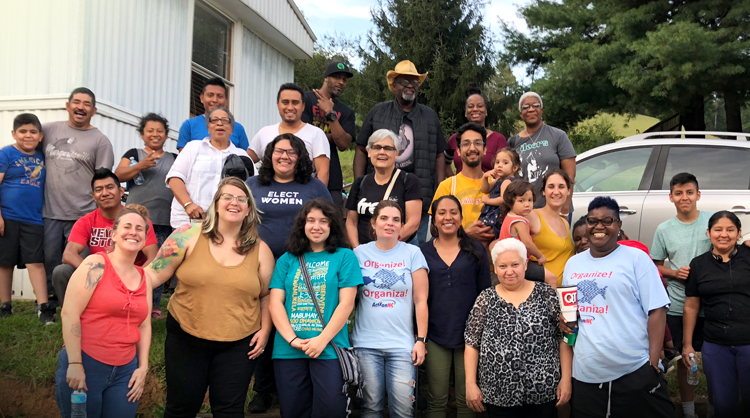
Las Casitas, an immigrant-led cooperative mobile home community in Asheville, NC, that Kate invested in, alongside co-lender Southern Reparations Loan Fund.

What Does an Investment Portfolio that Centers on Wealth Redistribution Actually Look Like?

There are so many ways we talk about aligning our investments with our values. I often talk about being in the impact investing space because I believe in the power of moving investments out of public equities and into direct investments. I also am a practitioner of Integrated Capital, an approach developed by Leslie Christian, Joel Solomon, and RSF Social Finance, that includes using diverse forms of capital (including giving and investing) to address injustices and imbalances in our economy. After ten years of researching and experimenting with values-aligned investing, I realized I could do my most powerful work as an investment advisor. Tiffany Brown and I co-founded Chordata Capital, and joined the Natural Investments team. Together we’ve developed a backbone to our investing and advising work that includes an explicit commitment to racial and economic justice, accountability and shared risk-taking, and bringing an embodied, spacious approach.

Tiffany and I build investment portfolios that center on racial and economic justice. We know poor people are the real experts on poverty, black activists are experts on anti-black racism, and any attempt to solve a social problem must be shaped and guided by those affected. Racial and economic justice requires wealth redistribution, including a commitment to both building wealth in black, brown, poor, and immigrant communities and a commitment to ending wealth accumulation and hoarding in white, wealthy communities. Closing the racial wealth divide isn’t simply about lending money to people of color (POC) entrepreneurs. It includes white wealthy people choosing to give more money away and invest it in ways that decrease their total wealth over time. Closing the racial wealth divide requires wealthy people to support the infrastructure that grassroots movements for racial and economic justice were building to set up and run community-controlled loan funds. [1]
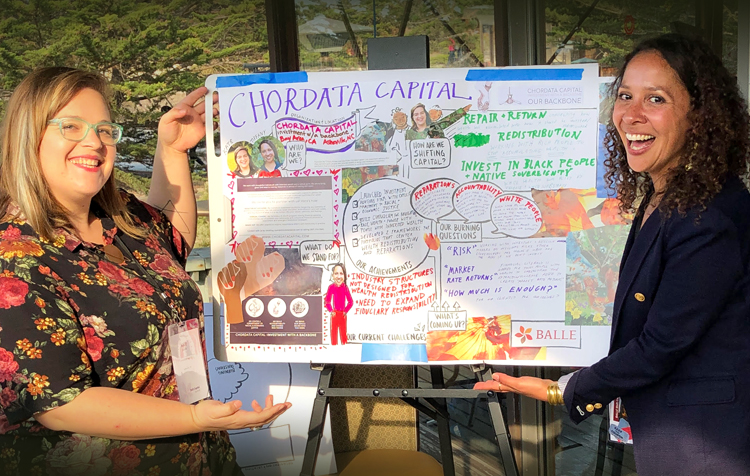
Kate Poole and business partner Tiffany Ann Brown at the 2018 fall BALLE summit, presenting how they integrate a reparations lens into their business at all levels.

Advice for Millennials about Money

Thinking about and talking about money has a huge impact on how we understand ourselves, our families and our relationships. My advice to millennials about money is to find spiritual and embodiment practices that support you as you navigate financial conversations and decisions. Those personal practices can serve as a foundation for working in community to do transformational money work. My practices are rooted in community and relationship.

Like many generations before us, we live in a complicated, frightening and expansive political moment. Unlike generations before us, much of the technology and culture we are immersed in has been built to fragment and isolate us. We need each other. Our work is more powerful and grounded when it is anchored in loving, accountable relationships. You don’t have to do this work alone, and you shouldn’t do this work in isolation. If you’re in the top 10%, connect with your local chapter of Resource Generation. If you’re not wealthy but looking for radical financial resources check out – Ride Free Fearless Money. And start those difficult but fascinating conversations with your friends and family about wealth, money, giving and investing.

For me, the work of redistributing wealth and power required both communities of practice (like Resource Generation) and personal practices. My personal practices include meditation, journaling, therapy, dance, and making art. These practices support my capacity for experimentation and vulnerability, core competencies for making bold moves with my money.

There’s a need for healing and repair in our economy. Massive redistribution of wealth is required to address the history of violence, extraction, colonization, slavery and oppression that are the foundation on which wealth has been built in this country.[2] We need reckoning and reconciliation on a national scale, on a personal scale and in our investment portfolios.


Article by Kate Poole, an investment advisor at Natural Investments and co-founder of Chordata Capital. Kate works with people who have inherited wealth to design and implement investment portfolios that embody an explicit commitment to racial and economic justice.

She started her work in the new economy field at Schumacher Center for New Economics after graduating from Princeton University in 2009, where she wrote her thesis on the intersection of spiritual beliefs and economic action. She went on to work with Michael Shuman, researching local investing for his books Local Dollars, Local Sense and The Local Economy Solution. She co-founded Regenerative Finance in 2014 to organize other young people with wealth to shift control of capital to communities most affected by racial, economic and environmental injustices. In 2017 she was an RSF Integrated Capital Fellow.

She is a member of Resource Generation, organizing young people with wealth to redistribute land, wealth and power, and she serves on the board of directors of the Schumacher Center for New Economics and the New Economy Coalition.

Kate Poole and Tiffany Ann Brown, the principals of Chordata Capital, are investment advisory representatives of Natural Investments LLC. Natural Investments is an independent Registered Investment Advisor firm. Chordata Capital is not a registered entity and is not an affiliate or subsidiary of Natural Investments.

Article NOTES:

[1] The infrastructure I support includes:

Working World’s Financial Cooperativehttps://www.theworkingworld.org/us/peer-network
The New Economy Coalitionhttps://neweconomy.net
The Runway Projecthttps://www.therunwayproject.org/oakland
The Ujima Fundhttps://www.ujimaboston.com
The Buen Vivir Fundhttps://thousandcurrents.org/buen-vivir-fund

[2] To learn about the racist history of wealth accumulation in this country you can read:

Decolonizing Wealth by Edgar Villanueva – http://decolonizingwealth.com
Restorative Economics by Nwamaka Agbo – https://www.nwamakaagbo.com/restorative-economics

or connect with or attend trainings by:
United for a Fair Economy – http://www.faireconomy.org
Resource Generationhttps://resourcegeneration.org

Featured Articles, Impact Investing

Millennials & Money: Insights from an Often Overlooked Community

By Erika Andraca, Director, Operations, Nia Impact Capital

Millennials are receiving quite the attention from the media. We are often characterized as lazy and entitled. What I find to be true is that our generation has little trust in large institutions — from governmental offices to our large banks and financial institutions. We are steeped in our values and want our money aligned with our desires for a more sustainable planet. We are poised to catalyze big shifts in how financial services operate. What has yet to be adequately covered are the ways many millennials are left out and marginalized from our financial systems.

Making Do

Growing up in a low-income immigrant community in Los Angeles, I witnessed and experienced first-hand this lack of financial access. In my community, most people did not have access to checking accounts or relationships with banks. They lived paycheck-to-paycheck, not earning enough to maintain an account free of monthly fees. For some, legal status required living in the shadows and that influenced their interactions with money as well.

Without access to financial services, raising families in the informal economy is an uphill battle. Most of the women in my community stay home to care for their children and find ways to make extra money by engaging in entrepreneurial activities such as selling food and clothing, cutting hair, cleaning houses, providing childcare and much more.

Without banking or credit cards, these communities have no credit scores and therefore struggle with basic needs such as renting a home or buying a car. Out of necessity, many operate in cash or trade, while some fall victim to predatory payday lenders. Despite being excluded from the formal economy, many in my community have extensive experience with savings and loans through their lending circles. Family, friends, and neighbors lent and borrowed money in small groups called “tandas,” with each person contributing a set amount each month and one person from the group taking the pot each month. This informal “line of credit” came in handy many times. I recall what a relief it was when a family member was able to use the tanda to help with the unexpected expense of repairing his car.

Eyes Toward the Future

In 2004, I was one of the fortunate few in my community to earn a scholarship to attend college. There I met other millennials who experienced money very differently. A classmate told me her parents opened a brokerage account for her when she was 16 and her money had been growing ever since. I had heard of a brokerage account in my economics course, but it was not a tangible concept for me, as having extra money to put into such an account was completely foreign. Other students referred to each other as “trust fund babies,” — another concept difficult to relate to. Despite the vast differences in our financial backgrounds, the promise of a top-notch education offered me the comfort that someday I would be able to earn enough money to enter the formal economy, open a savings account, start investing and saving for my future.

As a senior in college, I was ready to take on the world — and then the financial crisis hit. I graduated alongside 1.4 million millennials, who had taken on more student debt than ever before, amid the largest financial meltdown since the 1930s. We graduated to an environment with dramatically low wages, high unemployment, and a changing political landscape. The economic conditions made it incredibly difficult for millennials to find stable jobs, and as a result many of us went back to school, accruing even more debt.

I wanted to be a public servant — to engage in and work toward solutions for the income inequality that I knew was a big issue for our nation. With that in mind, I pursued a Master’s in Public Administration. During graduate school, I encountered the concept of Social Impact Bonds. I was excited to learn that private companies and public entities could form partnerships to lower recidivism in New York jails. Intrigued, I did more research. I learned about impact investing and was won over by the possibilities of shifting capital for good. In 2014, I read of a company turning guns into luxury jewelry, an endeavor that took weapons off the streets and helped fund gun-control advocacy. Still reeling from the Sandy Hook Elementary shooting, I could see that impact investing was a force for positive change and I had to be part of it.

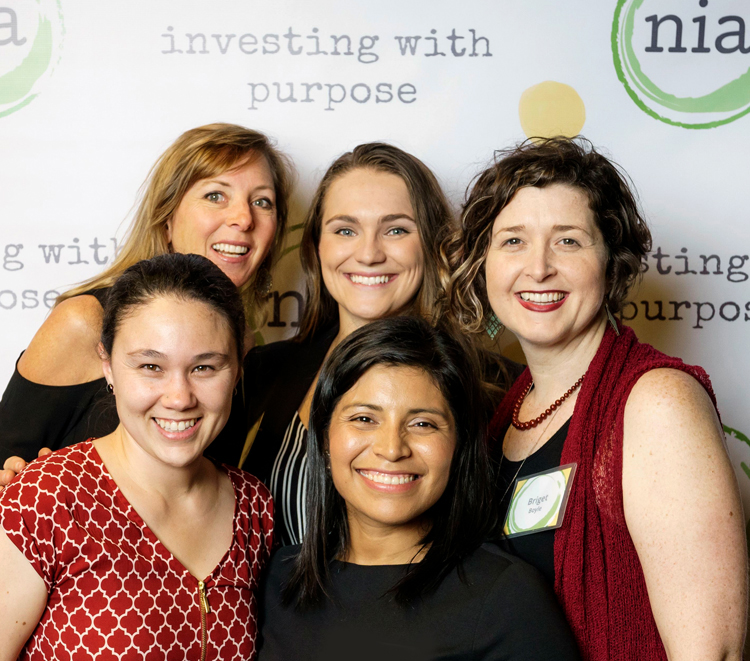
Nia Impact Capital team at the 3-year celebration event. ©Nathan Phillips Photography

Working to Shift Capital

Today, I have the privilege to work for a company that believes in, and works for, equity, diversity, inclusion, women’s empowerment, and social justice. We at Nia Impact Capital understand that for everyone to thrive, we must include everyone. This means having equal representation in leadership, empowering women with financial education, removing the stigma around lack of financial literacy, and making financial products accessible to those who have been traditionally excluded.

At Nia, we are activist investors, engaging our portfolio companies and other asset managers to move the needle on social change issues.

My background has influenced the work I do and the issues I care about, and my work has influenced my personal relationship with money.

I am clear I do not want my money sitting in the big banks causing crisis. Growing up amongst women without access to capital, I want my savings account to work for them, so I invest with CNote. I also provide loans to women through Kiva. Having benefited personally from non-profit organizations that help low-income communities, I value charitable giving and give annually to organizations improving college access to underrepresented students.

One of the most meaningful actions I have taken is gifting my parents an Individual Retirement Account. When I discussed opening an IRA with my stepfather, he was nervous because he was unfamiliar with the concept, but as I explained the benefits, he became excited about having savings for retirement. My parents have since been contributing to their IRA in small amounts and I try to match their contributions annually.

When I think of my parents or the many entrepreneurial women in my community, I see unlocked economic potential from a population more than willing to contribute to financial growth. For many millennials whose families and communities have been systematically excluded from the financial system, the cycle of exclusion will continue until we begin to focus on the benefits of bringing these communities into the formal economy.

I cannot speak for all millennials, though, from my view, millennials have similar goals to other generations. We want financial security, we want to contribute to the economy, and have the freedom to choose a job that brings us purpose and joy. This clarity around our values is often mistaken for entitlement, and yet millennials are uniquely positioned to help solve for some of the world’s most difficult challenges. We grew up in era of major technological transition and political change, and we have lived through the Great Recession of 2008. All these experiences have helped–if not forced us–to identify and assess our values. While we have varying backgrounds and paths on our money journey, as millennials we share a desire for a sustainable world. Our collective economic power is already shaping the way we invest our dollars and as that economic power grows, we must remember that the sustainable future we seek must also be inclusive.


Article by Erika Andraca. Director of Operations & Client Services for Nia Impact Capital, a woman-owned, women-led Registered Investment Advisor firm.

Prior to joining Nia Global Solutions, Erika worked as a Legislative Assistant for the City of Berkeley, where she oversaw community engagement projects and economic development research. Erika also has over five years of experience as a Legal Assistant for a private law firm in Berkeley, CA, where she handled civil litigation cases. Immediately after college, Erika had the opportunity to work with the Feminist Majority Foundation where she provided testimony before the California Commission on the Status of Women, for protections against predatory Crisis Pregnancy Centers.

Erika received her Master’s degree in Public Administration from San Francisco State University and her Bachelor’s degree in Government and History from Claremont McKenna College.

Featured Articles, Impact Investing, Sustainable Business

How Exxon Taught Me That Shareholders Can Change the World

By Gabe Rissman, Co-Founder and President, Yourstake.org

I rose to the podium, looked Exxon then-CEO Rex Tillerson in the eye, and spoke. “Why does Exxon fund climate-denying organizations, when you publicly support a carbon tax?”

Tillerson deflected the question at the time: “we would never impinge on ALEC’s free speech.” D’oh. Two years later, in July 2018, Exxon ceased funding ALEC, the climate change denying organization I highlighted.[1] Who was I? Just a college student with a tiny amount of stock, who took it upon myself to write a shareholder resolution. Socially responsible investors like Zevin Asset Management and Walden Asset Management, helped me get on that podium at Exxon’s annual meeting. “Holy cow, more people can be doing this!”, I said to myself. So I co-founded Stake, because I saw that David could beat Goliath.

Your Stake

Stake organizes shareowners around petitions. At yourstake.org you can sync with your investment account and use your shares to Ask a company or mutual fund to improve. With a few clicks, you can support Asks like this one for Vanguard to support corporate political spending disclosure: https://www.yourstake.org/ask/vanguard-require-disclosure-of-political-contributions

Stake has a not-so-secret sauce. We pair popular Asks with Champions – socially responsible fund managers that negotiate with the company management on behalf of all the individual shareowner supporters.

Again and again, Champions lead the charge in getting companies to protect all workers from discrimination, remove firearms from grocery store shelves[2], and limit financing of coal power plants.[3] My Champions, Walden and Zevin, can now be yours through Stake.

Now, Stake can be your podium.

How I Got Here

I studied physics, so I usually like numbers. But the climate change numbers terrify me. Four years before my encounter with Tillerson, as a wide-eyed college freshman, I read the Stern review on the economics of climate change. One-sixth of the world could face threats to their water supply. Hundreds of millions of people could be left without access to sufficient food. And the World Bank said that to have any chance at avoiding a climate disaster, annual emissions have to peak by 2020. That number, 2020, stuck with me. Just a few years for the world to switch to the right path.

I immediately got to work, joining, and soon leading, Yale’s fossil fuel divestment campaign. The divestment movement brilliantly recognized that students could move large institutions towards climate action. Yale didn’t divest, but did commit to vote in support of climate-related shareholder resolutions.

So I took them up on it. I convinced a law professor to teach me how to write a resolution for a semester. I convinced my student investment fund to invest enough in Exxon to qualify for a resolution. I traveled from Connecticut to Texas to present at the annual meeting.

And we won.

Let’s Build a Movement of Investors

When I was 18 years old back in 2012, the need for peak emissions in 2020 seemed an eternity away. But like the deadline for a final paper, it’s coming fast and there’s a long way to go. The Paris commitments aren’t nearly enough to achieve climate stabilization, and we’re already failing to meet them.[4] That said, the mainstream is shifting. Corporations, after all, fought for the U.S. to stay in the Paris Climate Agreement, and almost won.[5]

Shareholders already have the power to influence their companies by writing resolutions or voting on annual proxies. But almost no one uses that power. Most people literally throw their proxy ballots in the trash![6] While proxy votes aren’t binding, companies care about what their shareholders care about.

At the same time, individuals have had no formal channels to communicate their values to their fund managers. Vanguard could do more, but it “does not hear from many of its 20 million investors on governance”.[7] Not yet, at least.

Stake allows mass shareholders to organize around the issues that matter most. Any issue, not just ones that pass SEC ordinary business restrictions. Any time, not just at the annual meeting.

When we watch our early Stake users look under the hood of their investments, we witness epiphany. People see that there’s an Ask for a company they own to cut its ties to genocide, or stop denying climate change, and want to do more than just click support. They want to build the movement, and they want to invest in a better world.

Let’s build a movement of individual investors, holding corporations accountable to social good.


Article by Gabe Rissman, Co-Founder and President of Yourstake.org. Gabe also co-founded Real Impact Tracker, which scores the social impact of investment funds. Gabe is the former co-head of Yale’s Dwight Hall Socially Responsible Investment Fund, which became the first undergraduate organization to file a shareholder resolution. Gabe graduated from Yale College with a B.S. in Physics. When he’s not working, Gabe likes to eat Thai food and talk about moral philosophy.

Article Notes

[1] https://www.ucsusa.org/press/2018/exxonmobil-departure-climate-denying-alec-long-overdue#.XC1t689KjOQ

[2] https://www.institutionalinvestor.com/article/b17r5lnhcr02zr/how-an-asset-manager-pressured-a-grocery-chain-on-gun-sales-%E2%80%94-and-won

[3] http://news.bostoncommonasset.com/wp-content/uploads/2017/01/Update-Report-On-Borrowed-Time-Banks-Climate-Change.pdf

[4] https://www.nytimes.com/interactive/2017/11/06/climate/world-emissions-goals-far-off-course.html

[5] http://fortune.com/2017/06/01/apple-google-facebook-trump-stay-paris-accord

[6] https://www.broadridge.com/proxypulse/reports/2013/second-edition.html?oldurl=http://proxypulse.broadridge.com/reports/does-shareholder-behavior-vary-by-company-size.html

[7] https://www.reuters.com/article/us-vanguard-climate/vanguard-seeks-corporate-disclosure-on-risks-from-climate-change-idUSKCN1AU1KJ

Energy & Climate, Featured Articles, Impact Investing, Sustainable Business

Best Kept Secret for Millennials: A Career in Financial Services

By Kelly Coyne, VP, Impax AM and Pax Ellevate Mgmt.

Why millennials eschew jobs in financial services and how to change that

(Reader Favorite from February 2019)

If I had a nickel for every time someone has asked me how I got into the financial services industry, I’d be signing up for a pricey yoga retreat in Tulum next month. I’m asked a LOT. To be fair, the question usually comes from a person who has been in the field for a while and who is genuinely curious about how a millennial woman arrived at the table — it is still relatively infrequent to see someone like me in the room. They ask the question as if finance is a secret society: How did I know it existed? Who taught me the secret knock? I’ve asked friends in other industries whether they get the same question and the answer across the board has been: Never, that is so strange.

It’s an easy question for me to answer, and mine is a common response — I knew someone. My father is a longstanding member of the industry, and he opened the door for me, pushed me through that door, and told me it was an incredible business in which I would be lucky to build a career. My experience is not unique — most millennials I know who are working in financial services also had someone they know open a door for them. But millennials in this profession are few and far between.

Why Aren’t Millennials Taking Up Careers in Financial Services?

The lack of millennials in our industry is a huge problem. Top executives in financial services say their most pressing concern is competition over global talent. Not only attracting the top talent but keeping it. When you narrow in on my generation, it is no surprise that top business talents land at the Googles and Amazons of the world, but it may surprise you to find out that, of the millennials our profession has been able to attract, only 10 percent currently plan to stay in the field long-term.[1]

I asked Jim Seuffert why this is. Jim is director of Envestnet’s Institute on Campus, a scholarship program geared toward students pursuing careers in wealth management. He speaks with more millennials on this topic than anyone I know, and he told me there are two major reasons why we aren’t attracting them. First, there is still a major misconception that our industry is not doing the right thing. I have said this many times, but it is critical to reiterate: The ’08 financial crisis (and the hyperbolic Hollywood films that followed it) shaped our mindset about finance and left a bad taste in our mouths. Second, Jim says, is that millennials are unaware of what jobs in finance actually look like. What are the differences between investment banking, wealth management, insurance, fintech, or securities trading? Our profession has done a fabulous job keeping the roadmap to a career in financial services the best kept secret out there. Couple this with the impression among college and university leadership that the only jobs in our space are commission sales, and the pipeline shrinks even further. These misperceptions and complexities are not attractive. Period. If you can’t understand the basic landscape, why would it ever pique your interest? It wouldn’t.

How to Attract and Retain Top Talent

What can we change in order to compete and attract top talent to financial services? First, we need to get the message out that this industry is available to everyone — it is not a secret society! Jim’s work with Envestnet’s Institute on Campus is doing exactly that, educating thousands of college students about the opportunities available to them in financial services and, as they graduate from the program, opening the necessary doors to help them find a job (74 percent of program graduates are in the business). I asked Jim why this became a priority for a massive company like Envestnet and whether buy-in from leadership was a challenge. He explained that there was no hesitation from leadership because they value the millennial perspective and that “nothing is cooler than to have that mindset around you, next to the people who have been there forever. We need it,” he said.

Several other firms and organizations have similar initiatives that are aiming to attract not only millennials but also more women and minorities, such as the Money Management Institute’s Gateway to Leadership program and the CFP Board’s Women’s Initiative (WIN). If more firms were to sponsor or join such efforts, word would spread quickly that, Hey, believe it or not, this profession isn’t only available to you, it needs you.

What else can a financial service firms do to attract millennials? Be a company that we can feel proud to work for. Create a culture that inspires us and makes us feel as if we’re part of something big. I laugh as I write that because, as an insider, I know that the influence our industry has on the world is massive and that there’s perhaps no better profession to join to be part of something big and influential; but the scandal-du-jour reputation is casting a dark shadow on the good that we do.

The companies that are winning at attracting millennials are nailing it on culture and values. My own career path is a perfect example of this. I left a large mutual fund company in Boston to join a sustainable investing firm in New Hampshire because its focus on investing for both performance and impact resonated with me personally. At Impax, we have above-average representation of millennials on staff and on leadership teams, and that is a direct reflection of the fact that my generation wants to succeed at something we believe in. We are, after all, the generation obsessed with making a positive impact on the world around us. And hard on our heels is Gen Z, whose members are just beginning to enter the workforce and who share the millennial zeal for doing good. Firms that are authentically promoting their commitment to being good corporate citizens and fair employers are seeing the greatest levels of interest from talented candidates of both generations.

We know the financial services sector — especially sustainable investing — does a lot of good in the world. I feel privileged to have had a door opened for me, and it is a personal mission of mine to clue in the rest of my generation about how rewarding an investment career can be. We all need to make this a mission, from wherever we sit within the business, whether seasoned veterans or just out of college, Gen X, Gen Y or baby boomers. We all need to help change the reputation, kick the door open and welcome in the next generation of talented professionals — before they settle in elsewhere.


Article by Kelly Coyne, Vice President, Global Women’s Strategies, Impax Asset Management LLC and Pax Ellevate Management LLC. Kelly is responsible for national sales and marketing initiatives related to the Pax Ellevate Global Women’s Leadership Fund. She also helps financial advisors build their practices and better engage and serve the next generation of clients through the firm’s Millennials & Money practice management initiative. Kelly joined the firm in 2014, bringing with her several years of sales and client service experience within the mutual fund industry at Eaton Vance Corporation and F-Squared Investments.

Kelly earned a Bachelor of Arts degree in Human Rights from Trinity College. She holds the Financial Industry Regulatory Authority (FINRA) Series 6, 63 and 65 registrations. Kelly Coyne is a registered representative of ALPS Distributors, Inc.

Article Note

[1] PWC, “Millennials at Work: Reshaping the Workplace in Financial Services,” 2012

Additional Articles, Impact Investing, Sustainable Business

On Impact Investing and Building the Next Economy

By Nikishka Iyengar, Founder and CEO, The Guild

Nikishka Iyengar - The GuildGrowing up in Mumbai, India’s financial hub, it was hard to escape the pervasive Slumdog Millionaire-esque wealth disparities. Coupled with other issues like gender-based violence, Mumbai served as my primer for recognizing that socioeconomic issues like poverty are a systems issue involving multiple, interdependent systems, and can’t be solved by one or two interventions alone. It also lit a fire in me to use a justice-based lens to dismantle the intersecting systems of oppression that create outcomes where a small percentage of people at the top thrive at the expense — and severe detriment — of the majority at the bottom. That fire stayed with me as I moved across continents in 2007 to pursue a dual degree in Finance and Economics at The University of Texas at Austin. It was an interesting time to be studying those topics. Amid the global financial meltdown, I found myself having more questions than answers about our current economic system of capitalism. I decided to shift my energy to grassroots international development and student organizing instead. As part of an interdisciplinary research study on Microfinance and Sustainable Development in Developing Countries, I spent several summers and winters in South Asia researching grassroots development — including an internship with the Nobel Laureate Grameen Bank in Bangladesh. When back on campus during the fall and spring semesters, I spent time organizing with student-led movements around anti-poverty and climate action campaigns.


Rajasthan Villages Microfinance - The Guild
Working on a grassroots financial inclusion campaign in the villages of Rajasthan, Summer 2008

At the time, microfinance (specifically microcredit) was being touted as a panacea of sorts to ending extreme poverty. It involved giving small, uncollateralized micro-loans to the poorest of women so they could start businesses and help pull their families out of poverty. Women were the primary targets of these loans for two key reasons: the data showed that women spent a higher percentage of their earnings on the well-being of their families than men did, and empowering women economically meant empowering them socially as well — which was of particular significance for communities with rampant gender-based violence. In theory, this seemed to work well for a few years. Women that were previously left out of the formal economy entirely were able to start micro-businesses and contribute financially to sustaining their households.

However, as microfinance started to scale, questions around its true impact surfaced, and the industry experienced a bubble and crash of its own. One of the main critiques of microfinance was its high interest rate, which often climbed over 35 percent and as high as 80 percent in some markets. Theoretically, the risk/return trade off that institutional finance hinges on justified such high interest rates. The borrowers were the poorest of the poor—often unbanked, without any formal identification, and without collateral to back the loan—thereby making them the most risky investment. But it is important to question who bears the true risk in interventions like this — the lender with wealth or the borrower that is already struggling below the poverty line — and whether there is another trade off at play between scale at “market rate” and real impact. The dark side of microfinance that I bore witness to as part of my research was that borrowers who defaulted on their payments were often left worse off than they were before accepting the loan. The lessons from microfinance, and what I learned subsequently in my career after graduating college, have given me a renewed focus in how I approach my work in this industry of Sustainable Business and Impact Investing.

A Grameen Bank borrower making her weekly repayment, Summer 2009

When it was time to think about life after college, I had the choice to either go back home to India and work on grassroots economic development, or stay and find a job in the U.S. I chose the latter with the understanding that so much of what I identified as the root causes of global problems (i.e., capitalism) had its basis and stronghold in the U.S. So after graduating, I went to work at a management consulting firm — one of the few companies that hired international students who required work visas — where I worked my way to our newly minted social impact and sustainability consulting practice. There, I worked with Fortune 500 clients on their sustainability strategies, helping them transition to renewable energy, implement community impact initiatives, and reduce carbon emissions. Much like my experience with microfinance, what soon became apparent and frustrating — millennials are nothing if not impatient, right? — was that all of our work in corporate responsibility was only having an incremental impact at best. But the severity of the problem demanded exponential and transformative change. As businesses continue their pursuit of relentless growth, wealth continues to accumulate at the top while climate change continues to accelerate at a truly apocalyptic pace. And, increasingly, more middle and low-income communities are stripped of their autonomy and power.

What impact is Sustainable Business and Impact Investing having on a net basis? As impact investing moves from niche to mainstream, it is critical we ask these questions. The majority of impact investing funds today seek a market rate-return, and while the last few decades have proven that investing for impact can indeed be profitable, we need to question to what extent they need to be profitable. As microfinance has shown us, market returns can help achieve scale, but not necessarily impact. Consider the history (and present) of this country’s economy — built by enslaved labor on stolen land and furthered by free-market capitalism that keeps Black and Brown labor in global supply chains oppressed while continuing to extract natural resources at unsustainable rates. What does a market-rate return perpetuate in a market that is based on these fundamentals?

Bringing this line of questioning home, I examine my personal finances by asking myself three overarching questions: How am I making money? How am I investing it? And how am I spending it? As I’ve transitioned from working a job to becoming a full-time social entrepreneur, I routinely ask myself if I’m making money in a way that allows me to have the impact I want, or if I’m unintentionally reinforcing oppressive systems. From an investment perspective, at a minimum, I recommend examining your banking relationship. I opened an account with a credit union last year and am working on fully transitioning out of my current account with a large bank. We millennials love our convenience, and while credit unions don’t always offer the same online banking experience as the bigger banks, they also don’t do the same kind of harm. Most multinational banks fund (with our deposits) private prisons and pipelines that destroy indigenous lands, while community banks and credit unions are more likely to fund small businesses in our communities. If you have an IRA/401K along with a regular savings account, you can also look into platforms like Swell Investing and OpenInvest or work with a fund manager to screen for and divest from investments in the weapons industry, fossil fuels, etc. I also invest a portion of my savings with RSF Social Finance through a social investment fund note. The returns are small and fixed — but at 1.25% they’re greater than what you’d make if the money was in a savings account, and it’s comparable from a liquidity standpoint, and you get the opportunity to directly invest in social enterprises that are making an impact on issues you care about. If you’re a millennial with sizable wealth, you can even go a step further: Millennial-led organizations like the left-leaning Resource Generation are committed to investing in the equitable distribution of wealth and power. And finally, am I spending money on ethical consumption or am I contributing to our impending ecological crisis? Do I have a giving strategy that is proportionate to the amount of money I save?

I still have a long way to go, but asking myself these questions along the way helps me recenter and refocus my priorities. The most important work of our time, is building a new economy that is based on entirely different fundamentals than our current extractive economy, and it’s heartening to know and work with so many of my fellow millennials who are leading the charge.


Article by Nikishka Iyengar, a systems entrepreneur working at the intersection of finance, climate action and racial justice. She is the founder and CEO of The Guild, an organization focused on building community wealth through equitable and entrepreneurship. She is also the owner of Whole Systems Collective, an impact consulting collective working towards a just and regenerative economy through two key initiatives – the transformation of our financial systems, and climate action through carbon drawdown and responsible stewardship of our natural resources. Previously, as a sustainability consultant at a top management consulting firm, she helped her clients unlock ~$1B worth of value from renewable energy, water stewardship, and emissions reduction opportunities. Then, as a product manager at a waste tech startup, Nikishka built software (including artificial intelligence products) to allow companies to uncover waste diversion opportunities within their supply chain and operations.

Nikishka was recognized by GreenBiz as a “30 under 30” emerging leader in sustainability (www.greenbiz.com/article/2016-greenbiz-30-under-30). She has a BBA in Finance, a BA in Economics and an Interdisciplinary Certificate in International Development from The University of Texas at Austin.

Featured Articles, Impact Investing, Sustainable Business

How Impact Investing Can Change Our Relationship with Money

By Yuliya Tarasava, Co-Founder and COO, CNote

About five years ago, I had a conversation about finance with my friend Anna. She told me, “I want to tell you something I haven’t told anyone else before.” I thought she was going to spill some big family secret, but she said “A few weeks ago, I walked into a branch of my bank where I had my first and only checking account. I approached one of the bankers there and explained that I wanted to open up an investment account—he came back with a stack of papers and brochures, passing the pile to me he said, ‘go home, read it and come back.’” My friend paused. “I went home but I did not come back.”

Embarrassed, Anna admitted to me, “I tried to look at the materials, but they were overwhelming. All the fine print, disclosures, financial lingo—it made me feel dumb.” Which was surprising coming from such a sharp person, one who had majored in business and now is an HR executive at a big technology company. She continued: “I don’t think investing is for me. I guess I’ll just leave things the way they are, keeping my money in cash.” The only thing I could squeeze out, “Believe me you are not dumb and I am sorry people, like me, in finance, made you feel this way.”

At that time I worked on Wall Street in product development and risk management and was heavily involved in creating products and explaining them in the way that made my friends feel “dumb.”

Understanding Why Millennials Have a Strained Relationship with Money

This conversation with Anna was one of many that I had with my friends, mostly millennials, about money and their limited interactions with the financial world. Sadly, there were not many bright spots. What I heard were concerns about student debt, credit card debt, and distrust towards a system that had failed them and their parents. The last recession and market crash had left real scars. The fear of loss never disappeared and there was an external pressure to invest because ‘it is what you’re supposed to do as an adult’ and yet most of my friends felt like they weren’t equipped. If I had to summarize my friends’ attitude towards money in a few words it would be “intimidated”, “overwhelmed”, and “embarrassed.”

I grew up in the Soviet Union, in a family where we had to be strict with our money because we did not have debt available to us. We could only spend what we had. We never had enough and we were always operating in scarcity mode. I was raised to be very careful with money. What I discovered to my surprise when I moved to the U.S. is that even though we think of the U.S. as this universally prosperous country, the discrepancy in wealth is drastic.

The access to financial services and products is not equally distributed and is influenced by biases involving gender, race, and even location. Access to financial products is like entering a high-rise building—most of us only have access to the first few floors. For example, when my friend Anna tried to get in the elevator up to the investments floor, she was handed a stack of papers and effectively turned away at the lobby. Can you blame her for feeling intimidated?

Searching for a Better Way

While difficult at the moment, the conversations with my friends about money inspired me to explore a different path. Conversation after conversation, I started to chip away at what felt wrong about money, and we would talk about their “wish list” when it comes to finance. What came up again and again was the desire to feel smart about money decisions – “whatever I do should be easy to understand, available to all, convenient to do, and make me feel good and empowered.”

I discovered that for many of my millennial friends, money decisions are not about high returns and becoming rich. Their goal is to have enough money to support their lifestyle and feel empowered about the decisions they make. They also had strong views that “how” they make money matters. Indeed, millennials are two times more likely to make investments that target specific social goals than your typical investor[1]. They already buy fair trade coffee at local cafes, shop for organic produce at farmers markets and avoid clothing that isn’t sourced from an ethical supply chain. So, why can’t they request that same transparency from their banks and other financial institutions?

Call it “impact investing,” “aligning your money with your values,” or “socially responsible investing,” — what they wanted to do was to make a difference with their dollars. The challenge is that impact investing is generally unavailable to the masses and often requires a big bankroll or “being in the know.” Even if you just want to buy an ESG ETF, you need to have a brokerage account, which is a non-starter for many. What if we made it easier? And, what if the ability to connect your money with meaning changed the way you felt about your finances?

Which leads me to why I started my company, CNote.

Knowing that 76 percent of millennials see investment decisions as a way to express their social, political and environmental values[2], we wanted to make investing simple and impactful. With CNote, our members’ money works hard to revitalize communities around the country; women and minorities get loans to start and scale their businesses; affordable housing gets built in lower middle income (LMI) communities; and new charter schools open their doors — all because someone like Anna opens a CNote account and invests.

Small Investments, Big Change

We tend to underestimate the collective power our money can have. Even just a few hundred dollars from a few hundred people can drive significant change. That’s why I named my company CNote; it’s slang for “$100 bill” and short for “Community Note.” Together, our $100s become $millions, and these millions have tremendous power. To illustrate, CNote members have already helped create and maintain over 2,000 jobs in America, and that’s just the beginning.
When friends ask me for money advice, what I typically say is, “Whatever unfortunate experience you’ve had so far with finance, don’t get discouraged. Reflect on the goals you have, your ideal lifestyle and balance that with the social outcomes that matter to you. That will be your compass.” And, remember, every $100 matters. Whether you invest with CNote or somewhere else, make sure your money is working for you in a way that makes you proud. If you do, your feelings about money and finance will likely change drastically for the better.


Article by Yuliya Tarasava, the COO and Co-founder of CNote

mycnote.com, an impact investment platform delivering competitive returns by investing in women, minorities and low-income communities across America. As an experienced financial professional with expertise in risk management and product development, Yuliya focuses on leveraging financial tools to increase economic opportunity for everyone.

Previously, Yuliya led the quantitative due diligence for over 20 mutual funds across multiple asset classes for AMG Funds. Later at Summit Rock Advisors, she co-developed the proprietary analytics and risk management framework for a portfolio of over $10B in assets. She was one of 12 individuals selected for Acumen’s Global Fellows program, which led to her running strategy and operations for Juhudi Kilimo, a micro-financial institution in Nairobi that supports farmers and small-to-medium agro-businesses throughout Kenya. Yuliya was born and raised in Belarus and moved to the United States in 2004. She is a CFA charterholder.

Article Notes:

[1] https://www.ey.com/Publication/vwLUAssets/ey-sustainable-investing-the-millennial-investor-gl/$FILE/ey-sustainable-investing-the-millennial-investor.pdf

[2] https://www.hks.harvard.edu/sites/default/files/centers/mrcbg/working.papers/CRI69_FINAL.pdf

Featured Articles, Impact Investing, Sustainable Business

Natixis Investment Managers Launches Mirova International Sustainable Equity Fund

Natixis Investment Managers recently announced the launch of the Mirova International Sustainable Equity Fund (MRVYX), an international equity mutual fund which utilizes Mirova’s sustainable investing experience. The fund became effective on December 28, 2018. The Mirova International Sustainable Equity Fund is an all-cap international equity fund that seeks long-term capital appreciation. The Fund also seeks to maximize exposure to companies with a positive impact on the United Nations’ Sustainable Development Goals, while avoiding companies whose activities or products have a negative impact on or create risk to achieving such goals.

• The Fund’s focus is on investments that offer solutions to major global transitions such as demographics, environmental issues, technological advances, and governance changes.

• The Fund can offer core international equity allocation; complement core equity allocation; improve portfolio sustainability.

“At Mirova, we believe there’s an inextricable link between long-term value creation and sustainability,” said Jens Peers, CFA, Chief Investment Officer, Sustainable Equities, at Mirova. “We feel that investors should be connected to the real world economy by investing in innovative businesses that play a real role in building a sustainable world, and therefore, we are giving investors the opportunity to be actively involved in improving corporate environmental, social and governance practices.”

Mirova takes a thematic approach, investing in companies they believe present opportunities and solutions related to sustainable development themes derived from long-term transitions – demographics, environmental issues, technological advances, and governance changes. The managers conduct detailed fundamental research to select companies they believe are well-managed, are expected to benefit from strong, sustainable competitive advantages, and have demonstrated a solid financial structure while avoiding irresponsible risks. Managers invest in securities trading at significant discounts to what they believe are their intrinsic values.

“We are pleased to provide investors with an opportunity to further diversify their portfolios in an international equity fund that draws on the expertise of our affiliate Mirova,” said David Giunta, CEO for the US and Canada at Natixis Investment Managers. “Through the fund, investors are able to gain access to the growth potential associated with long-term, sustainable investment themes. In doing so, they are also potentially improving the carbon footprint and sustainability profile of their overall portfolio.”

The fund is co-managed by Jens Peers, CFA®, Hua Cheng, CFA® and Amber Fairbanks, CFA®. The fund seeks to maintain a relatively concentrated portfolio of approximately 50 non-US stocks and is managed by Ostrum Asset Management U.S., LLC (“Ostrum US”).

More information about the fund


Natixis Investment Managers consists of Natixis Distribution, L.P., Natixis Advisors, L.P., Natixis Investment Managers S.A., Natixis Investment Managers International, and its business development units across the globe, and the French holding company Natixis Investment Managers, parent to the affiliated investment managers and distribution companies. This material should not be considered a solicitation to buy or an offer to sell any product or service to any person in any jurisdiction where such activity would be unlawful. Natixis Distribution, L.P. and Natixis Advisors, L.P. are located at 888 Boylston Street, Boston, MA 02199.

Additional Articles, Impact Investing, Sustainable Business

Green Alpha Next Economy Index Achieves Ten-Year Milestone

The Next Economy Index’s strong track record demonstrates that climate change-focused, innovation-driven investing offers an effective way to preserve and create wealth.

Green Alpha Advisors announced in early January that its Next Economy™ Index celebrated its ten-year anniversary on December 31, 2018. The Green Alpha Next Economy Index is an actively-researched, passively-managed investment strategy designed to reflect the innovation-driven sustainable economy. The strategy currently holds 115 publicly traded companies, all of which create or enable solutions to systemic risks like climate change.

Since its inception in 2008, the Next Economy Index has returned 10.20% annualized to clients, net of fees versus the MSCI All Country World Index IMI of 10.64%. The Index is offered to clients as a Separately Managed Account (SMA) and is available on 15 custodial platforms.

“We developed our Next Economy investment process from scratch because a marginally greener version of ‘business as usual’ economics is unworkable, and our holdings reflect that,” said Garvin Jabusch, Co-Portfolio Manager. “Rather than building our investment universe from an index fund—which would represent the old economy—we look to where the economy is heading and invest accordingly.”

The Next Economy Index exists to:

• provide clients with an avenue to decisively allocate their stock holdings away from the downside risks associated with climate change, resource degradation, widening inequality, and other systemic risks,
• enable portfolio growth from exposure to rapidly expanding solutions to those risks,
• demonstrate the diversity, growth, breadth and depth of the emerging Next Economy,
• and serve as the universe of stocks from which Green Alpha’s Investment Committee can select to create the firm’s actively-managed Next Economy portfolios.

“The Next Economy opportunity set has never been clearer. There are companies that are at the tipping point of dominating an entire industry like energy, yet they are trading at or below book value,” said Jeremy Deems, Co-Portfolio Manager.

“The market has witnessed a spike in demand for sustainability-driven portfolios over the last few years, but many of the products out there are still pretty new,” said Chief Operating Officer, Betsy Moszeter. “We’ve been putting our Next Economy thesis to the test for ten years, and our portfolio managers have been building fossil fuel free portfolios together since 2002. I feel confident that we are offering time-tested, high-quality portfolios to all of our clients—from institutions to individual retirement accounts.”


About Green Alpha Advisors, LLC

Green Alpha Advisors (https://greenalphaadvisors.com) is led by three pioneering executives who each have 20+ years of asset management experience. Green Alpha has been redefining asset management since 2007 by investing in the Next Economy – an indefinitely thriving economy driven by companies that are developing innovative solutions to major systemic risks, like climate change, resource degradation and scarcity, and widening inequality. As these threats continue to materialize, and risk-mitigating solutions rapidly develop, the economy of the next decade is unlikely to look like that of the past. It’s time to invest in what’s next. Green Alpha manages $130 million in client assets, primarily through financial advisors, family offices, and institutional consultants.

Green Alpha’s investment philosophy is straightforward: always invest in the solutions to global systemic risks, never in the causes. That’s investing in the Next Economy.

Important Disclosures

This press release is for informational purposes only and nothing in this press release should be construed to be individual investment advice, nor an offer to sell or the solicitation of any offer to buy any security. Green Alpha Advisors, LLC is a registered investment advisor. Registration as an investment advisor does not imply any certain level of skill or training. Green Alpha is a registered trademark of Green Alpha Advisors, LLC. Green Alpha Advisors also owns the trademarks to “Next Economy” and “Investing in the Next Economy.” Please refer to www.greenalphaadvisors.com for more information and additional important disclosures.

Performance data quoted represent past performance. Past performance does not guarantee future results and current performance may be lower or higher than the data quoted. Investment returns and principal will fluctuate with market and economic conditions and investors may have a gain or loss when shares are sold.

All performance and characteristics data are sourced from Bloomberg Finance L.P. The Next Economy Index may invest in companies with small and medium market capitalizations, which may have more limited product lines, markets and financial resources than larger companies. In addition, their securities may trade less frequently and in more limited volume than those of larger companies. Small or mid-cap stocks may be more volatile than those of larger companies and, where trading volume is thin, the ability to dispose of such securities may be more limited. The Next Economy Index may also invest in foreign domiciled companies. Investing in foreign securities may involve additional risks, including exchange-rate fluctuations, limited liquidity, high levels of volatility, social and political instability and reduced regulation. Emerging markets are often more volatile than developed markets, and investing in emerging markets involves greater risks. International investing may not be suitable for everyone. An investment in the Next Economy Index should be considered a long-term investment.

The MSCI ACWI Investable Market Index (IMI) captures large, mid and small cap representation across 23 developed markets and 23 emerging markets countries. With over 8,600 constituents, the index is comprehensive, covering approximately 99% of the global equity investment opportunity set. Investors cannot invest directly in this index.

Additional Articles, Energy & Climate, Food & Farming, Impact Investing, Sustainable Business

The Real Leaders 100 Top Impact Companies 2019

Business can be a force for good and here’s the proof: 100 companies that are growing by doing good.


The Real Leaders 100 Top Impact Companies, in collaboration with Big Path Capital and B Lab, is the first ranking of positive impact companies. The awards rank the top companies applying capitalism for greater profit and greater good. These companies are driving a dynamic segment of the economy, bearing a new vision of capitalism that demonstrates that every transaction is an opportunity for both growth and a better world.

Given the plethora of published lists that already exist – the richest people, sexiest celebrities, fastest growing companies, biggest organizations or most popular startups – a group of like-minded visionaries including Real Leaders, realized that what the world really needs is a list of companies that are a force for good in the world. Not a feel-good, granola list either; rather, a list of real companies that have shown actual economic growth by including the greater good in their mission and business strategies.

1. Rescue Agency
2. Amalgamated Bank
3. Traditional Medicinals
4. World Centric
5. Grove Collaborative
6. OPTEL Group
7. BDC
8. Vital Farms
9. TriLinc Global
10. Koru Distribution
11. Simple Energy
12. BlueWave Solar
13. The Redwoods Group
14. Fully
15. Galileo Camps
16. CleanFund
17. CleanChoice Energy
18. NationSwell
19. Gaia Herbs
20. Encore Renewable Energy
21. Advantage Capital
22. SunCommon
23. Lotus Foods
24. Cascade Engineering
25. Sunrise Banks

Find the full list of 100 companies and links to each one here – https://real-leaders.com/the-real-leaders-100-top-impact-companies-2019

Additional Articles, Energy & Climate, Food & Farming, Impact Investing, Sustainable Business

Reflections on SRI Investing in 2018

By Lisa Woll, CEO, US SIF and US SIF Foundation

Sustainable and impact investing in the United States continues to grow and to make a difference. Investors now consider environmental, social and governance (ESG) factors across $12 trillion of professionally managed assets, a 38 percent increase since 2016.
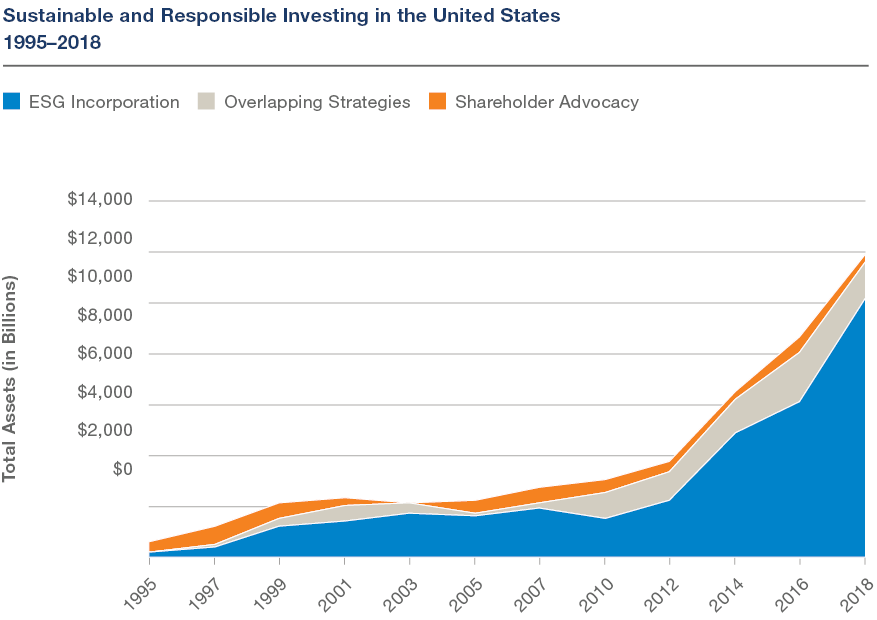
Asset management firms and institutional investors are addressing a diverse set of environmental, social and governance concerns across a broader span of assets than in 2016. Many of these money managers and institutions, concerned about racial and gender discrimination, gun violence and the federal government’s rollbacks of environmental protections, are using portfolio selection and shareowner engagement to address these important issues.

SOURCE: US SIF Foundation

Meanwhile, a number of surveys show that individual investors, too, are interested in investing for positive impact. Financial advisors are also becoming aware of the need and opportunity to offer sustainable investment options to clients. Innovation and technology advancements, such as targeted investment products, robo-advisors, and big data and artificial intelligence, have driven further interest and growth in sustainable and impact investing.

We at US SIF are heartened by these developments, and encourage investment professionals to continue learning about sustainable, responsible and impact investing and to aim for best practice. US SIF’s research and resources, including our Roadmap Series for advisors, asset managers and asset owners, and our online and live courses on the Fundamentals of Sustainable and Impact Investment, can assist in these efforts. We are pleased to partner with the College for Financial Planning in its launch this year of a Certified SRI Counselor designation.

The Report on US Sustainable, Responsible and Impact Investing Trends 2018 is a resource that provides a wealth of information on broad trends as well as detailed data on specific investment vehicles, ESG criteria and investor engagement strategies. I encourage you to dig into the contents of this report and use it to advance your organization’s work and the sustainable investment field. Please visit https://www.ussif.org for more information on our work.


About Lisa Woll   As the CEO, Lisa leads US SIF and the US SIF Foundation’s overall direction and sits, ex-officio, on all board committees. She has been the CEO of US SIF and the US SIF Foundation since 2006, and has been responsible for strategic planning, developing a robust policy presence, expansion and diversification of funding, launching our national conference and creating the Center for Sustainable Investment Education.  

Prior to US SIF, Lisa was executive director of the International Women’s Media Foundation, an organization focused on press freedom and expansion of women’s role in the media. During her tenure, the IWMF played a significant role in re-orienting the way journalism training was carried out on the issues of HIV-AIDS, malaria and TB in several African media organizations. Lisa also spent a decade working on children’s human rights.  She was the director of the first international study to look at the impact of the Convention on the Rights of the Child and directed the Washington, DC office of Save the Children. She is a member of the Advisory Council of the Children’s Rights Division of Human Rights Watch.

Energy & Climate, Featured Articles, Impact Investing, Sustainable Business

Signup to receive GreenMoney's monthly eJournal

Privacy Policy
Copyright © GreenMoney Journal 2025

Website design & development by BrandNature

Global Events Calendar

View All Events

april

21aprAll Day232026 Sustainable Packaging Coalition: SPC Impact – Nashville

27aprAll Day30Women Deliver 2026 Conference (WD2026) – Melbourne

X