Tag: Impact Investing

Domini Funds Releases its 2018 Impact Report

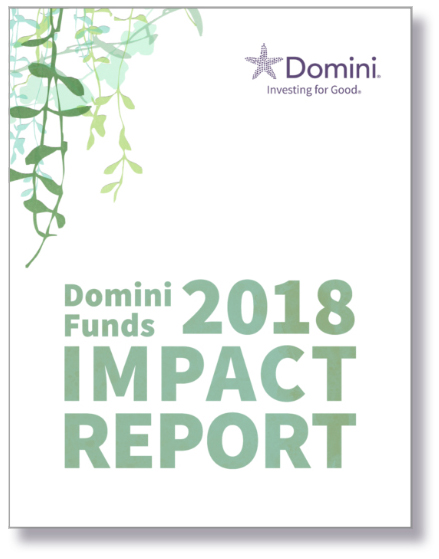
DominiFunds2018ImpactReportDomini Funds shareholders use their investment dollars to make a difference, helping to build a world of universal human dignity and ecological sustainability. We are excited to release the Domini Funds 2018 Impact Report, which details the many ways we work for change on behalf of our fund shareholders.

Highlights of our 2018 impacts include:

• In light of the urgent need to accelerate the transition to a low-carbon future, we expanded our exclusionary screen on fossil fuels. While we previously excluded oil and natural gas exploration and production companies from our investment portfolios, we now also exclude oil and gas equipment and service providers, refiners, marketers, and storage and transportation companies.

• To ensure our investment evaluations remain focused on the most meaningful and relevant information, we refined and enhanced our research process for automobile manufacturers, healthcare equipment providers, and pharmaceutical companies.

• We launched a unique, innovative new investment strategy for the Domini Impact Equity Fund, designed to provide exposure to the U.S. economy through the lens of the classic impact investor, with an added emphasis on innovation and sustainability.

• We tied our Impact Investment Standards to the UN’s Sustainable Development Goals to demonstrate how we believe our social and environmental standards help us build SDG-aligned portfolios.

• The Domini Impact Bond Fund continued to direct capital to investments that support access to housing, healthcare, economic and community development, environmental sustainability, and more. As of December 31, the Fund had $24.3 million invested in bonds that finance low- and very low-income housing and $4.9 million invested in green bonds.

• We engaged in direct dialogue with 135 companies and fixed-income issuers on a variety of issues related to the environment, human rights, public health and safety and more. The many topics addressed in our dialogues included employee and supply chain labor rights, access to medicine, gun violence, opioid accountability, climate change, and deforestation.

• Building on our long history of collaborating with other investors and civil society organizations, we joined several new initiatives, including the Investor Alliance for Human Rights, the Plastic Solutions Investor Alliance, the Thirty Percent Coalition, and the Investor Agenda: Accelerating Action for a Low-Carbon Future.

• The Domini Impact International Equity Fund and the Domini Impact Equity Fund collectively voted on 4,463 management and shareholder proposals at 341 corporate meetings during the 2018 proxy season. Among other topics, our votes promoted diverse and independent boards of directors and fair and just compensation practices. We also supported 108 shareholder proposals on a variety of environmental, social and governance issues.

• We filed or refiled 4 shareholder proposals for the 2018 proxy season and 3 for the 2019 proxy season. Our proposal at Walgreens Boots Alliance, seeking a report on governance measures related to opioids, received strong shareholder support with 60% of the votes.

Our shareholders want to know how their investments make a difference, and we are excited to continue that conversation with the release of this report. More than ever, we remain committed to showing that The Way You Invest Matters.®

Download a copy of the Report here or get a print copy here.


Additional Articles, Energy & Climate, Food & Farming, Impact Investing, Sustainable Business

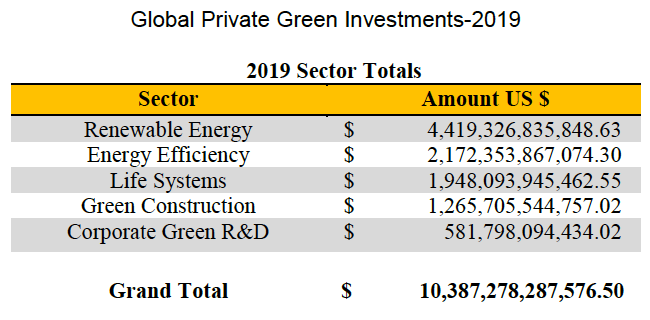
Green Transition Scoreboard Reports over $10 Trillion in Private Green Investments

Ethical Markets Media, a Certified B. Corporation, recently released its annual Green Transition Scoreboard for 2019-2020, tracking private green investments since 2009, now a cumulative $10.387 trillion. New capital continues expanding Earth-saving clean energy, green construction, corporate R & D and widening the healthier global plant-protein food sector.

GlobalPrivateGreen2019Investments-EthicalMarketsMedia

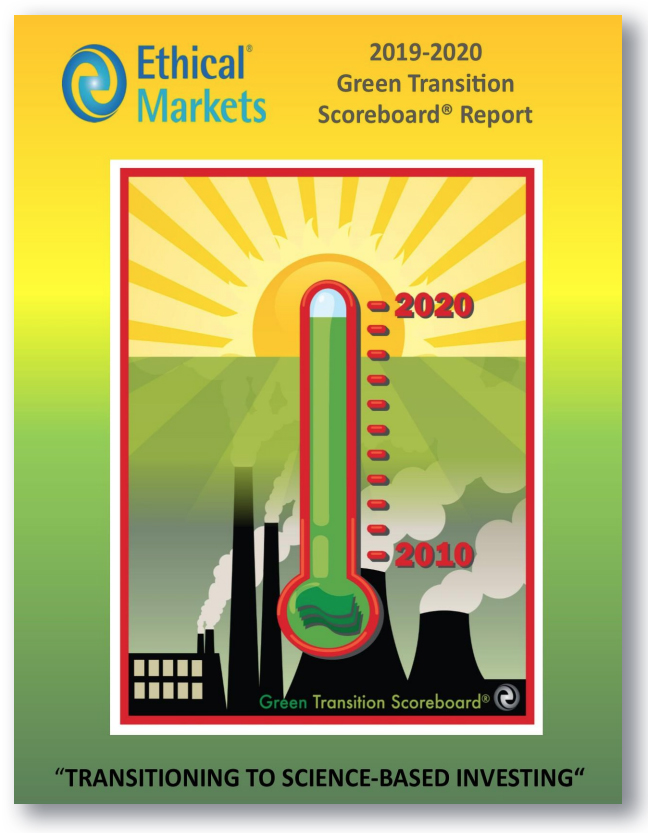
The report: “Transitioning to Science-Based Investing: 2019-2020” updates our continual research from scientists on these tectonic shifts affecting mainstream financial markets and their portfolios of “stranded assets” beyond fossilized sectors. We identify a class of hidden financial risks in “science-denial”. These risks lie in disruptive progress of scientific research revealing obsolete processes, externalized costs over-hanging balance-sheets, for example: big polluting, livestock-based meat producers and sellers. Earth systems science-focused research is driving the growth of plant-based food companies offering healthier choices, while reducing livestock’s 15% of climate-changing greenhouse gas (GHG) emissions, waste and pollution of land and water.

While science-denial is driving financial risks, the report indicates that science-based investing is the latest model, with many start-ups headed by scientists. This new model is essential to mainstream finance, beyond conventional anthropocentric models from obsolete economic textbooks. These include financial concepts, formulas still encoded in algorithms driving indexes, ETFs, benchmarks and similar herd-behavior driven financial models of narrow market risks and rewards.

Download the full 2019-20 GTS Report

GreenTransitionScoreboard2019-20-EthicalMarketsMedia

As science continues to lead financial markets into emerging sectors and innovative start-ups, the report expands on its 2018 forecast: “Capturing Co2 While Improving Human Nutrition and Health “finding more investments in thousands of overlooked, nutritious plant foods, including those that thrive on the planet’s 97% saltwater. 40% degraded land without fertilizers or pesticides, eaten in 22 countries, e.g. quinoa, salicornia and China’s salt-tolerant rice. Dr. Hazel Henderson, former US science-policy advisor, CEO of Ethical Markets and lead researcher of these reports says ”Today’s unsustainable food crisis reliant on the planet’s dwindling 3% of freshwater, exacerbating climate change, biodiversity losses, is a case of science-denial. This results in financial risk while causing diet-related human diseases. We cover the science-based investments and startups accelerating the plant food nutrition revolution worldwide.“

The science behind all the startups, Beyond Meat, Impossible Foods, Protifarm, and trendy vegetarian restaurants, alternatives to meat, fish, cheese, and milk foods and beverages have mainstream financiers scrambling to catch up. The rapid growth of investments in the green economy has reached a new benchmark. Co-author Timothy Jack Nash, who blogs at www.sustainableeconomist.com and is founder of Good Investing (www.goodinvesting.com) in Toronto, Canada says, “It’s been a remarkable journey from our first report in 2010 that found $1.6 trillion. This report is signaling the unstoppable transition to a global green economy”. Also, watch “Investing in Saltwater Agriculture: The Next Big Thing”, TV with NASA Chief Scientist Bushnell at www.ethicalmarkets.tv and available for educational use at www.films.com


About Ethical Markets Media Certified B. Corporation: founded in 2004, covering the worldwide growth of cleaner, greener, knowledge-richer, more inclusive, sustainable economies, following the UN’s Sustainable Development Goals (SDGs), produces the annual Green Transition Scoreboard ®; the “Transforming Finance “TV series distributed globally; the Principles of Ethical Biomimicry Finance ®; sponsors the EthicMark® Awards for Advertising that Uplifts the Human Spirit & Society (www.ethicmark.org) that are announced annually at the SRI Conference and partners with investor networks and professional organizations worldwide. www.ethicalmarkets.com

Contacts

Dr. Hazel Henderson

hazel.henderson@ethicalmarkets.com

phone +1 (904) 829-3140

Tim Nash

nash@sustainableeconomist.com

phone +1 (416) 821-9179

Additional Articles, Energy & Climate, Food & Farming, Impact Investing, Sustainable Business

America’s Leading Financial Institutions Report High Confidence in Renewable Sector Growth

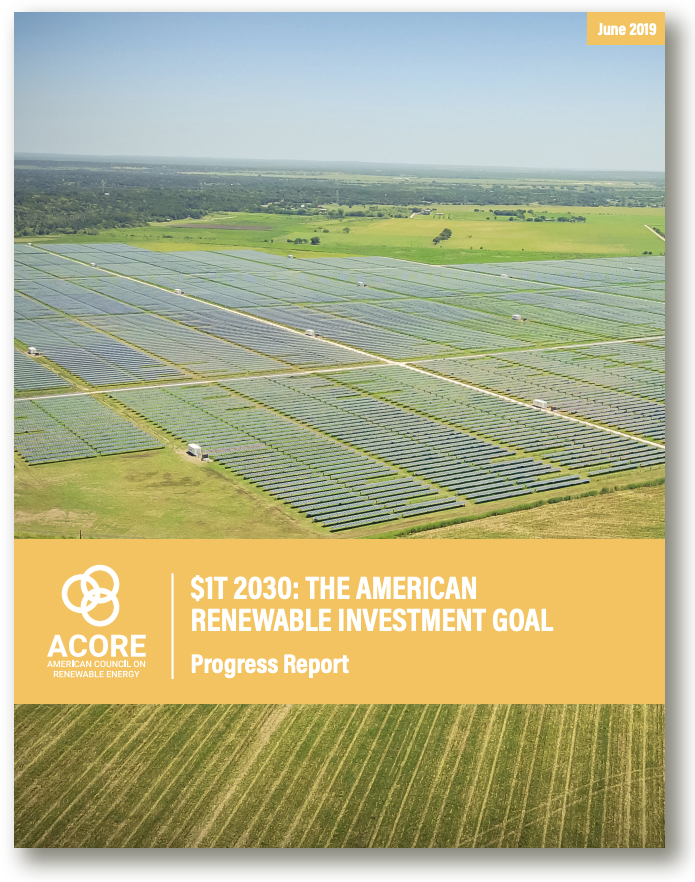
ACORE Releases New Survey and Progress Report on $1T 2030: The American Renewable Investment Goal

One year into its campaign to reach $1 trillion in U.S. private sector investment in renewable energy and enabling grid technologies by 2030, the American Council on Renewable Energy (ACORE) is releasing a progress report tracking U.S. renewable investment and assessing the policy and market pathways needed to achieve $1T 2030: The American Renewable Investment Goal.

The new report also includes an updated survey of America’s leading financial institutions that reports high near-term confidence for renewable energy growth over the next three years and a strong appetite for increased investment.  Download the Report

“Renewable energy remains one of the most attractive investment options in America today,” said Gregory Wetstone, ACORE’s President and CEO. “Over the long-term, however, the renewable sector is going to need predictable policy drivers, competitive power markets and a modernized grid to meet its potential and answer Americans’ growing calls for a clean energy economy.”

In 2018, the private sector invested more than $56.7 billion in U.S. renewable energy ($48 billion) and enabling grid technologies, including energy storage ($8.2 billion).

Among the key findings of ACORE’s new survey gauging investor confidence in the U.S. renewable energy sector:

• Investors’ confidence in renewable energy sector growth over the next three years remains high, with an average confidence level of 77/100

• Renewable energy maintains its attractiveness compared with other asset classes in respondents’ portfolios

• Most 2019 survey respondents indicated that the U.S. continues to be an attractive venue for investment compared with other leading countries

• More than one-third of survey respondents plan to increase their investments in U.S. renewables by more than 10% in 2019 compared to 2018; no respondents reported that they would decrease their investments by more than 5%

• Utility-scale solar and energy storage tied as the most attractive renewable energy investment options between 2019 and 2022, with onshore wind close behind

• Investors cited the low cost of renewable energy, expanded state renewable portfolio standards, increased demand from corporate end-users, the potential for new carbon legislation, and a rush to benefit from the tax credits before they sunset among their main reasons for optimism over the next three years

The report outlines the progress that has been made since the $1T 2030 campaign launched in June 2018, including the adoption of ambitious renewable portfolio standards in multiple states. Over the past several weeks, a number of federal legislative proposals have also been introduced that could have important impacts for the renewable sector. These bills include a new tax credit for energy storage, new national renewable energy and clean energy standards, a federal price on carbon emissions, and a technology-neutral tax credit for carbon-free electricity generation.

The report concludes with ACORE’s near-term strategic focus toward achievement of the $1T 2030 goal, which includes acceleration of energy storage deployment, modernization of power markets, and an expanded marketplace that includes a broader pool of investors and buyers.

To read the new report and survey, and for more details on the $1T 2030 campaign, please visit http://www.acore.org/1T2030


About ACORE

Founded in 2001, the American Council on Renewable Energy (ACORE) is the nation’s premier pan-renewable organization uniting finance, policy and technology to accelerate the transition to a renewable energy economy. For more information, please visit www.acore.org

Media Contact

Alex Hobson, VP of Communications

American Council on Renewable Energy

hobson@acore.org

202.777.7584 (o) | 202.594.0706 (c)

Additional Articles, Energy & Climate, Impact Investing

Conservation Finance Takes Off as the Netherlands Issues One of the Largest Green Bonds Ever

The conservation finance market hit a new high-water mark in recent weeks as the Dutch government issued one of the largest green bonds ever: 5.98 billion euros (roughly $6.8 billion). This bond for low-carbon development and sustainable water management will finance, among other things, natural infrastructure solutions in the Netherlands that are crucial for protecting one of the world’s lowest-lying countries from floods and sea-level rise.

The enthusiasm for the bond also signals a bigger trend: the shift in conservation finance from a niche market to a mainstream, large-scale investment strategy.

What Is a Green Bond?

A bond allows an institution (in this case the Dutch government) to borrow money from multiple investors and pay them back over time. For example, the U.S. government issues treasury bonds to raise money from citizens to finance government projects. Now the concept is being applied to the challenges of climate change and disaster risk management.

The bond benefits the Dutch government by allowing it to raise capital for major infrastructure projects, such as renewable energy facilities, low-carbon transportation systems and water and flood defense infrastructure. The bonds benefit investors (which includes pension funds, banks, and insurance companies) by offering them a stable and predictable investment with a regular rate of return. The Dutch government can repay investors with money raised through a variety of tax and revenue sources.

So, what qualifies as a “green” bond? Several labeling and certification schemes have been developed to determine if the investments meet certain criteria for sustainability. The Dutch bond was certified by the Climate Bonds Initiative (CBI), which uses a robust set of standards that have become a leading framework for green bonds. The certification followed CBI’s Water Infrastructure Criteria, which was crafted with the help of experts at WRI and the Alliance for Global Water Adaptation, along with technical and industry professionals.

Fighting Climate Change with Finance

The Netherlands is naturally vulnerable to climate change. Much of the country lies below sea level and is protected by dikes, levees and sea walls. Massive floods periodically inundate parts of the country, often causing extensive damage and loss of life. In response, the Dutch have become not only a world leader in engineering solutions to rising sea levels, but a nation heavily invested in fighting climate change even as it adapts to it.

The bond will fund a wide range of low-carbon projects, including renewables (such as onshore solar energy and offshore wind energy), energy efficiency (such as residential energy efficiency upgrades) and clean transportation (such as public passenger transport infrastructure). The bond also has a focus on sustainable water management, especially the use of nature-based solutions and green infrastructure approaches for reducing flood risks in coastal and low-lying areas.

The Netherlands has already embraced the natural infrastructure approach through its Room for the River program, a pioneering example of how to live with rising water, rather than fight it. Instead of building higher and higher levees to confine rivers to narrow channels, the project restored part of the natural river flood plain by pushing back dikes and digging new channels. The flood-prone areas are restored into wetlands, reservoirs or public parks that are designed to temporarily store flood water. The new green bond could take the lessons learned from Room for the River and scale them even more widely across the country.

The Dutch have several examples of projects that harness natural processes to enhance large-scale infrastructure construction. In the province of South Holland, erosion of sand dunes and shoals on the Delfland Coast put the inland areas at risk for flooding. Engineers devised a system to address this through regular “sand nourishment” – replacing the lost sand with material dredged elsewhere. In 2011, the Dutch Ministry of Infrastructure and Water Management developed an innovative approach by building a giant “Sand Motor” that mimics the natural structure and movement of dunes – continually replenishing the sand while providing primary sea defense.

Seeing Green

So how did investors react when the recent Dutch Green Bond was issued? Within 90 minutes of the bond’s issuance, the government had received 21.2 billion euros ($23.8 billion) worth of orders for 5.98 billion ($6.71 billion) euros of certificates, over-subscribing the bond by 3.5 times the original amount. The prospect of a AAA rated bond that credibly met investors’ needs for certified and innovative green investments clearly hit the mark. The Netherlands for their part gave preference to investors with registered sustainability credentials.

This green bond, while exceptionally large, was not an anomaly. China, France, Nigeria, Indonesia, Fiji and dozens of other nations have also issued green bonds. Others, such as a large green bond from Germany, are anticipated to follow soon. Globally, the green bonds market reached about $168 billion in 2018, up more than 80% from 2016. And despite some recent slow-downs, many estimate that the green bonds market will continue to grow as more emerging economies begin to issue green bonds of their own. There is also growth in related conservation finance tools, such as “sustainability bonds”, “social bonds”, and investments focused on water resources.

Many historians trace the birth of modern banking back to the Netherlands in the 16th and 17th centuries, including the issue of the first general government bonds. Why did this happen in the Netherlands? Water likely played a role- the Dutch financial system was cultivated out an elaborate system of global trade enabled by the city’s waterways and access to the sea. Now once again, water and finance are inextricably linked in the Netherlands. It likely won’t be the last time.


Article by James Anderson, Todd Gartner, Alex Mauroner and John Matthews

James Anderson, Associate II, Natural Infrastructure at the World Resources Institute. Todd Gartner, Director, Cities4Forests and Natural Infrastructure Initiative at the World Resources Institute. Alex Mauroner, Network Director for the Alliance for Global Water Adaptation. John Matthews, Executive Director for the Alliance for Global Water Adaptation

Source: WRI website

Additional Articles, Energy & Climate, Impact Investing

VERGE Conference: The Platform for Accelerating the Clean Economy

Fast-changing technologies and growing global risks are forcing companies and cities to become more adaptive, and business models to evolve and diversify. It’s a challenging time, but it’s also a time of unprecedented opportunity to create a clean economy that increases economic and community resilience — equitably and inclusively.

To unlock this $13.5 trillion opportunity, the world needs a platform to convene a diverse and influential audience — including leaders from companies and utilities, city and regional governments, policymakers, NGOs, solution providers and startups — and to address systemic challenges by elevating scalable, cross-cutting solutions at the intersection of technology and sustainability.

The VERGE 19 conference and expo is the platform for accelerating the clean economy. VERGE 19 offers attendees a unique mix of content, solutions and networking opportunities.

It will be held October 22-24 at the Convention Center in Oakland, California.

This year’s conference and expo includes four concurrent conferences — VERGE Carbon, VERGE Circular, VERGE Energy and VERGE Transport — dozens of inspirational plenary sessions, the solutions-focused Interconnect Expo, a 100% renewably powered microgrid, unique special programs and unparalleled networking opportunities.

VERGE Carbon – Creating value from carbon pollution by sequestering it and using it to create innovative products, materials and services

VERGE Circular – Leveraging technologies and systems necessary to shift from a linear to circular economy

VERGE Energy – Decarbonizing global energy systems at both the grid and distributed scales

VERGE Transport – Accelerating zero-emissions transportation and sustainable, livable cities


Find all the Conference details here.

Additional Articles, Energy & Climate, Impact Investing, Sustainable Business

The Movement Towards Natural & Organic Food and Healthy Lifestyles

By Steven Hoffman, Managing Director, Compass Natural

Sales of Natural and Organic Products Outpace Conventional Food and Beverage as Consumers Get the Message About the Relationship Between Diet and Health
Launching natural products and organic companies, as well as investing in them, is a challenge in today’s competitive retail and consumer products marketplace. Yet, consumer demand for healthier products continues to grow. With concerns ranging from the cost of healthcare to the effects of food and agriculture on climate change, consumers of all ages are opting for natural, organic and functional foods and beverages, nutritional supplements, natural medicines and other eco-friendly products from mission-based companies that share their values and address their concerns.

And, with conventionally grown apples at the top of the Environmental Working Group’s infamous “Dirty Dozen” contaminated fruits and vegetables list (Each conventional apple contains on average 4.4 toxic, synthetic pesticide residues.), people are realizing that it’s the organic apple a day that keeps the doctor away. By choosing organic, regenerative and other healthful and eco-friendly products, people are investing directly in their family’s health, the health of the planet, and the health of family farms and local communities. And it’s translating into sustained business growth in the natural and organic products sector.
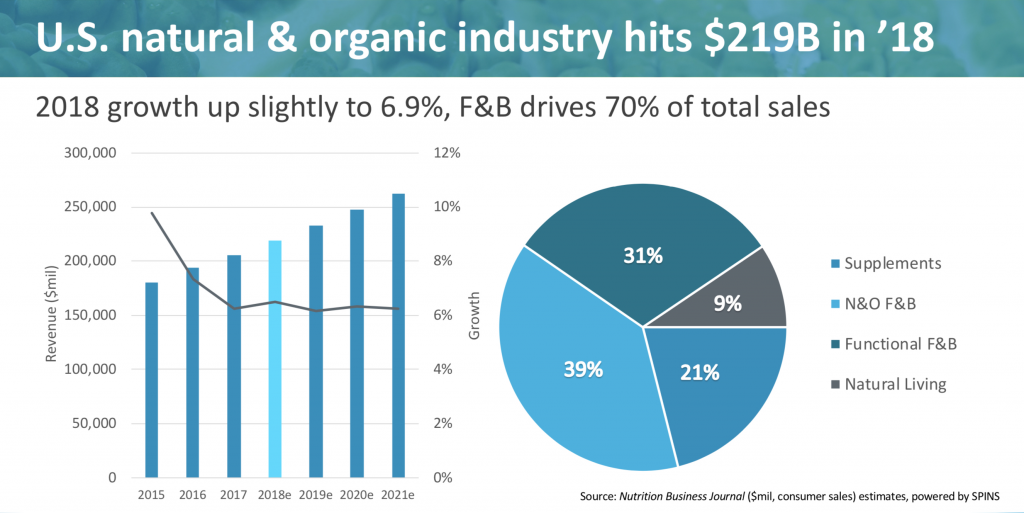


In 2018, sales of natural and organic products increased 6.9 percent to $219 billion, according industry market research leader New Hope Network, while sales of conventional food and beverage products, totaling $634 billion, declined by -0.2 percent. “It’s not news that sales of natural, organic and functional foods and beverages are growing at a far faster pace than conventional food and beverage,” said Carlotta Mast, New Hope’s Senior VP of Content and Insights, in an industry trends seminar presented at Natural Products Expo West in Anaheim, CA, in March 2019. (Attracting nearly 90,000 visitors from over 70 countries, Expo West is the world’s largest natural and organic products trade show.) “The natural and organic products industry is on track to surpass $250 billion in sales by 2021,” Mast added.

In a real sense, Mast noted, conventionally produced, highly processed food and beverage products with artificial flavors, colors and other ingredients are experiencing negative growth. All the growth today in the food and beverage sector is in natural, organic, nutritional, non-GMO and other clean label products. From a small health food and crunchy, hippy movement of independent natural foods stores and co-ops in the 1950s, ‘60s and ‘70s, natural and organic is now leading the way in food and beverage retail and manufacturing innovation – marking a huge shift in the market and in the consumer mindset.

Online vs Brick & Mortar

While manufacturers are compelled in today’s market to pursue what’s referred to as “omnichannel” sales strategies, natural and organic continues to be a “brick and mortar” industry, with 86 percent of total sales being rung up in either mass market or natural foods stores. Conventional grocery retailers including Kroger, Walmart, Costco and others are taking a larger chunk of the market. According to New Hope data, 60 percent of total natural and organic product sales are happening in the mass market and mainstream conventional grocery channel, which grew 7.4 percent to $130 billion in 2018. However, more midsize natural food retail chains such as Sprouts Farmers Market (NASDAQ: SFM), Natural Grocers (NYSE: NGVC) and others, which are dedicated to selling predominately natural and organic products, continue to perform well.

“The natural channel, which helped create this industry and continues to be vitally important, grew at a slower rate of 3.3 percent to reach about $58 billion in sales in 2018. Although natural is now smaller than the mass market channel, it is still strategically important, particularly for new brands,” Mast said.

Online sales are getting a lot of attention in the natural and organic products space, but according to 2018 data from New Hope Network, e-commerce is driving less than five percent of total sales. However, “that will change pretty quickly over time,” Mast said. E-commerce is becoming increasingly important as a launch pad for new products and brands, and online sales for natural and organic products grew 18 percent to reach $8.4 billion in 2018. “In a survey of 300 natural brands, half of the new companies that entered the market between 2015 and 2018 started selling online before they moved into any kind of retail distribution. That’s a huge shift for our industry,” Mast noted.

“Even with wild swings in the economy over the past nine years, people are moving into natural for health reasons and not financial ones,” said Nick McCoy, Co-founder and Managing Director of Whipstitch Capital, a leading independent M&A and private placement advisory firm focused on the healthy living consumer market. And the good news for natural products businesses trying to establish themselves in the market is that “retailers are still embracing smaller brands, even in conventional natural food sets. Once people start investing in their health, they’re not likely to go back,” he added.
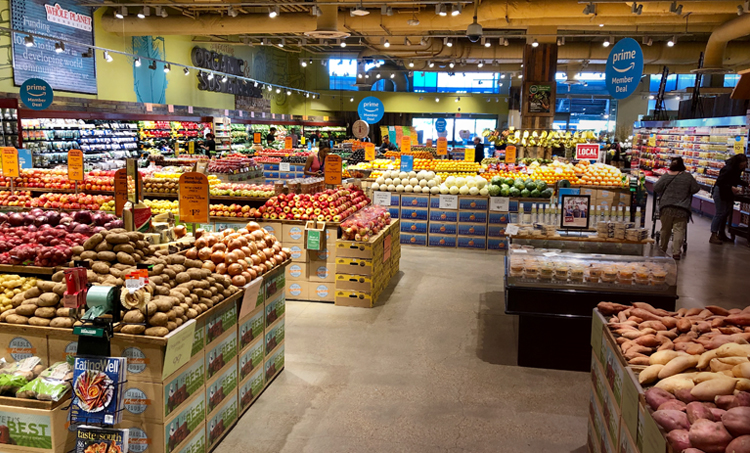
Categories and Trends Driving Growth in Natural and Organic

Organic: Sales of organic foods and beverages grew 5.6 percent to become a $45 billion market segment in 2018. According to the Organic Trade Association, the organic industry’s leading trade group, in the last decade alone, the U.S. organic market has more than doubled in size. According to New Hope’s Mast, “Organic is absolutely mainstream now and with increased volume and size has come a slight slowing of growth. Some of this has come from the struggles of organic dairy, which makes up 14 percent of the category, and last year the organic dairy category continued to see growth plateau due to oversupply and growing consumer preference for plant-based beverages,” Mast observed. According to New Hope’s data, organic produce – fresh fruits and vegetables – comprises 38 percent of all organic sales. “Organic supply is lagging behind growing consumer demand, a challenge the organic industry has to address,” Mast added.

According to the Research Institute of Organic Agriculture (FiBL) and IFOAM Organics International, leading international organizations based in the EU, the global market for organic food reached an estimated $97 billion USD in 2017 (approximately 90 billion euros). The U.S. is the leading market with 40 billion euros, followed by Germany (10 billion euros), France (7.9 billion euros), and China (7.6 billion euros). The Swiss spent the most on organic food (288 Euros per capita in 2017), and Denmark had the highest organic market share (13.3 percent of the total food market). In 2017, 2.9 million organic producers were reported worldwide, a five percent increase over 2016. Total global farmland under organic production increased 20 percent to nearly 70 million hectares (173 million acres), representing the largest growth ever recorded by FiBL and IFOAM. Yet for all the global success of organic, only 1.4 percent of the total estimated world farmland is organic. Organic production, and in particular, Regenerative Agriculture, with its focus on sequestering carbon and building healthy soils, has the potential to help mitigate climate change and is a powerful new movement emerging in sustainable food and farming.

Plant Based: With a $183.8 million IPO filing submitted recently by plant-based meat alternative company Beyond Meat, maker of the Beyond Burger, plant-based foods are now firmly a trend, as more Americans seek “flexitarian” diet options to reduce the consumption of meat and incorporate more plant based options in their diet. According to the Plant Based Foods Association, sales of plant-based foods grew 20 percent in 2018 to more than $3.3 billion. This growth is significant when compared to the sales of all foods, which grew just 2 percent, so plant-based foods dollar sales are outpacing dollar sales of all retail foods by 10X, the association claims. In particular, plant-based dairy alternatives are a rapidly growing category with 50 percent growth reported. This category includes plant-based cheeses, creamers, butter, yogurts, and ice creams (but not plant-based milk). Plant-based milk now represents 15 percent of the total milk market, says the Plant Based Foods Association.

Hemp and CBD: According to data collected by Nutrition Business Journal, sales of products derived from industrial hemp, including full spectrum hemp extract and CBD products, grew 60 percent to reach $238 million in 2018. Industrial hemp, while derived from the same Cannabis sativa plant as marijuana, is defined as containing less than 0.3 percent THC. At such low levels, hemp is the non-intoxicating cousin to marijuana. With more than 25,000 recorded uses throughout human history from building materials, paper and bioplastics to textiles and fashions, superfoods and natural medicines, hemp is rich in other cannabinoid compounds, of which CBD or cannabidiol is the most widely known. These cannabinoid compounds have been shown to be beneficial to human and animal health. In a historic move championed by U.S. Senator Mitch McConnell (R-KY), industrial hemp was legalized in the United States for the first time in over 80 years when the 2018 Farm Bill was signed into law by President Trump in December 2018. For farmers seeking alternative crops to GMO corn and soy and tobacco, hemp has been a godsend. According to industry group Vote Hemp, total acreage under hemp cultivation in the U.S. exceeded 78,000 acres, an increase of nearly 26,000 acres over 2017 estimates. For independent natural product retailers, sales of CBD products, are now legal across the U.S., though some states and municipalities are still challenging the national law. And while the Food and Drug Administration (FDA) is monitoring sales of CBD products, the agency has indicated it will allow the market to evolve while also keeping a close watch on potential bad players who make misleading or fraudulent claims on products.

Functional Foods and Ingredients: Consumers are opting for food and beverage products that provide real health benefits and functionality, reported Mast. Beverages and functional snacks helped drive 7.5 percent growth in this category to $68 billion in sales in 2018. The most popular functional ingredients included the herb ashwaganda, pre- and pro-biotics, and hemp and CBD. “The growth in probiotic foods and beverages represent a continued blurring of the lines between dietary supplements and foods and beverages, as consumers have a growing preference for non-pill and non-capsule delivery forms for functional products,” Mast shared. In addition, the “snackification” convenience trend continues to drive expansion in better-for-you and functional snacks.
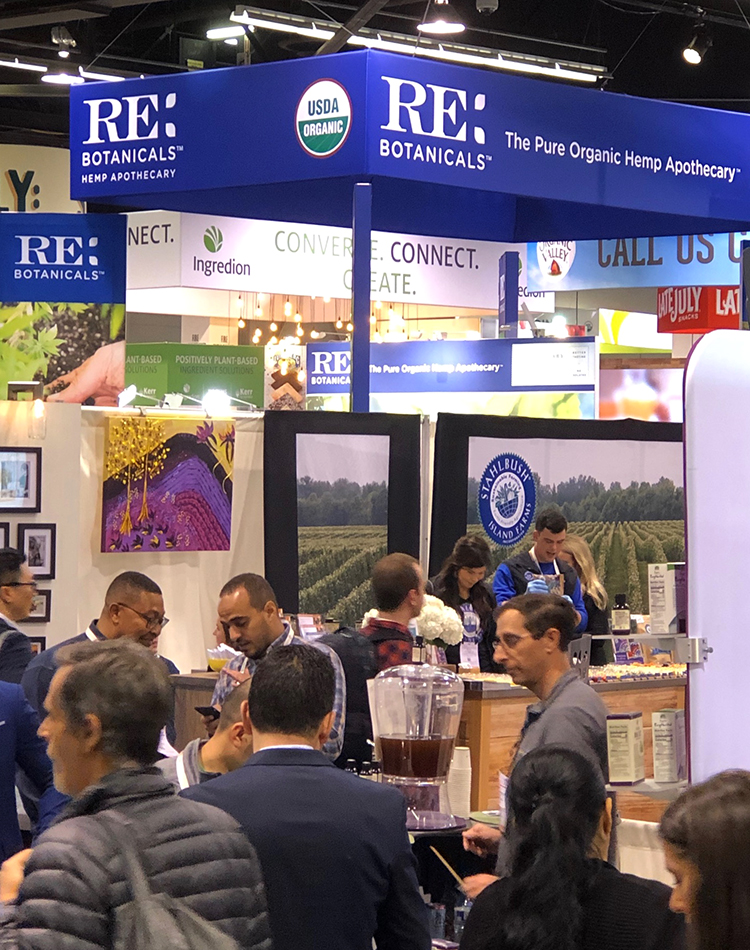
Dietary Supplements: Sales of nutritional supplements grew 6.1 percent in 2018 to $46 billion, driven by sales of collagen products, adaptogenic herbs and other botanical products, mushrooms and other immune support products, anti-inflammatory products such as turmeric, pre- and pro-biotics, multivitamins, and CBD and hemp products.

Natural Living: A $20.8-billion category comprising natural personal care and beauty care products, household products and pet care. In addition to pet care, product trends driving this category, which grew 6.5 percent in 2018, include household cleaners (double-digit growth), organic oral care and feminine care products. Mast observed that consumers in this “self-care” category are embracing clean beauty and paying more attention “not only to what they put into their bodies but also what they put on their bodies and bring into their homes.”

Pet Products: “Natural and organic pet products outperformed all other categories in 2018 – sales growth for the natural pet category was up 10.2 percent to $7 billion,” reported Mast, who also shared that growth in natural and organic pet products far outpaced the 1.9 percent growth achieved in 2018 by the $26-billion conventional pet products market. “More than 70 percent of Millennials currently own a pet, according to the American Pet Products Association, and 86 percent of Millennials believe that natural and better-for-you pet food is vital for the health of their pet,” Mast added.

Sugar Ain’t So Sweet: Other “macro trends” driving the market include changing consumer perceptions around nutrition and healthy fats, and a growing awareness that “sugar isn’t all that sweet when it comes to health.” Diet trends include the Paleo and Keto diets, and convenience still rules, but products have to have great nutrition and taste. Consumers are also becoming increasingly concerned about packaging waste and are looking to support inventive business and ownership models, sustainable sourcing and packaging, and fair trade, socially responsible and mission driven brands.

Where to Invest?

Motley Fool writer Brian Stoffel says, “If you’re looking for the short answer as to who will be the big winners in the organic and natural food movements, the answer is simple: smaller, local organic farmers … and Amazon (NASDAQ: AMZN).” The reasons, he says, include the trend that today’s Millennials – now the largest demographic spending group – want to purchase from brands that are more organic, smaller, and locally focused. Stoffel posits that when bigger brands buy out smaller natural and organic brands, today’s savvy consumers simply pivot to different brands that better reflect their desires.

On the other side of the coin, Stoffel’s reasoning behind considering online power house Amazon as a major player in natural and organic products is its position as owner of natural products retail pioneer Whole Foods Market, as well as its leadership position in the e-commerce world where it sells millions of natural and organic products at low margins.

In between are a number of publicly traded companies including distribution leader UNFI (NYSE: UNFI) and mid-size natural and organic products retail chains Sprouts Farmers Market (NASDAQ: SFM) and Natural Grocers (NYSE: NGVC). Seeing the shift in consumer preference to natural and organic, major retailers including Kroger (NYSE: KGR), Costco (NASDAQ: COST), Walmart (NYSE: WMT) and others have all become significant sellers of natural and organic products. Kroger, which reported more than $16 billion in natural and organic products sales in 2017 and double-digit growth of natural products over the past several years, also is a majority investor in Lucky’s Market, a rapidly growing, midsize natural and organic products retail chain with 35 stores in 11 states.

In the exploding market for hemp and CBD products, a handful of companies have emerged as market leaders, among them some publicly traded companies including Charlotte’s Web (NASDAQOTH: CWBHF), Elixinol (OTCMKTS: ELLXF), CV Sciences, sold under the brand name +CBD Oil (NASDAQOTH: CVSI), Isodiol International (CNXS: ISOL), Aurora Cannabis (OTCMKTS: ACBFF), Canopy Growth (NYSE: CGC), and others.

As a closing piece of advice, independent natural foods retailer Philip Nabors, co-founder of the family-owned Mustard Seed Market in Akron and Cleveland, OH, proffers that while an investment in market giant Amazon might seem attractive, it does not necessarily support local business and economies. “Green investors who want to place some of their funds in higher risk investments might want to consider investing in local businesses, where such investments can more directly impact local communities – and also where individual investors can invest not only money, but potentially time, energy, resources, and relationships, and be rewarded with a more immediate connection in the communities in which they live, and in the long run as these businesses grow and build value,” he says.


Article by Steven Hoffman, Managing Director of Compass Natural, a company dedicated to providing brand marketing, public relations, social media, and strategic business development services to natural, organic and sustainable products businesses. A former agricultural extension agent and also former Editorial Director of New Hope Network’s natural products trade magazine and trade show division, Hoffman brings 30+ years of communications, sales and brand marketing expertise to his clientele. Contact him at steve@compassnaturalmarketing.com
Featured Articles, Food & Farming, Impact Investing, Sustainable Business

A Seed to Stalk Future: Financing America’s Grain Economy

By Leah Thibault & Brett Richardson, CEI Capital Mgmt & Coastal Enterprises, Inc.

The idea of “nose-to-tail” dining, shorthand for using as much of an animal as possible, has no field-grown counterpart. What about the grains that make up so much of our agricultural production and diet? Where is our “seed to stalk?”

Crafting a Sustainable Grain Cycle

In Maine, a collective of innovative businesses is making sure that grain is valued from field to glass to trough, thanks to the state’s vibrant craft beer industry.

The 92 breweries that make up the Maine Brewer’s Guild use nearly 76 million pounds of malt each year [1]. Malt, which makes up over 90 percent of the non-water ingredients in beer, is made from barley, wheat, and other grains. But until 2014, there was no local source for this vital ingredient, meaning that $35 million of malt was imported from out of state.

To provide the missing link in the creation of a Maine beer made with 100 percent local ingredients, entrepreneur Joel Alex established Blue Ox Malthouse, sourcing and malting Maine grains. In Maine, barley is typically grown as a rotation crop, mostly for potatoes. Since rotation crops are typically undervalued for that single purpose, they are plowed under to replenish the soil, or sold cheaply for animal feed. Blue Ox Malthouse, however, offers farmers an alternative offtake and gives local breweries a critical local ingredient. The project is a win-win-win for the whole brewers’ supply chain. Today, Blue Ox Malthouse counts 100 different breweries in Maine and New England as customers and works with about 10 local Maine farmers.

“At Blue Ox Malthouse, we aren’t just building a business; we are building missing infrastructure in a supply chain that is maximizing connections between local brewers and local farmers. We enable new and old breweries to push innovation, create good jobs in our community, and increase the economic viability of our grain suppliers,” says Joel Alex, Founder and Maltster at Blue Ox Malthouse.

But it nearly didn’t happen. There was a reason Maine wasn’t malting its own grain. Joel Alex had the winning idea, but not the capital. What kind of lender would recognize the market potential, appreciate the linkages, and take a chance on Joel? Community Development Financial Institutions (CDFIs) are ideally suited for providing this kind of patient loans and investments on terms the borrower finds reasonable. Working within the community, CDFIs understand the linkages between growers and processors and producers and retailers, and the kind of exacting balance required to grow markets. Joel was able to find a suitable lender in locally-based Coastal Enterprises Inc. (CEI), a CDFI with a long history of agricultural lending.

One outcome of the malting process is a pint of IPA, but that’s not all. In reciprocity, the waste, or spent grains from the malting process, returns to the farm. This after-product still contains a significant amount of nutrients, meaning that even after being processed, barley can still be used as livestock feed. Blue Ox has developed an efficient system for gathering the spent grains into a transportable form for local pig farms to use as a low-cost feed source.

And yet, there’s more to grain than what we eat (or drink).

Reimagining Grains

Wheat straw that is left behind in the field after a grain harvest can be used for many things, including livestock feed, animal bedding, erosion control, and even basket weaving. Often, the cost to bale and transport the straw outstrips the value of the material, so farmers are left with the choice to till the straw into the soil or burn it.

In 2016, 7.1 million metric tons of wheat straw were burned in the U.S. alone, resulting in emissions equivalent to 557,011 metric tons of C02 2. Put another way, the burning of wheat residue in the U.S. is equivalent to the greenhouse gas emissions of 118,261 passenger cars over a year 3. Emissions from wheat burning has declined by 30 percent from 1992-2016, but clearly, there is still much work to be done.

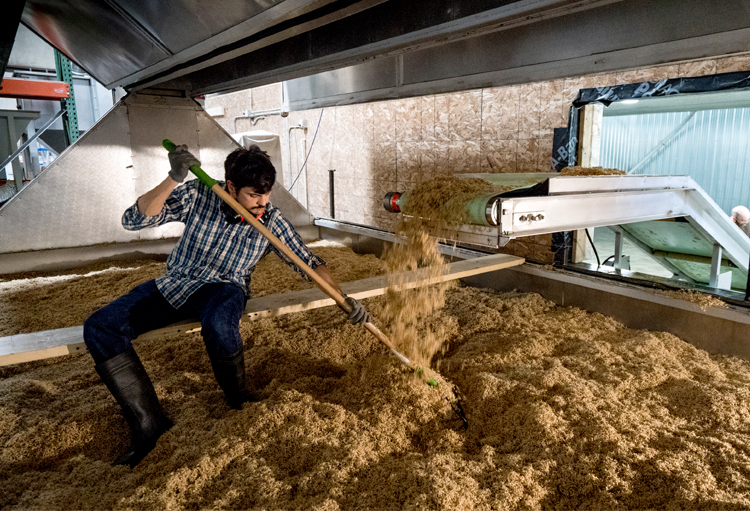
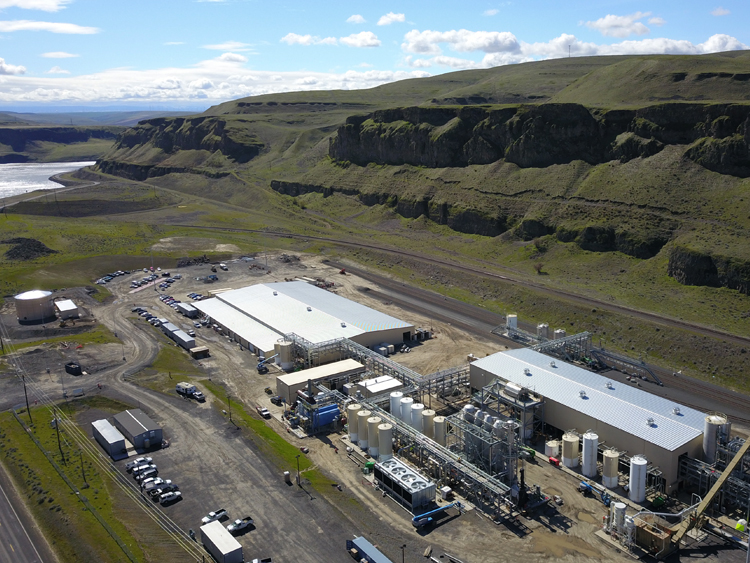
Wheat straw is seeding innovation in Columbia County, Washington. Columbia County has one of the highest concentrations of wheat farms in North America, with farmers in the region producing millions of tons of wheat straw each year, much of which is burned. To better use this resource, Columbia Pulp, LLC developed an environmentally-focused pulping process to turn the waste straw into pulp that can be used to manufacture paper products, packaging, including food grade packaging, and personal care items, as well as creating a bio-polymer that has numerous industrial applications including dust control, de-icing and animal feed.

“We are excited about our ability to convert a troublesome waste product for the farmers into a useable product. In addition, we are the first tree-free pulping facility to be constructed in North America. It’s our desire to bring sustainable, non-wood, market grade pulp to the marketplace. Customers are demanding it, end users are demanding paper products that have a lower impact on the environment,” says Michele McCarthy, CFO/Board Member of Columbia Pulp.

This brand-new enterprise forecasts it will process 230,000 tons of wheat straw annually. That new straw market will produce about $14 million in new annual income for the region’s farmers and their associated contractors from the sale of wheat straw. It will also significantly reduce farmers’ cost of burning the straw, all while reducing annual greenhouse gas emissions from straw burning in Washington State by 40,000 tons.

As was the case with an innovative idea in Maine, traditional financing would not be enough to fund the new concept in Washington State. Entrepreneurship in rural America too often dies on the vine because of underinvestment. In this case, public-private partnerships were necessary to make Columbia Pulp a reality, and the business came online this month thanks to a combination of Washington State bond financing, private equity, and a New Markets Tax Credit-incentivized loan from Maine via CEI Capital Management, a subsidiary of CEI.

Planting Future Seeds

Grain-based innovation is happening in rural America, no surprise given the deep knowledge of and connection to the field. Grain processors help develop new markets for farmers, create jobs and may provide a greener usage for this underutilized crop. But innovation and impact can be stymied by lack of access to appropriate funding, particularly financing that is flexible and adaptable to the seasonal nature of agricultural cycles. Mission-driven investors like CEI and its subsidiaries, with access to various forms of capital and more flexibility than traditional lenders, are well-equipped to provide both technical assistance and financing to businesses of varying size and scale.

With companies like Blue Ox Malthouse and Columbia Pulp placing value on all parts and life-stages of grain plants, “seed to stalk” dining isn’t just a theory. It’s easy enough to imagine a meal eaten on plate made from wheat straw pulp, where the pork in your taco came from a pig fed with spent malted grains that were used to make your beer. The future of “seed to stalk” dining isn’t only possible, it sounds delicious too.


Article by Leah B. Thibault and Brett Richardson

Leah B. Thibault, as Director of Executive Administration and Special Projects for CEI Capital Management, Leah provides a wide range of strategic and administrative support to CEI Capital’s work financing businesses in underserved rural areas across the United States. Prior to joining CEI Capital, Leah worked in the non-profit performing arts and educational sectors. Leah holds a B.A. from Willamette University in Salem, Oregon.

Brett Richardson, as Director of CEI’s Sustainable Agriculture and Food Systems program, Brett supports innovative food and beverage companies with growth planning and sustainable supply chain development. Prior to joining CEI, Brett was a founding partner in a food waste collection and composting company. Brett holds a B.A. from Michigan State University and a Masters of Community Planning from the Muskie School of Public Service at the University of Southern Maine.

FOOTNOTES
[1] https://www.nytimes.com/2014/12/31/business/start-ups-rise-to-close-a-gap-for-farmers.html?emc=eta1&_r=2
[2] Data retrieved from Food and Agriculture Organization of the United Nations at http://www.fao.org/faostat/en/#data/GB/visualize  on March 11, 2019.
[3] https://www.epa.gov/energy/greenhouse-gas-equivalencies-calculator

Featured Articles, Food & Farming, Impact Investing, Sustainable Business

Global Sustainable Investment Review 2018 Reports SRI Assets Globally Surpass $30 Trillion

Report Highlights

• At the start of 2018, global sustainable, responsible and impact (SRI) investment assets reached $30.7 trillion, a 34 percent increase from 2016.

• Responsible investment commands a sizable share of professionally managed assets in each region, ranging from 18 percent in Japan to 63 percent in Australia and New Zealand.

• Europe accounts for the largest pool of sustainable investment assets with €12.3 trillion ($14.1 trillion) in assets under management, followed by the United States with $12.0 trillion.

• Negative/exclusionary screening remains the most prevalent sustainable investment approach globally, affecting $19.8 trillion in assets, followed by ESG integration, applied to $17.5 trillion in assets.

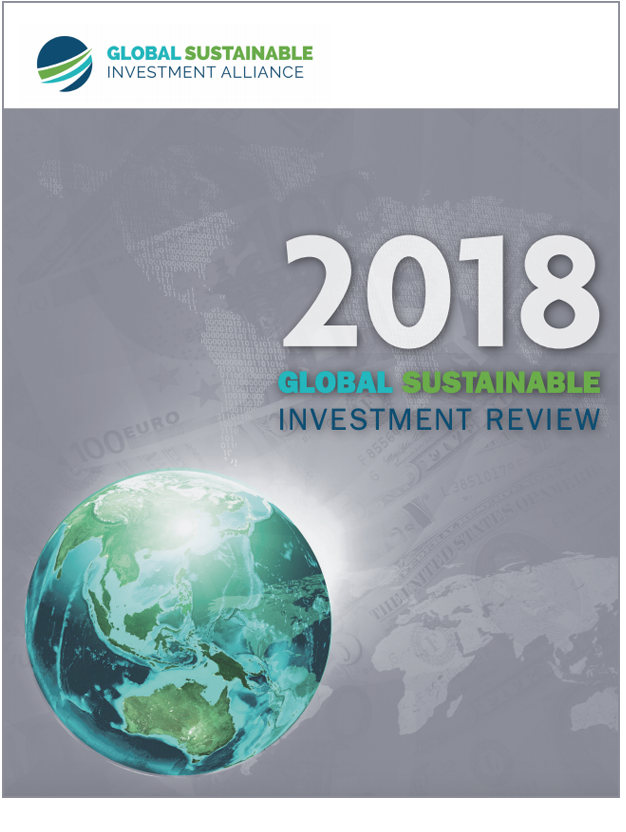
In early April 2019, the Global Sustainable Investment Alliance (GSIA) released its biennial Global Sustainable Investment Review 2018, showing that global sustainable investment assets reached $30.7 trillion at the start of 2018, a 34 percent increase from 2016.

In its fourth edition, the biennial Global Sustainable Investment Review brings together the results from regional market studies by the sustainable investment forums of Europe, the United States, Japan, Canada, and Australia and New Zealand. It also includes data on the African sustainable investing market in cooperation with the African Investing for Impact Barometer and highlights from several countries in North, Central and South America provided by the Principles for Responsible Investment.

The 2018 Global Sustainable Investment Review found that sustainable investing assets have grown in all regions except Europe. While Europe accounts for the largest concentration of sustainable investment assets globally, with total assets of €12.3 trillion ($14.1 trillion), Europe’s share of the overall market declined from 53 percent to 49 percent of total professionally managed assets. The slight drop may be due to a move to stricter standards and definitions of sustainable investing.

The United States is the second largest region based on its value of sustainable investing assets. Total US-domiciled assets under management using sustainable strategies grew from $8.7 trillion at the start of 2016 to $12.0 trillion at the start of 2018, an increase of 38 percent.

In Japan, sustainable investing assets quadrupled from 2016 to 2018, growing from just 3 percent of total professionally managed assets in the country to 18 percent. This growth has made Japan the third largest center for sustainable investing after Europe and the United States.

For the first time, Australasia (Australia and New Zealand) is the region with the greatest proportion of sustainable investment assets relative to total assets under management, with 63% of assets in Australasia using a responsible investment approach.

The largest sustainable investment strategy globally is negative/exclusionary screening ($19.8 trillion), followed by ESG integration ($17.5 trillion) and corporate engagement/shareholder action ($9.8 trillion). Negative screening remains the largest strategy in Europe, while ESG integration continues to dominate in the United States, Canada and Australia/New Zealand in asset-weighted terms. Corporate engagement and shareholder action is the dominant strategy in Japan.

Norms-based screening has lost ground in Europe, with substantially fewer assets managed under this strategy than in 2016. Despite modest growth in Canada, and more rapid growth in Japan in assets managed under norms-based screening, the global total of these assets fell from 2016 to 2018.

Impact investing is a small but vibrant segment of the broader sustainable and responsible investing universe in all the markets studied. GSIA defines impact investing as targeted investments aimed at solving social or environmental problems. Community investing, whereby capital is specifically directed to traditionally underserved individuals or communities, is included in this category, as is finance that is provided to businesses with an explicit social or environmental purpose.

Click to download the full report.


About the Global Sustainable Investment Review

Now in its fourth edition, the biennial Global Sustainable Investment Review is the only report presenting results from Europe, the United States, Canada, Asia, Japan, and Australia and New Zealand.

The report draws on in-depth regional and national reports from GSIA members – Eurosif, Responsible Investment Association Australasia, RIA Canada and US SIF – as well as data and insights from the Principles for Responsible Investment, JSIF (Japan), LatinSIF and the African Investing for Impact Barometer. Together, these resources provide data points, insights, analysis and examples of the shape of sustainable investing worldwide.

The Global Sustainable Investment Review 2018 was made possible through the generosity of report sponsors Hermes Investment Management, RBC and UBS.

About The Global Sustainable Investment Alliance

The Global Sustainable Investment Alliance (GSIA) is a collaboration of membership-based sustainable investment organizations around the world. GSIA’s mission is to deepen the impact and visibility of sustainable investment organizations at the global level. Its vision is a world where sustainable investment is integrated into financial systems and the investment chain and where all regions of the world have coverage by vigorous membership-based institutions that represent and advance the sustainable investment community. For more information.

Additional Articles, Impact Investing

The Growing Organics Market Presents a Natural Investment Opportunity

By Nick Cherney, CFA, Senior VP, Janus Henderson

As Americans become more aware of the environmental and health benefits of organics, we are presented with an opportunity to align our investments with our lifestyle choices – by investing in the companies and agricultural operations that are driving organic innovation and bringing natural products to the marketplace.
“More and more, we’re seeing that people want to put their money into things they know and are passionate about,” says Nick Cherney, Senior Vice President and Head of Exchange Traded Products at Janus Henderson.

Through thematic investing, investors are able to take part in transformative forces that could permanently alter our lives and behaviors, creating opportunities shaped by meaningful change. Janus Henderson’s The Organics ETF provides investors with the opportunity to invest in organic farming operations and companies globally that provide the organic food, beverages and cosmetics we use in our everyday lives.

Organic Goods are a Sustainable Global Trend

With many Americans focused on living healthier and more natural lifestyles, organic foods and products are moving into the mainstream. By 2014, 85 percent of Americans were already buyers of organic products, according to a Consumer Reports survey, with nearly half (45 percent) doing so at least once per month.[1] As a result, the U.S. organics industry increased nearly thirteen-fold, from $3.6 billion in 1997 to more than $45 billion in 2017.[2]

Demand for organics is growing internationally as well. The U.S. exported roughly $550 million worth of organics in 2016, up from $412 million in 2011, and the global organic food market is projected to achieve a compound annual growth rate of 16 percent through 2020.[3]

But the organics market isn’t limited to food – it also includes personal care goods, including cosmetics, hair and skin care products. The global organic personal care industry is expected to reach almost $16 billion in revenue by 2020. Skin care alone may see a compound annual growth rate of 9.8 percent from 2014 to 2020.[4]

The Market is Booming for Organic Farmers

The increasing global demand for organic products is creating a noticeable shift in supply, offering a clear opportunity to invest in organic farming.

Certified organic farming has been expanding in the United States for years, particularly for fruits, vegetables, dairy and poultry. Farmers with certified organic operations use production practices with environmental benefits such as water management practices, no-till, habitat maintenance for beneficial insects and biological pest control. Generally, organic operations are required to consistently demonstrate that they are protecting natural resources, conserving biodiversity and using only approved substances.[5]

The environmental benefits of organic agriculture have become increasingly apparent to consumers and farmers alike. As of April 2017, there were more than 24,000 certified organic farming operations in the United States and over 3,000 farms transitioning to organic products.[6] As organic agriculture continues to grow exponentially, it is clear that we’ve only just begun to scratch the surface of organic farming and markets.

An Industry Coming of Age

The growth of the organics marketplace and the opportunity it represents has not gone unnoticed. The evolution from niche to mainstream is illustrated by the growing interest of major consumer goods companies in gaining a foothold in this potentially lucrative market. One barometer of this interest is merger and acquisition (M&A) activity. Developing winning products and identifying attractive market segments can be a painstaking endeavor, often undertaken by nimble first movers who have spent years honing their offerings. Given the rise in demand for organic products, established food and consumer products companies realize they can no longer ignore this segment. Rather than take the trial-and-error path of product development, established companies are instead buying their way into the organics space. This was the impetus behind France’s Danone 2016 acquisition of WhiteWave Foods, a maker of organic dairy, plant-based and other agricultural products. In addition to the $12.3 billion price tag, Danone’s appetite for increasing its organics offerings is also evidenced by the 23% premium it paid for WhiteWave, based on the company’s pre-deal stock price.

Distributors are also seeking to make inroads with organics-focused consumers. Amazon’s $13.6 billion purchase of Whole Foods Market in 2017 caught the retail food sector by surprise, not only due to the e-commerce giant moving aggressively into the brick-and-mortar segment, but also by expanding the potential organics market to Amazon Prime members, which numbered 80 million at the time of the deal. Similar to Danone’s WhiteWave acquisition, Amazon was willing to pay nearly a 20% premium for Whole Foods stock.

While these deals grabbed headlines, smaller M&A activity continues as the industry consolidates and legacy consumer products companies take steps to defend their overall market share. The increasing consumption of organic products alone can make a compelling investment thesis. The likelihood of M&A activity continuing as the industry matures, however, may serve as an additional catalyst for investment returns, if one uses the premiums paid for recent deals as a metric.

Investing in a Natural Future

As consumer and investor interest in natural products continues to grow, more companies may be willing to focus on organics, expanding the marketplace and the impact these goods can have on people’s wellness and investment portfolios. Organic farming operations and companies that advance these causes by bringing naturally derived foods and products to the marketplace should continue to benefit, as consumers’ affinity toward these products shows no signs of waning.

For impact investing enthusiasts interested in aligning their investments with their values, The Organics ETF represents an opportunity to put their money where their mouth is.


Article by Nick Cherney, CFA, Senior Vice President, Head of Exchange Traded Products at Janus Henderson Investors. Mr. Cherney was the chief investment officer and co-founder at VelocityShares from 2009 until Janus’ acquisition of the company in 2014. Prior to VelocityShares, he worked at Barclays Capital in New York and had product development and management responsibilities for iPath ETNs. Previous to this role, Mr. Cherney was a portfolio manager for iShares at Barclays Global Investors in San Francisco, where he managed more than $25 billion of ETF assets across asset classes. Earlier, he was an index research analyst at Barclays Global Investors. Mr. Cherney is frequently sought out by leading financial publications and news agencies including CNBC, Bloomberg TV, the Financial Times, The Wall Street Journal, Reuters and Barron’s, among others.

Mr. Cherney received a bachelor of arts degree in economics from the University of California – Berkeley, where he graduated with highest honors. He holds the Chartered Financial Analyst designation and has 13 years of financial industry experience.


Please consider the charges, risks, expenses and investment objectives carefully before investing. For a prospectus or, if available, a summary prospectus containing this and other information, please call Janus Henderson at 800.668.0434 or download the file from https://janushenderson.com/info. Read it carefully before you invest or send money.

ETF shares are not individually redeemable and owners of the shares may acquire those shares from the Fund and tender those shares for redemption to the Fund in Creation Units only.

OBJECTIVE: The Organics ETF (ORG) seeks investment results that correspond generally to the performance, before fees and expenses, of an index which is designed to track the performance of companies globally that are positioned to profit from increasing demand for organic products, including companies which service, produce, distribute, market or sell organic food, beverage, cosmetics, supplements, or packaging.

Investing involves risk, including the possible loss of principal and fluctuation of value. There is no assurance the stated objective(s) will be met.

RISKS: ORG focuses its investments in organic products companies. Because of this, companies in the Fund may share common characteristics and may be more sensitive to factors such as consumer demand, consumer confidence and spending, environmental factors and production costs. As a result, the Fund may be subject to greater risks and the value of its investments may fluctuate more than a fund that does not focus its investments.

The opinions are as of 4/26/19 and are subject to change without notice. Janus Henderson may have a business relationship with certain entities discussed. The comments should not be construed as a recommendation of individual holdings or market sectors, but as an illustration of broader themes.

As of 4/26/19, the top 10 portfolio holdings of The Organics ETF are: Chr Hansen Holding A/S (20.68%), Sprouts Farmers Market Inc (10.74%), Hain Celestial Group Inc (8.17%), Green Organic Dutchman Holdings Ltd (5.43%), Wessanen (5.37%), Bellamy’s Australia Ltd (4.92%), John B Sanfilippo & Son Inc (4.69%), Ariake Japan Co Ltd (4.58%), L’Occitane International SA (4.47%) and United Natural Foods Inc (3.52%). There are no assurances that any portfolio currently holds these securities or other securities mentioned.

Holdings are subject to change without notice. For a complete list of holdings as of the most recent publicly available disclosure period, visit https://janushenderson.com/info

Janus Capital Management LLC is the investment adviser and ALPS Distributors, Inc. is the distributor. ALPS is not affiliated with Janus Henderson or any of its subsidiaries.

JNS788 / C-0419-23797 05-30-20

Article Footnotes:
[1] Consumer Reports. As of March 2014.
[2] Organic Trade Association, National Restaurant Association. As of April 2017.
[3] TechSci Research, Organic Trade Association. As of April 2017.
[4] Grand View Research. As of August 2015.
[5] Organic Farming Research Foundation. As of January 2018.
[6] Organic Trade Association. As of May 2018.

Featured Articles, Food & Farming, Impact Investing, Sustainable Business

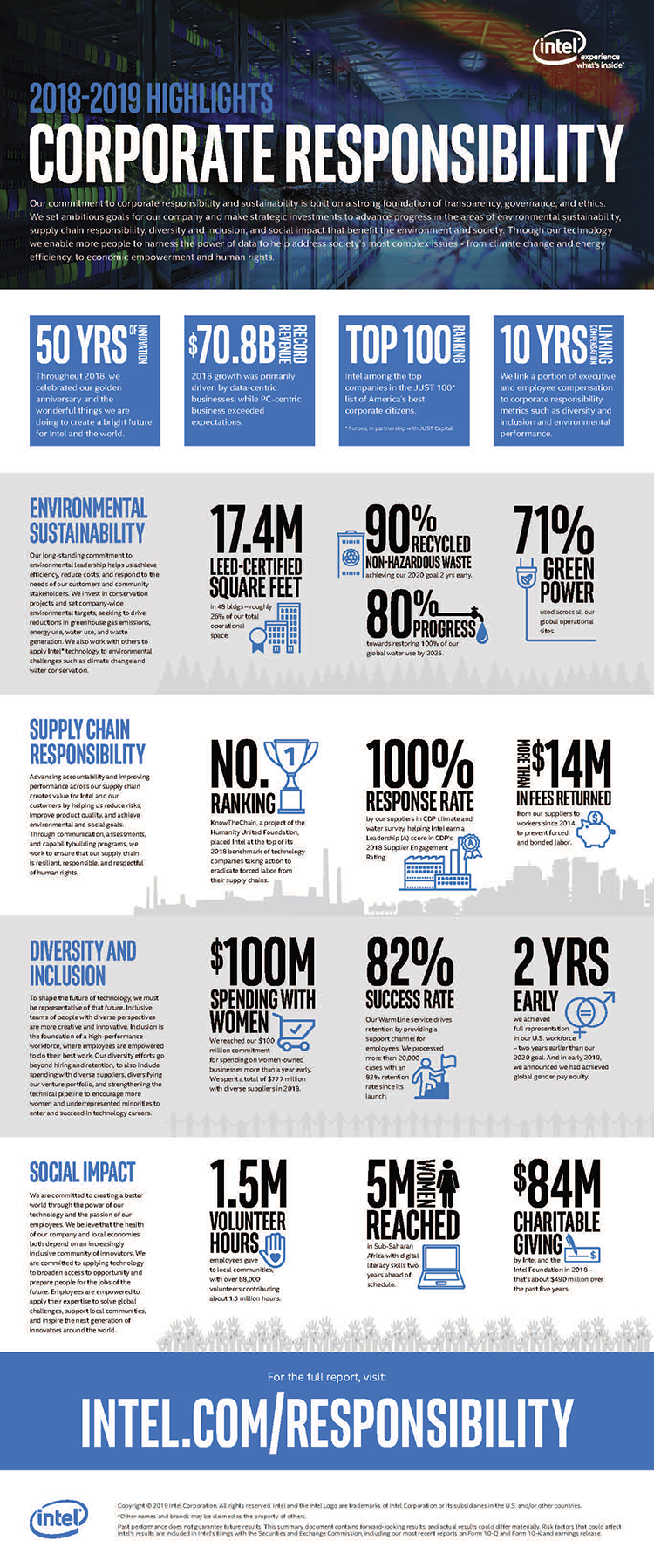
Intel releases 2018-19 Corporate Responsibility Report: Creating Value Through Transparency

How Intel Evolves its Reporting Strategy so it’s Meaningful to Investors, Customers and Employees

In the two decades that Intel has been releasing environmental and corporate social responsibility (CSR) reports, the CSR reporting landscape has changed dramatically. Once a topic reserved for specialists, today 85% of S&P 500 companies[1] regularly publish CSR reports and many reporters cover CSR for major media organizations.

In mid-May, Intel released its latest CSR report, highlighting the progress made over the past year toward our 2020 goals. But do these reports really matter?

We at Intel think they do – more than ever, in fact – because of how important they are to our stakeholders, including investors, customers and employees. These groups demand more accountability than ever, and companies have an obligation to be transparent with them.

Investors

Investors are increasingly focused on environmental, social and governance (ESG) issues. From 2016 to 2018, sustainable investment assets – including portfolios screened for ESG issues, investors integrating ESG factors into their investment and/or engaging in shareholder advocacy activities – grew 38 percent in the U.S. As of 2018, such assets totaled $12 trillion, accounting for $1 of every $4 under professional management.[2] This increase is largely driven by mainstream investors integrating ESG issues into their strategies.

At Intel, we have expanded our year-round outreach to investors on ESG issues to obtain regular feedback on our reporting and performance. In response, we aligned our reporting to new external frameworks used most by investors, further increased integration across our annual report/10-K, proxy statement and corporate responsibility report and expanded disclosure on how our approach affects our financial results. For example, since 2012 we have invested more than $200 million in energy conservation projects in our global operations, resulting in more than 4 billion kilowatt-hours conserved and approximately $500 million saved through the end of 2018.

Customers

More companies are driving responsibility programs throughout their global supply chains and looking for improved data to help them evaluate supplier performance. Intel’s major customers are other large global companies that have their own commitments to corporate responsibility and sustainability, including formal supplier expectations. Our report helps them quantify their indirect environmental footprint and better understand how possible labor risks are assessed in the extended supply chain. We earned a leadership score in CDP’s 2018 Supplier Engagement Rating for our work to encourage improved climate and water reporting by our suppliers. We also made significant progress toward our goal to restore 100 percent of our global water use by 2025, and we’re on track to achieve our 2020 water-use reduction goal. Also, as a result of our work to prevent forced and bonded labor in our supply chain, our suppliers have returned over $14 million in fees to workers since 2014.

Employees

Research indicates that an employer’s corporate responsibility reputation and programs are often very important to employees. Intel’s success depends on our ability to attract and retain top talent by making Intel an employer of choice and fostering a strong and inclusive culture. In 2018, we reached full representation in our U.S. workforce, two years ahead of our original goal. And in early 2019, Intel achieved global gender pay equity. Eighty-five percent of our employees surveyed reported that Intel’s corporate responsibility efforts contribute to their pride in the company. And our employees are more involved in their communities than ever, with 68,000 employees volunteering 1.5 million hours last year.

For CSR reporting to serve our investors, customers and employees well, we must get the right data to the right audiences at the right time. This requires use of technology to enable real-time data collection, insights and reporting, and it requires processes such as independent report assurance, to improve data quality, reliability and comparability. It requires further integration with financial reporting teams to ensure alignment to the business and relevance to investors. And, most importantly, it requires ongoing conversations with stakeholders as their needs evolve.

Intel’s leaders believe in the value of transparency to our key stakeholders, and these reports are a critical part of that transparency. As we work toward our next generation of corporate responsibility and sustainability goals, we will continue to work to make our CSR reporting better, timelier and more useful, and we hope that others companies do the same.

Download Intel’s Corporate Responsibility Report:

Highlights (Fact Sheet)

2018-19 Full Report


Editorial article by Suzanne Fallender, director of Corporate Responsibility at Intel Corporation

In this role, Suzanne collaborates with key stakeholders across the company to integrate corporate responsibility concepts into company strategies, policies, public reporting, and stakeholder engagement activities to advance Intel’s corporate responsibility leadership and create positive social impact and business value. Suzanne leads a team of experienced professionals who engage with internal and external groups to review Intel’s corporate responsibility performance and to identify new opportunities to apply Intel’s technology and expertise to address social and environmental challenges. The team also works closely with Intel’s investor relations and corporate governance groups to drive an integrated outreach strategy with investors on governance and corporate responsibility issues.

Suzanne has more than 20 years of experience in the field of corporate responsibility and socially responsible investment. During her time at Intel, Suzanne has held a number of corporate responsibility-related roles, including leading Intel’s Global Girls and Women’s Initiative, a set of programs and partnerships designed to empower millions of girls and women around the world through technology and education. Prior to Intel, Suzanne served as Vice President at Institutional Shareholder Services where she managed the firm’s socially responsible investing division.

About Intel

Intel (NASDAQ: INTC), a leader in the semiconductor industry, is shaping the data-centric future with computing and communications technology that is the foundation of the world’s innovations. The company’s engineering expertise is helping address the world’s greatest challenges as well as helping secure, power and connect billions of devices and the infrastructure of the smart, connected world – from the cloud to the network to the edge and everything in between. Find more information about Intel at https://newsroom.intel.com and https://www.intel.com

Article Footnotes:
[1] Governance and Accountability Institute
[2] US SIF Foundation, Report on U.S. Sustainable, Responsible, and Impact Investing Trends 2018 – https://www.ussif.org/trends

Intel and the Intel logo are trademarks of Intel Corporation in the United States and other countries.

2018-19 Intel Corporate Responsibility

Additional Articles, Impact Investing, Sustainable Business

Signup to receive GreenMoney's monthly eJournal

Privacy Policy
Copyright © GreenMoney Journal 2025

Website design & development by BrandNature

Global Events Calendar

View All Events

april

21aprAll Day232026 Sustainable Packaging Coalition: SPC Impact – Nashville

27aprAll Day30Women Deliver 2026 Conference (WD2026) – Melbourne

X