Tag: Impact Investing

US SIF Foundation releases Moving Forward with Sustainable Investing: A Roadmap for Asset Owners

The US SIF Foundation recently released Moving Forward with Sustainable Investing: A Roadmap for Asset Owners to provide best practices and practical steps for retirement plans, corporations, educational institutions, philanthropic foundations, family offices, nonprofit organizations and other asset owners.

The guide is the third and final in a series of roadmaps issued by the US SIF Foundation. The roadmaps are a core deliverable from US SIF’s strategic plan goal of identifying and disseminating information about best practices within the sustainable investing field. The US SIF Foundation previously issued roadmaps for financial advisors and money managers.

“While institutional asset owners vary widely in organizational purpose and structure, they are uniquely positioned to shift the investment industry toward sustainability,” said Lisa Woll, CEO of the US SIF Foundation.

“By considering ESG factors in portfolio selection and shareholder engagement, asset owners can help ensure that their investments support—not contradict—their values or mission. Sustainable investing strategies can also help institutions and their asset managers minimize risk and improve returns over the long term.”

The Asset Owner Roadmap was created with input from investment consultants and asset owners. It covers the basics of sustainable investing and includes 10 steps asset owners can take to develop and enhance investing strategies that take environmental, social and corporate governance (ESG) indicators into account. The Roadmap also provides sample investment policy statements, proxy voting guidelines, resources on investor engagement and impact measurement and case studies of three institutional asset owners.

The case studies feature philanthropic foundation Wallace Global Fund, single-family office Blue Haven Initiative, and the California State Teachers’ Retirement System (CalSTRS), with links to resources and materials from each organization. The Wallace Global Fund case study looks at the foundation’s multi-year transition to a fully comprehensive mission investing portfolio. The Blue Haven Initiative case study highlights specific ESG considerations the family office uses to evaluate its investments in each asset class. The CalSTRS case study features the investment policy and management plan that serves as the foundation for CalSTRS’s comprehensive ESG investment approach to more than $200 billion in assets under management.

The Asset Owner Roadmap is available on US SIF’s website. To view or download a copy go to https://www.ussif.org/pubs


About US SIF

US SIF: The Forum for Sustainable and Responsible Investment is the leading voice advancing sustainable, responsible and impact investing across all asset classes. Its mission is to rapidly shift investment practices toward sustainability, focusing on long-term investment and the generation of positive social and environmental impacts. US SIF members include investment management and advisory firms, mutual fund companies, asset owners, research firms, financial planners and advisors, broker-dealers, community investing organizations and nonprofit associations. The 9th US SIF Annual Conference will take place June 10-12, 2019 in Minneapolis. Details at https://www.ussif.org/conference

US SIF is supported in its work by the US SIF Foundation, a 501(C)(3) organization that undertakes educational and research activities to advance the mission of US SIF, including offering training for advisors and other financial professionals on the Fundamentals of Sustainable and Impact Investment https://www.ussif.org/courses

Additional Articles, Impact Investing

What Innovative Companies and Women on Boards Have in Common

By Meggin Thwing Eastman, Impact and Screening, MSCI ESG Research

I started my career over two decades ago at the socially responsible research and index firm KLD Research & Analytics (which was acquired by MSCI in 2010). From this vantage point, I have watched environmental, social and governance (ESG) investing garner more and more acceptance and enthusiasm in the market. It is an exciting, compelling time to help define and shape the field of ESG as investors tackle some of the most urgent environmental and social issues of our time, from climate change to social inequalities. I have long been passionate about women’s advancement and inclusion in the workplace — MSCI ESG Research’s recent studies have found that diversity has been a compelling element of human capital management for long-term corporate resilience.

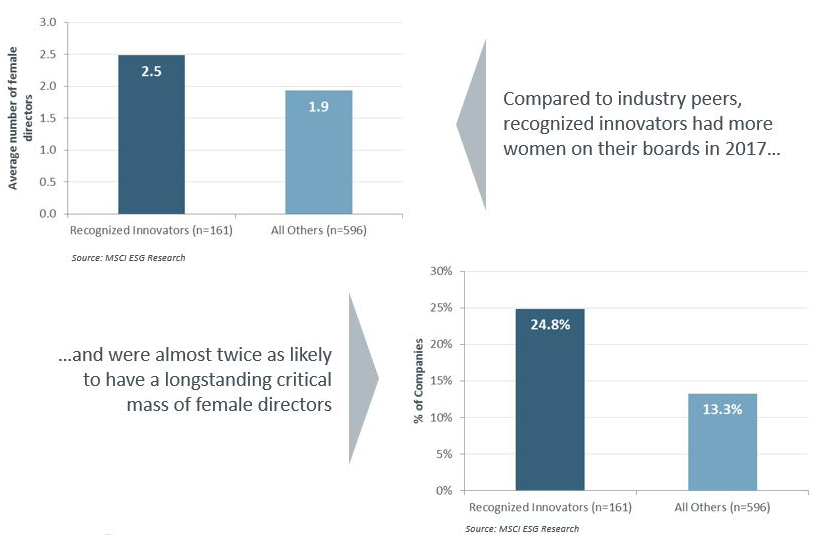
With International Women’s Day just behind us, we looked at the relationship between some of the most innovative publicly listed companies in the world — including Amazon.com Inc., Nike Inc. and Visa Inc. among others — that have something in common that you might not expect: more women on their boards than their industry peers. They also tended to have stronger diversity and inclusion programs.

We examined constituents of the MSCI ACWI Index that had been recognized as innovators on one or more annual lists produced by Forbes, Fast Company, MIT Sloan and the Boston Consulting Group between 2015 and 2018. All told, there were 202 index constituents in 42 industries over three years, with the majority (161) clustered in 17 industries, such as software and services, pharmaceuticals and automobile manufacturers. Strong female presence on the board was a defining feature of these companies compared to others in their industries.[1] They were also about 1.5 times as likely to have quantitative diversity targets for recruitment and/or senior management dedicated to overseeing gender diversity and inclusion initiatives.

Innovators Tended to Have More Female Directors

While we can’t tell what’s cause and what’s effect – a culture that embraces new ideas might also be a culture that values gender diversity – there’s research suggesting that more diverse groups are more creative.[2] And our analyses have found that companies with more women on the board also tended to have more gender-diverse workforces and senior leadership teams.[3] Investors interested in innovation capacity might do well to take a hard look at board gender diversity.

Further Reading on the Topic:

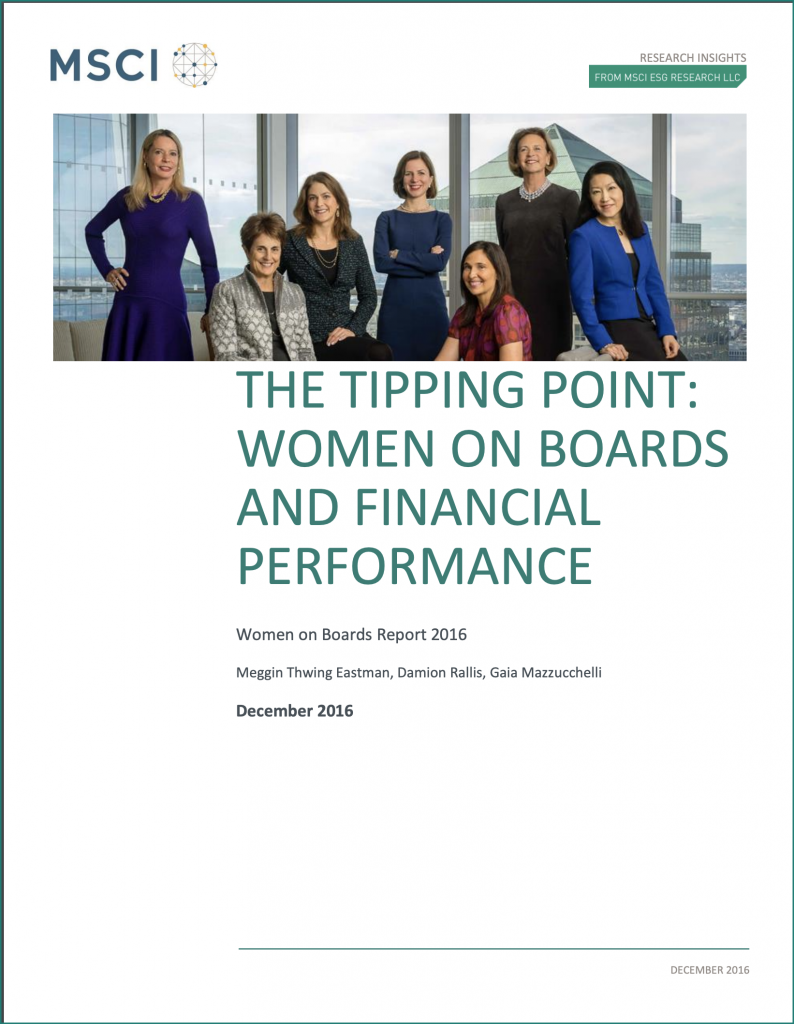
The Tipping Point: Women on Boards and Financial Performance

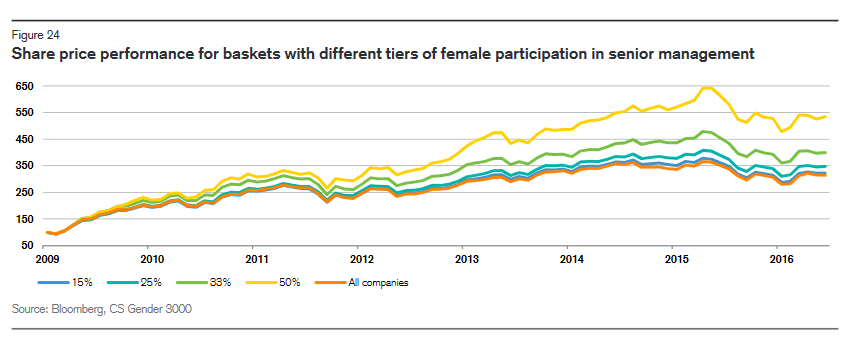
A growing body of research shows that having three women on a corporate board represents a “tipping point” in terms of influence, which is reflected in financial performance. U.S. companies that began the 2011-2016 period with at least three women on the board experienced median gains in Return on Equity (ROE) of 10 percentage points and Earnings Per Share (EPS) of 37%. In contrast, companies that began the period with no female directors experienced median changes of -1 percentage point in ROE and -8% in EPS over the study period. However, a causal link was not established.


Women on Boards Progress Report 2018

MSCI ESG Research has been reporting annually on the state of women’s representation on corporate boards of directors since 2014. As part of this evolving series we have added other areas of interest, relevant to the investment case for gender equality on boards, the differences in compensation regimes between male and female CEOs, and market specific corporate gender diversity issues, such as in Japan, and industry specific issues, such as those in Financials companies. This latest paper in the series provides an update on the state of female representation on corporate boards and in senior management for MSCI AWCI Index constituents as of October 16, 2018.


Women on Boards: One Piece of a Bigger Puzzle

Previously, we have asked whether the number of women on boards has a relationship to corporate financial performance. Research suggests that it has. But is that the whole story? Does the number of women on boards reflect companies’ overall approach to managing human capital and their financial performance?

In its Sustainable Development Goals for 2030, the United Nations set out a vision of a world that includes economic growth, increases in productivity and the eradication of gender discrimination so that women have “full and effective participation and equal opportunities for leadership at all levels.” Our latest research suggests the connection between these goals is relevant to investors.


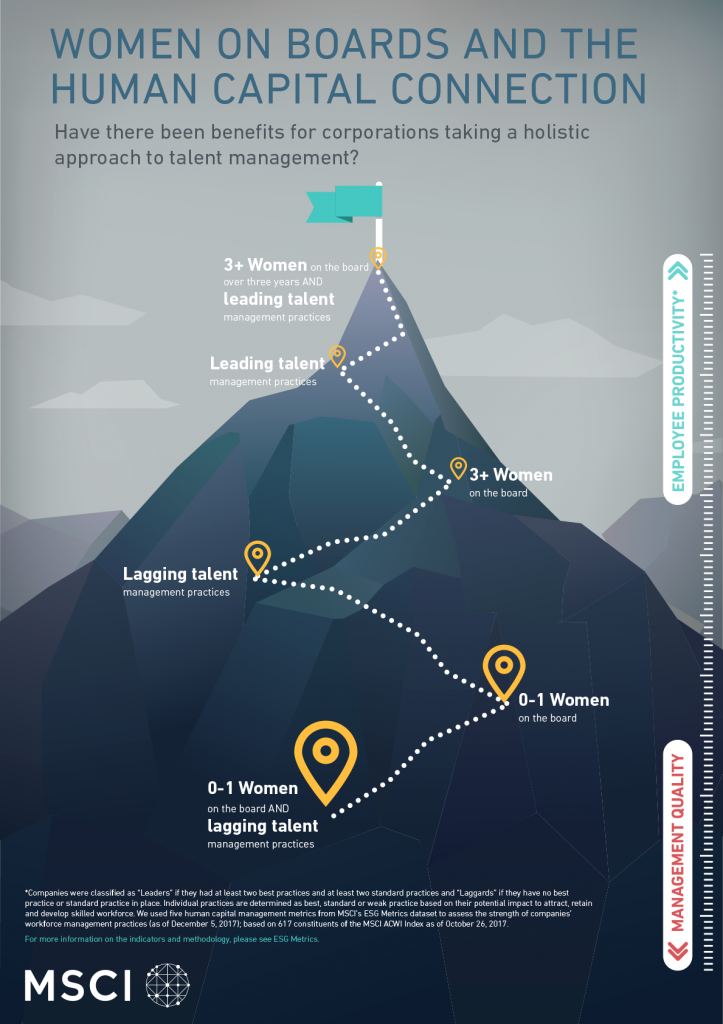
Women on Boards and the Human Capital Connection

Studies have asked whether having multiple women on a board of directors has translated into better financial performance. But is that the whole story? Does the number of women on boards relate to a company’s overall human capital policies and its financial performance? Our findings suggest that the whole is greater than the sum of the parts. Companies with both a more diverse board and stronger talent management practices enjoyed higher growth in employee productivity compared to companies with a diverse board only and to companies with strong talent management practices only.


Article by Meggin Thwing Eastman, Head of Impact and Screening Research for MSCI ESG Research, which includes business alignment with the UN Sustainable Development Goals, controversies, global norms, and involvement in controversial business activities such as tobacco, weapons, and fossil fuel extraction. She has authored numerous research insights and guidance for asset owner and asset managers seeking to incorporate ESG considerations into their investment process. Corporate gender diversity is an area of particular focus.

Recent publications include The Right Stuff: Talent Management and Innovation, Institutional Investing for the SDGs (with the OECD); Women on Boards and the Human Capital Connection; Bitter Pills: The US Opioid Crisis and Potential Impact on Healthcare Companies; Investor Responses to Gun Violence in the US; The State of Investing for SDG Impact Through Public Equities; and Has Gender Pay Parity Arrived in the Executive Suite? Meggin has worked in the ESG field since joining the former KLD Research & Analytics in 1998. She holds a BA from Williams College and an MA from the University of California, Berkeley.

Article Notes:
[1] There were too few recognized innovators per industry for meaningful analysis of the rest of the sample. A “longstanding critical mass” of female directors was defined as at least three women on the board over three consecutive years from 2014-2016.

[2] For example, see Hewlett, S. A., M. Marshall and L. Sherbin. (2013). “How Diversity Can Drive Innovation.” Harvard Business Review; “Fostering innovation through a diverse workforce.” (2011) Forbes Insights

[3] Eastman, M. T. and D. Rallis. (2016). “The Tipping Point: Women on Boards and Financial Performance.” MSCI ESG Research

Featured Articles, Impact Investing, Sustainable Business

Morgan Stanley and Bloomberg: Sustainable Investing a Business Imperative Among U.S. Asset Managers

• New survey shows that 75% of U.S. asset managers say their firms now offer sustainable investing strategies, up from 65% in 2016.

• Most asset managers are embracing sustainable investing as a business building approach and believe that financial returns and impact outcomes can go hand in hand.

• Expertise, better data and impact reporting identified as factors to support customization and drive future success in the space.

A majority of U.S. asset managers are now practicing sustainable investing, viewing it as a strategic business imperative. In a new survey entitled Sustainable Signals: Growth and Opportunity in Asset Management, from the Morgan Stanley Institute for Sustainable Investing and Bloomberg, 75% of respondents reported that their firms have adopted sustainable investing, up from 65% in 2016.

“The survey results demonstrate that sustainable investment strategies are now a strategic imperative,” said Matthew Slovik, Head of Global Sustainable Finance at Morgan Stanley. “It is clear that asset managers will continue to invest new resources and expand their product portfolios in the coming years.”

Respondents cited several key drivers of success in sustainable investing, including increased investment stability, high client satisfaction, product popularity and possible high financial returns. Despite the recognition of the strategy as a business imperative, almost all asset managers highlighted the need for increased expertise, better data and impact reporting to drive future success in the space.

“As investors increasingly consider sustainability factors across asset classes and investment products, we expect to see a shift toward better data tracking and reporting mechanisms,” noted Curtis Ravenel, Global Head of Sustainable Business & Finance at Bloomberg. “This will increase credibility and improve measurement of impact across portfolios.”

The survey polled 300 respondents at U.S. asset management firms with at least $50 million in client assets. The survey gathered insights about the growth, direction and future outlook of sustainable investing among asset managers, which builds on a previous Morgan Stanley and Bloomberg survey and interview series first conducted in 2016 titled, Sustainable Signals: The Asset Manager Perspective.

Results from the 2018 survey identify sustainable investing as a mainstream strategy that will continue to grow as an investing strategy in years to come. Key findings include:

Sustainable Investing Goes Mainstream

• Three in four U.S. asset managers say their firms now offer sustainable investing strategies, up from 65% in 2016.
• Asset managers overwhelmingly agree that sustainable investing is no longer a fad, with nine in 10 (89%) saying it is here to stay and 63% expecting it to continue to grow in the next five years.

A Financial Case for Sustainable Investing

• As sustainable investing matures, asset managers are putting financial considerations at the forefront of their sustainable investment strategies.
• 82% think strong ESG practices can lead to higher profitability and that companies with such practices may be better long-term investments.
• Almost two thirds of asset managers (62%) believe that it’s possible to maximize financial returns while investing sustainably.

Product Types Proliferate, Expanding Investor Choice

• As more firms embrace sustainable investing strategies, they are offering more ESG-tailored investment vehicles and expanding investor choice.

• Many employ a full spectrum of sustainable investing approaches, with 63% employing more than one strategy across shareholder engagement, restriction screening, ESG integration, thematic investing and impact investing.

Expertise, Better Data and Impact Reporting Will Support Customization and Drive Future Success

• Nearly all (89%) respondents report their firms will devote more resources to sustainable investing in the next two years. Common strategies for developing in-house skills and capacity include employee training (41%), dedicating more employee time (36%) and specialist hires (34%).
• Seven in 10 asset managers agree that the industry lacks standard metrics to measure nonfinancial performance of sustainable investments. The field is wide open for better data and the development of impact measurement tools.

Click here for more information


About The Morgan Stanley Institute for Sustainable Investing

The Morgan Stanley Institute for Sustainable Investing builds scalable finance solutions that seek to deliver competitive financial returns while driving positive environmental and social impact. The Institute creates innovative financial products, thoughtful insights and capacity building programs that help maximize capital to create a more sustainable future. For more information: Morgan Stanley Institute for Sustainable Investing

About Morgan Stanley

Morgan Stanley (NYSE: MS) is a leading global financial services firm providing investment banking, securities, wealth management and investment management services. With offices in more than 41 countries, the Firm’s employees serve clients worldwide including corporations, governments, institutions and individuals. For more information about Morgan Stanley, please visit – www.morganstanley.com

About Bloomberg

Bloomberg, the global business and financial information and news leader, gives influential decision makers a critical edge by connecting them to a dynamic network of information, people and ideas. The company’s strength – delivering data, news and analytics through innovative technology, quickly and accurately – is at the core of the Bloomberg Terminal. Bloomberg’s enterprise solutions build on the company’s core strength: leveraging technology to allow customers to access, integrate, distribute and manage data and information across organizations more efficiently and effectively. For more information, visit www.bloomberg.com/company or request a demo.

Acknowledgements

The Morgan Stanley Institute for Sustainable Investing and Bloomberg would like to thank the Initiative for Responsible Investment at the Hauser Institute for Civil Society at the Harvard Kennedy School and Edelman Intelligence for their contributions to this work.

Source: Morgan Stanley and Bloomberg

Additional Articles, Impact Investing, Sustainable Business

ImpactAssets Releases New IA 50 Impact Investment Fund Manager Showcase

Industry’s first publicly available, searchable resource of impact investing fund managers sees record number of applicants and features firms that manage $28.5 billion in assets.

ImpactAssets recently released its ImpactAssets 50 2019 (IA 50), a publicly available, online database for impact investors, family offices, financial advisors and institutional investors that features a diversified listing of 50 private capital fund managers that deliver social and environmental impact as well as financial returns. IA 50 users can sort and filter across a range of asset classes (debt, private equity and real assets), geographies, size of funds, themes and more.

“This year’s IA 50 highlights a diverse and tested group of fund managers that are delivering environmental and social impact as well as solid investment returns,” said Jed Emerson, ImpactAssets Senior Fellow, and IA 50 Review Committee Chair. “Whether you are just starting your impact investing journey or are a veteran impact investor, the IA 50 is a trusted database to help investors identify experienced impact investment firms and explore the landscape of potential investment options.”

The IA 50 2019 saw a record number of private debt and equity fund manager applications. Managers who met the IA 50’s in-depth review criteria manage an estimated $28.5 billion in assets devoted to creating measurable, positive impact.

This Year’s Showcase Includes:

‘Unicorns’ and Emerging Funds: Six fund managers in the 2019 list have more than $1 billion in assets under management (AUM), while six have $10 million to $49 million in AUM. The number of fund managers in the $100-$500 million range saw the greatest growth, increasing nearly 30%, due in part to several new fund managers who made the IA 50 listing for the first time.

UN Sustainable Development Goals Categorization: New this year, the IA 50 database is aligned with the UNSDG framework, with the primary SDG listed for each fund manager.

Deep Experience: Fund managers in this year’s IA 50 have weathered multiple market cycles, with 66% of fund managers in operation for more than 10 years—a dramatic increase in manager tenure since the database was launched. In aggregate, IA 50 fund managers have more than 1,500 years of impact investing experience.

Diversity and Inclusion: Nearly 9 in 10 (86%) IA 50 fund managers report that 25% or more of their investment professionals are women and/or from under-represented groups, while half have teams with 50% or more women and other under-represented groups, a significantly higher percentage than investment industry averages.

Impact and Return: More than 75% of fund managers target market rate or above market rate returns, and 94% have delivered either in line or above their initial target returns.

Read the full IA 50 database and review criteria.

“As impact investing continues its inexorable rise, it is critical to provide investors with a curated, objective evaluation of impact fund managers,” said Jennifer Kenning, CEO and Co-Founder of Align Impact, and IA 50 Senior Investment Advisor. “The IA 50 is built to filter out the noise that is growing louder in impact investing and help investors focus on deep, meaningful impact.”

In addition to Emerson and Kenning, the IA 50 Review Committee is comprised of impact investment experts and leaders, including Karl “Charly” Kleissner, Co-Founder of Toniic and KL Felicitas Foundation; Kathy Leonard, Senior Vice President, Investments and Senior Portfolio Manager for UBS; Stephanie Cohn Rupp, Managing Director, and Partner, Tiedemann Wealth Management; Fran Seegull, Executive Director, U.S. Impact Investing Alliance, Ford Foundation; Liesel Pritzker Simmonsand Ian Simmons, Co-Founders of Blue Haven Initiative and Matthew Weatherley-White, Co-Founder and Managing Director of The CAPROCK Group.

“ImpactAssets is focused on fostering deep impact investing with innovative investment solutions, resources and education,” said Margret Trilli, President and Chief Investment Officer at ImpactAssets. “The IA 50 is a cornerstone of our efforts to help investors gain access to the resources they need in order to help double the impact of their capital.”

The IA 50 is not an index or investable platform and does not constitute an offering or recommend specific products. It is not a replacement for due diligence. In order to be considered for the IA 50 2019, fund managers needed to have at least $10 million in assets under management, more than 3 years of experience as a firm with impact investing, documented social and/or environmental impact and be available for U.S. investment. Find additional details on the selection process here.


About ImpactAssets 
ImpactAssets is a nonprofit financial services firm that increases the flow of capital into investments delivering financial, social and environmental returns. ImpactAssets’ donor advised fund (“The Giving Fund”) and field-building initiatives enable philanthropists, other asset owners and their wealth advisors to advance social or environmental change through impact investment and philanthropy. More information at – https://www.impactassets.org

About the ImpactAssets 50
The IA 50 is the first publicly available database that provides a gateway into the world of impact investing for investors and their financial advisors, offering an easy way to identify experienced impact investment firms and explore the landscape of potential investment options. The IA 50 is intended to illustrate the breadth of impact investment fund managers operating today, though it is not a comprehensive list. These 50 firms have been selected to demonstrate a wide range of impact investing activities across geographies, sectors and asset classes. Find the IA 50 database here

Additional Articles, Impact Investing, Sustainable Business

Pentegra, Social(k) and LeafHouse Financial Introduce the Big Green Retirement Plan

In early March 2019, Pentegra, a leading provider of retirement planning and fiduciary outsourcing solutions, announced that it will partner with Social(k) and LeafHouse Financial to introduce the Big Green Retirement Plan. The Plan is an aggregate 401(k) retirement program with a focus on socially responsible investing. The plan offers comprehensive, bundled 401(k) plan services with full fiduciary outsourcing capabilities for companies who align themselves with the importance of socially responsible investing.

Unique in the industry today, the plan allows an individual to consider his or her own closely held beliefs as part of making retirement investment choices, and offers plan sponsors a path toward simpler, safer, easier plan administration by outsourcing both the fiduciary administrator and investment roles.

Pentegra Senior Vice President and National Practice Leader, Pete Swisher said: “Until now green companies have had limited options for retirement plans that solely offer socially responsible investing alongside fully bundled 401(k) plan services and outsourced fiduciary responsibility. The Big Green Retirement Plan offers a tremendous market opportunity.”

Pentegra will provide recordkeeping and 3(16) fiduciary administrator services for the program, enabling plan sponsors to minimize retirement plan fiduciary responsibility and liability and greatly reduce their internal administrative workload. With more than 75 years in the industry, Pentegra is one of the most experienced retirement plan fiduciaries in the nation.

LeafHouse Financial, a national investment fiduciary, will provide 3(38) discretionary investment fiduciary services for the plan. LeafHouse will evaluate, select, monitor and manage the Plan’s SRI/ESG investment platform. “Environmental, social, and governance (ESG) factors are increasingly viewed as important elements in determining the financial performance of companies,” said LeafHouse President Todd Kading.

“Our firm sees the trajectory of ESG investing rising, and believes the time is right to offer investment oversight to retirement plans. In our opinion, there is no better way to do this than to partner with two industry leaders, Pentegra and Social(k).” Kading added.

Social(k) Founder and Owner Rob Thomas said: “Today, more and more, employers and employees are interested in retirement plan investments that make a positive impact not only on their lives but also the lives of others. Interest in ESG/SRI investment options continues to grow, but 401(k) plans have had fiduciary concerns that have slowed the growth of these investment options for ERISA plans. The Big Green Retirement Plan offers a terrific solution.”

Swisher added: “With a focus on oversight and fiduciary responsibility, all three organizations’ values are closely aligned, so it made great sense for us to come together to offer the program. It’s a win-win for clients as well as for our organizations as partners.”


About Pentegra
Pentegra is a leading provider of retirement planning and fiduciary outsourcing solutions to organizations nationwide. Founded by the Federal Home Loan Bank System in 1943, Pentegra offers a broad array of qualified and non-qualified retirement plan solutions and TPA services. For more information, go to – https://www.pentegra.com

About LeafHouse Financial
LeafHouse Financial is a national discretionary investment manager for retirement plans. We are an independent and Flexible Fiduciary™ that aims to provide the maximum level of protection at a low cost. The firm acts in both a 3(21) and a 3(38) fiduciary capacity for a multitude of private and public plans. LeafHouse developed proprietary technology that is designed to prudently select, evaluate, and monitor investments that are solely in the best interests of plan participants and their beneficiaries.

LeafHouse is a registered investment advisor. Registration does not imply a certain level of skills or training. More information about the firm, including its investment strategies and objectives, can be found in our ADV Part 2, which is available, without charge, upon request. Our Form ADV contains information regarding LeafHouse’s business practices and the backgrounds of our key personnel.

About Social(k)
Founded in 2005, Social(k) has brought Environmental, Social and Governance (ESG) screened investment options to retirement plans for more than a decade. Its mission is to provide people the option to invest their money in conscionable companies that prioritize social and environmental responsibility alongside continued profit growth. In the past decade, Social(k) has invested more than $150,000,000 on behalf of 7,500 people working for more than 300 organizations nationwide. Social(k) is a founding member of B Corporation, 1% For The Planet, Slow Money, and the Common Good Capitalism Movement and an advocate for responsible and sustainable businesses and organizations. For more information, go to – https://socialk.com

Additional Articles, Impact Investing, Sustainable Business

Women and Sustainable Investing: Driving Assets and Benefitting from a Gender-Lens Approach

By Lisa Woll, CEO, US SIF and US SIF Foundation

The mission of US SIF is to rapidly shift investment practices towards sustainability, focusing on long-term investment and generation of positive social and environmental impacts. This includes the actions of institutional asset managers and asset owners as well as high net worth individuals and retail investors.

Women are Increasingly Driving Asset Growth

Women are and will continue to be critical to the ability to move forward investments in sustainability-focused products and strategies. According to a Morgan Stanley study, 84 percent of women expressed interest in sustainable investing, compared to 67 percent of men. Similarly, research from Moxie Future found that 83 percent of women investors care where their money is invested, 69 percent feel a sense of urgency to invest responsibly, and 63 percent are motivated to be responsible investors.

According to the most recent data from the US Department of Labor, 57 percent of women participate in the US labor market, compared to 34 percent in 1950. Thirty nine percent of all privately held firms are women-owned, including one in five with revenue of $1 million or more, the National Association of Women Business Owners indicates. A US Census Bureau study found that women are now the primary breadwinners in 23 percent of households, compared to 11 percent in 1960. US Trust research identified that globally, the income of women has surpassed $15 trillion, making it a growth market larger than China’s economy and second only to the US economy.

Women’s Advancement and Equality are Increasingly Considered in Investment Products

Additionally, in the last decade, the practice of gender lens investing has become one of the hottest thematic areas of impact investing.

In 1993, the Women’s Equity Mutual Fund, the first US fund investing in companies with positive track records of hiring, promoting and generously compensating women was created. According to Veris Wealth Partners, this heralded the birth of “gender lens investing” (GLI). GLI is founded on the premise that investing intentionally for gender balance and equity can generate both financial and social returns.

The US SIF Foundation tracked data on gender lens investing for the second time in its Report on US Sustainable, Responsible and Impact Investing Trends 2018. The report identified $868 billion in institutional investor assets under management that take gender lens issues under consideration, more than double the $397 billion identified in 2016.

Additionally, organizations like the Thirty Percent Coalition, which seeks to assure that women hold 30 percent of board seats across public companies in the United States, have been created to create a more equitable playing field.

The Work of US SIF Will Help Accelerate Women’s Involvement in Sustainable Investment

US SIF advocates for policies and practices that can help women move assets to more sustainable and impactful options. A key barrier to sustainable investment asset growth is the lack of investment options in 401Ks. In 2015, the US Department of Labor rescinded a 2008 bulletin that had discouraged investors from considering environmental and social factors in the companies and funds in which they invest, a move that US SIF had long advocated. Nonetheless, very few companies currently offer sustainable investment 401K options to their employees. Given the demand for these options, as highlighted by a Natixis study, we encourage companies to add such funds to their plans. We have been proponents of adding one or more sustainable investment options to the Federal Thrift Savings Plan, the retirement program for federal employees and members of the uniformed services. We help educate retail investors on how to access sustainable investment.

Financial advisors also play an important role in increasing women’s access to sustainable investment options, but there remains room for improvement. One estimate from the Center for Talent Innovation found that 67 percent of women feel misunderstood by their financial advisor. This may be partly because so few financial advisors are women – only 32 percent, according to the US Bureau of Labor Statistics. Moreover, a 2018 study commissioned by Eaton Vance found that while 79 percent of financial advisors surveyed say their clients have expressed interest in sustainable investing, only 31 percent say that sustainable investing is currently an important part of their practice. The US SIF Foundation produced a guide in 2018 to provide financial advisors with the resources and steps to enhance their sustainable investment expertise. We also offer a course for advisors, and in connection with the CFFP, a sustainable investment designation for advisors. Sustainable investment expertise can help financial advisors win over more female clients and deepen relationships with current clients.

One of US SIF’s initiatives is focused on bringing young people, representing diverse backgrounds, into the sustainable investment field. In its sixth year, the Peter DeSimone Student Scholarship Program supports students to attend our annual conference. From June 10-12, the program will welcome six undergraduate or graduate students to attend the US SIF 9th Annual Conference, New Challenges New Opportunities, in Minneapolis. The objectives of the scholarship program are to enhance students’ knowledge of sustainable and impact investment, motivate students to become practitioners upon graduation, and provide opportunities to learn directly from sustainable investment experts and to make new professional contacts. The conference offers a unique opportunity to network with leaders of the sustainable investing community and to learn about new approaches, trends and policy developments in sustainable and impact investing.


Article by Lisa Woll, CEO, US SIF: The Forum for Sustainable and Responsible Investment. As the CEO, Lisa leads US SIF and the US SIF Foundation’s overall direction and sits, ex-officio, on all board committees. She has been the CEO of US SIF and the US SIF Foundation since 2006, and has been responsible for strategic planning, developing a robust policy presence, expansion and diversification of funding, launching our national conference and creating the Center for Sustainable Investment Education.

Prior to US SIF, Lisa was executive director of the International Women’s Media Foundation, an organization focused on press freedom and expansion of women’s role in the media. During her tenure, the IWMF played a significant role in re-orienting the way journalism training was carried out on the issues of HIV-AIDS, malaria and TB in several African media organizations. Lisa also spent a decade working on children’s human rights. She was the director of the first international study to look at the impact of the Convention on the Rights of the Child and directed the Washington, DC office of Save the Children. She is a member of the Advisory Council of the Children’s Rights Division of Human Rights Watch.

Additional Articles, Impact Investing, Sustainable Business

Board Diversity: Time’s Up on Good Intentions

By Julie Gorte, Ph.D., Senior VP, Impax AM and Pax World Funds

When I began working to make boards more gender diverse in 2001, the percentage of women on the boards of large companies in the United States was around 12 percent.[1] By 2011, women had gained a few more seats at the table,[2] and by 2016 women held 21 percent of board seats at Fortune 500 companies.[3] At this rate of progress — less than one percent increase per year — it will be three more decades before big companies’ boards achieve gender parity. And that, sadly, is the good news.

At smaller companies it will take even longer to reach board gender parity at the current rate of progress. In 2016, the average board of a Russell 2000 company had 12 percent women, compared with 20 percent in the S&P 500, and more than one-third of the companies in the Russell 2000 had all-male boards.[4] For minorities, the percentages are even narrower at both large and small companies.

We have known for many years that diverse groups do a better job with decision-making than homogeneous ones.[5] Moreover, there is a great deal of research showing that having more women in decision-making positions is correlated with better financial performance, and often with better risk management and lower risk of insolvency.[6]

Despite all these findings, the pace of change could be described as glacial, even when “glacial” meant the rate of progress of glaciers before climate change speeded them up. I’ve attended scores of conferences on diversity and heard many CEOs and other senior executives speak compellingly about the benefits of diversity and their own personal commitments to improving it — and then say “but of course, that will happen. We don’t need regulation.”

That was also the thrust of an October 2018 article in the New York Times, “Diversify the Boardroom, Just Not Like California.”[7] The main message: There are better ways to make progress than passing a law, as California did last year, mandating that boards include specified numbers of women by specified dates.

I’m sympathetic, up to a point. It’s almost always preferable to rely on market mechanisms to bring about change, compared with the sometimes clumsy and heavy hand of regulation. Look at what’s happened to coal, the most carbon-intensive fossil fuel, as a result of concerns about its impact on air pollution and climate change: The U.S., which once relied on coal for more than half its electricity use, has been retiring coal capacity at record rates and not building any new coal plants. Now coal creates less than one-third of our electricity, and it’s still dropping. Almost none of that happened as a result of regulation; as Michael Bloomberg famously said, “Obama didn’t kill coal. The market did.”[8]

Clearly, when business leaders want to make something happen, they often can. The fact that board diversity is happening at sloth speed in the United States — which, unlike several other countries, has not mandated it — says that our leaders don’t seem to see it as enough of a priority to make it happen faster. What do you do when something that should happen doesn’t? Mandate it.

Yes, mandates have drawbacks. Those who dislike board diversity mandates often point to a study of what happened when Norway mandated that boards be at least 40 percent women in 2006, which showed that, for awhile after the mandate took effect, performance suffered as board composition changed. Could that happen with the California law? Perhaps, but the California law does give companies several years to achieve acceptable diversity. Moreover, that one study doesn’t “prove” that board diversity mandates harm financial performance, particularly in light of the fact that it’s not just about Norway anymore. If that harm were an expected consequence of a mandate, we’d expect to see underperformance in all the countries that have such laws, which now includes Belgium, Italy, France, Germany and India.

Several other countries have comply-or-explain statutes that require companies to have certain levels of diversity or explain why they don’t. That includes countries like Australia and Great Britain. In short, if mandating board diversity were reliably penalizing financial performance, we would not expect to see studies like MSCI’s 2016 report showing that companies around the world (not just Norway) with three or more women on corporate boards enjoyed a higher return on equity of 10.1 percent per year, compared with 7.4 percent for companies that didn’t.[9]

Another objection to such a law is that the mandate could violate the civil rights of men because it requires women to be promoted and others to be disqualified on the basis of gender.[10] In my opinion, that is nonsense; nothing in such laws says that existing male board members must be replaced. There is natural board turnover, for one thing, and boards can also be enlarged by one or two in order to accommodate the laws.

The New York Times article and other writings on board diversity, urge us to rely on investors to send the signal to companies, noting that BlackRock and other investors are already working on that. News flash: Investors have been working on sending that message for years — in our case, decades. CalPERS and CalSTRS launched their Diverse Director DataSource, a tool for recruiting diverse directors, in 2011 — and that wasn’t the first time that a pension plan tried to move that particular needle. The treasurer of the Connecticut state pension plan has been working to make boards more diverse since the early 2000s.

We at Pax World Funds have been voting against all-male boards for more than two decades and writing letters to each and every company where we do this telling them why.

There was a superb article on Corporate Counsel’s website earlier this year that talked about racial diversity at law firms, noting, “We split atoms, we have placed men on the moon, we travel at the speed of sound, yet we cannot figure out the ultra-complex issue of law firm diversity.”[11] That’s exactly the right way to frame it: If we really care about this, we should be able to make it happen. It’s not rocket surgery.

This is why we have mandates. Reasonable people get tired of waiting for appropriate, well-supported things to happen. If you don’t want mandates, then gender diversity has to be more than a talking point: We need companies to set aspirational targets, make the appropriate people accountable for meeting them, and report on progress publicly. That is what makes things happen.


Article by Julie Gorte, Ph.D., Senior Vice President for Sustainable Investing, at Impax Asset Management LLC and Pax World Funds. She oversees environmental, social and governance-related research on prospective and current investments as well as the firm’s shareholder engagement and public policy advocacy. Julie is also a member of the Impax Gender Analytics team.

Julie serves on the boards of the Endangered Species Coalition, E4theFuture, Clean Production Action, Great Bay Stewards and is the board chair of the Sustainable Investments Institute. She also serves on the Investment Committee of the United Nations Environment Programme Finance Initiative.

Prior to joining Pax, Julie served as Vice President and Chief Social Investment Strategist at Calvert. Her experience before she joined the investment world in 1999 includes nearly 14 years as Senior Associate and Project Director at the Congressional Office of Technology Assessment, Vice President for Economic and Environmental Research at The Wilderness Society, Program Manager for Technology Programs in the Environmental Protection Agency’s policy office and Senior Associate at the Northeast-Midwest Institute. She received her Bachelor of Science in Forest Management at Northern Arizona University and a Master of Science and Ph.D. from Michigan State in resource economics.

Article Notes:
[1] 2001 Catalyst Census of Women Board Directors,” Catalyst, 2001 https://www.catalyst.org/wp-content/uploads/2019/02/2001_Catalyst_Census_Women_Board_of_Directors.pdf

[2] In 2011, the percentage of women on boards of the Fortune 500 was 16 percent, per “2011 Catalyst Census: Fortune 500 Women Board Directors,” Catalyst. Dec 13, 2011. https://www.catalyst.org/research/2011-catalyst-census-fortune-500-women-board-directors

[3] “2016 Catalyst Census: Women and Men Board Directors.” Catalyst. 2017. https://www.catalyst.org/wp-content/uploads/2019/02/census_2017.pdf

[4] Ernst & Young, “Governance trends at Russell 2000 companies,” October 2016. https://www.ey.com/Publication/vwLUAssets/EY-governance-trends-at-russell-2000-companies/%24FILE/EY-cbm-russell-2000-governance-trends.pdf

[5] Gorte, Julie. “The Investment Case for Gender Equality,” Jan. 29, 2018.

[6] See, for example, Julie Gorte, “The Investment Case for Gender Equality,” Pax World Funds, January 29, 2018. https://paxworld.com/the-investment-case-for-gender-equality-new/

[7] Andrew Ross Sorkin, “Diversify the Boardroom, Just Not Like California,” The New York Times, Oct. 1, 2018. https://www.nytimes.com/2018/10/01/business/dealbook/women-corporate-boards-california.html

[8] Michael R. Bloomberg, “Obama Didn’t Kill Coal, the Market Did,” Bloomberg, August 4, 2015. https://www.bloomberg.com/opinion/articles/2015-08-04/obama-didn-t-kill-coal-the-market-did

[9] Meggin Thwing Eastman, Damion Rallis, Gaia Mazzucchelli, “The Tipping Point: Women on Boards and Financial Performance,” MSCI, December 2016. https://www.msci.com/www/research-paper/the-tipping-point-women-on/0538947986

[10] David A. Katz and Laura A. McIntosh, “Gender Diversity and Board Quotas,” Harvard Law School Forum on Corporate Governance and Financial Regulation, July 27, 2018. https://corpgov.law.harvard.edu/2018/07/27/gender-diversity-and-board-quotas/

[11] Don Prophete, “A Black Partner Responds to CGs on Law Firm Diversity,” January 30, 2019. https://www.law.com/corpcounsel/2019/01/30/a-black-partner-responds-to-gcs-on-law-firm-diversity/?kw=A%20Black%20Partner%20Responds%20to%20GCs%20on%20Law%20Firm%20Diversity&et=editorial&bu=CorporateCounsel&cn=20190130&src=EMC-Email&pt=BreakingNews
Featured Articles, Impact Investing, Sustainable Business

Helping Women Build Assets through Successful Homeownership

By Laura Altomare, Chief Communications Officer, Homewise

Homeownership is one of the most important ways that Americans create financial security. Homeownership helps build assets, which are critical to financial well-being and quality of life. According to the U.S. Census Bureau, the median net worth of a homeowner is $199,600 compared to $2,200 for renters, barely one percent of the homeowner’s rate. Asset building can be particularly critical for women. The Asset Funders Network reports that single women own just 32 cents for each dollar owned by single white men. Single black and Latino women own just one cent on the dollar. Homewise is working to interrupt this cycle by helping women, particularly those of low-to-moderate income, to build assets through successful and sustainable homeownership. Each year single women and single mothers make up 30 percent of new Homewise homeowners; that’s nearly 200 New Mexico women buying a home of their own and building financial stability and wellbeing every year.


The Wealth Building Power of Homeownership

For most households, housing is the biggest monthly expense. Homeownership stabilizes that expense by locking in the principal and interest payment. Only a small portion of the payment, for taxes and insurance, can increase. With just two percent yearly inflation, a homeowner’s monthly payment would only be about $65 higher 10 years after buying their home. Meanwhile, a renter’s monthly payment would have increased by over $300 in that same time period. For homeowners, that’s hundreds of dollars every single month year after year that can be used to build savings, meet expenses, and invest in their businesses.

Homeownership also creates an automatic savings account by building equity. Each month, an increasing portion of a mortgage payment goes toward paying down principal. On a $250,000 mortgage, a homeowner would accumulate about $45,000 of equity in ten years simply from this principal pay-down. That doesn’t include any market appreciation, just the automatic savings effect of paying down a mortgage.

Appreciation can be difficult to predict but even with modest appreciation of only 2 percent per year, the owner of a $250,000 home would see over $50,000 in appreciation in ten years. Add that to the equity accumulated through the principal pay-down and the owner has about $100,000 of wealth to her name just by making her monthly housing payment.

Overcoming Financial Obstacles to Homeownership

Many low-to-moderate income women face financial obstacles that lock them out of the long-term economic benefits of homeownership. The challenges of excessive debt, poor credit, and lack of savings pose a risk to financial security and create barriers to achieving homeownership. Homewise helps to remove those obstacles through free financial literacy and homebuyer education to help people manage money, reduce debt, and build savings in order to build long-term financial wellbeing and support them on an affordable and sustainable path to successful homeownership.

The power of financial education as a tool for building financial resilience in preparation for successful homeownership can be seen in the results. In 2018, women who came to Homewise with financial obstacles and went on to successfully complete the steps in their financial action plan experienced an average 78 point increase in their credit score, a median decrease of $107 in their monthly debt, and a $3,100 increase in savings.

When clients complete the work to raise their financial profiles and become ready for homeownership, Homewise offers access to safe and affordable financing through the Homewise Mortgage. Assistance programs help low-to-moderate income homebuyers meet down payment requirements. And by eliminating the cost of mortgage insurance, buyers save an average of $150 in their monthly mortgage payments.

Conventional wisdom might say that these loans carry a higher risk, but Homewise loan performance proves that is not the case. As of September 30, 2018 Homewise loans past due were at 1.3 percent as compared with conventional loans at 3.58 percent and FHA loans at 9.37 percent.

Real Impact. Real Lives.

While the statistics are important measures, the best way to understand the real impact is through the stories of real women.

When Erika came to the United States from Mexico she had one goal: to make a better life for herself and her children. In the United States, Erika began working as a waitress at a popular local restaurant and did everything she could to make ends meet. Money was tight and extra time was in short supply, but she was determined to take care of herself and her children on her own. She was living in a mobile home, which she and her family had quickly outgrown, and wanted to buy a larger home of her own. But with her income and expenses, she thought that goal might be out of her reach.

Erika had some big financial obstacles to tackle. Her income was largely based on tips and fluctuated from month to month. She had credit challenges and collections, and very little savings. With the help and guidance of her Homewise Home Purchase Advisor, she was able to get her finances on track. They started by working on cleaning up her collections to improve her credit. She was even able to successfully remove some collection claims that did not actually belong to her. Then it was on to savings. Soon she was making bi-weekly deposits into her savings account. In just six months Erika’s collections had either been paid off or removed from her credit report, and her credit score drastically improved. She then worked with her Homewise Realtor and found an affordable four bedroom new construction home. While her home was under construction, Erika sold her mobile home and a second vehicle to increase her savings and have even more money to put toward the purchase and furnishing of her new home.

Less than a year after making her first call to Homewise, Erika closed on her new home. The kids eagerly share their favorite things about having a new home, “having a room of my own!” and “having a trampoline in the backyard!” For Erika, the best part is having a safe, quiet and comfortable place to raise her family, and space for her Mom to come visit often from Mexico. When asked what it feels like to be in her home, Erika responds happily, “It’s exactly how I imagined it would be. It is a great blessing for me and my children.”
A home of your own is more than the wood, tile and stucco that go into it. It’s a place to raise a family, be a part of a community, and build wealth. Homewise helps women and their families overcome obstacles to home purchase and make smart financial decisions both during and after home purchase to create financial security and build assets, which are critical to financial well-being and quality of life.


About Homewise
Homewise, Inc. is a nonprofit Community Development Financial Institution (CDFI) that works throughout New Mexico to help create successful homeowners and strengthen neighborhoods. Homewise offers financial education and coaching, real estate services, affordable mortgage lending and down payment assistance, refinance and home improvement lending, real estate development and disinvested property rehabilitation. Since our founding in 1986, over 16,000 households have attended our financial workshops. During that time over 5,000 people have purchased homes, over 2,200 have made energy efficient home improvements, more than 700 have refinanced their mortgages. Homewise has also built over 750 high quality, affordable homes. You can learn more about how to support our work at- https://www.homewise.org

Article by Laura Altomare, who serves as the Chief Communications Officer at Homewise. As the CCO, Laura leads the organization’s strategic communication and capital raising strategies. She earned a B.A. in English Literature from Colorado State University and holds a Certificate in Fund Raising Management (CFRM) from the Indiana University Lilly Family School of Philanthropy. She also holds certifications from the Soul of Money “Fundraising from the Heart” Institute and the NeighborWorks America Training Institute.

Energy & Climate, Featured Articles, Impact Investing, Sustainable Business

Women in the Field of Finance

By Amy Domini, Founder, Domini Impact Investments

This will be my fifth year contributing to this GreenMoney issue dedicated to Women and Investing. In the past I have discussed studies showing that women are good, that is, above average, investors; I have discussed my discomfort with making gender the only lens through which people make investment decisions, but I have not discussed the process by which a firm, like the two I am involved with, makes the move from minority female to majority female. Nor have I discussed one woman who was particularly important to my own advancement.

Domini Impact Investments has five employee equity-owning managers in leadership. Four of the five are female. The Sustainability Group has four partner-level members and three of the four are female. I feel pretty secure in stating that female leadership is possible, even within the financial asset management field.

When I asked the CEO of Tucker Anthony & RL Day to allow me to try to pass the exam necessary to earn a license that would allow me to be involved with the sales of securities in 1974, it was not totally unheard of. After all, plenty of men had secretaries who held the license. That way business could be conducted on behalf of some guy while he enjoyed a game of golf. It was unusual, however, upon passing the exam, to have been given a seat selling.

It took me a while to realize that I was the only female in the firm with a full-time sales job. But the times they were changing. I was the unknowing beneficiary of a movement that was powerful and sophisticated.[1] I’d like to say it was enlightened management, but it was the power of people being allowed to file a class action lawsuit. Dating back to the late 1960s women had been trying to break into real jobs on Wall Street. It wasn’t happening. But when a lawsuit was filed, disclosures were available to the press. One damning statistic made public was that as of May 1973 nearly 97 percent of Merrill Lynch’s 5,197 account executives were white males. Another was the fact that the hiring questionnaire asked, “When you meet a woman, what interests you most about her.”

Here, the most points were awarded if the candidate answered that it was her beauty, and the fewest if he answered that it was her intelligence. The company countered criticism and stated that the testing was fair, but eventually it settled and set in place gender diversity initiatives. My timing had been good; Tucker Anthony did not want the sort of headlines Merrill Lynch had suffered.

I had been a professional for years before the backdrop of my promotion became known to me, but I was just starting to become fascinated with the concept that you might not need to buy companies that made awful products or behaved in nasty ways. I was just learning about the few other people who felt that way, too. The one who most certainly turned my life on its head was a woman named Joan Bavaria.

Joan ran a small investment advisory firm called Franklin Research & Development (now Trillium Asset Management). She’d gotten the job the old-fashioned way, by marrying the boss, but that didn’t for a moment make her less than a powerful force for good in the field. She mentored me and introduced me to everyone she knew who was remotely involved with the intersection of money and finance. Joan Bavaria pulled together a group of people who, each in their own way, used money to create social change. That group eventually became US SIF: The Forum for Sustainable and Responsible Investment.

Through Joan’s network many alliances grew. Investors met faith groups who worked with the Interfaith Center on Corporate Responsibility. We wanted to support their work, which was to file shareholder resolutions with companies as a lever to bring the companies into solutions. The network also included participants in enterprises that were in the business of alleviating poverty. These were low-income credit unions, community development banks, and even non-profits created to make loans.

Eventually the three legs to the stool, as Joan called it, became the core framework to the field of responsible investing. Leg one, buy positively to create a demand from Wall Street for responsible corporate behavior; companies that made ergonomic furniture, not bombs, for instance. Leg two, engage with companies, government, non-profits and others to build coalitions that would engage to get something done; we joined together to keep the disgraceful governance of South Africa, which denied the Black majority a vote, in the headlines. Leg three, seek out and support non-traditional financial intermediaries with the mission of economic justice – because healthy economics include the least among us. We allocated investor dollars to debt instruments these grass-root defenders offered and shifted our corporate accounts to community development banks. Joan always pointed out that the removal of a leg would cause the stool to fall and that as a group we must commit to support all three equally.

Joan’s earliest clients were largely female. She was often sought out as a person who understood that just because you didn’t really make a study of investing, it didn’t mean that you were someone to talk down to or “take care of.” Like me, she had started with a conventional firm and had broken through the unstated barriers for women while there. I dedicated my first book, co-authored with Peter Kinder, Ethical Investing, to her. When she withdrew from the world to nurse her cancer, the cancer that eventually killed her, the world lost a powerful advocate.

Since then, I have found that professionally I do have a bit of an advantage in winning a female client or working with a female colleague. Perhaps it is as simple as the shared background. But there is an element of passing it on. Joan did it for me, and I want to do it for you. On the client side, there are clear messages. For instance, I once brought in a new client who resentfully told me that her former advisor treated her like a child. When I phoned him to make the friendly ‘no hard feelings’ call, he was a gentleman. He was a gentleman with advice. “In some ways she is really just a child. You have to guide her or she’ll make mistakes,” he told me. So many clients have such stories. It isn’t 1973 anymore, but attitudes take generations to truly subside.

Much as I enjoy managing assets for women, it is the female work-partners that I feel the strongest connection with. We seem to have the same assumptions. While we sometimes make appointments to catch up, we generally catch up several times a week without appointments. We all volunteer to write the first draft, to take on the tough phone call, to dig through the files for the key data point. Yes, I chose my partners sensing that they had these qualities, but we re-enforce them with our interaction. And it has led to long-term relationships.

Carole Liable, CEO at Domini Impact Investments has worked alongside me since before there was a Domini (she was originally with a vendor to the funds), and in the over twenty years we worked together we have gone through years when she worked four very long days so as to be home the fifth; we have built a workforce that largely reflects the population at large; we have gone through the worst of times and survived.

Wendy Holding, my most senior partner in the Sustainability Group has held the group afloat for fifteen years and, for some years now, has surpassed me in client volume, firm growth, and outreach to the various communities in the field. As a division in a smaller firm, we have also built a team (partners and specialists) that reflects the population at large, but is majority female leadership.

Over my career I have reached out to women, many of whom are now my fiercest competitors, and most loyal defenders. Julie Goodrich, founder of NorthStar Asset Management, and I together taught Ethical Investing classes. Patricia Farrar-Rivas, CEO of Veris Wealth Partners and Kathy Leonard, founder of the Leonard-McDevitte Sustainable Investment Group at UBS went on retreats together with me (yes men were invited too) to address barriers to our field and to evaluate solutions. Julie Eades, past President of New Hampshire Community Development Loan Fund was in the room with me as we drafted guidelines to create the predecessor to what is today Opportunities Finance Network. Listing names is not the point. The point is that it is clear to me that each of these women has tried to be deliberate in finding and promoting women in the field of finance, just as I was, and just as Joan was. What began as a slender silken thread has become a woven fabric. The African proverb reminds me of my female colleagues, “when spiderwebs unite, they can tie up the lion.”


Article by Amy Domini, Founder and Chair of Domini Impact Investments (https://www.domini.com). She is widely recognized as the leading voice for socially responsible investing. In 2005, Time magazine named her to the Time 100 list of the world’s most influential people. In 2006, she was awarded an honorary Doctor of Business Administration degree from Northeastern University College of Law. Yale University’s Berkeley Divinity School presented Ms. Domini with an honorary doctorate in 2007. In 2008, Ms. Domini was named to Directorship magazine’s Directorship 100, the magazine’s listing of the most influential people on corporate governance and in the boardroom.

Ms. Domini is a past board member of the Church Pension Fund of the Episcopal Church in America; the National Association of Community Development Loan Funds, an organization whose members work to create funds for grassroots economic development loans; and the Interfaith Center on Corporate Responsibility, the major sponsor of shareholder actions. She is a member of the Boston Security Analysts Society. She has been a frequent guest commentator on CNBC’s Talking Stocks and various other radio and television shows.

Ms. Domini holds a B.A. in international and comparative studies from Boston University, and holds the Chartered Financial Analyst designation.

Publications: Ms. Domini is the author of Socially Responsible Investing: Making a Difference and Making Money (Dearborn Trade, 2001) and The Challenges of Wealth (Dow Jones Irwin, 1988), and a coauthor of Investing for Good (Harper Collins, 1993), The Social Investment Almanac (Henry Holt, 1992), and Ethical Investing (Addison-Wesley, 1984).

Article Note:

[1] https://books.google.com/books?id=LPgb5DbeOs0C&pg=PA50&lpg=PA50&dq=%221973%22+merrill+lynch+suit+female+discrimination&source=bl&ots=Ci_SQHve8E&sig=ACfU3U0HeFOCRFB2kig8v0rRCWdmPdIJcg&hl=en&sa=X&ved=2ahUKEwiQ1fG_mungAhULMt8KHW6NCH0Q6AEwCnoECAYQAQ#v=onepage&q=%221973%22%20merrill%20lynch%20suit%20female%20discrimination&f=false

Featured Articles, Impact Investing, Sustainable Business

Signup to receive GreenMoney's monthly eJournal

Privacy Policy
Copyright © GreenMoney Journal 2025

Website design & development by BrandNature

Global Events Calendar

View All Events

april

21aprAll Day232026 Sustainable Packaging Coalition: SPC Impact – Nashville

27aprAll Day30Women Deliver 2026 Conference (WD2026) – Melbourne

X