Tag: Impact Investing

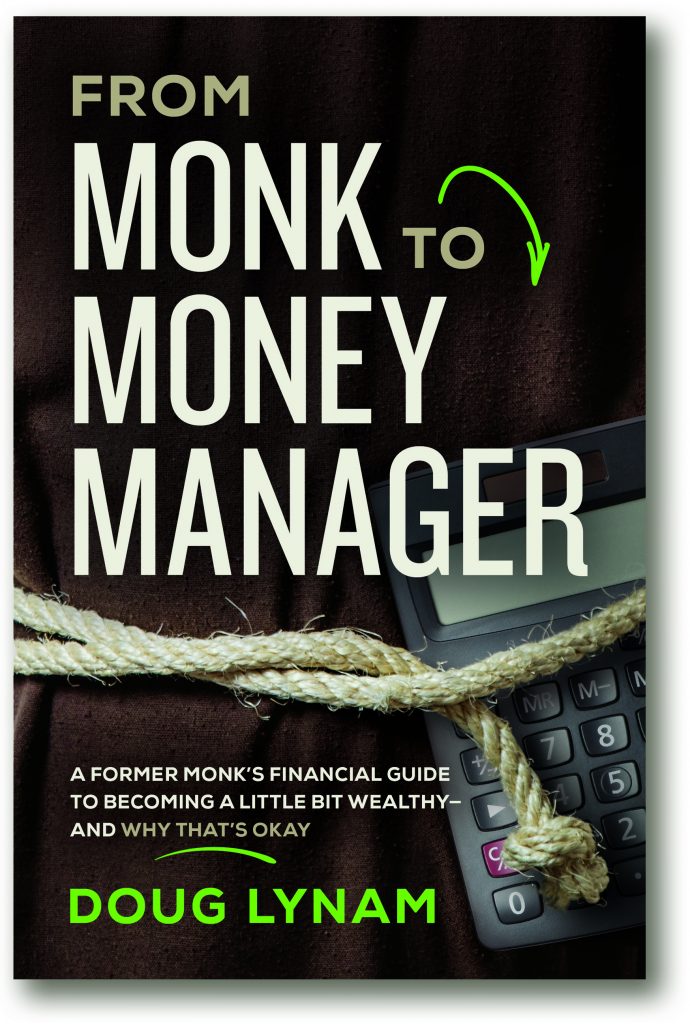
From Monk to Money Manager
By Doug Lynam, author & financial professional

From Monk to Money Manager by Doug LynamI’ve always hated talking about money. Growing up in a rich family, I learned through the behavior of those around me that money and materialism were evil. Instead of being used in love and service, money was weaponized and became a tool to manipulate and control behavior. So when I began studying philosophy and religion in high school and read the words of Paul the apostle, “For the love of money is the root of all evil,” I mistakenly believed Paul was right. I was a proto-monk in the making.

As a rebellious teenager, I found refuge in a hippie community, but despite the “one world” rhetoric, they didn’t seem to give a darn about anyone but themselves. So in college, I pivoted in the other direction and attended Officer Candidate School with the US Marine Corps and loved it. I was looking for a life of selfless service, but the Marines taught us to enjoy killing, and that freaked me out.

If I was to quit the Marines and do something better, what could be a higher calling? Where else could I live a noble life and avoid the “greedy capitalist corporate world?” Just then, I began to have a religious reawakening and started to explore the possibility of becoming a monk.

It seemed a perfect solution. In the monastery, I would have all the structure and discipline I liked about the Marines along with comradery, or esprit de corps, but with an even nobler purpose. God comes before country. Best of all, I would take a vow of poverty and be free from the grip of money and materialism forever.

Or so I thought.

I entered the monastery fresh out of college. My original intent was to try it out for a little while, like taking a gap year. It was the “road less traveled.” I was looking for the meaning of life, and I decided that if I was ever going to find it, a monastery was the most likely place to do so. Each day was rich with meaning, even if poor in spirit.

In my early years at the monastery, it was a struggle to pay the bills and keep the household running smoothly. Since the other brothers were older and wiser, I assumed they knew something about finance and bookkeeping. Sadly, this was not the case. Within a few years, it was clear that something was desperately wrong with the community finances. We were all working full time, but somehow there wasn’t enough money to pay the bills.

Eventually, I took over the monastery bookkeeping and stumbled into a Pandora’s box. I learned that the community had been running in the red for years. There were medical bills, car repairs, student loans, insurance payments, and all the living expenses. There were also retreats to Rome and help given to those in need. Credit cards became a necessity for survival. Even when our income level improved after we all landed good teaching jobs, it was too late. We were under an avalanche of debt.

How did our financial problems get so bad?

For two reasons. First was the hope that prayer alone could solve our money problems. If prayer alone was ever going to solve a big money mess, we were first in line. The second reason was that we viewed money as evil and didn’t own up to our individual or collective financial responsibilities. Somehow, everything was going to work out for the best, or it was someone else’s job to fix. The quest for blame is always successful — even for monks.

Hope and blame are not strategies. Prayer that leads you to the right action is great. Prayer that leaves you sitting on your backside isn’t. And prayer used as a form of denial or blame isn’t real prayer. Praying for the bills to get paid without taking right action is a guaranteed path to failure. You won’t have enough money for retirement if you don’t put any money into your account or buy lottery tickets as your financial plan.

After cleaning up the monastery finances, my life took another unexpected turn in 2005. I was working as a math and economics teacher at a private seventh-through twelfth-grade school, and serving as chair of the mathematics department. One day a good friend asked me for help planning her retirement. At sixty-four, she knew it was past time to start. However, her retirement savings was only $16,000! She had never faced this money demon, and had never opened her retirement account.

She is one of the strongest women I’ve ever known. But when I explained the gravity of her situation, as delicately as I could, she broke down in tears and cried. And cried. She then asked me when she could expect to retire. I lied and said I didn’t know. The answer wasn’t good, and I lacked the courage to speak the truth.

After seeing the trouble my friend and colleague had saving for retirement, I began to dig into the retirement plan at my school. Her situation wasn’t unique, and I wanted to know what went wrong. Someone must run the plan and be responsible for it, right? Why did our retirement plan fail to work for my friend and most of my colleagues?

Then, after more research, I discovered this wasn’t a unique situation. Almost every teacher retirement plan in the country is in shambles. For decades, retirement plans have been neglected by school boards in both public and private institutions, providing financial predators an easy feast.

To remedy these systemic problems, I formed my own company, Lynam Financial Services, then happily merged with a larger firm, LongView Asset Management. That’s when I left the monastery. I’d found a wider community to serve. In my mind, I didn’t leave monasticism; I’m just bringing what I discovered in the monastery out into the world.

The hard truth is that money is the root of almost everything, good and evil. And the deepest spiritual reality is that we are all interconnected. So we need a healthier attitude towards our finances that aligns our investments and money habits with our values. When we take a “green money” approach not only do we improve our own financial lives, we are also using our wealth to build a better world. It is a healthy way to love our neighbors as ourselves.


Article by Douglas Lynam

Author of From Monk to Money Manager: A Former Monk’s Financial Guide to Becoming a Little Bit Wealthy–and Why That’s Okay

Partner at LongView Asset Management

Email – doug@douglynam.com

Doug Lynam is Director of Educator Retirement Services at LongView Asset Management in Santa Fe, New Mexico. He is a graduate of St. John’s College in Santa Fe, the “Great Books” school, where he earned a degree equivalent to a double major, one in the History of Mathematics and Science and one in Philosophy, as well as a double minor, one in Classical Studies and the other in Comparative Literature. He is also a graduate of the Marine Corps Officer Candidate School.

Douglas has devoted his life to service. He was a Benedictine monk for twenty years, while working as a math and science teacher for eighteen years, and math department chair at Santa Fe Prep for over a decade. His work with teacher retirement plans and individual investors combines his desire to make the world a better place with his fascination for economics.

Before becoming a teacher, Doug worked as a legal analyst for Los Alamos National Laboratory. He was the vice president of the St. John’s College Search and Rescue Team and is a certified cycle instructor and an avid yoga practitioner. He continues to work as a pro bono financial adviser to low-income families, which he has done since 2005, and he has won awards for his volunteer efforts for the homeless.
Featured Articles, Impact Investing, Sustainable Business

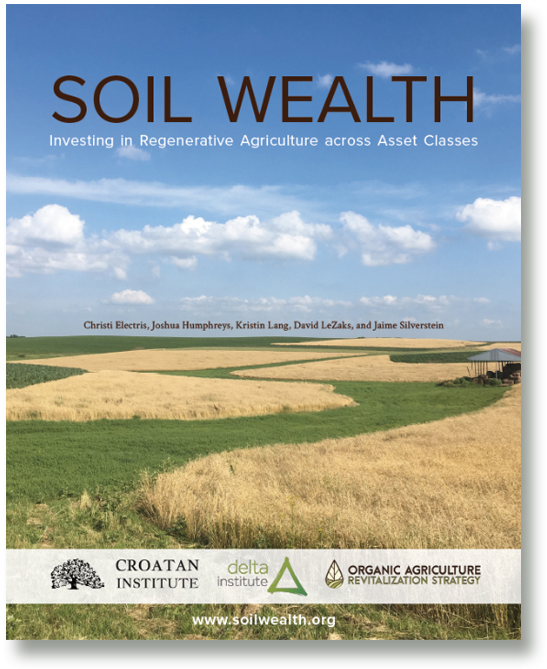
Soil Wealth – Investing in Regenerative Agriculture

SoilWealth-InvestingInRegenerativeAg-GreenMoney

Soil Wealth Report Identifies 67 Investment Approaches to Grow and Develop New Regenerative Agriculture Capital Opportunities. The Report showcases more than $320 billion in investments that focus on sustainable food and agriculture, with $47.5 billion of that now explicitly targeting “regenerative agriculture”

A team of researchers from Croatan Institute, Delta Institute, and the Organic Agriculture Revitalization Strategy (OARS) recently released a major new report for investors, agriculture practitioners, entrepreneurs, and philanthropists on financing regenerative agriculture. The report highlights 127 investments totaling $321.1 billion that explicitly integrate sustainable food and agriculture in their investment processes, with 70 of those strategies with combined assets of $47.5 billion including regenerative agricultural criteria in their investment strategy as well.

The new report, Soil Wealth: Investing in Regenerative Agriculture across Asset Classes, is the most comprehensive look to date at the US landscape of investment opportunities in regenerative agriculture — one of the leading trends in food and agriculture today. Regenerative agriculture refers to a diverse array of farming systems that enhance the biodiversity of farming landscapes, improve soil health and the water cycle, and strengthen the resilience of rural agricultural economies.

The report provides an in-depth analysis not only of investments in farmland, but also of investment opportunities across asset classes that support regenerative agricultural value chains and food systems, including banking and cash equivalents, fixed-income investing in both public and private debt markets, public equities, and the private equity and venture capital market. Across these asset classes, it identifies 67 distinct investment mechanisms, instruments, and approaches for further developing regenerative agriculture capital opportunities. The report concludes with a series of recommendations for investors and stakeholders to build greater “soil wealth” — the benefits associated with improving soil health and increasing rural wealth through regenerative agriculture.

Soil Wealth stems from a major, three-year project on innovative mechanisms for financing regenerative agriculture funded by a Conservation Innovation Grant from the US Department of Agriculture’s Natural Resources Conservation Service (NRCS).

“For years investors have claimed that there are few viable options for investing in more regenerative food systems. This report has documented existing strategies across asset classes, and the steps to take to unleash the many forms of capital needed to transform our food systems into ones that build soil health and community wealth,” said Dr. David LeZaks, Regenerative Food Systems Lead at Delta Institute, director of the NRCS Conservation Innovation Grant that funded the project, and co-author of the report.

Other key components of the report include:

• Identification of financial mechanisms and approaches across asset classes, some of which are commonly used in traditional conservation or agricultural finance that could be utilized to support regenerative agriculture outcomes;

• Quantitative analysis of the current state of investment funds across asset classes that are currently financing sustainable food and agriculture or regenerative agriculture; and

• A roadmap for the development of new investment opportunities in the capital markets incorporating regenerative agriculture criteria that could accelerate the transition of conventional agriculture to regenerative farmland.

The increasing need to address climate change has generated significant investment interest in regenerative agriculture. Implementing climate-friendly, regenerative agricultural practices could mitigate nearly 170 GtCO2e, while generating a nearly $10 trillion net financial return for investors and producers. To realize this climate mitigation potential, more than $700 billion in estimated net capital expenditure over the next 30 years will be required. Regenerative agriculture outcomes also align with UN Sustainable Development Goals, which sustainable, responsible, and impact investors are increasingly integrating into investment decision-making frameworks.

Dr. Joshua Humphreys, President and Senior Fellow at Croatan Institute, Senior Strategist of OARS, and lead author of the report noted, “Amid what is increasingly looking like a new farm crisis, this important research advances our understanding of how to finance the transition to much more diversified, regenerative farming systems that build soil health, sequester carbon, increase biodiversity, and foster greater resilience on farms and across rural communities.”


Additional Articles, Food & Farming, Impact Investing

From Brooklyn to Asia with Love

By Danielle Burns, Business Development, CNote

CNote logoWhen I was 30 years, 8 months and 1 day old I got my first passport. I was so excited to finally be able to travel the world and share stories of all the things I had seen. But my journey to global euphoria was slow and not quite steady.

Growing up as a little girl, in the mid 70’s, in Brooklyn, NY I had no idea that we were part of what you would now classify as low to middle income. Our community was rich and full. We loved and respected each other, our neighbors and our friends. We never talked about money but somehow we managed to “manage.” At the early age of 11, I experienced what not having money meant. It was a more superficial experience for me but my experience, nonetheless. It was the fall season and families were gearing up for Back to School. I remember so vividly, not being able to go back to school shopping because we didn’t have money “for that.” We had just enough to pay the bills. (If only my adult self could have told my 11-year-old self that, that was what really mattered, I probably would have been less traumatized.) My mom was a single parent and I was the youngest of three. We spent a lot of time with my maternal grandparents and they seemed “financially stable.” My grandfather was a decorated war veteran and policeman and my grandmother was a stay-at-home mom of five. My grandparents did a lot of traveling and I always admired that. I never gave thought to how they afforded it. Perhaps they managed their money well, perhaps they didn’t. I suspect they fell somewhere in between

It wasn’t until I was in high school that I started to really learn and appreciate the value of money, the evil it possessed and the joy it could bring. My family had moved to Florida and I began spending more time around teenagers who were doing things like traveling abroad and they seemed to have such worldly experiences. As I was nearing the end of my high school years, students were completing final semesters abroad and preparing to “go away” to college. I couldn’t travel abroad, and I didn’t go away to college. Instead, I received a local university experience where I had to work part time and often take courses at night. While I have a college education, it came at a price that is truly unconscionable – student loan debt. My mother is an excellent researcher, and she helped me identify grants that were available, however they weren’t enough and when it came to academic debt we were a bit naïve. Academic debt, left unmanaged and un-understood, is a terrible joke that lenders play on uneducated families who just want to get into college. As my student loan debt grew, I began to further understand the real concept of the evil that lurked within the walls of academic debt. Part of me felt like, it didn’t matter the cost of the loan, all that mattered was that I needed to graduate and I didn’t want to give society another reason to say NO. My skin color did that all by itself. I didn’t grow up seeing a lot of examples of the person I wanted to be, and I was determined to be a college graduate.

After college, I started to work in a meaningful career and my passion began to shift towards creating an environment for myself that I could be proud of and fully support. I started to think more holistically about money. How would it contribute not only to my life but to the lives of others around me? I wanted my money to support both the tangible and intangible needs and desires. I also knew that I didn’t want to be defined by money whether in the red or black.

Currencies Danielle Burns CNote GreenMoneyAs time passed, I began to better understand what it meant to be fiscally responsible, much different than just “managing to manage.” So while I had learned to create and work within budgets and save for retirement and rainy days, I had yet to fulfill my desire for travel. As I mentioned, it wasn’t until I was 30 years old that I got my first passport. I wanted to travel and be able to afford it! I had enough student loan debt to hold me just fine, and maxing out credit cards wasn’t an option for me. I leaned on the research skills that I learned from my mother and learned to find travel steals and deals that would help keep costs down. My travel journeys are just beginning but in the short 14 years that I have had a passport, I have managed to visit multiple continents and many countries. With a few of my favorite stops being Costa Rica, Hong Kong and Thailand. I am so inspired by the beauty I see when I travel abroad and the opportunity to embrace the uniqueness of other cultures.
Fast forward to today, I have my student loan debt in check and I am confidently walking in my truth and working to contribute to the growth and success of others. I believe that we live in a world where people can be kind and good, however we have deep rooted biases that cripple us as a society and don’t allow us to fully walk in our personal truths. Through my professional work, I have had the ability to help financial advisors and investors contribute to doing well by doing good and harness their investment dollars to create change. Unfortunately, I have also witnessed how we are in desperate need for economic inclusion for all people and specifically people of color. It was with those needs in mind that I shifted my career to work with CNote. Through my work with CNote, I’m excited to embrace a new and exciting challenge, helping to scale a high-growth financial technology company that is motivated not just by profits but by building a more inclusive economy as well. Through my work with CNote, we are helping to bring viable economic solutions to the very communities that I lived in as a child. So, in many ways, I feel like I have come full circle and look forward to what the next phase of my journey looks like.

Cheers!


Article by Danielle M. Burns, MBA, AIF, Head of Business Development for CNote. Prior to joining CNote, Danielle worked for First Affirmative Financial Network in a variety of Business Development roles from 2004 to 2019 most recently serving as Vice President of Sales and Marketing where she worked with a highly collaborative team that was responsible for the growth and profitability of the firm’s distribution channels. Danielle participated in all aspects of the sales and marketing process, attended and spoke at industry events and educated advisors on how to navigate the Sustainable, Responsible, Impact (SRI) investing and ESG landscape. Her background emphasizes business strategy and consulting and executing integrated campaigns, marketing communications, product launch and system development.

Danielle began her financial services career in 1994 with Wachovia Corporation where she worked for both Wachovia Bank and Wachovia Securities performing a variety of management duties over her nine-year tenure. Danielle serves on the board of Green America, a not-for-profit membership organization founded in 1982, whose mission is to harness economic power to create a socially just and environmentally sustainable society. Additionally, Danielle serves on the SRI Conference & Community Advisory Board. The SRI Conference & Community is the longest running gathering of asset managers, financial advisors, researchers, academics, mission-driven organizations who share the common goal of deploying private capital to address some of our most pressing environmental, social, and economic challenges.

Danielle is a certified trainer for Walking on the Glass Floor, which promotes Diversity and Inclusion for Women in Leadership and is passionate about working to narrow the wealth gap and create investment and economic inclusion for all. Danielle holds an MBA with an emphasis in marketing and the AIF® designation. Danielle, her husband and their son live in Noblesville, IN.

Featured Articles, Impact Investing, Sustainable Business

How Money Shapes the Story of Your Life

By John Christianson, author & CEO of Highland

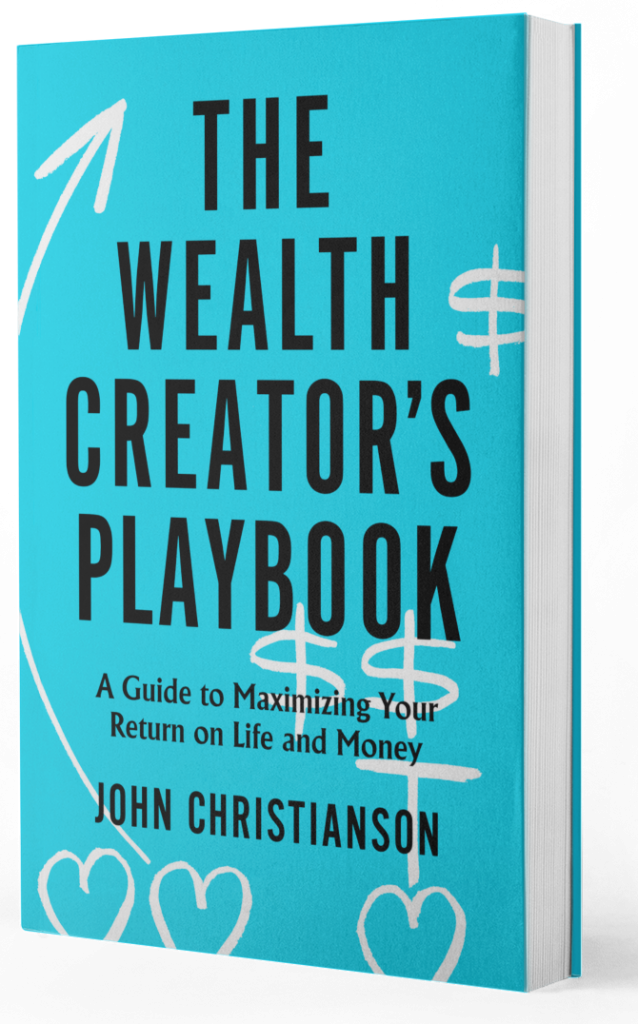
TheWealthCreatorsPlaybook-byJohnChristiansonEveryone has a money history comprised of memories, experiences, and feelings about money that we accumulate over a lifetime. The interactions we have with money during our formative years are particularly powerful and often have a lasting influence on our adult lives. The story money tells isn’t always a happy one, and often is filled with pages of anxiety and frustration. Or, you might be one of the lucky ones, where your relationship with money has been mostly healthy and stress-free. Examining your money history will help you understand behaviors and relationship challenges around money throughout your life. Your money story is also one key to envisioning ideal future outcomes in your life, where money is concerned.

My money story began in a middle-class neighborhood in the suburbs of Seattle. My father was a teacher and worked evenings selling financial products to bring in additional income. My mom stayed home and raised three children. My parents modeled frugality in their money choices: reusing and getting the maximum life out of everything from clothes to tools, searching for second-hand gems discarded at the dump, and changing the oil in the car themselves. I vividly remember my father’s excitement about salvaging used railroad ties to be used for a future building project and the multiple trips we took with the utility trailer to grab as many as possible before someone else discovered the treasure.

My parents did all their own home maintenance and repair projects, and I learned a lot working beside them. I appreciate them teaching me how to work hard and to be very careful with money. However, the constant focus on what things cost and the time and effort spent cobbling second hand parts together left me with the nagging feeling that we never had enough money.

A prime example of this scarcity mindset occurred when I was trying out for the high school baseball team my freshman year. I needed metal spikes instead of the rubber cleats I’d worn since I started playing baseball. I told my Dad I needed to go to the sports store to buy new cleats before the first practice. It wasn’t a surprise when we ended up buying a lightly worn pair of used cleats instead. They were white, and at the time, everyone wore black cleats. I would be the only player on the field with white cleats and I wanted desperately to fit in. To make matters worse, my dad got out his shoe shine kit and polished them so they were even more sparkling white. I remember feeling humiliated and totally distracted from the fielding and hitting drills during tryouts. I ended up making the junior varsity team that year, but the experience made a lasting impression that I never wanted to repeat.

A sense of anxiety about having enough money followed me into adulthood. I was highly focused on earning enough money to buy the nicer things (houses, cars, clothes, trips) that eluded me as a child, even to the point of overspending at times. This behavior created tension, anxiety, and guilt because it was in direct conflict with my frugal upbringing. I can still get stuck in a decision spin cycle around money, and this played out recently when it was time to replace the Ford Explorer I had driven for 10 years. I considered buying a newer version of the Explorer but I really wanted something different. Because the nicer SUV’s are very expensive, I found myself hesitant to even start looking. I could see myself in a Range Rover, Audi, or Mercedes, and while I felt I deserved a nice car and could afford it, my money history was putting me into sticker shock with the higher-end models. With some coaching and encouragement from my wife, we finally purchased a used Mercedes SUV with very low miles that struck the right emotional balance between indulgence and a more practical price tag.

As a financial advisor, I’ve worked with hundreds of clients over the years to uncover how their money stories impact their financial decisions and relationships. It has taken intentional introspection, growth, and coaching to understand and harness my own relationship with money and create better life outcomes (a process I explore in my new book, The Wealth Creator’s Playbook: A Guide to Maximizing Your Return on Money). I’m now able to recognize old, unproductive patterns of behavior and adjust my actions.

The following are 3 practical steps you can take to do the same thing:

1) Reflect on these questions: What role did money play in your home growing up? (i.e. anxiety filled, used for manipulation, or never discussed); What lessons about money were consciously or unconsciously taught by parents or caregivers? (i.e. it’s rude to talk about money, basic budgeting skills, attitudes toward generosity); What rules about money do you still live by today? (i.e. always be debt free, never buy new cars, live below your means).

2) Go on a money date with your spouse/partner to learn about each other’s money history. Studies consistently confirm that money and finances pose the biggest relationship challenges for couples. Listen to one another’s money stories, reserving judgment and criticism, and learn where spending, saving, and sharing decisions around money can be triggering. My wife grew up in a home where lavish spending on trips and gifts were the norm, but her parents were always stressed about money. By understanding our individual money journeys, it’s become much easier to navigate financial decisions in our marriage with compassion for each other instead of frustration.

3) Understand that you are the author of your money story today. The past is the past. You control how your money history influences your present and future. You may need to forgive yourself and others who were bad actors in your money past, keeping the positive storylines to build on for the future. I want my money story to be filled with abundance thinking and generosity because I believe the conclusion of that story is more joy and fulfillment.


Article by John Christianson, author of The Wealth Creator’s Playbook: A Guide to Maximizing Your Return on Life and Money, and the host of The Wealth Confidant podcast. He is also the Founder and CEO of Highland®, a financial life management company located in Bellevue, Washington. You may connect with John at https://www.jcchristianson.com

Featured Articles, Impact Investing

Frank Coleman of CBIS wins ICCR’s Legacy Award

The governing board of the Interfaith Center on Corporate Responsibility (ICCR) is pleased to announce that the recipient of its 2019 Legacy Award will be Francis G. Coleman, Vice Chair of Christian Brothers Investment Services.

The ICCR Legacy Award was created to honor those whose work has provided a strong moral foundation and an enduring record of demonstrated influence on corporate policies. The award was created in 2011 as a celebration of the 40th anniversary of ICCR.

With more than 30 years of experience serving Catholic institutions at Christian Brothers Investment Services (CBIS), Frank has developed a comprehensive knowledge of the needs of the Catholic institutional marketplace and is a nationally recognized expert in the application of Catholic Social Teaching to the investment process. Frank has also written and spoken extensively on matters related to ESG and Catholic Responsible investments.

Frank has given generously of his time to the SRI/ESG investing community by serving as a board member for countless organizations, including ICCR. His experience and wisdom in diplomatic, yet effective, corporate engagement have made him a sought-after source of counsel for many in the ICCR community and beyond.

“Frank Coleman has made a distinct mark on the history of sustainable and responsible investing both for faith-based investors and the broader investment community,” said Tim Smith of Walden Asset Management. “Frank served as Chair of ICCR’s board and also served on the board of USSIF, providing wise counsel and thoughtful strategic advice to both. Importantly, Frank has been a consistent voice calling for increased investor responsibility and the integration of ethics and values into investing decisions.”

“During his 30 year tenure, Frank ushered in a number of ‘firsts’,” said his colleague Julie Tanner of CBIS. “Under Frank’s leadership, and working alongside ICCR members, BP appointed its first independent expert following the Gulf spill to improve environmental stewardship; JPMorgan Chase created its first Director of Environment position to expand access to responsible finance; Newmont Mining underwent an inaugural review of opposition at its mine sites to protect communities; and ISS recommended Verizon investors vote in favor of the first resolution to prevent child sexual exploitation online and respect human dignity.”

Susan Makos of Mercy Investment Services observed of Frank, “For many years, Frank has been a leader in Catholic faith-based investing through thoughtfully exploring ways to advance addressing values into the entire investment process. He has been a champion of working for the common good and encouraging companies to address areas of concern, including human rights and the environment. He has also generously shared his time and talents in governance and leadership roles at ICCR and other responsible investor organizations to advance our efforts to promote a more just and sustainable world.”

“As a colleague of Frank at both CBIS and ICCR, I continue to be enamored of his steady, focused, thoughtful commitment to strategies to bring the impact of our corporate engagement to the next level,” said Sr. Patricia Daly of the Dominican Sisters of Caldwell, NJ. “Frank is an investment professional who truly understands the value of corporate commitment to the common good.”

Frank will be honored at ICCR’s annual event on October 29th at 150 W83 Ministry Center in NYC. Please join ICCR in congratulating Frank Coleman on receiving ICCR’s 2019 Legacy Award. Read more about the Award here.


About the Interfaith Center on Corporate Responsibility (ICCR)

Celebrating its 49th year, ICCR is the pioneer coalition of shareholder advocates who view the management of their investments as a catalyst for social change. Its 300 member organizations comprise faith communities, socially responsible asset managers, unions, pensions, NGOs and other socially responsible investors with combined assets of over $400 billion. ICCR members engage hundreds of corporations annually in an effort to foster greater corporate accountability. www.iccr.org

Note to Reader: Frank Coleman wrote one of GreenMoney’s most insightful articles, which looks at what was going on at Facebook and few ideas on how to fix it. Read his December 2017 article hereWhat’s next on a random walk down facebook lane.

Additional Articles, Impact Investing, Sustainable Business

Praxis Mutual Funds Celebrates 25 years of Impact

Praxis logoPraxis Mutual Funds®, a leading faith-based, socially responsible family of mutual funds from Everence® Financial, celebrates the firm’s 25th anniversary in 2019 by reflecting on the lasting, real-world impact the firm has had throughout the years while looking ahead to the future.

Founded in 1994, Praxis Mutual Funds has helped individuals and institutions integrate their investments with their values through a stewardship investing approach. The firm’s approach balances social and financial considerations and is motivated and informed by broadly-shared Christian faith convictions.

“Praxis is committed to making a real impact through its investments – not just by avoiding investment opportunities but by embracing those that lead to meaningful and lasting change,” said Chad Horning, CFA®, president of Praxis Mutual Funds.

Throughout the past 25 years, Praxis achieved a number of important milestones as it implemented its own brand of stewardship investing:

• The firm launched and today manages five mutual funds including the Praxis Growth Index Fund, the Praxis Impact Bond Fund, the Praxis International Index Fund, the Praxis Small Cap Index Fund and the Praxis Value Index Fund as well as the three Genesis Portfolios, mutual fund portfolios of varying risk levels comprised of the other Praxis Funds.

• It implemented investment strategies to achieve consistently competitive performance.

• The Praxis Impact Bond Fund was an early investor – and now a national leader – in the use of market-rate, positive impact bonds.

• Its values and environmental, social and governance (ESG) screening approach integrates broadly-shared values screens with restrictions rooted in ESG data.

• Since 2000, it has committed approximately 1% of each fund’s assets to benefit neighborhoods and individuals through community development investments.

• For more than two decades, Praxis has proactively engaged with corporate management on a range of social and environmental issues through proxy voting, shareholder advocacy and the development of investor coalitions. In fact, Morningstar recognized Praxis for “walking the walk” when it comes to voting proxies in a way that is consistent with stated environmental, social and governance and environmental mandates.[1]

“Praxis is among a handful of the original socially responsible fund families and we are committed to be a leader in this space,” said Horning. “We are proud of our dedicated and experienced team who have shown that investors can invest consistently with their values, have meaningful impact with their investments and at the same time achieve competitive results as they seek to achieve their long-term goals.”

For more information visit Praxis Mutual Funds.


About Praxis Mutual Funds

Founded in 1994, Praxis Mutual Funds is a leading faith-based, socially responsible family of mutual funds designed to help people and groups integrate their finances with their values. Praxis is the mutual fund family of Everence Financial, a comprehensive faith-based financial services organization helping individuals, organizations and congregations. To learn more, visit – https://www.praxismutualfunds.com and – https://www.everence.com or call (800) 348-7468.

Consider the fund’s investment objectives, risks, charges and expenses carefully before you invest. The fund’s prospectus and summary prospectus contain this and other information. Call (800) 977-2947 or visit www.praxismutualfunds.com for a prospectus, which you should read carefully before you invest. Praxis Mutual Funds are advised by Everence Capital Management and distributed through Foreside Financial Services, LLC, member FINRA (www.finra.org) Investment products offered are not FDIC insured, may lose value, and have no bank guarantee.

Article Notes:

[1] https://medium.com/the-esg-advisor/when-esg-funds-dont-walk-the-walk-on-climate-change-votes-46e28630caf

Additional Articles, Impact Investing, Sustainable Business

How do you get ahead in America?

By John S. Adams, CFP, UBS Financial Services

UBS logo“What creates financial success?” “How do you move from zero savings to financial security?” Those were my burning questions for many years. Now, things have improved personally. We have a city home with sweeping views of the skyline, and a country cabin set beside a quiet fishing stream. The desire to own a home and to have financial security springs from a circumstance I have not confessed to before writing this introduction. When I was young, I was homeless for a while. My parents were born to wealthy East Coast families and chose simpler lives as teachers. At age 16 after a quarrel with my father, I was out on the street, with nothing but a pack on my back. It was riches to rags in three generations.
I slept in parks and scrounged for food, working a few odd jobs and getting thin. I was fortunate to get by with work, however I did go to sleep hungry, which many in America have never experienced. There were several times I spent my last dime, not knowing where the next one would come from. There is no poverty like being without a home for the night, having no means and no education. It was a humbling and unforgettable experience.

Finally, a school friend’s parents took me in, and I slept on a basement couch for several months while finishing high school. That summer I worked nights at a grocery to pull together the first dollars to attend college and in the mornings, slept on an abandoned sofa atop an apartment building. This created an indelible imprint. From that point forward I asked the question “How do you get this right?” “How do you get ahead in America?”

For the next four years I worked my way through college. I figured out how to paint and roof houses, worked as a laborer loading ships on the docks and played music to earn my way and pay tuition. After college I married young and had a child. The financial pressure was on to provide for them. My wife was working on her degree, so it was up to me. I got a job with a firm that promised to train me as a “financial planner”, a brand new buzzword in 1982. Little did I know that management just wanted me to sell insurance and did not actually employ any financial planners!

After struggling to sell insurance and mutual funds during a deep recession, my luck turned. The company announced a new financial planning training program. When I told the local manager, he almost fell off his chair, as it was news to him. I was accepted to the program and began training to prepare financial plans for families.

Five years later I had earned the Certified Financial Planner™ certification from the College for Financial Planning. By then, I’d built and owned a small employee benefit company and developed a specialization in setting up retirement plans for small and mid-sized companies in the Olympia-Tacoma region of Washington State. It was a thrilling time from a career perspective as the 401(k) plan had recently been invented. Financial Planners help people to save and invest in a way that truly has long-term impact.

Over the years I’ve prepared financial plans for hundreds of individuals and couples. This has included blue-collar workers and executives of public companies. Every one taught me something. I kept asking the questions, “How do you get this right in America today?”, “How do you move from the bottom of the heap to attainment of financial security?”

On the way I learned systems — how to buy a house with little down payment, how to run a small business, how to avoid high-interest credit, and how to build up savings. I started four small independent businesses, and learned how to be an ‘intrapreneur’, the term for creating a business unit within a large corporation. I made some bad personal investments and made some good ones. I kept reading and learning and earned two Master’s degrees while working full-time. The academic work was valuable, but the personal investment losses and wins were the best teachers.

When working with clients, the conversation turned more and more to their question “How do we live a satisfying life with the resources we have?” And a key component of that was investing sustainably, as most people want a better world for their children and grandchildren. For 25 years now, sustainable investment management has been integrated with client financial planning.

After completing many financial plans, patterns emerged. Most of the people we work with don’t want a pile of money; they want to lead a satisfying life. And most have worked and created wealth incrementally, over long periods, while for a few results were quick — as with a business sale. And everyone went through times of stress and loss. There are families for whom I have helped multiple generations through life transitions.

For me, working up from nothing helped me learn each step on the ladder of financial success. There are personal rewards that are much bigger than having a good investment portfolio. Foremost is the ability to provide for my family. Sometimes I am very tight with a dollar and compare the prices on the cans of beans at the store — an old habit. And sometimes I get to be generous, especially with my grandchildren. Another reward is the satisfaction of giving to charities. I’ve found helping those in need lets us know we have enough and creates a feeling of fulfillment. It is a joy to grant a scholarship, donate to the arts and help preserve wild nature and beautiful places.

The key thing I found is that managing this life stage well, and managing your finances to set up your next life stage, is the clearest path to financial success and life satisfaction. Most people don’t think twenty to thirty years in advance. Rather, we respond to what is imminent. When we figure out the two to three actions we can do, in the here and now to improve our finances, it can have a ripple effect far into the future.


Article by John S. Adams, Senior Portfolio Manager at UBS Financial Service Inc., who leads the Arbor Group investment team in Seattle, WA. John is a CERTIFIED FINANCIAL PLANNER™ (CFP) and CERTIFIED INVESTMENT MANAGEMENT ANALYST™ (CIMA. He serves on the Executive Council of the Conservation Finance Alliance and on the Global Advisory Council of Birdlife International.

John and his family live in the Seattle area. He is an avid hiker, photographer and birder. He has a Master’s degree in management and a Master’s degree in financial services. John is a member Seattle Rotary Club #4 and is on the Board of the Rotarian Malaria Partners, which works to eradicate malaria worldwide. Contact John at https://financialservicesinc.ubs.com/fa/johnsadams

Featured Articles, Impact Investing

The Case for Investing in Sustainable Buildings

By Sam Adams, CEO & Co-Founder, Vert Asset Mgmt.

“We shape our buildings, thereafter they shape us” – Churchill

Why Invest for Sustainability in Real Estate?

At Vert Asset Management, our mission is to ‘make sustainable investing easier’. We believe investor choices help shape the world. When more assets are invested for sustainability, more companies will respond with better stewardship and responsibility. When we asked financial advisors how we could make sustainable investing easier, many asked for an environmental, social and governance (ESG) mutual fund that invests in real estate. So we built one, the Vert Global Sustainable Real Estate Fund, and launched it in 2017. At that time there wasn’t a dedicated ESG fund in this asset class, which is surprising, given the many compelling reasons to invest for sustainability in real estate.
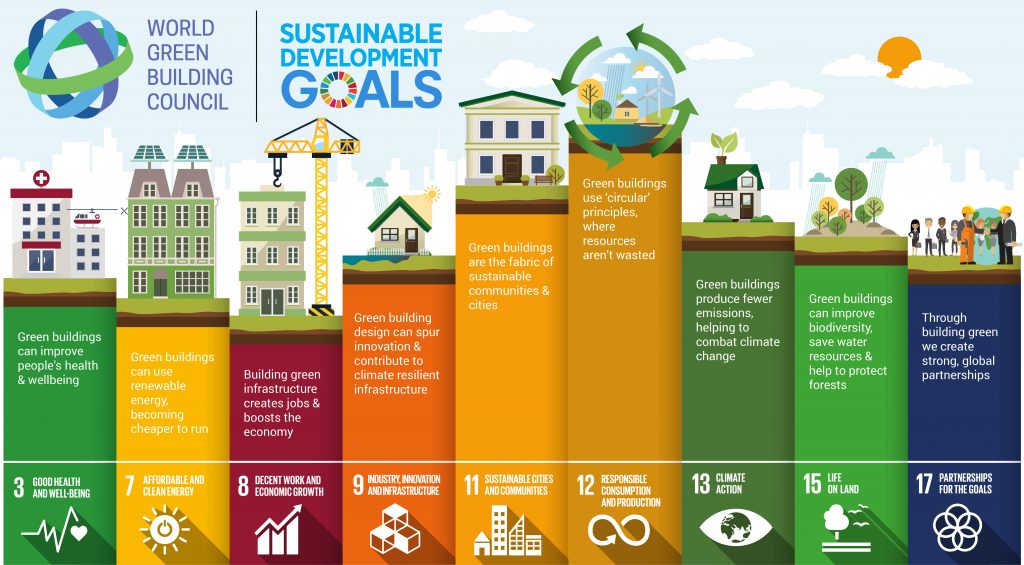

Firstly, buildings are a big part of the sustainability challenge, and thus a huge opportunity. “The construction and operations of buildings account for 40% of global energy use, 30% of energy-related GHG emissions, approximately 12% of water use, nearly 40% of waste, and employs 10% of the workforce.” [1] We spend 90% of our time indoors. If we want a more sustainable society and economy, we need to tackle buildings.

UN-9sustainabledevelopmentgoals
The World Green Building Council counts buildings as fundamental to 9 of the 17 Sustainable Development Goals.

Secondly, buildings are a fantastic Triple Bottom Line opportunity.[2] There are plenty of projects where better outcomes for People, Planet, and Profits are simultaneously achievable. Property owners can profit from energy efficiency retrofits and building improvements. Reducing energy use reduces utility bills. Better, healthier buildings typically command higher rents and are worth more.[3]

Third, investor engagement can make a big impact in the real estate sector. There are some Real Estate Investment Trusts (REITs) leading the way, demonstrating profitability through sustainability, but there are also many who haven’t been taking advantage of the opportunities yet. Investors who demand better performance, highlight best practices, and educate executives can push companies to do more and create impact.

The Triple Bottom Line Opportunity in Sustainable Buildings

Because buildings consume so many resources, and we spend so much time in them, they represent an outsized opportunity.

“The environmental impact of the built environment can be minimized with energy efficient buildings, as well as with environmentally sound siting decisions, materials selection, water use, and waste management. In addition, energy efficient buildings contribute to better indoor and outdoor air quality through reduced pollution and improved ventilation, leading to health and economic benefits.” [4] (World Resources Institute in 2017)

Making sustainable upgrades to properties old or new can be beneficial in terms of cash flow. Efficiency improvements can reduce operational costs through lower utility bills and maintenance costs; lower exposure to energy price risk; or lower insurance and debt cost. A property with a green building certification can result in higher occupancy rates or increased tenant satisfaction, which translates into longer leases, higher demand or a rent premium. Studies also show green buildings to enjoy a price premium, a lower default risk, lower volatility and slower rate of depreciation.[5]

REITs that focus on sustainability can maximize these benefits and attract ESG investors.

A Strategy for Capturing the Triple Bottom Line Opportunity

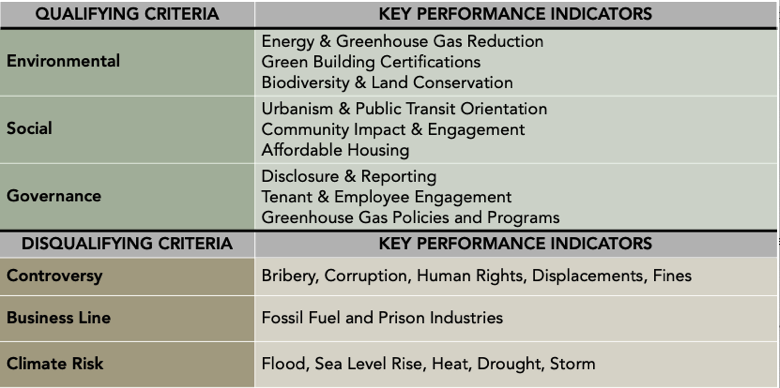
The Vert Global Sustainable Real Estate Fund owns liquid real estate through a portfolio of publicly-traded REITs. Our investment strategy is to invest in the REITs that create value with their ESG initiatives. We want to own the leading firms who are most committed to sustainability. In consultation, with leading academics, we chose the following metrics as our qualifying criteria. We believe these to be the most important, most material, and most relevant for identifying leaders.

Vert Real Estate Investment Strategy: Key Performance Indicators

Let’s look at some examples. First we look at two tried and true success strategies of reducing energy and emissions, and then we’ll take a look at some new and innovative ideas that are quickly gaining traction.

1) A Deep Energy Retrofit earns a green building certification, and big savings.

In 2010, the iconic New York Empire State Building underwent a retrofit[6]. Originally built in 1930, it languished in recent decades, having become expensive to operate, and unappealing to office tenants. The building has been restored to its former glory with higher occupancy, uses far less energy, and is saving lots of money, detailed below.

EmpireStateBuilding-VertAssetMgmt

Empire State Building Retrofit Details

Highlights:
• Rebuilt 6,524 windows
• Reflective insulation installed
• New control systems
• Renovated HVAC system– rather than replacing with new system

Results:
• Energy reduction of 38%
• Utility bill savings of $4.4 million per year
• Payback Period of only 3.1 years
• GHG reduction of 105,000 tons over 15 yrs
– equivalent to removing 20K cars from roads
• Achieved LEED Gold Status in 2011

It is estimated that 60% of existing buildings will be renovated between now and 2030.[7] Hopefully their owners take advantage as the Empire State Realty Trust did.[8]

2) Net-Zero Housing reduces energy use and greenhouse gas emissions.

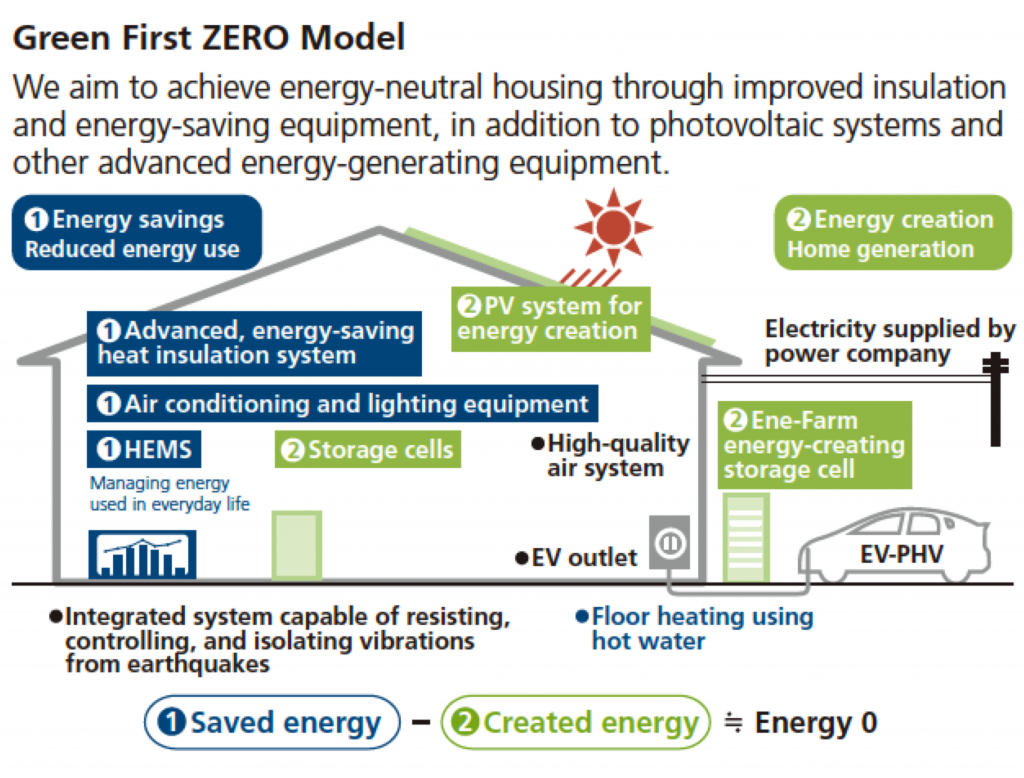
Back in 2009, Sekisui House[9], a Japanese REIT, launched their ‘Green First Zero’ homes initiative with the goal to create net-zero energy homes through sustainable design. These energy-producing and energy-saving homes reduce costs significantly for residents.

SekisuiHouseNet-ZeroEnergy
Sekisui House Net-Zero energy homes (acronyms defined in footnotes)[10]
Net Zero buildings are now achievable. In fact, the European Union has passed regulations that all new buildings from 2021 must be Net Zero or Near Net Zero.

3) Health and wellness initiatives add value

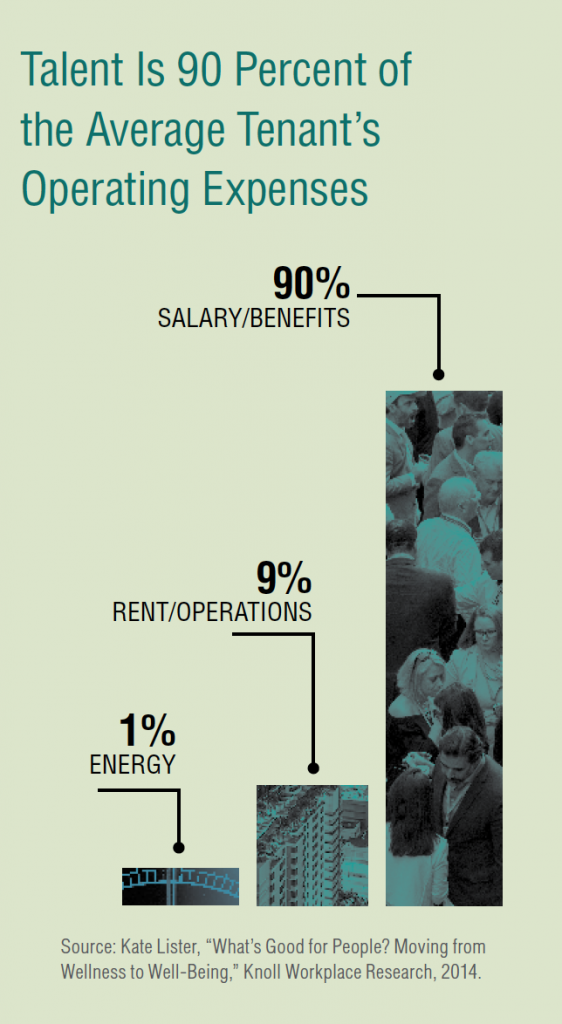
Leading REITs have long recognized the value of energy and operational efficiency; and as a result have significantly reduced their operating expenses. Now they are turning their attention to workplace health – helping tenants get more productivity from employees working in all types of buildings from offices to hospitals to warehouses.

WorkplaceHealthAndWellness-VertAssetMgmt
Workplace Health and Wellness

In 2017 CoreNet Global and CBRE surveyed 211 senior executives in real estate, tech, and finance firms that had improved their workplace health and wellness design. 19 percent reported a decrease in absenteeism, 25 percent reported increased employee retention, and 47 percent reported increased employee engagement. These so-called ‘soft’ metrics can translate to ‘hard’ profits. For example, a lawyer might cost $2,500 per sick day in lost billable revenue. In a 50,000-square-foot office with 100 attorneys, one less sick day per employee per year leads to $250,000 in extra income – $5 per square foot per year. This is a huge benefit for employers and they are starting to recognize the value, and are willing to pay a premium for offices that design healthy buildings.

4) A waterfront property gets prepared for climate risk

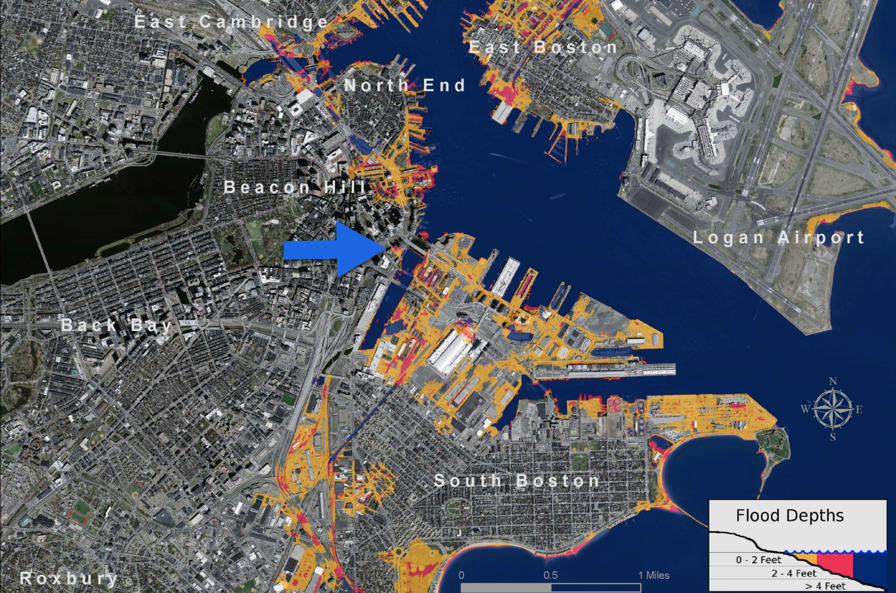
Buildings can’t really avoid climate risk. When disaster strikes, we can often move ourselves, but we can’t move the buildings. Unfortunately, some owners underestimate the risks by relying on outdated FEMA maps or increasingly invalid ‘1 in 100 year’ heuristics. Like many coastal cities, Boston often floods during high tides and severe storms. To keep their waterfront Atlantic Wharf property safe, Boston Properties[11] installed an ‘AquaFence’ which can be deployed quickly to keep water out of the building. We prefer to hold REITs that are proactively managing climate risks.

AtlanticWharf-mixeduse-VertAssetMgmt
The blue arrow indicates the Atlantic Wharf, a mixed-use property on the waterfront on Boston Harbor.

The Engagement Opportunity

REITs own a large share of the building stock, including offices, warehouses, data centers, shopping centers, apartment buildings, hotels, healthcare, and self-storage. As an investor in REITs, we can encourage them to be more sustainable, demonstrate to other owners what works, and collaborate with a range of stakeholders to promote successful technologies and policies. It’s a great opportunity to improve the built environment so we engage with every company in our portfolio through formal letter campaigns, policy working groups, and industry events.

The REIT industry has been very welcoming to our efforts. Vert was invited to speak at the National Association of Real Estate Investment Trust’s ESG Forum the last two years. This year we presented to over 80 REITs on climate risk, how we as investors measure it, and what we want so see in terms of planning and disclosure.

Conclusion

Sustainability in the built environment is a real triple bottom line opportunity that has outsized potential for people, planet and profit. Large Institutional Investors have figured this out and many invest in green building projects directly. Vert launched the Vert Global Sustainable Real Estate Fund so financial advisors and their clients can also invest for sustainability in real estate. The more money invested on a sustainable basis, the more companies will manage their environmental and social risks and opportunities.
 

Article by Sam Adams, CEO and co-founder of Vert Asset Management (http://www.vertasset.com). He also chairs the Investment Research Group. Sam leads the development of new products to help make sustainable investing easier for investors. He has been a featured speaker on sustainable investing at financial advisor conferences in the US, UK, Europe, and Australia. Prior to launching Vert, Sam spent almost 20 years working at Dimensional Fund Advisors. He started Dimensional’s European Financial Advisor Services business and led it for 10 years. Sam was part of the team that created Dimensional’s first ESG strategies, the Sustainability Core funds that are offered in the US. He also led the development and launch of Dimensional’s Global Sustainability Core Fund in Europe.

Sam has a BA in Philosophy from the University of Colorado, Boulder and an MBA in Finance from the University of California, Davis. Sam is an avid mountaineer and cyclist, and is very passionate about the environment. He lives in Mill Valley, CA with his wife and three children.

Article Footnotes:

[1] Originally quoted from UN Environment Programme from Sustainable Buildings and Construction. Similar figures now found at the International Energy Agency (2019). “Energy Efficiency: Buildings.” Retrieved from: https://www.iea.org/topics/energyefficiency/buildings
[2] The ‘Triple Bottom Line’ phrase originated in 1994 with John Elkington founder of SustainAbility; most notably in the paper: Elkington, J. (1994) “Towards the Sustainable Corporation: Win-Win-Win Business Strategies for Sustainable Development”, California Management Review, vol. 36, 2: 90-100. John Elkington is an Advisory Board Member of Vert Asset Management.
[3] Coleman, P., Deason, J. and Mathew, P. (2017, October). CRE Literature Survey. Presentation delivered at the Lawrence Berkeley Lab and US Department of Energy Research Workshop, University of North Carolina, Chapel Hill.
[4] World Resources Institute (2017). Accelerating Building Efficiency: Eight Actions for Urban Leaders. Retrieved from: http://publications.wri.org/buildingefficiency
[5] Fuerst, F. and McAllister, P. M. (2008, July 15) “Green Noise or Green Value? Measuring the Effects of Environmental Certification on Office Property Values.” Retrieved from https://ssrn.com/abstract=1140409
[6] Empire State Building (2014). “Sustainability & Energy Efficiency.” [Information Section]. Retrieved from www.esbnyc.com/esb-sustainability
[7] World Resources Institute (2016, May 11) “4 Surprising Ways Energy-Efficient Buildings Benefit Cities.” Retrieved from http://www.wri.org/blog/2016/05/4-surprising-ways-energy-efficient-buildings-benefit-cities
[8] Empire State Realty Trust is 0.30% of the Vert Global Sustainable Real Estate Fund (VGSRX) as of March 31, 2019.
[9] Sekisui House Reit Inc is 0.31% of the Vert Global Sustainable Real Estate Fund (VGSRX) as of March 31, 2019.
[10] These are the various acronyms referred to in figure 3: HEMS – Home Energy Management System, EV – Electric Vehicle, PHV – Plugin Hybrid Vehicle, PV- Photovoltaic.
[11] Boston Properties Inc. is 2.77% of the Vert Global Sustainable Real Estate Fund (VGSRX) as of March 31, 2019.

The Vert Global Sustainable Real Estate Fund’s investment objectives, risks, charges, and expenses must be considered carefully before investing. The statutory, and if available summary prospectuses contain this and other important information about the investment company and may be obtained by calling 1-844-740-VERT or visiting www.vertasset.com . Read carefully before investing.

Mutual Fund investments involve risk. Principal loss is possible. Investors should be aware of the risks involved with investing in a Fund concentrating in REITs and real estate securities, such as declines in the value of real estate and increased susceptibility to adverse economic or regulatory developments. Investments in foreign securities involve political, economic and currency risks, greater volatility and differences in accounting methods. A REIT’s share price may decline because of adverse developments affecting the real estate industry. REITs may be subject to special tax rules and may not qualify for favorable federal tax treatment which could have adverse tax consequences. The Fund’s focus on sustainability may limit the number of investment opportunities available to the Fund and at time the Fund may underperform Funds that are not subject to similar investment considerations.

The Vert Global Sustainable Real Estate Fund is distributed by Quasar Distributors, LLC.

Fund holdings and/or sector allocations are subject to change at any time and are not recommendations to buy or sell any security.

Energy & Climate, Featured Articles, Impact Investing, Sustainable Business

Millions of Idle Power Plants

By Ryan Dings, Chief Operating Officer, Sunwealth

Sunwealth-logoThe next time you walk around your community, look up! On the rooftops of buildings all around us, you’ll see idle power plants – potential sites for rooftop solar installations – just waiting to be activated in the fight against climate change.
The Power of Rooftop Solar

Combating climate change requires our economy to make a comprehensive transition to clean energy. If we are to make a full and complete transition, then rooftop solar must be part of the solution. The buildings all around us consume so much power and generate so much carbon. But on top of each building lies potential. Specifically, the rooftops of those buildings have high technical potential to generate solar power right at the point where it is consumed. According to the National Renewable Energy Laboratory’s 2016 study, the technical potential of rooftop solar across all building types and sizes could produce enough electricity to equal 39 percent of total national electric-sector sales.[1]

Before any building begins to pull power from the grid, we should maximize the potential for that building to generate its own power. In addition to rooftop solar becoming the hallmark of 21st century green buildings, three compelling reasons for incorporating rooftop solar emerge.

First, maximizing the energy production of a building makes reducing the energy consumption of a building a more meaningful exercise in the fight against climate change. For example, let’s say energy efficiency improvements can reduce a building’s total energy consumption by 25 percent. If you can first generate 50 percent of the building’s power needs through renewable energy (thus cutting its carbon emissions in half), then a 25 percent reduction in the building’s total energy consumption actually has the benefit of reducing the building’s remaining carbon emissions by 50 percent – creating a form of carbon reduction leverage.
Second, generating power on site is simply cheaper than pulling it through hundreds of miles of power lines. Consumers of the power can enjoy energy savings year after year, with many solar systems now designed to last more than twenty years.

Third, each rooftop represents a meaningful impact investment opportunity. A new roof with proper orientation and minimal shading represents a long-term stream of cash flow, because a quality rooftop solar project can produce and sell power year after year and immediately unlock the Investment Tax Credit available for every new commercial and residential solar project placed in service in the United States.

StPaulMassLutheranChurchSolarInstall-Sunwealth
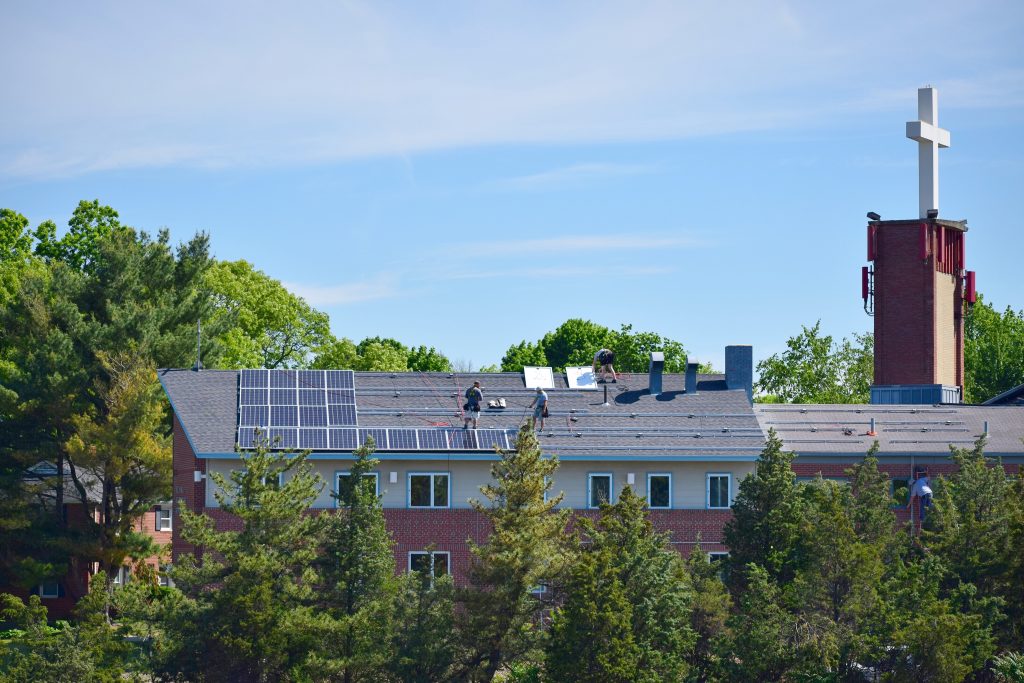
Panels being installed on the rooftop of St. Paul Lutheran Church in Arlington, Massachusetts, part of Sunwealth’s 2018 Solar Impact Fund; (Photo by Cody Eaton)

Adopted in 2005 and extended twice over in bipartisan fashion, the Investment Tax Credit provides the owner of the solar system with a tax credit equal to thirty percent (30 percent) of the value of the eligible basis of the solar system (26 U.S. Code § 48). With rooftop solar, it is highly likely the entire cost of the system will be included in the eligible basis. The tax credit is a dollar for dollar offset in taxes due, a meaningful tool for the owner of a solar system to reduce their taxable income. For a $100,000 solar project, that translates into $30,000 of tax credits, which will become the property of the owner of the solar project as soon as the system is placed into service (i.e., turned on). The Investment Tax Credit isn’t transferable or tradable, so the owner of the system must use them, creating both a challenge for system owners and an opportunity for impact investors.

The Impact Investment Opportunity

Incorporating rooftop solar into all the suitable rooftops across our built environment means deploying a notable amount of capital and addressing ways to monetize the investment tax credit that accompanies each solar system.

Tax credits are a meaningful incentive and a valuable investment tool. But tax credits are only valuable for individuals or organizations with tax liability against which they can apply those tax credits.

Suppose you are a commercial building owner who runs a for-profit business that generates a lot of income. Putting a solar project on your rooftop makes great economic sense, because that project will generate a 30 percent investment tax credit which, as the owner of the system, you can use to reduce your tax liability.

But let’s look at another example. Let’s take a house of worship, a community organization, a fire department or a school. These are tax-exempt organizations, which means owning a solar system comes with a tax credit that you cannot use, transfer or sell. The investment tax credit policy is intended to accelerate the adoption of solar, but in doing so, the policy has excluded the communities and building owners that could most benefit from clean energy.

This is where Sunwealth comes in. Through our Solar Impact Fund, we raise capital from tax equity investors who are eligible individuals and corporations, each of whom can monetize the tax credit. With the proceeds of our tax equity offering (and a corresponding debt offering), we acquire rooftop solar projects by leasing a rooftop from a building owner and building a solar system, which we own, on the leased rooftop. Then, we execute a power purchase agreement with the building owner, providing power to the building at a price that is 15-30 percent less than the retail electricity rate. By becoming the owner of the system, we – along with our tax equity investors who are passive co-owners of the system – become the owners and beneficiaries of the tax benefits. Now, the tax credits being produced by a system on the rooftop of a house of worship (or nonprofit, school, fire department, municipal building, etc.) can be monetized by an investor – creating more value for those providing capital to build the system and unlocking more energy savings for those organizations buying the power.

UrbanLeagueEastMassRooftopSolar-Sunwealth
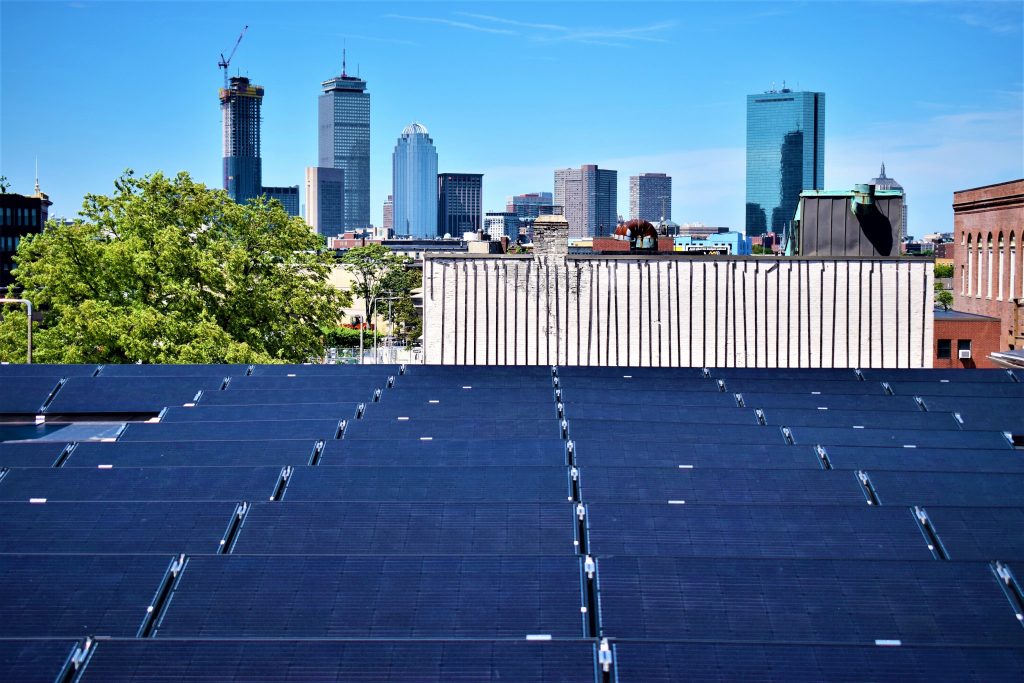
A solar system on the rooftop of the Urban League of Eastern Massachusetts in Roxbury, Massachusetts, part of Sunwealth’s 2017 Solar Impact Fund; (Photo by Cody Eaton)

Investment Tax Credit: Impact Capital & Green Building Catalyst

For 17 consecutive quarters, Sunwealth’s rooftop solar projects have consistently and simultaneously delivered solar power to a diverse community of organizations and target returns to investors. Without our tax equity investors, the projects on the rooftops of tax-exempt organizations could not be monetized by the building owners. At a time when buildings need to be as green as they can be to help drive a transition to a clean energy economy, tax equity investments in rooftop solar deliver incredible economic value and activate those otherwise idle power plants in the fight against climate change.
 

About the Author

A 2018 Boston Business Journal 40 Under 40 honoree, Ryan Dings is an experienced clean technology executive with a deep commitment to impact investment. As Chief Operating Officer of Sunwealth, Ryan leads the development of Sunwealth’s community of clean energy investors. In addition to his role at Sunwealth, Ryan serves as the chair of the board of directors of the Social Innovation Forum, Boston’s leading community for social impact engagement and connection.

To learn more about our company and the power of tax equity, contact us at 617-752-7322 or hello@sunwealth.com or visit- https://www.sunwealth.com

Article Footnote
[1] Rooftop Solar Photovoltaic Technical Potential in the United States: A Detailed Assessment, National Renewable Energy Laboratory, January 2016: https://www.nrel.gov/docs/fy16osti/65298.pdf

Energy & Climate, Featured Articles, Impact Investing, Sustainable Business

The Sustainability Edge in Real Estate Investing

By Kimberly Ryan, Portfolio Mgr., Wells Fargo Private Bank

Commercial real estate can have a significant impact on the environment and an increasing number of real estate industry professionals are incorporating sustainability practices into corporate strategy and building management. Kimberly Ryan, Portfolio Manager for Wells Fargo Private Bank’s Social Impact Investing (SII) REIT strategies offers her thoughts on the benefits of integrating sustainability and ESG analysis into the REIT investment process.

Why is sustainability important for real estate management teams to address?

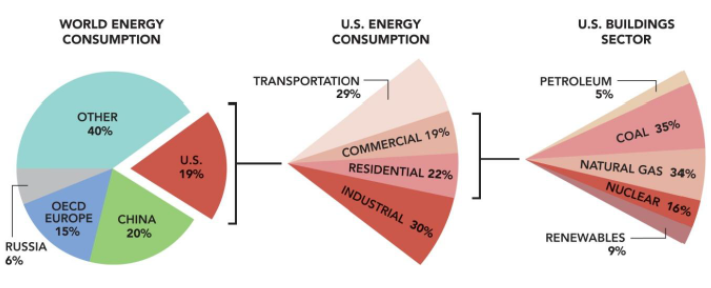
U.S. buildings account for 41% of primary energy consumption and 74% of all electricity consumed domestically.[1] They account for more annual energy use than the U.S. transportation sector and produce more greenhouse gases than any other country in the world except China. Greenhouse gas emissions from U.S. buildings are expected to grow faster than any other sector through 2030.[2]

WorldBuildingsEnergyConsumptionChart

Further, regulators are getting involved. In California, regulators have set a goal of having all buildings reach zero net energy – that is, consuming only as much energy as can be generated on-site by renewable sources – by 2030.[3]

We believe this presents a huge economic opportunity for real estate management teams to retrofit, upgrade and redesign to better position their assets for a lower-carbon economy.

Are there financial benefits that accrue to companies and management teams that prioritize sustainability?

Improvements in building efficiency can provide real cost savings to landlords and tenants. Some of the more impactful initiatives include the installation of more efficient LED lighting; upgrades to heating, ventilation and air conditioning (HVAC); smart metering; reductions in water consumption; and waste management.

Above and beyond any cost savings, however, sustainably-managed structures typically command higher rents, and experience lower vacancy and higher tenant satisfaction.[4] This positively impacts property valuations and may also play a role in portfolio strategy as management teams evaluate whether to dispose, renovate or acquire properties as a way to generate higher returns on investment.

As an investor, how do you evaluate the sustainability performance of a real estate operating company?

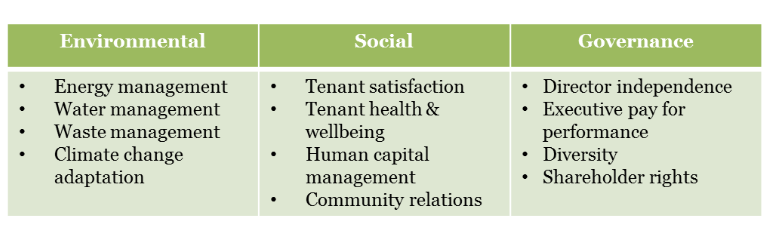
We take a broad view of sustainability, focusing not just on the environment, but also on broader social and governance issues. Some examples include:

We evaluate performance by reviewing a company’s environmental disclosures and talking with management about its specific goals for energy, water and waste management. We examine current progress toward these goals as well as future opportunities. Building certifications and the use of ‘green leases’ can serve as an additional avenue into management’s thinking on sustainability.

We pay attention to tenant health and well-being. This is an emerging area of interest, and industry leaders are innovating to create healthier environments for tenants. Initiatives may include improved air quality, green cleaning, exposure to natural light and access to healthy food, to name a few.

How might these factors differ when analyzing different types of real estate?

Our issue focus varies depending on the subindustry. For example, when assessing a data center REIT, one of the main environmental issues we will consider is the company’s management of water and electricity use, as data centers require significant amounts of water and electricity to operate. We will assess how exposed the company is to areas of high water stress, programs to reduce dependence on municipal sources of water, and efforts to improve energy efficiency. In contrast, when analyzing the ESG performance of a single family home rental REIT, we focus on customer satisfaction and service as key factors. We will investigate how well a company is serving its customers, maintaining the quality of the rental property and ensuring terms and conditions are clearly communicated to its tenants.

How would you describe the Social Impact Investing (SII) team’s philosophy when it comes to real estate investing?

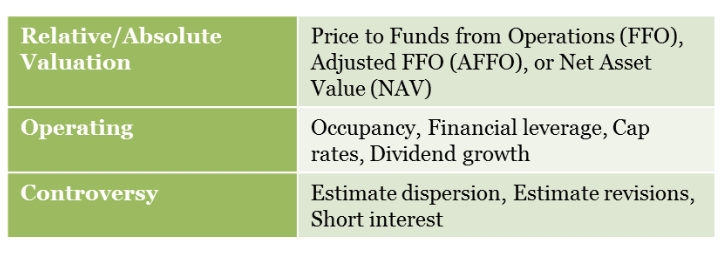
In general, we are looking for well-managed firms with good growth prospects, sustainable cash flows, and disciplined capital deployment, trading at reasonable prices. All of our strategies (equity, fixed income, REIT) employ a combination of fundamental, quantitative, and ESG assessments in their investment processes. We manage well-diversified portfolios with low turnover and we try to avoid controversy. We look at financial metrics that are specific to real estate as well as more common measures as shown below.

WellsFargoSII-investmentcriteria
(Please see the disclosures at the end of the report for definitions of terms)

Our long-term investment approach aligns well with a focus on sustainability, as the benefits of these initiatives take time to manifest. Just as a homeowner may decide to replace windows with double pane glass or add solar panels to the roof to reduce utility costs, real estate managers also expect to reap the benefits of building efficiency upgrades and tenant amenities over the long term. As investors, we understand it takes time for companies to see their efforts generate and return value to shareholders.

The SII Team launched two REIT strategies in September 2017. What do you see as differentiating these SII strategies from traditional REIT strategies?[5]

The two strategies similar to other REIT strategies in that they are composed of publicly traded US equity REITS diversified across property type and geography. Where we differ in our investment process is that we integrate ESG analysis alongside quantitative and fundamental analysis which helps us identify risks and opportunities that other managers might miss.

What this means, practically speaking, is that a company with a management team that delivers strong financial results yet fails to invest in projects or initiatives to mitigate long-term challenges like the environmental impact of its properties may not qualify for Social Impact Investing’s strategies. Conversely, those that proactively address environmental impacts will make for better candidates and may warrant higher weights in the strategies.

Closing Thoughts

We believe by evaluating a company’s intention and analyzing its performance around sustainability, we gain critical insight about its future risks and opportunities. There is evidence to suggest that real estate companies realize tangible financial benefits whether in the form of lower costs, improved cash flows or higher property valuations.

Managers of residential and commercial real estate have a financial incentive to care about sustainability. Real estate is energy, water and waste intensive and practices that promote better management of these challenges should be mutually beneficial to companies and investors while spilling over into society in a positive way.


Article by Kim Ryan, CFA, Senior Portfolio Manager for the Social Impact Investing team, part of Wells Fargo Private Bank  https://www.wellsfargo.com/the-private-bank/solutions/social-impact-investing and based in San Francisco, California. She co-manages equity and real estate strategies and manages the team’s analysts. The team’s investment process combines quantitative, fundamental security and environmental, social and governance (ESG) analysis. Ms. Ryan is a member of the Wells Fargo Bank Proxy Committee.

Most recently Ms. Ryan was a partner, senior portfolio manager with Nelson Capital Management. In that role, she served as a member of the investment and corporate engagement committees. Before joining Nelson Capital, Ms. Ryan spent 11 years as an investment manager and equity analyst with Wells Fargo Private Bank. She was a member of the Growth Equity Team and over the years covered stocks in the consumer, technology and telecommunications sectors.

Prior to her time at Wells Fargo, Ms. Ryan worked in the consumer healthcare and investment banking industries. At Deutsche Banc Alex Brown, she was an analyst on numerous corporate finance deals, primarily in the media industry. She has been in the financial industry for more than 20 years.

Ms. Ryan holds the Chartered Financial Analyst® designation and is a member of the CFA Institute and CFA Society of San Francisco. Ms. Ryan holds a B.B.A. from the University of Notre Dame with a double major in Finance and Government.

Article Footnotes

[1] U.S. Department of Energy Buildings Energy Data Book. March 2012. Chapter 1 and Table 1.1 Buildings Sector Energy Consumption.
[2] Buildings and Climate Change, US Green Building Council., http://www.eesi.org/files/climate.pdf
[3] California Energy Commission, Background on the 2016 Building Energy Efficiency Standards.
[4] Avis Devine and Nils Kok, “Green Certification and Building Performance: Implications for Tangibles and Intangibles”, Journal of Portfolio Management (2015)
[5] The SII team offers a Sustainable REIT strategy and a Faith Based REIT strategy. The key difference between the two is alignment. Both strategies exclude REITs with exposure to private prisons or casinos. The Faith Based strategy also excludes REITs that serve the healthcare industry since there may be unwanted activities in those facilities.

Definition of Terms:

Price-to-FFO Ratio: Price to FFO ratio is price to Funds from Operations ratio.

Price-to-AFFO Ratio: Price to AFFO ratio is price to Adjusted Funds from Operations ratio.

Net Asset Value: Often presented on a per-share basis, Net Asset Value (NAV) is the value of a company’s common equity calculated by applying an updated market value to the company’s real estate portfolio & other operating assets and deducting all liabilities, including preferred equity.

Occupancy: A measure, usually in a percentage, of the amount of real estate space currently being rented versus the total amount available for rent, for a given portfolio

Financial leverage: A measure of a company’s use of debt. Broadly defined as Total Liabilities divided by Total Assets

Dividend Growth: Dividend Growth measures annual growth rate of the split-adjusted indicated dividend per share.

Estimate dispersion: The degree to which the highest earnings estimate differs from the lowest estimate, as a percent of the average (‘consensus’) earnings estimate at a given point in time.

Estimate revisions: The degree to which, positive or negative, earnings estimates change relative to the average earnings estimate at a given point in time.

Short interest: A ratio, normally in percentage, of the total amount of shares being sold short versus the total available float of common stock.

Risk Considerations

Investing in REITs has special risks, including the possible illiquidity of the underlying properties, credit risk, interest rate fluctuations, and the impact of varied economic conditions.

Sustainable investing focuses on companies that demonstrate adherence to environmental, social and corporate governance principles, among other values. There is no assurance that social impact investing can be an effective strategy under all market conditions. Different investment styles tend to shift in and out of favor. In addition, a strategy’s social policy could cause it to forgo opportunities to gain exposure to certain industries, companies, sectors or regions of the economy which could cause it to underperform similar portfolios that do not have a social policy.

Disclosures

Wells Fargo Bank, N.A. (the “Bank”) offers various advisory and fiduciary products and services including discretionary and portfolio management. Financial Advisors of Wells Fargo Advisors may refer clients to the bank for an ongoing or one-time fee. The role of the Financial Advisor with respect to bank products and services is limited to referral and relationship management services. The Bank is responsible for the day-to-day management of non-brokerage accounts and for providing investment advice, investment management services, and wealth management services to clients. The Financial Advisor does not provide investment advice or brokerage services to Bank accounts but does offer, as applicable, brokerage services and investment advice to brokerage accounts held at Wells Fargo Advisors. The views, opinions and portfolios may differ from our broker-dealer affiliates. Wells Fargo Advisors is a trade name used by Wells Fargo Clearing Services, LLC and Wells Fargo Advisors Financial Network, LLC, Members SIPC, separate registered broker-dealers and non-bank affiliates of Wells Fargo & Company. Wells Fargo affiliates may be paid a referral fee in relation to clients referred to Wells Fargo Bank, N.A.

Wells Fargo Wealth Management, Wells Fargo Private Bank and Abbot Downing, a Wells Fargo business, provide products and services through Wells Fargo Bank, N.A. and its various affiliates and subsidiaries. Wells Fargo Bank, N.A. is a bank affiliate of Wells Fargo & Company.

The information and opinions in this report were prepared by Wells Fargo Wealth Management. Information and opinions have been obtained or derived from sources we consider reliable, but we cannot guarantee their accuracy or completeness. Opinions represent Wells Fargo Wealth Management’s opinion as of the date of this report and are for general information purposes only. Wells Fargo Wealth Management does not undertake to advise you of any change in its opinions or the information contained in this report. Wells Fargo & Company affiliates may issue reports or have opinions that are inconsistent with, and reach different conclusions from, this report.

© 2019 Wells Fargo Bank, N.A. All rights reserved.

CAR-0519-01802

Investment and Insure Products: NOT FDIC Insured, NO Bank Guarantee, MAY Lose Value

Energy & Climate, Featured Articles, Impact Investing, Sustainable Business

X