Tag: Impact Investing

Millennials and Money: A Shared Sense of Destiny
By Danan Kirby, Thornburg Investment Management

Thornburg Investments LogoMillennials are the proverbial whipping boy of the media. A multitude of tropes, memes and satire exist about unsavory stereotypes of my generation. Some include a dose of truth; others appear completely fabricated as part of some generational rite of passage. It’s not surprising that the world continues to be fascinated by Millennials and our impact on the world. We comprise the largest portion of the U.S. workforce. Millennials’ inability to reach traditional financial milestones in part contributes to the tongue-lashing they receive in the media and often in the workplace.

We are indeed a product of a different world. Millennials have grown up in a time of immense change: the (first) Gulf War as children, the rise of the Internet, the bursting of the dot-com bubble, the falling of the Twin Towers, the beginning of the global war on terrorism and the Iraq War. Many of us also began our careers just as the great financial crisis was getting underway. Meanwhile, the generation has experienced a rapid rise in educational costs only to face wage stagnation and a shrinking path to home ownership and family creation.

Despite these challenges, the shared experiences of Millennials have created an increased sense of shared destiny. No previous generation has been able to establish connection more easily, thanks to the rise of social media and the Internet. Seeing firsthand (via the web) the effects of market events and being able to share our responses to them has made risk very real for Millennials when making financial decisions. It has created a unique set of values with how we interact with money and our investments.

Consequences for One Means Consequences for All

While I have a lot of shared financial experiences with my Millennial cohorts, one area where my journey is dissimilar is a lack of student loan debt. Along with many compatriots of my generation, I paid for college via the GI Bill. So, while I don’t personally experience the student loan debt hangover shared by some of my Millennial peers, the tradeoff was not without personal risk.

I joined the U.S. Army straight out of high school, shortly after the 9/11 attacks. While serving, I naturally learned a few hard lessons about risk, but what I truly took away from my service was a broader sense of purpose and my inter-connectivity with others. I saw how decisions made above and below my rank would not only have implications for me, but for those outside our initial decision-making framework. The decisions I made at any point in time could have broad consequences for my brothers and sisters in arms, their families at home, and in the communities we operated in—for years to come.

After the military, I had more experience with the destiny I share with my generation as a federal regulator with the FDIC, learning that what seems like an individual decision can impact the lives of everyone when taken in aggregate. Just some loans a banker makes couldn’t possibly collapse the whole system, right? Processing FDIC claims for people who held accounts at collapsed banks instilled in me the importance of building sustainable systems to support one of the largest parts of people’s lives—their finances.

Sharing a Broader Understanding of Risk

Following my time as a regulator, I made my way into financial services in an investment capacity, with an intention to help people navigate their financial challenges. I wanted to help build a better outcome for their financial goals. Part of that was development of a process around investing in companies that support a more sustainable world as a whole, and not just companies that are financially sound.

Including sustainability – ESG – criteria means expanding one’s investment lens when evaluating a potential investment and determining how companies are serving not only the needs of their shareholders, but the other stakeholders of that company: employees, the community and the environment. Given Millennials’ experiences, it is no surprise that they demand ESG analysis be done when evaluating investments.

Thornburg Mgmt Team - GreenMoney Journal February 2020

Today, at Thornburg, I work extensively on the integration of ESG throughout our investment process. I focus on detangling the complexities of sustainability issues from an investment angle in order to deepen our understanding of the companies in which we invest. The goal for our organization always has been to serve our clients by helping them build a sustainable financial future for themselves. The work we are doing on ESG integration, along with policy related efforts with the US SIF, are key to helping Millennial investors build a better financial future.

The Ripple Effect

While my experience certainly isn’t every Millennial’s experience, I can say my career path led me to understand that Millennials have a broader sense of a shared destiny. My generation isn’t just “interested” in sustainability, we are the vanguard of building the systems, processes and policy around a sustainable financial system, which means ESG incorporation, not just longevity. Millennials aren’t junior folks in the office anymore, and as we move forward in our lives, we are cognizant that the ripples we make today will quickly become the waves that we feel tomorrow.


Article by Danan Kirby, client portfolio manager for Thornburg Investment Management. He works with Thornburg’s investment team and serves as a liaison for the team and key investment decision makers, communicating process and results of the firm’s investment strategies. He also works on ESG integration efforts across strategies and represents the firm at the US Forum for Sustainable Investments (US SIF) and The Principles for Responsible Investment (PRI). Danan joined Thornburg in 2016.

Prior to Thornburg, Danan served as portfolio manager for the Strategic Growth Bancorp family of banks, managing various strategies for institutions and individual investors. Before that, he was a financial institution specialist with the FDIC. He is also a veteran of the U.S. Army. Danan graduated summa cum laude from the University of New Mexico’s Anderson School of Management with a BBA, concentrating in finance. He is a CFA charterholder.

The views expressed are subject to change and do not necessarily reflect the views of Thornburg Investment Management, Inc. This information should not be relied upon as a recommendation or investment advice and is not intended to predict the performance of any investment or market.

Thornburg mutual funds are distributed by Thornburg Securities Corporation.

2300 North Ridgetop Rd. | Santa Fe, NM 87506 | 877.215.1330 | https://www.thornburg.com

Energy & Climate, Featured Articles, Impact Investing, Sustainable Business

Facebook – Another Moral Dilemma

By Francis G. Coleman, CBIS (retired after 32 years)

A Pew Research study revealed that social media is king when it comes to the news. In the US, 72 percent of millennials read the news via their Facebook, Twitter feed, and other social networking sites. Only 21 percent of people aged 50+ do the same. The older generation predominantly consumes news via their television.

Unilever CMO Keith Weed warned in a speech in March 2018 “that trusted brands could not afford to be associated with social media platforms that fail to safeguard users’ privacy.” He also said, “Across the world, dramatic shifts are taking place in people’s trust, particularly in media. We are seeing a critical separation of how people trust social media and more ‘traditional’ media. In the US only less than a third of people now trust social media (30%), whilst almost two thirds trust traditional media (58%).”

Mark Zuckerberg - Courtesy Politico - GreenMoney Journal
Photo courtesy of Politico

In the fall of 2017, I wrote an article for GreenMoney suggesting that Facebook was in the midst of a moral dilemma, based on a business model that sustains itself by removing as many privacy barriers to access its members’ data as was possible, within the context of what was legal and what the market permitted. Shortly after that article, Facebook’s roof began to leak.

In March 2018, we became aware of a massive breach (80-90 million uses) of its privacy agreement, by Cambridge Analytica. Mark Zuckerberg, Facebook’s CEO, spent quite a bit of time doing damage control, most notably before a Congressional Committee in the fall of 2019.

Shortly after that cycle of damage control, Zuckerberg appeared before a technology forum to discuss “Facebook News”, a now formal initiative to launch a “news” portal as part of its ecosystem. Facebook already enjoys the fact that it is a primary news source from it main feed. Now it has developed a “Facebook News” tab that is being tested in various markets.

And thus, we are now at the second saga of Facebook, an attempt to capitalize on the rise of social media as a primary news source for younger generations of Americans. The interesting thing is that they do not call themselves a news outlet, but a news ‘platform.’ That is a subtle but meaningful distinction as it relates to the issue of their responsibility for the news that finds it way onto its ‘platform’.

Here are some high level characteristics of the ‘news platform’ that are intriguing to me:

News will be optimized according to the infamous Facebook algorithm, which is a black box within a black box and not understood by many outside of Facebook.

Facebook will source its news from a variety of traditional sources and will pay some of those sources (distributors) for content. It is not clear how the payment system will work and whether those who are paid will have a preferred status for their news.

Facebook will cover Facebook. Their news will include direct news about Facebook. What’s the likelihood that this news will be negative? Many critics suggest they should refrain from being a source of news about themselves.

Facebook is loath to make judgments about the nature of certain political content (key difference between being an outlet and a platform), which is what leads to there being no or few filters applied to lies and deception, a continual problem for them.

Facebook’s Founder and CEO, Mark Zuckerberg has been clear that he is not likely to exercise any control over certain political speech. “Our policy is that we do not fact-check politicians’ speech. And the reason for that is that we believe that in a democracy it is important that people can see for themselves what politicians are saying.”

So what does all this mean and why should it concern you and me? I mean this is Facebook, the place where we put the cute pictures of pets acting in adorable ways, or of our children being precocious at just the right moment, or even the fantastic food we’re having in this moment. Why can’t we just let Facebook be Facebook?

Well if Facebook just wanted to be Facebook, the human connection portal that enriches our social lives with friends and family, then that would be fine. But Facebook doesn’t just want to be that. Facebook wants to be the centerpiece of our lives, that which delivers everything we need: connections, news, products, ideas and thoughts. And it wants to do that on its own terms, constrained only by the limits of its algorithms.

Here are the concerns that we all should be paying attention to, as Facebook embarks on this new initiative:

• We may be too far down the road of the absolute politicization of news to turn back. But to suggest that any entity defining itself as a news organization IS a news organization and equal weighting their contribution to news content is a dangerous precedent. But that seems to be Facebook’s approach when it identifies Breitbart as a valid source of news to be shared, even conveying “preferred partner” status on the outlet.

• While it denies this fact, Facebook is a gatekeeper. It doesn’t want to be perceived as one, because it would then be required to make judgments about what gets our attention and what doesn’t. So Facebook and other social media platforms profess to be utilitarian conduits, simply providing access and letting us make decisions about whether what we get is worth it by the amount of time we spend with it or by our clicks on it. But Facebook and its peers ARE gatekeepers. The purpose of their algorithms is to rank information in a way that prioritizes its appropriateness to us based on its ranking of our preferences. That is gatekeeping.

• Facebook does not want to be a news outlet, because it does not want the responsibility of deciding what news appears and what doesn’t. Once it calls itself a new outlet and labels those involved as journalists, then it would have the responsibility of establishing some rigor around what it reports and how it reports. That is a responsibility Facebook doesn’t want; and why not? Because that puts it in the middle of the fight around what constitutes news. All Facebook wants is content; content they can monetize.

And so where do we go from here? It is clear that the marketplace is pushing back somewhat against Facebook in a number of ways. These are the ways that are most impactful:

• Employees of Facebook, in a letter sent to senior executives were clear: “Free speech and paid speech are not the same thing.” At a minimum, Facebook will have to act like a news outlet for this work. It cannot allow paid speech to be acceptable if it does not meet certain standards. Like a news outlet, it will have to start fact checking political speech, ads and other news, to regain a sense of credibility.

• Facebook will have to begin recognizing that news needs to come from reasonably credible sources and it has to do so in a way that does not have it take sides. In doing this, it means establishing criteria for this designation.

So another moral dilemma for Facebook. First was the erosion of privacy concerns for the purposes of monetization and now they are having to address their desire to monetize news on their platform.

Can anyone say MeWe?


Article by Francis G. Coleman, former Vice Chair at CBIS an investment advisory firm that provides investment services to the Catholic institutional market. After 32+ years at CBIS, Frank announced his retirement effective December 31, 2019. The views expressed here are his personal views.

Faith & Investing, Featured Articles, Impact Investing, Sustainable Business

Ethical Corporation’s 2019 Responsible Business Awards

Maersk, Kimberly-Clark, BT, Hannon Armstrong, Intel and Firmenich among winners at the internationally renowned Ethical Corporation Responsible Business Awards.

In early October 2019, over 300 leading figures in global responsible business gathered at Ethical Corporation’s 10th Annual Responsible Business Awards ceremony held in London.

A great variety of different sectors and industries from all over the world were represented. The diversity on display – both in terms of geographical origin and working sphere – demonstrated how delivering a clean, more responsible business future is becoming an international mainstream effort – and opportunity.

(Pictured above) Krina Amin, Head of Strategy at Ethical Corporation, said in her welcome speech: “2019 marks the 10th year anniversary for the awards. The level of ambition and impact demonstrated by the Responsible Business Awards never ceases to amaze me, particularly in the new categories on SDG impact and business transformation. All this year’s shortlisted companies are delivering impressive and innovative impacts within their fields. To stand out from hundreds of entries is no mean feat.”

“The Responsible Business Awards are the only recognized global awards celebrating the leading strategies from across the globe. Seeing their ambition and impact gives hope that we can meet the challenges and goals that lie ahead. At Ethical Corporation we will look to shine the light on these leading strategies across our events and publishing activities” said Krina.

The chair of the judging committee Christine Diamente, head of brand at Nokia, said: “This year’s Responsible Business Awards judging has been yet another lively session with some new fellow judges joining the cast to choose the very best examples of Responsible Business across all categories. With an impressive amount of submissions, particularly on sustainable innovation, we are very excited by how responsible business is now “successful business” around the globe in terms of impact and scale. Congratulations to our winners and to the nominees. And I would like to extend my sincerest thanks to our judges too for their dedication and commitment to this year’s Responsible Business Awards.”

See the full list of Award Winners here.

Categories included: Sustainable Innovation; SDG Impact; New Start-Up; Community Impact; Plastic Innovation; Purpose-Driven Communications; Business Transformation; Responsible Investment; Business Leader of the Year; Partnerships of the Year; Clean Energy; Reporting and Transparency; Gender Diversity and Inclusion; Circular Innovation; Responsible Supply Chain; and the Responsible Business Honouree Award.

Additional Articles, Energy & Climate, Food & Farming, Impact Investing, Sustainable Business

Calvert Impact Capital hits Milestone & Launches New Guide

Calvert Impact Capital Passes $500 Million Milestone in Distribution of Community Investment Notes™ via Incapital Network and Releases New Guide to Impact Investing to Help Financial Advisors Keep Pace with Growing Client Demand

Calvert Impact Capital Launches New Guide-GreenMoneyCalvert Impact Capital, the mission-driven financial institution dedicated to creating a more equitable and sustainable world, recently announced that it has surpassed $500 million in distribution of its Community Investment Notes™ through Incapital’s network of broker-dealers and financial advisors. The volume of Community Investment Notes™ distributed demonstrates the continued increase in demand for impact investing opportunities from financial advisors.

“Incapital’s distribution network has been instrumental in helping us grow our business and in increasing access to investments that deliver deep impact as well as a financial return,” said Calvert Impact Capital President and CEO Jenn Pryce. “Channels like Incapital’s are essential for moving money at the scale we need to achieve the UN Sustainable Development Goals.”

The Community Investment Note™ program first became available through Incapital in November 2005. Calvert Impact Capital uses the proceeds from the notes program to invest in organizations in the U.S. and more than 100 countries that create affordable housing, finance small businesses, develop renewable energy solutions, and provide essential community services.

“The Community Investment Note™ serves as an important bellwether for the popularity of impact investing and passing this sales milestone is another encouraging proof point that impact investing is moving further into the mainstream,” said Incapital CEO John DesPrez III. “We are proud of our role in building a more equitable and sustainable world by providing values-based investing options on our Legacy™ Platform.”

New Advisor Guide to Impact

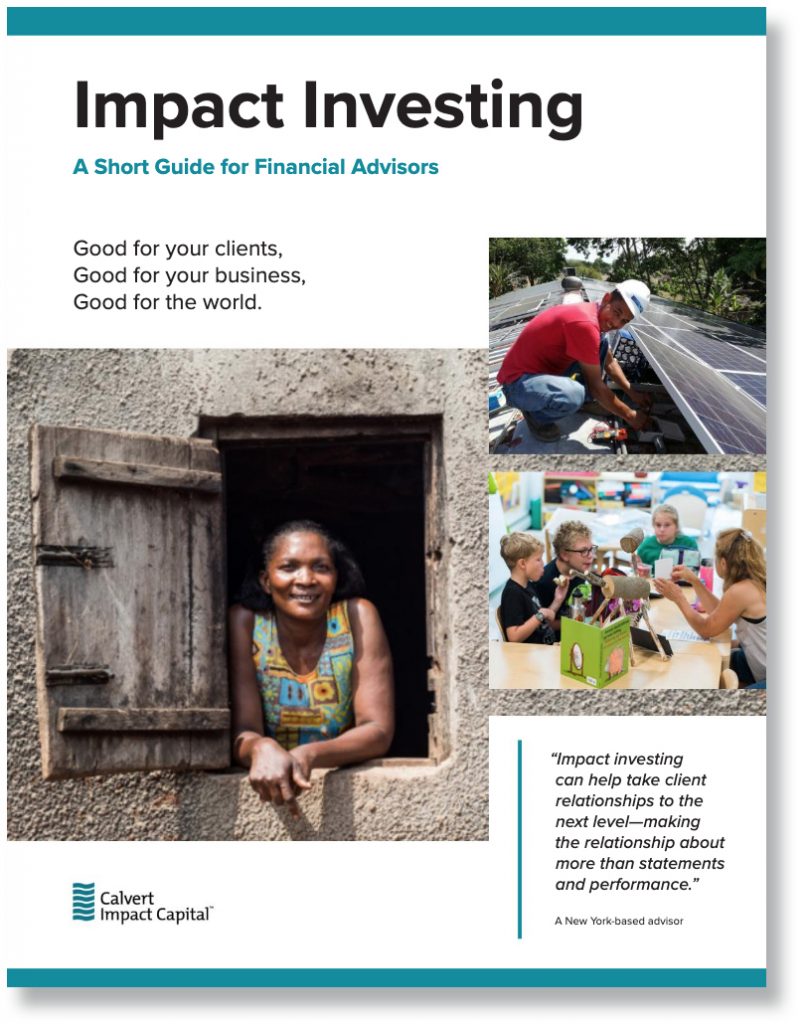
Calvert Impact Capital also recently released a new guide to help financial advisors meet the growing client demand for impact investing. “Impact Investing: A Short Guide for Financial Advisors” provides a useful overview of the impact investing industry, options currently available in the marketplace, as well as tips on how advisors can incorporate impact into their practice.

“As impact investing increases in popularity, it’s essential that financial advisors stay well-informed and understand how to broach the topic with their clients,” said Justin Conway, Vice President, Investment Partnerships at Calvert Impact Capital. “Our new Advisor Guide to Impact Investing is designed to concisely explain the opportunities that impact investing presents, as well as provide tips on how to engage a client in this important conversation. The good news for financial advisors is that having these conversations is proven to be good for their business, and this guide makes it easier than ever before to get started.”

Download a copy of Impact Investing: A Short Guide For Financial Advisors


About Calvert Impact Capital

Calvert Impact Capital invests to create a more equitable and sustainable world. Through our products and services, we raise capital from individual and institutional investors to finance intermediaries and funds that are investing in communities left out of traditional capital markets. During our 25-year history, we have mobilized over $2 billion of investor capital. Calvert Impact Capital also offers loan syndications, where we originate, structure and administer loans for institutional and accredited lenders seeking environmental and social impact. To date, we have syndicated and/or administered more than $200 million of capital for impact-oriented transactions.

About InCapital

Incapital was founded 20 years ago to deliver innovative, institutional-quality investments to the retail market. Today, the firm continues to underwrite and distribute InterNotes® retail corporate notes, Market-Linked Products, and other securities to more than 500 broker-dealers, institutions, asset managers, RIAs and banks. The firm represents more than 300 issuing entities and has underwritten more than $500 billion in securities. Incapital is headquartered in Chicago, Illinois, and has a principal office in Boca Raton, Florida.

Source: Calvert Impact Capital

Additional Articles, Impact Investing, Sustainable Business
RBC Global Asset Mgmt: 2019 Responsible Investing Survey

New survey from RBC Global Asset Management uncovers diverging views on responsible investing among institutional investors. While more institutional investors are going “all in”, others stay on the sidelines

Key Highlights

• More than 70% of institutional investors use ESG principles as part of their investment approach and decision-making process

• A positive performance impact (mitigating risk and enhancing returns) is now the top-cited reason for incorporating an ESG-based approach

• Cyber security ranks as the most important ESG issue for institutional investors surveyed

• On average, institutional ESG-based portfolios are 61% actively managed

Institutional investors in Canada, the United States and the United Kingdom who apply environmental, social and governance (ESG) principles are committing more of their assets to this approach than ever before, according to the 2019 RBC Global Asset Management (RBC GAM) Responsible Investing Survey released in mid-October 2019. Moreover, these investors are adopting an ESG-based approach specifically because they view it as a way to enhance returns and mitigate risk.

The RBC GAM survey revealed that in key markets, institutional investors are shifting more of their assets to an ESG-based approach. Regionally, the percentage of survey respondents who report using ESG principles “significantly” as opposed to “somewhat” rose slightly in the US (up about 3% from 2018), more significantly in Canada (up over 5%) and especially rapidly in the UK (up 30%). This group of adopters is also more convinced of the tangible value that an ESG-based approach provides to their portfolios. Mitigating risk and enhancing returns is now the number one reason institutional investors are incorporating this approach, with 53% of respondents citing it this year.

RBC GAM’s research also suggests that the responsible investing market is showing signs of maturing. After two consecutive years of rapid growth in the adoption of ESG investment strategies, this growth slowed in 2019. The percentage of institutional investors who said they use ESG principles as part of their investment approach and decision-making process remained relatively flat compared to last year, at 70%. However, on a regional basis, the percentage of institutional investors in the UK and Canada who “significantly” or “somewhat” adopt ESG factors continued to tick upward, reaching 97% and 80%, respectively. In the US, ESG adoption was flat versus 2018, at around 65%.

“This new data confirms that while the multi-year trend of rapid increases in ESG adoption by institutional investors may be tapering off, the vast majority of these asset owners are still committed to using ESG principles in their investment process,” said Melanie Adams, Vice President and Head of Corporate Governance and Responsible Investment at RBC GAM. “It is also noteworthy that institutional investors in the US, Canada and the UK, who already significantly incorporate ESG into their investment decision-making are more convinced than ever that this approach helps lower risk and increase returns, and these investors are committing a larger percentage of their portfolios to an ESG-based approach.”

Global Highlights

Responsible Investing: An Evolving Landscape is RBC GAM’s fourth annual survey of institutional investors’ perceptions and intentions regarding responsible investing. For this year’s report, RBC GAM, which includes BlueBay Asset Management, surveyed a total of 799 institutional asset owners, investment consultants and investment professionals in the United States, Canada, Europe and Asia. Key findings from the survey include:

Diverging views on the performance of ESG investing: The RBC GAM survey reveals a divergence of views about the value of ESG on investment performance, with “significant” adopters of ESG expressing greater confidence, but the full survey sample expressing more doubts in this area. For example, the percentage of respondents who believe an ESG-based portfolio will perform worse than a non-ESG-based portfolio increased from 10% to 18%. When also asked about ESG’s ability to mitigate risk, the percentage of respondents who said they were not sure rose to 24% this year from 18% in 2018. However, in contrast to the full survey sample, respondents who identified as “significant” adopters of ESG held fast in their conviction in this area in 2019, with 98% saying that an ESG-integrated portfolio would perform as well or better than a non-ESG-integrated portfolio.

What keeps institutional investors up at night? Cyber security: This year, the RBC GAM survey asked respondents to rank which ESG issues they are concerned about when investing. Cyber security ranked first globally, as 67% of respondents said they were concerned or very concerned about it, followed by 66% of respondents who had concerns with anti-corruption. When examined regionally, Europe and the UK combined ranked climate change as the No. 1 concern. In Canada, anti-corruption ranked first, whereas cyber security ranked top overall in the US.

Institutional investors are more likely to choose active management for ESG portfolios: For the first time, survey respondents were asked what percentage of their portfolio under the umbrella of responsible investing is actively managed. Despite the rise of passive management as a trend globally, the overall average level of institutional ESG-based portfolios that is actively managed is 61%, according to the survey data. Among institutional investors surveyed, 28% said their entire ESG-based portfolio is actively managed, while 10% said their entire ESG-based portfolio is passively managed.

Investors still prefer engagement over divestment: The RBC GAM survey data suggests that institutional investors prefer to engage with corporate management, rather than divest, as a way to influence company behaviour. In the context of the “fossil fuel free” movement, investors came down squarely on the side of engagement, as they did in last year’s survey. However, their enthusiasm for engagement appears to have diminished: 39% of respondents in 2019 said engagement is more effective than divestment, down from 45% last year. The number who said divestment is more effective edged up to 10%, compared to 8% last year.

Majority of US investors are skeptical about gender diversity targets: In the 2018 survey, three-quarters of respondents said gender diversity on corporate boards was important to them. This year, when the question was phrased in terms of whether corporations should adopt gender diversity targets, most investors said no. To be sure, it was a close vote: 52% said no and 48% said yes. The highest no vote came from the US, at 55%, while the highest yes vote, 55.6%, came from Europe and the UK combined.

Shifts in negative screening: Similar to 2018, three quarters of respondents said they do not apply negative socially responsible investing (SRI) screens, which is in line with their preference for engagement over divestment. But for those investors who do apply negative screens, this year’s results point to new trends. As in 2018, the cluster munitions and landmines category remains the most used screen, but it witnessed a 10% decrease this year. There were increases this year in the percentage of institutional investors who screen out gaming (37% of respondents who use screens, up 5%) and nuclear power (27%, up 6%). The application of fossil fuel related screens grew modestly in 2019 at a global level, but regionally the picture was more pronounced, as the use of this screen grew by over 10% in Canada (to 33% of respondents who apply screens) but declined by 15% in the US (to 44%).

“While institutional investors who already significantly incorporate ESG principles appear more convinced than ever before that this approach adds value, there still remains a lot of uncertainty around ESG in the broader marketplace,” said Habib Subjally, Senior Portfolio Manager and Head of Global Equities at RBC Global Asset Management (UK) Limited. “With this increased uncertainty, asset managers, financial advisors and consultants will be called upon to offer guidance to their clients about responsible investing options that support their long-term financial goals.”


About RBC Global Asset Management

RBC Global Asset Management (RBC GAM) is the asset management division of Royal Bank of Canada (RBC) and includes money managers BlueBay Asset Management and Phillips, Hager & North Investment Management. RBC GAM is a provider of global investment management services and solutions to institutional, high-net-worth and individual investors through separate accounts, pooled funds, mutual funds, hedge funds, exchange-traded funds and specialty investment strategies. The RBC GAM group of companies manage approximately $450 billion CAD in assets and have approximately 1,400 employees located across Canada, the United States, Europe

Additional Articles, Impact Investing, Sustainable Business

30 Under 30 Award Winners Named at The SRI Conference

Leading Millennial/Gen Z Financial Advisors, Investment Professionals, Social Entrepreneurs, Issue Advocates, Employees of Mission-Driven Organizations, Students and Researchers Set to Lead the Way Forward in Sustainable, Impact/ESG Investing


30 under 30 SRI Conference 2019 logoThe emerging generation of SRI/ESG/impact investing leaders were saluted in conjunction with the 30th convening of The SRI Conference. Organizers of the conference recently announced the first winners of the “SRI Conference 30 Under 30 Award,” an important new way to spotlight and nurture 30 Millennial and Gen Z leaders who will guide the SRI/ESG/impact investing industry well into the second half of the 21st Century.
The SRI Conference is the premier annual gathering of the sustainability/SRI/ESG/impact investing world. The 30th SRI Conference recently took place in November 2019 at The Broadmoor Resort in Colorado Springs, CO. 30 Under 30 winners were recognized as part of a gala awards dinner at the November 2019 conference where the coveted Moskowitz Prize, SRI Service Award, and EthicMark awards were also conferred.

The “SRI Conference 30 Under 30” award winners are being recognized for their contributions to the SRI field. Award winners include investment professionals, social entrepreneurs, financial advisors, researchers, academic professionals, investment marketers, issue advocates and employees of mission-driven organizations who exemplify the spirit of SRI.

The SRI Conference & Community CEO Paula A. DeLaurentis, said: “Young people are embracing SRI/ESG/impact investing today like never before, so it is appropriate that we recognize the emerging crop of industry leaders in this group. Honoring those who demonstrate the highest commitment to sustainable, responsible, and impact investing is a critical part of The SRI Conference’s mission. We are proud to host the presentation of a number of prestigious annual awards, including, for the first-ever time, the ’SRI Conference 30 Under 30’ Awards.”

The SRI Conference 30 Under 30 Award Winners

The winners are listed below by name, title and organization:

• Alexandra Chamberlin, manager, private impact investments, CapShift
• Bown Gu, investor engagement manager, Access to Medicine Foundation
• Colleen Orr, policy analyst, UNPRI
• Ebony Perkins, manager, community & investor relations, Self-Help
• Elizabeth di Bonaventura, senior institutional relationship associate, Domini Impact Investments
• Emily Dwyer, ESG research analyst, Brown Advisory
• Evan Quirk-Garvan, financial advisor, Money with a Mission/Natural Investments
• Fatoumata Diedhiou, Senegal Country Coordinator, Trees for the Future
• Gabe Malek, student / co-chair of the board, The Dwight Hall Socially Responsible Investment Fund at Yale University
• Gabe Rissman, co-founder, Stake PBC / Real Impact Tracker
• Hannah Lucal, associate director, Open MIC
• Hendrix Berry, advisor and impact investment analyst, Balanced Rock Investment Advisors
• Ivan Nechunaev, senior investment professional, Terra Nova Capital
• Jenna Nicholas, co-founder and CEO, Impact Experience, CEO
• Jessye Waxman, shareholder advocate, Green Century Capital Management
• Kacie Brennell, social enterprise accelerator and impact lab specialist, Mission Edge
• Katherine Kroll, sustainable investing analyst, Brown Advisory
• Katheryn Witt. director of funder education, BALLE
• Lily Styrmoe, financial planning associate, TCI Wealth Advisors
• Matthew Nabhan, financial advisor, Morgan Stanley
• Narottama Bowden, S&P Dow Jones Indices
• Nicole Torrico, program manager, Intentional Endowments Network
• Patrick Reed, co-founder, Real Impact Tracker
• Sean Martin, ESG associate, Institutional Shareholder Services
• Shaheen Contractor, ESG research associate, Bloomberg Intelligence
• Sindhu Lakshmanan, senior investment associate, Living Cities
• Sophie Peeters, investor relations analyst, International Finance Corporation, member of the World Bank Group
• Suzanna Buck, senior impact investment associate, Domini Impact Investments
• Trevor David, manager, client relations, Sustainalytics
• Usman Ali, investment team, Mobius Capital Partners LLP

The full list of winners along with their photos and bios can be viewed here. 


About The SRI Conference

The SRI Conference is the premier annual gathering of the sustainability/SRI/ESG/impact investing world. The 31st SRI Conference takes place November 7-11, 2020 at Walt Disney World Swan and Dolphin Hotel in Orlando, Florida. For more information, go to https://www.sriconference.com

Folio Financial, Inc. is the parent company of The SRI Conference & Community. Folio Financial (formerly FOLIOfn, Inc.), Folio Investing, Folio Institutional, First Affirmative, and VIA Folio together comprise the Folio brands, delivering innovation that benefits investors and those who serve them.

Additional Articles, Impact Investing, Sustainable Business

Positive Impact Bonds Build on Strong Foundations

By Benjamin Bailey, CFA, Praxis Mutual Funds & Everence Financial


Praxis Mutual Funds logoPraxis Mutual Fund shareholders expect us to invest with their values in mind. The Praxis Impact Bond Fund turned 25 this year and through the first half of the fund’s tenure we diligently focused on screening out holdings contrary to those shared values. In 2006, our eyes were opened by a public bond offering that showed us what positive impact bonds (those bonds that make a positive impact on the climate and/or communities) could do.

In November of that year, the International Finance Facility for Immunization (IFFIm) issued their inaugural “Vaccine Bond.” This bond raised $1 billion to help immunize children in developing countries. It accelerated the ability for six European nations to use their stellar credit rating to help save lives. An independent evaluation of the program in June 2011 calculated that over 2 million future deaths had been averted because of the IFFIm program.

For years the Praxis Impact Bond Fund had excluded “unaligned” issuers and invested nearly 1 percent of the fund in Community Development Investments. But with the advent of impact bonds, the opportunity to purchase bonds that promoted our core values while earning a market rate return was exactly what our investors desired before they knew it was possible.

The market for positive impact bonds paused for several years during the Great Recession, but, by the end of 2009, the International Bank for Reconstruction and Development (part of the World Bank) issued its first green bond in U.S. Dollars. This was another important step forward in developing a symbiotic market where issuers grew funding for the environmentally focused aspects of their business while generating products for a willing group of investors wanting to make a real-world impact.

Over the next decade, issuance of green, social and sustainability bonds exploded. According to the Climate Bond Initiative there has been about $190 billion in green bond issuance globally year to date through mid-October 2019. This already surpasses the $171 billion and $156 billion issued in 2018 and 2017, respectively.

This phenomenon extends beyond environmentally-focused initiatives. According to Bloomberg there has already been $49 billion in sustainability and social bonds issued in 2019, which is on pace to double the $29 billion issued in 2018.

We expect these markets to continue to grow in the hundreds of billions of dollars each year because both issuers and investors want to make an impact on the world that we share. According to Bloomberg there is over $600 billion in sustainable debt (green, social and sustainability) outstanding at this time. However, it still pales in comparison to the $102.8 trillion of global bonds outstanding according to SIFMA in 2018.

GettyImages--solar panels and wind turbines alternative energy from nature
Getty Images

Some say that specific rules and regulations should be established to discourage greenwashing (environmental impact in name only). But we believe the Green Bond Principles, the Social Bond Principles, the Sustainability Bond Guidelines, and market forces, not regulations, will sort this out.

The Green Bond Principles recommends external reviews of new bond issues. Several organizations have been analyzing and rating impact bonds issuing what is commonly known as a Second Party Opinion. As an example, green bonds issued by FNMA (Fannie Mae) are rated “light green” by CICERO (Center for International Climate Research). This rating suggests that Fannie’s bonds are a first step to a low carbon future, but they still include fossil fuel use. Some investors believe “light green” issues dilute the green label, but we believe more issuance, even if only partially addressing environmental and social challenges of our society, is better than less.

Our industry is also subject to hindsight bias with respect to the first green bonds issued. Looking back from our current vantage point, the earliest green bonds weren’t as impactful as ones that are issued today. But we believe those issuers needed to step up, so the next ones could stand on their shoulders. In the same way, worrying whether the next green bond has the perfect profile is not productive. There are no perfect issuers and no perfect bonds, but we dare not let perfect be the enemy of the good. We can be honest about the history of this market without being dismissive of what has been accomplished.

Robert Watson-Watt was a Scottish physicist credited with the development of radar. He justified his choice of a nonoptimal frequency in his radar construction because of the “cult of the imperfect.” He said, “Give them the third best to go on with; the second best comes too late, the best never comes.”

Watson-Watt’s perspective fits the impact bond market well. We simply can’t wait for the perfect green bond that receives two strong second opinions and the issuer that must receive perfect scores from all the ESG rating agencies. What we really need is change that is both flexible and fast and a market that generates the full spectrum of investments—from light green to dark green.

Ideally, this market must eventually be in the trillions of dollars. If the market raises $1 trillion a year in green bonds and we later find out that $10 billion was “light brown” instead of “light green”, then that is far better than having only $50 billion in perfect dark green bonds.

The market—and those who watch it so closely—will punish the issuers and their investment banks that bring bonds that fail to engage in this effort with integrity. However, we also need the market to reward those who bring innovative, needed change and progress even if their issuance is not perfect. The future of our planet and our communities demands the participation of the many, not just the perfect or the pure.

These are exciting times for investors to invest with their values and make a positive impact in the world. Everything in life is a balance and we don’t want grossly over-promised and under-delivered impact bonds, but we also know that we can’t wait around because “the best never comes”.


Article by Benjamin Bailey, Vice President of Investments and a Senior Fixed Income Investment Manager for Praxis Mutual Funds® and Everence® Financial, a leading provider of faith-based financial products in the United States and a ministry of Mennonite Church USA. He is a member of the organization’s investment management committee and has more than 15 years of experience in fixed-income investing. He has served as co-portfolio manager for the Praxis Impact Bond Fund since 2005 and co-portfolio manager of the Praxis Genesis Portfolios since June 2013. He also acts as co-portfolio manager on internal insurance portfolios and externally managed client accounts.

Cited in The Wall Street Journal, Money, The Banker and the Associated Press, Benjamin has spoken on Green Bonds and investing for a low-carbon economy at the US SIF Annual Conference, the SRI Conference and other national venues. In 2014, he was named a NextGen Bond Manager to watch by WealthManagement.com, highlighting a handful of managers younger than 45 who are quietly outperforming many of their peers.

Benjamin joined Everence in 2000, assisting portfolio managers as a socially responsible investing research analyst. A graduate of Huntington (Ind.) University, he earned the Chartered Financial Analyst® designation in 2003 and has served as president of the Investment Section for the American Fraternal Alliance. Benjamin often serves as a resource to regional and national organizations and events on positive investing in the bond market.

Disclosures

Bond funds will tend to experience smaller fluctuations in value than stock funds. However, investors in any bond fund should anticipate fluctuations in price, especially for longer-term issues and in environments of rising interest rates.

The Fund’s stewardship investing strategy could cause the fund to sell or avoid securities that may subsequently perform well, and the application of social screens may cause the fund to lag the performance of its index.

Consider the fund’s investment objectives, risks, charges and expenses carefully before you invest. The fund’s prospectus and summary prospectus contain this and other information. Call 800-977-2947 or visit www.praxismutualfunds.com for a prospectus, which you should read carefully before you invest. Praxis Mutual Funds are advised by Everence Capital Management and distributed through Foreside Financial Services, LLC, member FINRA. Investment products offered are not FDIC insured, may lose value, and have no bank guarantee.

Energy & Climate, Featured Articles, Food & Farming, Impact Investing, Sustainable Business

What Mainstream Means

By Lydia Miller, Dana Investment Advisors


Dana-Investment-Advisors-LogoWhat a year it has been for Sustainable Investing. The year before was noteworthy as well. In fact, a year ago in the GreenMoney Journal, Amy Domini called 2018 “The Year Wall Street Got Sustainable Investing.” BlackRock came onboard, along with a host of major investment banks, and CFA Societies across the country hosted seminars and curriculum on the topic. Evidence for the growth of ESG and SRI assets is supported by the oft-quoted Trends Report produced by The Forum for Sustainable and Responsible Investment (USSIF). In the 2018 edition, the report noted that “1 in 4 dollars of U.S.-domiciled assets” used SRI strategies at the start of that year. ESG and Sustainable Investing broke out with even more supporters in 2019, accompanied by a host of new products. A recent Morningstar article noted that “Sustainable funds are on track to triple” inflows in 2019 compared with 2018. As this decade comes to a close, let’s take a moment to assess the progress and the way forward for ESG Investing.

First, there has been significant progress in identifying and tackling ESG issues. U.S. renewable energy growth has been tremendously strong over the past several years, and supply forecasts for the early 2020s in the U.S. remain robust. Tax credits have helped, and are rolling off, but the economics continue to improve driven by falling prices in solar, wind, and storage. These gains are largely at the expense of coal. Investors have availed themselves of low-carbon portfolios that benefit from improved corporate, science-based carbon emissions targets and focus on exposure in supply chains. Data providers, such as Trucost, have helped in this area, as have efforts by TCFD (Task Force on Climate-related Financial Disclosures) and more. With this growth also come questions of balancing renewables with baseload or intermittency and reliability.

In water-related issues, corporate disclosure, metrics, and target setting have improved significantly. Investors are increasingly aware of the industries and companies with the greatest exposure to water scarcity, quality, and resilience issues, and have a far better awareness of the localized nature of water risks.

Proponents of a circular economy, most notably the Ellen MacArthur Foundation, have made great strides, particularly in the area of packaged goods. These are no small accomplishments in a global economy built on fossil fuels and a “take-make-dispose” system. There is clearly more to do, but the groundwork has been laid, and investors have taken note.

If “mainstreaming” is the end game, what exactly does that mean for 2020 and the next decade?

Responsible Investing has grown from a cottage industry, born from values-based investing, to one that truly is becoming mainstreamed based on material ESG factors that impact value, risk, and return. Increasingly, investors, including Dana Investment Advisors, are embracing Sustainability Accounting Standards Board (SASB) and its analytical framework for identifying and reporting materiality of ESG impacts. This is a unifying effort and one that we applaud. At Dana, quantitative models have always played a role in our investment management process, and the information flow over the past several years has brought greater granularity. Along with this existing data, Dana has increased efforts on fundamental analysis and engagement to uncover long-term trends, competitive positioning, and emerging disruptors. We believe that ESG and financial integration of material factors will continue to grow, providing more opportunities to add alpha and reduce risk for clients.

While ESG Investing has grown in popularity due to a variety of motivations, the main impetus should be the financial opportunities and risks. Corporations need more streamlined reporting functions, and analysts need data that is useful in modeling companies and making forecasts. This is happening, and the faster the advances, the better. The recent Business Roundtable’s press release also called upon investment managers to support corporations that invest in their employees and communities. We have long believed that short-term profit maximization is a poor business strategy.

During the early part of November, several important announcements have been made, each with far reaching impacts. Saudi Aramco formally announced its intention to float shares on its exchange in Riyadh. There have been false starts, but if this time the IPO occurs, it is potentially the largest IPO in history, involving several major U.S. and non-U.S. investment banks. This has geopolitical and economic ramifications, as well as conflict of interest, transparency issues, and more. President Trump announced that the U.S. would begin its formal withdrawal process from the Paris Accord, and the Securities and Exchange Commission voted to change the existing shareholder resolution filing requirements. The SEC proposed changes would limit smaller shareholders.

The stakes are greater now than they were several years ago, and the complexity of the issues continue to increase. In a dynamic and divisive sociopolitical environment, corporations and investors must be more nimble than ever. Mainstreaming may be the way forward, but it doesn’t mean the path is a straight or easy one.


Article by Lydia Miller, Senior Vice President of Dana Investment Advisors and focuses on the firm’s Sustainability and ESG investment strategies. She spearheads the firm’s collaborations with the Ceres Investor Network, including the Water Hub. Lydia has been a guest speaker at University of Michigan, DePaul University and University of Wisconsin’s MBA programs, as well as various industry conferences, on topics including water risks and opportunities, ESG integration and portfolio management. She is an advisor to Equarius Risk Analytics, a water risk management entity.

Prior to joining Dana, Lydia was a Managing Director at Big Path Capital (formerly Watershed Capital Group), an investment bank focused solely on sustainable and impact-driven private equity funds and companies. She was a Managing Director at UBS (and predecessor Swiss Bank Corporation) in New York and Chicago where she managed public global equity portfolios for large institutions, public funds, foundations, sovereign wealth funds and ultra-high net worth individuals.

Energy & Climate, Featured Articles, Impact Investing, Sustainable Business

Sustainable Investing & Stakeholder Capitalism

By Jon Hale, Ph.D, Morningstar

(Originally published December 2019)


Morningstar-logoThere’s a lot of hand-wringing in the investment world today about the meaning of sustainable investing. Most asset managers have some sort of ESG initiative underway but they struggle to define it and why they’re doing it. Advisors want to offer it to clients but are often unsure how to talk about it. End investors overwhelmingly say they’re interested but look to these same advisors and asset managers for guidance on turning their interest into actual investments. What in the world is happening here?

We’re in the midst of a paradigm shift, and as happens during such shifts when they take place in any field, the practitioners of the old way of doing things – in this case, a focus on short-term returns and traditional concepts of risk – are being left mostly flat-footed.

The old investing paradigm aligns with the notion of shareholder primacy, the idea that the purpose of a public company is to maximize shareholder value. That notion is also on the wane, and for good reason.

Combined with deregulation and tax cuts skewed to the wealthy and corporations, shareholder primacy produced enormous wealth for investors from the late 20th Century through the financial crisis and during its aftermath. Corporate profits set records, which was good for shareholders and corporate managers, but wages for workers stagnated, inequality increased, and tax cuts for the wealthy failed to produce economic outcomes that “trickled down” to the benefit of all. Meanwhile, lost revenue limited government’s ability to finance investments in the social safety net, public education, research, and infrastructure. The planet suffered too, as companies were able to off-load their negative impacts (“externalities”) on the environment and climate.

The failure of shareholder primacy is reflected in the growing sense that global capitalism just isn’t working for most people. And over the long run, that means it won’t work for shareholders, either.

Sustainable investors have long argued for a different model, one that has gained significant momentum in the past couple of years. Rather than focusing on maximizing short-term returns for shareholders, a public company should focus on serving all its stakeholders well, its shareholders, but also its customers, suppliers, workers, the communities it impacts, and the environment.

Indeed, companies today face heightened expectations to be good stewards of the environment, to treat their workers well and pay them fairly, to encourage diversity, respect human rights, deliver safe and useful products, protect their customers’ privacy, and govern themselves in an ethical and transparent manner. This requires making decisions through a sustainability lens, which considers the impact of decisions on all relevant stakeholders today and over the long term.

The shift in thinking about the purpose of the corporation is illustrated by the Business Roundtable’s new statement on the purpose of the corporation. Released in August, to much fanfare, the business trade organization explicitly renounced the notion of shareholder primacy, which it had endorsed for more than 20 years. In its place, the group said corporations have a fundamental commitment to all stakeholders and to generating long-term value for shareholders.

While sustainable investment strategies vary in their particular investment approaches, at some level most of them are trying to identify companies that are pursuing stakeholder value, avoid those that aren’t, and engage with the ones they own as shareholders to urge them in that direction. In so doing they are not only aligned with the new stakeholder-value paradigm, they are helping bring it into being.

Over the long run, corporations are more likely to adopt this worldview if they know they have a base of support for it among their investors who believe that long-term sustainable value for shareholders and society results from corporations being managed from a stakeholder perspective.

In one recent survey, an astounding 85 percent of investors said they’re interested in sustainable investing; in another, 82 percent agreed that when people work together, they can be effective at changing companies’ behavior.

Thus, my message to those struggling to define sustainable investing: don’t over-complicate it. Sustainable investing is still investing that aims to deliver competitive risk-adjusted returns, but it also raises the bar on traditional investing by supporting the transition to the new paradigm of stakeholder capitalism. In so doing, sustainable investing is helping make capitalism work better for everyone.


Article by Jon Hale, Ph.D., CFA, head of sustainable investing research for Morningstar. He directs the company’s research initiatives on sustainable investing, beginning with the launch of the Morningstar Sustainability Rating™ for funds in 2016.

In 2018, Hale was named to Barron’s list of the 20 most influential people in ESG investing, and in 2019, he was included in the InvestmentNews’ 10 leaders of ESG & Impact investing.

Before assuming this role in 2016, Hale was director of manager research, North America, for Morningstar, where he led approximately 60 manager research analysts based in North America and oversaw the team’s operations, thought leadership, and manager research coverage across asset classes. Hale first joined Morningstar in 1995 as a mutual fund analyst and helped launch the institutional investment consulting business for Morningstar in 1998. He left the company in 1999 to work for Domini Social Investments, LLC before rejoining Morningstar as a senior investment consultant in 2001. He became managing consultant in 2009 and head of the Investment Advisory unit in 2014.

Hale holds a bachelor’s degree, with honors, from the University of Oklahoma and a doctorate in political science from Indiana University.

Energy & Climate, Featured Articles, Impact Investing, Sustainable Business

Sustainable Investing: The Enduring Revolution

By Leslie Samuelrich, Green Century Funds


The climate crisis is precipitating a sustainable investment revolution, and I think that revolution will endure in 2020.

When the environmentally-responsible mutual fund company that I lead was founded in 1991, the average investor was not concerned about sustainability. Times have changed.

Nearly 80 percent of respondents to a recent study said that they “love the idea of investing in companies that care about the same issues” as them. This isn’t just lip service.

Investors are putting their money where their mouth is: sustainable funds attracted an estimated $8.0 billion in net flows in the first half of 2019, vastly eclipsing the $5.5 billion in flows for all of 2018.

All told, sustainable, responsible, and impact (SRI) investing assets now account for one in four dollars in total assets under professional management in the United States, according to the most recent US SIF Foundation Report on U.S. Sustainable, Responsible, and Impact Investing Trends.

I expect the exponential growth of environmental, social, and governance (ESG) investing to continue in 2020; and I think three factors largely will drive it.

The climate crisisConcerns about climate change continue to mount. Each new day seems to carry another account of deadly heat waves, devastating tropical storms, raging forest fires, or some other cataclysmic effect of climate change. As long as the existential threat posed by the climate crisis looms, investors are going to seek out ways to invest with their values.

The material risks associated with the climate crisisThere is growing evidence that corporations that manage their ESG risks may outperform their competitors. A Harvard Business School study found that “high sustainability companies significantly outperform their counterparts over the long term, both in terms of stock market and accounting performance.”

MillennialsIn the coming years, millennials will be the beneficiaries of the largest generational wealth transfer in human history — and millennials tend to care deeply about the environment. Almost three-quarters of the 92 million American millennials say that “global warming” is “personally important” to them. Millennial investors also are nearly twice as likely as non-millennials to make investment decisions based on specific environmental or social outcomes. I don’t foresee the millennial commitment to sustainability waning in 2020.

Increased “Sustainable” Investing Options

Given the skyrocketing interest in ESG investing, it’s unsurprising that “sustainable” investment options have proliferated — and I expect this trend to continue in 2020.

Between 2016 and 2018, the number of SRI mutual funds increased 50 percent and the number of ESG-themed exchange-traded funds (ETFs) grew 176 percent. While the number of new SRI/ESG funds may not continue to expand at this breakneck pace, I still expect steady growth. It’s simple supply and demand. In 2018, the ESG assets managed by the 500 largest global asset managers rose by 23 percent, while their overall AUM shrank three percent.

More Skepticism of ESG Greenwashing

Many of the new or revamped ESG funds are products of firms that historically have cared very little about sustainability. Few of their products use values-based screens and most only selectively consider ESG performance. I anticipate a growing skepticism of ESG greenwashing in 2020, as savvy investors learn that some “sustainable” funds include the companies most responsible for the climate crisis.

Larry Fink, CEO of BlackRock, the largest asset manager in the world, received plaudits for writing in his 2019 annual letter to shareholders that “every company must not only deliver financial performance, but also show how it makes a positive contribution to society.”

For investors concerned about the climate crisis, these are encouraging words — but where’s the (faux) beef? Blackrock remains the largest global investor in coal and one of the largest investors in oil and gas companies. At some point, I believe environmentally-responsible investors are going to start asking if it’s even possible to invest sustainability with a company like BlackRock.

Shareholder Proposals

As investors become more knowledgeable about ESG investing, I think they also are going to start asking more questions about how these new entrants are engaging with the companies they’re invested in — especially in regard to proxy voting, which is the most fundamental way shareholders can express their views to corporate management.

Climate related shareholder proposals are an integral way for shareholders to press companies to improve their sustainability and reduce their exposure to the risks associated with the climate crisis and environmental degradation.

In the year ending August 31, 2018, BlackRock and Vanguard, the two largest U.S.-based fund managers, supported only 23 percent and 33 percent of climate crisis reporting proposals. For comparison, the largest asset manager in the U.K., Legal & General, supported 85 percent of such proposals. Even the ESG-branded portfolios of BlackRock and Vanguard voted in favor of shareholder resolutions less frequently than peers, according to a Morningstar analysis.

If BlackRock and Vanguard had supported these investor efforts to address climate risks, at least 16 climate-related shareholder resolutions at S&P 500 companies would have garnered majority support in 2019. I think investors will start taking more notice of this inconsistency in 2020.

I also expect an uptick in the number of shareholder proposals that pertain to deforestation in 2020. Other firms finally are realizing that ending the destruction of tropical forests is one of the easiest and best ways to combat climate change and that corporations that fail to address this very real material risk are doing a disservice to their shareholders.

Investors are increasingly choosing to invest in responsible funds because they care about the environment and are concerned about the climate crisis. As SRI investing moves into the mainstream, I think investors are going to start demanding that firms walk the walk when it comes to sustainability.

This means supporting climate related shareholder proposals, publicly pressing companies to improve their sustainability, and – ultimately, I believe – divesting from the most polluting industries on the planet. Already, more than 1,000 organizations, almost 60,000 individuals, and at least one entire country have joined the divestment movement. I expect this trend to continue in 2020, too.

Vive la (sustainable) révolution!


Article by Leslie Samuelrich, who leads Green Century Capital Management, focusing on the firm’s investment strategies, business development, and impact investing program. The Green Century Funds have experienced 185% growth under her leadership. Ms. Samuelrich has more than 25 years of experience in ESG investing, corporate engagement, and environmental and public health advocacy. Her comments have appeared in The Wall Street Journal, Bloomberg, The New York Times, Responsible Investor, Barron’s, and many other outlets. She currently serves on the Board of Directors of the Forum for Sustainable and Responsible Investment (US SIF) and the Advisory Board of the Intentional Endowments Network. She is a guest lecturer on impact investing at The Wharton School and annually presents at dozens of national and regional industry conferences and events. Ms. Samuelrich holds a BA in Economics from Boston College.

Energy & Climate, Featured Articles, Food & Farming, Impact Investing, Sustainable Business

X