Tag: Impact Investing

GreenMoney Journal wins 2020 Business Excellence Award

Acquisition International Magazine has announced the winners of the 2020 Business Excellence Awards:

GreenMoney Journal – Best Sustainable Investment News & Information Publication

Whilst it is certainly a challenging time for businesses of all shapes and sizes, there are still causes for celebration to be found in every industry and sector. Indeed, even now, we endeavour to recognise those that are, and have been doing, incredible things. After all, success can be found anywhere – whether a large international conglomerate or single-person firm. That was really the goal of the Business Excellence Awards when they were launched over half a decade ago: to shine a spotlight on some of the quiet achievements of entrepreneurs, managers, owners and founders around the world.

Awards Coordinator Steve Simpson took a moment to discuss the success of the winners: “Now in its sixth year, the Business Excellence Awards are the cornerstone of Acquisition International’s annual celebratory programmes. Once again, it has been an absolute pleasure to speak to you all and find out how you continue to innovate and create in your respective industries.”

UK-based Acquisition International prides itself on the validity of its awards and winners. The awards are given solely on merit and are awarded to commend those most deserving for their ingenuity and hard work.

To learn more about our award winners and to gain insight into the working practices of the “best of the best”, please visit the Acquisition International website. See the full list of the 2020 winners here.


About Acquisition International Magazine

Acquisition International is a monthly magazine brought to you by AI Global Media Ltd, a publishing house that has reinvigorated corporate finance news and reporting. Its topical news articles make it a valued read, and this readability ensures that advertisers will benefit greatly from their investment. AI works alongside leading industry analysts to ensure we publish the most up-to-date figures and analysis. The magazine has a global circulation, which brings together all parties involved in deal making and, in an increasingly global deal market, we are uniquely positioned to reach the deal makers that matter.

Additional Articles, Impact Investing, Sustainable Business

As You Sow’s Invest Your Values wins FC’s World Changing Ideas Award

This online tool helps you make sure your retirement investments reflect your values

The mutual fund—essentially a basket of stocks—is a common investment option in employees’ retirement funds. What many workers don’t realize, though, is that the basket they’ve picked, usually from a limited set of options offered by a financial institution, is often filled to the brim with shares representing the most contentious industries in America: weapons manufacturers, big tobacco, and fossil fuels.

But people increasingly want to know that the conglomeration of corporations that they part-own is clean. That’s where As You Sow’s Invest Your Values online tool comes into play. The tool, the winner in the impact investing category of Fast Company’s 2020 World Changing Ideas Awards, gives users a chance to view what’s in the funds they’re paying into and—if they don’t like what they find—to pick a mutual fund more aligned with their politics. “Its essence is to help everyday investors to align their investing with their values,” says Andrew Behar, As You Sow’s CEO.

Most people are unaware of where their retirement fund money is going. Personal investors are able to be more scrupulous—1 in 4 dollars invested in 2018 were in sustainable and responsible companies, according to a report by the Forum for Sustainable and Responsible Investment—but that’s not true for people kept in the dark about the mutual funds that are part of their 401ks. Unknown to them, Behar says, they’re owning shares in assault rifles, weapons of war, and “the Exxons and Chevrons of the world.”

The roughly 1 million users of the free tool simply input the name of a fund to find where their money is going. On that fund’s page, they’ll find a letter grade, A to F, according to its inclusion of “vice stocks” such as gun or tobacco manufacturers, companies that encourage deforestation, or businesses that have bad records on gender equality, for instance, questionable histories on maternity leave, sexual harassment, and gender balance in the workplace.

If someone especially cares about rain forest destruction, say, they can view metrics for a fund’s commodities that contribute to deforestation, land grabbing, and human rights abuses, “companies that are literally burning down the Indonesian rain forest for palm oil, or burning down the Amazon rain forest for paper, pulp, timber, rubber, and soy,” Behar says. They can also see a list of the banks that are underwriting and lending to those producers and the consumer brands that source those products and sell them worldwide.

Read the Full Article here


Article by Talib Visram of Fast Company from the World Changing Ideas issue (May/June 2020)

Additional Articles, Energy & Climate, Impact Investing, Sustainable Business

Domini Launches the Domini Sustainable Solutions Fund

 
Domini Impact Investments LLC, a U.S. pioneer in the impact investing field, recently launched the Domini Sustainable Solutions Fund, a new mutual fund dedicated to investing in innovative, solution-oriented companies contributing solutions to global sustainability challenges. The Fund is available to individual and institutional investors (tickers: CAREX/LIFEX).

The Domini Sustainable Solutions Fund is designed to help impact investors make a difference and meet their own personal financial goals through a global equity portfolio of companies that Domini believes can play an important role in addressing some of the world’s greatest social and environmental challenges. The Fund invests worldwide in public companies of any size, seeking investments that support one or more of its seven sustainability themes:

• Accelerate the transition to a low-carbon future

• Contribute to the development of sustainable communities

• Help ensure access to clean water

• Support sustainable food systems

• Promote access to health and well-being

• Broaden financial inclusion

• Bridge the digital divide

By investing in companies providing solution-oriented products and services aligned with these themes — from renewable energy systems and electric vehicles to breakthrough medical technologies, healthy and organic food, and lending for underserved communities — the Fund is designed to help create a more sustainable future and provide investors an opportunity to better align their portfolios with the United Nations’ Sustainable Development Goals (SDGs). By seeking investments that support the transition to a more sustainable economy, Domini also believes it can identify strong long-term investments.

Domini CEO Carole Laible comments, “This Fund was designed to address very specific themes that impact investors seek to address and corresponds to the demands of those investors as they pursue competitive returns, but also look to align their investments with their deepest concerns for people and the planet.”

For more information about the Domini Sustainable Solutions Fund, and visit domini.com


About Domini Impact Investments LLC

Domini Impact Investments LLC is an SEC-registered investment adviser specializing exclusively in impact investing. Domini serves individual and institutional investors who wish to create positive social and environmental outcomes while seeking competitive financial returns. Domini applies social, environmental and governance standards to all its investments, believing they help identify opportunities to provide strong financial rewards to its fund shareholders while also helping to create a more just and sustainable economic system.

Before investing, consider the Fund’s investment objectives, risks, charges and expenses. Contact us for a prospectus containing this and other information. Read it carefully. The Domini Sustainable Solutions Fund is not insured and is subject to market, recent events, sustainable investing, portfolio management, information, mid- to large-cap companies, and small-cap companies risks. Investing internationally involves special risks, such as currency fluctuations, social and economic instability, differing securities regulations and accounting standards, limited public information, possible changes in taxation, and periods of illiquidity. You may lose money.

Domini Impact Investments LLC is the Fund’s investment manager. The Fund is subadvised by an unaffiliated entity. DSIL Investment Services LLC, Distributor, member FINRA. 04/20

Additional Articles, Energy & Climate, Food & Farming, Impact Investing, Sustainable Business

MSCI makes public ESG metrics for indexes and funds to drive greater ESG transparency

 
• MSCI Limited makes public ESG metrics for all of its EU regulated equity and blended indexes.

• MSCI ESG Research LLC makes public ESG metrics for 36,000 mutual funds and ETFs


MSCI announced recently that it has made public the MSCI ESG Fund Ratings provided by MSCI ESG Research LLC for 36,000 multi-asset class mutual funds and ETFs, and MSCI Limited has made public ESG metrics for all of its indexes covered by the European Union (EU) Benchmark Regulation (BMR). The ESG ratings and metrics are available as part of two new search tools now available to anyone on the MSCI website.

The launch is part of a wider ESG transparency initiative to provide consistent and comparable ESG metrics at the company, fund and index level. This follows the release of the MSCI ESG Ratings of over 2,800 issuers in November last year and is part of MSCI’s ongoing effort to encourage and support investors to integrate ESG considerations throughout their investment processes, as outlined in MSCI’s Principles of Sustainable Investing.

• The MSCI ESG Fund Ratings search tool[1] provides the ESG Fund Rating of a mutual fund or ETF, its peer and global rank, the ESG Rating distribution of the fund’s holdings and other ESG metrics, including green vs brown revenue, board independence and diversity and social screens such as tobacco. Clients of MSCI ESG Fund Ratings have full access to the fund’s exposure to controversies and over 200 ESG metrics.

• The MSCI Index Profile search tool[2] provides index level ESG metrics[3] for all of its EU-regulated equity and blended indexes, and information on whether these indexes include ESG criteria. The MSCI Index Profile tool has been launched to comply with a new EU regulatory requirement for benchmark administrators. As part of its efforts to help standardize ESG disclosures, MSCI has disclosed index-level ESG metrics for all of its EU BMR equity and blended indexes, with fixed income indexes to follow in the coming weeks. Metrics are available for both ESG and non-ESG indexes, enabling institutional investors to better access sustainability information for their investment decisions, and to select benchmarks that best reflect their investment beliefs and policies.

“We are proud to provide investors and industry stakeholders with publicly available ESG metrics for tens of thousands of funds, companies and indexes, helping to drive awareness, educate the market and raise ESG disclosure standards,” said Remy Briand, Head of ESG at MSCI. “We are firm believers that enhanced transparency and comparability is fundamental to ensuring broader adoption of ESG indexes, and in driving capital towards more sustainable investments.”

Visit the search tools here:

MSCI ESG Fund Ratings search tool
MSCI Index Profile search tool


About MSCI ESG Research Products and Services

MSCI ESG Research products and services are provided by MSCI ESG Research LLC, and are designed to provide in-depth research, ratings and analysis of environmental, social and governance-related business practices to companies worldwide. ESG ratings, data and analysis from MSCI ESG Research LLC. are also used in the construction of the MSCI ESG Indexes. MSCI ESG Research LLC is a Registered Investment Adviser under the Investment Advisers Act of 1940 and a subsidiary of MSCI Inc.

MSCI logo


MSCI is a leading provider of critical decision support tools and services for the global investment community. With over 45 years of expertise in research, data and technology, we power better investment decisions by enabling clients to understand and analyze key drivers of risk and return and confidently build more effective portfolios. We create industry-leading research-enhanced solutions that clients use to gain insight into and improve transparency across the investment process. To learn more, please visit msci.com 


[1] The MSCI ESG Fund Ratings search tool provides results for informational, non-commercial purposes only. Any other use would require a license from MSCI

[2] The MSCI Index Profile search tool is for information purposes only and is not designed to form part of the investment decision-making process. Any other use would require a license from MSCI

[3] As the final delegated acts have not be published or implemented, the ESG metrics are based on the requirements in the EU Commission Technical Expert Group (TEG) Final Report published in September 2019.

Additional Articles, Energy & Climate, Impact Investing, Sustainable Business

How to Spot Opportunities in Sustainable Food and Agriculture

By Michael Landymore, Impax Asset Management

The food and agriculture sector is in the early stages of a far-reaching transition toward more sustainable food production and consumption. Growing environmental and resource pressures, changing consumer demands, technological innovation and ever-tightening regulatory interventions are disrupting depletive practices and unhealthy preferences. This transformation is creating fast-growing insurgent companies and changing the business models of incumbent firms, creating compelling investment opportunities for active investors.

Drivers of Disruption

The food and agriculture sector both causes, and is vulnerable to, environmental degradation. Pressures are intensifying as growing populations and rising living standards drive increased consumption of resource-intensive foods. But awareness is rising, and consumption patterns are changing rapidly as consumers shift toward flexitarian diets that involve more natural and sustainably produced foods.

Meat alternatives are being developed rapidly, with sales of plant?based meats projected to expand by 25% per year over the next decade.[1] Similarly, for companies in the natural food space, the slowdown in the consumption of branded, processed food has had a significant impact.

Enormous volumes of waste produced by our food system exacerbate the above impacts. Up to one-third of all food produced for human consumption is lost or wasted, at an economic cost of up to $1 trillion per year.[2] There is growing consumer demand for solutions.

Food production and agriculture can contribute to climate change through deforestation, which reduces the planet’s natural carbon storage capacity, and through the sector’s use of inputs such as fossil fuels and fertilizers. Globally, livestock rearing is responsible for 14.5% of anthropogenic greenhouse gas (GHG) emissions.[3] Agriculture-related tropical deforestation contributes to around 8% of GHG emissions.[4]

bees and comb
Excessive use of chemical nutritional and crop protection inputs has negative ecological and human health impacts.

Excessive use of chemical nutritional and crop protection inputs has negative ecological and human health impacts. Global use of pesticides has increased 81 percent.[5] Pesticides can destabilize ecosystems by altering the nutrient balance and reducing soil biodiversity, leading to declines in crop yields.[6] Decaying nitrogen fertilizers produce GHGs, while nitrogen and phosphorus runoff pollute groundwater and can lead to vast hypoxic “dead zones” in lakes and coastal waters.

Water scarcity is one of the most urgent food security issues facing many of the world’s countries. Globally, 70 percent of fresh water is used for food production-related irrigation, exposing the sector to changing patterns of precipitation. Around 1.2 billion people live in areas of physical water scarcity; an additional 500 million people are approaching this situation.[7]

Overuse of antibiotics — some 70 percent of antibiotics in the European Union are used in animal farming — is contributing to an antibiotic resistance crisis that is already costing Europe €1.5 billion per year in healthcare costs and productivity losses.[8]

Across the range of environmental and social impacts, governments are responding with policies and measures to improve the efficiency of food and agriculture production, reduce its environmental impacts and improve health outcomes.[9]

Opportunities

Fortunately, there is a global universe of companies that are helping to address the sustainability challenges of this sector — companies working to reduce costs by improving efficiency, lower environmental impacts, facilitate the provision of safe and nutritious food and promote animal welfare standards along the food value chain.

Incidents around adulterated foodstuffs have increased demand for laboratory food testing services and technology, resulting in a tripling in the number of tests over the last five years.

The natural foods category, including better-for-you snacks such as fruit and nut bars and seaweed crisps, is growing globally at a compounded annual rate of nine percent, gaining share from processed foods.[10] In response, large branded food manufacturers are developing new products and investing in the reformulation of existing products, replacing artificial ingredients with natural ingredients and removing ingredients linked to harmful health effects, such as sugar, fat and salt. Investment prospects in this area include companies involved in natural ingredients, dietary and nutritional additives, flavors, colors, emulsifiers, cultures and enzymes.

Numerous opportunities to reduce food waste exist across all parts of the food value chain. Post-harvest technologies such as grain handling, grain conditioning and storage equipment can help to reduce or eliminate losses from weather, pests and disease.

Extending the shelf life of perishable foods can have a dramatic impact on reducing food waste. We believe companies producing natural preservatives, such as lactic acid, are a good example of this.

A range of technologies and practices are being developed to reduce the inputs needed to produce food. One example is sensor technology that detects weed species and applies just enough herbicide to kill them but not more, thereby reducing chemical use by 80-90%. Similarly, drip irrigation can reduce water use by up to 60% while almost doubling yields.[11]

Crop imagery and biomass measurement from drones and satellites is another important development, as it can help farmers more accurately apply fertilizers. Better nutrition and animal care within the dairy industry can increase milk-to-feed ratios and reduce animal mortality, which can improve yields and reduce cattle emissions. These outcomes could help retain consumers who would otherwise switch to lower-impact alternatives.

Efforts to reduce plastics pollution and the use of fossil feedstocks are encouraging a shift away from single-use plastics to fiber-based alternatives, such as cardboard for fresh produce. Meanwhile, bioplastics such as polylactic acid can be derived from renewable resources including sugarcane and corn starch.

What to Look For

ESG risks in the food and agriculture sector include reputational damage and loss of contracts if linked to deforestation, as well as operational and supply chain risks related to physical climate change. To manage risks, companies must thoughtfully consider the nuanced complexities of each ecosystem when it comes to implementing policies on land use and biodiversity or when promoting reduction in agricultural land conversion.

The transition of the food and agriculture sector from a depletive economic model toward one that can sustainably feed a growing global population is firmly underway, and it is creating opportunities for well?positioned companies to outperform. Identifying companies that can offer solutions to the sustainability challenges of the traditional food value chain will help investors avoid the businesses being disrupted, resulting in an innovative universe of companies from which to compile a compelling investment portfolio.


Article by Michael Landymore, Senior Portfolio Manager, Managing Director, Impax Asset Management. Michael is responsible for the food and agriculture strategy at Impax Asset Management. He focuses on industry analysis, stock screening, company analysis and portfolio construction. Michael has been advising investors and companies in the food and beverage industry since 1982. He was part of the highly rated food equity analyst team at Investec Securities/Henderson Crosthwaite, subsequently with Rabobank corporate finance, and he most recently served as the manager of the Léman Focus Global Food & Agriculture fund at Helvetica Wealth Management Partners in Geneva. Michael has a degree in economics from King’s College, Cambridge, and is a chartered fellow of the Chartered Institute for Securities & Investment (CISI).

FOOTNOTES

  1. Yusuk Khan, “UBS Predicts Plant-based Meat Sales Could Grow by More Than 25% per Year to $85 Billion by 2030,” Business Insider, July 19, 2019.
  2. Food and Agriculture Organization of the United Nations, “Food Wastage Footprint,” 2014.
  3. Lisa Friedman, Kendra Pierre-Louis and Somini Sengupta, “The Meat Question, by the Numbers,” The New York Times, Jan. 25, 2018.
  4. World Resources Institute, “Tropical Forests and Climate Change: The Latest Science,” Working paper, 2018.
  5. Food and Agriculture Organization of the United Nations, FAOSTAT database, Pesticides Use.
  6. Report of the Special Rapporteur on the right to food (A/HRC/34/48), ReliefWeb.
  7. United Nations Department of Economic and Social Affairs (UNDESA) website, last accessed April 29, 2020.
  8. FAIRR, “Responding to Resistance: FAIRR’s Engagement with the Restaurant Sector,” 2017.
  9. The EU adopted regulations in May 2018 to ban the use of three of the most widely used neonicotinoids, a type of pesticide. In 2018, the United States government was ordered by a federal court to ban the extensively used pesticide Chlorpyrifos due to concern about its effects on the brain and nervous system in humans.
  10. Berenberg Research, “Ten Trends” report.
  11. Jennifer Chu, “New Design Cuts Costs, Energy Needs for Drip Irrigation, Bringing the Systems Within Reach for More Farmers,” Massachusetts Institute of Technology, writing in Phys.org, April 20, 2017.

Energy & Climate, Featured Articles, Food & Farming, Impact Investing, Sustainable Business

Responsible Gender Lens Investing

By Betsy Moszeter, Green Alpha Advisors

Within a holistically-designed investment process, diversity of an Executive Team and Board of Directors is a powerful variable to analyze the stock’s long-term capability of preserving and growing wealth for shareholders.

GreenAlphaAdvisors-logoMy 22-year career in institutional investment management has been typical along several dimensions, including the fact that I have always been surrounded by older white men – in the office, boardroom, due diligence meetings, and at conferences. My experience reflects what Morningstar reports, “in the U.S., women make up just 10% of fund managers.”

In every business setting, I am almost always the only woman in the room. No one has ever said that older white men are incapable of carrying out high quality investment management services; of course they are. But they’re not the only ones with investment game, and evidence shows that diverse investment teams make better long-term decisions. I’m not so much arguing against the pale-male-stale investment managers as I am against their monopoly of the field. The 10% figure is no where near high enough.

Lack of diversity of financial services professionals is finally being talked about, but not sufficiently. It should be discussed more and in deeper ways, and – importantly – remediated in practice, because of the well-documented fact that heterogeneous teams outperform homogenous teams, across disciplines, and not by an insignificant amount.

Setting the specific world of asset management aside for a moment and speaking generally, heterogeneous teams create fewer governance controversies, they have higher rates of creating genuinely leapfrogging innovations, they are more customer-centric, they are more likely to capture new markets, and their sales growth rates are higher. In the case of asset management, they construct better portfolios.

I suppose it is no surprise that an industry lacking in diversity itself has not yet mastered the art and science of managing gender-lens and other diversity-oriented investment portfolios; it can be hard to recognize virtues that one does not practice. It may not be surprising, but it is embarrassing. I’m embarrassed on behalf of my financial professional brethren.

Not that they have not tried; there are gender-focused investment portfolios out there, but many can be found wanting. The first thing that I find objectionable about most of the publicly-traded equity gender-lens portfolios is that they ignore anything and everything about a company, except for whether a woman can be counted on a management team and/or Board of Directors (separately and collectively referred to as a ‘leadership team’ from here on).

I cannot imagine an investment professional judging an investment process to be prudent if it solely evaluates the constituents of a leadership team, ignoring what the company produces, how fast it is growing, where it receives revenue from around the globe, what its uses of capital are, or any number of other variables.

And yet, many gender-lens portfolios are constructed by simply applying a screen to an index to count the number of women in leadership, removing those companies without any women, and investing in the remaining list of stocks. As if the presence of a female in leadership ranks alone constitutes an investable company.

Yes, I am arguing that diversity of a leadership team is a highly material variable that should be assessed and factored into a prudent investment process. However, it is one of many variables that should be analyzed to create a holistic picture of a company’s risk and opportunity profile. First and foremost, how and from where a company derives its revenue stream must be evaluated to determine if it fits the portfolio’s growth thesis. Once that question has been answered and alignment between the company’s and portfolio’s reasons for being has been appropriately confirmed, then the other variables should be evaluated, including the diversity and strength of the leadership team.

The second thing that I find objectionable about many gender-lens equity portfolios is the prevalence of tokenism. After a company has passed through a multi-variate, rigorous analysis, and it is time to assess the diversity of a leadership team, it is not sufficient merely to find a lone woman on a leadership team and call that company worthy of investment on a gender-lens basis. In their academic paper “Critical Mass on Corporate Boards: Why Three or More Women Enhance Governance,” Kramer, Konrad and Erkut found that as a leadership team crosses a critical threshold of at least three women “difficult issues and problems are considerably less likely to be ignored or brushed aside, which results in better decision-making.” Those companies with at least three women on their Board of Directors suffered materially fewer governance controversies.

In the Credit Suisse “CS Gender 3000: The Reward for Change” report, an important section focuses on “outperformance of the 50% club” highlighting impressive findings, including: “for companies where there are over 50% females in the top echelons…lower leverage, higher dividend payouts, and higher return on capital employed lend support to the idea that diversity implies better returns for lower risk.” The financial metrics achieved by companies with a sole woman in leadership are not nearly as impressive as those with three or more women. Further, the most spectacular financial successes were achieved by companies with the ideal 50:50 women:men ratio in leadership. Again, tokenism is insufficient to yield meaningful results, so a prudently managed gender-lens portfolio must have higher inclusion thresholds than a sole woman in leadership.

I have empathy with investors who are trying to find gender-lens portfolios that are worthy of their hard-earned money, because it can be incredibly difficult to understand what the managers are doing from their marketing language. Fact sheets and other presentation materials often use phrases like “addresses gender disparities,” or “higher representation of women…” But the prospective investor is too often left to ask, ‘how does the portfolio address gender disparities?;’ ‘“Higher representation of women” relative to what? Does that mean higher than zero?’ And does that mean that counting a sole woman anywhere on a management team or the Board of Directors is sufficient to be included in that gender-lens portfolio? In my experience that is often what it means, but the portfolio management company does not want to tell investors that their bar is that low, and they use confusingly vague marketing language to give themselves as much leeway as possible in their portfolio construction processes.

So, what’s an investor to do? Ask questions, please! If you are interested in selecting a strong gender-lens portfolio, and you cannot tell exactly what criterion the managers have used or why they believe their criterion include the most material factors, either call or email the investment company and ask exactly those questions. In addition, I encourage investors to ask broad questions like, “Please tell me which holding in the portfolio has the lowest representation of women in leadership, and why it is included in the portfolio.” Answers to questions like that can quickly tell an investor if their values, assessment of materiality, and vision of a prudently invested portfolio are in line with the portfolio manager’s.

The evidence is clear: to perform at the highest levels, a team should be as diverse as possible along many lines, including gender. The investment management industry has a long way to go to achieve the ideal 50:50 women:men ratio in its workforce and leadership teams, and we can only get there through real discussion of the facts, and careful planning of steps to take to reach that goal. At the same time, knowing the increase in financial success it is likely to achieve, investment teams should include gender and other diversity analysis when evaluating the strength of a potential investment’s leadership team. When included as a component in a holistically-designed investment process, it can be a powerful tool to identify strong corporate performers, and thus to increase a portfolio’s capability of preserving and growing clients’ wealth.


Article by Betsy Moszeter, COO of Green Alpha Advisors. As Chief Operating Officer, Betsy ensures Green Alpha successfully serves the firm’s expanding client base. She is also an active member of the Investment Committee and oversees business development activities, coordinating progress on strategic and tactical objectives.

Betsy joined the team in January 2015, drawn to Green Alpha’s unique methods of building sustainability-oriented, innovation-driven portfolios one stock at a time—never deviating from the underlying Next Economics framework. She first became acquainted with Green Alpha through her work at First Affirmative Financial Network, LLC. As a core part of her job, Betsy became familiar with many sustainability-oriented investment options and was particularly impressed by Green Alpha’s rigorous research approach.

As the SVP and a Managing Member of First Affirmative, Betsy was responsible for building the firm’s third-party platform business and institutional account investment capabilities. She spoke often at industry conferences and worked with many organizations to promote the sustainable, responsible, impact (SRI) investing industry and The SRI Conference.

Energy & Climate, Featured Articles, Impact Investing, Sustainable Business

Why Investing in Women is Crucial Right Now

By Sallie Krawcheck, Ellevest

(Originally published April 2020)

Ellevest-logo-GreenMoneyIt’s been a strange and terrible couple of months. The world around us has changed faster than any of us could have imagined. I miss going into our Ellevest office in Manhattan every day. I miss seeing colleagues and friends. (I cannot imagine turning down a social invite ever — and I literally mean ever, again. Concert, basketball game, glass of wine, you name it, I’m there.)

While this pandemic has made many of us feel isolated and fearful, it has also given us the opportunity to connect in ways we previously wouldn’t have imagined. Our Ellevest community is engaging with us like never before on platforms like Zoom and Instagram Live. And in the first week since we launched a questions@ellevest.com inbox with a promise to answer any money question we received, we’ve gotten hundreds of questions and growing by the day. COVID-19 has brought the need for a new way of operating, and we’re all adapting.

Another thing I hear loud and clear from our community is the desire to help each other during this crisis. Some of us will donate our time, others our money. I think there’s another thing to consider doing: continue to shift capital to investments that are better for women. Because as we come out of this crisis, the same global issues that existed before COVID-19 will exist afterward — and in some cases, in a more pronounced way.

For example, as early reports of the effect of COVID-19 come in, we’re seeing a disproportionate impact on women. In the United States, women are already worried about the burden of taking care of children at home, while schools and daycares are closed. Women in the US already make up the majority of part-time and minimum-wage workers, and they’re likely to be more affected by layoffs as diversity tends to become deprioritized when companies downsize. And globally, the impact of the coronavirus could be extreme as women shoulder more childcare and healthcare burdens worldwide.

More than ever, it is important to invest in women. Since the early days at Ellevest, we’ve been big proponents of sustainable investing, with a particular focus on gender lens investing. We’ve always believed at the leadership level that investing in women is the right thing to do, but it’s also been a big ask directly from our community. This is not surprising, given that 85 percent of investors say they are interested in investing with their values. And so we’ve done the work to make these opportunities accessible via our digital platform (which has no investment minimum) and to our private wealth management clients.

My view of gender lens investing has expanded as access to company data has expanded. Early gender lens investing in a public equity portfolio was measured by looking at women in leadership in public companies. Today, we continue to know that having more women in leadership is better for women (and for a company’s bottom line); but we also know that climate change disproportionately impacts women. And that firearms play a significant role in domestic violence, which harms women more often than it does men. It’s important to go wider and deeper — because women worldwide face greater risk and bias in their everyday lives. When companies have harmful business practices around things like wage gaps, poor working conditions, and unsustainability — they affect all of us, but they affect women more.

The interconnectedness of these issues leads us at Ellevest to conclude that you can’t invest sustainably without investing in women, and you can’t invest in women without investing sustainably.

Our gender lens investing strategy at Ellevest reflects this thinking. We still look to shift capital to public companies ranked highly for advancing and supporting women in the workforce. But we also look for public companies whose policies and practices have been shown to be better for women. We’re looking at labor relations, human rights, exploitative products, and even water sources — to name a few.

Though the data and the desire to put this strategy into place was clear when we looked at the product landscape, we couldn’t find an existing option that we felt was robust enough. So we worked to put together our own framework. It takes 12 different sustainability criteria into account, all focused on companies that do better than their peers with policies and practices that affect women. The output of all of this work is our Ellevest Intentional Impact Portfolios, a separately managed account of about 300 securities.

As we continue to push sustainable investing forward and shift more capital to companies that are doing right by women, I hope we continue to see gender lens investing and sustainable investing converge. What’s good for women is good for all of us.

Now more than ever, in this time of market volatility and economic uncertainty, there’s a real opportunity to make the world a better place by aligning our money with our values. And that starts with investing in women — and the companies that support them.


Article by Sallie Krawcheck, the CEO and co-founder of Ellevest, an investing startup for women. Prior to Ellevest, Sallie held several executive leadership positions on Wall Street, including CFO of Citi, and Head of Merrill Lynch Wealth Management. She is the former chair of the Pax Ellevate Global Women’s Leadership Fund. She was named by Barron’s as one of the 20 Most Influential People in ESG Investing.

Featured Articles, Impact Investing, Sustainable Business

The 100 Women Leading the U.S. Finance Industry into the Future

Hetty Green was born in 1834 to a family that made millions from whaling and shipping. She read the financial pages to her grandfather, took over accounting for the business when she was 13, and at 14 declared that she knew “as much about finance as any man.” By investing in government bonds, real estate, and railroads, she later turned her inheritance into a fortune that rivaled those of John D. Rockefeller and Andrew Carnegie. But it was her gender that made her career the subject of “endless comment, curiosity, and astonishment,” the New York Times wrote upon her death in 1916.

Much has changed for women working in finance in the century-plus since, although there is plenty of room for improvement. Women remain under-represented in the top echelons of U.S. finance, at an estimated 25%. But there’s good news, too: Their clout has never been greater, nor their contributions more in demand.

For proof of that, look no further than the stature and achievements of the women named to Barron’s inaugural list of the 100 Most Influential Women in U.S. Finance: chief financial officers at major U.S. companies, leading executives at some of the nation’s largest banks and brokerages, investment managers and securities analysts, financial advisors and wealth managers, and public servants and policy makers, all of whom have helped shape the modern financial-services industry and are leading it confidently into the future.

To create Barron’s 100 Most Influential Women list, we solicited nominations from Barron’s readers, finance-industry executives, and our in-house experts: the writers and editors at Barron’s who cover markets every day, and make it their business to know who’s calling the shots on Wall Street and elsewhere in the financial sector. Culling an initial list of hundreds of names was no easy task, given the creativity and accomplishments of the women nominated. The final list was assembled by a panel of Barron’s journalists.

“This isn’t just about women. It’s about diversity of thought, of background, of ethnicity, of gender.…We’re at a moment where people recognize the business imperative of diverse thinking.”
— Alison Mass, Goldman Sachs

The women on our list are all U.S.-based. (Please consult our sister publication, Financial News, for the latest list of the 100 Most Influential Women in European Finance.) Other criteria for inclusion were positions in money management, investment research, banking, financial regulation, trading, brokerage, family offices, advisory services, and financial policy and advocacy. We also considered, and included, notable CFOs of major non-financial companies, but not CEOs or other senior management.

The 100 women on the list were chosen based on their accomplishments and leadership within their organization, influence within their sector, and the capacity to shape their business or the industry in the future.

Barron’s decision to recognize and honor influential women in finance comes at a time when business institutions themselves have begun to realize that their long-term competitiveness, and the health of the capital markets, require remediating the industry’s gender gap. In the financial world, men have generally made more money than women and dominated management.

Increasing the number of women managers leads to diverse thinking and better decision-making, however. For example, research shows that putting women on boards of directors helps to moderate management overconfidence. Companies also want to ensure they’re attractive to younger employees, some 50% of whom are female.

Barron's-Illustration by Charlotte Delarue-100 Women Leading US Finance
Illustration by Charlotte Delarue, Barron’s

Read the full story by Leslie P. Norton that includes the alphabetical list of The 100 Most Influential Women in U.S. Finance.

Additional Articles, Impact Investing, Sustainable Business

ImpactAssets’ IA 50 Impact Investment Fund Manager Showcase

ImpactAssets logoImpactAssets recently released its ImpactAssets 50 2020 (IA 50), a publicly available, online database for impact investors, family offices, financial advisors and institutional investors that features a diversified listing of private capital fund managers that deliver social and environmental impact as well as financial returns.

To continue to shine a light on impact fund innovation, the IA 50 added a new Emerging Impact Manager category, which spotlights newer fund managers that demonstrate potential to create meaningful impact. The inaugural list includes 16 emerging fund managers across a variety of themes and geographies.

“With record applicants and assets under management, the IA 50 continues to reflect the rapid growth and interest in impact investing,” said Jed Emerson, ImpactAssets Senior Fellow, and IA 50 Review Committee Chair. “This year’s showcase includes eleven impact funds with more than $1 billion in assets under management. And to ensure we’re capturing the best future ideas, we’ve added emerging impact managers, who have the hunger, creativity and a willingness to explore alternatives that more seasoned fund managers may not.”

The IA 50 2020 saw a record number of private debt and equity fund manager applications. Managers who met the IA 50’s in-depth review criteria manage an estimated $39.8 billion in assets devoted to creating measurable, positive impact, up from $26.9 billion in 2019. Emerging impact managers direct nearly $400 million into cutting-edge strategies and high impact investments.

This Year’s Showcase Includes:

Investment Targets and UN Sustainable Development Goals: A total of 83% of managers targeted investment in people or places that are under threat or lack access to resources and opportunity, while 64% focused on underdeveloped markets where the market is relatively new, emerging, or subject to systemic challenges. Top UN SDG categories that fund managers focused on included 8 – Decent Work and Economic Growth (68%); 1 – No Poverty (63%) and 10 – Reduced Inequalities (58%).

Diversity and Inclusion: While Wall Street continues to struggle with building diverse teams, 85% of IA 50 fund managers report that 25% or more of their investment professionals are women and/or from under-represented groups, while half have teams with 50% or more women and other under-represented groups. In addition, 75% of firms have 25% or more percent management teams that are women or from under-represented groups.

Impact and Financial Return: Impact fund managers remained focused on delivering both positive impact and investment performance, with 78% targeting market rates or above market rates of return. A total of 97% of impact fund managers delivered either in line or above their initial target returns.

Emerging Impact Managers

The newly-introduced IA 50 Emerging Impact Managers category represents fund managers that are in the early stage of their life cycle, and are often taking unique approaches to impact investing. Emerging Impact Managers may have less than $25MM in Assets Under Management and/or been operating for fewer than three years.

Emerging Impact Manager firms were selected according to a set of criteria developed to ensure a diverse set of firms with commitment to impact and representing a range of approaches, asset classes and impact areas. Particular consideration was given to firms that demonstrate a unique strategy, under-represented impact theme and diversity in leadership in view of the application pool.

• The emerging impact managers have an average AUM of $24.8MM. Of this year’s emerging impact managers, 75% were launched in the last three years.

• A quarter (25%) of managers list clean technology, alternative energy and climate change as their investment theme, while 19% are focused on small and medium business development, and 13% list racial equity as their investment theme

• A total of 69% of emerging impact managers report that 50% or more of their investment professionals are women and/or from under-represented groups and 75% report that 50% or more of their board members are women or from under-represented groups.

“As the impact investing field evolves, we can’t lose sight of innovation,” said IA 50 Review Committee Member, Julia W. Szw, CFA, of Julia W. Sze Consulting. “The emerging managers we selected have developed strategies in new sectors and geographies, are often led by women and people of color, and add new depth to the impact investment universe.”

In addition to Emerson and Sze, the IA 50 Review Committee is comprised of an expanded group of 14 impact investment experts and leaders, including Lauren Booker Allen, Vice President, Jordan Park Group Impact Advisory; Mark Berryman, Managing Director of Impact Investing, The CAPROCK Group; Ronald A. Homer, Chief Strategist, Impact Investing, RBC Global Asset Management (US) Inc.; Karl “Charly” Kleissner, Ph.D., Co-Founder of Toniic and KL Felicitas Foundation; Kathy Leonard, Senior Vice President, Investments and Senior Portfolio Manager, UBS; Malaika Maphalala, CPWA® Private Wealth Advisor, Natural Investments, LLC; Cynthia Muller, Director of Mission Investment, W.K. Kellogg Foundation; Stephanie Cohn Rupp, Managing Director and Partner, Tiedemann Wealth Management; Fran Seegull, Executive Director, U.S. Impact Investing Alliance, Ford Foundation; Liesel Pritzker Simmons and Ian Simmons, Co-Founders of Blue Haven Initiative; and Margret Trilli, President and CIO, ImpactAssets.

Sandra Osborne Kartt, CFA, Director, Investments, ImpactAssets and Jennifer Kenning, CEO and Co-Founder of Align Impact and IA 50 Senior Investment Advisor, led the ImpactAssets and Align Impact Investment teams in the application scoring and analysis process.

“The IA 50 is a proven and trusted way for investors to start exploring a subset of managers that are already working in this area and determining what interesting impact investments an investor can make today,” said Osborne Kartt. “We are excited by growing investor appetite as well as the diverse array of impact themes and strategies represented by this year’s list.”


About the ImpactAssets 50 The IA 50 is the first publicly available database that provides a gateway into the world of impact investing for investors and their financial advisors, offering an easy way to identify experienced impact investment firms and explore the landscape of potential investment options. The IA 50 is intended to illustrate the breadth of impact investment fund managers operating today, though it is not a comprehensive list. Firms have been selected to demonstrate a wide range of impact investing activities across geographies, sectors and asset classes.

The IA 50 is not an index or investable platform and does not constitute an offering or recommend specific products. It is not a replacement for due diligence. In order to be considered for the IA 50 2020, fund managers needed to have at least $25 million in assets under management, more than 3 years of experience as a firm with impact investing, documented social and/or environmental impact and be available for US investment. Additional details on the selection process are here.

The IA 50 Emerging Impact Manager list is intended to spotlight newer fund managers that may demonstrate future potential to create meaningful impact. Criteria such as minimum track record or minimum assets under management may not be applicable.

About ImpactAssets  ImpactAssets is a nonprofit financial services firm that increases the flow of capital into investments delivering financial, social and environmental returns. ImpactAssets’ $1.1 billion Donor Advised Fund and field-building initiatives enable philanthropists, other asset owners and their wealth advisors to advance social or environmental change through impact investment and philanthropy

Additional Articles, Energy & Climate, Food & Farming, Impact Investing, Sustainable Business

Gender Lens as a Winning Strategy in Impact Investing

By Tami Kesselman, LOHAS Advisors

Lohas Advisors - GreenMoney JournalWithin the impact investing community, the value of gender diversity as an investment evaluation screen is rarely questioned because we know a secret that mainstream private equity and venture capital investors have failed to identify. What’s that? We’ve discovered that investing in women-led companies is not only exceptionally impactful, but it is also an excellent alpha strategy!
There is a substantial and growing body of research proving the business case for investing in women-led companies, women on boards, and women in the C-suite. Traditional investors clearly aren’t quite as quant and numbers-oriented as we give them credit for, because the data is in, and it’s clear that they’re leaving value on the table. When investors remain stuck in traditional mindsets, clinging to a disproven perception that women-led companies and funds yield “concessionary” sub-standard returns, they hand alpha to smart impact investors. With overwhelming evidence that investing in women delivers equally strong – and often stronger – returns that are undervalued by private equity and venture capital, the resulting market inefficiencies equate to trillions of dollars in untapped opportunity. In fact, in a 2018 report by Morgan Stanley they estimate that there is a $4.4 trillion missed market opportunity in investing in women and minority-owned businesses. With centuries of both money and power traditionally having been in the hands of white men who invest in what they recognize, mainstream capital has been slow to see the exceptional opportunity available to invest in funds and entrepreneurs underserved by those financial markets.

Similarly, historically family investment decision-making has been passed down between generations in a patriarchal pattern from father to eldest son or sons. However, this dynamic has shifted dramatically in recent years, with wealth now often passing first to the wife (who is often a few years younger and outlives her husband) before transitioning to the next generation. Why is this significant? While men have been better at compartmentalizing, separating finances from personal values and traditionally philanthropic endeavors, women are more synergistic, looking for opportunities that blend their financial goals and their values. As such, women are far more likely to seek out investments (both public and private) that deliver the superior returns that diversity yields while also aligning with their values including supporting overlooked women-led ventures. When wealth transfers intergenerationally from patriarch or matriarch to the next generation, both young men and young women are prioritizing an impact lens on their investments, so their investment theses are beginning to mirror each other more closely than in any prior generation.

Exec teams gender diversity correlated to profitability-McKinsey

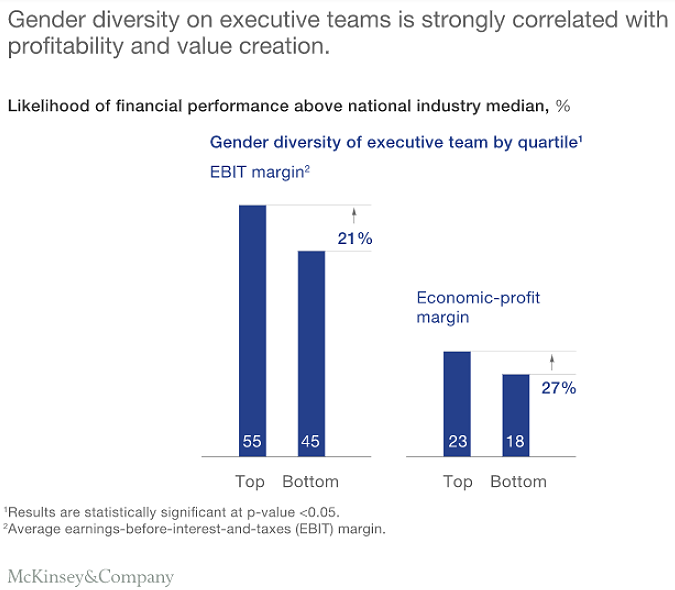
Because millennials are among the early adopters of impact investing in general and including “gender lens” strategies more specifically, they have been among the first to realize that investing in women and diverse teams has outperformed across sectors, size, and stage of companies. Traditional institutions have begun to take notice. The Credit Suisse Research Institute in 2016 found that companies which prioritized women on boards and in senior management delivered higher average returns on equity, better average growth, and higher price-to-book value multiples. In addition, McKinsey’s 2018 Delivering Through Diversity report found a statistically significant correlation between greater diversity in leadership teams and financial outperformance, with companies in the top quartile of gender diverse executive teams, 21 percent more likely to outperform in profitability and 27 percent more likely to deliver superior value creation.

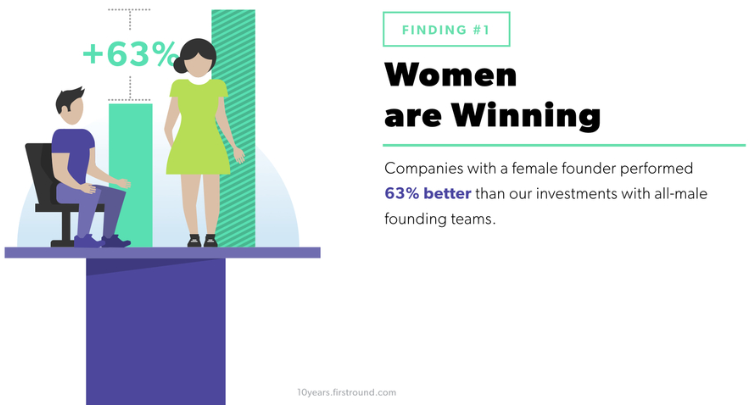
Outperformance is just as true in the private sector. For private equity and venture capital, BCG’s 2018 Why Women-Owned Startups Are a Better Bet reported that businesses founded by women ultimately deliver more than 2x the revenue per dollar invested than those founded by men, and a prominent seed-stage venture firm, First Round, found that teams with at least one female founder did 63 percent better than all-male founder teams over the life of their investments.

Given the abundant market research, it’s easy to see why impact investors increasingly seek investment funds that are explicitly filtered to include a gender lens approach, with diligence to ensure there is female leadership at the fund level as well as in the portfolio of investments the fund holds. For example, DigitalDx Ventures is a Silicon Valley healthtech fund that invests in companies developing non-invasive, low cost solutions for the early detection of large-scale diseases. Along with the fund itself being a majority-woman-owned fund, the portfolio companies DigitalDx invests in include medical and technology professionals who are women founders or whose companies have a significant number of women in their C-suite. As women entrepreneurs must often show a superior level of persistence and resilience to rise to a leadership position, this screen increases likelihood of entrepreneurial success, reducing investment risk.

The good news for DigitalDx and other funds and companies with a similar investment discipline is that, with proven gender investment statistics becoming more readily available, additional investment dollars are flowing to these opportunities from within the family office and institutional community. In fact, in 2018 US SIF research found that institutional investors considered gender lens a criterion in $868 billion of investment assets, up 2x from 2016.

The good news for those of us in the impact investing community, we’re way ahead of the curve on this and a main driver of the growth in the space! Why? Because along with recognizing the importance of no longer cutting women and minorities out of access to capital, social trends and family dynamics – with matriarchs and millennial inheritors prioritizing gender parity – has led us to invest in this sector for years. With the data now in, the arbitrage opportunity of altering investment screens ahead of the mainstream capital markets has paid off financially as well.

With $30 trillion dollars transferring intergenerationally over the next 30 years, at LOHAS Advisors we firmly believe that misconceptions of concessionary returns when investing in women will not only dissipate but will in fact swing investment dollars dramatically in the other direction, with companies and funds weighing equity of women in leadership as an important investment criteria as numbers prove out the investment thesis. Stay tuned!


Article by Tami Kesselman, Partner at LOHAS Advisors and Founder at Aligned Investing Global

A pioneer and thought leader in impact investing, Tami Kesselman is a Harvard-educated strategist and former Bain consultant working at the intersection of the highest levels of corporate, government, entrepreneurial and investor communities globally. A Partner at LOHAS Advisors, Tami is a strategy advisor for multiple investment funds and sustainability initiatives, helping clients navigate the increasingly complex intersection of capitalism, climate change, sustainability, public policy, business management, and geopolitics. Known for her innate ability to identify impact-related business model risks overlooked by others, she runs sessions for some of the world’s highest net worth families and leading asset managers and is regularly asked to pressure-test portfolio investments and philanthropic giving, advising on diligence filter revisions for impact alignment and for more comprehensive identification and mitigation of ESG and climate risks across asset classes.

Tami serves on the Steering Committee for the United Nations-NEXUS Small Island Resiliency Braintrust and the NEXUS Impact Investing Working Group where she advises next gen heirs of some of the world’s largest families on portfolio stewardship and wealth transition. She also annually chairs Opal’s Private Wealth Impact Investing Forum, curating discussions about today’s evolving wealth priorities for asset managers, wealth advisors and family office principals grappling with how evolving societal issues and climate change will impact their portfolios.

Tami also works directly with entrepreneurial management teams as they iterate businesses from seed through Series C funding rounds, and lectures annually on improved impact diligence at Harvard Business School, at the United Nations, and at conferences for investor audiences around the world. One of her most popular Harvard talks, based on the proprietary 10-question heuristic diligence framework she developed, SMARTimpact™, draws upon insights from analysis of more than three decades of business models that seemed successful on the surface but had systemic flaws which should have been flagged from the beginning and ultimately led to underperformance or worse. A book based this model is in the works. Tami serves on the Governance Committee for the Harvard Kennedy School’s Alumni Board of Directors and is President of Harvard Alumni IMPACTS (Investment | Measurement | Policy | Advocacy | Climate | Tech4good | Sustainability), an official Harvard alumni organization with more than 1000 members from all 12 Harvard graduate programs in more than 60 countries around the world. She has emceed multiple TEDx events and thrives on opportunities to inspire traditional investors to shift to an impact investing mindset while remaining true to their market objectives.

Featured Articles, Impact Investing, Sustainable Business

X