Tag: Impact Investing

GreenMoney Interviews: Jan Bryan talks with Jason Campbell

By Guest editor Jan Bryan talks with Jason Campbell,

As the guest editor of this edition of GreenMoney I had the opportunity to interview a leader in the Native American community and the first name that came to mind was Jason Campbell, because he understands how SRI can and does positively impact Indigenous Peoples. Jason was the 2010 recipient of the CFP Scholarship created by the Investors and Indigenous Peoples Working Group formerly at USSIF. Jason quickly understood that Sustainable, Responsible, Impact (SRI) investing could be a powerful force in Indian Country. He networked with SRI professionals and foundations like “Make it Right” and soon helped create a LEED Platinum affordable housing project on Fort Peck Reservation. Jason exemplifies the term “entrepreneur” and I recommend you follow his business trajectory as he takes “possibilities” and turns them into “reality.”

The Interview:

Jan Bryan: How did the Spokane tribe react initially to your proposal for the nation-building Sustainable Community Master Plan?

Jason Campbell: Nation-building implicitly is nothing new. When I started talking about nation-building specific to the energy sector, it made total sense to our elected leadership, to the citizens of the tribe. Renewable energy production is a form of stewardship, which is what their community has talked about as far back as they can remember.

Soveriegn Power logoI discovered that the Spokane tribe had on its books a very unique entity called Sovereign Power, Inc. When I took over Sovereign Power as CEO, it purely was engaged in power marketing. But if we’re going to be energy independent as a tribal nation, we also have to be into energy production, energy distribution and energy storage. We also have to be into legislative affairs.

Renewable forms of power production make sense. Solar makes sense.

We started off with a pilot project where we did residential scale solar, individual housing with low income houses and single moms. This Summer, we completed a community scale solar project with ten individual tribal governmental buildings.

Some of the challenges come in our governance. The largest of the buildings with solar is the Tribal Admin Building. We had to cap the size of that based on laws around how much can go into a single meter. The rooftop could have held a whole lot more.

Sovereign Power residential solar

We look at deploying this in a way where Spokane tribal citizens are gaining the skills necessary to design systems, install systems and engage in the operations and maintenance of those systems while mitigating monthly utility expenses for those vulnerable parts of our community.

Jan: How do you integrate your nation-building work with the climate resiliency work you were doing with your tribe?

Jason: The Spokane Indian reservation is roughly 160,000 acres. In the last several years, we’ve had two major wildfires. Each of those wildfires knocked out the power grid for an extended period of time. We lost houses. The fires really exposed the tribe’s vulnerability to continuity of governance and vulnerability to being able to serve members of our community.

We expanded on a planning effort that the tribe started through the Sustainable Communities Master Plan. We created an inventory of the state of the nation and a value set that the tribe wanted to follow moving forward. The Master Plan led to a more specific Wellpinit core revitalization plan that redesigned the major municipal seat on the reservation. The first major node incorporates renewable power generation through biomass heat timbers. Timber is the major industry, and largest employer, on the reservation.

We did an extensive biomass study based on the Department of Natural Resources 100 year forestry plan. We now have stamped engineered drawings of a biomass heat facility to build out a heat district that serves all of the major nodes in the community.

What is a bigger opportunity here? The Spokane Indian Reservation is a significant food desert. We built out a new grocery store that’s reflective of the Sustainable Communities master planning efforts. We reached out to Whole Foods market. We have Whole Foods-related people assisting with food access, store design, industry best practices, hard systems, and soft systems incorporating skilled labor development. We’re addressing the 45 percent tribal unemployment rate.

We’ve got a new grocery store with a learning kitchen that joins our food distribution program, and the commodities program. We can help people source healthy foods and start educating the community around doing the best with what you have.

Nation-building and addressing the food desert intersects energy in this way: The tribe was established through executive order in 1881. In 1889, pre-development began on Little Falls Hydroelectric Dam, which wholly sits on the Spokane Indian Reservation, but is part of the Columbia River watershed. The Spokane tribe were salmon people. The hydroelectric dam system eliminated those salmon runs, our source of food, a major source of education, and sources of medicine.

Jan: What is your business plan going forward?

Jason: The biomass heat district is one of two major projects in the pipeline. I’m building the capital stack. We will have direct relationships with federal departments, new markets, tax credits, and the impact investing community.

In close second place is utility scale solar. It’s through the formal permitting process. We have investors identified. We get to directly engage with our regional utility. The interconnection point is the Little Falls Hydroelectric Dam substation. We can engage in energy production at this place of historic trauma. We can rewrite the story in a very positive Spokane tribal value way where we are starting to control the landscape of that specific place, starting construction on that utility scale solar asset.

The challenges are state laws, federal laws, and the fact that now Sovereign Power is acting as a market disruptor.

Nation-building also lends itself to energy distribution, which requires us to build a formal tribal utility authority. We are about halfway through the process of building the Spokane Tribal Utility Authority.

In subsequent projects, we will build out the power storage side.

Jan: Is this process replicable with other tribes? If so, what advice would you give other tribes interested in embarking on a similar journey?

Jason: I absolutely believe that this model is replicable for every tribe. Tribes are unique and distinct.

Here is what’s universal if tribes are going to exercise self-determination and reflect true sovereignty: Vertically capturing the energy sector is absolutely necessary. There’s only one sector of nation-building that’s more critical than energy, and that’s water.

You tie it to all of the critical, critical history. And you fast forward to the present where the tribe is proactively reshaping the narrative to all of that traumatic space.

For more on Jason and his projects read this article form Native Business magazine


Jason Campbell is a citizen of the Spokane Tribe of Indians and a values-driven entrepreneur with over 20 years of experience overseeing sustainable development projects in Native communities. Campbell sits at the helm of multiple companies, including his own consulting company, Areté Development Group, all guided by the mission to improve self-determination, social responsibility and sustainability in Tribal nations. As CEO of Sovereign Power, Campbell identifies, leverages and develops renewable energy opportunities that promote energy independence for the Spokane Tribe of Indians. He sits on the Board of Directors for the National Aboriginal Trust Officers Association and serves as an Advisory Board member for First Peoples Investment Engagement Program. Campbell holds an MBA in American Indian Entrepreneurship from Gonzaga University, a Global Financial Strategist designation through Thunderbird, and completed the College for Financial Planning, Certified Financial Planner course. When he’s not nation building, Campbell spends his time elk hunting, fly fishing and exploring the wilds of Montana.

First Affirmative Financial Network logoJan Bryan has 30 years of experience in the field of Sustainable, Responsible and Impact investing. She is an Investment Advisory Representative of First Affirmative Financial Network, LLC, a Certified Financial Planner™, and Accredited Investment Fiduciary™ professional. First Affirmative is an independent Registered Investment Advisor with the Securities & Exchange Commission. Jan co-chairs Yethiya, the Investors and Indigenous Peoples Working Group (IIPWG) and she is a member of USSIF. Contact Jan here 

Additional Articles, Energy & Climate, Food & Farming, Impact Investing, Sustainable Business

How Native Entrepreneurs are Tapping into the Grand Canyon Tourism Economy

By Jessica Stago, Change Labs

Jessica Stago Change Labs-GreenMoney(Above) Germaine Simonson, owner of Rocky Ridge Gas & Market, is tackling the problem of access to healthy foods by finding ways to sell fresh produce through her remote grocery store in what was once one of the earliest trading posts on the reservation. Photo by Raymond Chee. 


There were almost 8 million overnight visitors to northern Arizona in 2017. Collectively they spent $664 million in the region according to the Arizona Office of Tourism. Over half of these visitors are coming to see the Grand Canyon, followed closely by outdoor activities, shopping, and historic sites. Tourism is a driving force in rural northern Arizona, but very little of the economic impact makes its way to Native communities, despite their being situated between the glorious experiences of the Grand Canyon, Lake Powell, and Monument Valley.

The reasons for this are a complicated maze of historical and social phenomena that have left Native communities out of the economic impact loop. Our historical battles over land, water, and natural resources have left us with little to invest in building the roads, power lines, commercial real estate, and information centers to serve visitors to the area. Our communities simply do not have the infrastructure to capture tourism spending and experience the economic benefits of the Grand Canyon, and to build it would take billions of dollars. The good news is that Native entrepreneurs are charting the course to develop the tourism industry in a way that honors the sacred homelands of our people. As Grand Canyon National Park commemorates 100 years, the time is ripe for visitors to rediscover the canyon through the lens of the Indigenous nations of the area.

When you go to the national parks, you see mostly older depictions of Native people and very few opportunities to see us as a living people. Changing this narrative is critical to support the development of a tourism infrastructure in Native communities, one that can enrich the tourism industry in the entire region.

Shash Dine Eco-Retreat-©Jake Hoyungowa
©Photo Jake Hoyungowa

Entrepreneurs like Alberta Henry with Big Hogan or Baya Meehan with Shash Diné Eco-Retreat are offering visitors exclusive insights into the culture of our people while immersing them overnight in the beauty of the landscape. Sacred Edge Tours and Mystical Antelope Canyon Tours invite visitors to tour their land, listen to family history, and experience the spiritual nature of these places. There are also talents like Carlos Deal of AlterNativEats, who is using his culinary knowledge to fuse Asian foods with local tastes and operates a food truck in Tuba City, Arizona. Or Germaine Simonson, of Rocky Ridge Gas & Market, who is tackling the problem of access to healthy foods by finding ways to sell fresh produce through her remote grocery store in what was once one of the earliest trading posts on the reservation. (See more information on these entrepreneurs and their businesses below).

©Photo Jake Hoyungowa

These entrepreneurs are doing two things. One, they are a new generation of Native-American-owned tourism entrepreneurs breaking the mold of tourism development in the Southwest. They are bringing products and services directly to consumers rather than through the types of non-Native brokers we see in the established Southwest art market. Second, they are launching these businesses with very little investment, relying on their own resourcefulness. Some of these business sites are not on the major thoroughfares that visitors usually take from one national park to another; most of these entrepreneurs don’t have a brick-and-mortar location where they can adequately welcome visitors and provide needed information.

There are very few hotels and restaurants on the reservation despite these services being among the highest dollar amount expenditures for tourists. This lack of accessibility and limited opportunity for commerce means visitors spend a majority of their money off the reservation supporting galleries, museums, and retail outlets located where there is easy access for tourists. There is huge competition from border-town communities, like Flagstaff, that have invested in this tourism infrastructure.

Aside from investment dollars, the relationship with national parks, museums, and border towns further exacerbates the isolation of Native communities. The lure of the majestic Grand Canyon is missing one important aspect: the people. Our role as the original inhabitants and stewards of the canyon is missing from the modern-day management of this landscape and visitors whose trip is meant to experience this historical monument of nature are being deprived of a human connection much more than 100 years old. The inaccurate storytelling of the role of local Natives in the Powell expeditions, the inauthentic plastic trinkets, and even the non-Native owned galleries that exploit Native artists, contribute to a narrative that puts Native businesses and entrepreneurs at a disadvantage in creating mutually beneficial commercial opportunities.

For entrepreneurs to make a measurable economic impact in our communities would require us to grow hundreds of new businesses and attract or deploy billions of dollars in investment to build the roads, utilities, and the workforce needed to support them. A recent study called “Reclaiming Native Truth” found that 40 percent of Americans think that Native people no longer exist. Another misconception is that we do not live in the modern world. When you go to the national parks, you see mostly older depictions of Native people and very few opportunities to see us as a living people. Changing this narrative is critical to support the development of a tourism infrastructure in Native communities, one that can enrich the tourism industry in the entire region.

A rediscovery of the Grand Canyon that includes our stories, accurate historical accounts, and true representation of Native people will provide visitors, who are already intrigued, as well as local off-reservation communities, the opportunity to interact with our people in a positive way. We can’t move toward an equally beneficial economic paradigm around tourism until Indigenous knowledge and thought are recognized, honored, and valued.


Article by Jessica Stago She is Bita’nii (Folded Arm) clan from the Dine (Navajo) Nation and born for the White Mountain Apache. Jessica is a cofounder of Change Labs and the Director of Business Incubation, a business incubator and coworking space located on the Navajo Nation supporting Native entrepreneurs. Jessica works with Native entrepreneurs to build and grow their business in an environment that has historically suppressed Native innovation in the private sector. She earned a Bachelor of Science degree in Economics and a Minor in American Indian Studies at ASU W.P. Carey School of Business and has a Master of Business Administration from the University of Phoenix. She teaches business management for cultural arts at Dine College and has served on the boards of the Navajo CDFI, Navajo Chamber of Commerce, and the Arizona Family Health Partnership. She is currently is a board member on the Colorado Plateau Foundation.


Native Owned Business Resources:

Rez Rising – A new database of 500+ Native owned small businesses across the Southwest was launched in November.

Big HoganLodging, camping, tours, and a complete cultural experience just east of Grand Canyon National Park. Owned by Alberta Henry

Shash Diné Eco-Retreat – A 5-billion star hogan glamping and Navajo experience near Horseshoe Bend, south of Lake Powell and Page, Arizona. Owned by Baya Meehan.

Mystical Antelope Canyon Tours & Arrowhead Campground – Hogan and tipi lodging, campground, and private tours of Mystical Antelope Canyon, a slot canyon that rivals the popular Antelope Canyon, without the crowds. Owned by Roseann and Lester Littleman.

AlterNativEats by Carlos Deal – Sushi, stir-fries, and Navajo-Asian fusion cuisine food truck at the Chevron station in Tuba City’s main intersection. Daily menus posted to Facebook at – https://www.facebook.com/Alternativeats-103428961136906

Rocky Ridge Gas & Market – A gas station and convenience and grocery store with parking spaces and a hitching post for customers who arrive on horseback, serving travelers and the rural community of Rocky Ridge, Navajo Nation. Owned by Germaine Simonson.

Additional Articles, Energy & Climate, Food & Farming, Impact Investing, Sustainable Business
Why Solar Makes Sense for Millennials

Millennials are the emergent leaders in every industry, as baby boomers are retiring en masse over the next decade. By default, Millennials are also becoming the largest consumers of energy. Previous generations may have been indifferent to where their energy came from; whether it was generated in a coal plant or hydroelectric dam didn’t matter as much as the utility bill.

But this is changing. The trajectory is different for Millennials because of their different values.

Millennials desire to have meaning in their work, their products, and even the type of energy they consume. Those are the findings in the new book The Purpose Revolution: How Leaders Create Engagement and Competitive Advantage in an Age of Social Good. It notes that 60 percent of millennials said “a sense of purpose” is part of the reason they choose to work for their company or consume the products they do.

In 2016, approximately 76 percent of millennials said they would prefer to take a pay cut than work for a company with unethical business practices. According to Deloitte’s 2015 Millennial Survey, respondents said there is an “impact gap” between millennials and organizations because they are “underperforming on social advancement, helping employees, etc,” illustrating a gap between the social good that millennials want from companies and what’s actually delivered.

So how does this relate to solar?

While fossil fuel-based generation has traditionally been the dominant global source of electricity, the benefits of solar energy are numerous. As noted at New Energy Solar, it has become one of the fastest-growing and cost-competitive energy resources in the world. We have the ability to harness and distribute this clean energy source more cheaply and more efficiently than ever before.

The positive social and environmental impacts are considerable. Compared to fossil fuel power generation, solar energy uses less water, produces less noise and waste. Also, global warming emissions associated with renewable energy are minimal, producing little to no carbon emissions during the life-cycle of a renewable energy plant.

But the growth possibilities for Millennials are also considerable. Solar is among the most rapidly growing renewable energy sector and increasingly able to generate electricity with limited environmental impact in the most cost-effective means possible.

There are public solar companies to invest in such as First Solar, Inc. and SunPower Corp., Canadian Solar or China based Jinko.

But what about smaller companies?

How GoSun Wants to Promote Solar

Although GoSun is still a small entrepreneurial business, the company believes it should do all that it can, whenever it can. Since the company’s inception, they have worked with dozens of nonprofit organizations to provide discounted solar cookers and other solar products to those that need them most.

GoSun solar cooker - GreenMoney Journal

GoSun offers a full ecosystem of solar products. In 2017, GoSun has provided funding to support the efforts of The Houston Food Bank, Global Giving, and Operation BBQ Relief. In 2018, GoSun made donations to The American Red Cross and World Central Kitchen to assist in Hurricane Florence relief efforts. And it made a donation to the California Community Wildfire Relief Fund. It also provided 1500 solar cookers to the American Red Cross to assist with relief efforts due to Typhoon Yutu. GoSun furthermore donates money each year to Trees for the Future. So far, it has helped plant over 40,000 trees.

GoSun is working tirelessly to lay the foundation for a green tech future of renewable energy cooking in both the developed and the developing world. It has the capability to address many of the shortcomings of these varied types of sustainable cooking.

The GoSun solar stove truly revolutionizes cooking into a post-fossil fuel 21st century. It relieves stress on ecosystems, allowing them to regenerate and sequester more carbon. It also empowers us to have a lower overall embodied energy in the infrastructure to achieve the relatively simple goal, that of cooking. It also frees people up to have more time to do other important tasks for the day, which will allow them to build a more educated human family that can build our sustainable future.

More Than a Solar Oven Company

GoSun literally started in an old garage and has now shipped over 35,000 solar products to over 60 countries. GoSun makes a variety of solar products including breakthrough solar ovens, which use vacuum insulation to bake, boil or fry a meal in only 20 minutes, using only sunlight. It has become the first consumer solar products manufacturer to break into mainstream markets centered around enjoying power, food and drink while outdoors. GoSun currently has relationships with major retailers including REI, ACE and Home Depot.

After three years in business, GoSun is taking its innovative Solar Energy company to Start Engine, for equity crowdfunding raise. Last year, GoSun sold $1.6 million of solar products, and now they are raising funds to ramp up all of their efforts. GoSun launched a campaign on October 16, 2019, and it has raised over $400,000.

In the future it is looking to help people with a solar water purifier and an off grid, net zero tiny solar house. To learn more, check out- https://www.gosun.co

Additional Articles, Energy & Climate, Food & Farming, Impact Investing, Sustainable Business

Millennial Workforce Tackles Poverty

By Andy Posner, Capital Good Fund

When I founded the Capital Good Fund in February 2009, I was driven by two simple observations. First, that predatory consumer financial services harm the most vulnerable populations in the U.S.; and second, that there are precious few equitable alternatives to payday lenders, pawnshops, rent-to-own stores, and other subprime lenders that represent a $200 billion industry. Fast-forward 11 years, and Good Fund has issued over 4,500 personal loans totaling $10 million, with a 95% repayment rate. We recently expanded into our fifth state and have been growing exponentially.

I attribute our success to many factors, but most important has been a dedicated and motivated workforce. We are at 32 full-time employees, of which 70% belong to the Millennial Generation (born 1981 – 1996). While I am a Millennial myself, I did not intentionally seek a Millennial workforce. Our team developed organically. Here are the reasons why Millennials are attracted to working for us:

Mission. It is a well-worn observation that Millennials want jobs that align with their values, but, taking it a step further, it is important that the values of the employees permeate throughout the social enterprise. Angela Tosca, Director of IT, notes that, “the supportive management, culture of openness and social awareness, and genuinely caring staff” keep her excited in her work as the business evolves. We are a nonprofit lender and U.S. Treasury-certified Community Development Financial Institution with the mission to create pathways out of poverty through equitable financial services. As the company has evolved and changed over the years, we have engaged our staff to ensure that their passion for social justice is reflected in our products, services, company culture, and customer service. As evidence of this, we often note that we have 230 Google reviews with a 4.8 average rating!

Millennials are also excited by the promise of social enterprise to tackle injustice at scale. For instance, they are motivated by the challenge of maintaining a balance between the imperative to fulfill our mission and the need to generate revenue. This challenge is communicated to all staff so that they can directly engage in finding solutions. We also have monthly all-staff meetings to provide a venue for people to see and hear the big picture directly from the executive team. In other words, having a notable mission is great, but the more important element is making people understand how the mission informs and guides the overall operation giving them a voice in that process. Millennials want to understand their role in the bigger picture and an ethos of strong communication provides that needed context.

Location. Of course, young and talented individuals live across the country. Increasingly, though, they are looking to live closer to home, or in smaller cities and towns that have less traffic, higher quality of life, and a lower cost-of-living. Capital Good Fund started in Rhode Island, and 24 of our 32 team members work at our Providence headquarters. The remaining team members are spread out across our footprint but remain highly connected via electronic communication and low-cost video conference features.

While there is some marginal benefit of being close to financial and industry hubs such as Boston, New York, or San Francisco, the price for that location needs to be paid by somebody. Higher operating expenses and higher wages quickly eat into profitability. Establishing the Good Fund in an attractive metropolitan area with a low-cost of living has allowed us to find and retain young talent. “After moving back from working at an NGO in Haiti, I was extremely excited to find an opportunity to work for another mission-driven organization in my hometown,” highlights Annie Dickson, Chief Operating Officer. This factor was especially important when we first launched and our salaries were below-market. As we have grown, our pay scale has reached prevailing rates, but it would have been impossible for us to scale had we launched in an expensive city: Millennials are willing to sacrifice some level of income for the right organization, but high housing costs can quickly make the sacrifice untenable, especially when factoring in student loan debt.

Training. From the start, our preference has been to find people who are the right “fit” for the organization and training them for the role, as opposed to hiring someone with the requisite skills and hoping that they will learn to embody our mission and values. Younger employees looking to gain experience are often passed over for more seasoned hires, but we have found that people with a passion for the work and experience serving the community are a better long-term fit. There is a fine line, of course, and Millennials often want more autonomy and independence on the job. Our intensive training cycle lasts for over a month, but we then move to give the employee significant freedom. “I love that I’m constantly offered opportunities to grow with the company; whenever I’ve asked if I could lead a project or try something new, my supervisor has always been supportive,” comments Siobhan Sturdahl, Direct of Development and Impact. We find providing structured freedom and opportunities sits well with our largely Millennial workforce.

As I look at the team and organization, I see a group of individuals that have come together because of the mission but stayed together because of culture and opportunities for growth afforded to each employee. The mission might create the initial traction, but the overall environment and opportunity has kept people eager and committed to the endeavor. This is true across all age demographics — thirty-percent of our staff is not Millennial, after all — but clearly our work is especially resonant for a younger generation eager for meaning in their professional as well as their personal lives.

Feature image: Capital Good Fund staff


Article by Andy Posner, who founded Capital Good Fund in February of 2009 while getting his Master of Arts in Environmental Studies at Brown University, where he was studying financing mechanisms for clean energy. After reading Banker to the Poor by Dr. Muhammad Yunus, the ‘Father of Microfinance’ and 2006 Nobel Peace Prize winner, he quickly realized that equitable financial services could unlock the potential of the poor just as they could do the same for clean energy technologies. At the same time, as the financial crisis of 2008 began to unravel the economy and devastate low-income communities, Andy decided to take action. He created Capital Good Fund with an eye toward using financial services to tackle endemic poverty, first in Rhode Island, and then nationwide.

Andy is a firm adherent of Dr Yunus’ dream to put poverty into museums; or, as Andy likes to put it, to put poverty out of business. Andy’s work has been featured in Providence Business News, the Providence Journal, the Providence Phoenix, the Federal Reserve Bank of Boston’s quarterly publication, the Rhode Island Small Business Journal, CNN and other print, radio and television media. He is also proud to be the Treasurer of the national Board of Directors of the Credit Builders Alliance, an organization of which Capital Good Fund is a member, as well as a member of the Board of the Community Reinvestment Fund, one of the largest nonprofit lenders in America.

Andy has published his ideas in the Huffington Post, the Stanford Social Innovation Review, and nearly a dozen poetry journals, to name a few examples. He was also selected as a 2011 Hitachi Yoshiyama Young Entrepreneur and a 2013 American Express Emerging Innovator (one of 45 globally), and a 2015 Rhode Island Foundation Nonprofit CEO Fellow. When not at work, Andy likes to blogwrite poetry, ride his bicycle, and spend time with his beautiful wife Bianca, his son Richard, and his Beagle, Chance. Last but not least, he is proud to have been nominated for the 2019 Puschcart Poetry Prize for his piece The Machinery of the State.

Additional Articles, Impact Investing, Sustainable Business

A Journey to Sustainable Finance

By Suzanna Buck, Domini Impact Investments

Domini Impact Investments Logo - GreenMoney Journal 2020I might be the only ecologist on Wall Street, but I don’t mind.
It’s exactly where I want to be: after a winding journey through field research, advocacy, and legal work, I believe changing the financial system may be the most effective solution to climate change.

I’ve always felt a duty to devote my life and career to solutions to climate change: everything I value is exposed as terribly fragile by this unprecedented threat. What good is a well-funded retirement in a world of extreme inequality and climate disaster? After searching for solutions from personal action to ecology, I now believe the answer is to change the paradigm of the investment community, so that it supports its own sustainability by combating climate change.

I began my odyssey trying to lead by example: I became a vegan, bought second-hand clothes and furniture, eschewed a car. I fielded the questions about protein sources and almonds, but I had to acknowledge that individual changes are not the answer to systemic problems.

I became an ecologist, studying how Lyme disease affects its hosts. This disease threatens us because of environmental degradation and loss of biodiversity in our own backyards. I wanted to show that conservation is not about preserving charismatic megafauna and exotic nature preserves for privileged vacationers. I was quickly frustrated, however—there was already plenty of data. More alarming statistics won’t change anyone’s mind.

So, I went to Argentina, working to equip communities with the tools they needed to advocate for themselves by using UN human rights principles to curtail encroachments by hydraulic fracturing companies. Yet, though meaningful, knowledge of international frameworks and unenforceable constitutional provisions wasn’t getting to the root of the problem either. To work on enforcement, I joined a public interest environmental law group where I helped take on ExxonMobil. After a grueling appellate battle, we won the largest ever award in a Clean Air Act citizen suit. The penalty, however, was less than $20 million.

I was forced to realize I was thinking too narrowly. To take on the enormity of climate change, our economic systems had to be changed more dramatically than I had imagined. A $20 million fine doesn’t alter Exxon’s single-minded focus on short-term profits. How could we fix the system that encouraged this folly? Go to the source: Exxon’s practices, while harming most people, are ostensibly for the benefit of their shareholders. As the most recent report from the Intergovernmental Panel on Climate Change starkly states, continued fossil fuel use isn’t compatible with a healthy and prosperous world. Yet many still accept the idea that making immediate financial returns for shareholders trumps even creating a safe future for those shareholder’s children and for future businesses.

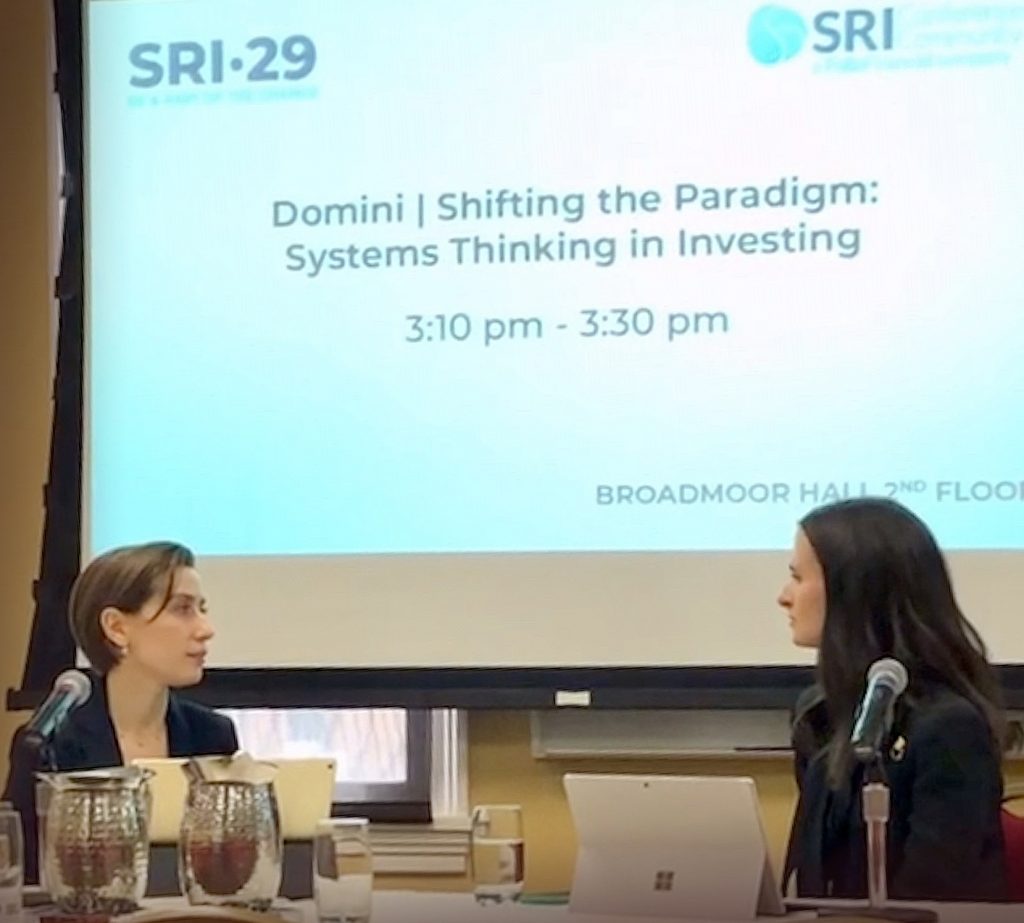
At Domini Impact Investments, I have had the chance to confront that foundational dogma of modern finance. When I joined the firm, they were attempting to understand and confront the macro risks that threatened our portfolios, from inequality to climate change. Entranced by the potential of this big-picture thinking, which proposed using systems-thinking tools to act on the root causes of macro risks, I jumped at the chance to work on the initiative and learn from the visionary Steve Lydenberg.

We found that macro risks stemmed from investors’ failure to support the economic, social, and environmental systems that underlie the value in their portfolios. This mindset must fundamentally shift for a sustainable future for investors and the world. With Steve’s Socratic prompting, I lead our efforts to shift this paradigm of finance, making the case for supporting the environment and social systems to some of the world’s largest companies and investors. For example, when some companies in a portfolio cause deforestation, other firms may lose water resources or other crucial ecosystem services. If deforestation proceeds far enough, it could accelerate climate change, harming the global economy. Investors should halt forest loss to ensure their own viability.

This thinking is challenging, yet many investors I speak with are realizing that a focus on quarterly profits and narrowly defined shareholder value won’t be adequate to provide returns to our clients in a warming, economically unequal world. They see the opportunity to be stewards of value for our beneficiaries in a much more profound way. But these investors are still waiting for the leadership to guide that daunting leap.

This leadership gap is a huge opportunity for our generation. We have the chance to overturn old doctrines and build a new system that can create prosperity linked with ecological sustainability and human dignity. It may involve defining wealth in new ways and other fraught questions. But this questioning and reinvention must occur if we want a cool and peaceful future and I’m grateful to Domini Impact Investments and Steve for giving me the opportunity to contribute to this transition.


Article by Suzanna Buck, Senior Impact Investment Associate, Domini Impact Investments. Suzanna leads Domini’s efforts to incorporate a systemic approach into its operations to better identify and mitigate the root causes of today’s interconnected challenges. Previously, she worked in environmental law in Boston, Chicago, and Buenos Aires. In 2019, Suzanna was named to the inaugural SRI Conference “30 Under 30” list. She has a degree in Ecology and Evolutionary Biology from Columbia University in the City of New York.

Energy & Climate, Featured Articles, Impact Investing, Sustainable Business

Born Ready: Millennials and the Financial Impact of the Energy Transition

By Dan Carreno, Change Finance

(Originally published February 2020)

Change - Finance - Logo 2020 - GreenMoney JournalI’m old. Well, old as millennials go. I was born in the early 1980s, which makes me one of the first entrants into the millennial generation. My senior status implies that I may remember some significant societal transitions more vividly than my younger generational counterparts. For example, I still remember what it was like being lost, driving with a road atlas spread upon the dash while cursing unreadable street signs. I’m not ashamed to admit that payphones and VHS tapes spark a bit of nostalgia somewhere deep inside of me. Of course, now we have abandoned those relics for a world of GPS, smartphones, and video streaming. Growing up in the information technology revolution of the 1990s and 2000s impressed upon me that things can change before we have had a chance to say farewell to the technologies and cultural legacies of years past.
It is with this perspective that I tend to fret over the implications of the next dramatic economic and cultural shift our generation will experience: the energy transition. The world is ready to abandon the foundation of modernity, fossil fuels, and embark on a journey toward an electrified future powered by renewable energy. And similar to the information technology revolution, this comes with enormous financial implications. In the last transition, Eastman Kodak gave way to Apple while Circuit City and Borders crumbled before Amazon. Vast sums of wealth were wiped away in one part of the economy while fortunes were created in others. History tends to repeat itself, and one must wonder if the millennial generation is adequately prepared for the next great economic upheaval.

In all likelihood, the energy transition is coming faster than we anticipate. Consider that wind and solar are projected to be the least expensive forms of energy generation everywhere in the world by 2030.[1] That’s the same date that the global fleet of internal combustion engine vehicles begins to shrink due to the electrification of transport.[1] And that’s just what market forces have in store for us. Humanity is waking up to the dire implications of the climate crisis. On our current trajectory, we will warm the earth by 4?, leading to global crop failures and mass migrations.[2] This sobering reality makes government policy responses inevitable and destined to accelerate the energy transition.

While the convergence of market and political forces to stem the tide of climate change is undoubtedly welcomed by most millennials, a poorly managed energy transition poses significant threats to the stability of financial markets. Rapid decarbonization would significantly disrupt and reduce the value of the oil, gas, automobile, utility, financial, and insurance industries.[2] A recent analysis from the Principles for Responsible Investment (PRI) suggests that policy responses to climate change alone will erase $2.3 trillion of market capitalization from publicly traded companies.[3] Noted impact investor and economist, John Fullerton, has asserted that the energy transition could result in the devaluation of $20 trillion in assets across various sectors of the economy. When compared to the $2.7 trillion in write-downs that triggered the 2008 financial crisis, the gravity of the situation comes into full focus.[1]

So the world could rapidly decarbonize. Great! But that process may dislocate the global financial system. Not great!

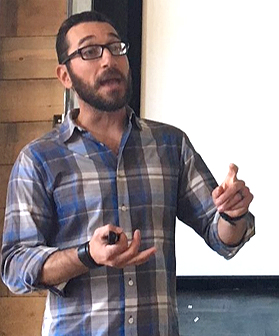
Dan Carreno Change Finance PBC talks - GreenMoney JournalWhere does this leave millennials? In reality, it leaves them doing what they should be doing, pursuing careers and taking care of their families; too busy to research the financial implications of the energy transition. The investing habits of millennials indicate that they tend to avoid expensive, actively managed funds in favor of low-cost index products. Sixty-two percent of millennial investors favor index products due to cost; however, the same percentage stated that those indexes would provide access to the best opportunities in the market.[4] These statistics indicate that millennials may not realize the degree to which those broad index products expose them to the good, the bad, and the ugly of the energy transition.

The lack of low-cost index funds that position investors for the energy transition was a notable factor that led to the founding of Change Finance, PBC. Our mission is to provide millennials, and all investors, with simple and cost-effective methods to invest in alignment with their values while avoiding the risks associated with unsustainable corporate behavior. We analyze companies on 50 factors that are relevant to the well-being of people, the planet, and profit. Unsurprisingly, companies that extract, process, or burn fossil fuels for electricity are viewed as too risky and are excluded from our portfolios.[5] We also include criteria for the use and production of renewable energy in our 50-factor screening methodology to better align investors with the opportunities presented by the energy transition. [5]

The millennial generation was born into a rapidly changing economic landscape that juxtaposed enormous investment opportunities and financial crises. That experience should inform us of the diligence required for the next economic revolution. Thousands of individuals, corporations, and institutions are moving investment assets away from fossil fuels and towards renewable energy. Millennial investors should follow suit. We can then one day tell our grandchildren about the days when the world turned its back on fossil fuels…and how we were ready for it.


Article by Dan Carreno, who has 15 years of experience working in the investment industry. Before joining Change Finance as Executive Vice President of Business Development, he served as a Regional Marketing Manager for Fred Alger & Co. where he consulted with hundreds of firms to help them meet the financial goals of investors. This experience allows Dan to efficiently provide investors with the knowledge and tools they need to make prudent investment decisions that minimize risk and maximize public benefit. Dan holds a BA in International Economics and Commerce from Lafayette College, an MS in Environmental Policy and Management from the University of Denver, and the designation as a Certified Investment Management Analyst® from the Investments and Wealth Institute.

Article Notes:

1BloombergNEF. 2019. “New Energy Outlook 2019.” Bloomberg New Energy Finance. https://about.bnef.com/new-energy-outlook/

2Lovins, Hunter L., Stewart Wallis, Anders Wijkman, and John Fullerton. 2018. A Finer Future: Creating an Economy in Service to Life. New Society Publishers: Gabriola Island, BC, Canada.

3Principles for Responsible Investment. 2019. Impacts of the Inevitable Policy Response on Equity Markets. https://www.unpri.org/download?ac=9857

4Natixis Investment Managers. 2017. Breaking the Millennial Myth. Investor Insight Series. https://www.im.natixis.com/us/resources/breaking-the-millennial-myths-report

5Change-Finance.com. 2019. Methodology. Change Finance, PBC. http://change-finance.com/methodology/

Disclosures

The opinions expressed herein are those of Change Finance, P.B.C. (Change Finance) and are subject to change without notice. This material is not financial advice or an offer to purchase or sell any product. Change Finance reserves the right to modify its current investment strategies and techniques based on changing market dynamics or client needs. Change Finance, P.B.C. (Change Finance) is an independent investment adviser registered under the Investment Advisers Act of 1940, as amended. Registration does not imply a certain level of skill or training. More information about Change Finance, including our investment strategies, fees and objectives, is available on our website at http://change-finance.com

Energy & Climate, Featured Articles, Impact Investing, Sustainable Business

Sustainable Fund Flows in 2019 Smash Previous Records

This could be the leading edge of a huge wave of assets into sustainable funds.

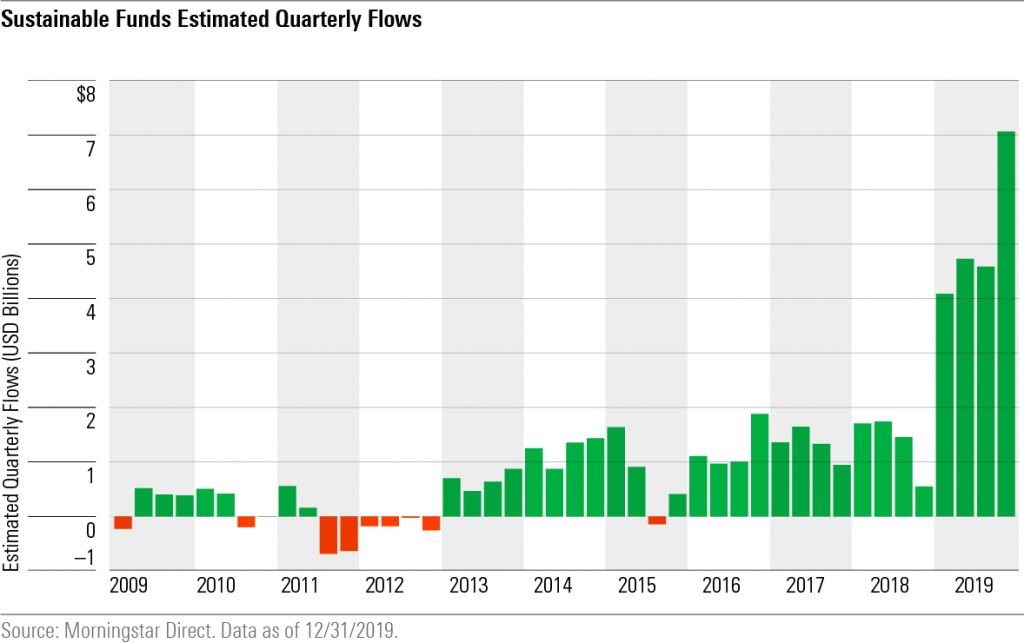
Sustainable funds in the United States attracted new assets at a record pace in 2019. Estimated net flows into open-end and exchange-traded sustainable funds that are available to U.S. investors totaled $20.6 billion for the year. That’s nearly 4 times the previous annual record for net flows set in 2018. (see featured chart above)

The flow data encompasses 300 mutual funds that thoroughly integrate environmental, social, and governance factors into their investment processes, and/or pursue sustainability-related investment themes, and/or seek measurable sustainable impact alongside financial returns.

The sustainable funds group does not contain funds that employ only limited exclusionary screens without a broader emphasis on ESG, nor does it contain the growing number of funds that now acknowledge that they consider ESG factors in a limited way in their security selection.

Flows picked up momentum over the course of 2019. During the fourth quarter, estimated net flows jumped to $7.1 billion, easily surpassing the record high for a quarter of $4.8 billion, set in 2019’s second quarter.


Sustainable Funds Estimated Quarterly FLows - Morningstar


With growing investor interest in sustainable investing, especially among younger investors, 2019’s flows may be the leading edge of a huge wave of assets to come.


Article by Jon Hale, Ph.D., CFA, is head of sustainability research for Morningstar.

Additional Articles, Energy & Climate, Impact Investing, Sustainable Business

The State of Green Business 2020 from GreenBiz

In mid-January, we publish our 13th annual State of Green Business report, examining the key trends and metrics about corporate sustainability: how, and how well, companies are making progress in assessing and minimizing their impacts and embracing a range of strategies that move them forward in significant ways.

It’s our annual report card on progress by the world’s largest companies: the 500 largest publicly traded companies in the United States and the 1,200 largest in the world. It’s a free download.

The report was produced in partnership with Trucost, part of financial information and analytics giant S&P Global.

Twenty-twenty promises to be a landmark year in the sustainable business realm. Besides turning the page to a new decade, it is the 50th anniversary of the first Earth Day, arguably the launch of the modern environmental movement. It is five years into the 15-year trajectory of the United Nations Sustainable Development Goals (SDGs), a time when the world’s businesses and governments need to be done planning how to achieve its 17 audacious objectives and well on the way to actualizing those plans. This fall will bring a landmark United Nations climate conference in Scotland and another, focused on biodiversity, in China. (This year is also the 20th anniversary of GreenBiz.com, the website.)

“Do we celebrate progress, however insufficient, or bemoan the S.O.S. signals the planet is sending?”

Of course, when it comes to sustainability these days, and especially the climate crisis, every year seems to be a landmark: records set for heat, drought and storms; new levels of melting polar icecaps; record deforestation; more species and habitat loss or degradation. And probably more inaction, or underwhelming action, by the world’s biggest economies and polluters.

It doesn’t have to be that way, of course. Any number of bold measures on the part of corporate boards, political leaders and legislatures could help slow or reverse some of these outcomes. The continued uptake of renewable energy, the surprising ramp-up of the circular economy, revolutions in food production and carbon removal and the technologies and policies that support these things — all could provide much-needed momentum and optimism.

Still, a lot of troubling outcomes are pretty much baked in, the result of decades of needless dithering and debate by influential actors on the world’s stage.

Enduring Questions

Therein lie enduring questions for sustainable business professionals: Do we celebrate progress, however insufficient, or bemoan the S.O.S. signals the planet is sending? Do we point to the leadership organizations, large and small, and encourage others to follow or berate the laggards in the hopes of moving them forward?

And, significantly: How do we keep from getting discouraged by bad news or blinded by the bright, shiny light of the newest, coolest, greenest thing?

Of course, it’s an all-of-the-above, both-and world, a delicate dance of optimism and cynicism, amazement and befuddlement, hope and despair. These days, that’s how a sustainability professional needs to roll.

There’s no better demonstration of this duality than in the world of sustainable business. Each month, it seems, there’s plenty to celebrate and berate. During 2019, for example, we read the usual assemblage of encouraging stories. A sampling of what we reported over those 12 months:

• The rise of ESG ratings by the world’s largest investors
• The continued growth of sustainable food systems
• New entrants seeking to dramatically scale up renewable energy purchases
• Companies taking a significant bite out of food waste
• More businesses making zero-net-carbon commitments
• More brands committing to dramatically cut plastic waste
• Banks and insurers factoring climate risk into loans and policies
• Vehicle companies electrifying transportation
• Markets for carbontech products and services taking off
• Reuse models starting to ramp up

There are lots more of these encouraging trends, some of which can be found in the report. I hope you’ll take the time to download and peruse it.

Of course, there is no end of discouraging news, too, from fossil-fuels companies doubling down on drilling and fracking, to auto companies supporting fuel-economy rollbacks, to food companies tolerating deforestation for key commodities.

And that’s just the business news. Political leaders — in the United States, Europe, Asia and South America — are variously stalling or backsliding on their climate and other environmental commitments or, in some cases, actively dismantling them. And even a casual reader of the daily news knows that the human impacts of climate change are already devastating and likely to worsen.

How will all this affect the fortunes of companies and economies? No one really knows. And companies, for their part, aren’t necessarily speaking up — or preparing for the worst.

And there you have it: The good, the bad and the unknown about business and the environment. As we’ve reported every year in these pages, there’s plenty of good news and more than a fair share of things to be discouraged about.

To be glad or sad? That is the eternal question.


Article by Joel Makower, Chairman and Executive Editor, GreenBiz Group. Joel is an award-winning writer and strategist on corporate sustainability practices and clean technology who, over 25 years, has helped a wide range of companies align sustainability goals with business strategy. He is the bestselling author or co-author of more than a dozen books, including “The New Grand Strategy: Restoring America’s Prosperity, Security and Sustainability in the 21st Century”, and a sought-after speaker to companies and business groups around the world.

Additional Articles, Energy & Climate, Food & Farming, Impact Investing, Sustainable Business

MSCI’s Five ESG Trends to Watch in 2020

• The resurgence of stakeholder capitalism means that shareholders are no longer alone in finding channels to hold companies accountable.
• Whether it’s accessing capital or embarking on a workforce makeover, the top echelon of corporate management will find that deft management of ESG issues becomes a critical core competency.
• Climate change accelerates as an investment theme, driving a looming re-valuation for “brown” properties and a search by investors for opportunities through mining alternative data sources.

ESG themes are long-term, but some can emerge with sudden force. We are watching Five Trends we believe will unfold in 2020 to catapult ESG investing into the new decade:

1) Climate Change Innovators: Spotting the Sleeping Giants

Solving the climate crisis is likely to take innovative technology, scalable deployment and a bit of luck. Many envision climate saviors coming in the form of plucky startups. But alternative data is hinting instead at big, established players, biding their time and quietly assembling an arsenal of climate solutions.

In 2020, investors turbocharge their use of alternative data to spot the companies plotting to take a lead in propelling us toward a carbon-free economy.

2) New Terms for Capital: Ready or Not, Here Comes ESG

Banks have stepped away from some gun makers, and investors have been keen to channel money toward green energy projects. But for the average, middle-of-the-road company, ESG has mostly been tossed to the corporate social responsibility office or used to prettify annual reports.

In 2020, ESG storms the CFO’s office, elbowing its way onto the bottom line as financiers get creative with ways to bind ESG criteria to their terms of capital, introducing a plethora of corporate borrowers into the wide world of ESG.

3) Re-valuing Real Estate: Investing in the Eye of the Hurricane

Wildfires, storms, floods, droughts, heat waves…. Just as real estate investors and managers begin to grapple with what climate change might do to their assets physically, now they may also have to contend with accelerating regulation. Location matters in real estate, and vast portions of the global property stock are in cities and regions marching towards zero-carbon building standards.

In 2020, greening the property portfolio will move from a nice-to-have reputation booster to an imperative in the face of a looming “brown discount” if real estate investors don’t kickstart their journey to zero carbon.

4) The New Human Capital Paradox: Juggling Layoffs and Shortages

It’s time to retire old skills, bring new ones in, and fast. The pressure is on for companies to transform their workforces as competitors go digital, automated and everything in between. The trick is “How?” Workers aren’t the only ones needing disparate new skills – HR and management likely do too.

In 2020, many more companies will have to become human capital multi-taskers, laying off some workers on the one hand while on the other simultaneously recruiting scarce new kinds of talent that may seem alien to management. Like a high wire juggling act, any lapse could prove disastrous.

5) Keeping Score on Stakeholder Capitalism: Looking for Accountability in all the New Places

Stakeholders are hot right now. But glossy mission statements have done little to shift the enduring power dynamic between companies, shareholders and other stakeholders. Until now, only shareholders have had clear channels for holding companies to account. Bit by bit, other stakeholders are trying to influence the conversation.

In 2020, stakeholders without proxy cards will evolve their activism, joining forces with willing shareholders, and using increasingly sophisticated means to size up whether companies really “walk the talk” when it comes to their stakeholder commitments.

While we’re not quite at the point where “ESG investing” has simply become “investing,” the 2020 trends illustrate how its effects have reached across asset classes, industries and investor types.

Read the full article, that includes a variety of useful charts and graphs.


Article by Linda-Eling Lee, Global Head of ESG Research, MSCI; Meggin Thwing Eastman, Research Editorial Director, MSCI; and Ric Marshall, Corporate Governance Research (ESG), MSCI.

Additional Articles, Energy & Climate, Impact Investing, Sustainable Business

Investors Have a Fiduciary Responsibility to Combat the Climate Crisis

By Jessye Waxman, Green Century Funds

Green Century Funds logoIn 1992, the year I was born, international governments began talking about how to solve the climate crisis. To much acclaim in 1997 and again in 2015, governments agreed to set emission reduction targets. And yet this decade was the hottest on record, and 2019 saw the highest concentrations of atmospheric carbon, which are now rising at a faster rate than ever before.

It’s no wonder that scientists are increasingly vocal and younger generations—including millennials—are increasingly disgruntled at the slow pace of progress and the failure to achieve meaningful results. World leaders and even investors have acknowledged the need for urgent action from all sectors: to prevent a climate catastrophe, we need to act – now.

In our capitalist system where “money talks,” institutional investors might be the best positioned stakeholders to influence the climate crisis.

But the investment community is falling far short of its obligation to act.

Engrossed by short-termism and reluctant to rigorously engage holdings on longer-term environmental risks, most institutional investors uphold a system that fails to recognize that protecting the environment protects long-term interests for both companies and investors.

We are already starting to see the ramifications of this myopic mindset, and it’s not just the climate that’s in crisis. In the Amazon rainforest, agricultural expansion has been driving massive deforestation. But the destruction of tropical forests isn’t essential to agricultural production—in the Amazon, soy production increased 400 percent while soy-driven deforestation declined. In fact, deforestation undermines agricultural productivity.

Due to flora density, rainforests generate their own rain and influence weather patterns; consequently, when rainforests disappear, so do the rains. Deforestation in the Amazon is reducing the rains that nourish agriculture in Brazil, and further Amazonian deforestation could negatively impact agricultural production as far as the American Midwest.

Clearing land to expand agriculture has begun to undermine the present and future profitability of Brazilian farmers and cattle ranchers – and the publicly-traded grain traders, meat processors, and consumer goods companies that depend on their commodities.

In December, leading scientists announced that the Amazon lacks enough rain to sustain itself. Unless immediate action is taken, the rainforest could turn into a degraded savanna.

Investors could be the key to reversing this situation.

As a shareholder advocate for an environmentally-responsible mutual fund company, I directly engage companies on their supply chain strategies and have successfully convinced them to adopt practices that have real-world impacts that protect a triple bottom line. I’ve collaborated with Aramark and Tyson Foods to develop robust no-deforestation commitments, and have successfully pressed Kroger, the largest grocery chain in the US, to adopt a no-deforestation policy that will cover its private label products.

More broadly, investor engagement is changing the corporate landscape on sustainability: more than 480 companies have committed to addressing deforestation in their supply chains. But with forest fires blazing and tropical forest conservation instrumental to meeting the Paris Agreement, it’s clear that more investors need to be doing more.

Institutional investors must therefore not only consider long-term climate and environmental risks as fundamentally material, but must act accordingly. This requires a shift in thinking about the prioritization of ESG and using all the tools of active ownership to hold portfolio companies accountable for mitigating the environmental and social harms that have traditionally been treated as externalities.

Simply: more institutional investors need to embrace a more comprehensive approach to climate risk. Climate change will affect all businesses—from increasing public pressure to changing resource availability to disruption of work—making it material to all companies in one way or another. Climate risk assessment should therefore be integrated throughout all portfolios, not just ESG funds, and climate-relevant factors must be considered on-par with, if not supersede, short-term financial factors.

This also requires a broader understanding of financial materiality to reflect the changing perspective of issues for which there is a “substantial likelihood that a reasonable person would consider it important.” As more people view climate change as a crisis and as investors generally—and millennials especially—are interested in sustainability issues that manifest in long-term shareholder value creation, what is “material” is moving away from what is just “immediately material” to encompass factors that create long-term shareholder value.

Similarly, investors need to take a portfolio-wide perspective to risk assessment. As noted by the Principles for Responsible Investment, until externalities, like carbon emissions, are appropriately priced, a company may strengthen its position by shifting externalities and associated harms onto others, which can result in negative outcomes for the portfolio as a whole. In other words, companies that contribute to the climate crisis may negatively impact the (long-term) performance of other holdings.

In tandem, investors need to practice active ownership rigorously. This means going beyond engaging portfolio companies about climate risk disclosure to pressing them about practices, progress, and accountability mechanisms. It means consistently voting on shareholder resolutions that advance climate mitigation efforts and filing resolutions at companies that haven’t set adequate emissions reduction targets. It means sending market signals that investors will not reward companies that pose long-term risks to the planet and profitability. And it means getting creative in finding ways to finance climate solutions through green bonds and impact investing.

We’re only at the tip of the iceberg for what institutional investors can be doing to impact the climate crisis: portfolio holdings of global investors are misaligned with the goals of the Paris Agreement; the world’s largest asset managers often vote against climate resolutions; and green bonds, those used to finance environmental and climate change mitigation projects, don’t even comprise 0.2% of the bond market.

With emissions rising, wildfires raging, and storms surging, our current model clearly is not working. If we want a chance at beating the worst possible outcomes of the climate crisis, everyone – including the finance community – needs to act using all the tools at our disposal. Otherwise, to echo Greta Thunberg, in the face of impending crisis, how dare we say what we’re doing now is enough?


Article by Jessye Waxman, shareholder advocate at Green Century Capital Management, leading the firm’s work to protect tropical forests. Using the firm’s leverage as a shareholder, she presses companies to adopt more environmentally-responsible policies and practices. Prior to joining Green Century, Jessye worked as a research associate at several nonprofits – where her research focused on environmental law, policy, and environmental security – and as an organizer on a sustainable agriculture campaign. In 2019, Jessye was named to the inaugural SRI Conference 30 Under 30 list. She holds a BA in Environmental Sciences and Policy from Duke University.

Energy & Climate, Featured Articles, Food & Farming, Impact Investing, Sustainable Business

X