Tag: Impact Investing

US SIF Releases new Roadmap for Financial Advisors

Guide helps advisors seeking to implement or enhance their sustainable investment practice.

US SIF Sustainable Investing Roadmap for Financial AdvisorsThe US SIF Foundation recently released Incorporating Sustainable Investing into Your Practice: A Roadmap for Financial Advisors, which details the steps financial advisors can take to begin offering sustainable investment services to clients as well as to enhance their practice. Financial advisors and other industry professionals contributed their insights to this guide.

In recent years, sustainable investing in the United States has grown rapidly. Professionally managed assets taking ESG factors into account increased from $12 trillion to $17.1 trillion between 2018 and 2020. This represents one out of every three dollars under professional management.

The comprehensive roadmap covers the basics of sustainable investing, including ESG incorporation and investor engagement strategies. It also explains the business case for sustainable investing with a review of current research on financial performance and risk reduction, fiduciary duty considerations, and data on the growing demand for sustainable investment products and services. The guide also details six steps advisors can take to get started or strengthen their sustainable investment practice:

  1. Adding relevant products
  2. Discussing sustainable investment with clients
  3. Updating clients’ Investment Policy Statements
  4. Identifying asset allocation and investment options
  5. Measuring and managing impact
  6. Communicating expertise

“The growing urgency of the climate crisis, movement for racial justice and continued reverberations of the COVID-19 pandemic have put ESG issues at the top of many investors’ agendas,” said Lisa Woll, CEO of US SIF and the US SIF Foundation. “As a result, financial advisors have an enormous business opportunity if they can introduce clients to sustainable investing options and follow up when clients express interest.”

To access a free copy of the guide, click here.


About US SIF and the US SIF Foundation

US SIF: The Forum for Sustainable and Responsible Investment is the leading voice advancing sustainable investing across all asset classes. Its mission is to rapidly shift investment practices toward sustainability, focusing on long-term investment and the generation of positive social and environmental impacts. US SIF members include investment management and advisory firms, mutual fund companies, asset owners, research firms, financial planners and advisors, community investing organizations and non-profit associations

US SIF is supported in its work by the US SIF Foundation, a 501(C)(3) organization that undertakes educational and research activities to advance the mission of US SIF.

Additional Articles, Impact Investing

Praxis Releases its Real Impact 2021 Report

Everytable is a Los Angeles based social enterprise providing nutritious, fresh food affordable and accessible to all, including many in food deserts or underserved communities

Praxis introduces ImpactX framework to help investors better understand the real-world difference their investments can make

Praxis Real Impact 2021 ReportPraxis Mutual Funds®, a leading faith-based, socially responsible family of mutual funds from Everence Financial®, recently released “Praxis Real Impact 2021.” The report seeks to communicate the many ways that Praxis’ unique values-driven approach to sustainable investing, delivered real-world change through a range of impact strategies in calendar year 2020.

The impact report is the second report of its kind for Praxis Mutual Funds and describes the firm’s longstanding commitment to environmental, social and governance (ESG) integration and impact investing.

This year’s report introduces Praxis’ ImpactX framework: seven strategies that Praxis uses when evaluating potential investments. This framework of distinct impact strategies highlights how investments can support and contribute to the change we want to see in the world.

The seven ImpactX strategies described in the report are:

  • Values + ESG Screening
  • ESG Integration
  • Positive Impact Bonds
  • Company Engagement
  • Advocacy & Education
  • Proxy Voting
  • Community Development Investing

“With sustainable investing only growing in popularity, we know that many investors are wondering how to assess sustainability investments,” said Praxis Mutual Funds President Chad Horning, CFA®. “At Praxis, we believe that focusing on ‘good’ ESG companies to invest in is just the start. As part of our ImpactX approach, our team developed an impact gauge for each strategy to help investors understand which ones deliver the biggest, real-world difference to the planet and its people.”

Report Highlights

  • A look at how the Praxis Impact Bond Fund has been a leader in positive impact bond investing for more than 15 years, with more than 30% of the Fund’s assets being invested in positive impact bonds at the end of 2020
  • A review of Praxis Mutual Funds’ alignment with the United Nations Sustainable Development Goals (SDGs) across the seven ImpactX strategies.
  • A discussion of some of key shareholder advocacy and fixed income engagement initiatives that Praxis has participated in during 2020, on topics including climate change, chemical safety, human rights policy and vaccine access, just to name a few.
  • An update on Praxis’ community development investing with stories highlighting the initiatives that Praxis’ has supported through its partnership with Calvert Impact Capital. For over 20 years, Praxis has channeled about 1% of each mutual fund into “deep social-impact” investments that bring direct benefits to low-income and underserved communities around the world.

Praxis Vice President of Stewardship Investing, Mark Regier said, “For over 25 years, Praxis has been committed to partnering with our clients to integrate faith, values and investing. This report and the stories within serve as an example of how Praxis’ approach to sustainable and faith-based investing focuses on the real-world impact that our investments can make to mitigate climate change, protect human rights and lift up the least among us.”

The full Praxis Real Impact 2021 report can be downloaded for free on the Praxis website.


About Praxis Mutual Funds

Founded in 1994, Praxis Mutual Funds is a leading faith-based, socially responsible family of mutual funds designed to help people and groups integrate their finances with their values. Praxis is the mutual fund family of Everence Financial, a comprehensive faith-based financial services organization helping individuals, organizations and congregations. To learn more, visit https://www.praxismutualfunds.com and https://www.everence.com or call 800-348-7468.

Consider the fund’s investment objectives, risks, charges and expenses carefully before you invest. The fund’s prospectus and summary prospectus contain this and other information. Call 800-977-2947 or visit praxismutualfunds.com for a prospectus, which you should read carefully before you invest. Praxis Mutual Funds are advised by Everence Capital Management and distributed through Foreside Financial Services, LLC, member FINRA. Investment products offered are not FDIC insured, may lose value, and have no bank guarantee.

Additional Articles, Energy & Climate, Food & Farming, Impact Investing, Sustainable Business

Gender Lens is Emerging as a Fundamental ESG Screen

By Jennifer Coombs, College for Financial Planning

Above image by designer Jordynn McKnight for the World Economic Forum, Global Gender Gap Report (2021)


Jennifer Coombs-College for Financial PlanningContrary to the anticipation of some market skeptics, the popularity of the use of environmental, social, and governance (ESG) screens for investments has continued to surge over 2021. The use of ESG integration has been touted by many Wall Street firms as a useful method for identifying risk factors that would otherwise be overlooked by traditional investment analysis, as well as optimizing investment returns in times of economic uncertainty. However, in the absence of oversight from the Securities and Exchange Commission, as well as general international standards for identifying optimal ESG screens, investment firms are now faced with addressing accusations of “greenwashing” (giving the impression that an investment is sustainable but cannot provide information or proof that it is).

Those firms that recognize the reputational damage that can be attributed to greenwashing have sought to develop new screens for investments and provide details as to how these screens are implemented. The most challenging of these screens, and often the last to be addressed, are those in the social (S) category. Social issues are rather broad and are often difficult to quantify, yet there are some issues that are emerging as the front runners in strong social screens. One of the simplest, yet most profound of these screens is the “gender lens” for investment.

Based on emerging societal norms, it would make sense to put equality for women at the forefront of investing, however it goes much deeper than a societal nicety; organizations that prioritize the rights and equality of women make their own organization stronger in general. Those companies that rank higher from an ESG perspective for embracing the gender lens for investments also help to optimize the returns on their investments as well.

Characteristics of the Gender Lens

According to the Global Impact Investing Network (GIIN), gender lens investing takes into consideration factors that help to advance gender equality and better inform investment decisions. They categorized two broad approaches to using gender lenses for investments, however the total number of screens are not limited to just these.1

One can invest for the purpose of addressing gender specific issues or promote gender equality by investing in:

  • Women-owned/led businesses
  • Enterprises that promote workplace equality (such as board representation or staffing processes)
  • Companies that offer products or services designed to substantially improve the lives of women and girls around the world.

Additionally, investors can use the following screens to address investment decisions:

  • Use a process that focuses on gender from pre-investment activities to post-deal monitoring (i.e. corporate strategies that promote equality and continue to monitor it)
  • Look to invest or do business with organizations who have a vision, mission, or organizational structure designed to address gender issues
  • Use data and metrics for gender-equitable management and find ways to incentivize changes in organizational behavior and accountability
  • Invest in firms that identify clear commitments and steps to advancing gender equality.

The Gender Gap is Slow to Improve

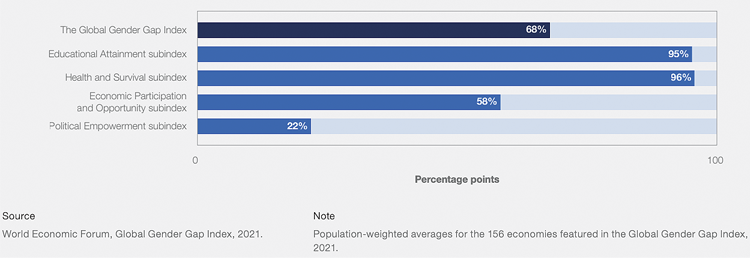
Women account for more than half of the global population but are massively underrepresented in the workforce. Underutilizing half the population means that organizations, and economics, are at a major disadvantage when diversity and equality is limited. On an annual basis, the World Economic Forum (WEF) measures the global gender gap, which is the difference between men and women as reflected in social, political, intellectual, cultural, and economic attitudes and attainments. The WEF’s Global Gender Gap Index shows the percentage of the gender gap closed as of 2021, and unfortunately on the whole, a little over two-thirds of this gap has been closed. On the other hand, political representation by women as well as economic participation have a long way to go before equality is obtained, with a gap of 22% and 58%, respectively.2 The figure below shows the percentage of the gender gap closed to date for selected subindexes.

Global Gender Gap Index - World Economic Forum 2021

Of the 156 countries measured by the study, the United States ranks 30th with an overall gender gap index of 76.3%. However, even the most gender-equitable country on Earth (Iceland) still possesses a gender gap index of 89.2% – this indicates that there is still a long way to go until equality is reached. Until this happens though, there are plenty of opportunities for investors to be a part of this growth.

The Importance of the Gender Lens for Investment Performance

According to research, women need to hold three or more seats on a board of directors in order to create “critical mass,” which in turn leads to better financial performance.3 In 2019 in the United States, only 56.2% of companies were reported has having three or more women on their board of directors.4

Additionally, gender-diverse companies have a propensity to outperform those that are less diverse, and diverse perspectives can translate into increases for a portfolio’s bottom line. According to a Morgan Stanley research report from 2019, a more diverse workplace has a positive correlation with higher average returns and overall lower volatility. From 2011-2019, companies with higher gender diversity experienced a one-year return on equity that was 2% higher than companies with low gender diversity, and companies that take a holistic approach toward equal representation of women outperformed their less diverse peers by 3.1% per year.5

So why exactly does gender diversity lead to outperformance? It is theorized by Morgan Stanley that corporate practices which advance and utilize the talents and skills of women workers translate into a stronger bottom-line. These positive externalities include, but are not limited to, employee satisfaction, the ability to recruit new talent, promoting innovation, addressing blind spots, and avoiding reputational risk.

Financial Advisors Need to Keep Up

As ESG screens reach a greater level of maturity and standardization, financial advisors need to recognize how to use emerging screens in their practices. The gender lens may seem simple enough, but its strength in identifying strong investments cannot be understated. Education is key with any emerging sector and the Chartered SRI Counselor designation program is an excellent way to stay up-to-date on important screens and strategies for sustainable investing practices. The 5th edition of the course will release in June 2022, and will include education on understanding and using the most commonly used ESG lenses for stronger investments.


Article by Jennifer N. Coombs, who is the creator, lead author, and lead instructor for the Chartered SRI Counselor™ (CSRIC™) designation program developed in partnership with US SIF as the first professional financial education program in the United States exclusively devoted to sustainable investing. She has given two TED talks on the topic of sustainable and responsible investing: “Investing for a Better World: Using Wall Street to Implement Social Change” (November 2015 at TEDx Jersey City), and “Stopping the Rebuttal: Millennial Investors and the Future of Sustainability” (April 2018 at TEDx Clarkson University).

She is sought out for her expertise on ESG education and market outlooks, and has been quoted in The New York Times, The AP, Market Watch, Investment News, Money Magazine, Citigroup, GreenMoney Journal, Financial Advisor IQ, RIABiz, Wealth Management, and Proactive Advisor Magazine. Jennifer Coombs holds a Master of Science in Finance and is a member of the ESG Advisory Board at Investment News and serves on the education committee of US SIF. She lives in her home state of Vermont.

Footnotes:
[1] Gender Lens Investing Initiative from the Global Impact Investing Network (GIIN), (2019) https://thegiin.org/gender-lens-investing-initiative
[2] World Economic Forum, Global Gender Gap Report (2021) https://www3.weforum.org/docs/WEF_GGGR_2021.pdf
[3] Cynthia Soledad, Karoline Vinsrygg, Ashley Summerfield, and Jennifer Reingold, 2018 Global Board Diversity Tracker: Who’s Really On Board? (Egon Zehnder, December 2018): p. 11. https://www.egonzehnder.com/global-board-diversity-tracker
[4] https://www.catalyst.org/research/women-on-corporate-boards/
[5] Refinitiv, FactSet, Morgan Stanley Research; Based on an Equal weighted average 12M forward return for the North America Top 1/3 fractile of HER score versus the excess equal weighted average 12M forward return for the region, 2011-5/2019; cited on https://www.morganstanley.com/access/gender-diversity

Additional Articles, Impact Investing, Sustainable Business

Esther Pan Sloane: Upping the game of international climate finance

By David Garrison, Climate & Capital Media

A discussion of market gaps in financing, using legacy data sources, and the risk of network biases with Esther Pan Sloane, head of partnerships, policy and communications for the UNCDF.

 

Climate and Capital Media Featured NewsIn this conversation with Climate & Capital’s co-founder, David Garrison, Esther Pan Sloane shares thoughts on these key points, as part of their Climate Leadership Interviews series:

1) The impact of climate is felt systemically. In that light, the problem we’re trying to solve “isn’t only about how energy is generated and distributed in the future; it’s also about how we restructure distribution and society to deliver some of those assets more equitably.”

2) Use the data you already have. “There’s a ton of data that leaders already track, and they may not be thinking about what sustainability elements are attached to existing data.”

3) There are known financing gaps in climate markets that must be addressed. “What I see is a structural problem with the international financial system that money is not flowing through. There just aren’t a lot of active funds there because it’s hard to generate pipeline.”

4) Leaders must develop strong networks. “Unless you deliberately try to expand and diversify your networks, you’re going to end up talking to people who think exactly like you. Even if they don’t look exactly like you, they’ll probably think exactly like you.“

5) Look beyond the leading economies. The work underway by LDCs is important too. “The LDCs are taking action, and there are things we can do to mitigate climate impacts — even if the big players are absent.”

This is an edited transcript.

David Garrison (DG) What’s the burning opportunity in climate change?

Esther Pan Sloane (EPS) – Investing in a clean energy transition. There’s a massive opportunity here to reshape the economy and also, human life.

Consider the way the global economy is structured: The biggest challenges that we see — poverty, migration, hunger — are not challenges because of a lack of resources. People are not poor because there’s not enough money. They’re poor because the distribution of money in the world is vastly unequal. They’re not hungry because there’s not enough food existing in the world. They’re hungry because they’re not able to access the food that there is, while other people are getting far too much food.

This is why the transition to the climate economy is so urgent: This isn’t only about how energy is generated and distributed in the future; it’s also about how we restructure distribution and society to deliver some of those assets more equitably.

DG – We often talk about longer-term outcomes, like an equitable and sustainable economy, but not about the transition itself. Are there actions that are disproportionately important earlier on in the transition?

EPS – It’s a great point: I do think vision is important. But we also have to look at what will get us there. It’s all well and good to have a utopian vision, but what are you doing tomorrow?

There are so many steps we can take as individuals who control resources — even at a micro level — to get to a future we want. And leaders are starting to think about the investments they’re making in people, systems, and structures to make sure they’re ready to take those steps.

We see this in the climate targets that corporations are setting. They’re ambitious — some more ambitious even than the U.N. Sustainable Development Goals. AB InBev (which is going to be no-emission by 2025), for example, realized they wouldn’t meet internal SDG targets with existing technology, so they started a venture capital arm to help recycle water, chemicals and bottles.

DG – Governments and corporations consider climate risk as part of their planning or diplomatic processes. The rigor and quality of those discussions vary, whether that’s because of board competence, data quality or something else. Does that concern you?

This is all a little bit Wild Westy. “G” is a new field, and I feel a lot like I did when I was a diplomat and all these Russian experts suddenly became Iraq experts. Demand shifts and supply goes to meet demand.

One place that comes out is in the scramble to find indicators. But there’s a ton of data that leaders already track, and they may not be thinking about what sustainability elements are attached to existing data. So, if you lack data, just start with what you’re already tracking as part of your core business — materially relevant things.

You probably know, for example, how much it costs to clean up your factories and dispose of waste. As Tony Milikin, chief supply chain officer at Keurig Dr. Pepper has said, “Waste is relevant.” If there was something leftover in the manufacturing process that Tony had to pay to have picked up but that he could sell to an organic farmer to use for compost, that’s reducing waste.

Is there a danger that, as large pools of capital enter and chase opportunities, we skew the market in certain directions?

The UNCDF faces this all the time: A focus on additionality and development rationale is critical in market intervention. Because if they’re applied incorrectly, you’ll crush free enterprise and massively distort the market.

Before the recent coup in Myanmar, for example, we supported a microfinance lender there. As they were about to launch their product, a development finance institution came in and gave the competing lender a zero-interest loan. That crushed the market — there was just no ability to compete.

Similarly in climate finance, existing structures get overbought. Some funds just have so much money and are looking for a certain kind of deal that you see outsized demand for things like renewable energy credit. Do those then start to water down impact, so that we wake up to find ourselves buying airspace in Denmark to offset our Tesla and not actually impacting places like Fiji or the Bahamas that are at massive climate risk?

There’s also a risk that we’ll see more bad deals when there’s a lot of liquidity sloshing around. The bar starts to lower, not-as-good deals get funded, and more of those fail. The challenge is that there’s the risk that people look at those and say, “Oh, clean water deals are terrible.”

And, of course, there’s a risk that money ignores all the smaller deals that aren’t as flashy or aren’t as easy but that are more impactful. We already see this happening: Finance in emerging markets tends to go to big entities and large projects that are de-risked by development banks; entrepreneurs looking for less than $5 million can’t borrow money.

There’s tons of impact investor money looking for the $50 million streetcar deal in Senegal. Everybody wants the same thing, but nobody’s willing to put in the time and effort and investment to grow a pipeline with deals that aren’t as beautiful.

DG – So how do you ease the selection process to make smaller investments more interesting to institutional investors?

EPS – The UNCDF’s been wrestling with that for the last forty years. What’s needed is a pipeline to move companies from very-promising-but-no-chance-they’ll-ever-get-funded to being attractive to commercial investors. Without that deliberate support, they’ll never make it.

So, four years ago, we created an in-house investment platform that uses grant money to make loans and guarantees to small businesses, along with a blended-finance fund that takes those small businesses and gives them follow-on finance in the form of debt and equity.

Through this, we’ll do technical assistance grants and concessional loans up to a million dollars. The business pays us back, establishes a credit history, and gets another loan from a local bank. When it needs $1 million to $5 million of debt and equity, we pass them to our blended-finance Build Fund.

They’re still risky at this point — they don’t have a tremendous track record — but they’re looking better than they did when we got them, and investors in mezzanine and senior stakes are getting a start-up in emerging markets that has de-risking protection in the form of grant money in the fund. Once the company pays off that portion, they have a really good track record, and they can go into full commercial finance.

This is an excerpt of their extensive interview. Read the complete interview here.


Climate & Capital’s Leadership Interviews is an ongoing series of in-depth discussions with a wide range of leaders in the climate economy. It explores the nuance and tension in leading bold transformations — of individuals, organizations and markets — at the intersection of climate and capital. We hope these conversations give you food for thought and spark conversations as you lead in the climate age. We’re looking forward to hearing from you.

Interview by David Garrison, co-founder of Climate & Capital, where he guides the business, strategy, and brand as publisher. An advisor to leaders on the most difficult challenges of building meaningful brands, he previously founded the Brytemoore Group, a brand consulting firm focused on bold transformations, and has led teams in markets as diverse as healthcare and music, advertising, and management consulting. David speaks on topics ranging from strategic leadership to organizational empathy and writes a regular column for Climate & Capital that shares insights from conversations with leaders. A Canadian living between Maine, NYC, and Toronto, he has an MBA from the Tuck School of Business at Dartmouth. Twitter: @davidcgarrison

Reprinted with permission from Climate & Capital Media, a strategic partner with GreenMoney Journal.

Additional Articles, Energy & Climate, Food & Farming, Impact Investing, Sustainable Business

Accelerating the Diversity Flywheel in 2022 and Beyond

By Emily Chew and Jade Huang, Calvert Research and Management

Every year, the message becomes clearer. Diversity is just good for businesses that embrace it – and bad for those that don’t.

Emily Chew and Jade Huang of Calvert Research and ManagementBy now, many companies understand that a diverse workforce can enhance innovation and in turn profitability. Many are also realizing the reverse is also true. As research indicates, companies with less diversity tends to correlate with those that may underperform. One recent study from McKinsey & Co. found companies with executive teams in the top quartile for gender diversity were 25% more likely to have above-average profitability than companies in the bottom quartile.1
Moreover, the same McKinsey study found companies in the bottom quartile for both gender and ethnic diversity to be 27% less likely to achieve above-average profitability. This may be because such firms face a number of business risks, including acquiring and retaining the best talent, and creating an environment where that talent can achieve optimal productivity.

Women Move Markets

Calvert’s own research, available on our website (www.calvert.com), shows that the number of women in named executive officer (NEO) positions has meaningful correlation with equity performance, as does the number of women on corporate boards. We found that U.S. large-cap companies with at least four women on the board outperformed the most when compared to those with less than four women board members. For the U.S. small-cap equity market and non-U.S. equity markets, we found the current tipping point for a positive performance correlation to be at least two women on corporate boards.2

In short, companies with a more diverse workforce, including more women in executive roles and in the board room, stand to benefit from a range of financial, social and reputational advantages.

As McKinsey and others report, companies with a diverse workforce are beating their less-diverse counterparts in terms of higher innovation, better employee engagement, improved reputation and decision-making, as well as performance. We see every reason for this trend to accelerate in 2022 and beyond, as responsible investors increasingly recognize that driving capital to companies with good diversity practices is a sound business decision.

Gains in 2020, More Work to Be Done

However, we still have work to do to achieve true gender parity in corporate America. McKinsey’s updated report, “Women in the Workplace 2021,” found that in company C-suites, fewer than one in four leaders is a woman, and just four percent are women of color.3 It noted that “in spite of the challenges of the COVID-19 crisis, women’s representation improved across all levels of the corporate pipeline in 2020.” However, pervasive burnout and dropout of women from the workforce during the pandemic are threatening progress. Significant gaps also persist, particularly for women of color, who are losing representation at every rung of the corporate ladder. The study states that from entry level to the C-suite, the representation of women of color drops off by more than 75 percent and that “as a result, women of color account for only 4 percent of C-suite leaders, a number that hasn’t moved significantly in the past three years.”

Taking some of these insights into account, Calvert has built a diversity factor that looks at a number of different criteria, including the number of people of diverse backgrounds on board, diversity on executive and management teams, and diversity demographics company-wide. But those are not the only factors we consider to be relevant or which we look at. An inclusive culture that harnesses the benefits of diversity is also very important, as is how companies are managing their human capital more generally. A culture that promotes all people’s best thinking is necessary to take full advantage of diversity’s benefits. Calvert recently launched a series of Diversity, Equity and Inclusion investment strategies that leverages this proprietary factor to identify companies demonstrating leadership and improvement in their diversity practices and inclusive workplace cultures.

Engagement Pushes Companies Forward

Despite the growing importance of diversity, it sometimes can be difficult to get the data necessary to evaluate a company’s performance in this area, particularly across workforce levels. Our engagement team has written to 100 of the largest companies in our portfolios, asking them to publicly release their EEO-1 reports. These reports provide details about the company’s workforce, broken down by several racial and ethnic categories and by gender at each of 10 professional levels. Companies of a certain size are required to disclose this information to the US Equal Employment Opportunity Commission, but are generally are not required to release this information publicly except in certain circumstances, such as a lawsuit.

When we began this project, 18 of the 100 were already publicly releasing their reports. For the others, we asked for a meeting with company management to allow us to explain why we think doing so is important. We have also reached out to other investors to encourage them to support this initiative and to coordinate with those that are already committed to the issue.

As of November, we have received responses from more than three quarters of the companies, and a total of 80 of the largest 100 companies now have agreed to release their EEO-1 reports. We will continue our dialogue with these companies to ensure that they follow through on their commitments.

Calvert will continue its decades-long efforts to push this process forward, using our research and engagement teams’ insights to give companies the business case for improved diversity and engaging with them to find the best way forward.


Article by Emily Chew, Chief Responsibility Officer for Calvert Research and Management; and Jade Huang, Director of Applied Responsible Investment Solutions for Calvert Research and Management.

See their biographies below.

This material is presented for informational and illustrative purposes only and should not be construed as investment advice, a recommendation to purchase or sell, or to adopt any particular investment strategy. This material has been prepared on the basis of publicly available information, internally developed data and other third party sources believed to be reliable. However, no assurances are provided and Eaton Vance has not sought to independently verify information taken from public and third party sources. Information contained in this material is current as of the date indicated and is subject to change at any time without notice. Future results may differ significantly from those stated, depending on factors such as changes in the financial markets or general economic conditions.

Calvert Research and Management is part of Morgan Stanley Investment Management, the asset management division of Morgan Stanley. Eaton Vance Management is an SEC registered investment advisor and is also part of Morgan Stanley Investment Management, and is responsible for issuing this material.

Article Writers Biographies: 

Emily Chew is the executive vice president and chief responsible investment officer of Calvert Research and Management, which specializes in responsible and sustainable investing across global capital markets, and part of Calvert’s senior management team. She is responsible for the continued development of Calvert’s research, engagement and stewardship functions. She joined Calvert Research and Management in 2021.

Emily began her career in the investment management industry in 2011. Before joining Calvert Research and Management, she was the global head of sustainability for investment management at Morgan Stanley Investment Management (MSIM), and she currently co-chairs MSIM’s Sustainability Council. Previously, she was global head of ESG research and integration for Manulife Investment Management, head of Asia-Pacific ESG research for MSCI Inc. and a capital markets lawyer with Baker & McKenzie in Melbourne, Australia, with a focus on funds management, capital raisings and REITs.

Emily earned Bachelors of Laws and Arts (honors) from the University of Melbourne and an MBA from the University of Oxford. She is a member of the CFA’s Technical Working Group to develop a new global ESG disclosure standard for investment funds, and formerly served as rotating chair of the Steering Committee of the Climate Action 100+ investor engagement initiative and chair of the Asian Investor Group on Climate Change.

Jade Huang is a vice president and director of applied responsible investment solutions for Calvert Research and Management, which specializes in responsible and sustainable investing across global capital markets. She is responsible for managing the suite of Calvert Responsible Indices, including the index construction processes, as well as developing new investment products at Calvert. She joined Calvert Research and Management in 2016.

Jade began her career in the investment management industry in 2005. Before joining Calvert Research and Management, she was a portfolio manager with Calvert Investments. Previously, she was an investment analyst at Microvest, an asset management firm specializing in impact investing, and led the certification department at Fair Trade USA.

Jade earned a B.A. from the University of California, Berkeley and an M.A. in international finance and economics from Johns Hopkins University, School of Advanced International Studies (SAIS).

Footnotes:
[1] McKinsey & Company, May 19, 2020, “Diversity Wins: How Inclusion Matters.”
[2] Calvert Research and Management, “Does an Ethnically Diverse Board Mean Better Stock Performance?” September 2021.
[3] McKinsey & Company, “Women in the Workplace: 2021.”

Featured Articles, Impact Investing, Sustainable Business

Recent SEC Staff Interpretation Bodes Well for Gender Lens Investor Advocacy

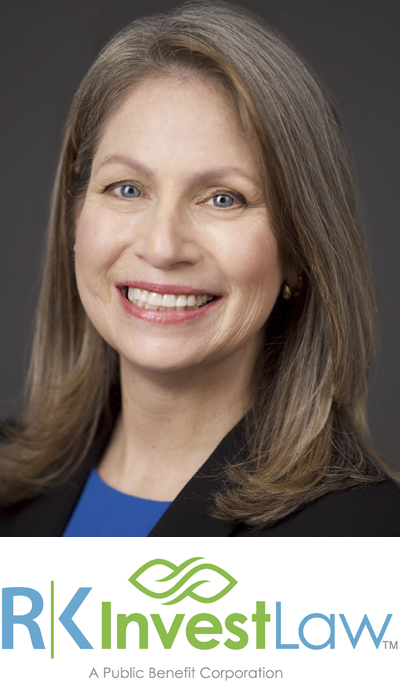
By Beth-ann Roth, RK Invest Law

Beth-ann Roth RK Invest LawThe newest SEC staff interpretation relating to shareholder proposals is poised to make it easier for ESG issues to get onto the ballot at company annual meetings. Investors should take steps to put issues of gender and diversity front and center. While terms like “diversity,” “inclusion,” and “gender lens investing” are becoming part of corporate and investing vocabulary, implementation of the values for which those concepts stand is far from complete.

When I left the staff of the SEC over three decades ago and began working in the field of responsible investing and shareholder advocacy, board diversity was one of the positive screens being applied to potential investments. Yet 30+ years hence, notwithstanding progress, there is still much to be done. In those early days, the SEC viewed ESG-related shareholder proposals as having broad social significance meriting inclusion in a company’s proxy statement. The courts, however, construed the issue more narrowly, stating that the timing for implementing policy decisions was an internal management issue not meriting shareholder attention.

The SEC division staff’s recent announcement heralded a return to a practice that will help keep companies from excluding ESG shareholder proposals. This is a positive development in the quest to move companies towards elevating a diverse group of women to senior positions. Imposing reasonable deadlines for implementation should be part of those proposals.

My first shareholder rights case after leaving the SEC staff was a 1991 appeal from Du Pont’s intent to exclude from its proxy statement a proposal to advance the date by which the company proposed to phase out production of chlorofluorocarbons (“CFCs”) and halons. The proponent was Amelia Roosevelt, and Friends of the Earth submitted the proposal to Du Pont on her behalf. The company had committed to phasing out production, but Ms. Roosevelt asked that Du Pont do so several years sooner because those chemicals were “destroying the Earth’s protective ozone layer at an alarming rate.”

I represented Calvert Social Investment Fund, the Comptroller of the City of New York, and the New York City Pension Funds in the court of appeals as amici curiae — “friends of the court.” The SEC joined the case as amicus, also in support of timing being a critical issue not subject to exclusion from the proxy statement. But climate change was not yet viewed with the urgency it has now been proven to be, and the court disagreed that timing merited shareholder consideration. Nevertheless, prior to the ruling Du Pont agreed to advance the date for phasing out production. Ms. Roosevelt’s case had forced the issue, and the mission was accomplished, but the larger issue of whether shareholders should be able to weigh in on timing on implementing ESG issues still loomed.

As we now know, climate change is indeed a critical issue not simply within the realm of “ordinary business operations,” and it is possible that a court today would reach a different conclusion on the timing issue. Likewise, given the failure of companies to diversify with any sense of urgency, timing should also be considered outside the realm of the day-to-day decision-making of management. Future shareholder requests for corporate action on diversity should make clear that adopting policies without specific timelines for action will not suffice.

In taking up the mantle, we can be inspired by the fact that women like Amelia Roosevelt were among the earliest individual investors at the forefront of shareholder advocacy, long before it became the norm for institutional shareholders to mobilize their assets for good. Gender lens investors should strive to continue the legacy of those women.

In 1947, Wilma Soss, a public relations specialist, proposed to U.S. Steel that the company appoint a woman to the board. She garnered some 10,000 votes in support of her resolution, but her efforts were rebuffed by U.S. Steel and by other companies that she subsequently approached with her “radical” idea. In 1950 she submitted a resolution to American Radiator and Standard Sanitary proposing that installing a woman on the board with industry expertise would both represent women’s interests and improve R&D. Her efforts, along with those of several contemporaries, have been credited with providing a framework for later advocacy efforts, including those of the Interfaith Council for Corporate Responsibility (ICCR) and the Council of Institutional Investors (CII).1

Shortly thereafter came Evelyn Davis, the self-monikered “Queen of the Corporate Jungle” — a phrase she inscribed on her tombstone long before she passed away — who owned stock in some 86 companies and who raised important issues at shareholder meetings for more than 50 years starting in 1959.2 She reportedly showed up to 30-40 shareholder meetings a year in order to state her case for corporate accountability.3 While some have criticized her approach as unnecessarily abrasive, her impact is undeniable.

In the continuing annals of shareholder advocacy, the bulletin recently issued by the SEC’s Division of Corporation Finance4 is significant because it announced the staff’s intent to return to the longstanding official SEC policy relating to the “ordinary business” exclusion. Specifically, if a shareholder’s proposal raises an issue of broad social significance, it will not be deemed “ordinary business,” and the company will be compelled to include the proposal in its proxy statement.

The new guidance reverses positions announced in recent years5 that tended to focus the staff’s analysis on individual company operations rather than on the broader social significance of the concerns being raised by shareholders in their proposals. The prior bulletins imposed burdensome requirements, such as requiring the board to provide an analysis, which often skewed the staff’s conclusion. The prior guidance also led to proposals being improperly excluded as having been “substantially implemented” under the guise of “micromanagement.”

The impact of the recently-announced change cannot be overstated. While the change might be viewed as part of an ongoing swing of the pendulum regarding staff review of shareholder proposals, we are at a point where issues such as diversity are ripe to pursue. Women have been at the forefront of shareholder advocacy, and should continue to take the lead to ensure that future generations of women are always at the table.


Article by Beth-ann Roth, a Certified Corporate Governance Professional® and shareholder of R|K Invest Law, PBC, a Public Benefit Corporation law firm. She counsels on SEC defense, ESG compliance and shareholder advocacy, and on the regulation and business of importing organic, biodynamic, vegan and fair trade wine, beer and spirits. She recently contributed four chapters to the American Bar Association’s 2021 volume entitled “ESG: A Guidebook for Directors.” She serves on the US|SIF Policy Council, and on the Organic Trade Association’s Climate Change Task Force. 

Ms. Roth is also President of ESG Legal Services, a 501(c)(3) public interest law firm that protects unaccompanied minor children from deportation and provides nonprofit and shareholder advocacy services. ESG recently launched the Corporate-Shareholder Communications Initiative to establish a legal framework for non-adversarial dialogue outside the shareholder proposal process. She serves as pro bono general counsel to Die Jim Crow, a non-profit record label giving voice to fighting racial injustice in the US prison system, and to PalTechUS, an organization mobilizing the Palestinian diaspora to create professional opportunities for young STEM professionals.

Ms. Roth was previously an appellate litigator in the Office of the General Counsel at the SEC, and then joined the rulemaking section of the Division of Corporation Finance. After serving as a lobbyist, she joined the Calvert family of responsible mutual funds, and was concurrently the first lawyer for Calvert Impact Capital, helping to launch the organization that has since mobilized $2.5 billion of investor capital. She was with the law firms of Katten Muchin Rosenman and Dechert, served as counsel to IFESH and Rev. Leon H. Sullivan (author of The Sullivan Principles) on impact investing initiatives both domestically and in Africa, and later served as Deputy General Counsel for FINCA International, providing microfinance services and overseeing legal operations in 21 countries.

Footnotes:
[1] R. Marens, “Inventing Corporate Governance: The Mid-Century Emergence of Shareholder Activism,” Journal of Business and Management Vol. 8, No. 4 365 (Fall 2002) at 367, 371, 374 and 376.
[2] E. Flitter, “Evelyn Y. Davis, Shareholder Scourge of C.E.O.s, Dies at 89. Washington Post (Nov. 7. 2018). “Evelyn Davis, Known as Corporate Gadfly, Dies at 89. Reuters (Nov. 5, 2018).
[3] L. Bennetts, “The C.E.O.’s Worst Nightmare.” Vanity Fair (Jul. 1, 2002).
[4] Division of Corporation Finance Staff Legal Bulletin No. 14L (Nov. 3, 2021).
[5] Division of Corporation Finance Staff Legal Bulletin No. 14L reversed Nos. 14I (2017), 14J (2018) and 14K (2019).

Featured Articles, Impact Investing, Sustainable Business

The Women Leading the Climate Change Fight and How We Can Support Them

By Nicole Systrom, Sutro Energy Group

(Originally published in December 2021)

Nicole Systrom Sutro Energy GroupLike most moms-to-be, I felt a mixture of total joy and utter terror when I learned my husband and I were expecting. My own doubts about my fitness to bring a child into this world tempered the elation I felt that…well, that I’d be bringing a child into this world!
Amid that whirlwind of emotions, I also felt another pang, much deeper in my stomach: the fear that our child would enter a world where the clock was ticking. Where climate change would be an unstoppable, devastating and life-altering force. Where the world my child would live in could be very different, possibly catastrophically so. It was an awful feeling of powerlessness.

What’s the best way to combat that feeling? As we look ahead to 2022, it’s important that we get to work, bringing to bear all the resources we, as women investors, have on this problem. One of the best parts of these efforts for me over the past 15 years has been doing it in community with other women.

Taking Charge of Finances: Align Your Portfolio

The most obvious tool we have is our investments. You can’t watch a single five-minute news report on climate change without realizing we need massive investments to decarbonize our economy, from electrification and new transportation systems to affordable long-term energy storage and regenerative agriculture. To the layperson, it’s mind-boggling.

While it has taken far too long for financial professionals to see us women as key decision-makers, with women set to control more wealth in the coming years, at last that seems to be changing. So what to do with this newfound power when it comes to climate? Start a conversation with your money manager on how to begin aligning your investments with a safe climate for all. Investing in climate interventions that offer “market-rate” risk/reward and are ready for deployment also sends a signal to the financial sector about the demand for more climate-aligned products and services, which, in turn, should result in more financing for climate-positive companies and projects.

There is no shortage of women-led funds to consider. Through Prime Coalition, I’ve watched Dr. Johanna Wolfson and Amy Duffuor attract investors — families, companies and foundations — to Prime Impact Fund and find game-changing entrepreneurs working on big climate impact ideas. Other women I admire on this front are Dawn Lippert and Ramsay Siegal at Earthshot Ventures, which funds hardware and software companies in climate tech from seed through Series B, and helps them grow by connecting them to global customers, investors and policymakers.

Those of us with more resources should consider direct investment in women-led companies. I met Beth Zotter through work with science-based startups at Cyclotron Road/Activate (on whose board I sit)—now she leads Umaro Foods, which is developing ocean-farmed seaweed as a sustainable protein. At Via Separations, Shreya Dave uses novel chemistries to help manufacturers like paper and pulp companies produce more while consuming significantly less energy. Beth and Shreya are two of many—the number of innovative companies founded by women continues to grow.

Considering Impactful Nonprofits: Make Your Giving Climate Forward

Women should also consider ways giving can shake up climate change without needing a return on their investment.

Not sure where to start? There are some fascinating nonprofits being led by women who deserve our support. They include the Solutions Project, led by Gloria Walton, which is doing incredible work funding everything from community organizing and democratically controlled rural electric cooperatives to policy work, all with the goal of reaching 100 percent renewable energy. In turn, it invests 95 percent of its resources in groups led by people of color, with 80 percent going to women-led organizations.

At Sustainable Energy for All, Damilola Ogunbiyi and her team work with businesses, governments, consumers and NGOs to speed renewable energy progress by 2030 in alignment with the UN’s Sustainable Development Goal 7 (SDG7). On a different end of the spectrum is the All We Can Save Project, founded by Dr. Katharine Wilkinson and Dr. Ayana Johnson, which is working to support and empower women leading the climate movement.

And there’s also Ceres, where Mindy Lubber has been showing us what leadership is all about for decades. Mindy leads an executive leadership team of women pushing investors, money managers, and capital markets influencers to act on climate through efforts like their Net Zero Asset Managers and Climate Action 100+ initiatives.

Raising Your Voice: Engage Policymakers

When it comes to climate, we don’t have the luxury of starting funds, making gifts and just walking away. We have to engage the decision-makers. And with big climate decisions due, on everything from power-plant standards and green building codes to the reconciliation bill and state climate business, there is no lack of places to start.

For instance, you can give to a 501c3 or c4 to build a public case for climate action. There are also innovative ways to connect scientists and entrepreneurs to decision-makers and mobilize/train more professionals as effective climate advocates by supporting a group like Climate Changemakers led by Dr. Eliza Nemser. Kelly Burton at the National Democratic Redistricting Committee is helping end congressional gerrymandering that often keeps the most climate-positive candidates from winning office. And Tiernan Sittenfeld at the League of Conservation Voters works to elect climate champions up and down the ballot—which, as we’ve learned from watching Congress grapple with the reconciliation bill this fall, could not be more urgent and necessary.

Ultimately, the truth is clear: Women are leading the fight against climate change—as scientists, as entrepreneurs, as venture capitalists, as advocates. The rest of us—professionals, moms and investors—owe them our support. And there’s no better time to start than now. Let’s make 2022—and our future—a brighter one for all.


Article by Nicole Systrom, founder of Sutro Energy Group, partners with philanthropists, investors, and entrepreneurs to accelerate high-impact climate and clean technology solutions.

With an extensive background in environmental science and a passion for helping entrepreneurs scale breakthrough technologies, Nicole counsels philanthropists and impact investors on how to direct mission-oriented resources toward innovative clean technologies. A valued advisor to founders and funders in clean energy, Nicole has helped channel millions of dollars into the development of technology solutions in recent years.

Nicole’s passion for motivating wealth holders to support clean energy technologies means she is frequently tapped by nonprofits, foundations and family offices for her counsel on their climate-positive programs. As a board member and former consultant to Prime Coalition, she helps philanthropists catalyze growth in technology startups that mitigate climate change. As an early advisor to Cyclotron Road, Nicole helped develop program and business strategies, positioning it to effectively support hard-science innovations and entrepreneurs.

In addition to Prime Coalition, she now serves on the boards of the Energy Foundation, one of the largest energy and climate philanthropies in the US; Energy Action Fund, which is the Energy Foundation’s 501c4 sister; and Activate, a fellowship program forging a new path for world-changing innovators and the successor to Cyclotron Road. Nicole is also a member of the President’s Council at Ceres, a nonprofit focused on sustainability challenges.

A published thought leader on climate-positive innovation, Nicole has written about identifying gaps in the clean tech ecosystem; building philanthropic tools for investing in climate solutions; and enabling better state energy policy. To build awareness of the climate change crisis, Nicole launched the investor education series “Investing in a New Climate” with the Stanford Steyer-Taylor Center for Energy Policy and Finance in 2015.

Earlier in her career Nicole worked at TerraPass, a venture-backed startup, where she managed a project portfolio that reduced 250,000 tons of greenhouse gas emissions across the U.S. Before that she was a fundraiser at the nonprofit Pacific Forest Trust, where she supported the development of methods to quantify the carbon stored in working forests.

Nicole holds a BS in Earth Systems from Stanford University and an MBA/MS in Environment and Resources from the Stanford Graduate School of Business. She lives in the San Francisco Bay Area with her family and golden retriever.

Energy & Climate, Featured Articles, Impact Investing, Sustainable Business

Sustainable Investing: Good News for 2022 and Beyond

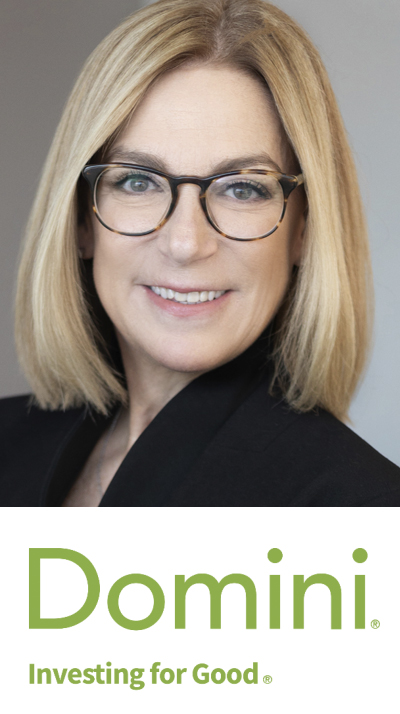
By Carole Laible, Domini Impact Investments

For women-led and impact leading Domini Impact Investments, sustainable investing isn’t a trend; it’s a tradition. CEO Carole Laible explains what’s ahead for sustainable investing in 2022—and why women are the ones that will continue to power its momentum.

Carole Laible Domini Impact InvestmentsImpact investing is everywhere these days. It’s in the news. It’s a part of an increasing number of investment portfolios. And with the urgent call from the 2021 Report of the Intergovernmental Panel on Climate Change,1 I expect all eyes will continue focusing on sustainability throughout 2022. This growth is a greatly appreciated phenomenon to watch unfold.

Interest in sustainable investing, also known as socially responsible, ESG (environmental, social, and governance), ethical, or impact, investing has never been stronger. Recent statistics and the results of Domini’s survey conducted in partnership with Kiplinger, support this statement. We’re seeing that more than ever, investors care—and they care a lot. They understand that if we are to live on a green planet and if we are going to allow every human to thrive, then they must play an active role.

Last year, 33 percent of $51.2 trillion in total U.S. assets under professional management were invested in sustainable, responsible, and impact investing strategies.2 As more asset managers enter the impact investing space, I smile; their entry is competition, yes—but more importantly, it’s the fulfillment of Domini’s vision. Since our inception, we have worked to make “investing for good,” the way all investing is done. Real progress is being made toward this goal.

It’s also incredibly satisfying to see the leadership of women in this transformation. I say this not only because it was our founder, Amy Domini, who helped launch the sustainable investing movement, or because we are a women-led organization, but also because on a daily basis, I witness the power of women investors, big and small, coming together to harness the power of finance to build a better future. A recent RBC Wealth Management study of their U.S.-based clients found that “female clients are almost twice as likely as their male counterparts to say it is important that the companies they invest in integrate ESG factors into their policies and decisions….[and are] more likely to prioritize ESG impact when considering what companies or funds to invest in, while male clients are much more likely to prioritize financial performance.” Women in particular, and a great many men too, look to sustainable investing to help express their care for the climate, for low-income communities, and for global health, knowing that all of these things are interconnected. They understand — often from personal experience — that gender diversity starts at the top. As companies hire more women and include more diversity in their upper management and on their boards, the organizations realize both better balance and better financial results. MarketWatch reported that companies with diverse teams attain 19 percent higher revenue than those that lack diversity.3 As part of our investing criteria, we consider diversity as a universal key performance indicator. But despite these statistics, the U.S. financial world is still struggling to realize the benefits diversity brings—at least if the largest public financial institution statistics are representative. According to a Deloitte study, only six of the 107 largest public financial institutions in the U.S. had female CEOs in 2019.

As investors, let us remember that what gets measured gets managed. When ethical investors decide not to invest in a company because it has no women on its leadership team or board, other companies start to consider the diversity of theirs. When we invest in low carbon footprint companies, other companies start paying attention to their own carbon footprint. When we boycott companies aiding warlords, companies reconsider aiding warlords for profit.

We can also use our voice as investors to create change when needed. Last year our firm communicated with companies on topics related to gender diversity, climate policy, executive compensation, and drug pricing. We were successful in reaching agreements with several companies. For example, we recommended that an automobile manufacturer publish a Diversity, Equity, and Inclusion report—and they did.

What gives me great hope is that while more than 70 percent of the respondents of our survey said a company’s environmental practices, social issue management, and governance policies are very or somewhat important to them when choosing investments, impact investing proves to be even more popular with younger investors.  Ninety-one percent of Millennial respondents to our survey say they are likely to add these types of investments to their portfolios soon. Baby boomers helped build the industry, and the younger generations will help propel it forward. Our future holds hope to be greater and greener as investors come together with mutual care for people, planet, and profit. That’s good news for 2022—and well beyond.


Article by Carole M. Laible, who is on a mission: to harness the power of finance to build a better world.

Since joining Domini Impact Investments in 1997, she has contributed to making that ideal a reality. Under her leadership as CEO, the impact-only investment adviser with $3 billion assets under management has empowered investors to grow communities, inspire companies, preserve the planet, and create a world of shared prosperity.

“Impact is when care reaches,” says Ms. Laible. But for Ms. Laible, this statement isn’t just a talking point; it’s a way of life. Besides being responsible for the overall research (the firm conducts proprietary in-house research) and mutual fund operations of Domini, she has been active in the fossil fuel divestment movement, supporting its efforts through public outreach and advocacy, including commenting on the issue, publishing op-eds, and participating in a roundtable on divestment of the NYS Common Retirement Fund.

With over 20 years of impact investing experience, Ms. Laible played a key role in the launch of a new strategy for the Domini Impact Equity Fund, for which she is also the Co-Portfolio Manager. It’s a role she also holds for the recently launched Domini Sustainable Solutions Fund and the Domini International Opportunities Fund. She also oversees the current investment strategy and sub-manager selection for the Domini Impact Bond Fund and the Domini Impact Equity Fund.

Instrumental in helping to make ‘investing for good’ the way all investing is done, Ms. Laible ensures Domini continuously shares information, works with peers, listens to stakeholders, and welcomes others to the industry. “We want our firm to demonstrate how today’s connections fuel tomorrow’s prosperity,” says Ms. Laible.

The rising momentum of the impact investment movement doesn’t surprise Ms. Laible, who has understood for decades that positive social, environmental, and financial returns aren’t mutually exclusive. “What’s good for people and the planet, is typically good for business” she says.

Nothing defines that legacy more than Domini’s Impact Investment Standards. “They’re a key differentiator for the firm,” says Ms. Laible, who serves on the Domini Standards Committee to define, clarify, and implement them. She also maintains a voting seat on Domini’s Impact Review Committee, which is responsible for the oversight of all companies’ consistency with Domini’s social and environmental standards and determination of investment eligibility.

In addition to her work at Domini, Ms. Laible is also a founding member of the Sustainability Accounting Standards Board™ (SASB)™ Investor Advisory Group. She works to support diversity in the field of finance, including as a Global Angel member of 100 Women in Finance.

Methodology

The Kiplinger-Domini national public opinion poll on ESG Investing was conducted August 4 to August 10, 2021, with 1,029 respondents. The survey has a margin of error of +/- 3.52%. Respondents were screened for age (25 and older), annual income (at least $75,000), and non-retirement investments (minimum of $10,000). A survey quota was implemented around familiarity with the term “ESG investing” to ensure that about half of the respondents were familiar with the term prior to taking the survey. Responses for some questions may not add up to 100 due to rounding or may exceed 100 if respondents could select more than one response.

Footnotes:
[1] https://www.ipcc.ch/assessment-report/ar6/
[2] US Trends Report, US SIF: The Forum for Sustainable and Responsible Investment, November 2020
[3] https://www.marketwatch.com/story/the-numbers-dont-lie-diverse-workforces-make-companies-more-money-2020-07-30

Before investing, consider the Domini Funds’ investment objectives, risks, charges and expenses. Contact us for a prospectus containing this and other information. Read it carefully.

The Domini Funds are not bank deposits, are not insured and are subject to certain risks. You may lose money. The Domini Impact Equity Fund is subject to impact investing, portfolio management, information, market and recent events risks. The Domini International Opportunities Fund is subject to foreign investing, geographic focus, country, currency, and impact investing risks. The Domini Sustainable Solutions Fund is subject to sustainable investing, portfolio management, information, market and recent events risks. The Domini Impact International Equity Fund is subject to foreign investing and emerging markets, geographic focus, country, currency, and impact investing risks. Investing internationally involves special risks, such as currency fluctuations, social and economic instability, differing security regulations and accounting standards limited public information, possible changes in taxation, and periods of illiquidity. The Domini Impact Bond Fund is subject to impact investing, portfolio management, style, information, and market risks.

The Adviser’s evaluation of environmental and social factors in its investment selections and the timing of the Subadviser’s implementation of the Adviser’s investment selections will affect the Fund’s exposure to certain issuers, industries, sectors, regions, and countries and may impact the relative financial performance of the Fund — positively or negatively — depending on whether such investments are in or out of favor. Public health crises caused by the COVID-19 outbreak may exacerbate other pre-existing political, social and economic risks in certain countries or globally. Shares of the Domini funds are offered for sale only in the United States. DSIL Investment Services LLC (DSILD) distributor, Member FINRA.  11/21

Featured Articles, Impact Investing, Sustainable Business

GreenMoney Wins 2021 Media Innovator Award

The world of media is highly captivating, with the ability to transform a customer’s perspective of business to be more accessible and desirable. A mixture of audio, visual, and multimedia, the industry moves very quickly, even despite the Covid-19 pandemic forcing many other industries to go slower. 2021 saw a rise in streaming media, and a need for business to be accessible from home in a digital space, and the need for innovation was increased.

With all this in mind, Corporate Vision magazine hosted this year’s programme to acknowledge those who look to innovate and define the future of the media industry. At announcement, Awards Coordinator Holly Morris took a moment to comment on the success of those recognised: “Getting the opportunity to contact this year’s winners was so exciting! I’d like to offer my sincere congratulations to all this year’s winners, and we can’t wait to see what you do next!”

GreenMoney Ejournal and greenmoney.com were named: USA–Leader in Sustainable Investing & Business News

Media is a highly captivating, and transformative industry that plays a significant role in global communication. It is an immense source of knowledge and conveys important influences on shaping society and corporate market trends. As the Covid-19 pandemic has continued, it has accelerated many trends within this sector and has ultimately created upcoming changes as digital has become the way forward.

Corporate Vision Magazine is proud to announce the winners of the Media Innovator Awards 2021 which acknowledges those prestigious businesses, and individuals who have excelled within the industry. The awards programme actively welcomed all businesses, enterprises and professionals, from print media, to broadcasting and social media, amongst numerous other areas, to get involved with this valuable opportunity.

To learn more about these illustrious winners, and to find out the secrets behind their success, please visit https://www.corporatevision-news.com/awards/media-innovator-awards/


About Corporate Vision Magazine

Corporate Vision is published monthly with the mission to deliver insightful features from across the global corporate world. Launched with an eye towards bettering business practices across the board, Corporate Vision focuses on spotlighting advances in the HR, marketing, coaching, and recruitment spheres, with the goal to shine a light on the gatekeepers of better business. Those that help build, through no small amount of creativity and expertise, to develop an altogether more productive and more efficient world of work.

Corporate Vision is bought to you by AI Global Media, a B2B digital publishing group founded in 2010. The group currently has 13 brands within its portfolio that include luxury lifestyle, construction, healthcare and small business focused publications. AI Global Media is dedicated to delivering content you can trust.

About AI Global Media

Since 2010 AI Global Media has been committed to creating engaging B2B content that informs our readers and allows them to market their business to a global audience. We create content for and about firms across a range of industries.

Today, we have 12 unique brands, each of which serves a specific industry or region. Each brand covers the latest news in its sector and publishes a digital magazine and newsletter which is read by a global audience. Our flagship brand, Acquisition International, distributes a monthly digital magazine to a global circulation of 108,000, who are treated to a range of features and news pieces on the latest developments in the global corporate market.

Additional Articles, Impact Investing, Sustainable Business

2021 Responsible Business Awards from Reuters Events

Ceres boss Mindy Lubber and Cranfield University’s David Grayson are also honoured in virtual version of the prestigious annual awards from Reuters Events Sustainable Business


On Thursday, 14th October, over 1,000 business executives tuned in to the 2021 Reuters Events Responsible Business Awards virtual ceremony.

A great variety of different sectors and industries from all over the world were represented. The diversity on display – both in terms of geography and working sphere – demonstrated how delivering a clean, more responsible business future is now an international mainstream effort – and opportunity.

Liam Dowd, managing director for sustainable business at Reuters Events, said: “Whilst we’ve been unable to host a night of celebrations, learning and networking, we took the opportunity to do things slightly differently in this year’s virtual event. We put learning at the heart of this year’s awards, with more information about the finalists, and interviews with the shortlisted and winners during the ceremony.”

He said there were more than 600 entries this year, a 20% increase on 2020. “If that didn’t make the judges work a little harder, then the increased standard of entries certainly did. I was lucky to be dialled into all judging calls and there were lengthy discussions as to who should be recognised as one of our 2021 winners. After the judging process, several judges remarked to me about how impressed they were with the entries and the ambition and impact that they’re achieving. Another remark was how global our cohort of finalists were; we could see innovative and leading programmes from across the globe.”

Dowd added: “Whilst this year we’ve experienced a continuing global pandemic that has crippled the global economy, as well as extreme weather events, with their devastating impacts, I look towards 2022 with hope and optimism. Looking at this year’s entries and the impacts that they’re having, I genuinely believe we can transform the business world. The finalists in this year’s awards represent some of the best examples of what companies can do to help solve the issues impacting them, their employees, customers, suppliers and local communities.”

Below find a couple of the categories and their winners. Find the full list categories and all the award winners here.

Sustainability Trailblazer Award nominees:

Audrey Choi – Chief Sustainability Officer, Morgan Stanley

Peter Simpson – CEO, Anglian Water and co-Chair, Corporate Leaders Group UK

Lucie Basch – Co-founder and Chief Expansion Officer, Too Good to Go

Ezgi Barcenas – Chief Sustainability Officer, AB InBev

Ivan Frishberg – Director of Impact Policy, Amalgamated Bank

Jose Villalon – Corporate Sustainability Director, Nutreco

Richard Ellis – Vice President of Corporate Social Responsibility, Walgreens Boots Alliance

Saker Nusseibeh, CBE – CEO, International at Federated Hermes

Sumant Sinha – Chairman and Managing Director, ReNew Power

Martha Patricia Herrera – Global Director of Social Impact and Director, CEMEX

“This was a tough category with a huge array of submissions that were uniquely inspiring. This category is really about individuals driving true change. We felt it only right to recognise two stand-out individuals as winners of this year’s award. Congratulations to all those whose names were listed!”

Winners: Audrey Choi (Morgan Stanley) and Richard Ellis (Walgreens)

Audrey Choi: “She is a real disruptor in her field who will catalyse change in multiple sectors. She’s swimming with sharks and succeeding!”

Richard Ellis: “The judges wanted to award this for a lifetime of dedication and change with Boots and Walgreens on sustainability. There was huge admiration from the jury for his many achievements. They only hope that the next generation can be inspired by Richard and follow in his footsteps.”

Responsible Business Honouree Award 2021

The Responsible Business Honouree Award recognises an individual, or individuals, that have dedicated their career to delivering change and have a track record of success. The Responsible Business Honouree has been and continues to be a catalyst for change within the industry. Recent recipients of the Responsible Business Honouree Award include: John Elkington, Christiana Figueres, Paul Polman, Lise Kingo and Mark Carney, to name but a few.

Responsible Business Honouree Award Winner: Mindy Lubber

Mindy Lubber is the CEO and president of the sustainability nonprofit organization Ceres. She leads an all-women executive leadership team and 125 employees working to mobilise the most influential investors and companies to tackle the world’s biggest sustainability challenges: climate change, water scarcity and pollution, and inequitable workplaces. She has been at the helm since 2003, and under her leadership, the organisation and its powerful networks have grown significantly in size and influence.

Under her leadership, Ceres co-founded Climate Action 100+, an initiative that has more than 500 investors with $47 trillion in assets under management.

Mindy has received numerous awards for her leadership. In 2020, she received the United Nations ’Champions of the Earth’ Entrepreneurial Vision award. In the same year, Mindy made Barron’s Magazine’s list of the 100 most influential women in U.S. finance, and then again in 2021. She has also received the Climate Visionary Award from the Earth Day Network; William K. Reilly Award for Environmental Leadership from American University; and the Skoll Award for Social Entrepreneurship from the Skoll Foundation. She has been recognised by the United Nations and the Foundation for Social Change as one of the World’s Top Leaders of Change. In 2019 and 2020, Ceres was named a top 100 women-led businesses in Massachusetts by the Globe Magazine and Commonwealth Institute.

The judges were keen to give her this accolade for many reasons, but notably for her hard work around climate policy and constructive lobbying during the Trump era when it was especially hard to do so. A deep and leading thinker in the space, she articulates a compelling case for why it’s simply good business to address the needs of stakeholders and create value for them.

Mindy is a pioneer, working tirelessly to advocate for collective action on climate change and always reminding business of its responsibility.

Find the full list award categories and winners here.


Reuters Events’ Sustainable Business mission is to help businesses around the globe do the right thing by their customers and the world. We believe this is not only how to guarantee a future for all, but makes good business sense. We serve sustainability, communications, supply chain and ESG with topical and insightful business intelligence and meeting places.

We provide business intelligence to more than 3,000 multinational companies every year. Our customers are also NGOs, thinktanks, academia, governments and consultancies. We publish the leading responsible business magazine, website and research reports. Our conferences are widely recognized as the best in the field bringing together CEOs, heads of business, ESG investors and public bodies to shape the future of responsible business. We’re a part of Reuters Events and based in London.

Additional Articles, Energy & Climate, Food & Farming, Impact Investing, Sustainable Business

Signup to receive GreenMoney's monthly eJournal

Privacy Policy
Copyright © GreenMoney Journal 2025

Website design & development by BrandNature

Global Events Calendar

View All Events

april

21aprAll Day232026 Sustainable Packaging Coalition: SPC Impact – Nashville

27aprAll Day30Women Deliver 2026 Conference (WD2026) – Melbourne

X