Tag: Impact Investing

How Women Are Leading in ESG Investing

By Jane Marsh, Environment.co

Jane Marsh of Environment.coWhen adults encourage young girls to dream about their future careers, they often mention becoming teachers, nurses, or childcare workers. Young boys get to imagine themselves in suits and ties while handling business transactions or leading meetings. It’s one reason why men have long dominated the financial world – but women are changing the game with ESG investing.

Check out how women are leading in ESG investing and why it’s so important. The future will look much brighter for women and the planet because of this specific economic growth.

What is ESG Investing?

You’ve likely heard about stocks and bonds related to traditional companies like Apple or Google. ESG investing is a bit different. It stands for Environmental, Social, and Governance (ESG) investing, which means investors consider those factors when considering the value of a potential investment.

ESG-focused companies will consider the environment and the well-being of their employees above traditional business practices and profits. The ethics behind a company’s operations are a primary component for ESG investors.

Why Is ESG Important for Women?

Companies that care about ESG values will be more willing to listen to their investors and consumers. Putting more money into those companies gives women a voice and additional economic prosperity.

U.S.-based ESG assets grew to $357 billion by the end of 2021, a substantial increase from the $236 billion in 2020. While women still have to deal with a gender pay gap and fewer professional opportunities than men, ethical investing can mitigate the systemic economic disadvantages and even provide more profits than traditional investments.

Corporations that listen to their retail investors equally to their board of directors will also help change the workplace structure. Female investors can push for more representation in leadership positions and provide valued input because the companies value their social and economic well-being beyond their shares in the company.

Types of ESG Companies

A few types of industries may consider ESG standards for their business. These are the most notable company types that are beginning to value sustainable business models, social well-being, and improved governance.

• Co-Op Corporations

Co-op companies are different from traditional corporations. Although they still have a board of directors, those individuals will prioritize business choices based on their ESG aspirations and the votes of their democratic enterprise. They start their company to create positive social change by working together with people on all levels of their organization, which makes ESG values inherent to their brand.

• Consumer Goods Brands

Retail companies and transportation corporations contribute significantly to climate change through airborne pollution and landfill waste. Given that 85 percent of consumers have become greener in their purchasing over the past few years, these companies have a significant incentive to align their practices with consumer demand.

People who live eco-friendly lifestyles by reducing their water usage or buying second-hand clothes still want to make financial investments. If they already have brand loyalty to sustainably minded companies, they’ll choose to make their ESG investments with those same brands. The expansive variety of consumer goods brands means more ESG investment opportunities will become available to women as more consumers demand green products and services.

• Mining, Industrials, Materials Companies

Sustainably minded investors want every aspect of their lives to support the planet. Materials companies and other businesses that utilize natural resources for their services or products will become greener as more young female investors want ESG-influenced stock.

• Financial Corporations

Some financial businesses hurt the environment – like bitcoin mining companies – and others have business models that don’t prioritize the well-being of their employees. Both things could change if they want to work with ESG investors and make the workplace more welcoming to women.

• Technology and Communications Brands

The high usage of natural resources in technology like computers and smartphones depletes the environment. Massive brands tend to prioritize profits over their employees and retail investors. An expanding pool of female ESG investors could make more of these companies turn to greener solutions and socially responsible business models.

Are Women More Likely to Invest Sustainably?

A healthy planet benefits everyone, so why are women more likely to invest in sustainable companies?

Recent research shows that while 51 percent of men will make investments in companies that don’t align with their values, only 19 percent of women will. It may relate to the same research demonstrating that men are twice as likely to be overconfident in their investments, while women make strategic financial decisions that require more of an in-depth understanding of each company.

Women are also more likely to live sustainably. Experts who conducted a study on gender-based altruism found that women are more often altruistic than men, so prioritizing sustainability is a quick way to care for themselves and others.

When these findings come together, they explain why female investors are more interested in ESG investment opportunities than men.

Women Are Leading in ESG Investing

ESG investments are for everyone, but these factors explain how women are leading in ESG investing specifically. The opportunities for economic prosperity and caring for others make it an excellent opportunity for women who share those values.


Article by Jane Marsh, an environmental journalist and the Editor-in-Chief of Environment.co. She covers all things related to the environment, sustainability, and renewable energy. Jane has been featured on sites like Renewable Energy Magazine, Manufacturing.net, and Nation of Change. When she’s not writing, Jane loves hiking, canoeing, and spending time with her rabbit and birds. You can keep up with her by subscribing to Environment.co.

Additional Articles, Impact Investing

Finding a Career in Financial Services with ESG Investing

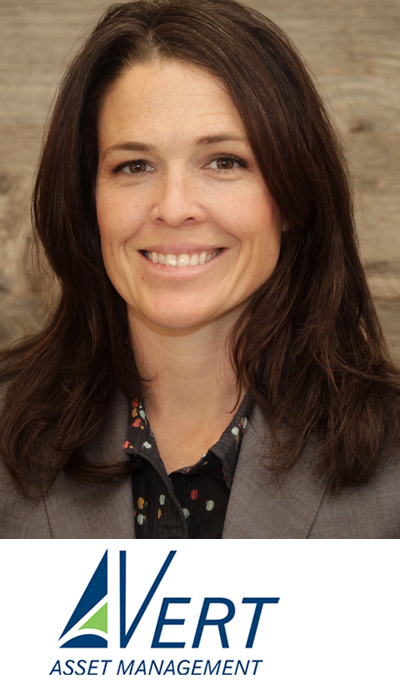
By Sarah Adams, Vert Asset Management

Above photo credit: Jason Goodman on Unsplash

Sarah Adams of Vert Asset Mgmt.There’s a conventional attitude toward work that entails leaving everything you do outside of work behind, as though nothing else exists. With this perspective, you are encouraged to fit your family, your morals, yourself, around the job.
I was raised that way. As an elementary school kid, if I had to call my mom at work she’d answer the call in a hushed tone, as though she was receiving an illicit phone call. Her office was not interested that her 10-year-old needed to be picked up from school, let alone that she had kids at all.

These jobs still exist, many of us have worked these jobs. Thankfully, there is another path, and some of us are fortunate enough to be able to take it. These days, it is my passion and interest in environment, social, and governance (ESG) investing that guide my career, not the job itself. Today, I work as Chief Sustainability Officer and co-founder at Vert Asset Management. But getting here wasn’t straightforward, or easy.

I did not study to go into finance. On a lark, I landed a college internship at a brokerage firm during the height of the dotcom boom in the late 90s. My financial services initiation, some would say ‘hazing’, was straight out of movies like Boiler Room. It was fast-paced and exciting to be near a NASDAQ trading desk. But there was an unspoken understanding that I leave my conscience at home. It was clear to me from this early exposure that investments had lost its humanity (if it had any to begin with).

In the field of finance there has long been an expectation that your background and interests should be in math and cold calculations. This is why so many engineers find their way into financial services. However, for those like myself (a history major) who are more interested in context and strategy, there is space in financial services for those roles, but they are more peripheral.

My light bulb moment occurred in 2006 when I was working in the UK at an institutional asset manager. I learned that UK city and county pension funds were required to ask socially responsible questions when searching for new asset managers. Why? Because they represented a large number of disparate beneficiaries who lived and worked in their geographical area, and they invested for the protection of all of these people’s retirement.

Back then, most investment professionals, including my bosses, rejected the notion that investments should take into account “non-financial” issues like environmental, social, and governance risks. Needless to say, things have changed. The 2020 Global Sustainable Investment Alliance (GSIA) report estimates that 35 percent of all professionally managed assets now incorporate sustainability criteria. Seven out of the ten largest pension funds in the world integrate ESG, including Japan’s Government Pension Investment Fund with assets over $1 trillion at the end of 2021.

Is ESG Investing One Way to Attract More Women into Finance?

I’ve tried several times to devise an exit out of finance to work in more creative and collaborative industries. The last time I left, I thought that in order to really roll-up my sleeves and work on corporate accountability, I needed to work in policy and research. It was while I was working at a non-profit on financial reform that I realized that there was just so much information available that investors were not including in the way they look at markets.

There is an entire ecosystem of service providers creating and disseminating non-financial information to markets now including: non-profits like CDP, ESG researchers, accountants like KMPG, PwC and E&Y. In fact, E&Y just launched E&Y Carbon to help companies with carbon accounting and corporate disclosures to the marketplace. There are standard setters working to refine what is meant by non-financial metrics with financial materiality. In 2018, Sustainability Accounting Standards Board (SASB) identified material indicators in 77 industries. They are now part of the International Sustainability Standards Board bringing integrated reporting mainstream.

ESG issues are interdisciplinary. While financial and accounting metrics have become standardized over time and through usage, ESG metrics are still evolving. Many ESG metrics are still considered ‘externalities’ because the market struggles to measure their economic value – things like clean air and well-being are hard to price. But integrating these environmental and social issues into markets is an opportunity for those from non-math fields because it takes an understanding of people and planet to value them.

Research by Professor Brad Barber, a Professor at UC Davis Business School and a member of Vert Asset Management’s Advisory Board, analyzed the absence of women in finance in 2017 by examining the percentage of women who’ve earned the Chartered Financial Analyst designation as a proxy. It was less than 20 percent. Barber concluded that more women would be in financial services if they were encouraged to study STEM subjects – science, technology, engineering, math. This would certainly help. But there are now more non-STEM roles in financial services. Investment management needs financial planners and advisors, researchers, sustainability experts, integrators, and communicators too.

There are increasingly more professional educational choices on sustainable investing to choose from than ever before. The CFA Institute now offers a Certificate in ESG Investing. The College for Financial Planning offers the Chartered SRI Counselor (CSRIC). The standard-setter SASB offers its own Fundamentals of Sustainable Accounting Certificate (FSA).

Flexible and Remote Work a Welcome Change

I found it difficult to get a job with small children at home even after reorientating my career to focus on sustainability. One friend told me bluntly that as a young mother, “you just aren’t attractive to the marketplace.” A well-known sustainability consultancy didn’t hire me because I had not worked directly with corporate sustainability reports before, despite the fact that I have a background in finance and completed two master’s degrees in environment policy and sustainability.

I took the rejection as an opportunity to start my own business consulting with financial advisors on the landscape of philanthropy and impact investing. I called it Values-Based Investing Consulting, borrowing from a concept that was used at the time within financial services to start to orientate investors to investment managers around an emerging set of non-financial criteria.

Entrepreneurship and small businesses often offer more flexible working conditions than bigger firms. But the pandemic has changed all that quite dramatically. Women can now work from home with flexible hours at all sorts of companies.

In 2016, that entrepreneurial spirit led me to co-found Vert Asset Management with my husband Sam Adams. As the Chief Sustainability Officer, I lead on engagement which is three main areas: 1) communicating with the companies we invest in about ESG topics like net-zero goals, 2) building capacity within financial services for ESG disclosures, and 3) creating good business practices as a business ourselves, a Certified B Corp.

If you are interested in the interdisciplinary topics of environmental, social, and governance and how they influence businesses, you might consider a career with ESG. If you have hard time reconciling the person you need to be for your day job versus the person you are outside of work, ESG could be a good fit. If you want to be part of the solution, instead of being part of the problem, again ESG! The traditional requirements of a finance career, i.e., a STEM background and the lack of a personal life, are falling away. There are so many opportunities today at the intersection of finance, business, and sustainability.


Article by Sarah Adams, Chief Sustainability Officer and Co-founder at Vert Asset Management. Vert was founded to bridge the gap between financial services, capital markets, and environmental advocacy.

Sarah has a multidisciplinary experience across the finance sector and environmental policy. Before Vert, Sarah started a consultancy educating financial advisors on sustainable and impact investing in the UK and US. Previously, Sarah worked in institutional finance. Additionally, she worked on social finance initiatives for advocacy NGOs in the UK.

Sarah is interested in the development of sustainability education for financial services. She sits on the USSIF Education Committee and is a teacher for the Chartered SRI Counselor (CSRIC). She earned the CFA UK Certificate in ESG Investing and the Sustainability Accounting Standards Board’s FSA Credential. Sarah has a BA in History from UCLA (US), a MSc in Environment and Sustainable Development from University College London (UK), and a MA in Environmental Law from SOAS (UK).

Featured Articles, Impact Investing, Sustainable Business

How to Avoid Greenwashing When Choosing ESG Investments

By Lori Keith, Parnassus Investments

ESG strategies are rapidly gaining popularity as interest in supporting companies that manage their carbon footprints, invest in their employees, and promote diversity surges. As more and more funds claim the ESG label, how can investors effectively decide which investments are genuine?

Lori Keith of Parnassus Investments

Avoiding Investments that Masquerade as ESG Choices

If you’re seeking to align your financial investments with your values, your decisions about which funds to include in your portfolio take on an additional dimension of complexity. Naturally, you should look for funds that most closely align with your own principles. And, above all, you should take steps to avoid any ESG-labeled fund that does not diligently pursue its stated objectives.

A Practical Framework for Evaluating ESG Funds

Here are some steps you can take to perform effective ESG due diligence and avoid being misled by labels:

  1. Read the prospectus and review the holdings. The prospectus should identify whether all the fund’s holdings are evaluated using ESG metrics, or whether the fund simply employs screens to exclude a few types of companies, such as tobacco or gambling firms, but does not vet each company in the portfolio for broad ESG progress. The prospectus should also reveal whether a fund “considers” ESG or fully integrates ESG criteria into its investment process and portfolio construction. In addition, reviewing the holdings can provide insights about whether the Fund’s portfolio aligns with the claims made by the fund company.
  1. Learn about the fund’s investment philosophy and process. Does the fund have a discernable ESG philosophy, and does the investment process include ESG analysis? Does the team perform their own ESG materiality assessment, or do they rely exclusively on third-party research providers for ESG ratings on companies? Do the portfolio managers and analysts actively buy into the ESG process, and are they truly engaged in assessing material ESG risks and opportunities?
  1. Investigate what the portfolio managers seek to gain by choosing ESG-vetted investments. Do they consider ESG progress an indicator of company quality? Are they seeking to avoid material ESG risks?
  1. Look for markers of stewardship excellence. Does the fund manager disclose their proxy voting decisions, and do these decisions align with their stated ESG values? Does the investment firm encourage positive change in portfolio companies through engagement with senior management? Does the firm maintain memberships in any independent organizations that promote ESG investing, such as Ceres or US SIF?
  1. Consult third-party sources. For example, Morningstar has several ESG rating systems. The Morningstar Commitment Level qualitatively evaluates funds’ commitments to ESG and rates them on a scale ranging from Leader to Low. The Morningstar Sustainability Rating measures how the companies held in portfolios are managing their ESG risk relative to the fund’s Global Category peer group. Funds may also be given carbon scores by Morningstar.

The good news is that there are many more choices for ESG investors than ever before. However, because regulatory standards don’t yet exist, it is important to do your own homework to make sure your financial investments match your values.


Article by Lori Keith, the Director of Research at Parnassus Investments and Portfolio Manager of the Parnassus Mid Cap Fund with responsibility for portfolio management for the firm’s Mid Cap strategy. She joined Parnassus Investments in 2005 after serving as a Parnassus research intern. Before joining the firm, Ms. Keith was a Vice President of Investment Banking at Deloitte & Touche Corporate Finance LLC and was a Senior Associate in Robertson Stephens & Company’s investment banking division. Prior to that, she worked in the management consulting practice at Ernst & Young. Ms. Keith received her bachelor’s degree in economics from the University of California, Los Angeles and her master’s degree in business administration from Harvard Business School.

Disclosures

For the current holdings of the the Parnassus Core Equity Fund, the Parnassus Endeavor Fund, the Parnassus Mid Cap Fund, the Parnassus Mid Cap Growth Fund and the Parnassus Fixed Income Fund please visit the fund’s individual holdings web page. Current and future portfolio holdings are subject to change.

The views expressed are subject to change at any time in response to changing circumstances in the markets and are not intended to predict or guarantee the future performance of any individual security, market sector or the markets generally, or the Parnassus Funds.

ENVIRONMENTAL, SOCIAL, AND GOVERNANCE GUIDELINES – The Fund evaluates financially material ESG factors as part of the investment decision-making process, considering a range of impacts they may have on future revenues, expenses, assets, liabilities, and overall risk. The Fund also utilizes active ownership to encourage more sustainable business policies and practices and greater ESG transparency. Active ownership strategies include proxy voting, dialogue with company management and sponsorship of shareholder resolutions, and public policy advocacy. There is no guarantee that the ESG strategy will be successful.

Mutual fund investing involves risk, and loss of principal is possible. There are no guarantees any investment strategy, including a socially responsible (ESG) investment strategy, will be successful in any market environment.

The Parnassus Funds are underwritten and distributed by Parnassus Funds Distributor, LLC.

US SIF: The Forum for Sustainable and Responsible Investment is the leading voice advancing sustainable investing across all asset classes. Its mission is to rapidly shift investment practices toward sustainability, focusing on long-term investment and the generation of positive social and environmental impacts. Our members, representing $5 trillion in assets under management or advisement, include investment management and advisory firms, mutual fund companies, research firms, financial planners and advisors, broker-dealers, banks, credit unions, community development organizations, non-profit associations, and asset owners.

Ceres is a nonprofit organization transforming the economy to build a just and sustainable future for people and the planet. Ceres works with the most influential capital market leaders to solve the world’s greatest sustainability challenges. Through powerful networks and global collaborations of investors, companies and nonprofits, Ceres drives action and inspires equitable market-based and policy solutions throughout the economy.

Before investing, an investor should carefully consider the investment objectives, risks, charges and expenses of the Funds and should carefully read the prospectus or summary prospectus, which contains this information. A prospectus or summary prospectus can be obtained on the website, www.parnassus.com or by calling (800) 999-3505.

Energy & Climate, Featured Articles, Impact Investing, Sustainable Business

Changing Your Relationship with Money for Good

By Dani Pascarella, OneEleven Financial Wellness

Above photo: ©Getty Images, courtesy of OneEleven Financial Wellness

Dani Pascalrella - CFP and Founder of OneEleven Financial WellnessThe concept of financial wellness is often associated with managing your money the right way or having a certain net worth. But this definition leaves out something just as important as the numbers – how your finances impact your mental and physical well-being. At OneEleven Financial Wellness, we are changing that by looking at more than just the numbers and taking a holistic approach to personal finance. Our Wealth Coaches help our members change their relationship with money for good and build healthy spending habits.

According to the APA, money is the #1 cause of stress in America. There is a huge need for apps like OneEleven that can help Americans reduce this stress and get to the root cause of why it’s happening. We’re not alone in these beliefs, Well+Good listed financial wellness apps (including OneEleven) as one of top self-care trends for 2022. This year, it’s predicted that financial wellness will continue to expand as we embrace this new convergence of money, psychology, and technology. Now more than ever, people have strategies at their fingertips to learn effective financial habits and take control of their financial situation.

What Motivated Me to Leave Wall Street and Launch OneEleven

My own money story begins with my mother, who at a very young age had to learn how to support herself financially. At age 16, my mom was living completely on her own in New York City. Despite having massive financial struggles in her early years, she was able to become a homeowner and comfortably retire early – all because she was able to reframe her relationship with money.

This isn’t the norm. We live in a world where socioeconomic status often predicts your future. But seeing this kind of financial transformation firsthand and knowing what is possible, I became deeply motivated to help people manage their finances. After graduating college, I started my career on Wall Street in private banking where I ended up managing money for individuals with $25 million or more in the bank.

Working on Wall Street, I became painfully aware of the wealth gap in America and how hard it is to get good financial guidance if you’re not already rich. The type of financial services available to my private banking clients weren’t accessible to people who needed it the most. Even more, important financial topics are not taught in school. Our education system never taught us how to have an emergency fund or spend in a way that is in line with your values.

I felt that the status quo needed to change so I left on a mission to democratize financial wellness in our country by launching OneEleven. The OneEleven Financial Wellness app gives our members access to 1-on-1 private coaching, custom financial plans (that would otherwise cost them thousands of dollars), educational video lessons, and accountability to stay on track to achieve their goals. Our goal is to make financial wellness as accessible as possible. Our memberships are offered by organizations to their employees at little to no cost, as well as directly to individuals on our website.

Money Advice for Women

• Boost your money knowledge.

Learning about personal finance is so powerful. The knowledge will give you a better understanding of your financial situation and also help you increase your confidence when making financial decisions. There are many ways to do this (podcasts, courses, books, coaching, etc.), but what’s important is you find the method that works best for you. At OneEleven, our clients have access to an entire library of short video lessons where they can learn about money topics in just a few minutes per day. They can also work 1-on-1 with their Wealth Coach to apply what they learn to their personal lives.

• Work on your relationship with money.

The majority of Americans live paycheck to paycheck, but oftentimes this is a result of spending habits more than income. That is why a big part of our approach at OneEleven is helping people to develop healthy spending habits and changing their relationship with money so that they can become financially well. The end result of this can look like a couple of things:

  1. You’ve created a spending plan that is aligned with your personal values. Every dollar you spend is getting you closer to the person you want to become.
  2. You saved up an emergency fund with at least 3-6 months of your living expenses. With this financial insurance, you won’t ever have to fear unexpected expenses.
  3. You feel confident about your financial decisions. This can be achieved by taking the time to learn those money topics that weren’t taught in school.
  4. You have a plan for your future, and you are consistently saving towards those goals. When you are funding your future goals and see that number increase, it is motivating and encourages you to stay on track.
  5. You have little to no financial stress!

By creating a realistic spending plan, building healthy money habits, and investing in your future, you can break the regretful spending cycle, avoid debt, and increase your happiness by feeling confident with your financial situation.

• Start Investing Sooner Rather Than Later.

When it comes to investing, the best time to start is now! Sometimes high-interest credit card debt or a lack of savings may take priority, but the sooner you start investing the better.

Statistically, women live longer than men; the average life expectancy at birth is 79 years for women, 72 years for men (PRB). Additionally, women also earn less because of the pay gap. So, this means we have to do a lot more with a lot less.

The solution is compounding and understanding the time value of money. If you want to be a millionaire by age 65, start saving at age 25 by putting $322 away a month. If you wait to start your retirement savings until 35, you’d need to put away $736 to become a millionaire at age 65. That’s more than double the contribution, just because you waited 10 years.


Article by Dani Pascarella, CFP®, Founder of OneEleven Financial Wellness 

Dani is a Certified Financial Planner™ and earned a B.A. and M.A. in International Business from the University of Florida and a M.S. in Journalism from Columbia University. She previously worked on Wall Street where she managed money for ultra-high net worth individuals with at least $25 million in investable assets. While working on Wall Street, Dani became painfully aware of the wealth gap in America and left to democratize financial education in our country by launching OneEleven. In her free time, she loves hanging out with her husband and black lab. Her favorite activities include yoga, boxing, and reading biographies.

Featured Articles, Impact Investing, Sustainable Business

Investing in Women, Impacting the World

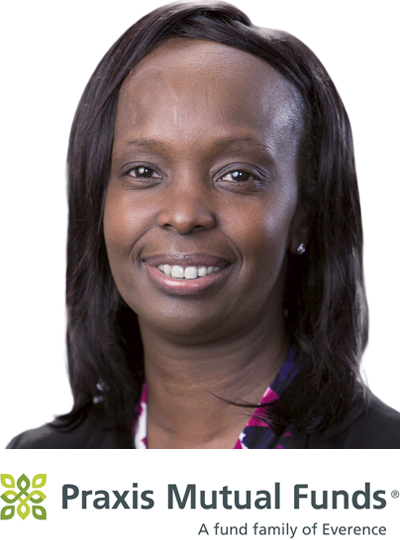
By Stella Tai, Praxis Mutual Funds

Above: Stella meeting with representatives from SunCulture, an organization connecting rural farmers with solar power.


Stella Tai-Praxis Mutual FundsIn my 15-year career working as a woman in impact investing and its various facets geared towards investing in women, I have learned that communities and families benefit greatly when women thrive economically.

In December 2021, I had the privilege of visiting several organizations in Kenya supported through Praxis Mutual Funds’ commitment to community development investing. This was alongside a visit to my family in my birth country, after five years of being away. This article is a personal reflection on how impact and gender lens investing delivers real-world impacts – and how advisors can help their clients understand those impacts.

Impact investment moves capital to where it’s needed most. This often revolutionizes the lives of women and girls. During my visits, I saw what capital was achieving, on the ground among rural women, many of whom were poor, and on small farms using affordable products developed and customized to meet their needs. This solidified the importance of this work in my mind.

Gender lens investing (GLI) is critical in closing global gaps in access to capital and thereby increasing human capital wealth, education and helping countries achieve their full developmental potential. In a more diverse and equal society, everyone benefits.

Project in Kenya

Many rural women in Kenya face specific and unique challenges such as a lack of easy access to clean water and affordable clean energy. When there are appropriate interventions, these women are placed on the fast track to achieving economic milestones that can propel them and their families into the middle or the upper-middle class.

The organizations I visited were not founded with the primary purpose of helping women, but by evaluating the results of these investments through a gender lens, it becomes clear that the positive effects on the lives of women and girls are disproportionately greater.

SunCulture client Mrs. Ndegwa: Local women farmers are able to access solar-powered farming technology because of SunCulture.

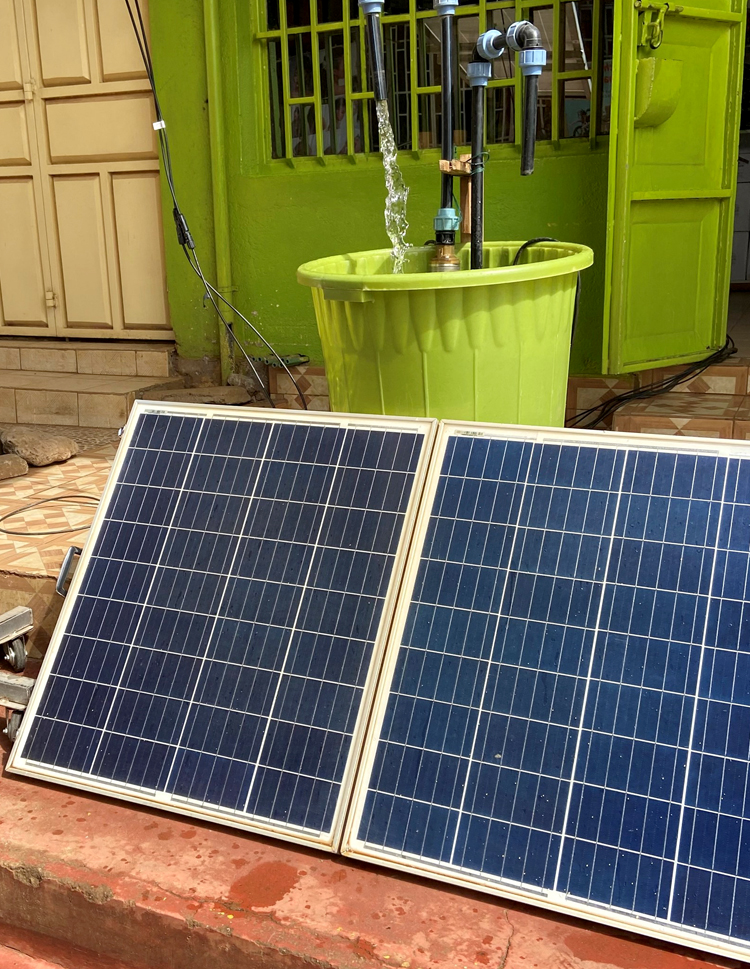
SunCulture – This organization focuses on providing energy access through solar home and irrigation systems. About 65 percent of land in sub-Saharan Africa is tilled, plowed, weeded and watered manually. I met with two industrious women farmers whose lives had been transformed by access to energy.

SunCulture off-grid solar panels and tech provide smallholder farms with reliable lighting, water generation and mobile charging
SunCulture off-grid solar panels and technology provides smallholder farms with reliable lighting and mobile charging.

With access to a water pump for their wells, they could irrigate their farms more efficiently and increase productivity. The energy then led to increased yields and higher incomes for their households, which in turn meant that these women could invest in their children’s educations – creating more opportunities for the future of their families.

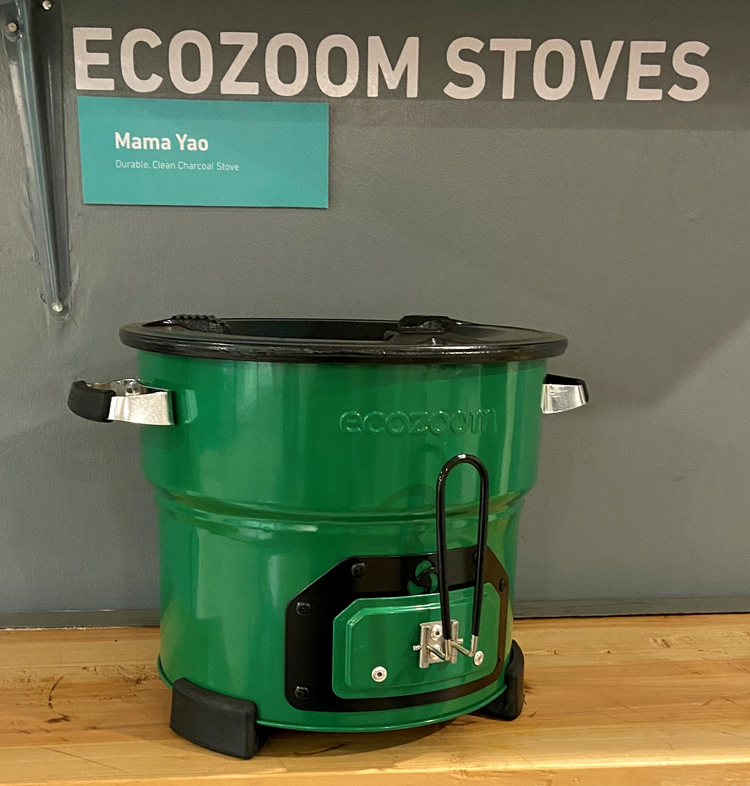
BioLite cookstoves provide a safe way to cook food - Praxis Mutual Funds
BioLite cookstoves provide a safe way to cook food, charge electronic devices, and generate light for families in Kenya.

BioLite – BioLite developed a clean energy cookstove and home lighting solar system with USB ports for charging devices like cell phones. They aim to bring electricity to the nearly 600 million people in sub-Saharan Africa who are not connected to the national electricity grid and the hundreds of millions more who live with unreliable connections and are plagued by frequent blackouts.

Investors need to appreciate the benefits these stoves offer women specifically. To meet the domestic needs of their families, many rural women often walk hours to fetch water or carry wood for cooking, which can be arduous and takes time away from a girl’s education or a woman’s economic opportunities. These regionally appropriate innovations not only connect the whole families with electricity, but the stoves allow women to cook more safely and redeem precious time to better themselves educationally, economically and socially.

What Does the Future Hold?

Impact investments with a gender lens are projected to increase over the next decade across all asset classes. In recent years, we’ve seen growing demand from investors to take gender into account when considering impact investing.

Additionally, the projected wealth transfer to women is predicted to increase from about $50 trillion in 2015 to $72 trillion, that is two-thirds of the worlds’ wealth, by 20301. Women investors are more likely to demand increased inclusivity, diversity, and values-aligned investing, which may lead to increased consideration of gender in impact investing.

Gender-lens investing is a field that will continue to grow, considering the increased attention and engagement with the 17 UN Sustainable Development Goals (SDGs)*. SDGs relevant to gender include SDG 5 (gender equity), SDG 10 (reduce inequality), SDG 8 (sustainable economic growth) and SDG 7 (sustainable energy).

The SDGs aim to end poverty, protect the planet and ensure prosperity for all. As more investors and investment companies call for alignment with these goals, gender equity and equality will become areas of greater interest for impact investors.

What Can Financial Advisors Do?

Advisors interested in impact investing that incorporates a gender lens should initiate the conversation. They can open the door to a discussion on a client’s gender lens investing goals by engaging with clients on how they can better align their portfolios or a portion of their portfolios with their values.

Secondly, advisors can familiarize themselves with gender lens investing topics and be ready to engage with the clients, especially women, as their percentage of global wealth continues to grow.

Another option for advisors is to encourage the use of donor advised funds that hold immense opportunities for increasing a client’s impact. DAFs are a powerful tool that allows investors interested in aligning their investment portfolios with their values to make charitable contributions while simultaneously getting tax benefits.

Advisors and/or their clients can take part in insight trips and observe how their funds contribute to improvement in the lives of women and girls. This is a great way for younger people to be inspired at the start of their investment journeys and for established investors to confirm the difference their investments are making in the world.

One of my hopes is that, as an industry, we might build greater collaborations around gender lens investing themes. For example, investment firms, both for-profit and non-profit, and other stakeholders such as government entities interested in gender lens investing can collaborate on sharing information, participating in deals, spurring innovation, building systems of educating clients and thereby accelerating greater amounts of capital flowing into this theme.

The cumulative effect of all these efforts will deliver real impact and will also help investors understand the range of possibilities available on the investing spectrum — from 100 percent philanthropic to 100 percent market-rate returns and everything in between.

How Praxis Approaches Community Development Investing 

By committing approximately 1 percent of its funds to Community Development Investing nationally and internationally, Praxis has further deepened its commitment to GLI. This investment is managed by Calvert Impact Capital, a nonprofit investment firm that makes loans to roughly 100 mission-driven organizations worldwide with high impact social and/or environmental focus such as micro-finance, affordable housing and cooperatives.

As of 2021, the CIC portfolio had impressive gender impact numbers. Women represented:

  • 70% of the end clients of the borrowers.
  • 53% of the borrower staff.
  • 42% senior leadership in borrower organizations.
  • 43% of the board of directors.

Impact investing through a gender lens is an accelerator to gender equity and equality not only in the United States but globally. If we want to effectively give people the tools they need for economic and educational advancements, focusing on raising the economic power of women is a key step in creating lasting change. That is why at Praxis Mutual Funds, we are committed to making real impacts when it comes to gender equity and why we are passionate about showing advisors the effects of gender lens investing.


Article by Stella Tai, Stewardship Investing Impact and Analysis Manager

Stella provides primary leadership for the promotion, integration and development of impact investing and reporting. Before joining Praxis, she was assistant vice president of Lending at FINANTA, a Community Development Financial Institution (CDFI) in Philadelphia. Stella has served on the board of Chariots for Hope, a nonprofit supporting a network of eight children’s homes in Kenya, her country of origin. Connect with Stella on LinkedIn.

Footnote:
[1] “Here’s who will benefit the most from the $59 trillion ‘Great Wealth Transfer’”: Bankrate, Sept. 25, 2018
*  In 2015, the UN announced the Sustainable Development Goals as a call to action for countries, governments, funders, and investors to unite to accomplish 17 global goals. These goals recognize that ending poverty and other deprivations must go hand-in-hand with strategies that improve health and education, reduce inequality, and spur economic growth – all while tackling climate change and working to preserve our oceans and forests. The UN has provided a framework of specific indicators to measure progress and a timeframe to achieve them by 2030, both of which reinforce the urgency and crucial nature of this work.

About Praxis

Praxis Mutual Funds is a leading faith-based, socially responsible family of mutual funds designed to help people and groups integrate their finances with their values. Praxis is the mutual fund family of Everence Financial, a comprehensive faith-based financial services organization helping individuals, organizations and congregations. To learn more, visit praxismutualfunds.com and everence.com, or call 800-348-7468.

Consider the fund’s investment objectives, risks, charges and expenses carefully before you invest. The fund’s prospectus and summary prospectus contain this and other information. Call 800-977-2947 or visit praxismutualfunds.com for a prospectus, which you should read carefully before you invest.

Praxis Mutual Funds are advised by Everence Capital Management and distributed through Foreside Financial Services, LLC, member FINRA. Investment products offered are not FDIC insured, may lose value, and have no bank guarantee.

Energy & Climate, Featured Articles, Food & Farming, Impact Investing, Sustainable Business

The Year Ahead: Three Water Trends

By Will Sarni, The Water Foundry

In January 2021, I wrote in GreenBiz that the year ahead for water could be viewed as the roaring 20s and as a period of creative destruction. As I reflect on 2021 and the year ahead, I am doubling down on this view with three trends that are proof points that water innovation is accelerating and disrupting the status quo.

Extreme Decentralization is Moving into your Home

The move to diversify from centralized water and wastewater treatment systems has been underway for years. This is not to imply that centralized systems will be completely replaced. Instead, there are now alternatives for water supply and treatment.

The trend to provide options to centralized systems is accelerating with a recent move to technologies that can be viewed as “extreme decentralization,” as outlined in this essay, “The Third Route: Using Extreme Decentralization to Create Resilient Urban Water Systems.” The authors frame a complementary path to centralized systems that includes “household-based personalized water systems.”

In my view, these personalized water systems include technologies for off-grid water supply systems (such as the panels from Source), home water reuse (including technologies from Hydraloop) and real-time water data information sources for quantity (Conservation Labs) and quality (Safespout).

Off-grid water supply, reuse and home water performance will be enabled by these real-time data digital technologies. View these technology categories as augmenting centralized water and wastewater treatment systems and delivering access to water where centralized systems are unavailable. An important initiative in this trend is the work of the 50 Liter Home Coalition which has a vision to create abundance for water through the adoption of advanced water technology in the home.

Exponential Technologies are Taking Off

Deloitte defines exponential technology as “innovations progressing at a pace with or exceeding Moore’s Law” that “evidence a renaissance of innovation, invention and discovery … [and] have the potential to positively affect billions of lives.”

Xponential Works adds that “exponential technologies are those innovations that continue to advance exponentially, with disruptive economic and lifestyle effects.”

Examples of technology categories in the water sector include digital technologies and advanced materials. Digital technologies encompass artificial intelligence, augmented and virtual reality (AR, VR) and robotics.

The applications of these technologies are appearing in the utility and private sector to vastly improve resource use, reduce carbon emissions and manage infrastructure, manufacturing assets and supply chains. Company examples include Plutoshift and Fido Tech, the work of KWR Water and WatchTower Robotics. Advanced materials are being applied in off-grid water supply technologies (such as Source) and treatment membranes (evove).

Typically, water technology innovation is linear: slow and evolutionary not revolutionary. But these exponential technologies are disruptive, not just evolutionary, innovations that will transform public sector and private sector water management. One just has to look at how exponential technologies have disrupted other sectors such as the energy sector. The rise of residential solar is one example that is illustrative of what could happen for water.

The Hydration Revolution

This is not an indictment of tap water but instead, a recognition that consumers are moving to alternative hydration methods and in-home water treatment solutions. The reality is that an estimated 60 million Americans don’t trust tap water. The reasons are complex but can be broken down into perceived risks from tap water, such as the taste; real risks such as lead contamination; and brand preferences for bottled water. Regardless of the motivation, this lack of trust in tap water is driving innovation and consumer preferences about how they hydrate.

According to research by Asher Rosinger, Anisha Patel and Francesca Weaks, Americans don’t trust the water from their tap. The two state, “Taking that into account that an estimated two million Americans don’t have access to safe drinking water, about 59 million people have tap water access from either their municipality or private wells or cisterns but don’t drink it. While some may have contaminated water, others may be avoiding water that’s actually safe.”

Since the 2013 to 2014 timeframe (just prior to the lead crisis in Flint, Michigan’s water system), the prevalence of adults who don’t drink their tap water has increased by 40 percent. The number of children not consuming tap water rose by 63 percent. The authors reference a 2020 study by anthropologist Sera Young, which found that tap water avoidance was declining before the Flint water crisis that began in 2014. In 2015-2016, however, it started to increase again for children.

The implications of this trend are that consumers seek alternatives to tap water and installing in-home treatment systems. They are attracted to “personalized water” options (such as SodaStream or rocean) and tracking hydration as part of the trend in personal wellness (via bottles and apps such as Rebo). While these supplies will not replace traditional water utilities, they will challenge them to manage customer perceptions and consider potential partnerships with alternative hydration businesses.

What This All Means: Investors Just Add Water

The rush is on to invest in the water sector. Disruption of the water industry (I view the “water industry” as very broadly defined beyond water utilities and water technology providers) is accelerating and being driven by investors.

This increasing interest is being driven by the impacts of climate change on our hydrologic cycle resulting in water scarcity in places such as the American West. Organizations such as Nasdaq and the Financial Times (Water stress drives investor interest to address supply shortage) recently reported on investing in water in response to water-related risks to the private and public sectors.

Investors are looking for innovative solutions to address water scarcity, poor quality and access to safe drinking water. It is likely that most investments will be in evolutionary innovation technologies; however, some will go towards hydrating disruptive technologies and new business models such as water as a service.

These three trends, fueled by increasing investor interest, will continue to challenge and disrupt the water sector status quo. The traditionally slow pace of innovation and scaling of new technologies and business models is giving way to faster adoption in response to the harsh reality of the impacts of climate change; democratized access to data and actionable information; and failing aging infrastructure and outdated public policies.

Originally published in GreenBiz on January 12, 2022


Article by Will Sarni, founder and CEO of water strategy consultancy, Water Foundry. He is also the CEO of the Colorado River Basin Fund, the first placed-based water-focused investment fund in the United States.

Prior to Water Foundry, Sarni was a managing director at Deloitte Consulting where he established and led the water strategy practice. He was the founder and CEO of Domani, a sustainability strategy firm, prior to Deloitte.

Sarni is the author of five books: Corporate Water Strategies;  The Water Tech Book;  Beyond the Energy-Water-Food Nexus;  Water Stewardship and Business Value;  Creating 21st Century Abundance Through Public Policy Innovation.

Sarni is a co-founder of WetDATA and a host of the podcast, The Stream with Will and Tom. He is a board member of Flowater, Silver Bullet, Project WET and the Rocky Mountain Rowing Club. He was the Chairman of the Scientific Advisory Board for the WAITRO Global Water Innovation Summit 2020 and was on the Scientific Program Committee for Stockholm World Water Week from 2013 through 2019. His advisory work includes working with the 2020 X-PRIZE (Infinity Water Prize), as a Bold Visioneer for the 2016 X-PRIZE Safe Drinking Water Team and a Technical Advisor for the Climate Bonds Initiative: Nature- Based Solutions for Climate and Water Resilience. He is also on the Editorial Board of the Journal of Water Security. 

Visit WillSarni.com for more information.

Additional Articles, Energy & Climate, Impact Investing, Sustainable Business

Community Capital Mgmt. Releases Ninth Annual Impact Report

Community Capital Management, LLC (CCM), a leading impact and environmental, social, and governance (ESG) investing manager, recently released the Ninth edition of its ground-breaking annual impact report with a new video featuring CCM team members. The report has grown over the years as CCM has added investment strategies, impact customization options, and impact measurement. The video and report are both available on CCM’s website.

“With over two decades of experience in impact and ESG investing, we have seen many types of annual impact reports in the past few years,” said Jessica Botelho, director of impact and CRA research at CCM. “We have adapted and improved our impact reporting over the years based on client feedback, internal discussions, and enhanced metrics and outcomes. We are honored that so many entries into the impact arena have followed our lead and published impact reports on their activities.”

The video highlights content in the 42-page report including, but not limited to:

  • Comprehensive impact metrics for 2021
  • Evolving impact themes
  • Impact customization investment case studies

CCM began managing assets in 1999 and has kept its mission the same over its 22-years: to seek to deliver superior risk-adjusted returns through investment strategies that contribute to positive environmental and social outcomes. Strategies are available in separate accounts, mutual funds, and exchange-traded funds, and we develop custom solutions for clients based on their missions and values. Examples include place-based impact investing portfolios, faith-based alignment, and sustainably focused initiatives.

“We have seen significant growth in the demand for our pioneering impact and ESG investment strategies over the last decade from a variety of investors, including endowments, foundations, faith-based organizations, high net worth investors, non-profits, and healthcare organizations,” said Alyssa Greenspan, president and COO of CCM. “We are extremely proud of our team members and their dedication to making CCM a leading impact and ESG investing manager and are excited to share the video and ninth impact report with clients, colleagues, and friends who have supported us along the way.”

To watch the video, click here; to download the complimentary 2021 impact report, click here.


About Community Capital Management, LLC

Community Capital Management, LLC (CCM) is an investment adviser registered with the Securities and Exchange Commission. Headquartered in Fort Lauderdale with employees in Boston, Charlotte, the New York City area, and Southern California, CCM was founded in 1998 and manages approximately $4.2 billion in assets. The firm believes a fully integrated portfolio — one that includes environmental, social, and governance (ESG) factors — can deliver strong financial performance while simultaneously having positive long-term economic and sustainable impact. CCM’s strategies utilize an innovative approach to fixed income and equity investing by combining the positive outcomes of impact and ESG investing with rigorous financial analysis, an inherent focus on risk management, and transparent research. Within our fixed income portfolios, impact customization provides investors the opportunity to direct their capital to support specific geographies (also known as place-based impact investing), one or more of 18 impact themes, and impact initiatives.

Community Capital Management, LLC (CCM) is an investment adviser registered with the Securities and Exchange Commission under the Investment Advisers Act of 1940. Registration as an investment adviser does not imply a certain level of skill or training. The verbal and written communications of an investment adviser provide you with information you need to determine whether to hire or retain the adviser. Past performance is not indicative of future results. CCM has distinct investment processes and procedures relating to the management of investment portfolios. The firm’s strategies are customized, rather than model-based, and utilize an innovative approach to fixed income and equity investing by combining the positive outcomes of impact and environmental, social, and governance (ESG) investing with rigorous financial analysis, an inherent focus on risk management, and transparent research. Bonds are subject to interest rate risk and will decline in value as interest rates rise.

Additional Articles, Impact Investing, Sustainable Business

Clean200 Companies Continue to Outperform MSCI ACWI Global Index

As You Sow and Corporate Knights recently released their 9th update of the Carbon Clean 200, a list of 200 publicly traded companies worldwide that are leading the way among their global peers to a clean energy future.

Key Findings Include:

  • Clean200 companies generated a total return of 107.09% beating the MSCI ACWI broad market index (103.15%) and MSCI ACWI/Energy Index of fossil fuel companies, (31.67%) on Total Return Gross — USD Basis from the Clean200 inception of July 1, 2016 to Jan. 31, 2022.
  • $10,000 invested in the Clean200 on July 1, 2016, would have grown to $20,709 by Jan. 31, 2022, versus $20,315 for the MSCI ACWI broad market benchmark and $13,167 for the MSCI ACWI/Energy benchmark for fossil fuel companies.
  • 10 companies that contributed the most to the Clean200’s outperformance over the past year were primarily from China, the U.S., South Korea, and Canada and include electric vehicles, environmental protection, energy conservation solutions, and green energy themes.

“In 2016 we created the Clean200 in response to investors saying, ‘if we divest fossil fuels there is nothing to invest in,’” said Andrew Behar, CEO of As You Sow and report co-author. “The Clean200 has demonstrated consistently that the clean energy future is the clean energy present. This year, the scale and global diversity of leading companies continue to expand and redefine the term cleantech to be any company that has products and services that will reduce demand for fossil fuels and water.”

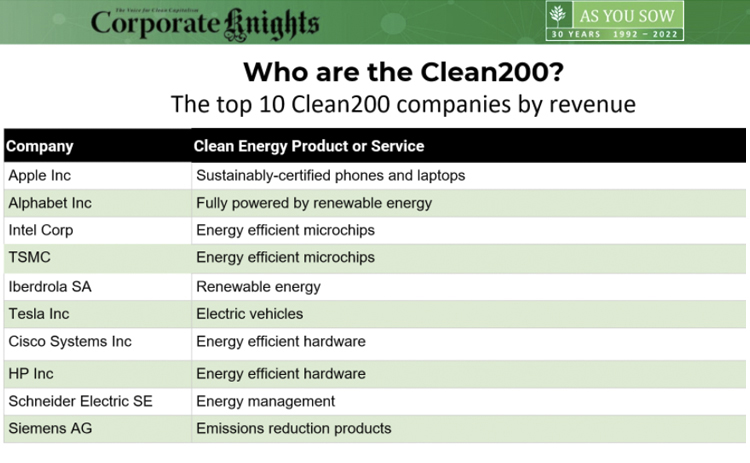
The top 10 companies on the list by revenue include Apple Inc., which offers sustainably-certified phones and laptops; Alphabet Inc. whose operations are 100% powered by renewable energy; Intel Corp.; Taiwan’s TSMC for low-energy microchip solutions; and Iberdrola SA for clean power generation. Thirty-two countries are represented in the Clean200, including the U.S. (53), Canada (18), China (16), France (12), and Japan (11).

Top 10 Clean200 companies by revenue chart

“Without major tech outperformers like Amazon and Microsoft or any of the fossil fuel stocks now surging on the back of high oil prices, the Clean200 still managed to outperform both the blue-chip and oil and gas indices over the past five years, signaling the market’s confidence in their mojo to take our economy forward post-pandemic,” said Toby Heaps, CEO of Corporate Knights and report co-author.

The Clean200 utilizes Corporate Knights Clean Revenue database which tracks the percent of revenue companies earn from clean economy themes including energy efficiency; green energy; electric vehicles; banks financing low-carbon solutions; real estate companies focused on low-carbon buildings; forestry companies protecting carbon sinks; responsible miners of critical materials for the low-carbon economy; food and apparel companies with products primarily made of raw materials with a significantly lower carbon footprint; and Information and Communications Technology (ICT) companies that are leading the way on renewable energy while also being best-in-sector according to currently accepted privacy benchmarks.

The list excludes companies that are flagged on As You Sow’s Invest Your Values suite of mutual fund transparency tools that identify companies involved in fossil fuels, deforestation, weapons, gender inequality, tobacco, and the prison industrial complex.

“We will continue to track and share the emergence of this economic powerhouse,” Behar continued. “There is now clear financial evidence showing a broad spectrum of companies and market forces making the economic transformation, which is our greatest hope in controlling climate change.”


As You Sow is the nation’s leading shareholder advocacy nonprofit, with a 30-year track record promoting environmental and social corporate responsibility and advancing values-aligned investing. Its issue areas include climate change, ocean plastics, pesticides, racial justice, workplace diversity, and executive compensation. Click here for As You Sow’s shareholder resolution tracker.

Corporate Knights is a research and media B Corp that seeks to provide information that empowers people to harness markets for a better world.

As You Sow and Corporate Knights are not investment advisors nor do we provide financial planning, legal, or tax advice. Nothing in the Carbon Clean 200 Report shall constitute or be construed as an offering of financial instruments or as investment advice or investment recommendations.

Additional Articles, Energy & Climate, Impact Investing, Sustainable Business

Top Sustainable Business Trends of 2022

By Joel Makower, GreenBiz Group

We find ourselves in uncharted and unfamiliar territory. Again.

The worlds we collectively inhabit — corporate sustainability, sustainable finance, the circular economy, climate tech — are all reaching inflection points, growing and changing faster than many could have imagined. Along the way, they’re roiling industries, companies, jobs and career paths — mostly for the better but also in a be-careful-what-you-wish-for kind of way.

The Age of COVID has coincided with the rise of nearly every aspect of sustainable business: companies’ commitments to achieving net-zero greenhouse gas emissions; the mind-blowing uptake of green bonds and sustainability-linked loans; the inexorable growth of renewable energy, alongside its declining price; the mainstreaming of electric vehicles; the rise of concern about biodiversity loss and its economic impact, and more.

Indeed, the past two years of pandemic life seem to have left sustainable business relatively unscathed. With good reason: Despite our self-imposed isolation, the klieg lights focused on companies’ environmental and social commitments and performance have grown increasingly brighter and hotter, in lockstep with the rise of concern about the scale, scope and pace of change. With the signs of a changing climate becoming ever more apparent — and costly — the business world is finally recognizing that sustainability is not merely a nice-to-do activity.

Which is not to say that companies are solidly on the case. True, the pace of change has quickened, with more companies making bigger commitments, but it’s far from what’s needed to address the challenges before us. Carbon emissions, which dropped in tandem with the tanking global economy during 2020, resumed their relentless climb in 2021, faster than many scientists predicted, according to the Global Carbon Project. And scientists expect emissions to rise even further in 2022 as the global economy continues to pick up steam.

That’s just one data point, albeit a significant one, casting a pall over the corporate sustainability landscape. There’s the continued loss of biodiversity spurred by land-use changes from economic growth coupled with the ravages of a changing climate. There’s the ongoing loss of fisheries and marine ecosystems upending the seafood industry. There’s the growth of water stress due largely to population and economic growth: Just over half — 52 percent — of the world’s projected 9.7 billion people will live in water-stressed regions by 2050, with most in developing economies, according to the MIT Integrated Global System Model Water Resource System.

That’s the duality in which the world of sustainable business exists: Impressive progress, innovation and achievements, but nowhere near enough to stem the tide of the terrifying environmental and socioeconomic challenges ahead.

Still, there’s no denying that the pace of change is quickening inside companies. The number of consortia, partnerships, initiatives, and innovations can be overwhelming, even breathtaking at times. Whereas not long ago, the center of gravity could be found inside a handful of sectors — consumer goods, information technology, retail and apparel come to mind — today, there’s no part of the economy untouched by sustainable innovation.

Witness the rise of climate tech, shorthand for a stunning array of technologies and solutions aimed at decarbonizing business and commerce. They represent the convergence of leading edge thinking in artificial intelligence, blockchain, green chemistry, synthetic biology, advanced materials, remote sensing and other disciplines and technologies. Individually and in concert, these future-facing advances stand to reinvent large swaths of the economy.

We’re already seeing the fruits of those innovations: plant-based proteins, textiles and chemicals; advanced, low-carbon steel, concrete and other materials; the electrification of buildings and vehicles; cleaner and more resilient energy systems; adaptive, climate-resilient infrastructure.

One challenge, and opportunity, is whether and how these innovations scale quickly enough to offset the growing global economy, and whether they will be accessible to those at every rung of the economic ladder — in particular, communities, businesses and individuals in rapidly growing economies in Asia, Africa and South America.

It won’t be easy. If the inequitable distribution of COVID vaccines is any indication, the world’s richest countries are ill-prepared to adequately care for those in need. To the extent that we can view the current pandemic as a peek into the kinds of global emergencies we may increasingly be confronting — well, it’s a sobering reality check.

One bright spot in all this is the world of finance, which has finally recognized both the business risks and opportunities of a climate-changing world. The world’s largest banks, insurance companies, institutional investors and pension funds are increasingly moving funds out of polluting industries — or, at least, companies within those industries deemed to be least prepared to meet the new environmental realities — and into companies and funds that seem to be part of the solutions.

It’s a highly imperfect process. The ability to accurately distinguish climate leaders from laggards continues to befuddle the world’s largest investors and financial markets. Many of the banks that profess to be shifting funding away from polluting companies and industries are still backing coal mines and oil wells. Investment funds purporting to focus on companies that score well on environmental, social and governance (ESG) issues still have polluting companies in their portfolios.

It will be a long, slow process to shift completely away from the bad to the good, assuming we can agree on what “good” even means. The sobering challenge: We don’t have that kind of time.

One area of growing focus are companies’ lobbying efforts and political support of legislation and public policy that can accelerate the kinds of changes scientists say we need to make. For years, companies willing to stand up against the well-funded fossil-fuel lobby were relatively few and far between. That’s just beginning to change. The pressure of activist and advocacy groups pushing businesses to get off the sidelines and take a stand is rising. If corporations do — and that’s a big “if” — the private sector could further burnish its credentials as a positive force for change.

However, if businesses opt for short-term profit over longer-term survival, it will be that much tougher to make progress. Either way, the story of corporate climate advocacy will be one of the more interesting to watch in the year ahead.

There are other story lines we’ll be following in 2022 and beyond, some of which are detailed in this report: the challenges of driving sustainability and decarbonization through company supply chains; how “true zero” is becoming the new mantra for clean-energy buyers; regulators’ newfound focus on sustainable finance and ESG reporting; the professionalization of the circular economy; the growth of resale in consumer markets, and more.

There’s plenty to be hopeful about in 2022 — and even more to instill fear for our collective future. Which will predominate?

The Top Sustainable Business Trends 2022:

  • HR Ups Its, Sustainability Game
  • Resale Finds Its Second Life
  • The Circular Economy Gets Professional
  • Biodiversity Meets the, Bottom Line
  • Sustainability Gets Baked into Food Design
  • Circular ‘Mining’ Reaches for the Mainstream
  • Supply-Chain Data Gets Granular
  • Clean Energy Aims for True Zero
  • Regulators Rein in the ESG Bandwagon
  • Logistics Gets on a Sustainable Track

Download the free State of Green Business 2022 report to explore the top sustainable business trends of 2022, as well as two new components of this year’s report: the state of green jobs and skills, developed in collaboration with LinkedIn, and the state of net zero, by S&P Global Sustainable.


Article by Joel Makower, Chairman & Co-Founder, GreenBiz Group

Additional Articles, Energy & Climate, Impact Investing, Sustainable Business

WAVE Fills Gap in Evaluating Water Risk

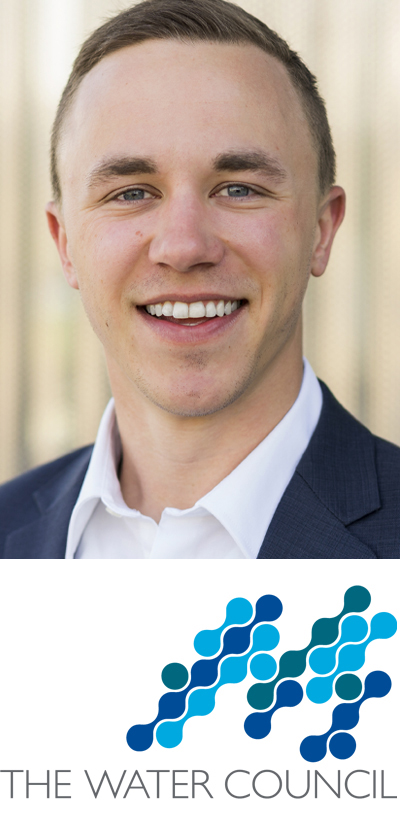
By Dylan Waldhuetter, The Water Council

(Above image – the Milwaukee skyline and Lake Michigan. Photo credit: Peter Zuzga, courtesy of The Water Council)

Dylan Waldhuetter The Water CouncilWater risk hasn’t received the same attention as carbon emissions in sustainable investing, but if you’re not paying attention to water, you’re already behind. Droughts, floods, deteriorating infrastructure, poor water quality and more are materially impacting companies’ direct operations and supply chains across the globe. The changing climate will only accelerate the manifestation of these water risks.

“Besides climate change, I don’t think there’s a more important issue in terms of investing,” said Julie Gorte, senior vice president for sustainable investing at Impax Asset Management. “We’ve all seen companies take material hits because of drought. There’s hardly any place now where water is immaterial to an investment decision.”

Companies are good at monitoring, quantifying, and reporting on withdrawals and usage, but exposure and response to water risks and opportunities is trickier to measure. Businesses deal with a variety of risks related to water quality and quantity depending on how they use water and where their facilities and supply chains are located. While many companies have pledged their commitment to water and frameworks exist to adopt water stewardship practices at the site level, there is a critical execution gap between the two.

The Water Council, an internationally acclaimed nonprofit dedicated to freshwater innovation, created WAVE to fill that gap. WAVE – Water Stewardship Verified – provides a methodology to develop thoughtful strategies, set meaningful goals and take impactful action on water across the enterprise, concluding with independent verification that the company has built a credible foundation of knowledge on which to base its water stewardship work. Based on global best practices, it sends a strong message to investors, customers and employees that the company is methodically defining its exposure to water risks and taking a strategic approach to mitigating them across the enterprise. Ultimately, the company is better able to translate credible water action into verified external reporting.

The Water Council has helped companies from large multinational corporations to small family-owned businesses mitigate water-related risk and improve water stewardship outcomes. From 2015 to 2021, The Water Council served as the North American Regional Partner for the Alliance for Water Stewardship, helping build the business case for water and creating the world’s first credentialing program for water professionals.

The WAVE program, launched earlier this year, follows a six-step process for a company to understand its water uses, impacts and risks; approve a corporate water stewardship policy; prioritize sites to mitigate water-related risk; and communicate plans and goals.

“WAVE helps cut through the complexity and gives companies a good entry point into water stewardship by demystifying key concepts and best practices,” said Matt Howard, vice president of water stewardship at The Water Council. “We want to lower the barrier to entry for companies starting a water stewardship plan.”

While the program evaluates water-related risk, it also addresses opportunity by engaging with stakeholders in watersheds where the company operates.

“When you get into true water stewardship, then you’re proactively looking for ways to address those common challenges and common opportunities that people share within the same watershed,” Howard said. “The upside is long-term security and sustainability of the water resource.”

All of this demonstrates the need for investors to improve their evaluation of company water performance. If companies and investors don’t recognize water risk and opportunity, they’re opening themselves up to surprise and uncertainty in the future, Gorte said. “You want every company to be aware of its dependence on and vulnerability to water throughout the supply chain,” she said. “But you also want companies to be aware that there are opportunities.”

Independent verification is key to the WAVE program, said Rae Mindock, manager for responsible water practices at SCS Global Services. Since 1984, SCS Global Services has been a leader in the field of sustainability standards and third-party certification. Many companies are trying to capture the Environmental, Social and Governance (ESG) investment dollars flooding the market, but often they aren’t verifying their sustainability work, leading to a component of greenwashing, Mindock said.

“With WAVE, that component is gone,” she said. “When you work with people who are knowledgeable about stewardship combined with people who are knowledgeable about verification, that’s a program we can get behind and be proud of.”

Upon verification, WAVE participants are entitled to use a seal and claim indicating the company has assessed water-related risk across the enterprise, identified the highest water-related impacts using credible water-related data, and implemented best practice in improving water stewardship performance.

The Water Council headquarters at the Global Water Center in Milwaukee, WI (photo courtesy of The Water Council)

The Water Council pilot tested the program with public companies A. O. Smith Corporation, Badger Meter, Nutrien and Watts Water Technologies.

The WAVE process helped Nutrien, a fertilizer producer and the world’s largest provider of crop inputs, services and solutions, think about the watersheds it operates in, not just water use at its own sites, said Mike Nemeth, senior advisor for agricultural and environmental sustainability. It also helped the company develop a corporate water stewardship position and pathway for Nutrien to participate in water stewardship more broadly in the agriculture sector.

“From the very top of our organization all the way down, we knew exactly what we were saying about water and how we were going to act to be good water stewards in our sector,” Nemeth said.

As a result of the program, Nutrien created a cross-functional water targets team committed to developing context-based water targets and identified watersheds with higher water-related risk that they can prioritize for action.

Watts, a global water solutions provider, got connected to WAVE through Impax, one of its investors, as it sought to continue improving its water stewardship. Through the program, the company chose eight sites to prioritize for water stewardship action based on water withdrawals, wastewater discharges and local watershed risks.

Robert J. Pagano Jr., president and CEO of Watts, said that his company’s participation in the WAVE “allowed us to better understand how we affect water resources, both upstream and downstream, at eight of our worldwide facilities.”

Water is a unique and vital resource that all businesses and communities depend upon, with diverse challenges depending on how you use water and where you operate. Companies must move beyond a narrow-minded, non-contextual focus on water use and efficiency. It’s time for companies to embrace water stewardship and implement a strategic approach to water risk mitigation across the enterprise – and it’s time for investors to start asking for it.


Article by Dylan Waldhuetter, Director of Water Stewardship Solutions at The Water Council, where he is responsible for program development and support related to the council’s water stewardship initiative.

Additional Articles, Energy & Climate, Impact Investing, Sustainable Business

Signup to receive GreenMoney's monthly eJournal

Privacy Policy
Copyright © GreenMoney Journal 2025

Website design & development by BrandNature

Global Events Calendar

View All Events

april

21aprAll Day232026 Sustainable Packaging Coalition: SPC Impact – Nashville

27aprAll Day30Women Deliver 2026 Conference (WD2026) – Melbourne

X