Tag: Impact Investing

The 100 Best Corporate Citizens of 2022

Owens Corning, PepsiCo, Apple, HP and Cisco top annual U.S. ranking measuring environmental, social and governance (ESG) transparency and performance

3BL Media announced recently their annual 100 Best Corporate Citizens ranking, recognizing outstanding environmental, social and governance (ESG) transparency and performance among the 1,000 largest U.S. public companies.

For the fourth consecutive year, Owens Corning tops the ranking. PepsiCo, Apple, HP and Cisco round out the top five.

The 100 Best Corporate Citizens ranking is based on 155 ESG factors in eight pillars:

  • climate change
  • employee relations
  • environment
  • finance
  • governance
  • human rights
  • stakeholders and society
  • ESG performance.

Using a methodology developed by 3BL Media, all Russell 1000 Index companies are researched by ISS ESG, the responsible investment research arm of Institutional Shareholder Services. There is no fee for companies to be included in 100 Best Corporate Citizens.

View the 100 Best Corporate Citizens of 2022 ranking here.

To compile the ranking, corporate data and information is obtained from publicly available sources only, rather than questionnaires or company submissions. Companies have the option to verify data collected for the ranking at no cost. Data and information used in the 2022 edition of the 100 Best Corporate Citizens ranking is from March 19, 2021 to March 18, 2022.

To ensure companies in the ranking were not lobbying against Paris Climate Agreement-aligned policies, in 2021 3BL Media partnered with InfluenceMap to assess a “red flag” penalty to such oppositional companies. Taking it a step further, in 2022 a “green flag” bonus was introduced to recognize firms using their political influence and spending in support of Paris aligned policies. PepsiCo, Apple, Microsoft, PSEG and Salesforce were the only companies to receive this “green flag.”

“Achieving the transformational targets in the Paris Agreement and UN Sustainable Development Goals in this decisive decade requires all companies to truly embed ESG issues into the core of their business,” said Dave Armon, CEO of 3BL Media. “The 100 Best Corporate Citizens of 2022 are answering the call by demonstrating the societal and bottom-line value of leadership and transparency around ESG topics. They are setting ambitious goals, outlining robust strategies for achieving them, disclosing data to measure progress, and accounting for all stakeholders in business decisions.”

2022 Takeaways

Owens Corning topped the ranking for the fourth consecutive year and is the first company to ever do so.

Out of the 24 industries assessed, companies from 23 were in the top 100 (see FAQs for industry details). The Materials industry group had the most representation in this year’s ranking, with 11 companies placing within the top 100. The second most represented industry is Capital Goods, having placed eight companies in the ranking. No companies from either the Media & Entertainment industry made the top 100. In terms of highest performing industry, there are six companies in the top 100 from the Technology Hardware & Equipment sector, three of which are in the top five!

Twenty-one companies are new to the top 100 or returning after a hiatus (compared to 20 companies in 2021): Apple, Ford Motor Company, Public Service Enterprise Group (PSEG), Kimberly-Clarke, salesforce.com, International Flavors & Fragrances, Alcoa Corporation, Freeport-McMoRan, Illumina, International Paper Company, CSX Corporation, First Solar, NiSource, Yum! Brands, Applied Materials, Molson Coors, Hormel Foods, Humana, Starbucks, Berry Global Group, and Marriott International.

Since 2009, only 19 companies have made the ranking each year: 3M, Abbott, Accenture, Baxter, Bristol Myers-Squibb, Cisco, Colgate-Palmolive, Eaton, Gap, General Mills, Hess, IBM, Intel, Johnson Controls, Microsoft, Nike, PepsiCo, Weyerhaeuser, and Xerox.

Click here to access the complete 100 Best Corporate Citizens of 2022 ranking and methodology.


About the 100 Best Corporate Citizens Ranking
The 100 Best Corporate Citizens debuted in 1999 in Business Ethics Magazine and appeared annually in Corporate Responsibility Magazine for many years. 3BL Media has managed the ranking since 2018. To compile the ranking, each company in the Russell 1000 Index is ranked according to its transparency and performance on 155 environmental, social and governance factors.

About 3BL Media
3BL Media’s unrivaled distribution platforms and TriplePundit Brand Studio promote the environmental, social, governance (ESG) initiatives of leading companies, private equity firms, nonprofits and NGOs to a global audience.
Learn more here.

Additional Articles, Energy & Climate, Impact Investing, Sustainable Business

Introducing the GoSun Grid – Outdoor Fun & Resilience

GoSun-LogoGoSun is focused on building resilience and supporting outdoor enthusiasts, and for creating products that are good for the planet and good for you. And since GoSun has a registered CF offering, GoSun also provides a unique Green Investment Opportunity.

GoSun has created a micro-grid of self-reliance that integrates nearly 30 products designed to work in unison, or as stand-alone portable energy solutions. These appliances that have been developed are some of the most efficient appliances possible, so you only need a small amount of energy to get the job done in the first place. Indeed, a conventional oven needs up to 4000wh to cook a meal, the GoSun oven only needs 150wh.

Designed to maximize versatility and compatibility – and unlike many other offerings – the GoSun Grid is an open ecosystem. All of these energy efficient appliances run on solar energy or 12 volts, the most common port in the world, and these products can continue to run even if the utility power grid goes down.

The following is an overview of the GoSun Grid and how each area can support self-reliance:

REFRIGERATION – GoSun’s top selling portable refrigerators, the Chill and Chillest, feature Tesla inspired, highly efficient brushless compressors, that only draw 40 peak watts of power when cooling is needed, and a lightweight lithium battery. Now there is never a need to buy ice again- and no more wet sandwiches. Both the Chill and Chillest come with their own battery, providing around the clock power regardless of weather or location. The coolers have a reflective white top paint so the unit never heats up, and when used in combination with the optional solar table can essentially run continuously.

COOKING – GoSun’s most remarkable products are their patented vacuum-insulated solar ovens that make meals in any sunlight; even the clouds, plus they can continue to cook even after the sun sets, with the compact lithium battery. These solar ovens can reach temperatures of 550 degrees! From backpack to BBQ there are now small, medium and large; there is the Go, great for hiking, the very quick Sport, and the impressive 150 watt Fusion that can cook an entire meal for a family day or night.

GoSun

WATER – Clean drinking water is critical, so the portable GoSun Solar water filter is capable of purifying from any water source, whether it’s a lake, stream, creek or even rainwater runoff. Thanks to an amazing micro USB powered pump, one doesn’t have to do the work, or wait for gravity to drain the filter. With the push of a button one can have purified water, a kitchen sink and even a shower. Make that a hot shower with the Fusion in the Sun or drop the 130 watt Submersion Heater into the vacuum tube.

BREWING – GoSun wants to keep everyone energized out there, so there is now an all-in-one coffee brewing travel mug and French press, called the Brew. The brew can run off any 12-volt battery-including your car, boat, RV or the GoSun portable power pack. Add up to 14 ounces of water, plug in the 130 watt heater, then add coffee or tea and your fresh, hot beverage is made anywhere you’re going.

LIGHTING – Gosun doesn’t want the darkness of nighttime to slow one down, so GoSun makes a range of lighting solutions to guide your way whether camping, working, or when the lights go out. The Solar Lamp weighing only 6 ounces can light for 6 hours with just one day’s worth of sunlight. It also can provide up to 50 lumens of light.

HEATING – Staying warm without a fire can be difficult, so GoSun developed a completely portable heated blanket to get comfy while you work, play, or rest, or if the power ever goes out. Use as a cover, a heated seat, or just on your couch. This battery-powered, solar rechargeable blanket is also great for taking to those cold football games.

COOLING – With all this fun in the sun, things can heat up and when they do, GoSun has a high-power fan to push out the sweaty, dog days of summer, helping you stay cool indoors or out. The fan includes a highly energy efficient brushless motor, so it can run on 12 volts or solar yet still put out a powerful breeze.

POWER – Now it’s time to get into the power generation and storage devices. Packed with energy and ports, these powerbanks run our technology when they aren’t running directly on solar power. They come in a range of sizes depending on how long you’re staying off-grid, and are named for the watt hours stored when fully charged. To re-charge the powerbanks, you can use AC power or 12 Volt.  Now with these solar generators, you can still have the power you need, without the noise, or pollution.

GoSun Power

SOLAR CHARGING – And since we are GoSun, we make a wide range of lightweight and portable solar panel solutions that also range in size to match your energy needs. Keeping the Go in GoSun, everything is designed for portability and durability to help you have more resilience and independence. The foldable solar panels can charge your phone or other electronic devices wherever and whenever you need a boost.

So there you have it, Portable Power for the People. Versatile, compatible, and complete, we invite you to start building your GoSun Grid. Check out all of the products of this micro grid at gosun or look at becoming part of Gosun at startengine.

Additional Articles, Energy & Climate, Food & Farming, Impact Investing, Sustainable Business

How Will Celebrity Investors Impact the Agriculture Industry?

By Jane Marsh, Environment.co

Jane Marsh of Environment.co(Above photo credit: Spencer Davis / Unsplash)

The future of food and farming may not be dependent solely on breakthroughs in science — celebrities may play a role in changing the way society thinks about food from farm to table. Celebrity investors are known for drawing eyes to sectors that need more people’s help, and they typically invest in things that are worth society’s attention.

With several recent circumstances bringing food to the forefront of many people’s minds, all eyes are on whether there will be shortages and scarcities as time goes on. As improvements in agriculture technology become more well-known, more investors look at agriculture through new eyes — and choose to invest in something that will benefit the world.

Current Problems Agriculture Faces

The agriculture industry is more fragile than some people realize. While it is made up of many moving parts, just disrupting a couple of those parts can mess up the entire supply chain for a time. For example, during the COVID-19 pandemic, shortages disrupted many families’ ways of life. The Farmers to Families Food Box Program, a response by the U.S. Department of Agriculture, ran for an entire year and helped many families eat when they had no access to food otherwise. In the future, more shortages are sure to happen as more areas around the globe become intertwined.

Climate change is another big worry. While most people know about rising sea levels, not everyone understands just how rising seas can affect the food we eat. Only 2.5 percent of the water on the planet is freshwater, meaning that only a small percentage of the water on Earth is drinkable and can be used to nourish crops.

Another area that might be concerning in the future is the limited land. Farming takes space — crops and livestock take up resources. There soon won’t be enough farmland to sustain local crops in more urbanized areas. Still, there may be a way to combat this issue in the future by improving agricultural technology. The right developments could enable people to grow crops with less land.

Livestock will still be a challenging issue, though. Acreage is something to watch as the number of farms decreases. Still, it seems like acreage per farm has increased despite the lessening number of farmsteads. Though small in terms of farmland, this extra space could assist with raising meat animals, especially smaller ones like free-range chickens or turkeys. Due to the adverse environmental effects of raising cattle, opting for poultry or plant-based meat might be in the public’s best interest in the near future.

Without the proper education, people may not know how scarce water is and how quickly they need to take action — if they can. They also may not know that it’s a beneficial sector to invest in — as agriculture technology is continually growing, and the industry will always remain one of the most important ones in the world.

Where Celebrities Shine

With celebrity investor influence, people can rest assured that the process of farm to table will be more transparent. Since people are more concerned with the quality and health of their food before it reaches them, understanding more about the agricultural industry can help put people at ease and support the farmers who work tirelessly to bring food to them.

Celebrities who invest in certain companies do so because they believe in them. Some companies may advocate for greener practices, and celebrities could align themselves with those views. Then, like-minded people may seek to invest in the same companies because they appreciate the celebrity’s involvement and the cause itself. Stars shedding light on issues works almost like a form of education, which can help the agriculture industry tell the public more about what threatens their work.

Plenty of celebrity investors have already seen the value in the agriculture industry and its future developments. People like Bill Gates have invested in alternative, greener forms of meat in the form of plant-based substitutes, and several other celebrities have shown interest in the tech that makes farming easier. Soon, other people will follow suit and see the value of investing in agriculture and food production.

The Future of the Agriculture Industry

Society will continue to push for more sustainable farming in the foreseeable future. Beef cattle take up several resources and release methane gas into the atmosphere, making them a less sustainable meat choice than fish or poultry. If society pushes for more sustainable farming, then beef may be less prevalent — but only if people are willing to take steps to make agriculture even more sustainable than it is.

Photo by Megumi Nachev - Unsplash
Photo by: Megumi Nachev / Unsplash

Despite supply chain disruptions being an issue for the future, agriculture will carry on with more sustainable practices in the future. Thanks to celebrity investors, more and more people are being made aware of the issue and doing what they can to help — whether that’s to invest their money in new agriculture technology to increase project efficiency or give a helping hand by donating or distributing food to people themselves. In the future, people may feel more ready to advocate for better, more sustainable agricultural practices.

Even though the agriculture industry is one of the oldest out there, it’s still one of the hottest with the most projected growth. Annually, the agribusiness sector in just one state could be almost $100 billion soon. Farming is necessary to sustain life, so people should grow more interested in it. Investors should be the ones to lead the way toward caring more about agriculture. From there, everyone else may start to follow their lead and place even more value on the field.

Changing How People View the Agriculture Industry

The agriculture sector is one that everyone benefits from, but not everyone thinks about it. Society, for the most part, is not as concerned about how their food is made as much as wanting to know that it’s on their table. Still, a push for sustainability and celebrity investors casting light on agricultural issues can transform the entire industry. Once more people get invested in knowing the quality of their food and supporting their local farmers, the agriculture industry will flourish.


Article by Jane Marsh, an environmental journalist and the Editor-in-Chief of Environment.co. She covers all things related to the environment, sustainability, and renewable energy. Jane has been featured on sites like Renewable Energy Magazine, Manufacturing.net, and Nation of Change. When she’s not writing, Jane loves hiking, canoeing, and spending time with her rabbit and birds. You can keep up with her by subscribing to Environment.co

Additional Articles, Food & Farming, Impact Investing, Sustainable Business

Setting the Benchmark for Sustainable Agriculture

By Craig Wichner, Farmland LP

Craig Wichner of Farmland LPLike many Americans, I’ve started travelling again. Flying over the Midwest recently on my way to a conference in New York, it was hard not to be awed by the sight of mile after mile of cropland – around 180 million acres – growing just two crops, corn and soy.

What’s less visible from 30,000 feet but very evident on the ground, however, is the immense cost of growing these two crops year after year – topsoil loss, chemical residue in the soil from pesticides like 2-4-D and atrazine, a loss of pollinators, and vast water pollution. This type of agriculture is also at the center of a system responsible for about a third of the planet’s greenhouse gas emissions.

U.S. agriculture has a concentration problem. It started 50 years ago, when the head of the USDA told farmers to plant for maximum production – from “fence row to fence row” and “get big or get out.” It worked. Today, 56 percent of American cropland acres are growing just corn and soy.


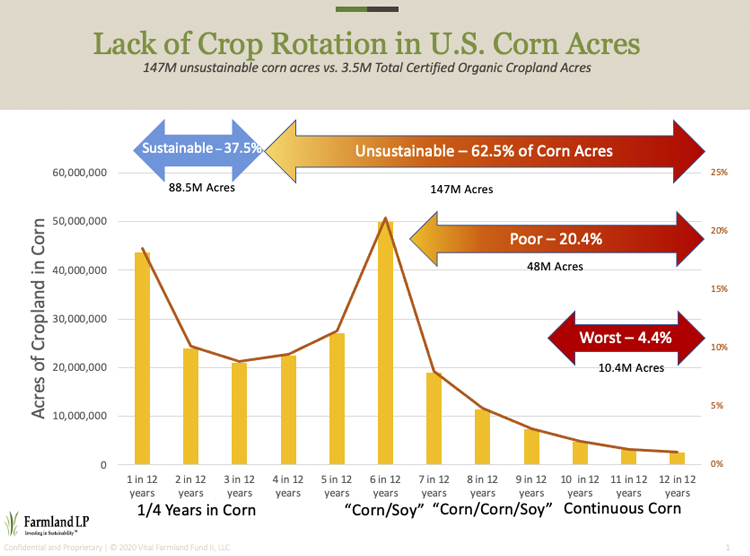
Lack of Crop Rotation in US Corn Acres - Farmland LP

Crop diversity and crop rotation, once the hallmarks of land stewardship and productivity, are vanishing. Only one-third of America’s corn acres are planted sustainably, defined as planted once out of four years. Roughly 62.5 percent of corn acreage rotates only minimally, alternating between soy and corn. And of these, about 10 million acres have practically no crop rotation at all, planting corn in ten or more years of a 12-year period, according to USDA data. That’s a large-scale problem, as those continuous-corn acres comprise three times more than all the organic cropland in the U.S. combined.

What’s even more troubling is that some industry players now want to classify their damaging practices as “sustainable” agriculture. They’re seeking to paper over destructive practices to make their products more appealing to consumers and meet investor demand for ESG accountability. Sadly, greenwashing has come to agriculture, with some trying to put green lipstick on their pig.

Misleading people about “sustainable” agriculture is possible because there are neither legal nor science-based standards for it. The Certified Organic standard, on the other hand, is grounded in Federal Law, managed by the National Organic Standards Board, which is an independent body appointed by the US Department of Agriculture.

Yet even without a formal standard, nearly everyone agrees that certain farming practices are harmful, and clearly not sustainable, such as growing corn year-after-year on the same farmland. This practice is entirely dependent on genetically modified crops and requires increasing amounts of toxic herbicides, pesticides and fertilizers to try to overcome the damage it causes to the soil and ecosystem.


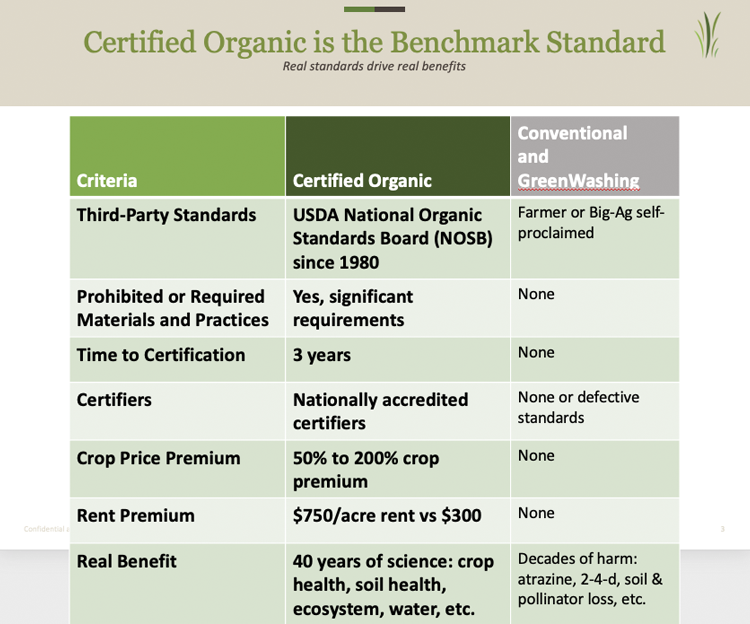
Certified Organic is the Benchmark Standard from Farmland LP

In our view, any self-proclaimed standard for sustainable agriculture should meet a three-part test:

1) Independence. It should have an independent board with full transparency of membership, affiliations and decisions.

2) Materials and Practices. It should identify specific materials and practices that are prohibited, as well as those that are required. For example it would bar the use of chemicals like 2-4-d (Agent Orange) or soil fumigants (nerve gas) and prohibit practices such as continuous corn, or even a corn-soy rotation, which is a below-average practice in the U.S. It should require crop rotation of 3 or 4 crops, or set aside 1-5 percent of land as pollinator habitat or ecosystem reserve, or mandate use of cover crops.

3) Impact and Outcomes. It should produce specific, measurable on-farm changes and outcomes, ideally affecting regional or global goals. Examples might include clean water, improved ecosystem function or habitat improvement, carbon sequestration, or food production (vs producing ethanol as a fuel additive).

The USDA Certified Organic standard meets these criteria today. Its 15-member National Organic Standards Board includes: organic farmers; environmental conservationists; organic processors; a retailer; a consumer representative; a USDA accredited certifying agent; and a scientist with relevant background. Authorized certifiers review documents and inspect fields to ensure farmers and products meet these rigorous standards. And 40 years of published scientific research supports the many benefits of organic agriculture on human health, soil health, and the ecosystem.

Investors and consumers are waking up and beginning to ask tough questions of farm managers. But rather than make changes, some organizations try to claim they have “sustainability standards,” with pretty logos and appealing marketing language, although they permit the worst agricultural practices that we’re all trying to change.

One misleading standard that’s popular with large institutional managers was organized by the firms themselves, including support from giant industrial agriculture companies. There is no independent standards body, there are no restrictions on ag practices, and they don’t change outcomes. It’s like having tobacco companies set health standards. But strong investor demand for (real) sustainable agriculture, combined with no legal restrictions on what they can represent and clever marketing, has grown them to over 2 million acres in about two years – a level it took certified organic land 25 years to reach.

It takes three years for a farm to become Certified Organic. It’s not designed to be an easy, check-the-box process. But the benefits to organic certification are clear and tangible to farmers, in terms of higher crop prices and acreage rents, and to the environment.


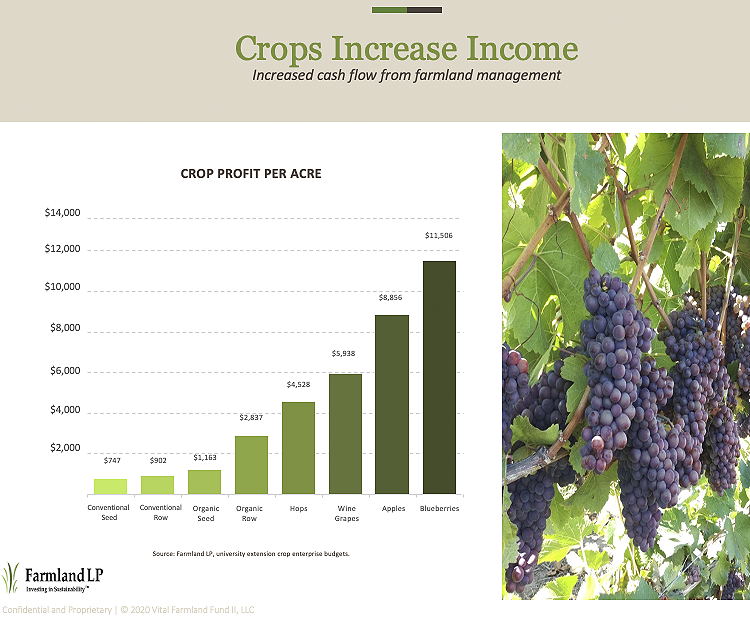
Crops Increase Income from Farmland LP

Our own experience bears this out. We’ve shown that organic farming is both good for the environment and can generate attractive returns. Our first fund had a 69 percent financial gain in net asset value over seven years. As importantly, a two-year USDA-sponsored study on our 4,200 acre California farm shows we also generated a 46 percent net gain for the ecosystem, measured by data-driven metrics including: carbon sequestered in the soil, harmful conventional ag practices avoided, enhanced biodiversity, establishment of healthy pollinator habitats, and improved quality and reduced use of water for crops.

Helping agriculture become more sustainable is a daunting but important challenge, and some aspects are not always clear-cut.  But some assessments are easy to make. Any purported standard that allows the worst-of-the-worst agricultural practices, such as monocropping continuous corn, to certify as sustainable is not legitimate.

We all should support sustainability initiatives that promote independent standards with science-based criteria and verifiable environmental and health benefits. And we all should stand up to greenwashing and self-declared standards. Investors and consumers are demanding real change, and those who mislead should not harvest their support.


Article by Craig Wichner, CEO of Farmland LP, the largest fund manager of organic farmland in the US, with 15,000 acres in Washington, Oregon and Northern California valued at over $200 million.

Read Craig’s June 2021 GM article: Roots & Returns: Craig Wichner Explains Regenerative Agriculture

Featured Articles, Food & Farming, Impact Investing, Sustainable Business

Food and Agriculture: Finding Sustainable Solutions, Old and New

By Mary Beth Gallagher, Domini Impact Investments

Mary Beth Gallagher of Domini Impact Investments.2I recently had the opportunity to sit on a panel on the importance of preserving our forests, alongside the founders of the Lenape Center and other experts. The Lenape are an Indigenous people with historical territory in what is now known as New York, New Jersey, and Pennsylvania. As a New Yorker based at an investment firm in NY, I found their reflections especially affecting. One of the Lenape Center leaders reframed our discourse on the United Nations climate goals and global deforestation risks, putting it in historical context. As land was forcibly taken from Indigenous tribes and our economy grew with roots in extraction and exploitation—of people and our natural resources—society developed systems that are fundamentally unsustainable. Just as the cause of these problems is rooted in 400 years of history, so too are some of the most powerful solutions.

An Unsustainable System

One example of this extractive model is industrial agriculture. Our global food systems have been under increasing pressure, with 2.37 billion people around the world without food or unable to eat a healthy balanced diet, a crisis exacerbated by the pandemic and again by the tragic war in Ukraine.

The predominant agricultural models are generally run by a few major players, whose monoculture crops, use of chemical fertilizers and pesticides, and long supply chains have climate impacts and often contribute to economic hardship for farmers. An estimated 23 percent of global carbon emissions are from agriculture and land use change. Climate change, water scarcity, and the degradation of biodiversity may result in the loss of seeds and arable land.

Frameworks for Change
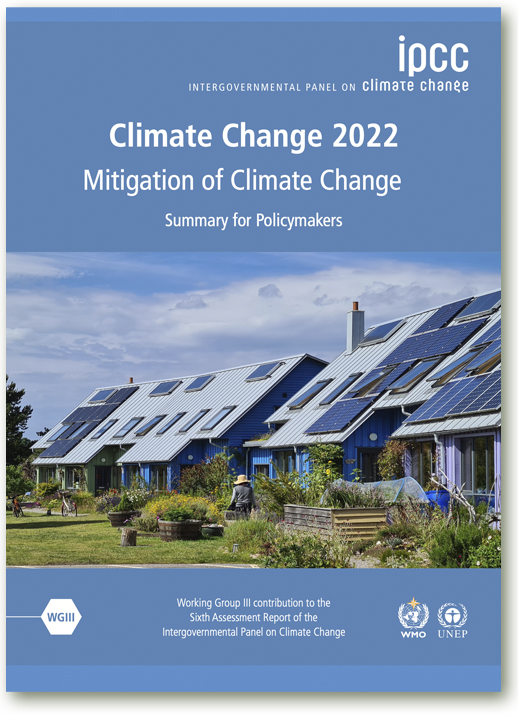
All this amounts to a global environmental crisis. A recent UN Intergovernmental Panel on Climate Change (IPCC) report reinforced this urgency, noting that improved land stewardship and afforestation are among our greatest available tools to mitigate climate change. In October 2021, the UN recognized the right to a clean, healthy and sustainable environment as a human right. This encompasses a right to sustainably produced food free of toxins—and, further, calls for meaningful protections for environmental human rights defenders who have fought to protect their land from exploitation.

There is a powerful alternative model from the Lenape people that can be applied to many of these challenges. Over centuries, the Lenape have protected and stewarded their seeds, and they are now attempting to return seeds to their homeland, Lenapehoking. This is a demonstration of the acknowledgement of their land and cultural seed sovereignty. It is also a poignant embodiment of what regenerative and sustainable agriculture mean in practice.

Drawing Connections at Domini

Regenerative agriculture involves practices that equitably use land to address climate change, biodiversity, soil health, and the well-being of workers and local economies. In 2019, Domini launched its Forest Project, focusing on the systemic importance of forests to environmental systems, businesses, and investments. We recently drew more explicit connections between our forest work and our sustainable agriculture work, recognizing the relevance of our expectations across all. Deforestation and large-scale agriculture plantations result in similar conversion of land, from old growth forests or wild mixed-use purposes, to a single monoculture crop. From a climate perspective, this reduces climate resilience and carbon sequestration benefits. It also erodes soil health and contributes to biodiversity loss. The importance of equity around land rights, food sovereignty, and the rights to self-determination are similarly fundamental.
How We Analyze Companies

At Domini, as an investor in public equities and fixed income portfolios, we look to be additive in addressing key sustainability challenges through our investments and engagements. Specifically for forests, we identify our direct and indirect impacts, encourage a forest positive system, and collaborate with partners and investors to elevate this work. This manifests through the refinement of our industry specific key performance indicators (KPIs) that our research analysts use to evaluate companies for investment. It also informs our expectations of companies that we advance through engagement and leads us to advocate for strong public policy.
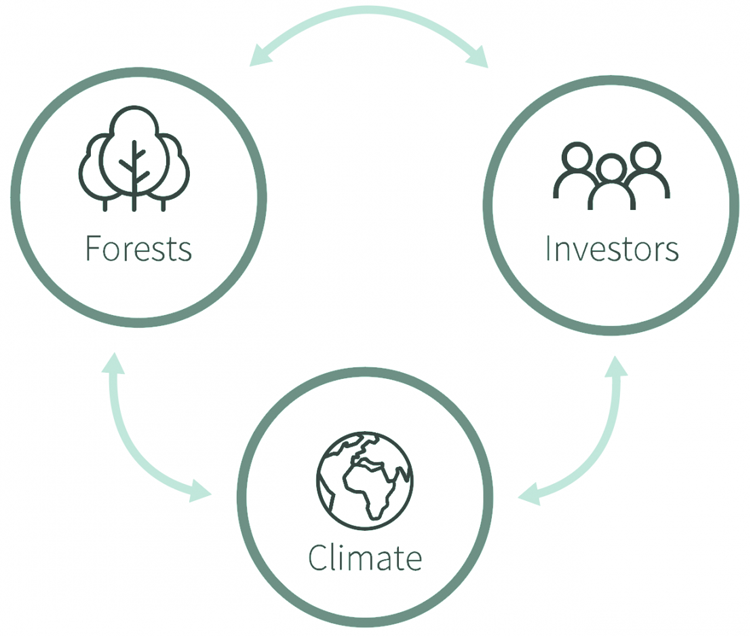
Domini Forest Project triad
At Domini, we are encouraged as more companies recognize the importance of their agricultural inputs and land use in meeting global “net-zero” climate commitments. Many are setting science-based emissions reduction targets, which include their supply chain, often adopting regenerative agriculture commitments.

At this stage, expectations are still emerging, so we are meeting with companies we invest in to better understand the scope of their commitments. For example, we ask about the percentage of their supply chain covered, which regenerative practices are deployed, and how equity and justice are incorporated. Meeting these commitments generally requires actions from suppliers. To understand the depth and quality of companies’ supplier engagement, we ask about how Indigenous and local communities are consulted in designing new models, and the technical assistance and incentives to help farmers adopt regenerative practices. And as this continues to evolve, we’ll encourage companies to be transparent about their methodology and impact measurement. All of these changes should be reflected in companies’ long-term business planning and capital expenditures, including investments in innovation. 

Learning from the past and looking ahead

The scope of Domini’s engagement and investment goes beyond traditional food and beverage companies. We look favorably on innovative new models of agriculture, often investing in companies that advance state-of-the-art technology and use practices that will benefit ecosystem and business outcomes in the long term. For example, we invest in a U.S. farming company that uses non-GMO seeds, integrated pest management, and chemical-free agricultural practices that result in significant reductions in energy and water use. We appreciate the similarity of this new innovative solution with what Indigenous communities have long known and incorporated in their stewardship practices.

Our future calls on us to collectively identify and scale such solutions, while respecting the rights of Indigenous communities, honoring their cultural traditions, and following their lead. The Lenape diaspora and other Indigenous leaders have practices of cultural and ecosystem regeneration unique to their communities and land. We encourage companies to make their business models more resilient and equitable—by building relationships with Indigenous and local communities and learning the unique lessons that they offer.


Article by Mary Beth Gallagher, Director of Engagement at Domini Impact Investments LLC. Ms. Gallagher, an attorney and former Executive Director of a non-profit organization representing institutional investors, has been advancing social justice and human rights issues for most of her professional career.

Ms. Gallagher is responsible for leading Domini’s engagement efforts with portfolio companies, broader stakeholder groups and policy makers, as well as developing initiatives and campaigns in areas such as worker’s rights in the supply chain, climate change mitigation, deforestation, health, and racial justice. In Domini’s work to advance ecological sustainability, Ms. Gallagher encourages companies to adopt policies and practices that advance the low-carbon transition, also in alignment with the needs of workers and community stakeholders. Forests are an important aspect of the discussion on climate resilience. Domini’s forest project is committed to understanding the drivers of forest destruction, biodiversity loss, and the impacts on the rights of Indigenous peoples, and addressing this through our investment decisions, and engagement efforts, to further forest value creators.

Prior to joining Domini in 2021, she was the Executive Director of the non-profit organization Investor Advocates for Social Justice. In this role, she represented institutional investors in stewardship and shareholder advocacy with corporations to encourage more disclosure and responsible business practices to advance systemic change. Ms. Gallagher holds a B.S. in environmental science from Boston College and a J.D. from the Washington College of Law at American University. She is a Member of the New York Bar, admitted in 2009. She was a Peace Corps Volunteer in Benin, West Africa.

Disclosures:

Before investing, consider each Fund’s investment objectives, risks, charges and expenses. Contact us at 1.800.225.3863 for a prospectus containing this and other important information. Read it carefully.

An investment in the Domini Funds is not a bank deposit, is not insured, and is subject to certain risks, including loss of principal. The market value of Fund investments will fluctuate. You may lose money. The Domini Impact Equity Fund is subject to certain risks including impact investing, portfolio management, information, market, recent events, and mid- to large cap companies risks. The Domini International Opportunities Fund is subject to certain risks including foreign investing, geographic focus, country, currency, impact investing, and portfolio management risks. The Domini Sustainable Solutions Fund is subject to certain risks including sustainable investing, portfolio management, information, market, recent events, mid- to large-cap companies and small-cap companies risks. The Domini Impact International Equity Fund is subject to certain risks including foreign investing, emerging markets, geographic focus, country, currency, impact investing, and portfolio management risks. Investing internationally involves special risks, such as currency fluctuations, social and economic instability, differing securities regulations and accounting standards, limited public information, possible changes in taxation, and periods of illiquidity. These risks may be heightened in connection with investments in emerging market countries. The Domini Impact Bond Fund is subject to certain risks including impact investing, portfolio management, style, information, market, recent events, interest rate and credit risks.

The Adviser’s evaluation of environmental and social factors in its investment selections and the timing of the Subadviser’s implementation of the Adviser’s investment selections will affect the Fund’s exposure to certain issuers, industries, sectors, regions, and countries and may impact the relative financial performance of the Fund depending on whether such investments are in or out of favor. The value of your investment may decrease if the Adviser’s or Subadviser’s judgement about Fund investments does not produce the desired results. There is a risk that information used by the Adviser to evaluate environmental and social factors, may not be readily available or complete, which could negatively impact the Adviser’s ability to evaluate such factors and Fund performance.

The Domini Funds are only offered for sale in the United States. DSIL Investment Services LLC (DSILD) distributor, Member FINRA. Domini Impact Investments LLC is the Funds’ Adviser. The Funds are subadvised by unafilliated entities. 5/22

Featured Articles, Food & Farming, Impact Investing, Sustainable Business

Why Slow Money?

By Woody Tasch, Slow Money

Some Thoughts on Fiduciary Responsibility, Mutually Assured Destruction and Small, Diversified Organic Farms

Woody Tasch Slow Money(Above photo: 0% loan recipients Blain Snipstal and Samaria King of Juniper’s Gardens (Brandywine, MD)
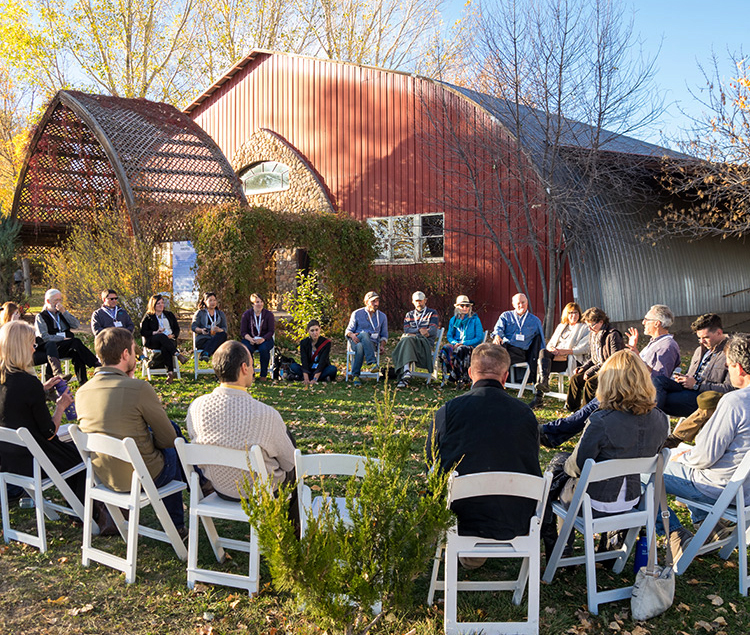
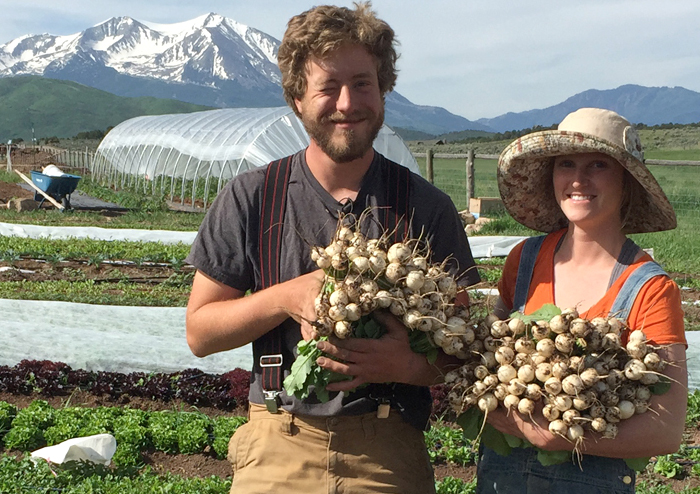
Since the slow money movement’s first low interest loan to a local organic farm in 2010, more than $80 million has flowed to over 800 small farms and local food businesses, via volunteer-led groups in a few dozen communities. Events of the last few years have emphatically accentuated our shared concerns.

The pandemic heightened appreciation of community supported agriculture and local food systems. COP26, Greta Thunberg and wildfires highlighted the urgency of climate change. Another kind of wildfire—that of populism—erupted in ways that were surprising to those who assumed that neoliberal democracy was ascendant and secure. And, today, Mutually Assured Destruction, that Dr. Strangelove-esque doctrine of nuclear deterrence, is brought to our breakfast tables and into our hearts and minds by the war in Ukraine.

The connection of war to issues of food and farming goes far deeper, has far deeper historical and systemic roots, than the current disruption of Ukrainian wheat and sunflower exports. We are talking, here, of the 10,000-year agriculture-enabled process of urbanization that turned the Fertile Crescent into the Oil Patch, taking us from the nomadism of hunter-gathering to the nomadism of cyberspace.

Oxymoronically, agriculture, as it became subsumed by and central to industrialization and globalization, passed—as if Passing Go on a Monopoly board—the culture of Taking Care of The Places Where We Live and proceeded straight to Big Box Stores And The Realm of Cheap Shelf-Stable Calories.

The Green Revolution and industrial agricultural systems are dedicated to increasing production via large-scale agricultural operations and global supply chains, in order to feed the growing world population. Since the mid-20th century, they’ve been doing this to a T, powered by synthetic fertilizers, herbicides, pesticides, GMOs and other food and farming technologies. As the threshold of the new millennium arrived, something called “the food movement” emerged. Consumers in developed countries woke up to what was being degraded, ecologically and culturally, by the advent of highly-processed food. Community supported agriculture and farmers’ markets expanded. In 1989, Carlo Petrini famously pronounced when McDonald’s opened in Rome, “We don’t want fast food. We want slow food.” Slow food became a movement, linking hundreds of thousands of consumers, producers, chefs and food activists in many scores of countries, in support of indigenous food culture and biodiversity. Then, slow money came on the scene to address the investing side of things.

If we want to preserve and restore small, diversified organic farms, we are going to fund them not only as consumers, but as investors. Which is going to require new ways—slow, small and local ways—for capital to flow across the boundaries of investing and philanthropy.

Over the past few years, some of us have begun accomplishing this via SOIL groups, with SOIL standing for Slow Opportunities for Investing Locally. We’re pooling local charitable donations and then making 0% loans to organic farms and food businesses, by majority vote of member donors—one person, one vote, no matter the size of the member’s donation. When loans get paid back, the money recirculates as future loans. Today there are five groups (four in Colorado and one in Virginia), with two in formation (one in Montana and one in Israel). They’ve loaned almost $2 million to more than 60 farms.

Slow Money - Soil Boulder meeting at Lone Hawk Farm-Longmont CO
SOIL Boulder meeting at Lone Hawk Farm, (Longmont, CO)

Recently, we’ve launched beetcoin.org as a platform for small donors across the land to participate in this process, too, building a grassroots source of capital for use as matching grants to SOIL groups. We are aiming for widespread replication of local 0% loan groups in the coming decade, fixing things from the ground up in ways that industrial food systems and industrial financial systems cannot.

Bombs come from above, as do edicts from the Great Fiduciary in the Sky.

The latter are not designed to kill, of course. Fiduciary processes are designed to increase efficient capital flows, in pursuit of higher living standards. However, there is such a thing as too much efficiency. At some point, the pursuit of efficiency comes at irredeemable costs to diversity. Biodiversity. Cultural diversity. Economic diversity. We begin to think that diversification, upon which investment strategies depend, is more important than diversity, upon which living systems depend.

Two Roots Farm Emma Colorado - Slow Money
Two Roots Farm received a 0% loan, (Emma, CO)

Efficiency is not exactly at war with Diversity. Or is he? Efficiency does sometimes seem hell-bent, as if he were a kind of Greek god, to vanquish Diversity, who might become, were the Fates to smile, his better half. The whole world, the future of our species and so many others, depends on the outcome of their relationship.

Mutually Assured Destruction as a geopolitical doctrine is almost mythic in its cultural implications. Perhaps what is being destroyed is our very capacity for myth, for elevated storytelling, part of which, in the 21st century, must include a new economic narrative. Mutually Assured Destruction is not a terribly satisfying system for keeping the peace and it is an awfully sad expression of our increasingly desperate need, in these times of multiple crises, for greater mutuality.

Hence the need for those of us of a certain persuasion to get together directly, locally, personally, informally. Yes, we are funding small diversified local farms and local food systems. We can track the number of farms, the amount of food produced, nutrient density, price, the amount of carbon sequestered. We can develop new metrics. But at a level that is both deeper and simpler, we are finding new ways to reconnect to one another, to the places where we live and to the land.  In the name of health and peace.

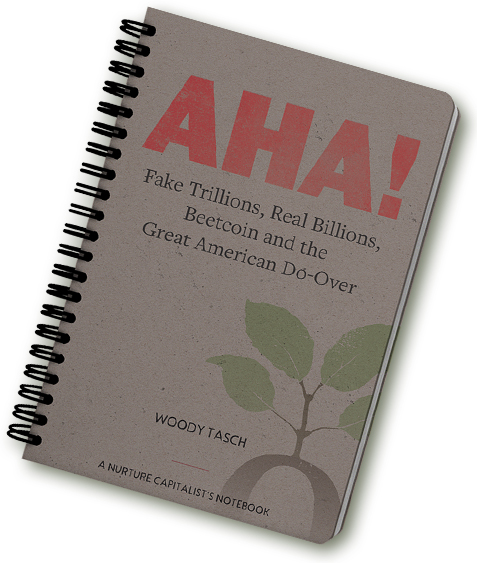
Aha Fake Trillions by Woody Tasch

Article by Woody Tasch is founder of the Slow Money Institute and author of AHA!: Fake Trillions, Real Billions, Beetcoin and the Great American Do-Over (Slow Money Institute, 2021)

Featured Articles, Food & Farming, Impact Investing, Sustainable Business

Climate Finance Campaigner Wrangles Europe’s Giant Banks and Companies

By Blair Palese, Climate and Capital Media

Lucie Pinson talks about how to win the big fights.


Climate and Capital Media Featured NewsI’ve been long overdue for a Beers with Blair conversation in the new year. Who better to talk to than the highly energetic, award-winning climate finance campaigner Lucie Pinson, CEO of Reclaim Finance. We spoke remotely, her in Paris, me in Sydney, and the discussion ranged from her work journey to some of her incredible successes over the years in getting banks and companies to move — and move more effectively — on climate change.

Lucie founded France-based Reclaim Finance in 2020, which she has headed up ever since. That same year, she was one of the six winners of the Goldman Environmental Prize — the Nobel Prize, if you will, for environmental activists. Her many successes include leading campaigns that saw 16 French banks end investment in coal and 15 of the world’s biggest insurers and reinsurers stop supporting new coal mines and plants.

I asked Lucie to share the secret for getting results from business sectors not known for moving quickly on anything that doesn’t generate profit.

“I try to identify the biggest fights where I can have the biggest impact.” Then she focuses on four priorities:

“Being strategic, using each campaign to become stronger and ensuring your work helps the broader movement … And being very well connected.”

Blair:  So, is it hard to be taken seriously by the banking and insurance sectors and what motivates them to take action?

Lucie: “Just a few years ago it was hard,” she said. “Most had the idea that to work in finance, you needed to be a man and wear a suit and to talk only about economics and finance,” she said. “That started to change about a year ago. We’ve seen people everywhere become quite scared of the gravity of the climate crisis.”

Blaire:  OK, but has that translated into more action? Is it real or just business as usual?

Lucie:  “Most companies are doing what they need to do to protect themselves,” she said. “But we are still looking for big examples of companies and banks taking real action.”

AXA IM, which manages more than €869 billion ($994 billion) in assets, she said, recently announced new climate commitments, including moving “toward” divesting from high impact companies and bolstering investment in climate solutions.

Sounds like progress, but it’s easier said than done.

“We had hopes that AXA was going to be a real leader last year. Before COP26 they were well-positioned to do it,” she said. “They were one of the first to announce plans to move out of coal in 2015, but they lost their ambition.”

Rather than announce solid initiatives, the company continued to commit only to stop the financing of fossil fuels “at some point.”

Not exactly the kind of leadership one expects from the leader of the Net Zero Asset Owners Alliance.

Blair:  So, are efforts like the Net Zero Asset Owners Alliance and the Glasgow Financial Alliance for Net Zero (GFANZ) coming out of COP26 helpful or not?  

Lucie:  “These things have no enforcement mechanism, no way to kick out those that are greenwashing,” she said.

I can’t resist asking Lucie what she thought of the recent BlackRock letter by CEO Larry Fink that focused on stakeholder capitalism and climate change.

“BlackRock … it’s a joke. The company has done nothing real in the last two years,” she said. “They made a 2020 commitment that we thought might be the beginning of something. Nothing happened. Their voting record is full of holes. They continue to advocate for gas, ignoring the IEA mandate. They continue to support hundreds of new gas plants locking in decades of fossil fuels. Vanguard and State Street are the same.”  

Blair:  Any good companies?

Lucie:  “Unfortunately at the moment, it’s a short list,” she said. “Allianz has been a driver of climate change action. When Oliver Bäte became CEO three years ago, he said we must lead the charge against climate change, but the company hasn’t cleaned up its investments. BNP Paribas had a great position in 2017 on oil and gas but has now tripled down on its financing of oil and gas.”

Given how slowly corporate climate action is moving, I ask Lucie how she and her team keep the pressure on and how they keep the dialogue going.

“We let financial institutions know if we are going to target them, let them see our reports before we release them so that they can fact check them and respond, make sure there are no mistakes. We want to make sure the debate is about the right issues, the big issues.”


Article by Blair Palese, a writer and project manager on a wide range of climate change projects. In 2009, she cofounded 350.org Australia and was its CEO for 10 years. Previously, she was a communications director for Greenpeace International and Greenpeace USA, head of international public relations for the Body Shop, editor-in-chief of Greenpages magazine, and worked at Washington Monthly and ABC.

Additional Articles, Energy & Climate, Impact Investing, Sustainable Business

Plant-based Innovation & Climate ETF from VegTech Launches on NYSE

VegTech™ Plant-based Innovation & Climate ETF (Ticker: EATV), a global ETF of publicly-traded plant-based innovation companies, recently launched on the New York Stock Exchange (NYSE).

The first financial product from the VegTech™ Invest advisory, the VegTech™ ETF (Ticker EATV), includes 37 publicly traded companies actively innovating with plants and plant-derived ingredients and producing primary products that are animal-free. VegTech Invest advisors, Elysabeth Alfano and Sasha Goodman, believe these companies positively impact climate change as well as solve some of the world’s most pressing problems such as food security, deforestation, animal cruelty and growing public health concerns.

VegTech: A Pure-Play in Plant-Based Innovation

“We are excited to be what we believe is the first pure-play ETF that invests in companies innovating with plants and producing animal free products. We believe that today’s investors want a more resource efficient, climate friendly, and cruelty-free food and materials supply system…and want to invest their dollars in the same,” says VegTech Invest CEO and CMO, Elysabeth Alfano. “My partner Sasha Goodman and I are excited to offer an ETF that empowers the average person to invest with their values and participate in this large-scale, secular trend.”

“With this ETF, I am excited to drive capital to plant-based innovation companies. I also hope to encourage public companies to lead the way and replace animal products with innovations that are better for people, the planet and the animals,” VegTech Invest President and Fund Manager, Sasha Goodman says.

The Big Shift: A Secular Trend for Health & Sustainability

According to a June 29, 2020, study by Aramark, 65% of Gen Zers want a more “plant-forward” diet, while 79% would eat meatless meals once or twice a week, either now or in the future. Further, First Insight: The State of Consumer Spending noted on October 28, 2021, that “growing plants requires fewer resources than raising animals for meat,” and reported that 68% of Millennials are willing to pay more for sustainable products.

A March 23, 2021, report by Boston Consulting Group indicates that the alternative protein market will reach at least $290B by 2035. Indeed, Covid-19 has provided an unexpected boost to the alternative protein industry, which is expected to grow at a compound annual growth rate (CAGR) of 11.2% from 2020 to 2027, according to an April 2021 report from Meticulous Research. That report also noted that an alternative protein-based diet can help reduce the effects of the novel corona virus on at-risk people as there is the presence of an abundance of macronutrients, micronutrients, and antioxidants.


About VegTech™ Invest

VegTech Invest™ is an investment management firm advising the thematic ETF, EATV. EATV invests in VegTech™ Companies: those that are actively innovating with plants and plant-derived ingredients and producing primary products that are animal-free.

At VegTech™ Invest, we believe these companies positively impact planetary health, human health, and animal health. We also believe that we are on the cusp of a long-term, secular trend of plant-based innovation that will result in the disruption of the global food and materials supply chain for a more efficient, climate friendly and cruelty-free system. The VegTech™ ETF is dedicated to providing exposure to this key and growing trend. 

For information on the ETF, including the prospectus, visit our website.

Exchange Traded Funds (ETF) are bought and sold through exchange trading at market price (not NAV) and are not individually redeemed from the fund. Shares may trade at a premium or discount to their NAV in the secondary market. Brokerage commissions will reduce returns.

The fund’s investment objectives, risks, charges and expenses must be considered carefully before investing. The prospectus and summary prospectus (if available) contains this and other important information about the investment company, and it may be obtained by calling 1-424-237-8393, emailing info@vegtechinvest.com or visiting EATV.VegTechInvest.com. Read it carefully before investing.


The compound annual growth rate (CAGR) is the rate of return (RoR) that would be required for an investment to grow from its beginning balance to its ending balance, assuming the profits were reinvested at the end of each period of the investment’s life span.

Investing involves risk including the possible loss of principal. Past performance does not guarantee future results.

The fund is an actively managed ETF that does not seek to replicate the performance of a specified index. Foreign securities may be more volatile and less liquid than domestic (U.S.) securities, which could affect the Fund’s investments. Stocks of companies with small and mid-market capitalizations involve a higher degree of risk than investments in the broad-based equities market.

The fund is non-diversified and may hold large positions in a small number of securities. A price change in any one of those securities may have a greater impact on the fund’s share price than if it were diversified. The Fund is newly organized and has a limited operating history to judge.

ETF distributed by Quasar Distributors, LLC

Additional Articles, Energy & Climate, Food & Farming, Impact Investing, Sustainable Business

ImpactAssets releases its 2022 Impact Investment Fund Managers List

Industry’s first publicly available, searchable resource of impact investing fund managers zeroes in on some of the industry’s most impactful managers.

ImpactAssets recently released the ImpactAssets 50 2022 (IA 50), a free annual database for impact investors, family offices, corporate and family foundations and institutional investors that features a diversified listing of private capital fund managers delivering social and environmental impact as well as financial returns.

This year marks the eleventh edition of the IA 50, which now includes the IA 50 Emerging Impact Managers list and IA 50 Emeritus Impact Managers list. Across all three categories, 143 impact fund managers reported assets totaling $116.96 billion invested in a range of asset classes and impact themes. Fifteen managers selected in this year’s showcase reported assets exceeding $1 billion. An additional ten had assets under management between $500 million and $1 billion.

“We’re excited about this year’s IA 50, with its dramatic expansion and diversification of impact fund managers across a spectrum of strategies, geographies and investment targets,” said Jed Emerson, ImpactAssets Senior Fellow, IA 50 Review Committee Chair and Global Lead, Impact Investing with Tiedemann Advisors. “This group of managers reflects the intentionality of our manager selection process to provide investors with a resource that shines a light on the breadth and diversity of impact fund managers. These managers bring unique and informed perspectives to the challenges impact investing is addressing.”

Some Highlights from this year’s IA 50:

Impact Focus – About 18% of IA 50 managers across all three lists focused on clean technology, alternative energy and climate change, making it the top impact theme. Microfinance, low-income financial services, and micro-insurance (16%) comprised the second-largest impact focus. Notably, 12% of funds selected Diversity, Equity, and Inclusion as their primary investment theme. The most represented Sustainable Development Goals cited by fund managers included Decent Work and Economic Growth (21%), No Poverty (15%), Reduced Inequality (13%) and Climate Action (9%).

Diversity and Inclusion – While asset management as a whole remains overwhelmingly non-diverse—with approximately 2% of asset managers who are Black, Indigenous or People of Color — IA 50 fund managers are leading with diversity. This is most prevalent among IA 50 Emerging Impact Managers, where 50% reported that 50% or more of their investment professionals were people of color. In addition, 60% reported more than half of their investment professionals were women.

Asset Class – IA 50 fund managers drive their focus on deep impact chiefly in private markets. Managers reported that 55% of their funds are primarily private equity, while 36% are primarily private debt. Private Equity – Early Stage (US), with 22% of all funds, is the most represented focus of managers.

Impact and Financial Return – Although impact investing can offer a range of returns—from concessionary to above-market rates of return—IA 50 managers reported delivering both positive impact and competitive investment performance. A total of 74% of IA 50 managers target market rates or above market rates of return, and 97% reported delivering either in line or above their initial target returns. Emerging Impact Managers reported similar results, with 76% of managers targeting market rates or above market rates of return and 72% delivering either in line or above their initial target returns.

In addition, 25 of the IA 50 fund managers are signatories to the Operating Principles for Impact Management—a framework for investors to ensure that impact considerations are purposefully integrated throughout the investment life cycle—and 18 of the 25 have been verified to date, according to a separate analysis by BlueMark, a provider of independent impact verification services for investors and companies.

“The caliber of this year’s IA 50 lists is a product of the rigorous application scoring and analysis process that the IA 50 Review Committee has fine-tuned through the years,” added Sandra Kartt, CFA, Managing Director, Investments, ImpactAssets. “We’re thrilled to foster the continuing growth of these unique, innovative investing approaches addressing critical issues from climate to racial equity and gender equality.”

In addition to Emerson, the IA 50 Review Committee is comprised of impact investment experts and leaders, including Lauren Booker Allen, Senior Vice President, Impact Advisory, Jordan Park Group; Mark Berryman, Managing Director of Impact Investing, The CAPROCK Group; Ronald A. Homer, Chief Strategist, Impact Investing, RBC Global Asset Management (US) Inc.; Jennifer Kenning, Senior Advisor, IA 50 Review Committee and CEO & Co-Founder, Align Impact; Karl “Charly” Kleissner, Ph.D., Co-Founder of Toniic and KL Felicitas Foundation; Justina Lai, Chief Impact Officer and Shareholder, Wetherby Asset Management; Andrew Lee, Managing Director, Global Head of Sustainable and Impact Investing, UBS Global Wealth Management; Tony Lent, Co-Founder, Capital for Climate; Malaika Maphalala, CPWA® Private Wealth Advisor, Natural Investments, LLC; Cynthia Muller, Director of Mission Investment, W.K. Kellogg Foundation; Rehana Nathoo, Founder & CEO, Spectrum Impact; Stephanie Cohn Rupp, CEO and Partner, Veris Wealth Partners; Liesel Pritzker Simmons, Co-Founder and Principal of Blue Haven Initiative; and Margret Trilli, CEO and CIO, ImpactAssets.

The ImpactAssets Investment team led by Kartt conducted the application scoring and analysis process, and collaborated with Align Impact on fund analysis.


About the ImpactAssets 50 

The IA 50 is the first publicly available database that provides a gateway into the world of impact investing for investors and their financial advisors, offering an easy way to identify experienced impact investment firms and explore the landscape of potential investment options. The IA 50 is intended to illustrate the breadth of impact investment fund managers operating today, though it is not a comprehensive list. Firms have been selected to demonstrate a wide range of impact investing activities across geographies, sectors and asset classes.

The IA 50 is not an index or investable platform and does not constitute an offering or recommend specific products. It is not a replacement for due diligence. To be considered for the IA 50 2022, fund managers needed to have at least $25 million in assets under management, more than three years of experience as a firm with impact investing, documented social and/or environmental impact and be available for US investment. Additional details on the selection process are available here.

The IA 50 Emerging Impact Managers list is intended to spotlight newer fund managers to watch that demonstrate potential to create meaningful impact. Criteria such as minimum track record or minimum assets under management may not beapplicable.

The IA 50 Emeritus Impact Managers list illuminates impact fund managers who have achieved consistent recognition on the IA 50.

About ImpactAssets

ImpactAssets is an impact investing trailblazer, dedicated to changing the trajectory of our planet’s future and improving the lives of all people. As a leading impact investing firm, we offer deep strategic expertise to help our clients define and execute on their impact goals. Founded in 2010, ImpactAssets increases flows of money to impact investing in partnership with our clients through our impact investment platform and field-building initiatives, including the IA 50 database of private debt and equity impact fund managers. ImpactAssets has more than $2 billion in assets in 1,700 donor advised fund accounts, working with purpose-driven individuals and their wealth managers, family offices, foundations, and corporations. ImpactAssets is an independent 501(c)(3) organization.

Additional Articles, Energy & Climate, Food & Farming, Impact Investing, Sustainable Business

Domini Funds Releases their 2021 Impact Report

The Report Highlights a Just Transition, Corporate Emissions, and Access to Affordable Housing

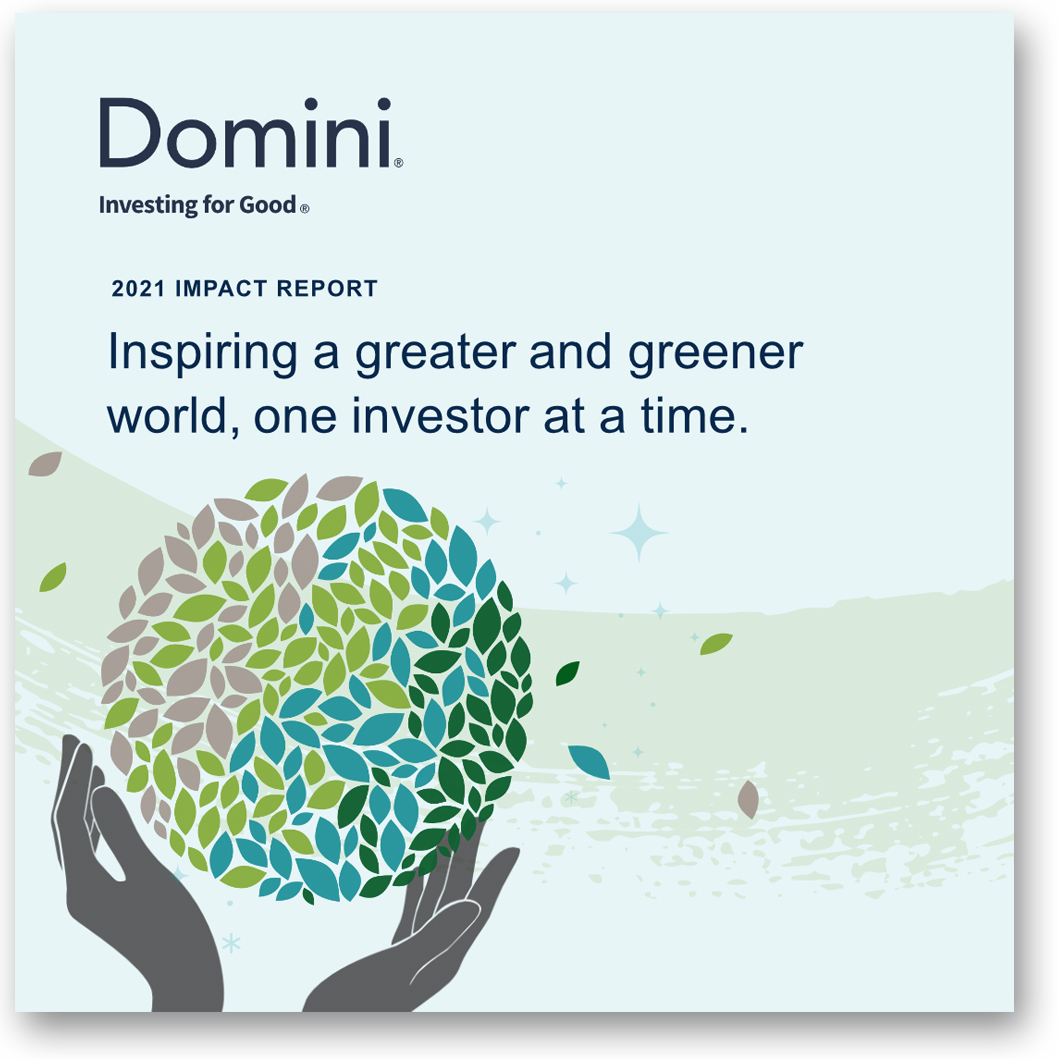
Domini Fund 2021 Impact Report coverProgress stems from the connections we make — between our money, our values, and an array of social and environmental issues. In 2021, assets in the five Domini Funds reached over $3 billion. For Domini, this growth has gone hand-in-hand with new efforts to understand critical global challenges and look closely at how companies are responding.

The Domini Funds’ new report underscores how the legacy of our impact investment standards, in-house research, and investor community helped to address some of 2021’s most pressing issues—the climate crisis, cyberwarfare threats, and a number of other sustainability priorities.

“Our future holds hope to be greater and greener as investors come together with a mutual care for people, planet and profit,” says CEO Carole Laible. “We use our environmental and social investment standards to help us identify strong, long-term investments. We apply these standards consistently across all of our products as we believe it is how all investing should be done.”

Report Highlights:

Reducing carbon intensity

The Domini Impact Equity Fund’s portfolio was 61% less carbon intensive than its benchmark in 2021.

  • The fund has lowered its carbon intensity vs. the S&P 500 over the past two years. In 2019, it was 55% less carbon intensive than its benchmark.

Enhanced corporate climate analysis

Domini analyzes how companies’ business models are positioned for an environment that limits global temperature rise to 1.5 degrees.

  • As a result, the firm strengthened its approach to corporate climate change policies and practices to better assess companies’ climate action targets.

New cybersecurity considerations

  • Cyberwarfare can target hospitals, critical infrastructure, and high-risk weapons facilities.
  • Domini views it as a potential weapon of mass destruction and has updated its Impact Investment Standards accordingly. The firm excludes from its investment universe the sovereign debt of countries most extensively involved in cyberwarfare.

Advocacy for a just transition

Emissions targets are just one component of an adequate and inclusive climate response.

  • Domini encourages companies to design climate transition plans that meet the needs of workers and support the most vulnerable communities.

Helping expand access for all

Providing affordable access to basic services and resources without discrimination helps communities thrive.

  • The Domini Funds, particularly the Domini Impact Bond, help channel capital to support the foundational needs of communities—such as healthcare, education, and infrastructure. The fund holds bonds of several issuers that work to improve access to affordable housing, financial services, and other basic services.

Direct dialogue with companies

Investors have a powerful voice. Direct dialogue, collaboration, and partnerships play a crucial role in improving corporate governance and encouraging stronger policies.

  • Domini—on its own and in collaboration with other investors—engaged 365 companies (53% U.S.-based, 47% international) on areas such as board diversity (race and gender), vaccine access, workers’ rights, and supply chain transparency.
  • Domini joined global institutional investors on the Pandemic Resilience 50 in engagements across real estate, international drug stores and pharmacy chains, technology companies, and transportation, encouraging companies to share board accountability for human capital management and workers’ well-being.

To find out more about these initiatives and highlights, read our full report:  www.domini.com/2021Impact


About Domini Impact Investments LLC:
Domini Impact Investments LLC is a women-led SEC registered investment adviser that harnesses the power of finance to help create a better world. With an exclusive focus on impact investing that aims to help create positive outcomes for our planet and its people while seeking competitive financial returns, our continuous innovation and caring, diverse community fuel tomorrow’s prosperity as we endeavor to make “investing for good” the way all investing is done.

Before investing, consider each Fund’s investment objectives, risks, charges and expenses. Contact us at 1.800.225.3863 for a prospectus containing this and other important information. Read it carefully.

The Domini Funds are not bank deposits and are not insured. Investing involves risk, including possible loss of principal. The market value of Fund investments will fluctuate. The Domini Impact Equity Fund is subject to certain risks including impact investing, portfolio management, information, market, recent events, and mid- to large-cap companies’ risks. The Domini International Opportunities Fund is subject to certain risks including foreign investing, geographic focus, country, currency, impact investing, and portfolio management risks. The Domini Sustainable Solutions Fund is subject to certain risks including sustainable investing, portfolio management, information, market, recent events, mid- to large-cap companies and small-cap companies’ risks. The Domini Impact International Equity Fund is subject to certain risks including foreign investing, emerging markets, geographic focus, country, currency, impact investing, and portfolio management risks. Investing internationally involves special risks, such as currency fluctuations, social and economic instability, differing securities regulations and accounting standards, limited public information, possible changes in taxation, and periods of illiquidity. These risks may be heightened in connection with investments in emerging market countries. The Domini Impact Bond Fund is subject to certain risks including impact investing, portfolio management, style, information, market, recent events, interest rate and credit risks.

The Adviser’s evaluation of environmental and social factors in its investment selections and the timing of the Subadviser’s implementation of the Adviser’s investment selections will affect the Fund’s exposure to certain issuers, industries, sectors, regions, and countries and may impact the relative financial performance of the Fund depending on whether such investments are in or out of favor. The value of your investment may decrease if the Adviser’s or Subadviser’s judgement about Fund investments does not produce the desired results. There is a risk that information used by the Adviser to evaluate environmental and social factors, may not be readily available or complete, which could negatively impact the Adviser’s ability to evaluate such factors and Fund performance.

The Standard & Poor’s 500 Index (S&P 500) is a market-capitalization weighted index representing the performance of large-capitalization companies in the U.S. Investors cannot invest directly in the S&P 500. The S&P 500 Index is a product of S&P Dow Jones Indices LLC (“SPDJI”) and has been licensed for use by Domini. Standard & Poor’s® and S&P® are registered trademarks of Standard & Poor’s Financial Services LLC (“S&P”); Dow Jones® is a registered trademark of Dow Jones Trademark Holdings LLC (“Dow Jones”); S&P® and S&P 500® are trademarks of S&P; and these trademarks have been licensed for use by SPDJI and sublicensed for certain purposes by Domini. Domini product(s) are not sponsored, endorsed, sold or promoted by SPDJI, Dow Jones, S&P, or their respective affiliates and none of such parties make any representation regarding the advisability of investing in such product(s) nor do they have any liability for any errors, omissions, or interruptions of the index.

The Domini Funds are only offered for sale in the United States. DSIL Investment Services LLC, Distributor, Member FINRA. Domini Impact Investments LLC is the Funds’ Adviser. The Funds are subadvised by unafilliated entities. 3/22

Additional Articles, Energy & Climate, Impact Investing, Sustainable Business

Signup to receive GreenMoney's monthly eJournal

Privacy Policy
Copyright © GreenMoney Journal 2025

Website design & development by BrandNature

Global Events Calendar

View All Events

april

21aprAll Day232026 Sustainable Packaging Coalition: SPC Impact – Nashville

27aprAll Day30Women Deliver 2026 Conference (WD2026) – Melbourne

X