Tag: Impact Investing

Despite a Tough Year, Women are Still the Future of Sustainable Investing

By Leah Cantor, Longview Asset Management

Above image – ©metamorworks, istockphoto
Leah Cantor Longview Asset MgmtAs a woman who is passionate about gender equity and fighting climate change, the last year has been a roller coaster. Russia’s invasion of Ukraine and the resulting energy crisis in Europe has led to a renewed global emphasis on oil and gas production, and despite the billions of dollars allocated to renewable energy infrastructure in the Inflation Reduction Act passed by congress in August, the transition to a carbon neutral economy seems further out of reach than it did just a year ago. In my opinion, the reversal of Roe v. Wade set women in the United States back decades, and around the world, progress towards equal rights for women has slowed.

As an investor who cares about the social and environmental impacts of my financial decisions and as an employee at LongView Asset Management – an advisory firm that helps clients align their investments with their values – I’ve felt the anxiety of watching the market slide into its worst year since the financial crisis of 2008. ESG investments underperformed the broader market due to many sustainable funds’ heavy reliance on technology stocks and exclusion of fossil fuel stocks, which have soared in value as the world scrambles to secure near-term energy resources.

Over the last year, sustainable investing also weathered attacks from all sides of the ideological spectrum, with environmentalists calling out the financial industry for greenwashing, while right-wing politicians in a growing number of states denounce ESG investing as “woke capitalism” and pursue legislation aimed at boycotting financial institutions accused of undermining the fossil fuel industry.

Despite all the chaos, I feel strongly that now is a critical moment for women to take control of their finances and the direction of ESG investing.

I entered the field after working as an environmental journalist, where I saw how much of a difference it makes to local communities and ecosystems when a company cleans up its act. I decided to pursue a career where I can help make this the norm. LongView is a certified B Corp, which means we’ve made a legally binding commitment to consider people and the planet in addition to profit, and we’ve gone through an exhaustive assessment to prove that our policies and practices are in line with our mission as a sustainable investment firm. The majority of our clients are women, and I know first-hand that women are eager to use their money to drive positive change.

Women are at the forefront of the movement towards a new kind of capitalism – one where companies don’t simply focus on maximizing profits for shareholders, but consider their impacts on all stakeholders, including the environment, their workers, and the communities in which they operate.

This interest is reflected in the workplace and in the way we invest.

Companies where women hold top leadership roles tend to meet higher environmental, social, and governance standards than their industry peers.

When it comes to investing, women have helped fuel the explosion of ESG into the mainstream. In one recent report, 79 percent of women said they want their investments to reflect their values. Another survey found that women are almost twice as likely as men to say it is extremely important that the companies they invest in incorporate environmental, social and governance factors into decisions and policies.

Women have historically been underinvested compared to men, however interest in investing among women has risen by 50 percent since the start of the pandemic.

With women expected to gain control over much of the $30 trillion in baby-boomer wealth over the next decade, the growth potential for the ESG industry is huge.

Given these trends, it’s unlikely that sustainable investing will be a passing fad. Still, the industry is facing some serious growing pains.

While federal and foreign regulators try to pass new rules to raise reporting standards, right-wing lawmakers have thrown sustainable investing into the fray of America’s culture wars.

In the last year, Republican state treasurers collectively pulled more than $1 billion from Blackrock – the world’s largest investment company – and blacklisted other major financial institutions including JP Morgan, Chase and Goldman Sachs due to company policies that allegedly harm the fossil fuel industry.

In 2021, Texas became the first state to pass laws that stop local agencies from doing business with banks that offer ESG funds or policies – a move that caused the five biggest lenders in the US to pull out of the state, ultimately costing local agencies an estimated $303-$532 million in additional interest. Since Texas’ decision, twelve other states have followed suit with legislation that attempts to outlaw aspects of sustainable investing.

On a brighter note, the US Securities and Exchange Commission, European Financial Reporting Advisory Group, and the International Financial Reporting Standards Foundation all proposed new rules in 2022 to standardize reporting on greenhouse gas emissions by companies and reduce confusion and mislabeling in the investment industry through detailed disclosure on ESG strategies and ranking systems used in funds.

The three regulatory bodies expect to finalize their proposals within the next 12 months.

Going forward into 2023, there are still many hurdles for ESG investors to overcome. The potential for continued underperformance of sustainable investments, a general economic slowdown, and new attacks from the right could all dampen the appetite for ESG investing in the short term.

For women, I see the debate around ESG as an opportunity for us to reflect on the outcomes we want to achieve and the investment strategies that would best align with our goals.

In the past, divestment has largely dominated the ESG conversation. This exclusionary approach screens out bad actors while investing more heavily in companies and industries that meet high social and environmental standards. More recently investors have also focused on ESG metrics to manage risk and boost performance.

As we head into 2023, a new generation of investors are pursuing positive change by filing and voting on shareholder resolutions and engaging directly with company management around specific issues. In 2022, shareholders filed a record number of proposals related to social and environmental concerns.

ESG issues are women’s issues – we not only want to protect the environment, but we also want to invest in companies that treat their workers with dignity, that protect women in the workplace at every step in the supply chain, and that adopt policies that increase diversity in leadership. By leveraging our power as shareholders, we can push companies to adopt policies that bring us closer to gender equity and carbon neutrality.

At a time when progress on issues that women care about seems to be backsliding, shareholder engagement is one way forward-and it’s gaining momentum. Despite the trials we are likely to face in 2023, this is a silver lining.


Article by Leah Cantor, Sustainability Associate at Longview Asset Management LLC, a registered investment advisor in Santa Fe, New Mexico, that focuses on socially and environmentally responsible investing for individuals and organizations. Leah led the firm in becoming a certified B Corporation in 2018 and is responsible for helping the firm continually improve on its sustainability commitments. Prior to pursuing a sustainable business career, Leah worked as an environmental journalist. She is a passionate believer in money as a tool for positive change.

Energy & Climate, Featured Articles, Impact Investing, Sustainable Business

Building Trust Through Authenticity

By Cameron Barsness, KBBS Financial Counsel

Above – Cameron with her kids for Working Mother magazine. Courtesy of Cameron Barsness

Our care, sincerity, reliability, and competence show clients who we are—and achieve results.

Cameron Barsness - KBBS Financial CounselCompared to just two years ago, clients are far more aware of ESG as an investment approach. This includes awareness that ESG is, to some, a controversial topic. For example, many clients are aware of the term “greenwashing” — and are asking questions about how to avoid it.

Part of our role as advisors is to dig into investment opportunities to ensure we understand the mandates and how they match up with clients’ goals for a more sustainable future. Then, we have conversations with clients about how they can be part of a forward-looking push toward a better planet and society in five, 10 and 20 years.

None of this works without trust. Trust enables mutual understanding—between clients and advisors and within couples and families. As I think back on my 17-year career and look forward to 2023 and beyond, I see more than ever that trust is the touchstone.

Trust & Vulnerability

A book that’s made a profound impact on me as an advisor is Charles Feltman’s The Thin Book of Trust.Trust is choosing to risk making something you value vulnerable to another person’s actions,” Feltman writes.

What could be a better definition of the trust we require as advisors? Feltman goes on to say that trust is built — or eroded — in four different categories: care, sincerity, reliability, and competence.

I am struck by how important these four categories are to our work as advisors, leaders and investors. At a time when trust in government, news media, science, elections, police and companies is eroded, people are yearning to experience trust.

I’ve learned to think in terms of Feltman’s four categories as I seek to be my authentic self. That’s how I can best serve clients.

Care

Feltman defines care as “the assessment that you have the other person’s interests in mind as well as your own when you make decisions and take actions.”

One might argue that in our business care is a fiduciary standard. But we have to communicate care on an emotional level.

First of all, we do so by listening. The worst thing we can do as advisors is assume we know what a client is asking by answering the question we hoped they asked, rather than simply answering the question they really asked.

Second, we share ourselves. Early in my career, I watched as clients shared many intimate details about their families, their struggles, and their dreams. This sharing wasn’t reciprocated by advisors, which I interpreted to mean sharing would somehow make me NOT trustworthy.

But what I’ve learned through my career is sharing about my challenges in raising children, marriage and family forms a deeper connection.

For example, I can never hide the fact that I am first and foremost a mother and that experience has shaped me in profound ways. I cannot decouple my business self from my mom self (or my daughter self). These aspects will forever be intertwined and will deeply shape my view of the world.

Sincerity

Feltman calls sincerity “the assessment that you are honest, that you say what you mean and mean what you say; you can be believed and taken seriously.”

Beyond basic honesty, the need here is to “walk the talk.” Clients need to believe that you believe in and do what you tell them to do.

If you recommend certain investments or investment styles, I believe it is important to invest in a similar fashion (of course, there will be variably due to suitability and income/asset level thresholds). As I sit with clients, I always want to be able to say that I, too, own that investment or would invest my own money in the fund. 

Reliability

“The assessment that you meet the commitments you make, that you keep your promises” is how Feltman approaches reliability.

We all know how client meetings go. We feverishly take notes, talk about the follow-up items and then leave that meeting going directly to the next meeting or task at hand. Circling back to follow up items discussed in a meeting can be a challenge — but one that must be met.

Say when and how you can complete something. It is better to commit to a date further in the future than to be quiet and hope that clients aren’t noticing if deadlines are not being met.

Perhaps most importantly (and maybe hardest) is to say when you don’t know how and when you will get back to the client with the information. In fact, what clients will remember longer is the “reliability piece,” not that you didn’t know the answer in the moment.

Competence

Competence, writes Feltman, is “the assessment that you have the ability to do what you are doing or propose to do.”

When you are young in your career, it’s not experience but education that garners clients’ trust in your competence. That is the very reason, at 24 — and just two months into my first job — I dove quickly into the CFP® process. I finished my education component and passed the CFP® exam before my two-year anniversary at my firm — long before I’d fulfilled the three-year experience requirement.

To build competence, I also leaned into my weak spots. When I first started in the field, I hated reading the Wall Street Journal. But my then-boss said it was requirement to be more conversant in meetings and become a better writer.

My family's vacation - Courtesy of Cameron Barsness
Our family vacation; courtesy of Cameron Barsness

So, for Christmas I asked for the Wall Street Journal (paper version) from my dad. For years, I diligently read it on the bus to work. Yes, I was that person trying to fold and unfold a newspaper on a crowded bus (sometimes standing up). But I learned a lot — and I became a better, more confident writer because of it. Over the years, my newspaper of choice has changed, but the one thing that hasn’t is my need to read publications and stories outside of my wheelhouse.

Another key aspect of competence is captured by a comment my business partner often makes: “It’s really important to know what you don’t know.”

I remember clearly one very difficult meeting with a client talking about investment returns and thoughts on future market movements. She asked, pointedly, “Why do you guys always have all the answers?”

In that moment, I realized that in an effort to be confident and inspire trust, we inadvertently eroded trust. I stopped the conversation and said, “You’re right. And we don’t. The honest truth is that our job is to do our best to digest information about trends, economics and future possibilities, and help communicate that to clients. The reality is it’s all our best educated guess. So perhaps the most honest answer is that we don’t know for sure.”

It was uncomfortable, to say that least. But it was also disarming. The conversation became more open and less defensive, just with the admission of vulnerability.

Closing Thought

To serve clients well, we must gain their trust. We then nurture and maintain that trust by delivering outstanding client experiences in pursuit of client objectives, including sustainability and impact. To do so, we need to be our authentic selves.


Article by Cameron Barsness, CFP®, principal at Seattle-based financial advisory firm Kutcher Benner Barsness & Stevens, Inc. In her work as a primary financial planner to many clients, Cam is drawn to the financial coaching aspect of the business. She leads conversations around values, goals and the integration of these facets into clients’ investment portfolios and broader financial lives. These conversations often lead to strategies around charitable giving, impact investing and environmental, social and governance (ESG) issues. Cam then develops tax-advantaged giving plans and, together with the firm’s investment committee, identifies suitable investments.

Cam joined the firm in 2006 as an Associate and became a shareholder and Principal in 2015. In addition to her work with clients, she serves as the firm’s Chief Compliance Officer and, with her human resources hat on, its Chief Happiness Officer.

In the local community, Cam is active in the Seattle Philanthropic Advisors Network (SPAN). She is also a regular participant in Seattle Mothers in Finance events. In the national financial advisor community, Cam volunteers with the CFP® WIN (Women’s Initiative) mentor program to help other female CFP® certificants and candidates to gain confidence and navigate their careers in finance.

Cam and her husband Erik live in Renton with their daughter Reece and sons Thymer and Ollie. She is a competitive athlete at her core and is happiest when outside hiking, camping or soaking up the summer sun.

Energy & Climate, Featured Articles, Impact Investing, Sustainable Business
Gender is an Untapped Opportunity for Climate-Smart Investors

By Suzanne Biegel, Catalyst at Large and GenderSmart

Above image – ©Shannon Fagan, istockphoto

Suzanne Biegel - GenderSmart and Catalyst at LargeI’ve always been an environmentalist. I grew up with a real love for nature and especially the ocean – not only for humans, but for all living things – and as a young adult, supported groups like Tree People, Ocean Conservancy, NRDC, and Heal the Bay.
So when my business partner and I sold our company in 1998 and I began using my capital to support other entrepreneurs, it was only natural that sustainability would be one of my key investment themes.

I started investing in companies making sustainable food, sustainable packaging, and products that would reduce the amount of toxins in the environment. Soon after, I began to invest in climate solutions such as clean energy including solar, wind, and water. Early on, I joined Toniic’s 100% impact network, for investors who are committed to using their capital for impact across every investment.

Sustainability wasn’t my only investment theme. I was also an early adopter and field builder in gender-smart investing – a field which has become my life’s work, as the co-founder of GenderSmart Investing Summit and CEO of Catalyst at Large. But combining these two lenses was challenging for a long time.

In theory, ESG covered both, with climate and sustainability being covered by the “E” and the gender being folded into the “S” and the “G.” But in practice, gender and other diversity factors such as race and ethnicity often got pushed to the side under ESG’s broad umbrella.

Besides, I was looking for a deeper approach. One that accounted not just for the risks of ignoring climate and diversity, but for the opportunities that came with paying attention to them: of investing in innovators, creating good jobs, meeting the needs of all stakeholders, and working with investee companies to help them do better. Financial return had to be a part of that picture, but I was willing to consider a whole portfolio approach to return.

Over the last few years, it’s become easier to find vehicles that combine climate, sustainability, and gender/inclusivity – especially in the private markets, where at least 100 funds now have a dual gender and sustainability lens.

We’re also seeing major infrastructure players such as PIDG deploy a gender lens to sharpen their climate investments, working closely with investees to improve the gender balance of their workforce, reach customers, and ensure their projects meet gender-differentiated needs around issues such as safety and economic inequality. In the public markets, players like PAX/Impax, Adasina Social Capital, Trillium, Boston Common, and Nia Impact Solutions are leading the way in creating investment offerings that combine climate, sustainability, and diversity factors.

In real estate, PGIM combines a focus on climate change resilience and preparedness with a dedication to diversity and inclusion – including gender inclusion – across development, construction, supply chains, and their customer base. They work directly with tenants and residents to ensure that women’s needs are taken into consideration on everything from sustainability to safety.

Meanwhile, community lender Calvert Impact Capital’s emerging markets portfolio is both gender- and climate-smart, investing in everything from clean cookstoves to loans for environmental products, while CNote’s portfolio includes loans to help people put solar panels on their homes, while also taking into account gender-balanced teams and addressing accessibility concerns.

On the gender side, these changes are driven partly by the urgency of the climate emergency, with both entrepreneurs and gender lens fund managers deeply motivated to create and invest in solutions that address both climate adaptation and mitigation and gender diversity.

There is also a growing recognition that gender-smart investing is not just about counting women, but part of a broader matrix of justice, equity, diversity, and inclusion issues.

On the climate side, there is a budding recognition that addressing the climate crisis will require tapping into the knowledge, insights, and expertise of the whole population. If we want climate solutions that create a just transition for everyone affected, we need everyone involved – as innovators, entrepreneurs, workers, policymakers, customers, investors, and more.

There is a growing body of evidence that gender and other forms of inclusivity are material to climate investment. A 2020 report from Bloomberg New Energy Finance found that energy companies with at least 30 percent women on their boards performed better on climate governance and innovation. For now, we don’t know if this is correlation or causation, but what we do know is that women are not a minority group. We constitute at least 52 percent of the population. As a 2021 paper my organization GenderSmart co-published with Kite Insights put it, to discount women’s needs “is to build in failure.”

For example, gender-blind infrastructure projects that ignore the needs and norms of women (safety, freedom from harassment, design for end-users), may fail to recruit women employees or be underutilized by women customers and users. And allocators who fail to diversify their investment pipelines will miss vital market opportunities and innovations that may be key to helping communities mitigate and adapt to the climate crisis.

We need gender-balanced leadership and decision-making across all climate investment processes to unlock innovations and services that are responsive to market needs.

The good news is that there are so many credible gender and climate funds and vehicles that are ready for capital, across all asset classes, right now. But we need much more capital moving in this direction – and we need it yesterday.

The World Resources Institute estimates that the world will need to invest $5 trillion a year by 2030 to fund measures to fight climate change. In 2019/2020, just $46 billion was invested in climate adaptation and mitigation. We need this to change fast, and we need it to move smarter, in ways that take into account the needs and intelligence of the whole population.

There are so many extraordinary women and men who are already doing this work and walking this journey. But there is still a lot of room – and a lot of need – for more leaders.

If you are a person in a position of influence in the investment space, or you just have capital you want to move in smarter ways, I encourage you to join us. Two great places to start are this toolkit from 2X Collaborative and these guides and the editorial work from GenderSmart. People and the planet need you.

If you are a person in a position of influence or with investment capacity – but especially if you are a woman in a position of influence or capacity – I encourage you to get behind these vehicles now. There are so many extraordinary women and men who are already there, ready to meet and walk along the journey with you.


Article by Suzanne Biegel, the founder of Catalyst at Large and co-founder of GenderSmart. Suzanne sits on the board of the 2X Collaborative (which will merge with GenderSmart on January 1 to become 2X Global). She is a global leader in gender-smart investing.

Suzanne leverages her deep networks in finance, philanthropy, development, research, and entrepreneurship to connect public and private investors to the people and information they need to move their capital in a gender-smart way. Biegel’s mission is to increase the flow of global capital to gender-smart investments and initiatives, to make sure this capital is used in ways that will generate the most impact, and to ensure that it reaches the entrepreneurs and innovators who need it in the most efficient way possible. To do this, she works with actors spanning the entire spectrum of investment to forge catalytic relationships, build collaboratives, and transform the entire system of global capital. Her work has influenced hundreds of funds and institutional investors, and billions of dollars of capital to move with a gender-smart lens.

Additional Articles, Energy & Climate, Featured Articles, Impact Investing, Sustainable Business

Just Good Investing: Our Gender Lens Investing Journey

By Jenn Pryce, Calvert Impact

Calvert Impact Portfolio Partner Greenline Ventures and Small Business Capital Fund Investee Voormi. Greenline Ventures Small Business Capital Fund I (SBCF) provide attractive loans at favorable or better-than market-rates to underserved small businesses in distressed census tracts throughout the U.S. Objectives include job creation and retention, worker training, improving employee benefits, boosting minority or women owned businesses, reducing environmental impacts and assisting low-income workers. Find more information below. Photo courtesy of Voormi.

Women’s History Month is a celebration of women’s contributions to history, culture and society and has been observed annually in the month of March in the United States since 1987.

Jenn Pryce Calvert Impact - GreenMoney(First published Dec. 2022) The upcoming 2023 Women’s History Month theme is “Celebrating Women Who Tell Our Stories.” This theme recognizes “women, past and present, who have been active in all forms of media.” It is not often that women in finance are invited to tell their stories, here is mine, the story of Calvert Impact’s journey into gender lens investing.


Calvert Impact has invested in women since our founding nearly 30 years ago. As an investment firm dedicated to investing in solutions that people and planet need, we helped grow the microfinance and community development financial industries, both of which are important sources of capital for female entrepreneurs. Ten years ago, we began experimenting with a more formal approach to investing in women. On International Women’s Day in 2012, Calvert Impact launched our first strategic initiative focused on empowering women, the Women Investing in Women Initiative (WIN-WIN). The goal of this initiative was to move from the dialogue of ‘why’ investing in women was important to actually putting capital to work. We sourced potential deals for gender impact and inclusiveness and created specific metrics to track our progress. We built a diverse global portfolio, from affordable housing in Texas to off-grid solar solutions in Tanzania. While the successes of WIN-WIN were numerous – nearly 900 investors channeled capital into projects that benefited over 20 thousand women and their families – some of the most valuable outcomes for us were the lessons learned from this endeavor.

As we analyzed the data from this diverse, global portfolio, it became clear that to understand our impact over time, we needed to take a sector and region-focused approach. Energy was the first sector we explored deeply with a gender lens. Access to clean, reliable energy led to positive impacts in health, education, and economic status. We chose this sector both for its level of maturation, needing patient debt capital to scale, and the outsized impact that access to clean energy has on women. Women make up 50 percent of the global population, but account for almost 75 percent of those living in energy poverty. Access to clean energy can improve women’s health by reducing indoor air pollution, and it can improve their economic situation by allowing more time in the evenings for productive activities like education and managing businesses. And while women were often the primary beneficiaries of access to clean energy, that impact didn’t always show up in the data because in many countries and contexts they were not the customers on paper as men often made the final decision to purchase and signed the contract.

responsibilityAbility Access to Clean Power Fund - courtesy of Calvert Impact
Calvert Impact Portfolio Partner responsAbility Access To Clean Power Fund Investee d.Light. responsAbility’s Access to Clean Power Fund is a private debt fund that seeks to address the lack of access to clean power globally, with a strong focus on Sub-Saharan Africa and South and Southeast Asia. The Fund targets companies that provide solutions to households without access to electricity and to businesses looking for cleaner, cheaper and more reliable energy. Beyond the financing of the dynamic off-grid energy sector, the Fund will also actively address the solar potential for the commercial and industrial (C&I) sector. Find more information below. Photo courtesy of d.Light

In 2014, as a part of our second phase of WIN-WIN, we committed to investing another $20 million in organizations that work specifically in providing access to clean energy for women. Throughout this work, it became clear that gender is not a standalone issue, but one that overlaps and affects others. It is not an impact element that can or should be isolated, but an aspect of all investments in every sector, whether we acknowledge it or not.

Today Calvert Impact considers gender across all our investments and our gender lens investment strategy is both wide and deep. Wide in the sense that we collect gender-specific metrics for all our investments to understand gender dynamics across our multi-sector portfolio—and deep in each sector to understand where the need for our capital intersects with the potential to make a difference in women’s lives at scale.

Our partners include groups like Grameen America, a nonprofit microfinance organization dedicated to helping women who live in poverty build small businesses to create better lives for their families, that are explicitly dedicated to serving women. As well as groups like SunFunder, a solar finance business that directly impacts the lives of girls and women by providing energy access to households across Sub-Saharan Africa and Asia that has embedded gender into their investment process through credit appraisals and monitoring as well as internal operations.

Accion Opportunity Fund investee Lia Hirtz - World Empanadas courtesy of Calvert Impact
Calvert Impact portfolio Partner Accion Opportunity Fund Investee Lia Hirtz, owner of World Empanadas. Accion Opportunity Fund (AOF) works to create an inclusive, healthy financial system that supports the nation’s small business owners by connecting entrepreneurs to affordable capital, educational resources, coaching, and networks. Through innovative partnerships and outreach strategies, they reach entrepreneurs of color, underfunded entrepreneurs, and women, who often lack access to the financial services they need to build and grow their businesses. For over 25 years, AOF has served a client base that is nearly 90% women, people of color, or immigrants. Find more information below. Photo courtesy of World Empanadas

We use gender as a lever and a lens: a lens to see risk and opportunity more clearly and as a lever to pull for greater impact. Gender is nuanced and contextual; there is no one way to incorporate gender into a strategy and our borrowers’ diverse approaches demonstrate this. We’re proud to work with our borrowers to introduce, improve, and enhance their gender strategies.

Gender equity is not just good for women – it’s good for investment, good for business, and good for society. In short – it’s good for us all. Ultimately, gender equity is not only an important impact goal as highlighted by Sustainable Development Goal 5, but a critical tool that has the potential to make all of us better investors.

Our challenge now is to ensure that more investors use it. We’ve published two guides to gender lens investing to help investors start incorporating gender into their investment processes – Just Good Investing: Why gender matters to your portfolio and what you can do about it, and Gender Lens Investing: Legal Perspectives. And we plan on doing more. We hope that this article serves as further inspiration to other investors and as always, our door is open to any who have questions.


Article by Jennifer Pryce, President and CEO of Calvert Impact. For 25+ years, Calvert Impact has strived to make markets work for more people, more often, by investing in communities overlooked by traditional finance. Calvert Impact invests globally across a range of sectors including affordable housing, environmental sustainability, microfinance, renewable energy, small business, and more.

Over the past decade, Jenn has lead Calvert Impact with a focus on innovation, sustainability, and scale. The work of Calvert Impact includes direct lending and investing, arranging, syndicating, advising, and developing new investment products. Calvert Impact is committed to ensuring impact investing is accessible to all investors, large and small, having worked with over 20,000 individuals, institutions, and advisors to raise more than $4.0 billion since their founding.

Jenn began her career in the Peace Corps in Gabon, worked as an equity analyst at NeubergerBerman, on the investment banking team at Morgan Stanley’s London office, and was a Director at the Nonprofit Finance Fund. She studied engineering at Union College and holds an MBA from Columbia University. Jenn currently serves as a Forbes contributor, a lecturer at Oxford Saïd School of Business and sits on various boards, including the UNICEF Impact Investing Fund.


IMAGES:

(Top) from Calvert Impact Portfolio Partner Greenline Ventures and Small Business Capital Fund Investee Voormi. Greenline Ventures Small Business Capital Fund I (SBCF) provide attractive loans at favorable or better-than market-rates to underserved small businesses in distressed census tracts throughout the U.S. Objectives include job creation and retention, worker training, improving employee benefits, boosting minority or women owned businesses, reducing environmental impacts and assisting low-income workers. Voormi is a high-performance, natural fiber based active apparel brand located in Pagosa Springs, CO, a mountain town of less than 2,000 people. Their goal is to create sustainable products that are built to endure hard conditions, are durable, support the local community, and deliver its goods without the need of thousands of gallons of oil and gas to get there. They also strive to transform rural communities into small manufacturing hubs providing economic development where it is needed most. As a result of the financing from SBCF, Voormi projects they will create 3 new positions in the local community. All jobs will include benefits and do not require a 4-year degree. In addition, Voormi will provide training to low-income workers for high paying “technical seamstress” jobs.
Image from Portfolio Partner responsAbility Access To Clean Power Fund Investee D. Light. responsAbility’s Access to Clean Power Fund is a private debt fund that seeks to address the lack of access to clean power globally, with a strong focus on Sub-Saharan Africa and South and Southeast Asia. The Fund targets companies that provide solutions to households without access to electricity and to businesses looking for cleaner, cheaper and more reliable energy. Beyond the financing of the dynamic off-grid energy sector, the Fund will also actively address the solar potential for the commercial and industrial (C&I) sector. In June of 2022, responsAbility issued a $14 million loan to d.light, a leading producer of solar-powered products for low-income families in emerging markets. The loan will provide flexible capital to fund d.light’s newly established financing vehicle, Brighter Life Kenya 2 (BLK2), and allow the organization to expand its operations across Africa. BLK2 is the largest off-balance-sheet financing facility of its kind.
Image from Calvert Impact portfolio Partner Accion Opportunity Fund Investee Lia Hirtz, owner of World Empanadas. Accion Opportunity Fund (AOF) works to create an inclusive, healthy financial system that supports the nation’s small business owners by connecting entrepreneurs to affordable capital, educational resources, coaching, and networks. Through innovative partnerships and outreach strategies, they reach entrepreneurs of color, underfunded entrepreneurs, and women, who often lack access to the financial services they need to build and grow their businesses. For over 25 years, AOF has served a client base that is nearly 90% women, people of color, or immigrants. Their clients’ businesses have historically had a 96% survival rate, compared to the national small business survival rate of 50%. AOF’s work has supported or created more than 50,000 jobs and generated $1 billion in economic activity.
A first-time entrepreneur at 55 years young, Lia wanted to share an Argentinian tradition with Southern California. Her goal was to provide customers with the best empanadas in town! Even throughout COVID-19, her family-owned small business found a way to continue to share sweet and savory versions of this amazing dish. Lia was facing more than just a freezer dilemma. Her business was also tied up in aggressive merchant cash advance loans that helped finance their move into their new space and other improvements like installing a hood for the stove. She had some capital thanks to personal loans from friends and family, but World Empanadas needed help to get the freezer unit that could make their business really take off. Lia’s loan officer, Robert, offered Lia a $15,000 Accion Opportunity Fund loan, which helped World Empanadas purchase the walk-in freezer unit. “I couldn’t believe it,” Lia said. “Within a few weeks Robert called me and told me I could pick up our check. It was just like that.”

Featured Articles, Food & Farming, Impact Investing, Sustainable Business

Calvert Impact Capital announces new strategy & creation of Calvert Impact

New corporate structure strengthens mission and supports strategy to build suite of impact investment product and service offerings


Calvert Impact Capital logoCalvert Impact Capital, Inc. recently announced the formation of Calvert Impact, Inc. as its new 501(c)(3) holding company and Calvert Impact as the overall brand to expand its impact investment activities. The changes are intended to facilitate the launch of new impact investment products and service offerings that advance Calvert Impact’s goal of better connecting the capital markets with organizations that positively affect communities and the planet.
Calvert Impact Capital, Inc. isn’t going away. It is now a subsidiary of Calvert Impact and will continue to issue the Community Investment Note, the flagship product launched more than 25 years ago as one of the first impact investment products available to everyday investors.

The new nonprofit holding company, Calvert Impact, Inc., will provide a broader and more flexible platform from which to expand and diversify activities in lending, structuring services, and new product development. Calvert Impact has already created several subsidiaries and is working to develop new products for investors focused on reducing carbon and supporting unbanked small business. In recent years the organization developed its syndications, structuring and advisory work and arranged a series of new investment funds, bringing more than $750 million into the impact markets.

But expanding beyond services to bring new financial products to market — thereby giving investors more impact investment choices and ultimately increasing the amount of money invested in communities — required a new legal structure.

“We found that our original organizational framework sometimes prevented us from going bigger and bolder, taking catalytic but prudent risks,” said Calvert Impact CEO and President Jennifer Pryce. “This new organizational structure will allow us to form stronger relationships with partners and expand our products and services to meet their capital needs. By organizing our activities under Calvert Impact, we can offer a more robust set of tools and deliver greater and more targeted impact to our growing community of investors.”

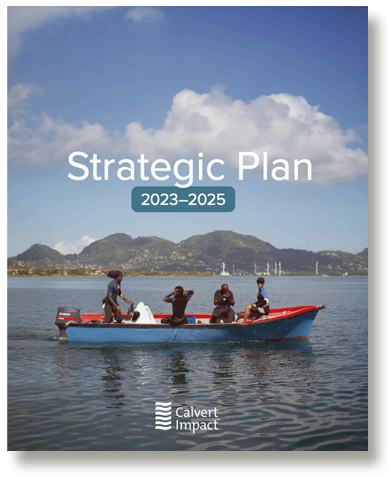
Calvert Impact Strategic Plan 2023-25Calvert Impact also released its new strategy, which details their ambitious goals for the next three years to continue growing and scaling impact markets. “Our strategy reflects our impatience with the pace of adoption across the capital markets,” added Pryce. “We appreciate the need for ongoing financial innovation, but we also need to double down on what we know works in and for communities. We look forward to demonstrating that we can achieve scale without compromising impact integrity.”


About Calvert Impact
Calvert Impact is a global nonprofit investment firm that helps investors and financial professionals invest in solutions that people and the planet need. During its 25-year history, Calvert Impact has mobilized over $4 billion to build and grow local community and green finance organizations through its flagship Community Investment Note™ and structuring services. Calvert Impact uses its unique position to bring the capital markets and communities closer together.

Calvert Impact Capital, Inc., a 501(c)(3) nonprofit and subsidiary of Calvert Impact, Inc., offers the Community Investment Note™, which is subject to certain risks, is not a mutual fund, is not FDIC or SIPC insured, and should not be confused with any Calvert Research and Management-sponsored investment product. Any decision to invest in these securities should only be made after reading the prospectus or by calling (800) 248-0337.

Additional Articles, Energy & Climate, Impact Investing, Sustainable Business

Impact Investing Market Reaches $1.1 Trillion Globally in Industry Milestone

GIIN’s widely-cited estimate of assets under management in the global impact investing market tops USD $1 trillion for the first time, reflecting more comprehensive measurement and ongoing market growth.

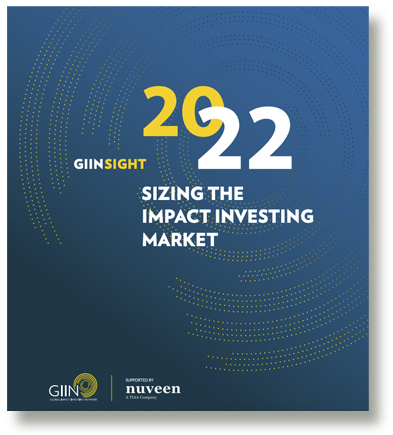
The Global Impact Investing Network (GIIN), the global champion of impact investing, announced at recent GIIN Investor Forum in October 2022 that it now estimates the size of the worldwide impact investing market to be USD $1.164 trillion, marking the first time that the organization’s widely-cited estimate has topped the USD $1 trillion mark. The figure, which is the central finding of the GIIN’s new 2022: Sizing the Impact Investing Market report, reflects an increasingly comprehensive measurement of impact investments globally and ongoing growth in the market.

2022 GINN Sight Sizing the Impact Investing Market reportThe report, which was produced with the financial support of Nuveen, also spotlights two major areas of development relevant to impact investing: green bonds and corporate impact investing practices. Since their inception in 2008, green bonds — a typical bond instrument where the proceeds are specifically used to finance or re-finance projects that are labeled as green — have become increasingly widespread among public and private institutions alike. Meanwhile, shareholder pressure in recent years to invest cash reserves productively, coupled with stakeholder demands for corporations to help address major global challenges, has led to the rise of corporate impact investing.

GIIN Co-Founder and CEO Amit Bouri described the new market size estimate as a sign of the impact investing industry’s “undeniable momentum,” when revealing the number during his keynote speech at the forum. The comprehensive estimate of market size is a foundational data point for the still-growing industry – allowing industry players to compare impact investing to related sustainability-focused investment approaches, track the volume of capital flows into impact investing, and evaluate the changing nature of the market itself.

“We now estimate the global impact investing market has grown to more than one trillion dollars. This represents a significant milestone for the industry as it matures and grows in sophistication,” said Bouri. “While the market growth to $1.164 trillion serves as a very positive sign for impact investing, it is also a call for further action. Investing more capital with an intentional focus to generate positive impact is required right now if we truly want to meet the UN Sustainable Development Goals by 2030 and achieve net zero emissions by 2050.”

“As responsible investing moves into the mainstream, in addition to their expectation that robust ESG principles are being applied to portfolios, many investors are also embracing impact investing, which seeks to produce direct benefits for people and the planet while generating market-rate returns,” said Amy O’Brien, Head of Responsible Investing at Nuveen. “We are so pleased to have sponsored this report, which demonstrates the growth in demand for impact investments we have seen from clients in recent years. We look forward to continue assisting our clients as they look for new ways to deploy capital while seeking to address some of the most critical sustainable development challenges of our day.”

The GIIN estimates that more than 3,349 organizations currently manage the industry’s USD $1.164 trillion in impact investing assets worldwide.

The market sizing report also includes subsamples that reveal the following:

  • Average impact assets under management, per organization, is USD $485 million, based on a sample of 1,289 organizations
  • Median impact assets under management, per organization, is USD $62.5 million, based on a sample of 1,289 organizations
  • Fund managers account for 63% of organizations in the GIIN’s sample, and 61% of directly invested impact assets under management, based on a subsample of 896 organizations

To produce this new market sizing estimate, the GIIN followed a four-step research methodology which resulted in the creation of the most expansive database capture of impact investors in GIIN history. First, the GIIN research team compiled a database of known impact investing organizations based on the GIIN’s existing data assets and data provided by the following third-party investor networks and data houses: National Community Investment Fund (NCIF), Phenix Capital Group and Pitchbook.

Then, it collected data on organizational-level impact assets under management. Next, it estimated the impact assets under management of organizations for which data was unavailable. And finally, it estimated the portion of the impact investing universe not captured in its analysis to that point. To learn more about the data analyzed in the report and the GIIN’s methodology, please visit the GIIN’s research repository.

“The results of this market sizing study should fill us with optimism and determination,” said Bouri. “We should be optimistic about the capacity of the impact investing market to enact positive change, and we must be determined to continue to grow the use of impact investing as a critical strategy to address the challenges of our time.”


About the Global Impact Investing Network

The Global Impact Investing Network (GIIN) is the global champion of impact investing, dedicated to increasing the scale and effectiveness of impact investing around the world. Impact investments are investments made into companies, organizations, and funds with the intention to generate positive, measurable, social and environmental impact alongside a financial return. Impact investments can be made in both emerging and developed markets and target a range of returns from below market to market rate, depending upon investors’ objectives. The GIIN builds critical infrastructure and supports activities, education, and research that help accelerate the development of a coherent impact investing industry.

About Nuveen

Nuveen has supported the financial futures of millions of investors for over 120 years. Under the leadership of TIAA, we invest in the growth of businesses, real estate, infrastructure, farmland and forests while building long-term relationships with clients from all over the globe. With expertise across income and alternatives, and as one of the first in the industry to practice responsible investing, we continue to expand our capabilities while maintaining our legacy as a leading investment manager.

Additional Articles, Energy & Climate, Impact Investing, Sustainable Business

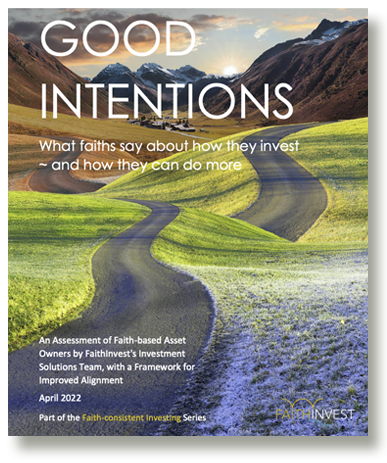
Good Intentions: What faiths say about how they invest – and how they can do more

First in-depth, multi-faith analysis of the extent to which faith groups align their values with their investment portfolios

There’s been a huge rise in interest in values-driven investing in recent years, including among faith groups who are increasingly aware of the importance of investing in line with their faith values – particularly when it comes to achieving their environmental and social goals.

However, there is still a big gap between their aspirations to align their investments with their faith values and actual implementation, according to a new study by FaithInvest.

Good Intentions

The world’s faiths have billions of dollars invested in global markets. is the first multifaith, in-depth assessment of faith groups’ publicly available statements about their investment policies.

Good Intentions ReportFaithInvest, a UK-based international non-profit founded to empower the faiths to invest in line with their beliefs and values, developed an analytical framework to assess the extent to which faiths are integrating values into their investments.
It found that while many faith groups profess a faith component in their investments, this practice is by no means universal, and of those that do, the extent of the alignment varies widely.

The FaithInvest study looked at the investment policies and guidelines of organizations that are formally a part of, or affiliated with, a faith practice. The extensive survey was multi-faith and global in scope, and in addition to faith organizations it also included faith-oriented financial institutions, professional networks, non-profits, schools, and other faith-based institutions.

Essential Guiding Principles

“Investment policy and guidelines (IPG) statements are the essential guiding principles and prescriptions for how faith-based investment portfolios are managed,” says Mathew Jensen, author of the study and a member of FaithInvest’s Investment Solutions team.“Turns out, faith-aligned IPG statements are more a rarity among faith-based asset owners than one might expect.”

With 84% of people globally belonging to a religion, according to the Pew Research Center, and thousands of religious organizations worldwide, Jensen says: “We were surprised to find only 164 publicly available statements about faith investment policies.”

Of these, only 42 provided enough information in their investment policy statements to make a credible analysis, and just 69% of these indicated that faith values have a role in the principles and guidelines that govern their financial assets.

Even among this group, the extent to which faith values were integrated into portfolios varied widely. In fact, only two of the 42 investment policy and guidelines statements studied indicated extensive integration of faith values in their investments.

“We found that many faith organizations make at least some mention of pursuing faith-consistency in their investments, and some have done much to move toward full alignment, but many others have a long way to go.” explains Jensen.

Billions of Dollars

Why is this important? Although a full picture of global faith investments is hard to come by, faith groups manage billions of dollars of funds. Examples of faith holdings include:

According to the Zug Guidelines to Faith Consistent Investing, a landmark 2017 publication that outlined the investment priorities of dozens of faith traditions from eight of the world’s major faiths – including Buddhism, Christianity, Daoism, Hinduism, Islam, Judaism, Sikhism and Shintoism – faith organizations likely own 10% of world’s entire financial investment.

“With extensive resources and deeply held values, the faiths are vital to planning environmental and sustainable development around the world, and mapping faith values with investments is central to that end,” says Nana Francois, Director of Investment Solutions.

Analytical Framework

To conduct the study, FaithInvest developed an analytical framework to assess the extent to which faiths are integrating values into their investments. “This is the first in-depth assessment of the publicly available investment policy and guidelines statements of faith groups, and we wanted a robust tool to conduct the analysis,” Jensen said.

The analytical framework consists of a series of questions that the researchers posed to reveal the presence or absence of ‘indicators’ of faith-based alignment. For example, the first and arguably the most important question, ‘Does faith have a role in the organization’s investment policy and guidelines?’

This ‘front door’ query is followed by a battery of questions that probe several aspects of policy, including declarations of the use of strategies such as screening, engagement, and impact investing, and the presence of guidelines (specific portfolio management directives), such as explicit exclusions or reporting requirements.

Work to be Done

While it’s clear that a lot of work has been done by some faith-based asset owners to integrate faith values with their investable assets – i.e., faith-consistent investing – this study shows there is much more work to be done: from a greater number of faith organizations declaring a faith role in their investment policies, all the way to more detailed guidelines and robust reporting to ensure effective integration of faith-based guidelines.

“It’s likely that fiduciary concerns are holding back some faith-based asset owners from taking a more faith-aligned approach, but with faith-conscious investments becoming more widely available, often providing market-like returns, this may not be a valid rationale for long,” explains Jensen.

Assess Your Progress

The methodology used for this study can be applied to any faith organisation’s investment policy and guidelines statement to help them assess their own progress against their intentions. FaithInvest’s Investment Solutions team is available to assist any faith-based asset owner with an examination of its IPG statement in pursuit of more fully faith-aligned investments.

The Findings in More Detail

  • 164 publicly available statements were found and considered
  • Of these, only a quarter (42) contained sufficient detail for an assessment to be undertaken.
  • 69% indicated that faith values have a clearly stated role in the principles and guidelines that govern their financial assets (labeled the ‘Yes’ group)
  • 31% made no mention of their faith (the ‘No’ group).

The ‘Yes’ Group

  • Only two organizations had clearly documented that they had extensively integrated faith values throughout the entirety of their investments.
  • On average this group’s score was just 5.4 on our 10-point scale, indicating that better alignment is achievable for many.
  • Nearly 70% of the Yes group use negative screening and/or divestment practices
  • Just over 50% use positive screening
  • Nearly two thirds outlined engagement and advocacy activities
  • Two thirds document a specific reason or goal for incorporating faith values
  • Just over 40% document documented proxy voting policies
  • 45% stipulated that faith values are integrated (ie, applied across all assets)
  • 34% designated a separate sub-portfolio


Read the report in full – Download the Good Intentions study.

Additional Articles, Energy & Climate, Food & Farming, Impact Investing

Dave Ramsey, The Market, and Jesus

By Rosa Lee Harden, Neighborhood Economics

Above photo by Jose Alonso, Unsplash


Rosa Lee Harden - Neighborhood EconomicsJesus says: If your hand offends you, cut it off!
But what if the hand that offends you is the invisible hand of the market? How do we cut that hand off?

Dave Ramsey, in a recently shared video clip that’s gotten more than 1 million views, says that isn’t our hand. Speaking about the idea that Christians who might own rental property and raise their rents to market rates and cause someone to be displaced, he said: “I own rental property… and when I raise my rent to market rate … I did not displace the person out of that house if they can no longer afford it, the marketplace did, the economy did.” 

I believe that what we do with our money, our real estate assets, is an expression of who we are, and the responsibility is ours, as Christians, to make sure that our ethics around our property and money are consistent with who we are as followers of Jesus. If the market does force us – and sometimes it can – to take action that is antithetical to Jesus, then we must ‘cut it off!’

But, there’s a bigger question:

Why do we think we can’t change the market? Why do we think the market and the economy have agency on their own, that they have the power to move us around, like pieces on their chessboard?

Because the people who benefit from the system being exactly as it is want us to believe that. We need to cut that hand off, too.

I have always been skeptical of Dave Ramsey’s prosperity gospel and his message that having more money is always the answer. But truthfully, he just said out loud what most people who aren’t thinking critically about the economy actually believe.

As long as we believe that the economy is a force of nature, that it is like gravity, we won’t ever change it because we don’t believe that we can change it. But we cannot believe or behave this way if we want to be like Jesus.

Jesus flipped the tables. Jesus called out economic injustice. It’s pretty clear that the reason Jesus turned over the tables in the temple, a story reported in all four of the gospels, was because of the way the financial system of the temple treated the poor. The poor would bring what they had, but it was not in the currency of the temple. So they had to exchange it with unscrupulous money changers at a considerable loss in order to get currency that was acceptable. Jesus recognized this abuse and rejected it. He did not accept the market as unchangeable.

This is scary business. Within a week of turning over those tables, Jesus was dead. Walter Bruggemann has said that he believes that the reason Jesus was crucified was because he challenged the injustice in the economic systems which threatened the leaders of the day who were extorting the poor.

It is no surprise that it is hard for Christians to talk about these issues. Too often, we act as if our finances are irrelevant to our faith. Ramsey says ‘the market’ tells us what to charge, how to behave as property owners. Certainly in these times with financiers being turned topsy-turvy and more evictions on the way, this is a difficult path for many Christians who are landlords. But our work and our use of our assets is not excluded from faithful decisions that need to be made with reflection on what Jesus would do.

We can change the economy. We can call out where it is unjust.

We can and should look at our own business practices and ask, is this practice consistent with my faith?

We must look at our investments and see what the companies we invest in produce. Do those products bring health and healing to the world?

If the market will allow us to charge more rent, do we need that money to pay our bills? Or are we simply making more money to enrich our lives while causing displacement that was not needed? Just because ‘the market’ will let us do something doesn’t mean we have to or that we should. It was the Apostle Paul who said all things are lawful, but not all things are beneficial. He concludes that thought by adding, “Let no one seek his own good, but the good of his neighbor” (1 Corinthians 10:24).

Are there actions we can take locally that create a more just economy? Can we support minority businesses? Can we find a bank or credit union that is more in line with our ethical stance?

The list of questions that we might ask is long, and we can’t do it all, but we can do some things. The market does not tell us what to do. Jesus does. Where are we called to flip the tables?


Article by Rosa Lee Harden, executive producer, Neighborhood Economics

The Rev. Canon Rosa Lee Harden is a self-described serial-entrepreneur. Her vocational life has included being publisher of weekly newspapers, trade journals, a business journal and CEO of a ‘Silicon Valley’ start-up. She was ordained as an Episcopal Priest in 2000 and served as Vicar of Holy Innocents Episcopal Church in San Francisco for ten years. She also served as the Canon for Money and Meaning at All Soul’s Episcopal Cathedral in Asheville, NC. In 2003, she developed ‘via media,’ a video curriculum about basic theology for the Episcopal church, developed at a time when the church was under great stress. Purchased by more than 1000 churches, it brought healing and connection across the denomination. In 2008, she and her husband, Kevin Jones, launched the global SOCAP (Social Capital Markets) conference, the conference at the intersection of money and meaning. In its 11th year, SOCAP18 brought more than 3,000 people from more than 60 countries to San Francisco to accelerate the good economy.

Now, Rosa Lee is leading F+F: Reimagining God’s Economy, a conference to enable the varied and disconnected tribes of the Christian church to learn a language for making theological sense of money and its uses. She is also executive producer of Neighborhood Economics, a convening in Indianapolis that brought together leaders and practitioners in the field.

Additional Articles, Impact Investing, Sustainable Business

Aligning Faith and Finances: A Personal Journey

By Rob Carney, Eventide

Above photo by Erol Ahmed, Unsplash

Rob Carney EventideI grew up in a typical Irish Catholic household. My parents dutifully made sure that my siblings and I received the sacraments — Baptism, First Confession, First Communion, etc. — and that we attended Mass on major holidays and some Sundays. Other than this, my exposure to God was limited to religious education classes and an evangelical Christian missionary who lived across the street from me. Thus, my faith was not very mature in the early years of my life, but I believed in God and I loved to ask big questions.
My hometown was small. This, in addition to the fact that my mother taught classes in my church, meant that our priest knew our family well. At the age of 14, while attending Christmas Eve Mass, I sensed that the priest acknowledged my presence. That simple act was enough to get me thinking about the Ten Commandments, most prominently the Third Commandment — “Keep holy the Lord’s Day.” In response, I told my family I wanted to go to church each Sunday.

Hearing the Word of God proclaimed each week at Mass marked the beginning of my journey to being a faithful Catholic and embracing more fully the teachings of the Catholic Church. Then, for my 16th birthday, in order to find answers to my big questions, I asked for the Catechism of the Catholic Church. I dove into it, wanting to know as much as I could about the social teachings of the Church.

It didn’t take long before I began to recognize some of the real-life applications of what I was learning. For instance, as I began working some part-time jobs I noticed a difference when I was treated with dignity as an employee, and when my fellow employees would in-turn pass on that same respect to our customers. This drove me to start seeking out other businesses that operated with the same kindness, and I preferred to support these businesses over some of their peers that didn’t seem to take the same approach of loving their neighbors through the way they ran their business.

Having developed a view of the social responsibility of business in my teenage years, it was not long before I began to think about what it meant to invest in businesses that were promoting the common good. After graduating from college, I started a regulatory role at a large bank in Boston, compiling shareholder documents for exchange-traded funds (ETFs). As I developed a stronger understanding of the mechanics of ETFs, I noticed two things. First, some of these funds were explicitly investing in companies that promoted or produced products and services contrary to Catholic values. Second, I realized that my 401(k) investments, which were invested in index funds, were doing the same.

For years, I had thought about what it meant to follow Christ outside of church, in my purchasing decisions and in leadership opportunities at work and school, but I now faced the possibility that I had failed to serve Christ as an investor.

Uncomfortable and overwhelmed with this thought, I did some research and found that there were other funds in the Catholic investing space that were listed as being compliant with the United States Conference of Catholic Bishops Investment Guidelines. I was relieved to see that these funds were not profiting off of one of the most difficult decisions a woman could make (abortion) or off of someone’s addiction to pornography, for example. However, I was still troubled to find that many of these funds were profiting off of the predations of big tobacco and did not mention anything about enhancing the common good, pursuing economic justice, or caring for our common home, the environment (3 out of the 5 categories mentioned in the Investment Guidelines).

Not only this, but I was disappointed in the returns of the funds. Wanting to be a good steward of my assets, I questioned whether God was calling me to sacrifice my financial returns (and, in turn, the amount of funds I had available for charitable contributions) to invest according to Catholic values.

It was several years later, while in business school, that I stumbled across others in the asset management industry who were trying to express their values through their investments and who were perhaps a little further along the journey of pursuing their faith through the practice of investing. On one such occasion, I attended a breakout session where an industry veteran was speaking at a Christian MBA networking conference (Believers in Business). She described an approach to investing that sought to avoid areas that extract value from society by exploiting others and, conversely, promote areas that create value for society.

In line with this theme of values-based investing, she also explained the importance of having a framework to look at how a company treats all of its stakeholders, namely, its customers, employees, suppliers, host communities, the environment, and broader society. I resonated with all that the speaker shared, including her assertion that what is right is also, in many cases, smart. In other words, caring for a business’s neighbors (i.e., its stakeholders) is often good for business.

My personal values that were being formed as I grew more mature in my faith were guiding how I approached every area of my life, including how these deeply-seated values could be applied to business and investing. Realizing how I could invest responsibly and still align my faith with my finances was such a fulfilling step in my journey that I would encourage others to explore values-based investing as well.


Article by Rob Carney who serves as a Portfolio Consultant at Eventide. As a member of the Investment Consulting Group, he helps advisors design portfolio illustrations around values criteria and relevant risk and return objectives.

Prior to joining Eventide in 2021, Mr. Carney spent a summer at Ford Motor Company’s Treasury group, where he identified benchmark and investment guideline improvements to reduce risk in Ford’s fixed-income portfolio for two of its largest pension plans in Canada. Prior to that, Mr. Carney worked in fund administration managing regulatory filings at State Street Bank in Boston, Massachusetts.

Mr. Carney holds an MBA from Cornell University’s SC Johnson Graduate School of Management, where he focused on investment research and asset management. He also holds a B.A. in History and a B.B.A. in Finance from University of Massachusetts Amherst. He is pursuing the CFA charter and is a CFA Level II candidate.

Featured Articles, Impact Investing, Sustainable Business

It’s Not a “Nice Thing”!

By Mark Regier, Praxis Mutual Funds and Everence Financial

Mark Regier of Praxis Mutual Funds and Everence FinancialOne of the most frequent comments I get following any presentation on the real-world impacts that are possible through one of Praxis’ five mutual funds, is how “nice” it is that we’ve decided to commit 1% of each of these funds to community investing. While I appreciate the appreciation, in my head I’m usually screaming “It’s not a ‘nice thing!’” The allocation of concessionary, catalytic capital to marginalized people and communities is — or should be — much, much more, especially for people of faith.

For too long, community investing has been seen as an act of charity, equated with largesse or evidence of excess resources in one’s economic life.  And while charity — financial gifts drawn from excess finances and given to causes and organizations that require such support to do their good work (disaster recovery, the arts, crisis food and shelter, ministry support, etc.) — can be an important aspect of one’s faith and worship life, community investing fulfills a different function. Far from just a “nice thing”, community investing is something altogether different.

But before we explore some of the deeper motivations community investing has for people of faith, particularly those in the Judeo-Christian tradition, perhaps a definition is in order. Community investing — or community development investing (CDI) as we frequently call it at Praxis — is distinguished from other good/responsible/social/faith-based/ESG investing by the primary intent of the investment being to help deliver the benefit of economic opportunity for others even at the cost of a competitive return for the investor. This intentionally concessionary capital can take many forms but it plays a critical — catalytic — role between truly charitable contributions (or grants), which are frequently limited, and the scale of impact offered through more traditional, market-rate, socially-oriented investments.

Arguably, there appears to be a clear contradiction between an “investment” and a deliberately concessionary rate of return (a conversation I and my colleagues have regularly had with SEC examiners!). It seems to defy convention and the common understanding of investing to begin with. Yet, therein lies the true power of community investing — and its importance for faith-based investors. Community investing combines the rigor, prudent management and economic sustainability of traditional investments with a deep vision and understanding for the special challenges faced by organizations seeking to bring opportunity and long-term financial viability to individuals and institutions on the margins of our society. Where charity seeks to do good work, community investing seeks to leverage an organization’s charitable and inherent community resources to expand that “good work” by multiples.

So why then is this unique — and powerful — niche of impact investing so important to Christian faith-based and other values-driven investors? And why are faith-based, values-driven investors so important to community investment-oriented organizations? As the concessionary nature of many community investments continues to confound most investment consultants and mainstream financial professionals, the support and involvement of investors with the faith- or values-orientation to see first the benefits to underserved communities is more important than ever.

If community investing is not just a “nice thing” for faith-based investors, what is it and where does it fit?

It’s a “good thing” — For starters, we have ample evidence of the incredibly important role that catalytic capital — and the investors that provide it — play in sustaining and expanding economic opportunity to those who would otherwise not have access. The success of such efforts have been previously addressed by community investment leaders such as Debra Schwartz, Tim Freundlich, and Dana Bezerra in the October 2022 issue of GreenMoney Journal. Investors today can understand the vital role their community investments have in lifting up the underserved in local and global communities.

It’s a “sustainability thing” — People of faith are routinely called through holy texts to care deeply for the people and created world around them. Passages in both the Old and New Testaments speak frequently to our responsibility to be responsible. The concept of sustainability inherent in community investing reflects not only the support and empowerment of those left on the margins, but also the desire to see all people included in productive, sustainable economic relationships that bring lasting hope for a life of wholeness and wellbeing.

It’s a “justice thing” — Themes of justice (and condemnation for those who fail to be concerned) abound throughout Judeo-Christian scripture. Some of Christ’s harshest critiques were focused on people of power and privilege who routinely ignored faith’s call to care for those around them deeply and sacrificially. Meeting society’s rites and standards were not enough if the needs of the poor, the widow, the orphan, and the outcast remained unaddressed.

It’s a “faith thing” — Fundamentally, particularly for Christians, the intentional inclusion of the marginalized in our financial decision-making is inextricably linked to the concept of stewardship. Stewardship is the prudent management of resources on behalf of the owner of those resources. This includes both the productive use of those resources as well as the general interests/instructions of the owner. For Christians, the true owner of all is God. As Christian stewards we need to be both productive and deeply aligned with God’s will and vision for wholeness (shalom) in this world. The intentionality and impact of community investing mirror these fundamental faith commitments.

It’s a “relationship thing” — Probably one of the most important, but often overlooked (or under-implemented), teachings within Christian scripture is the primacy of relationships — our relationship to God and our relationship to those around us. This concept is made clear in the Greatest Commandment, documented in Matthew 22:34-40, where Jesus, quoting the Old Testament, tells us to “Love the Lord your God with all your heart and with all your soul and with all your mind” and “Love your neighbor as yourself.” (NIV) It is our understanding of these two fundamental relationships that should undergird all our choices — financial and otherwise.

Courtesy of Praxis Mutual Funds - Getty Images
Courtesy of Praxis Mutual Funds; Getty Images

It’s a “transformational thing” — This is where community investing really shines — for me personally as a Christian and for my values- and faith-driven organization. Community investing provides both the opportunity and the challenge to bring us into direct relationship and a deeper understanding of those who have been shut out of our economic system for a wide-range of reasons. This is one reason Praxis works to support organizations like the national Christian Community Development Association and the fledgling Anabaptist Community Development Network, which serves our own faith community. Their on-the-ground work strengthens community development organizations and their impact and connects us with challenges and realities we might not fully understand.

As people of faith, community investing helps us understand our own privilege and the world’s needs in new ways. It connects us with new partners for this good work. It opens doors of response in meeting real human needs, often in lasting and sustainable ways. It expands our reach — many of us have more to “invest” (in a safe, if concessionary, manner) than we have to “give”. Perhaps most importantly community investing has the power to transform us as Believers, seeking to live out our most deeply held values, responding to a world in need with hope and opportunity.


Article by Mark A. Regier, Vice President of Stewardship Investing for Praxis Mutual Funds and Everence Financial, a leading provider of faith-based financial products in the United States and a ministry of Mennonite Church USA. Mark has been involved in the field of ethical and socially responsible investing at Everence for more than 25 years. He oversees the company’s work in socially responsible investing (including investment screening, ESG integration, proxy voting, corporate engagement and community investing). In 2015, Mark assumed leadership of the sales and marketing efforts for the Praxis Mutual Funds.

Mark has served as a member of the Board of Directors for the US Social Investment Forum, the Interfaith Center on Corporate Responsibility, Partners for the Common Good, the International Working Group (USSIF), and The Isaiah Fund for Disaster Recovery Investing. In 2006, Mark received the SRI Service Award, the US social investment industry’s highest honor.

With over 30 years of service to the church and a background in ethics and theological studies, Mark is often a resource to national and international media and organizations on faith-based and community investing issues.

About Praxis

Praxis Mutual Funds is a leading faith-based, socially responsible family of mutual funds designed to help people and groups integrate their finances with their values. Praxis is the mutual fund family of Everence Financial, a comprehensive faith-based financial services organization helping individuals, organizations and congregations. To learn more, visit praxismutualfunds.com and everence.com, or call 800-348-7468.

Consider the fund’s investment objectives, risks, charges and expenses carefully before you invest. The fund’s prospectus and summary prospectus contain this and other information. Call 800-977-2947 or visit praxismutualfunds.com for a prospectus, which you should read carefully before you invest.

Praxis Mutual Funds are advised by Everence Capital Management and distributed through Foreside Financial Services, LLC, member FINRA. Investment products offered are not FDIC insured, may lose value, and have no bank guarantee.

Mutual fund investing involves risk. Principal loss is possible.

ESG: environmental, social, governance.

The Fund’s investment strategy could cause the fund to sell or avoid securities that may subsequently perform well, and the application of ESG and/or faith-based screens may cause the fund to lag the performance of its index.

The market rate (or “going rate”) for goods or services is the usual price charged for them in a free market.

Rate of return is the net gain or loss of an investment over a specified time period, expressed as a percentage of the investment’s initial cost.

Featured Articles, Food & Farming, Impact Investing, Sustainable Business

Signup to receive GreenMoney's monthly eJournal

Privacy Policy
Copyright © GreenMoney Journal 2025

Website design & development by BrandNature

Global Events Calendar

View All Events

april

21aprAll Day232026 Sustainable Packaging Coalition: SPC Impact – Nashville

27aprAll Day30Women Deliver 2026 Conference (WD2026) – Melbourne

X