Tag: Impact Investing

ESG Incorporation by Money Managers 2021

From the US SIF Foundation


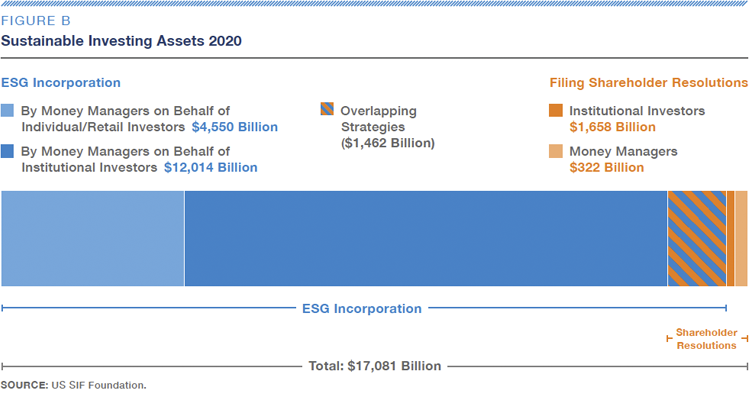
The US SIF Foundation identified 384 money managers and 1,204 community investing institutions incorporating ESG criteria into their investment analysis and decision-making processes. The $16.6 trillion in ESG incorporation assets they represent is a nearly 43 percent increase over the $11.6 trillion in such assets identified in 2018.

Of this 2020 total:

  • $4.6 trillion were managed on behalf of individual investors, and $12.0 trillion were identified as managed on behalf of institutional investors as shown in Figure B.

Figure B-Sustainable Investing Assets 2020-Fig B-US SIF Foundation

  • $3.1 trillion — 19 percent — were managed through registered investment companies such as mutual funds, exchange-traded funds, variable annuities and closed-end funds, as shown in Figure C.
  • $716 billion — 4 percent — were managed through alternative investment vehicles, such as private equity and venture capital funds, hedge funds and property funds. 
  • $266 billion in assets were managed by community investing institutions. 
  • $985 billion in money manager ESG assets were managed through other commingled funds.
  • The majority — $11.5 trillion, or 69 percent — remains largely opaque as they were managed through undisclosed investment vehicles and the managers for 60 percent of these undisclosed vehicles — $6.9 trillion — also did not disclose the specific ESG factors that they consider, reporting only that they consider ESG in general.

Figure C-Money Manager Assets-by Type-Incorporating ESG Criteria 2020-US SIF

In terms of assets, money managers incorporate ESG factors fairly evenly across environmental, social and governance categories, as shown in Figure D, above.

  • Overall, in asset-weighted terms, money managers incorporated social factors slightly more than environmental and governance criteria. Social criteria incorporation by money managers increased 49 percent from 2018 to $16.1 trillion.
  • Environmental criteria as a whole grew faster than social or governance factors over the past two years, increasing 57 percent, from $10.1 trillion to nearly $16.0 trillion.
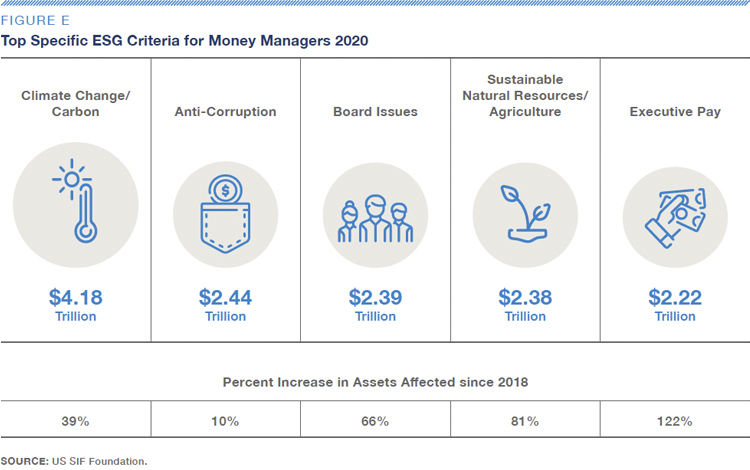
  • Among all specific ESG criteria, governance factors related to executive pay saw the greatest growth, increasing 122 percent since 2018 to $2.2 trillion, as shown in Figure E
  • However, climate change remains the most important specific ESG issue considered by money managers in asset weighted terms. The assets to which this criterion applies increased 39 percent from 2018 to 2020 to $4.2 trillion, also shown in Figure E
  • Fig E–Top Specific ESG Criteria for Money Managers 2020-US SIF
  • Anti-corruption was the largest governance criterion, with growth of 10 percent from 2018, affecting $2.4 trillion in money manager assets.
  • Board issues also ranked high among the top specific ESG criteria for money managers, affecting $2.4 trillion in assets under management, a 66 percent increase from 2018.
  • Sustainable natural resources and agriculture grew by 81 percent to $2.4 trillion in assets under management.
  • Conflict risk was the largest social criterion at $1.8 trillion assets under management, although this was a decrease from 2018 of 22 percent.

SRI Trends Report 2020-US SIF-Cover

Order a copy of the Report on US Sustainable and Impact Investing Trends 2020 from the US SIF.

Energy & Climate, Featured Articles, Impact Investing, Sustainable Business

SRI Trends Report 2020: Executive Summary

From the US SIF Foundation


Sustainable investing in the United States continues to expand at a healthy pace. The total US-domiciled assets under management using sustainable investing strategies grew from $12.0 trillion at the start of 2018 to $17.1 trillion at the start of 2020, an increase of 42 percent. This represents 33 percent, or one in three dollars, of the $51.4 trillion in total US assets under professional management.

Overview

Since 1995, when the US SIF Foundation first measured the size of the US sustainable investment universe at $639 billion, assets have increased more than 25-fold, a compound annual growth rate of 14 percent. The most rapid growth has occurred since 2012. (See Figure A. above)

Through surveying and research undertaken in 2020, the US SIF Foundation identified, as shown in Figure B:

Figure B-Sustainable Investing Assets 2020-Fig B-US SIF Foundation

  • $16.6 trillion in US-domiciled assets at the beginning of 2020 held by 530 institutional investors, 384 money managers and 1,204 community investment institutions that practice “ESG incorporation” — applying various environmental, social and governance (ESG) criteria in their investment analysis and portfolio selection.
  • $2.0 trillion in US-domiciled assets at the beginning of 2020 held by 205 institutional investors or money managers that filed or co-filed shareholder resolutions on ESG issues at publicly traded companies from 2018 through 2020.

Order a copy of the Report on US Sustainable and Impact Investing Trends 2020 from the US SIF.


Energy & Climate, Featured Articles, Impact Investing, Sustainable Business

Why Climate Finance? Why Now?

By John Howell, Climate & Capital Media

Climate and Capital Media-logo“Why climate finance,” you might ask?

In 25 years of reporting on sustainable business, I have become fascinated by the pivotal relationship between capital and innovative solutions to climate-related issues.

Over the past few years, I have engaged with organizations, companies, conferences, webinars, and workshops about several varieties of values-based investing, especially the increasing number pointed toward ESG, impact investing, and SRI strategies and practices that address climate change. Each of these variants contains its own sub-categories, variously defined by institutional and individual investors, research firms, financial advisors, analysts, and academics. These, in turn, are connected to a rapidly growing range of products being introduced to activate the concepts, from green bonds to target-specific impact funds and ESG ETFs.

This unprecedented activity is among the most exciting developments in a time that could use more good news. It can also get confusing — fast. As a field, climate finance is a pioneering effort, based on analysis of data and science to generate new methodologies but by definition, one that creates new, uncharted paths within the financial sector.

As a field, climate finance is a pioneering effort that creates new, uncharted paths within the financial sector.

Speaking of definitions, when l went looking for a coherent way to assess the concept of climate finance, I found this one by the United Nations Framework Convention on Climate Change, Standing Committee on Finance:

“Finance that aims at reducing emissions, and enhancing sinks of greenhouse gases and aims at reducing vulnerability of, and maintaining and increasing the resilience of, human and ecological systems to negative climate change impacts. This definition represents finance for climate change in its broadest form as it relates to the flow of funds to all activities, programs or projects that support climate change-related projects, whether mitigation or adaptation, anywhere in the world.

This expansive mandate is being filled to the brim with concrete action. Some selected recent examples:

How to make sense of this exponentially expanding field of activity?

Our newsletter is one answer. Climate Finance Weekly, or CFW, provides a concise yet comprehensive weekly digest of news and insights about investing with climate-related capital, curated for context.

At Climate & Capital Media, we believe CFW is a vital link between climate-finance activity and the growing audience of financial professionals who want to know more to advance their practice. Its voice is journalistic in tone and draws on experience in the field. CFW fills a gap between the occasional coverage in the mainstream financial media and the deep data of trade publications and white papers.

As a best-practice guide in evaluating support for budding entrepreneurs, there is a strong case to be made for looking closely at capital that filters for solutions to climate change. That’s the general mission of Climate&Capital and the specific focus of CFW, which will look at climate-finance activity in detail.

There is a strong case to be made for looking closely at capital that filters for solutions to climate change.

“What gets the money gets done.” That’s how one prominent ESG investor put it in a recent seminar, replying to a question as to why investment in climate change solutions is a worthy idea.

Indeed, climate finance is seeing record inflows of capital. Globally, $71.1 billion globally was recorded between April and June of this year, pushing worldwide sustainable assets under management to a new high of more than $1 trillion. Sustainable fund flows in the U.S. for the first half of this year totaled $20.9 billion, nearly as much as the record $21.4 billion set in 2019 for the entire year. And 2019’s flows were four times the previous record for one year. These are large numbers that can make a big difference.

As for that “why now” question, the simple answer is to take a look at recent heat records. This past summer — June through August — ranked fourth hottest and among the driest one-third of all summers. The last five years rank as the hottest on record, according to NOAA, and the organization’s scientists predict that each year in the next decade will be among the top ten warmest years globally.

Last month was the hottest September on record. Earth’s average temperature was 0.05ºC warmer than the previous record, set last September. We’re two-thirds of the way to the 1.5º C that the UN Intergovernmental Panel on Climate Change (IPCC) says will irretrievably change life as we know it by 2030. The future of global warming is now.

Our work at Climate&Capital and in the CFW newsletter is to help you navigate all this; to avoid and manage the rapidly escalating risks of global warming while acting on opportunities in the new climate economy.

Join me as I chronicle the new Climate Age. Sign up for the CFW newsletter here.


Article by John Howell – a writer, editor, and broadcaster who oversees the Climate Finance Weekly newsletter and advises on communications and media strategy. He was co-founder, editorial director, and chief of thought leadership for 3BL Media, for which he managed all original editorial content, wrote, and edited newsletters, and created the Brands Taking Stands initiative. He has worked as an editor and contributor for Elle, Artforum, and High Times magazines, developed new media for Hearst Magazines, and created communications for Calvin Klein, Polo/Ralph Lauren, and The Body Shop. He lives and works in New Hampshire and Maine.

Additional Articles, Energy & Climate, Food & Farming, Impact Investing, Sustainable Business

Fortune’s Most Powerful Women in Business 2020

By Kristen Bellstrom & Beth Kowitt, Fortune

This year, 2020, has been like no other — and it was clear to us that this year’s ranking, too, must break the old rules and evolve to meet the moment. So, for the first time in the list’s 23-year history (!!) we’ve changed our methodology and added a new consideration: In addition to weighing the power of each executive (by evaluating her business, career arc and influence), we asked how she is wielding that clout. Is she, in this time of global crisis and uncertainty, using her influence to shape her company and the wider world for the better?

Gratifyingly, for many of the business world’s leading female executives, the answer was a resounding yes.

This year’s No. 1, Accenture CEO Julie Sweet, leads not only a massive company—more than half a million employees and a market cap of nearly $150 billion—but one that is devoted to helping its clients navigate the new digital world order, a task that became all the more urgent due to the pandemic.

She’s joined in the top 10 by executives including Carol Tomé (No. 5), who took the reins at UPS at a moment when the shipping giant is playing an increasingly critical role in the coronavirus economy; incoming Citi CEO Jane Fraser (No. 6), who is poised to break banking’s highest, hardest glass ceiling; and Best Buy CEO Corie Barry (No. 9), who took aggressive steps to keep her employees safe—and has been rewarded with strong business performance.

One of the distinguishing factors of this year’s list is the number of new faces: 13 of our honorees are newbies to the ranking, while two others are making a triumphant return in brand new jobs. Many of these women are playing major roles when it comes to building more socially and environmentally conscious companies: Consider Apple sustainability head Lisa Jackson (No. 35)—she’s responsible for ensuring the tech juggernaut hits its goal of being carbon neutral by 2020—and Intel chief diversity and inclusion officer Barbara Whye (No. 40), whose company reflects the true composition of the U.S. workforce and is working to set diversity standards for the tech industry as a whole.

Covering industries ranging from space exploration to book publishing, and highlighting women who are using their power in myriad ways, we believe the 2020 ranking is more diverse and dynamic than any we have published before. We hope you’ll take a moment to explore it.

Since 1998, Fortune has ranked the Most Powerful Women in Business using four criteria: the size and importance of each woman’s business in the global economy; the health and direction of the business; the arc of her career; and her social and cultural influence.

See the Complete List here with What’s New in 2020 and the Ones to Watch .


Article by Kristen Bellstrom and Beth Kowitt, Fortune

Additional Articles, Energy & Climate, Impact Investing, Sustainable Business

Gender Lens Investing: Strong Returns for Investors and Society

Once viewed in terms of number of women in leadership roles, focus now looking at pay equity, anti-harassment policies, benefits, supply chain, access to mentorship, and other issues.

When what is now known as “gender lens investing” started a decade ago, the focus was largely on the number of women in management/CEO roles, but a more nuanced and far-reaching approach is now emerging and it is likely to find increasingly wide acceptance among investors, according to the recent report published in October 2020 by the wealth management firm Glenmede alongside an advisory board of gender lens investing experts.

Titled Gender Lens Investing in Public Markets: It’s More Than Women at the Top, the new paper identifies five gender equity areas of concern to investors: women in leadership; access to benefits; diverse supply chains; pay equity; and talent & culture (including access to mentorship and how a company advances — or fails to advance — women to management). Each of the areas are shown in the paper to either quantifiably or potentially lead to stronger overall financial results for investors in publicly traded companies.

The paper concludes: “As the field of gender lens investing matures in terms of asset size and sophistication, investors may look beyond the women in leadership metric to accelerate progress towards corporate gender equity… the existing data seem to indicate that inclusive corporations demonstrate good financial performance and clearer impact metrics for investors seeking to confront remaining gender inequities in the workplace. In the face of an ongoing pandemic and vulnerable economy — both of which are affecting women disproportionately — considering how to embed a gender mandate into our strategies is more relevant than ever.”

Natasha Lamb, managing partner, Arjuna Capital and advisor to the paper, said: “Not only is fair treatment of women and minorities in the workplace the right thing to do… it also is the smart thing to do. Women who are paid fairly and advanced equally, who have access to benefits, mentorship, and real protections against harassment, not only stay with companies, but they also make those companies stronger, smarter, and more resilient. The data are clear: Investors who focus on gender equity profit by investing in a better world and a stronger bottom line.”

Laura LaRosa, executive director of client development, Glenmede, said: “Metrics like pay equity, parental leave, family health care benefits, and anti-harassment policies are critically important to how we evaluate corporate gender scorecards and attribute positive, sustainable change.”

Suzanne Biegel, cofounder of the GenderSmart Investing Summit, catalyst at large, and an adviser to the new paper, shared that the demand from investors, globally, for investment products that take the analysis and engagement to the next level is tremendous. She said: “Investing in women is smart not only because of what it does for gender equity but for what it means for society to have access to the products and services that are better informed by diverse voices and that solve the problems we face today;  to the talent that is represented from diverse sources; and to the value chains that are more resilient because of diversity.”

Julia Enyart, officer on the Sustainable & Impact Investing team at Glenmede, was originally motivated to initiate this research after hearing concern from endowments, foundations, and individuals that existing gender lens strategies focused only on the experience of women at the highest level of a company. She said: “These investors sought strategies that would peer deeper into a public company’s access to benefits, pay equity reports, and culture, corporate features that contribute to creating a more inclusive and equitable environment for women- and men- at all levels.”

“It is time to advance the gender discussion beyond the very real need to grow the number of women in senior roles in public markets to reflect a holistic approach that can lift up the lives of all women at all levels,” said Patience Marime-Ball, founder & CEO of Women of the World Endowment. “As the Glenmede study makes clear, creating an enabling environment for diversity to be reflected and thrive across all teams leads to more positive outcomes, and ultimately greater profitability. Furthermore, investors seeking to optimize their investments for both financial returns and positive impact on some of our most critical social and environmental issues, whether it is COVID-19 or climate, must therefore incorporate investment strategies at the intersection of gender and these other issues or risk missing out on some of today’s most exciting opportunities.”

Among the Key Findings Cited in the Report:

  • The fast-growing gender lens investing market reached $3.4 billion in 2019.
  • Glenmede’s analysis of Equileap’s gender equity data indicated that companies in the top quintile of gender equity—including pay equity, access to benefits, training and career development, anti-harassment policies, and diverse supply chains—experienced greater returns of 2.3 percent and 0.8 percent less risk than the bottom quartile firms from December 2014 through June 2020.
  • Women are increasing their wealth faster than ever before, adding $5 trillion to the wealth market globally and outpacing the wealth market overall between 2016-2019.
  • As of 2019, women constitute 46 percent of the incoming class of S&P 500 boards of directors (whereas minorities represent 23 percent), reflecting gradual changes to board demographics. US large cap companies with at least four women on their boards outperformed those with fewer than four by a difference of 10 basis points. In Credit Suisse’s gender diversity report scanning 3,000 companies across 56 countries, researchers found that companies with more women on management teams outperformed their less equitable peers by over 4 percent a year.
  • Vodafone instituted global minimum maternity pay (16 weeks) after an analysis from KPMG showed a worldwide cost savings of $19 billion dollars per year. Likewise, Google increased paid maternity leave from 12 weeks to 18 weeks, cutting by 50 percent the rate at which new mothers left the company.
  • As of 2019, women earned $0.82 for $1.00 earned by men, indicating an annual compensation gap of $10,122. Compounded over the course of a career, women’s pay gaps can amount to nearly half a million dollars. A gap in equal pay takes a toll on women’s health. For women, the gap in life expectancy between those in the top 1 percent of wage-earners and those in the bottom 1 percent is approximately ten years.
  • The US lags much of the world. For example, looking at gender pay equity reports, only 5 percent of all Russell 1000 companies publicly disclose this information. In Equileap’s 2019 assessment of over 3,500 companies, 78 percent of UK-based companies disclosed report gender pay information compared to only 2 percent of US-based companies.
  • While women and men enter the workforce in roughly equal numbers, men outnumber women nearly 2:1 when they reach the first step into management.
  • One study found that 34 percent of female employees have been sexually harassed by a colleague with destructive follow-on effects: 38 percent of harassed women left a job early and 37 percent found that it disrupted their career advancement.


About Arjuna Capital

Arjuna Capital is a sustainable and impact investment firm that works with high-net-worth individuals, families, and institutions to invest with a lens toward Environmental, Social, and Governance (ESG) risk and opportunity. Lamb and Arjuna Capital have been recognized for using shareholder resolutions to promote gender and racial pay equity in the tech, banking, and retail sectors. Natasha Lamb was named to the “Bloomberg 50” list of influencers who defined global business in 2017.

About Glenmede

An independent and privately held investment and wealth management firm, Glenmede was founded in 1956 to serve in perpetuity as the investment manager and trustee of the Pew family’s charitable interests—The Pew Trusts. Today the trust company provides highly customized investment, fiduciary and advisory services to high-net-worth individuals and families, endowments, foundations, and institutional entities, representing more than $40 billion of assets under management.

Additional Articles, Impact Investing, Sustainable Business

Swing Out Sister: How Women Founders Can Shine in 2021 and Beyond

By Dr. Cathy Key, World Tree USA

Above: A tree planting event at a World Tree farm with investors: (from left to right) Michelle Bonsu, Marlene Lewis, Kevwe Omologe, Emily Lewis.

Dr.Cathy key-World Tree USA“Sisters are doin’ it for themselves,” sang Aretha Franklin in 1985. “We’re standing on our own two feet and ringing our own bell.” That powerful call to women to stop hiding in the shadows of men is now thirty-five years old. Yet, it is still as relevant today as it was then.

While many women have come out of the kitchen and into the boardroom, there is still a long way to go. While women represent 40 percent of entrepreneurs1:

  • Female founded start-ups received only 2.7 percent of venture capital in 20192
  • Women entrepreneurs received only 9 percent of the investment overall3
  • Only 12 percent of venture capital decision makers are women4
  • Only 7 percent of Fortune 500 companies have female CEOs5
  • Women make $0.82 for every dollar that men make6

These are pretty gloomy statistics, especially when women-founded companies have a proven track record for performance:

  • Investments in companies with female founders perform 63 percent better7
  • 70 percent of the most successful funds have female partners8
  • 80 percent of purchasing decisions are made by women9

So, what’s a girl to do? How do women founded companies make their mark in what is still very much a man’s world?

This year World Tree became the highest funded female-founded company on Wefunder. We raised over $2 million and became the third most funded company on the platform ever. Here are three things I’ve learned on our investment journey.

Prepare to Knock Their Socks Off

I joined World Tree as Chief Operations Officer in 2015, alongside founder Wendy Burton. Our vision was to transform forestry with a fast-growing tree that we would give to farmers for free, train them to grow, and harvest for profit.

It never occurred to us that gender would impact our ability to attract investments and build the business. In retrospect, that was naive. We were disrupting the bluest of blue industries — forestry — with a business model focused on cooperation, sustainability, and profit-sharing.

Our tree even had heart-shaped leaves and a female name: The Empress.

Wendy would come back from meetings shaking her head, “They didn’t even listen,” she would say after talking to rooms full of foresters (all men).

We started doing pitch events, with audiences that were 95 percent men in suits. We prepared like our lives depended on it. Our materials, pitch decks, financials, and offering documents were first class. We knew our stuff and it showed.

It was common to walk into a room at 9 a.m. and be totally ignored. We would pull our shoulders back, walk to the front of the room, and start talking. After a few minutes you could hear a pin drop: we had their attention.

Heart-centered Business is Good Business

Our core mission at World Tree is to “Elevate, Educate, and Innovate for the Planet.” We value people and we value Mother Earth. Our business is designed to address big issues like climate change, poverty, and deforestation. We value our team, our farmers, and our investors as real people and part of our mandate is that our employees love their lives.

In Aretha’s day this focus on people and the planet would be called fluff and nonsense. Today, it’s called good business practice. Sustainable, regenerative businesses make more profit, have better performance and more robust share prices than their counterparts.10

Running a heart-centered business comes naturally to most women, and this is a strong suit that will continue to help us make an impression in the market.

Surround Yourself with Good People

As a female founder, your most important role is to maintain the company’s vision. This is easy at the start, but gets harder over time especially when you are in the crunch of raising capital.

If you are a woman who is good at multi-tasking and someone who is reliable at getting things done (most women entrepreneurs are) then sooner or later your vision is likely to get lost in the mix. You will be burning the midnight oil working on contracts, offering documents, and marketing materials. Things you could hire other people to do at least as well as, if not better than, you.

Hiring good people to take care of the day to day will be critical for you to keep the vision alive. Save your energy for meetings that will really bring the company forward.

Conclusion

Last year 21 female-founded tech companies broke through the $1 billion evaluation mark. These “unicorns,” along with thousands of other successful women entrepreneurs, have been leading the way for our next generation of women in business.

Across North America there are accelerators, pitch events, and angel networks set up purely to focus investment dollars on women owned businesses. Women are supporting each other and the more we do that, the closer we will get to a level playing field. As Aretha said:

“Can you see, can you see, can you see,

There’s a woman right next to you…ho ho… ”


Article by Dr. Cathy Key, President of World Tree USA LLC, an agroforestry company that grows trees for the purpose of carbon drawdown and timber production. Dr. Key oversees the Company’s operations in 5 countries.

With a PhD in Anthropology, specializing in the economics of cooperation, Dr. Key brings a unique perspective to the way we can do business. She  has presented World Tree to Canadian and US audiences on the stage of conferences including the Social Finance Forum and Sustainatopia, as well as investment groups in cities throughout North America.

Energy & Climate, Featured Articles, Food & Farming, Impact Investing, Sustainable Business

Advancing Women Through Sustainable Investing

By Jennifer Coombs, College for Financial Planning

Jennifer Coombs-College for Financial PlanningAlthough we are two decades into the 21st Century, there is still not much discernible difference between the demographics of the financial services sector compared to forty years ago. One could argue that the main difference between now and then, is why women are taking a far more active role in the financial services space, both as advisors and investors. The rise of sustainable, responsible and impact investing strategies, has led many firms and their investors to seriously question the importance and prominence of gender diversity in leadership positions. Although the financial services sector is still very much a male-dominated industry, considerations regarding environmental, social and governance (ESG) issues have provided an avenue to bring more women to the table.

The Sustainable Finance “Wedding Cake”

Much of the focus regarding ESG factors is fixated on the “E” component, which makes perfect sense. Human rights and equality, which constitute the bulk of the issues with the “S” component, are often overlooked because they are sometimes difficult to measure and justify. However, a strong society where all participants are treated fairly and equally is essential before a country can truly realize a strong and sustainable economy. Dutch professors Dirk Schoenmaker and Willem Schramde of the Rotterdam School of Management and authors of Principles of Sustainable Finance,1 frequently describe the fundamentals of sustainable finance as a wedding cake: the bottom layer represents the environment, the middle layer represents society, and the top layer represents the economy.

The top layer cannot exist without the bottom layers to support it; so an economy cannot exist without a properly functioning society, and society cannot exist without a thriving environment. However, many still overlook the fact that a strong, thriving economy cannot exist in a scenario when half of society is being marginalized. Therein lies the issue that needs to be addressed for women in 2021 and beyond: how much more optimal would our economy be if all members of society could benefit equally?

Advancing Women Makes Economic Sense

While it should not be too shocking that a society where all participants can actively contribute to the economy will grow and thrive, there are still quite a few skeptics as to what kind of importance gender diversity would provide for corporate profitability.

Many research studies have been conducted in recent years making the business case that providing a level playing field and expanding employment and leadership opportunities for women not only improves societies but also drives a more sustainable economy. US SIF, The Forum for Sustainable and Responsible Investment,2 cited a number of these studies in their 2020 report, Investing to Advance Women, and among these studies were:

  • McKinsey’s 2018 whitepaper, Delivering Through Diversity, which confirmed their original findings from a 2015 study noting a statistically significant correlation between the diversity of leadership teams and financial performance. In fact, the top 25 percent of companies with the most gender diverse executive teams were 21 percent more likely to be more profitable and 27 percent more likely to contribute greater value to the firm.
  • In 2015, MSCI ESG Research found that companies listed in their MSCI World Index with strong female leadership – denoted as three or more women on their board of directors or representation above the national average in the country of origin – achieved higher returns on equity and stronger stock valuations.
  • A 2014 study from The Peterson Institute for International Economics found that a company that went from having no women in corporate leadership to a 30 percent proportion, saw an increase in corporate net margins of one-percentage point, or in other words, a 15 percent increase in corporate profitability.

As much as we would like to think that definitive proof of the importance of equality would be reflected across our society, we are far from this reality. US SIF also notes in this report that in 2018 only about 26.9 percent of CEO positions are held by women despite the fact that women held about 46.8 percent of the civilian workforce. Also in 2017, at all levels of education, full-time employed women earned only about 80.5 cents for every dollar their male counterparts earned, which is only slightly better than the 77 cents in 2012. In other words, there is still a lot of ground to cover in order to achieving meaningful gender equality.

While 2020 should have been a year to continue this advancement, COVID-19 has resulted in a major setback which ultimately hit working women harder than working men. Women are far more likely to work in industries hardest hit by the pandemic, work in occupations that do not easily allow for telecommuting, and unlike times of national strife, like World War II, access to childcare has dwindled, leading many women to choose between staying home with their children and helping with schooling, or continuing their work.3 This hole that COVID-19 has caused for women has resulted in a setback, but recognizing the shortcomings can lead to meaningful change in 2021 and beyond.

Rights are not Pie

Actively seeking equality should not be a revolutionary idea, and yet there is this misconstrued assumption that somehow human rights are like a pie: the more people who come to the table to have dessert, the smaller each person’s piece becomes. The simple truth is human rights are not pie. Human rights are like air. Rights, like air, exist in abundance and nothing is lost if you help more people get to a place where they can easily breathe.

Far more women advisors are seeking to help women investors in the sustainable investing space, which is quite apparent in my interactions with students in the Chartered SRI Counselor (CSRIC) designation program. Sustainable investing, which includes screening investments for positive environmental factors and focusing on human rights is no longer a way to simply feel good; it makes logical sense from a business perspective.

Don Phillips, managing director at Morningstar, summed up the use of ESG quite nicely when he said “ESG is a great and powerful movement, not because it rights some wrong inherent in business, but because it removes obstacles that keep people from investing.” 4 If you want to bring more investors to the table, you simply make the table longer. By encouraging women to invest in a manner that advances important causes, this in turn will lead to a far more equitable society and subsequently a far more efficient economy.


Article by Jennifer Coombs, associate professor at the College for Financial Planning and the founder of the financial blog, GradMoney. She is the creator, lead author, and lead instructor for the Chartered SRI Counselor™ (CSRIC™) designation program, and serves as a subject matter expert on a number of the College’s investment courses.

Prior to joining the College, Jennifer worked for several different Wall Street firms in such varied roles as technical and fundamental analysis, equity research, trading, and portfolio management. The knowledge gained in these roles has led to her passion for educating the public. To this end, Jennifer has given TED talks on the topic of sustainable and responsible investing: “Investing for a Better World: Using Wall Street to Implement Social Change” (November 2015 at TEDx Jersey City), and “Stopping the Rebuttal: Millennial Investors and the Future of Sustainability” (April 2018 at TEDx Clarkson University). She has also given presentations and interviews on “Dollars & Change” Wharton Business School Radio on Sirius XM, Bank of America/Merrill Lynch Wealth Management, Garrett Planning Network, Society of Financial Services Professionals (FSP), The CFA Society of New York, US SIF Annual Conference, SRI Annual Conference, and Advisor Group. Jennifer is also sought out for her expertise on environmental, social, and governance (ESG) analysis for sustainable investing, and has been quoted in The New York Times, The Associated Press, MarketWatch, Investment News, Wealth Management, Financial Advisor IQ, RIABiz and Proactive Advisor Magazine.  

Jennifer earned her Master of Science in Finance (MSF) from the College for Financial Planning, and graduated with distinction (cum laude) from Clarkson University, where she earned a Bachelor of Science with majors in financial information analysis and political science, and minors in economics and law. In addition to her degrees, Jennifer holds the Chartered SRI Counselor™ (CSRIC®), the Chartered Retirement Planning Counselor™ (CRPC®) designation, the Financial Paraplanner Qualified Professional™ (FPQP™) designation, and is a Certified Financial Education Instructor (CFEI) through the National Financial Educators Council. Jennifer is also a proud member of US SIF and the Financial Plan

Contact information
Email: jennifer.coombs@cffp.edu
LinkedIn: https://www.linkedin.com/in/jennifernicolecoombs/
Twitter: @JNCoombs

Featured Articles, Impact Investing, Sustainable Business

The Future Can Be Female: Starting the Finance CEO Pipeline Even Earlier

By Jane Carten, Saturna Capital

Above Image from: What is ESG Investing? Saturna Capital video

Jane Carten-Saturna Capital-The Future Can Be Female- Starting the Finance CEO Pipeline EarlierWhen I walk into a room and see a crowd full of white men over the age of 40, I know I’m in the right place. Lack of diversity in the asset management industry is a fact that is palpable.

Earlier this fall, when Jane Fraser was announced as the next CEO of Citigroup, there was much celebration for the first woman to head a Wall Street bank. One Fortune headline promised a tell-all about how Fraser “broke banking’s highest glass ceiling.” An article in the Financial Times stated that there was an “amorphous sense of tribal pride, a collective ‘we did it.’”1 But given Citi’s recent regulatory troubles — resulting in a $400 million fine for “unsafe and unsound banking practices”2 — Fraser’s promotion may appear, to the cynical, like just another example of an extremely capable woman being appointed to a glass cliff. It’s been well documented that women and minorities are more likely to be promoted to “top leadership roles when an organization is in crisis,”3 but regardless of the mess that needs cleaning at Citibank, having more female leaders, visible role models, is crucial for developing the next generation of female leaders in finance

Cited within the same Fortune piece that announces Jane Fraser’s shattering of the Wall Street glass ceiling is a McKinsey study comparing the rates at which men and women climb the ladder in banking and consumer finance. While 51 percent of entry level banking and consumer finance employees are women, only 26 percent of the industry’s C Suite are occupied by women.4 Meanwhile, women have obtained bachelor’s degrees at higher rates than men since the early 1980s5 though Glassdoor reports that men are taking 61.5 percent of degrees in finance.6 Portfolio Management is particularly barren of women, with Morningstar finding that in the US, the ratio of male to female fund managers is 9 to 1.7 And despite the number of female portfolio managers staying pretty much flat since 2000, it appears as though positions for male portfolio managers have grown somewhere around 55 percent over the past twenty years.

These disturbing numbers hold true in my experience. I was recently included among Citywire’s top Portfolio Managers for my fund’s category, where only two women made the top fifty and only nine women rounded out the top 100. I guess the silver lining here is supposed to be that Morningstar’s study has already ruled out that the lack of gender diversity among fund managers has nothing to do with issues of poor performance.

Looking around and seeing very few other women is something I also experienced as an undergraduate majoring in computer science. I was drawn to computers quite young: my family had a Commodore 64 and then later, a Macintosh to share among five siblings. (Side note: is there anything more iconic than the “1984” Macintosh commercial, with a strong female athlete running to free the drones and destroy Big Brother?)

Our family had a guide the size of a thick phonebook of BASIC computer games that we could try our hand at programming, and there was something that lit me up about getting the games to work: if you typed in the language correctly, the computer would respond – and you could play. But outside of my family home, as an adolescent and young teen in the 1980s, I noticed it was mostly boys who were spending their free time among computers. Boys appeared to be much more motivated to learn how to break down and set up computer networks in order to play games than the girls I knew, and in this act of play, it was the boys who became more comfortable, more experienced, and then later more dominant. By the time we were college age, that comfort – or lack of intimidation – translated into an instinctive grasp of computer science. The games the boys had played as children parlayed into serious application.

I think that play and gamification are critical for making potentially challenging subjects fun instead of overwhelming. Beyond computer science, finance was another natural call for me – largely because I saw both of my parents doing it, and I didn’t grow up with any reticence or self-consciousness around investing because I’d been playing at investing with my parents for my whole life. The important work of mentoring and promoting women early in their careers to help them rise through the ranks in this industry cannot be overstated, but I also want to focus on starting the C-Suite pipeline even earlier, when kids are still just playing. How can we purposefully grow future female finance CEOs, when it’s so unusual to have a mother as interested in investing as mine was? Much has been said about the need to include personal finance among high school curriculum, but what about classes that teach about the power of money around the time elementary students first learn to count money?

Junior Achievement and Girls Who Invest each have programs that have been successful in encouraging financial literacy among youth, but if we wish to see more women in finance, it’s up to us as role models to volunteer in schools and other youth organizations to encourage play from an early age. We can also help to teach little girls the power of money by linking it to achieving better environmental and social outcomes; after all, as values-based, sustainable, and impact investors know, money is often the key to making real change in this world.


Article by Jane Carten, President and Director, Saturna Capital and Portfolio Manager of the Saturna Sustainable Equity Fund .

Jane Carten joined Saturna Capital in June 1997. Ms. Carten graduated from Western Washington University with an MBA and undergraduate degree in Computer Science and Business. As President, Jane oversees Saturna’s daily operations and directs Saturna’s internal and external information systems, managing the technology and marketing activities.

Ms. Carten also directs Saturna’s continuing education program and the philanthropic efforts of the firm. Also she currently serves on the ICI Board of Governors and as Chair of ICI’s Small Funds Committee, on the SEC’s Asset Management Advisory Committee, and on the Board of the Whatcom Business Alliance. She is active in the Bellingham Bay Rotary, is a member of the Young Presidents’ Organization, and is a former member of the Whatcom Museum Children’s Advisory Board. She is a founder and former director of the nonprofit OpenAccess Internet Services and is a Bellingham Sister Cities member and contributor. She enjoys her family, cooking, and wildlife, as well as international travel and fine and theatre arts.

Featured Articles, Impact Investing, Sustainable Business

How Investing in Women Helps Everyone During a Pandemic

By Ebony Perkins, Self-Help Credit Union

Above photo: Shaw Legal Services, a Self-Help Credit Union borrower based in Chicago, IL, provides free legal services to immigrants and people who don’t have access to the legal system. Before COVID-19, they were in the process of expanding, but clients soon put services on hold and the court system shut down. Attorney Anne Shaw used all the funds to pay her employees so they could provide for their families. Photo courtesy of SHCU

Ebony Perkins-Self-HelpCU

Can women really have it all?

Women have made much progress in the last century. They gained the right to vote, currently earn a higher percentage of college degrees than male counterparts, and represent more than half of the American workforce. Despite their strides, women have been disproportionately impacted by the pandemic’s economic effects, and their progress is in jeopardy.

Many women with varying levels of income have been successful at juggling their work and family lives — those with strong support systems were able to “have it all,” albeit with much hard work and stress. But today, the pandemic and subsequent economic downturn have placed new pressures on women, especially those who are essential workers, parents, or both. Supervising children who are engaged in remote learning and balancing other caretaking responsibilities means that many women are in two places at the same time: at work and at home.

The United States is now facing what some experts are describing as the first female recession.” Many industries impacted by the pandemic — like retail, childcare, food service and entertainment — have a majority female workforce, causing women to be more vulnerable to layoffs. Because women are often the primary caretakers in a household, many have also been forced to reduce their work hours to care for children and sick or elderly family members.

Economic insecurity among women brings long-lasting consequences for American families and our overall economy. As families have evolved, many women are now the breadwinners in their households. Their loss or reduction of income impedes their ability to provide for their families. This, in turn, can have a negative impact on the well-being of children and can lead to increased education and economic inequality.

Linda Jordan a Self-Help mortgage borrower in Tarboro NC - GreenMoney
Linda Jordan, a Self-Help mortgage borrower in Tarboro, NC. Stuck in public housing, Linda dreamed of something more and was ready to become a homeowner. After working with Self-Help to secure a loan, Linda said “Self-Help really helped me a lot. Now, I’m in my own home, and I’m loving it.” Photo courtesy of SHCU

Working women need support now more than ever. Investors seeking high impact can tailor their funding choices to have a direct, positive effect on women and their families. Here are five ways:

1)  Invest in Community Development Credit Unions 

Community Development Credit Unions (CDCUs) have historically supported women, people of color, and low-income communities. CDCUs, therefore, are well-positioned to support women who are carrying the weight of today’s public health crisis and economic downturn.

Many CDCUs also participated in the Paycheck Protection Program and provided funding and hands-on support to help women-owned businesses stay open and pay their employees during the pandemic. For example, Self-Help Credit Union provided over $183 million in loans to business owners and have saved 19,895 jobs. Fifty-two percent of the funds lent were to businesses led by women.

One of the easiest ways you can help is to place your cash reserves in a CDCU because they provide on-the-ground support for women in local communities. For instance, Self-Help Credit Union has a Women & Children’s CD that supports women as they start their own businesses, buy homes, and support their families. By investing in products like this, you can have a direct impact and earn a competitive return on your cash.

2)  Invest in Corporations with Diverse Boards and Leadership 

When women feel supported in the workplace, their productivity and retention improve. To build a strong, productive, and resilient workforce, companies must have leaders that come with diverse experiences and a commitment to creating a workplace that values female employees. Diverse leaders build a more inclusive and resilient culture by implementing policies that support women, such as offering on-site childcare, remote work options, and equitable promotion opportunities.

Invest in companies that have diverse board members and executives. US SIF has created a Mutual Fund Performance Chart you can use as a starting place to learn which mutual funds and ETFs screen for diversity. Their report, “Investing to Advance Women: A Guide for Investors,” also helps you use your investments to advocate for diverse leadership.

3)  Use Your Voice and Hold Corporations Accountable 

Your voice matters. Review your investments and ask the corporations you’re invested in to disclose their board and employee diversity data. Inquire about the number of women in leadership positions and ask if their female employees are receiving equitable pay. Use your voice to encourage fair treatment for women.

Brighter Beginnings a nonprofit providing family health services in the San Francisco Bay Area received PPP loan through Self-Help CU-Photo credit-CNote-GreenMoney
Brighter Beginnings, a nonprofit providing family health services in the San Francisco Bay Area since 1985, received a PPP loan through Self-Help Federal Credit Union. Photo credit: CNote

4)  Support Women-Owned Businesses 

According to the US Chamber of Commerce, 47 percent of female business owners ranked their business’ overall health as “somewhat or very good.” In comparison, 62 percent of male business owners ranked their businesses as such. Women-owned businesses are reeling from the pandemic, and many do not expect much improvement in 2021.

Small businesses are vital parts of our communities. When you help women-owned businesses, you are helping families and local economies. You can support them by ordering online or over phone, buying gift cards, or even tipping extra. Every little bit helps.

5)  Advocate for Workplace Policy Changes 

Federal and local legislation can support working women across industries. Increased minimum wage, mandated childcare support, increased employee benefits, and tax breaks are just a few ways legislation can provide much-needed relief. Contact your local, state, and federal elected officials to encourage them to pass legislation that will support all women and families.

When we support women, everyone wins. Use your investments and your voice to provide direct impact and make a difference for working women.


Article by Ebony Perkins, a dedicated, solution-oriented social entrepreneur whose heartbeat is community. She has a demonstrated ability of working with investors and philanthropists to help them make smart and strategic decisions. As the Investor & Community Relations Manager at Self-Help Credit Union, Ebony manages a 7-person team that helps groups and individuals invest funds in a socially responsible financial institution that supports communities of all kinds, especially those underserved by conventional lenders. Before that role, she served as the Donor Relations Manager at Central Carolina Community Foundation where she managed a system to engage and educate over 400 individuals and groups to help them achieve their charitable goals.

Ebony’s commitment to community investing is evident by her service and contributions to Women In Philanthropy, Financial Planning Association, Durham Center for Senior Life, and the University of North Carolina MPA Alumni Board. Ebony was also recognized on the SRI Conference’s inaugural 30 Under 30 List.

Ebony holds a Master of Public Administration from the University of North Carolina at Chapel Hill and a Bachelor of Science in Marketing from Claflin University as a summa cum laude graduate. She also has an Executive Certificate in Financial Planning from Duke University.

Featured Articles, Impact Investing, Sustainable Business

Moving Beyond Child Labor: Faith Investors Must Pay Greater Attention to Impacts on Children from Our Market Decisions

By Julie Tanner, Christian Brothers Investment Services

Julie Tanner-CBIS(Above – Julie Tanner at the Vatican attending the Address of his Holiness Pope Francis during The Congress on Child Dignity in the Digital World that was held in November 2019.)

Faith investors have long engaged companies and governments on exploitative practices involving child labor. They have also weighed in on negative infant formula marketing, violent video games, and obesity impacts from junk food over the past four decades. In fact, faith investors are typically the first shareowners to flag negative business impacts on children.

However, children are increasingly affected by corporate practices extending far beyond labor and other traditional focus issues. It is critical for faith investors to take the lead in highlighting the full range of harms facing young people, and build broad coalitions to work with companies and governments to advance children’s rights.

At Christian Brothers Investment Services (CBIS), we have focused on protecting children from sexual exploitation online since 2016. Our work on this issue has revealed a larger problem: Too often, children are not considered in corporate dialogues on human rights, or the due diligence companies conduct before launching a product or service. We hope that by working together, investors can help change that dynamic.

When CBIS became the first investor to engage tech, social media, and telecom companies on child sexual exploitation four years ago, few businesses were discussing this growing threat. We drew inspiration from Pope Francis’ sense of urgency on the issue, and Catholic social doctrine that implores us “to engage in a battle… against the violations of the dignity of [children] caused by sexual exploitation.”

At the time, there wasn’t much research to make an investment case for change. We were driven by a moral conviction that Information and Communication Technology (ICT) companies needed to tackle the escalating spread of child sex abuse material online. When we surveyed our Catholic investors on 40 issues related to human dignity, economic justice and environmental stewardship, child sexual exploitation online emerged as a top concern.

In 2017, CBIS conducted interviews and learning sessions to a broad range of experts on preventing child exploitation. We also began working with child welfare advocates to refine our requests of ICT companies. In addition, CBIS performed due diligence on U.S. and international legal frameworks that compel or prevent companies from taking appropriate action. We discovered that U.S. law compels several types of ICT companies to report child sex abuse content when found, but not to actively seek it out. With that revelation, we knew we needed to raise awareness among fellow investors and build alliances to amass enough influence to convince companies to rethink their core strategies.

Today, CBIS is part of a growing coalition of investors pressuring them to do more to protect children online from sexual harm and broader exploitation. In collaboration with issue experts, we seek to convince ICT companies to improve their practices to more effectively identify, disrupt, and prevent child sexual grooming and abuse on the internet.

Our work focuses not only on eliminating certain activity, but addressing the fact that the entire ecosystem around internet technology is not “fit for purpose” to keep children safe. We now ask companies to assess child rights and risks across their enterprises to truly evaluate their impacts on their most vulnerable stakeholders. We have also raised the issue of “safety by design,” asking ICT companies to consider user and child safety at the start of the process of designing a new device, service, or app.

Beyond moral arguments, we now know there is a strong investment case for these engagements. ICT companies are now widely held components of many investor portfolios. However, without effective practices to protect children from sexual exploitation online, they face brand, reputational, and legal risks. Companies may also feel direct financial consequences in the form of advertiser boycotts. In fact, in addition to engaging the ICT sector, CBIS seeks to exert indirect influence by educating online advertisers to push for higher child safety standards when deciding where to spend their marketing dollars. CBIS has also encouraged data plan and device sellers to ask device makers to consider child protection during the design process.

Since beginning our work with ICT companies, CBIS has seen progress on multiple fronts:

  • Apple Corporation implemented a policy in 2017 of removing apps from its App Store, and reporting the companies to authorities, if they are found facilitating human trafficking or child sex abuse. In 2019, Apple revised its user policies to indicate it was pre-scanning user materials in the iCloud to identify child sex abuse imagery.
  • Facebook has launched a child sexual exploitation video detection tool. After plans for more widespread encryption drew concern from observers, Facebook launched a multi-year plan to detect grooming and child sex abuse through metadata analysis of user information and other tools.
  • Alphabet platform YouTube announced new restrictions on users’ abilities to post comments after family videos received unwanted attention from pedophiles. YouTube also removed hundreds of accounts over these incidents in 2019.
  • Verizon and AT&T agreed to conduct a child rights and risk impact assessment across their businesses in 2020. Both also recently launched internal Online Safety Committees, and now report to their boards on online safety and child exploitation issues.
  • Six of the companies CBIS has engaged have committed to reporting metrics around preventing child sexual exploitation online. All companies we have engaged thus far increased their involvement in initiatives such as child protection groups, abuse reporting hotlines, improved detection tools, and awareness-building campaigns.

In 2019, Pope Francis proclaimed that investors and asset managers must hold ICT companies accountable for eradicating child sex abuse activity from their platforms and products. Now more than ever, investors must galvanize to heed this call to action—and fulfill the the U.N. Sustainable Development Goals to drive down violence and exploitation facing children worldwide.

Together, we must demand better performance and disclosure from companies, identify leading practices, and help spur industrywide cooperation on child protection. With 800,000 children going online for the very first time every day, we are called upon to take responsibility for our investments in the ICT sector by calling for an internet that works for children.


Article by Julie B. Tanner, Managing Director – Catholic Responsible Investments SM, Christian Bros Investment Services

Ms. Tanner leads the development and implementation of CBIS’ Catholic Responsible Investments SM Program and oversees a team responsible for Catholic investment screening, engagement and proxy voting activities. In addition, she crafts substantive agreements and strategic initiatives with boards and senior management in order to positively influence corporations and their impact on society. She is a member of the governing board of the Interfaith Center on Corporate Responsibility (ICCR) and is a member representative of Partners For The Common Good, which provides critical financial products and services to low-income people and communities.

Prior to joining CBIS in 2002, Ms. Tanner spent ten years in the financial services industry, most recently with JPMorgan Chase, before moving to lead the Finance and Environment Program at National Wildlife Federation. Ms. Tanner holds a B.A. from Rutgers University, an M.B.A. from Pace University, and an M.S. from North Carolina State University.


The securities identified and described do not represent all of the securities purchased, sold or recommended for CUIT Funds, CBIS Global Funds and separate managed accounts. For a complete list of securities please contact CBIS. The reader should not assume that an investment in the securities identified was or will be profitable.

Additional Articles, Food & Farming, Impact Investing, Sustainable Business

Signup to receive GreenMoney's monthly eJournal

Privacy Policy
Copyright © GreenMoney Journal 2025

Website design & development by BrandNature

Global Events Calendar

View All Events

april

21aprAll Day232026 Sustainable Packaging Coalition: SPC Impact – Nashville

27aprAll Day30Women Deliver 2026 Conference (WD2026) – Melbourne

X