Tag: Impact Investing

GreenMoney Interviews: Liesel Pritzker Simmons

By Cliff Feigenbaum, GreenMoney

(Originally published in February 2021)

Welcome to the latest “GreenMoney Interviews.” For this issue I spoke with Liesel Pritzker Simmons of Blue Haven Initiative, where she oversees an impact investing portfolio structured to generate financial returns and address social and environmental challenges.

The portfolio spans asset classes, from traditional equities and private equity to philanthropic programs. A longtime advocate for informed, conscientious investing, Liesel co-founded Blue Haven, a single-family office, with her husband, Ian Simmons. Their family office is considered to be one of the first to have been created with impact investing as its mission. She works closely with numerous organizations that support and advance the field of impact investing.

CLIFF:  In your July 2014 article for GreenMoney you talked about your experiences as a millennial investor and called on the financial services industry to stop talking about trade-offs, broaden their definition of risk, and understand that young people want to create real value. How have you seen progress on these fronts in the past six and a half years?

LIESEL:  I think there has been a big shift, at least in the rhetoric. There is no doubt that impact investing is here to stay. Financial performance of ESG has been pretty solid, both in market corrections and bull runs, so the knee-jerk “BUT THERE ARE TRADE-OFFS!” position becomes more and more hollow. In terms of risk, every major financial institution has at least published a white paper on climate risk, which is quite something. And the #MeToo movement and Racial Justice conversations have mobilized employees and customers of major companies to clamp down on toxic and discriminatory cultures. These are all positive developments, I think. Are things happening fast enough? Of course not.

I think my hottest take in my 2014 piece was that this generation of investors is not convinced by Milton Friedman’s shareholder primacy doctrine. And I’m even more sure of that now. Trickle-down economics is not working. Time for something new: more accountability.

CLIFF:  You and your husband, Ian Simmons, are co-founders and principals of Blue Haven Initiative. You’re aligned in many ways, but how have you structured your family office and portfolio to reflect your individual interests?

Blue Haven Initiative-logoLIESEL:  Ian and I were both interested in impact investing and aligned when it came to structuring a portfolio that was dedicated to it. But when forming our family office, we wanted to make sure to reflect our individual interests and impact-focused activities beyond investing. For example, I’m extremely interested in supporting startups in sub-Saharan Africa. Our direct investment portfolio focuses on early-stage energy, fintech, logistics and human capital ventures there. We’re really excited to help build the talent pipeline in Kenya and East Africa. In early-stage companies we saw how recruiting and empowering talent is one of the most import things to build to scale – and really see it as one of the biggest opportunities to accelerate impact.

In addition to impact investing, Ian has also focused on civics, especially policy and accelerating civic engagement policy solutions. I think there’s an argument to be made that our most important work on climate has been in engaging more Millennial and Gen Z voters to show up and vote for a clean energy future these last two elections. That kind of structural change, along with good policy and a healthy democracy—something that we’ve seen we can’t take for granted—are essential for markets over the long-term. And the way we’ve structured our family office incorporates all of that.

CLIFF:  How has your approach to impact investing evolved, as the industry has evolved? How have your expectations and even definition of ‘impact’ evolved?

LIESEL:  Early on we really focused on “knowing what we own” and making sure our investments were aligned with our values. But increasingly we’ve focused on how policy, philanthropy and investing are interconnected.

2020 helped show how much we take for granted in terms of how important norms and democratic foundations are to our society. I think more and more people are coming around to the idea that long-term investing isn’t just about investing in assets that have a long duration or long-view manager, but also doing things that are healthy for investors over the long term and for future generations.

That encourages us to keep pushing things. Whether it’s practices within Blue Haven or evaluating who is managing our money, we’ve been focused on upgrading our practices, insisting on higher standards for managers and evaluating hiring policies, particularly around issues of racial and gender equity. It’s not so much about saying, “Look at us”—we still have a lot to do and learn—but we want to show that it’s possible to adopt higher standards.

CLIFF:  Why is it important for business leaders to pay attention to the impact investing movement?

LIESEL:  The single biggest reason to pay attention to the ideas around impact investing is that it is absolutely essential for recruiting talent of any caliber to your organization. Kids these days want it all—they want to work for a thoughtful organization that has a purpose and treats stakeholders (including the planet) with respect. And it needs to be authentic. People can see through the pithy platitudes and actually want to see if there’s any follow through.

CLIFF:  What advice do you have for other millennials who are just starting their impact investing journey? And do you have any advice to those who want to address climate change and environmental changes on how to take effective action?

LIESEL:  Ultimately, the impact investing journey starts with being curious about what’s going on with money around you. In my early investing days I learned that a vehicle manufacturer company I was investing in was supplying the Sudanese government during genocide. I was surprised—and disappointed—but I sold the stock.

No matter how much you have in a bank account, you can learn more about the business practices of what, say, your bank is doing—who they’re lending to and so forth. Check in on what your college endowment is investing in. Wherever you are, you can have an impact, and you can engage others to do the same.

I like to say perfect is the enemy of the good, and that definitely applies here. It’s not about getting things exactly right the first time around. Just get started. And it’s okay to start small!

CLIFF:  Coming full circle from 2014: What advice do you have for the financial services industry in 2021 and beyond?

LIESEL:  If I were in the leadership of a financial services firms —or any large firm, for that matter, I’d develop a hypocrisy index. How much does my firm say that is in direct opposition to what it does, meaning how it allocates capital? Easy examples are around climate change. Take Larry Fink and BlackRock. On one hand they talk about stakeholder capitalism, but at the same time they still vote at a relatively low percentage on climate resolutions as a stockholder. But things get much more interesting when you look at lobbying efforts and government relations—what’s going on over there? If you’re supporting candidates or initiatives who are instituting policies that are actively undermining your bold statements, you should not get credit for your bold statements.

So, get proactive about issues like climate and racial justice and corruption, and figure out ways to integrate them into your brand and business model. If you do it quickly enough, there’s a competitive advantage. It’s never too early to show leadership.


Biography:  Liesel Pritzker Simmons is Co-Founder and Principal of Blue Haven Initiative, where she oversees an impact investing portfolio structured to generate financial returns and address social and environmental challenges. The portfolio spans asset classes, from traditional equities and private equity to philanthropic programs.

A longtime advocate for informed, conscientious investing, Liesel co-founded Blue Haven, a single-family office, with her husband, Ian Simmons. Their family office is considered to be one of the first to have been created with impact investing as its mission.

Liesel works closely with organizations that support and advance the field of impact investing. She was a co-founder of The ImPact, a network of families committed to the conscientious stewardship of wealth. She also serves on the board of Toniic, which provides tools for investors to evaluate impact investments, and on the board and the investment committee of ImpactAssets.

Note to Readers: Read Liesel’s article An Open Letter to the Financial Services Industry From a Concerned Millennial that she wrote for GreenMoney in July 2014.

Additional Articles, Energy & Climate, Food & Farming, Impact Investing, Sustainable Business

GreenMoney Journal’s 2021 Editorial Calendar

Photo by Markus Winkler on Unsplash

The GreenMoney Journal team is excited to announce our updated Editorial Calendar for 2021. Truthfully, we spend months deciding on these themes and you’ll notice we have added a couple of new ones for 2021 including ‘Green Impact Bonds’ and ‘Oceans and Climate’

Each issue explores different aspects of the topic throughout the month online and in our biweekly eJournals. Overall, GreenMoney reports on the growing impact of sustainable investing and business on sectors including Organic Agriculture, Climate Change, Renewable Energy, Women’s Leadership, Millennial Activism, Ethical Business, Social Change Philanthropy, Impact Investing, and more. 

And believe it or not, next year 2022 is our 30th Anniversary year!

2021 Editorial Calendar Themes

March 21 Our Money Stories: Truth Be Told
April 21 Women and Investing: Changing the World
May 21 Annual All-Videos Issue: SRI, ESG and CSR
June 21 Investing in Sustainable Agriculture
July 21 The World of Green Building and Energy
August 21 Circular Economy and Sustainable Business
September 21 Oceans and Climate (new theme)
October 21 Community Impact Investing
November 21 Green Impact Bonds (new theme)
December 21 Women and Investing: Outlook on 2022
January 22 Our Special 200th Issue: Readers Favorites
February 22 Millennials and Money: Next Gen of Impact

If you are interested in working with us, you can find more information here: Advertising and Sponsorships here on greenmoney.com and in our biweekly eJournals.

We are also always looking for good content. If you have news to submit, contact founder/publisher Cliff Feigenbaum.   

Subscribe to our free biweekly eJournal here.


Additional Articles, Energy & Climate, Food & Farming, Impact Investing, Sustainable Business

Starbucks Announces Mellody Hobson as Next Board Chair

Currently serving as vice chair of the Starbucks board of directors, Hobson will succeed current chair, Myron E. Ullman, III upon his retirement in March 2021

Starbucks Corporation recently announced that Mellody Hobson will serve as the company’s next non-executive chair of its board of directors starting in March 2021. Hobson, who first joined the board as an independent director in 2005 and was appointed as the board’s independent vice chair in 2018, will succeed Myron (Mike) E. Ullman, III. Ullman, who has served on the board since 2003 and has served as its chair since 2018, will retire from the board in March 2021, and Hobson will assume the role of chair in connection with the Starbucks Annual Meeting of Shareholders in March 2021.

“It has been remarkable to be a part of the Starbucks board for nearly 18 years as this enduring company has grown with a mindset of prioritizing its people and its customers,” said Ullman. “It also has been an honor to serve as the chair of the Starbucks board, and to support and oversee the relationships of trust built with our stakeholders. With its Mission and Values as its guide, I am confident in the future of the company.”

“From the very beginning, I set out to build a different kind of company – one in which all decisions were to be made through the lens of humanity,” said Howard Schultz, Starbucks modern day founder and chairman emeritus. “As a member of the board for the last 18 years and board chair since my departure, Mike has been instrumental in ensuring Starbucks answers its higher calling to be a different kind of public company. I am grateful to him for all his contributions and his enduring partnership to me and to Starbucks. Mellody has been a trusted advisor to me and the company for more than 20 years. She is a fearless leader defined by her grace and wisdom. She has long embraced the purpose of Starbucks and, along with the leadership team, will continue to reimagine Starbucks future through the foundation of its past. My heart is full and thankful that Starbucks will have Mellody’s leadership as chair.”

In addition to serving over 15 years on the Starbucks board of directors, Hobson is the co-CEO of Ariel Investments, LLC, a global value-based asset management firm. In this role, she is responsible for management, strategic planning and growth for all areas of Ariel Investments outside of research and portfolio management. Additionally, she serves as Chairman of the Board of the company’s publicly traded mutual funds. Prior to being named Co-CEO, Hobson spent nearly two decades as the firm’s President. Beyond Starbucks, she has brought invaluable experience to boardrooms across the nation. She currently serves as a director of JPMorgan Chase. Hobson is also a past director of Estée Lauder Companies and served as Chairman of the Board of DreamWorks Animation until the company’s sale.

“I am thrilled and honored to take on the role of chair,” said Hobson. “Over nearly two decades, I have seen the company continue to elevate and transform its business – adapting to various market environments and evolving consumer trends. I look forward to working with the board and talented leadership team on accelerating our strategy, supporting our valued partners, and continuing to create significant value for all of our stakeholders.” Hobson continued, “On behalf of the board, I would also like to thank Mike for his strong leadership, and all of his invaluable contributions.”

Hobson also serves as Chairman of After School Matters, a Chicago non-profit that provides area teens with high-quality after school and summer programs. Additionally, she is vice chair of World Business Chicago; co-chair of the Lucas Museum of Narrative Art; and a board member of the George Lucas Education Foundation and the Los Angeles County Museum of Art (LACMA). She is a member of The Rockefeller Foundation Board of Trustees and serves on the executive committee of the Investment Company Institute.

Hobson earned her AB from Princeton University’s School of Public and International Affairs. In 2019, she was awarded the University’s highest honor, the Woodrow Wilson Award, presented annually to a Princeton graduate whose career embodies a commitment to national service. She has also received honorary doctorate degrees from Howard University, Johns Hopkins University, St. Mary’s College, and the University of Southern California. In 2015, Time Magazine named her one of the “100 Most Influential People” in the world.

Other members of the Starbucks Board of Directors include: Richard Allison, Roz Brewer, Andy Campion, Mary Dillon, Isabel Ge Mahe, Kevin Johnson, Jørgen Vig Knudstorp, Satya Nadella, Joshua Cooper Ramo, Clara Shih and Javier Teruel.


About Starbucks

Since 1971, Starbucks Coffee Company has been committed to ethically sourcing and roasting high-quality arabica coffee. Today, with more than 32,000 stores around the globe, the company is the premier roaster and retailer of specialty coffee in the world. Through our unwavering commitment to excellence and our guiding principles, we bring the unique Starbucks Experience to life for every customer through every cup. To share in the experience, please visit us in our stores or online at https://stories.starbucks.com or www.starbucks.com .

Note to Readers – Read Mellody Hobson’s article on “Women and the Future of Investing” that she wrote for GreenMoney in 2015.

Additional Articles, Food & Farming, Impact Investing, Sustainable Business

CNote Raises $3M to Invest in Underserved Communities

CNote logoFintech company focused on advancing economic justice through community investments will use the funding to grow its team and scale its cash and fixed income offerings

CNote, a women-founded and led financial technology platform that makes it easy to invest in economic inclusion, has closed a $3 million dollar oversubscribed private funding round to extend its reach in the fast-growing socially responsible investing space. The funding round was led by ManchesterStory, with additional investments from Artemis Fund, SixThirty Ventures, H/L Ventures, Clearstone Capital, and Lateral Capital.

Since 2016, CNote has been developing technology to unlock access to investments in racial equity, economic justice and gender equity and help close the wealth gap in underserved communities across America.

“This investment is particularly timely, as CNote works to match growing investor demand for impact investments with increased capital needs from our community partners,” said CNote CEO Catherine Berman. “Our partners, community development financial institutions (CDFIs), are leading the economic response and recovery efforts for underserved communities impacted by the pandemic and our technology can help speed the flow of capital into these communities to support a faster recovery.”

CNote empowers investors to directly align their values with their investments through innovative cash and fixed income offerings. CNote’s community partners benet through access to new sources of capital that are often more flexible and mission-aligned.

CNote is building a suite of tools to make community investing seamless. CNote’s diligence and underwriting technologies reduce the time to onboard community investments while maintaining stringent underwriting standards and risk controls.

“Historically, there’s been no easy way to quickly source community investments addressing a specific cause like gender equity and the underwriting process and time to investment has been lengthy,” Berman added, “Today, investors can source, deploy and service community investments through CNote’s platform in a matter of days or weeks, not months, and this funding round allows us to continue reducing the barriers to investing in communities across America.”

Over the last 18 months, CNote has earned recognition as an Emerging Impact Manager in the 2020 Impact Assets 50 List and as the “Best Alternative Investments Platform” by Finovate 2020. Since CNote’s inception, investors have helped create more than 3,000 jobs across America and CNote has deployed over 50% of investor capital in BIPOC communities. In October of 2020, Mastercard expanded its partnership with CNote and made a $20 million-dollar commitment into CNote’s cash management solution, the Promise Account. In response to the pandemic, CNote launched the Rapid Response Fund to provide flexible long-term, low-cost capital to help communities recover.


About CNote

CNote is a women-led impact investment platform that uses technology to unlock diversified and proven community investments to generate economic mobility and financial inclusion. Every dollar invested on CNote’s platform funds small businesses owned by women and people of color, affordable housing, and economic development in financially underserved communities across America. With the mission of closing the wealth gap, CNote’s customizable products allow anyone to generate social and economic returns by investing in the causes and communities they care about.

Note to Readers – Read the article from Yuliya Tarasava, Co-Founder and COO of CNote on “How Impact Investing Can Change Our Relationship with Money” that she wrote for GreenMoney in 2019.

Additional Articles, Impact Investing, Sustainable Business

Rodale Institute Invests $2M in IVF to Grow Organic Acres

(Above) An agri-penuer working with MN Main Street Project – a beneficiary of Iroquois Valley Farmland – MSP uses a poultry-based regenerative system to develop farming opportunities for Latinx immigrants working in the food system.

Impact investment with Iroquois Valley Farmland REIT will provide farmer-friendly leases, mortgages, and lines of credit for farmers transitioning to organic.

Rodale Institute, the global leader of regenerative organic agriculture, is “putting its money where its mouth is” by investing $2 million dollars with Iroquois Valley Farmland Real Estate Investment Trust (REIT), a farmland finance company that works with mission-driven investors to provide organic and regenerative farmers land security through long-term leases and mortgages.

The Board of Directors at Rodale Institute approved the decision to invest a portion of the organization’s endowment fund and general operating budget with Iroquois Valley in an effort to increase land access for organic farmers across the country and boost organic acreage, a core tenet of Rodale Institute’s mission.

Rodale Institute has been researching the benefits of regenerative organic agriculture for over 70 years, focusing on growing the organic movement through science, farmer training, and consumer education. This investment makes Rodale Institute one of the top 5 shareholders in Iroquois Valley, allowing the Institute to support organic farmers while responsibility stewarding its assets and growing its endowment.

Rodale Intitute-In Organic We Trust-1947“Rodale Institute has always been committed to socially responsible investing,” said Maya Rodale, Co-Chair of Rodale Institute’s Board of Directors. “We are thrilled to have the opportunity to invest with Iroquois Valley, whose mission to put more organic farmers on more organic acres couldn’t be more in line with ours. We are taking the opportunity to make a difference in the world with our investments—because the future is organic.”

Despite the organic market reaching $55 billion in the U.S. in 2019, only 1% of U.S. farmland is certified organic. Programs like Rodale Institute’s Organic Crop Consulting service, which puts trained agronomists on transitioning farms in a one-on-one mentorship model, are working to bridge that gap. However, land access and capital remain a barrier for potential organic farmers across the United States.

Iroquois Valley seeks to break down those barriers by purchasing farmland and entering into a lease agreement or underwriting a mortgage for organic farmers who are looking to start or expand their operation. Rodale Institute’s investment allows Iroquois Valley to purchase more land and offer those resources to farmers nationwide.

With the availability of farmable land decreasing every year, the power of Iroquois Valley to purchase land quickly for organic farmers who may not have access to traditional funding sources is critical in ensuring the growth of the organic movement. Iroquois Valley also offers lines of credit for organic farmers who need to jumpstart their operation. Iroquois Valley’s portfolio currently includes over 60 farms on more than 13,000 acres in 15 states.

“One of our founding goals at Iroquois Valley was simply to support organic farmers in growing their businesses and stewarding more land,” explained Iroquois Valley co-founder and board chair, Dr. Stephen Rivard. “We believe that more land in organic production is essential to changing both our food and healthcare systems. Rodale Institute’s investment will allow us to deploy more capital to organic and transitioning farmers who are building healthy soils and supporting healthy outcomes for people & planet. We are proud to partner with Rodale Institute and work together toward an organic future.”

Rodale Institute’s impact investment with Iroquois Valley not only increases land access for organic farmers but ensures responsible investment and growth of Rodale Institute’s endowment in a way that aligns with its mission. “Impact investing” refers to investments that provide capital to address social or environmental issues while generating a financial return. Rodale Institute’s bylaws state that “up to 100% of investment assets should be allocated to socially responsible investment opportunities.”

“Investing in farmland is an excellent addition to our already diverse portfolio,” said Elaine Macbeth, Rodale Institute’s Chief Financial Officer. “This addition allows for more stability in our portfolio and creates an investment that is inflation-resistant during adverse market conditions while upholding the mission we work towards every day.”

One example of the direct impact of Rodale Institute’s investment is Main Street Project, a nonprofit based in Northfield, Minnesota. Main Street Project uses a poultry-based regenerative system to develop farming opportunities for Latinx immigrants working in the food system.

Iroquois Valley, through the help of their investors, was able to scale up Main Street Project’s model to a 100-acre farm where the organization can document the economic, ecological, and social impacts of regenerative livestock on a family-farm level. Iroquois Valley’s support has also allowed Main Street Project to increase training opportunities for upcoming and established farmers looking to integrate regenerative poultry.

In addition to advancing the impact of Rodale Institute’s investments, Iroquois Valley is also utilizing Rodale Institute’s research, farmer training, and educational resources, such as consulting, to assist their clients with the economics of transition.

Rodale Institute has always believed that investment in organic agriculture is an investment in rural communities, farm families, and public health. Investing in Iroquois Valley’s diversified portfolio of farmland allows the Rodale Institute to spread its impact across the United States, moving closer to an organic future.

Source: Rodale

Additional Articles, Food & Farming, Impact Investing

New Domini International Opportunities Fund Launched

Domini Impact Investments LLC, an investment adviser specializing exclusively in impact investing, recently launched the Domini International Opportunities Fund. This new mutual fund combines core exposure to international equity markets through the lens of the impact investor with an allocation to solution-oriented companies helping to address some of our greatest sustainability challenges. This Fund was built to capitalize on the success of the U.S. equity strategy used by the Domini Impact Equity Fund since December 2018.

“We are excited to replicate the approach of the Domini Impact Equity Fund for use in another region. Investors can now geographically diversify their portfolios while helping promote universal human dignity and ecological sustainability around the world,” said Carole Laible, CEO of Domini.

The Domini International Opportunities Fund combines two unique investment strategies:

  • Core: Through its “Core” strategy, the Fund invests across developed international markets, primarily in Europe and the Asia-Pacific regions, and across most industries in a broad, diversified selection of companies that demonstrate strong environmental and social performance relative to their peers, as determined by Domini’s proprietary research and analysis of each company’s impact.
  • Thematic Solutions: Through its “Thematic Solutions” strategy, the Fund adds opportunistic exposure to a select number of solution-oriented companies in which Domini has strong long-term conviction and that it determines support certain sustainability themes, including the low-carbon transition, access to clean water, sustainable food systems, financial inclusion, and more.

Under normal market conditions, Domini expects to allocate approximately 80 to 95 percent of the Fund’s net assets to the Core strategy and the remaining 5 to 20 percent to the Thematic Solutions strategy.

Domini Impact Investment Standards

All of the Fund’s investments are evaluated on environmental and social factors using proprietary research guided by Domini’s Impact Investment Standards. These standards, with fundamental goals of universal human dignity and ecological sustainability, serve as the foundational framework for the research used across all of Domini’s investment strategies.

The Fund will also leverage Domini’s industry-leading engagement experience to amplify its impact. As with all Domini Funds, it will use a combination of engagement tools, including the disciplined use of proxy voting and direct dialogue with corporate management teams.

Domini’s Founder and Chair, Amy Domini, and CEO, Carole Laible, serve as co-portfolio managers for the Fund. Its Investor shares (ticker: RISEX) and Institutional shares (ticker: LEADX) are open to investment as of November 30, 2020.

For more information on Domini International Opportunities Fund, visit domini.com


About Domini Impact Investments

Domini Impact Investments LLC is an SEC-registered investment adviser specializing exclusively in impact investing. Domini serves individual and institutional investors who wish to create positive environmental and social outcomes while seeking competitive financial returns. Domini applies environmental and social standards to all its investments, believing they can help identify opportunities to provide strong financial rewards while also helping create a more just and sustainable economic system.

Before investing, consider the Domini Funds’ investment objectives, risks, charges and expenses. Visit domini.com or contact us at 800-225-FUND for a prospectus containing this and other information. Read it carefully. An investment in the Domini International Opportunities Fund is not insured and is subject to foreign investing, geographic focus, country, currency, impact investing, recent events and market risks. Investing internationally involves special risks, such as currency fluctuations, social and economic instability, differing security regulations and accounting standards, limited public information, possible changes to taxation, and periods of illiquidity. The Adviser’s evaluation of environmental and social factors in its investment selections and the timing of the Subadviser’s implementation of the Adviser’s investment selections will affect the Fund’s exposure to certain issuers, industries, sectors, regions and countries and may impact the relative financial performance of the Fund –  positively or negatively – depending on whether such investments are in or out of favor. Public health crises caused by the COVID-19 outbreak may exacerbate other pre-existing political, social and economic risks in certain countries and globally. You may lose money.

DSIL Investment Services LLC (DSILD), Distributor, Member FINRA. Domini Impact Investments LLC (Domini) is the Funds’ investment manager. 11/20

Additional Articles, Energy & Climate, Impact Investing, Sustainable Business

Calvert Impact Capital 2020 Impact Report & 25th Anniv.

By Jennifer Pryce, Calvert Impact Capital

October 2020 marks an important anniversary for Calvert Impact Capital. Twenty-five years ago, on October 25, 1995, we sold the first Community Investment Note®. Today, our cumulative Note sales are over $2 billion, but that journey began with a single check. What started as a novel, somewhat eccentric idea — aligning your investments with your values — is now gaining significant momentum.

Over the past 25 years, we have grown from a three-person shop, sending fliers through direct mail to teachers, nurses, and firefighters, to a firm with over $575 million in total assets, raising capital from hundreds of brokerage firms and institutions and thousands of individuals, who can now invest with us for as little as $20. We’ve made nearly 1,000 loans and investments to over 500 organizations across 100+ countries, supporting hundreds of thousands of businesses and benefitting millions of lives around the world.

Despite the challenging year, we’ve continued to do what we do best: build a more equitable and sustainable world by connecting capital with communities that need it. And the need is stronger than ever. We have already deployed $100 million this year to new and existing portfolio borrowers. In March 2020, we began arranging COVID-19 recovery funds to support Main Street businesses across America, designing them intentionally to reach low-income communities, women-owned businesses, and entrepreneurs of color through trusted local community lenders. We were named mid-sized Asset Manager of the Year by Environmental Finance, and our Community Investment Note® balance passed $500 million for the first time in our history.

We are proud of our success, but know our work is far from over. This is especially important to recall now, when a global pandemic, stark displays of systemic racism and injustice, and near-daily evidence of a rapidly changing climate have made it clear our systems are failing us.

The clarity of our vision, the strength of our mission, and the experience and knowledge we have built up over the past 25 years anchors our work and points us towards the future. Our history shows that it is possible to use the capital markets in service of sustainability and opportunity. But it will require matching the lofty rhetoric that often characterizes this space with equally inspiring action.

The challenges we face are daunting, but we remember that the journey to $2 billion started with one check and the refusal to believe the status quo was the best we could hope for.

We must think bigger, move faster, and work together. To that end, Calvert Impact Capital is forging new partnerships, developing new products, and reaching new audiences and new markets. We are committed to meeting this moment with the urgency it demands and we are grateful to have you all as partners in our work. Together with your support, we can continue connecting capital and communities, working towards a more equitable world.

Investing in a More Equitable World-2020 Impact Report-Calvert Impact Cap

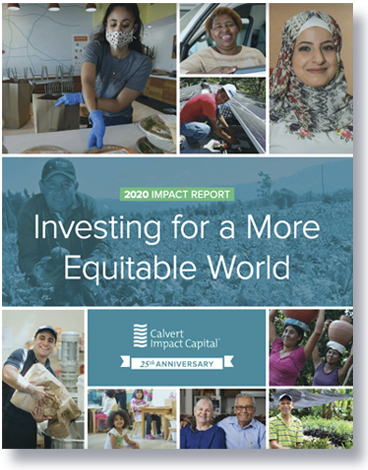
Download a copy of the Calvert Impact Capital’s 2020 Impact Report – Investing for a More Equitable World .


Article by Jennifer Pryce, President and CEO of Calvert Impact Capital. For nearly a quarter of a century, Calvert Impact Capital has strived to make markets work for more people, more often, by investing in communities overlooked by traditional finance. Calvert Impact Capital invests through organizations that on-lend to people and businesses in the US and over 120 countries. In 2017 the organizations in their portfolio provided more than $5 billion to finance everything from solar panels in Tanzania and small businesses in Texas. 

Over the past decade, Jenn has shaped the strategic direction of Calvert Impact Capital to focus on innovation, sustainability and scale. Under her leadership the organization has expanded the sectors it works in, developed new products and services, and committed to sharing their knowledge and expertise with the field on key topics like gender lens investing. Calvert Impact Capital remains committed to ensuring impact investing is accessible to all investors, large and small, having worked with more than 17,000 individuals, institutions and advisors to raise $2.5 billion since their founding.

Additional Articles, Food & Farming, Impact Investing, Sustainable Business
ESG Moves Towards a Single Standard

By John Howell, Climate and Capital Media

CCM Featured news for GreenMoney readersHas the Hydra-headed, variously defined beast known as ESG finally been harnessed into a single, overarching authority for values-driven investment?
ESG-driven products have continued to attract billions at a rapid rate during the last year, including a record $36 billion in October alone. The market keeps calling for a common set of rules to guide and govern such investments in a sector with an estimated 600 different ESG rating frameworks. Has that call been answered?

A newly created organization, The Value Reporting Foundation, formed by the merger of the Sustainability Accounting Standards Board (SASB) and the International Integrated Reporting Council (IIRC), looks to have stepped up to try. The foundation’s proposed goal: “providing investors and corporates with a comprehensive reporting framework across the full range of enterprise value drivers and standards to drive global sustainability performance.”

Both SASB and IIRC, leaders in their respective areas of operations, had asked for such joint action, along with some other climate-focused groups, including CDP (formerly the Carbon Disclosure Project), the Climate Disclosure Standards Board (CDSB), and the Global Reporting Initiative (GRI). Each of these organizations has distinctive origin stories and specific missions. But they share the common objective of establishing a reporting system that can measure and manage financial factors in business that are affected by climate change. Now, these multiple and overlapping systems look to become aligned (the “how”—the real nitty-gritty of the doing— is to be determined), creating a simplified reporting framework that will offer guidelines for practices, benchmarks and taxonomic definitions — in short, a commonly agreed-upon set of rules and regulations by which investors and advisors can confidently operate.

The SASB-IIRC merger is a result of the larger group’s manifesto, the Statement of Intent to Work Together Towards Comprehensive Corporate Reporting. In a statement, the Value Reporting Foundation says that it could “eventually integrate other entities focused on enterprise value creation.” Talks with CDSB are apparently underway, so presumably we’ll see more such integration of climate investment forces in the future.

Is this all happening a little too fast? While I am definitely an advocate for a more unified ESG investing sector, the more I dig into the issues at a granular level the more aware I’ve become of several speed bumps studding the ideal highway to a single, comprehensive ruling authority.

Six ESG’s in Search of an Authority

Some of those issues are outlined in a paper from the MIT Sloan School of Management—a 64-page tome I have only recently managed to finish. The title is appropriately descriptive: “Aggregate Confusion: The Divergence of ESG Ratings.” It’s a deep dive into the data of six prominent ESG ratings agencies: KLD (MSCI Stats), Sustainalytics (now part of Morningstar), Vigeo Eiris (Moody’s), RobecoSAM (S&P Global), Asset4 (Refinitiv) and MSCI. The authors — Florian Berg, Julian F Kölbel, and Roberto Rigobon — focus on differences in three areas:

1) Scope of categories

2) Measurement of categories

3) Weights of categories

The bottom line: The researchers “find that scope and measurement divergence are the main drivers, while weights divergence is less important.” In an additional finding, they “detect a ‘rater effect’ where a rater’s overall view of a firm influences the assessment of specific categories.” While the paper doesn’t deliver a clear view of the proprietary platforms of each agency, you do get a good sense of how ESG works within their different systems. For a sobering splash of cold reality, read the entire paper to get a full picture of current, existing complexities.

Four Things No One Will Tell You About ESG

Another paper, published by Harvard Business School, adds more fuel to this bonfire of confusion. “Four Things No One Will Tell You About ESG” expands on “the lack of transparency among data providers about peer group components and observed ranges for ESG metrics.” The bottom line finding by authors Sakis Kotsantonis and George Serafeim is that differences, discrepancies and disagreements inevitably create confusion in the ESG investment marketplace. Surprise, surprise. If you needed confirmation that a sole authority was necessary, this research proves the case.

In fact, today’s cautionary studies may be more of a look into the rear-view mirror: See the above-outlined efforts by SASB, IIRC and others to integrate resources.

More evidence of consolidation: In a strong vote of confidence in ESG as a reliable process (if not yet a unitary practice), Morningstar has integrated ESG into all its investment analysis. The company’s equity analysts are using Sustainalytics ESG Risk Ratings to evaluate a company’s exposure to material ESG risks. (Morningstar acquired Sustainalytics, an ESG ratings pioneer founded in 1992, this past summer.) Research results will factor into Morningstar’s assignment of a stock’s value of between one and five stars.

The more that ESG factors are judged as material to the bottom line, the more we should watch for this consolidation process to continue. These may once have been seen as “non-fiduciary” matters, but they are fast becoming key to all investment. Just follow the money.


Article by John Howell, a writer, editor, and broadcaster who oversees the Climate Finance Weekly newsletter for Climate & Capital Media and advises on communications and media strategy. He was co-founder, editorial director, and chief of thought leadership for 3BL Media, for which he managed all original editorial content, wrote, and edited newsletters, and created the Brands Taking Stands initiative. He has worked as an editor and contributor for Elle, Artforum, and High Times magazines, developed new media for Hearst Magazines, and created communications for Calvin Klein, Polo/Ralph Lauren, and The Body Shop. He lives and works in New Hampshire and Maine.

Additional Articles, Impact Investing, Sustainable Business

SRI and ESG Investors Advocacy

From the US SIF Foundation


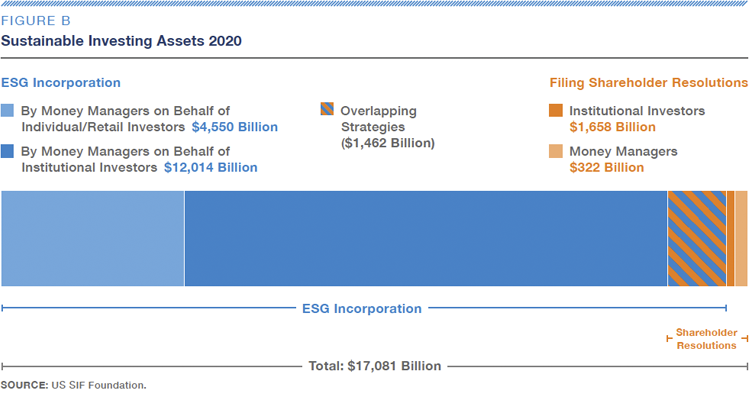
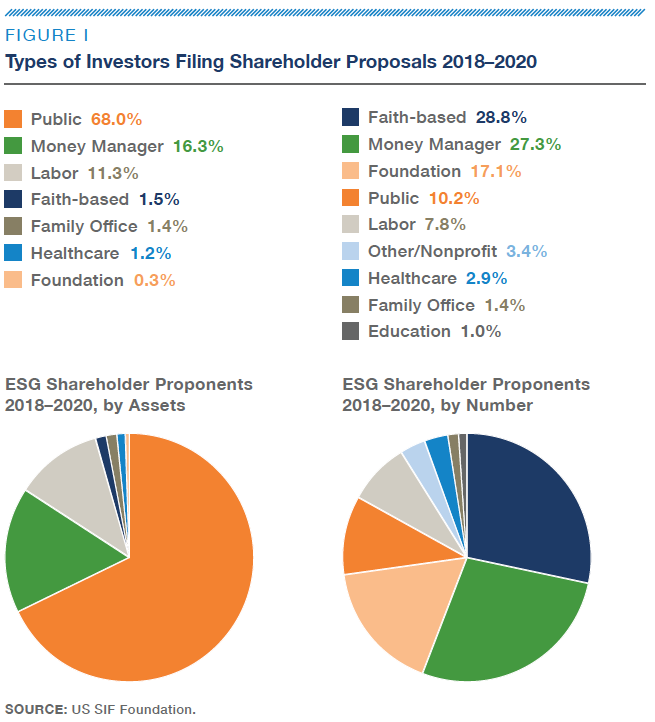
From 2018 through the first half of 2020, 149 institutional investors and 56 investment managers collectively controlling nearly $2.0 trillion in assets at the start of 2020 filed or co-filed shareholder resolutions on ESG issues. See Figures B and I.

Figure B-Sustainable Investing Assets 2020-Fig B-US SIF Foundation

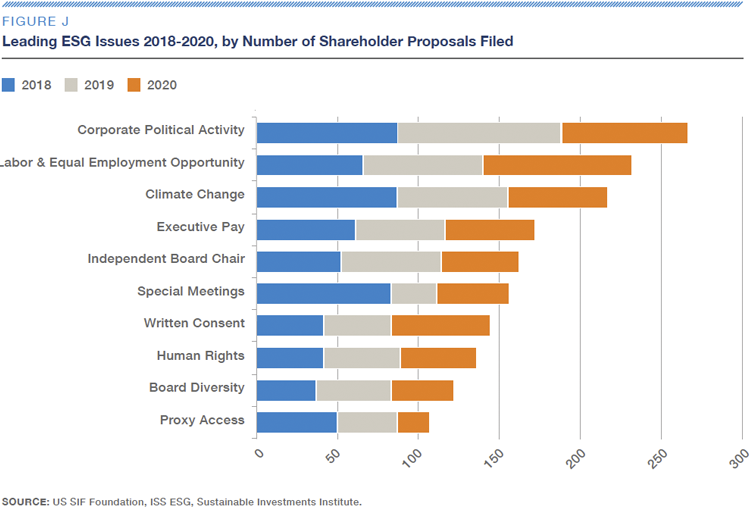
  • As shown in Figure J, below the leading issue raised in shareholder proposals, based on the number of proposals filed, from 2018 through 2020, was corporate political activity. Investors filed 270 proposals on this subject from 2018 through 2020. These resolutions focused on company contributions aimed at influencing elections or on corporate lobbying to influence laws and regulations. Many of the targets were companies that have supported lobbying organizations that oppose regulations to curb greenhouse gas emissions.

Fig-I-Types of Investors Filing Shareholder Proposals 2018–2020-US SIF

  • Fair labor and equal employment opportunity issues also rose to the top, with shareholders filing 228 proposals between 2018 and 2020, which included several resolutions calling for gender pay equity.
  • A surge in shareholder proposals on climate change that began in 2014, as investors wrestled with the prospects of “stranded” carbon assets and US and global efforts to curb greenhouse gas emissions, has continued: 217 proposals were filed from 2018 through 2020.
  • The proportion of shareholder proposals on social and environmental issues that receive high levels of support has been trending upward as well. During the proxy seasons of 2012-2014, only two shareholder proposals on environmental and social issues that were opposed by management received majority support, while 26 such proposals received majority support in 2018 through 2020.
  • Investors are engaging in other ways than filing shareholder resolutions. A subset of survey respondents, including 44 institutional asset owners with more than $1 trillion in total assets and 77 money managers with $7.8 trillion in assets under management, reported that they engaged in dialogue with companies on ESG issues.

Figure J–Leading ESG Issues 2018_2020 by Number of Shareholder Proposals Filed

SRI Trends Report 2020-US SIF-Cover

Order a copy of the Report on US Sustainable and Impact Investing Trends 2020 from the US SIF.

Energy & Climate, Featured Articles, Impact Investing, Sustainable Business

ESG Incorporation by Institutional Investors 2020

From the US SIF Foundation

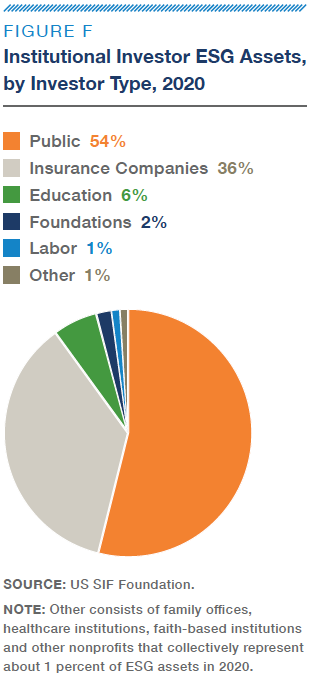
The US SIF Foundation also conducted research on 530 institutional asset owners with $6.2 trillion in ESG assets, equivalent to 51 percent of the $12.01 trillion that money managers identified as institutional assets. Because money managers do not disclose information about their institutional clients, the data received from our direct research of institutional investors shows how and why they incorporate ESG criteria into their investment analysis and portfolio selection. The institutional ESG incorporation trends revealed through this research should be understood as representing the most transparent institutional investors in the United States. The group included institutional asset owners and plan sponsors such as public funds, insurance companies, educational institutions, philanthropic foundations, labor funds, hospitals and healthcare plans, faith-based institutions, other nonprofits and family offices.

Fig-F-Institutional Investor ESG Assets by Investor Type 2020-US SIF

Of this $6.2 trillion in institutional ESG assets:

  • Public funds represented the largest share — 54 percent ($3.4 trillion) — as shown in Figure F.
  • Social criteria were applied to more than 92 percent. The assets managed in accordance with social criteria increased 9 percent since 2018, as shown in Figure G, above.
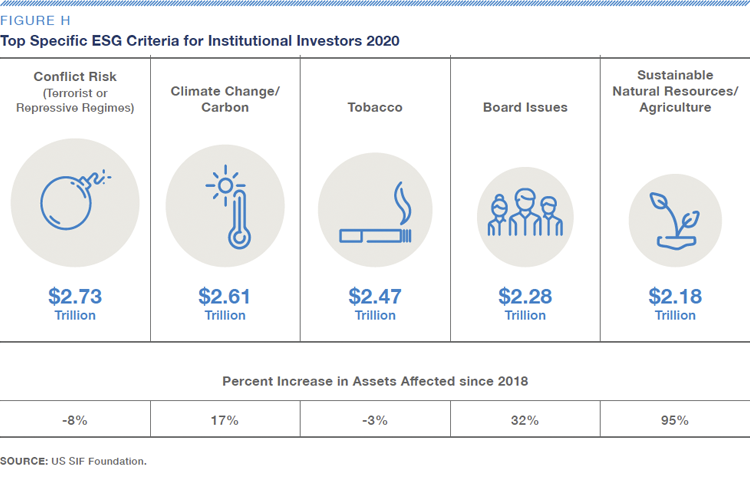
  • Investment policies related to conflict risk affected $2.7 trillion, as shown in Figure H, making it the single most prominent ESG criterion among institutional investors, in asset-weighted terms.
  • Continuing a trend that began in 2012, criteria related to climate change and carbon emissions remained the most important environmental issue for these institutions, affecting $2.6 trillion.
  • Tobacco remained in the top five specific ESG criteria for institutional investors, although slightly decreasing from 2018 by 3 percent to affect $2.5 trillion in assets in 2020.
  • Fig-H-Top Specific ESG Criteria for Institutional Investors 2020-US SIF
  • Board issues were the most prominent governance criterion reported by institutional investors, incorporated into the management of $2.3 trillion in assets, a 32 percent increase from 2018.
  • Sustainable natural resources and agriculture ranked as the second most heavily weighted environmental issue for institutional investors, affecting almost $2.2 trillion in assets, a 95 percent increase since 2018.

SRI Trends Report 2020-US SIF-Cover

Order a copy of the Report on US Sustainable and Impact Investing Trends 2020 from the US SIF.

Energy & Climate, Featured Articles, Impact Investing, Sustainable Business

X