Tag: Impact Investing

Koehler Group Invests in the European Circular Bioeconomy Fund

  • The European Circular Bioeconomy Fund (ECBF) has announced its third closing with significant financial commitments in order to reach its overall target of EUR 250 million
  • Koehler will be contributing EUR 5 million, with a focus on advancing new technologies and business models in view of expanding the circular economy and bioeconomy
  • The ECBF already counts companies such as Nestlé and Neste among its investors, as well as numerous private investors and family businesses

The Koehler group is investing in the European Circular Bioeconomy Fund (ECBF) with the aim of actively fostering the development of sustainable innovations and technologies. The ECBF is the first growth investment fund to be dedicated exclusively to projects in the field of the bioeconomy in Europe, including the accompanying circular economy. With a targeted fund size of EUR 250 million, the ECBF is set to become an important international financial instrument and to contribute to making Europe climate-neutral by 2050. Koehler is investing a total of EUR 5 million.

Spotlight on Innovations and Business Models that Promote the Circular Economy

Koehler Paper entered the flexible packaging paper market in 2019 with a EUR 300 million investment in a new manufacturing line for this type of paper, making this the largest investment in the history of the over 210-year-old company. The intention is for flexible packaging paper with functions specific to particular applications to replace plastic packaging in future. As Dr. Stefan Karrer, Chief Operating Officer at Koehler, says: “Koehler is specifically developing new products that meet the sustainability objectives of both its customers and of society as a whole, thereby establishing a leading role in the bioeconomy.” In doing so, the company is also tapping into new markets, for example thanks to its plans to start manufacturing bio-based materials for the rubber industry.

The circular economy conserves natural resources, and is one of the prerequisites for reaching the EU’s climate objectives in order to become climate-neutral by 2050. The Koehler Group is currently working on a range of innovations with a focus on circular economy concepts. “When developing innovations, we not only make use of internal expertise, but also rely on collaborations and start-ups. Our involvement in the ECBF will hopefully help to ensure that targeted funding is provided for promising technological developments,” Dr. Karrer continues. This not only pertains to technologies for Koehler Paper, but also to a range of other activities and business models within the Koehler Group.

Participation in the European Circular Bioeconomy Fund (ECBF): A Sustainable Investment

Participating in the ECBF represents a responsible and sustainable investment into a fund that, unlike many others, is focused on the long term. It works on the basis of a 10-year horizon, and concentrates on companies with growth potential in the bioeconomy, including the bio-based materials and industrial biotechnology sectors, in order to promote the circular economy through new technologies and innovations. How-ever, its contribution is not only a financial one: Its investors share their expertise at regular workshops on various market segments in order to identify promising target markets and investment opportunities for the ECBF. Koehler sees this as an opportunity to create synergies for the flexible packaging paper business area, for example in order to foster the development of bio-based barrier functions. However, the development of new business models based on the circular economy is also of paramount importance.

First Investments in Companies Already Made

Alongside Koehler, BÜFA and another private investor participated in the third closing of the ECBF. Michael Brandkamp, General Partner at ECBF Management GmbH is delighted by Koehler’s involvement: “What unites all of the investors in this fund is the desire to stimulate growth in innovative, bio-based companies and to promote solutions to pressing needs in the quest for sustainability. Thanks to its expertise in developing flexible packaging paper, Koehler is an asset to our fund and thus to the further development of the circular economy.” Together with the European Investment Bank (EIB) the ECBF, which has its headquarters in Luxembourg, has already made its first investments in companies. During the final phase of expansion, up to 25 companies with a high potential for innovation, and that are in an advanced stage of development, are set to receive funding.


About the Koehler Group

The Koehler Group was founded in 1807 and has been family-run from that moment to the present day. The group’s core business activity lies in the development and production of high-quality specialty paper. This includes—among others—thermal paper, playing cardboard, drinks coasters, fine paper, carbonless paper, recycled paper, decor paper, wood pulp board, sublimation paper, and also innovative specialty paper for the packaging industry since 2019. In Germany, the Koehler Group employs 2,500 people across five production sites, with three additional sites in the USA. The group has international operations, with exports of over 70% in 2020 and annual revenue of 770 million euros.

As an energy-intensive company, Koehler invests in renewable energy projects such as wind energy, hydropower, photovoltaics, and biomass. The Koehler Group has set a goal of producing more energy from renewable sources by 2030 than is required for its paper production operations.

About the ECBF

The European Circular Bioeconomy Fund (ECBF) invests in ambitious and visionary entrepreneurs and en-courages private and public investors to assist in the development of late-stage bioeconomy companies. The objective of the fund is to close the funding gap in the European bioeconomy, in particular in order to bring Europe’s first-class expertise in the field of circular technologies to the market. The ECBF is based in Luxembourg, is managed by Hauck & Aufhäuser Funds Services S.A. as Alternative Investment Fund Man-ager (AIFM) and is advised by an experienced investment team at ECBF Management GmbH. As a growth-stage venture capital fund, ECBF is able to offer both project financing and typical venture capital invest-ments.

The objective of the ECBF is to invest in the most promising investment targets in the European bioeconomy and to encourage private and public investors to participate in financing rounds.

Additional Articles, Energy & Climate, Impact Investing, Sustainable Business

The Next Steps Towards a Circular Economy

By Lydia Miller, Dana Investment Advisors

Lydia Miller - Dana Investment AdvisorsThe concept and acceptance of moving toward a circular economy have grown significantly in the last several years. While definitions vary, most focus on maximizing the value of materials, products, and other resources (i.e., water, energy) that circulate in the economy by maintaining them in the economy for as long as possible while also minimizing the consumption of materials and the generation of waste.1

The Ellen MacArthur Foundation has been a primary source of information on and driver of circular economic principles and practices, synthesizing many schools of thought (i.e., Cradle to Cradle, Biomimicry, and more). A circular economy moves beyond our take-make-waste industrial model and works toward designing products to eliminate waste and pollution and to regenerate natural systems. It’s a tall order for our complex global economy and demands a fundamental change within and across industries and stakeholders. It is an equally tall order to imagine achieving carbon emissions reduction and a more sustainable economy without both embracing a circular economy mindset and putting it into practice.

The Circularity Gap Report

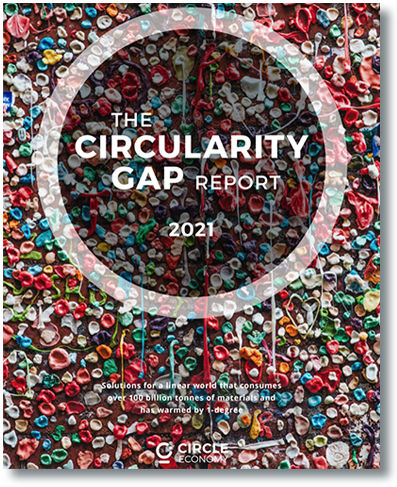
The Circularity Gap Report produced by the Amsterdam-based impact organization, Circle Economy quantifies the circularity rate, which is defined as recovered materials as a percentage of overall materials used in the global economy. Thus, the remainder is the “gap” and what we need to close. The Circularity Gap Report estimates that the global circularity rate remains at less than 10%.2 This may seem low, and it is. Putting circular economics into practice is challenging work, made even more difficult in light of COVID-19 impacts. The report also shows the major contributors along Resource (fossil fuels, minerals, ores, biomass, and waste), Process, Produce, and Provide stages, or in linear economy terms, “take-make-waste” functions. As investors, this breakdown helps us focus our questions and assessments on the most challenging area and/or those with the most potential for improvement on an industry and company basis. One final point is that the Circularity Gap Report for 2021 focuses explicitly on how a circular economy can mitigate the carbon emissions gap. We appreciate this work as it helps expand the potential opportunities to fix our environmental problems, in part by broadening mindsets and efforts beyond carbon reduction via fossil fuel reduction. While fossil fuel reduction is critical, we need as many doors opened as possible.

In terms of next steps for advancing the circular economy, we consider water a critical variable to add to the framework, as has been done with carbon emissions. Water, a necessity for life itself, is a key natural resource, maybe the key natural resource and input for almost everything we make and use. In discussing corporate efforts to reduce consumptive and non-consumptive water use over the past decade, setting targets and achieving or exceeding them have lowered some costs, but often it is energy cost savings that outstrip any savings in actual water costs. This is because water costs are low (until a crisis unfolds) and energy use and costs are often more significant in moving, storing, heating, and/or cooling water. Incorporating water specifically may also assist in identifying climate solutions that could actually increase risks to quality, quantity, or resilience of water in specific watersheds. If greater water usage, especially in stressed watersheds, is drawn upon to meet carbon targets, are we moving forward in our goals to achieve a greater circular economy? Clearly integrating efforts within and across companies and other stakeholders is worthwhile.

We are supportive of efforts to focus on watershed management and stewardship. This often brings agricultural and industrial entities to the table. Significant water loss due to inefficient irrigation and water-quality issues through runoff as well as extraction of freshwater above replenishment rates are critical agricultural issues. Pollution from utility, industrial, and extractive industrial activities often occur and compete within watersheds. The Alliance for Water Stewardship (AWS) is a global program that teaches and certifies best practices for watershed management and stewardship. While AWS in North America is still at early stages, it is encouraging to see the methodologies being put into practice and improved upon as more companies accept the challenges. We think that these watershed discussions and the mounting pressures for carbon reductions have the potential to move the needle on creating and adopting more circular manufacturing practices, thus achieving sustainability targets without exacerbating unintended consequences. Such discussions might also provide specific examples of balancing interests amongst various stakeholders in a particular watershed, thereby addressing social concerns. Lastly, costs of solutions need to be a part of these discussions. A focus on energy and water, particularly in agriculture, would also bring to light more cost effective, nature-based solutions. That in itself, would be a huge step forward.


Article by Lydia Miller, Senior Vice President and Portfolio Specialist with Dana Investment Advisors and focuses on the Firm’s Sustainability and ESG investment strategies. Prior to joining Dana, Lydia was a Managing Director at Big Path Capital (formerly Watershed Capital Group, a certified B Corporation). She was a Managing Director at UBS where she managed a global sustainability equity fund. Lydia is an advisor for Equarius Risk Analytics LLC and guest lectures at various universities on topics related to sustainability and portfolio management. Lydia graduated summa cum laude from the Pennsylvania State University and has an MBA in Finance and International Business from the University of Chicago.

Energy & Climate, Featured Articles, Impact Investing, Sustainable Business
3BL Media Announces 100 Best Corporate Citizens

Owens Corning, General Mills and HP top annual U.S. ranking measuring environmental, social and governance (ESG) transparency and performance

3BL Media recently announced its annual 100 Best Corporate Citizens ranking, recognizing leading environmental, social and governance (ESG) transparency and performance amongst the 1,000 largest U.S. public companies.

Owens Corning tops the ranking for the third consecutive year and is the first company ever to do so. Owens Corning is followed by General Mills, HP, Cisco, and Intel.

Since 2009, only 19 companies have made the ranking each year: 3M, Abbott, Accenture, Baxter, Bristol Myers-Squibb, Cisco, Colgate-Palmolive, Eaton, General Mills, Hess, IBM, Johnson Controls, Intel, Microsoft, Nike, PepsiCo, Gap, Weyerhaeuser, and Xerox.

Twenty-four companies are new to the 100 Best in 2021, 14 of which are appearing for the first time. The companies making their first appearance are: AptarGroup, The AES Corporation, ON Semiconductor, Crown Holdings, Prologis, Walmart, Marathon Petroleum, Host Hotels & Resorts, Walgreens Boots Alliance, LyondellBasell Industries, Boston Scientific Corporation, Regeneron, Essential Utilities and Kilroy Realty Corporation.

View the 100 Best Corporate Citizens of 2021 ranking here.

“The next decade is pivotal if we are to achieve global climate and societal goals and rebuild an inclusive and resilient economy,” said Dave Armon, CEO of 3BL Media, which owns the 100 Best Corporate Citizens ranking. “Achieving these transformational outcomes depends on corporate leadership and transparency on ESG topics. Through 100 Best Corporate Citizens, 3BL Media has set a standard for transparency that advances corporate accountability.”

The 100 Best Corporate Citizens methodology is set by 3BL Media and based on 146 ESG transparency and performance factors across eight pillars: Climate Change; Employee Relations; Environment; ESG Performance; Finance; Governance; Human Rights; Stakeholders and Society. There are also several factors within the 2021 methodology that account for the response to the various social issues emerging during the pandemic.

Additionally, thanks to a partnership with InfluenceMap, an organization that maintains the world’s leading database of corporate lobbying on climate policy, the 2021 ranking ensures that ranked companies’ political actions are aligned with the Paris Agreement.

“In response to the many crises of 2020, the demands for corporate transparency, accountability and leadership have never been louder. Stakeholders at all levels are interested in how companies are engaging on issues from COVID-19 and climate change to systemic racism and voting rights,” Armon continued. “That is why we’ve moved to measure performance on these emergent issues and increase our scrutiny of political actions, to ensure that corporate citizenship is defined by both internal action and external lobbying efforts.”

To compile the ranking, data and information is obtained from public sources only, rather than questionnaires or company submissions. Research is conducted by ISS ESG, the responsible investment research arm of Institutional Shareholder Services. There is no fee or costs for companies to be assessed or to verify research by ISS ESG.


About the 100 Best Corporate Citizens

The 100 Best Corporate Citizens ranking was first published in 1999 in Business Ethics Magazine and then by Corporate Responsibility Magazine from 2007 to 2019. 3BL Media has owned 100 Best Corporate Citizens since 2017 and continues the legacy of ranking the Russell 1000 Index against a set of ESG transparency and performance factors using only public data and information. Learn more here.

About 3BL Media
3BL Media delivers purpose-driven communications for the world’s leading companies. Our unrivaled distribution, editorial and leadership platforms inspire and support global sustainable business. Learn more
here.

Additional Articles, Energy & Climate, Food & Farming, Impact Investing, Sustainable Business

Beyond Investing Expands Range of Animal-Friendly Investment Products

Launch of Europe Vegan Climate Index, Vegan World Index Certificate and US, UK and global vegan venture capital funds

In June 2021, Beyond Investing announced it is launching five new investment products in partnership with its affiliate Beyond Impact. The products are spread across both public and private markets, provide more options to investors, and further Beyond Investing’s mission of a world free of animal exploitation.

Beyond Investing is the world’s first and only vegan investment platform and the creator of the US Vegan Climate Index, launched in 2018 and tracked by the US Vegan Climate ETF (ticker: VEGN) since September 2019. Assets tracking the Index (which includes the recently launched US Vegan Climate Index Certificate) have grown to over $55 million. Beyond Impact has operated an impact venture capital vehicle investing in plant-based and alternative protein companies since 2017.

The five new investment products are:

  • Europe Vegan Climate Index
  • Vegan World Index Certificate
  • Beyond Impact vegan venture capital funds
    – Vegan Diversity Fund
    – Vegan Diversity S/EIS Fund
    – Beyond Impact Fund II

Europe Vegan Climate Index

The platform extends its range of large cap ESG stock indexes with the Europe Vegan Climate Index. This pan-European index applies the same policies as the US Vegan Climate Index.

Criteria for exclusion include:

  • Animal testing
  • Animal-derived products
  • Animals in sport and entertainment
  • Fossil fuel production
  • Energy production from fossil fuel
  • Other environmental concerns
  • Military and defense
  • Financing of excluded activities

These exclusions remove approximately 54% of the market capitalization of the Solactive GBS Developed Markets Europe Large & Mid Cap EUR Index.

The new index will be calculated real-time by Solactive and published on Bloomberg under the ticker “VEGANE” from 3rd June 2021.

Vegan World Index Certificate

In a collaboration with UK FCA-regulated specialist ESG manager Impact-Cubed it has created the Vegan World Index of global small to mid-cap growth companies producing plant-based and cruelty-free products. This will be available for investment through the launch of the Vegan World Index Certificate, which will be quoted on the Leonteq structured products platform from 15 June 2021.

The Vegan World Index applies the same exclusions as its Vegan Climate indexes, but instead of including all eligible companies in its universe, it proactively targets companies with products relevant to the trend away from the use of animals. Constituents will include not only headlining vegan companies such as Beyond Meat and the recently listed Oatly, but also more under-the-radar companies in Asia and the emerging markets in consumer products, food, agriculture, materials and ingredients sectors, which are part of the plant-based supply chain.

Beyond Impact Vegan Venture Capital Funds

Beyond Impact, with its specialism in animal-free impact investing, is launching three venture capital funds to provide seed and growth funding to entrepreneurs whose products and services obviate the use of animals. Beyond Impact has been an active investor in this space since 2017, its portfolio including some of the earliest rounds of cellular agriculture companies, like Mosa Meat and Blue Nalu, alternative protein, such as Geltor and Clara Foods, and plant-based brands, such has Meatless Farm and Mighty Pea, along with other companies who, since their initial investment, have gone on to raise 100s of millions of dollars.

Its Vegan Diversity Fund will launch on the Angelist platform on July 1st 2021 with the goal of seeding primarily US companies with diverse founding teams, to ensure a continuing stream of entrepreneurs entering the plant-based space, with innovative products that expand the range of vegan options available. A similar Vegan Diversity Fund is in the process of being launched in collaboration with Sapphire Capital Partners LLP, to provide seed and early-stage financing to diverse teams of UK founders, whilst taking advantage of the SEIS and EIS tax advantages available to qualifying UK-based investors.

Beyond Impact already boasts significantly better metrics for gender and racial diversity within its first vehicle than the venture capital industry as a whole, with close to half its current portfolio companies co-founded or led by a woman, and almost 40% co-founded or led by members of other minority groups.

Finally, Beyond Impact is launching a global flagship institutional fund, Beyond Impact Fund II, to continue its trailblazing strategy of investing in companies that accelerate our transition towards a kinder, cleaner, healthier world. This fund will participate in larger seed raises from start-ups with disruptive technology as well as providing follow-on funding to existing portfolio and other later stage companies to fuel their growth.

Claire Smith, CEO of Beyond Investing and CIO of Beyond Impact, brings 35 years of senior level finance and investment experience at UBS and alternatives advisory firm Albourne Partners, and, in this expansion of her venture capital activities, she is joined by four other professionals with expertise in food and agtech investing, food company operations, industrial processing and impact venture funds.

Smith founded Beyond Investing in 2017 with Larry Abele of Impact-Cubed and Lee Coates of Ethical Investors, to provide animal-friendly investment solutions for vegans and environmentalists within public listed markets. Beyond Impact directly invests in companies that provide superior, scalable and sustainable solutions to the social, environmental, and moral concerns associated with animal exploitation, providing market access and targeting substantial value to investors.

Comments Smith, “Unlike others, our expertise and investment experience extends across both public and private markets, particularly important since companies are moving rapidly through investment rounds and may have the opportunity to IPO. Through identifying exceptional entrepreneurs whose companies have the potential to grow quickly, we aim to have large-scale positive impact and produce superior returns to our investors. The more listed companies there are, the more complete our solution becomes in our public market portfolios, and we expect the universe of companies for the Vegan World Index to grow strongly in coming months and years.”

Beyond Investing and Beyond Impact claim to contribute to the achievement of 12 of the 17 United Nations Sustainable Development Goals, across themes of hunger, sustainability, climate, biodiversity, health, water, work, clean energy and gender equality. Metrics produced by Impact-Cubed demonstrate a 76% lower carbon footprint, 97% lower waste generation and 90% less water consumption by companies in its US Vegan Climate Index, versus the market benchmark S&P 500 Index.


About Beyond Investing

Beyond Investing is a vegan investment platform comprising Beyond Investing, a US-based registered investment adviser, Beyond Advisors, a Jersey-based research firm, and Beyond Impact Advisors a Swiss-based investment advisor. It is owned by three experienced investment professionals who follow a vegan lifestyle: CEO Claire Smith who has 35 years’ experience working in the finance industry at UBS and as a partner at Albourne in fund research; Lee Coates, OBE, of UK financial advisor Ethical Investors and founder of Cruelty Free Super in Australia; and Larry Abele, founder of Impact-Cubed, an FCA-regulated asset manager recognized for its leadership in ESG research and investing. Visit www.beyondinvesting.co for more information.

For more information on the US Vegan Climate ETF and important disclosures, please visit www.veganetf.com

For more information on the US Vegan Climate Index Certificate, please visit https://dynamiccapitalgroup.com/en/products/

For more information on the Vegan World Index Certificate, please visit https://structuredproducts-ch.leonteq.com/

For information on the Beyond Impact US Vegan Diversity Fund, please visit https://angel.co/v/back/beyond-impact-vegan-diversity-fund

The fund’s investment objectives, risks, charges and expenses must be considered carefully before investing. The prospectus contains this and other important information about the investment company, and it may be obtained by calling 1-800-617-0004 or visiting www.veganetf.com . Read it carefully before investing.

This list is only partial and these investments are not representative of the entire portfolio. Most early-stage investments fail. A complete list of past investments is available upon request.

Beyond Investing LLC is the adviser to the US Vegan Climate ETF. VEGN is distributed by Quasar Distributors, LLC.

Additional Articles, Food & Farming, Impact Investing, Sustainable Business

Green Finance Goes Mainstream, Lining Up Trillions Behind Global Energy Transition

A wind turbine operated by Dominion Energy off the coast of Virginia Beach, Va. Photo by Julia Rendleman for The Wall Street Journal.

After years of intermittent excitement and fizzled expectations, environmental-oriented investing is no longer just a niche interest

Some of the world’s biggest companies and deepest-pocketed investors are lining up trillions of dollars to finance a shift away from fossil fuels. Assets in investment funds focused partly on the environment reached almost $2 trillion globally in the first quarter, more than tripling in three years. Investors are putting $3 billion a day into these funds. More than $5 billion worth of bonds and loans designed to fund green initiatives are now issued every day. The two biggest U.S. banks pledged $4 trillion in climate-oriented financing over the next decade.
“We’ve reached the tipping point and beyond,” said James Chapman, chief financial officer at Dominion Energy Inc., one of the country’s biggest utilities. Dominion, which has begun issuing green bonds, is planning to spend $26 billion or more on clean energy such as wind and solar in the next five years.

After years of intermittent excitement followed by fizzled expectations, green finance is now looking less like the niche interest of socially conscious investors and more like a sustainable gold rush. Driven by surging valuations for electric-vehicle companies such as Tesla Inc. and startup battery producers, banks and investors are betting the transition from fossil fuels is here to stay, and that they can make money by getting behind it, further entrenching the shift.

Behind the geyser of capital is a confluence of forces. Big money managers see opportunities for substantial profits, and they also worry about financial risks associated with climate change. Many of their clients—giant pension funds and fast-trading young investors alike—want to put their wallets behind projects that aim to curb environmental damage.

Read the full article by Scott Patterson and Amrith Ramkumar of the Wall Street Journal.

Additional Articles, Energy & Climate, Impact Investing, Sustainable Business

A Better World?

By Cynthia Curtis, JLL

Cynthia Curtis-JLL-GreenMoney Striving for something better is a very human thing. Whether it be a better house, better clothes, a better job, it’s our nature to seek a future, which is an improvement upon the current state. The definition of better, of course, can be as unique as the individual. But when you widen the aperture and pose the question, ‘what does a better world look like?’, it forces consideration of the collective.
JLL’s purpose is to shape the future of real estate for a better world. This isn’t a new purpose for JLL, for over 250 years we’ve been at the heart of real estate bringing diverse thinking and perspectives to investors and businesses worldwide. But over the last 18 months we’ve delved deeper into the various dimensions of that statement. The pandemic, for example, resulted in a top-to-bottom evaluation of our role, as a leading real estate and investment management services firm, in contributing to the future of health. But with the built environment accounting for approximately 38% of global energy consumption and 40% of total direct and indirect CO2 emissions, we knew addressing climate change was fundamental to our purpose. For us – and the title of our new Global Sustainability Report 2020 – a better world is a net zero world.

Hence, in May 2021, we took the bold step of committing to net zero carbon by 2040 across all areas of our operations, as well as all the sites we manage for our clients and our extensive global corporate supply chain. Further, we’ll deliver against that goal with no more than 5% offsets, fully abating 95% of our 2018 baseline GHG emissions.

With over 95% of JLL’s emissions coming from our client portfolios, key to our net zero trajectory is helping all our clients with their decarbonization journey. Importantly, many if not most of our clients have their own reduction targets. And, as JLL’s new research, Responsible Real Estate – Decarbonizing the Built Environment shows, the real estate industry has accelerated its focus on responsibility and social purpose, with occupiers and investors making strong commitments to decarbonize and build back better for the future. Coupled with the anticipated growth in carbon regulation, an increasing number of solutions include renewable energy.

In 2020 alone, JLL provided advice on renewable energy projects (either installed or received planning consent) estimated to have averted more than 20,627 metric tons of CO2e. Furthermore, if advised renewable energy projects in the planning and feasibility stages achieve planning consent or successful development, there is the potential to avoid more than 287,919 additional metric tons of CO2e.

Washington Metro Area Transit Authority-JLL-GreenMoney

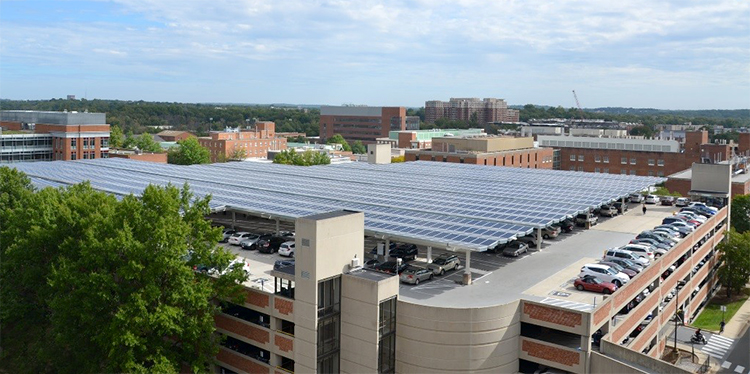
One project example is the Washington Metropolitan Area Transit Authority (Metro). Serving the Washington, D.C. region, Metro is the second-largest transit system in the United States. In support of the Clean Energy DC plan to reduce emissions by 56% in 2032 over a baseline year of 2005, Wash. D.C has incentive programs for solar energy projects. Metro saw an opportunity to create a new revenue stream while increasing its impact on regional carbon emissions reductions. They enlisted JLL to help.

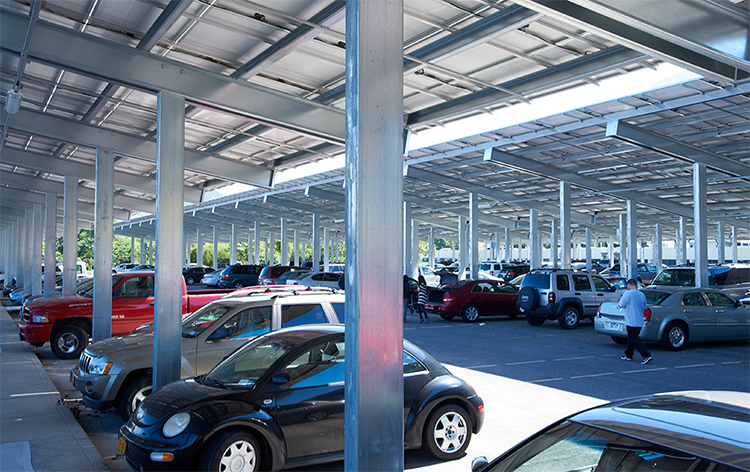
The project’s financial viability depended on choosing locations covered by the D.C. solar incentives and where interconnection was feasible. The result was an innovative solution to install 17 acres of solar panels on garage rooftops and parking lot canopies. Upon completion, it will be the largest solar project in the region, generating 12.8 MWh of power that will provide clean energy to approximately 1,500 single-family area homes. At no cost to Metro, the project will provide $50 million in revenue over a 25-year solar power agreement.

Washington Metro Area Transit Authority parking lot solar canopy-JLL-GreenMoney

This win-win-win project, brought to life in this short film, provides a blueprint for further options to help the Washington region achieve its sustainability goals.

Creative solutions like Metro weren’t possible all that long ago, however. Solar and wind farms are a fairly common sight today. That wasn’t the case a decade ago when the U.S. Department of Energy Loan Program Office (LPO) financed the nation’s first five utility-scale photovoltaic (PV) solar power projects. These landmark projects proved the feasibility of the concept and sparked the development of the commercial market for utility-scale PV solar power. But the story is little known.

LPO had to overcome many challenges to establish the financial, technical, legal, and environmental experience to fulfill its mission. Through American Recovery and Reinvestment Act, the LPO gained $16 billion in capital to lend – within a two-year window. LPO needed to scale its operations to rapidly deploy its available capital in the tight timeline.

They tapped JLL to help develop every aspect of its lending programs, from financial analyses and management, loan structures, and credit policies to risk rating tools, origination practices, and more. The team also helped LPO establish an enterprise risk management framework. With its portfolio rapidly expanding, we supported LPO’s portfolio management operations by implementing a digital management system to streamline workflows.

Since 2010, LPO-financed projects have helped the U.S. avoid more than 60 million metric tons of CO2 emissions. In addition, its auto manufacturing loans have supported production of more than 20 million EVs, and its energy projects have generated 73,473-gigawatt-hours of electricity.

These are just two examples of the dramatic impact creative collaborations can have. Together with our clients we’re committed to drive disruptive, meaningful change at scale. We will continue invest in sustainability services and capabilities across our entire enterprise, building on the strength of our global platform to create a net zero – and indeed better – world.


Article by Cynthia Curtis, Senior VP of sustainability stakeholder engagement for JLL, responsible for elevating JLL’s sustainability program, Building a Better Tomorrow, embedding it broadly throughout the business and driving meaningful impact with and through JLL’s clients. Included in her scope is delivering against JLL’s science-based target of reducing scope 3 emissions from the properties that it manages on behalf of clients. She serves as the company’s representative on the World Green Building Council’s Corporate Advisory Board. Cynthia also collaborates with the Investor Relations team to ensure its investors have a more complete understanding of JLL’s competencies, goals and impacts.

Cynthia serves on the Board of Directors for Greenback Renewable Energy Company, LLC, which is dedicated to investing in projects and managing capital for its public shareholders as well as institutional investors in the sustainable infrastructure sector. Previously, Curtis has worked in the public, private and non-profit sectors, including Ceres and CA Technologies, where she served as vice president and chief sustainability officer. She lives in the Boston area, is a member of the New England Women in Energy and the Environment, chairs the Wellesley Village Church Energy Committee, and built one of the region’s first gold LEED-certified residences.

Additional Articles, Energy & Climate, Impact Investing, Sustainable Business

State of the Green Building Industry

By Deisy Verdinez, U.S. Green Building Council

Deisy Verdinez of US Green Building CouncilAbove: Pharmavite headquarters, maker of dietary supplements MegaFood and Nature Made; LEED v4 Certified and reflect the company’s mission of promoting better health worldwide. © Eric Laignel

There’s renewed commitment from companies and organizations to run their business and operations in more sustainable ways. As communities and consumers begin to demand more from organizations to do more to support their communities, many are not only including sustainability in corporate social responsibility plans but are also are setting ambitious goals to reduce their impacts on the environment. And they’re making real strides in achieving these goals.

For over 25 years, The U.S. Green Building Council (USGBC) has supported its members – which include corporations, small businesses, government entities and nonprofits – to achieve their green building goals through its Leadership in Energy and Environmental Design (LEED) program. LEED is the world’s most widely used green building rating system and promotes the use of strategies that reduce environmental impact, enhance human health and support economic development. Currently, there are over 102,000 LEED certified projects across nearly 180 countries and territories.

USGBC continues to evolve LEED, adapting the program based on public feedback and the latest in green building innovation. Today’s version, LEED v4.1, raises the bar on building standards to address energy efficiency, water conservation, site selection, material selection, day lighting and waste reduction. LEED prioritizes sustainable materials, helping manufacturers to design, produce and deliver building materials that reduce a building’s environmental impact.

Companies and organizations are seeing the benefits of adopting LEED certification into their sustainability plans. With LEED, certified buildings are consuming fewer resources, reducing operating costs, increasing value and creating safer and healthier environments for its occupants.

But the newest version of LEED goes beyond design and construction of the building and takes into consideration the building’s most important asset – the people living, working and using these buildings. In fact, LEED v4.1 supports projects to implement sustainable and healthy building practices to realize environmental, economic, social and community benefits for decades to come. The specific focus on social equity ensures that buildings are not considered in isolation of their communities but prioritize access and inclusiveness for all and ensures buildings are resilient from natural and unnatural disturbances.

DATA 1 - USGBC
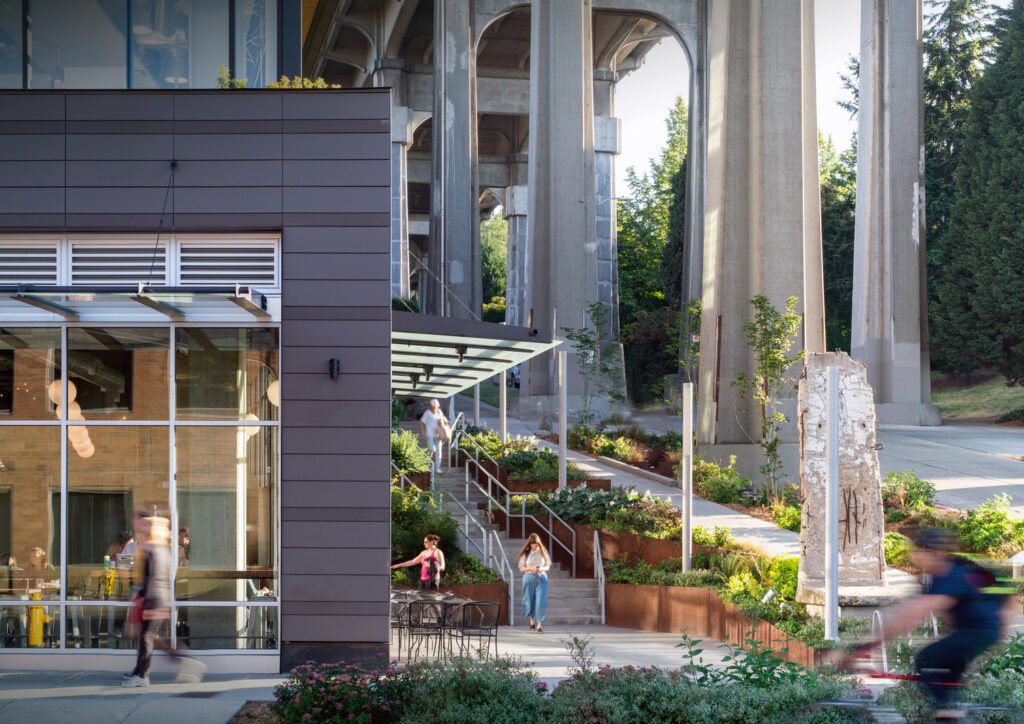
Reflecting an evolving typology of urban mid-rise office buildings within neighborhood retail cores, the Fremont Office Building in Seattle is a LEED Gold v3 Core and Shell building, completed in 2017.

Rethinking our Environments

Over the last year, we all had to rethink the environments in which we live and work. USGBC also reflected on the events of 2020 and in response launched its Healthy Economy Strategy, a path for how healthy places and LEED will support recovery efforts as businesses, governments and communities prepare for a post-pandemic world.

LEED Gold certified DATA 1 Seattle © Ye-H Photography
LEED Gold certified DATA 1, Seattle ©Ye-H Photography

To support its members as business and workplaces reopen in the midst of the COVID-19 pandemic, USGBC released the six LEED Safety First Pilot Credits. These credits outline sustainable best practices related to cleaning and disinfecting, workplace reoccupancy, HVAC and plumbing operations, social equity as well as pandemic preparedness and response and support project teams working toward reentry and safe operation.

More than 150 projects have started using the LEED Safety First pilot credits, such as Miron Construction, a century-old private company. It is using the credits in its Madison, Milwaukee, and Green Bay offices, for which it is pursuing LEED Silver certification, and is also implementing them in its LEED-certified offices in Neenah, Wisconsin and Cedar Rapids, Iowa.

The credits will continue to evolve as more communities re-open and as science and information are updated. The LEED Safety First Pilot Credits were designed to be agile so USGBC can update them as we learn more about the virus that causes COVID-19, while also incorporating membership feedback and best practices.

The Race to Net Zero

We’re also seeing companies make commitments to become carbon neutral as the threat of climate change continues to become more prevalent in our everyday lives. Building and construction account for 39 percent of the carbon emissions in the world, according to the World Green Building Council, and the use of energy and water in buildings emits 28 percent of emissions.

The wider green building community is taking notice and setting its sights squarely on zero. Industry groups like Architecture 2030 created the 2030 Challenge back in 2006, and the engineering arm of the building industry issued its own call to zero in the Structural Engineers 2050 Commitment Program (“SE2050”).

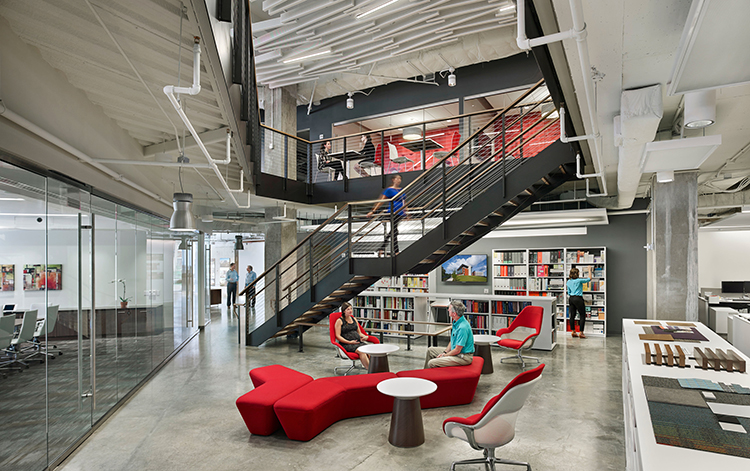
HDR Arlington office
The HDR regional office in Arlington, VA is a LEED Certified Platinum space that is designed to demonstrate how the built environment can be a powerful tool to create identity and rebrand an office culture.

USGBC developed LEED Zero, a complement to LEED that verifies the achievement of net zero goals. LEED Zero Carbon recognizes buildings or spaces operating with net zero carbon emissions from energy consumption and occupant transportation to carbon emissions avoided or offset over a period of 12 months. Projects can earn certification in LEED Zero Carbon, LEED Zero Energy, LEED Zero Water and LEED Zero Waste.

And we’re seeing more and more decision-makers ranging from state governments to major corporations pledging to go net zero or net positive. Some of the first LEED Zero certified projects include Entegrity Partners in Arkansas, Discovery Elementary School in Virginia, and even the Curitiba headquarters of Brazilian engineering and green building consulting firm Petinelli.

Corporations are also being recognized for their efforts in taking these pledges and turning them into action. During the 2021 USGBC Live conference in June, Colgate-Palmolive’s Burlington, N.J., facility was recognized for becoming the first site in the world to achieve LEED Zero certification in all four LEED Zero categories.

For decades, the green building industry has demonstrated how sustainable practices are not just beneficial for the environment but also shown how adopting these measures can improve the efficiency and costs effectiveness of an organization’s operations. It’s an exciting time for the building sector. As more groups adopt these measures, the industry will continue to push the envelope, creating innovative ways to build in a smarter and more sustainable way. USGBC will continue to evolve LEED and provide tools to support the industry.


Article by Deisy Verdinez, who supports the US Green Building Council’s communications efforts, working with media and partners to amplify USGBC’s message. Deisy have more than a decade of media and communications experience and has worked with prominent international organizations, nonprofits and federal government agencies.

Energy & Climate, Featured Articles, Impact Investing, Sustainable Business

Ecofin Strives to Make a Positive Impact Without Compromising Returns

By Brent Newcomb, Ecofin

Brent Newcomb of EcofinWho We Are

Ecofin is a sustainable investment firm that’s passionate about striving to deliver strong risk-adjusted returns while making a true impact on the environment and society.

Our roots date to the 1990s as a London-based boutique advisory firm focused on water and energy infrastructure. In the early 2000s, Ecofin began managing money as a utility-focused investment manager and by the end of the decade, was awarded an environment-related mandate from a large Scandinavian sovereign wealth fund.

In 2018, we sought a partner to help fuel our growth, including in the US. We ended up merging with Tortoise, an essential asset investment firm, which had begun shifting its strategic focus to sustainability in 2016. What we found was a shared vision that sustainable investing does not compromise performance to make an impact. Moreover, we shared a view that we are experiencing a sustainability revolution with decades of growth ahead of us, along with exponential impact to the environment, society and in communities.

When we joined Tortoise in 2018, we retained the Ecofin brand as a platform for our products, which now includes all of our sustainability-oriented strategies. Today, Ecofin is the result of a deliberate process between 2016 and 2018 to bring together experts and world-class investors with decades of experience in sustainable investing. Our team invests in both private and public market strategies across the following major themes: climate action, water and social impact.

What makes us different and is the source of our strength, is our talented team. This is demonstrated in our performance and in our perspectives on the future, which aligns with our devotion to the sustainability revolution and our commitment to investments that help solve pressing global challenges, while creating compounding wealth opportunities for our clients.

What We Do

We are a sustainable specialist dedicated to climate action, social impact and water.

First, climate action is the drive to reduce emissions, and includes both the energy transition and waste transition.  This means conventional categories such as solar, wind, hydro and batteries, in addition to the electrification of transport, energy efficiency, waste-to-value (recycling) and waste-to-energy (cleaner fuels such as renewable natural gas).

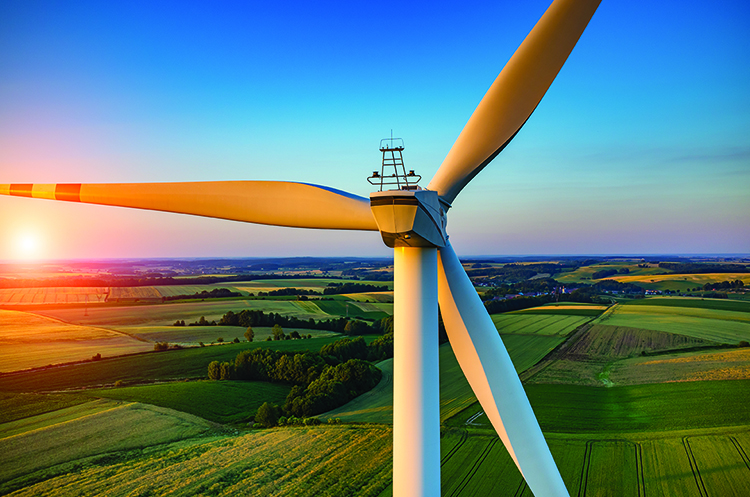
EcoFin Turbine-2 - GreenMoney

Second, our investments in social impact focus on providing access to quality education, particularly the underserved population, as well as affordable housing and equal access to healthcare and sustainable communities.

Third, our water investments endeavor to help provide access to clean water and improve water scarcity and sanitation.

Across all themes, we focus on companies and assets that we believe provide investors with the opportunity to compound wealth and preserve capital, while providing a social good.

Why We Do It

Some of the world’s most pressing challenges have been given newfound attention. The devotion to these issues is the bedrock of the Sustainability Revolution. These are long-term secular themes and structural changes occurring on a global scale. We believe we are in the early stages of a multi-decade tectonic shift. The consequences of these changes are shifts in how we make basic decisions, how we consume resources and how we live on the planet. The shift in behavior is also re-shaping the investment landscape.

After decades of debate and procrastination, in our view, it is now clear these forces of change are irreversible and here to stay, strengthened by demands from multiple generations. The power of these forces makes sustainable investing a GARP-like strategy (Growth At a Reasonable Price), and in some cases, tech-like, in which companies’ growth potentials and valuations are misunderstood. They have aggressive growth prospects where value is not appreciated.

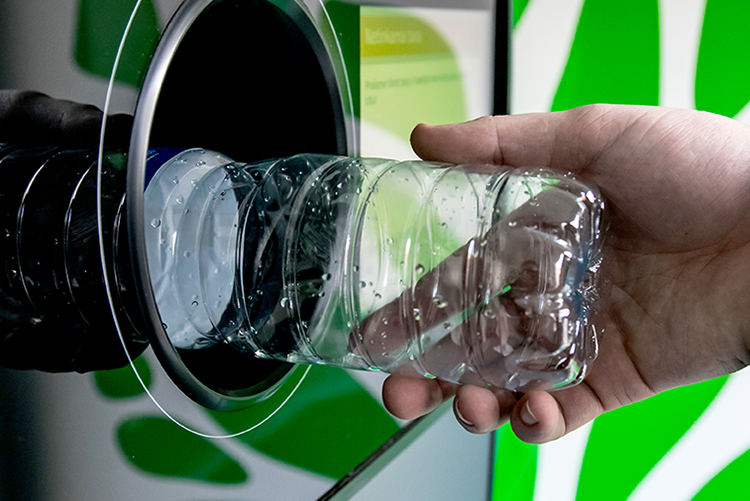
Reverse,Vending,Recycling,Machine.,Recycling,Machine,That,Dispenses,Cash.,Man
Reverse vending recycling machine – a recycling machine that dispenses cash

Addressing societal and environmental challenges can be a highly profitable business. This is part of the conscious capitalism philosophy that businesses should operate ethically while pursuing profits. Many companies are growing their top and bottom lines and benefitting from rapidly improving growth prospects, multiple expansion and lower cost of debt. Moreover, the expanding pool of ESG capital is bringing greater awareness and receptivity to their stocks. In addition, we think these companies will have better access to talent, and be less exposed to certain regulatory risks and the risks posed by environmental and social variables. The companies that are dedicated to sustainable practices – and providing transparency – have been attracting lower costs of capital and experiencing the early stages of a “sustainability premium”.

Key Drivers of Growth

Three key bills are before Congress that could have a significant impact on the energy sector: The Build Back Better, Green and Clean Future Acts.  Of course, others may well emerge. One of the biggest objectives of the Biden administration is to commit America to a Zero Net Carbon goal by 2050 and to attach some meaningful near-term targets and opportunities to achieve that. Specifically the White House wants 100 percent decarbonization of the utility system by 2035.

These bills will undoubtedly take multiple twists and turns, but with control of the White House and Congress we think it is highly likely some form of these bills will pass. Wealth creation with adding new sources of energy to the system over the past 100 plus years has been bigger than you can calculate. But it was all carbon. Now we’re decarbonizing and we have options because of technology.  We have the will because people, governments and corporations know it’s worth their time.

Looking to the Future

The case for a return-oriented approach to sustainable investing has become clear. The impact of addressing sustainable issues, from climate change to racial and social justice, has become a compelling investment case and, just as important, not factoring these issues represents an investment risk. Societies desire to accelerate the transformation to greener, decarbonized and more sustainable economies. These powerful and secular forces can generate substantial wealth creation and compelling risk-adjusted investment opportunities for both companies and investors for the many decades to come. Ecofin is up for the challenge of striving to deliver strong risk-adjusted returns to investors, while also making a positive impact on society.


Article by Brent Newcomb, President of Ecofin.  Mr. Newcomb joined the firm in 2014 and is a member of the Executive Committee and Ecofin Development Committee and serves as President of Ecofin. He is a member of investment committees for various Ecofin investment strategies as well as Tortoise Essential Assets Income Term Fund. Previously, Mr. Newcomb worked for GCM Grosvenor where he focused on portfolio management. He earned a Bachelor of Science degree in business administration from the University of Kansas and a Master of Business Administration degree from the University of Chicago Booth School Of Business.

Energy & Climate, Featured Articles, Impact Investing, Sustainable Business

The Second Wave of Sustainability is Health and Wellbeing

By Sam Adams, VERT Asset Management

Kilroy Realty’s Columbia Square Residence Tower: First apartment rental project to achieve WELL Multifamily Residential Certification

For health and wellbeing in buildings, a wellness certification for a building was a luxury a year ago. Now some consider it a must have, and a way to encourage workers back to the office.

Sam Adams-VERT Asset MgmtWe humans typically spend 90 percent of our time indoors. Perhaps that’s why many us are somewhat complacent about buildings. We generally assume they are safe places to be. The pandemic changed all that. Suddenly, our attention is on whether our immediate environs can make us sick. We are asking questions about air quality, surface cleanliness, and even elevator capacity.
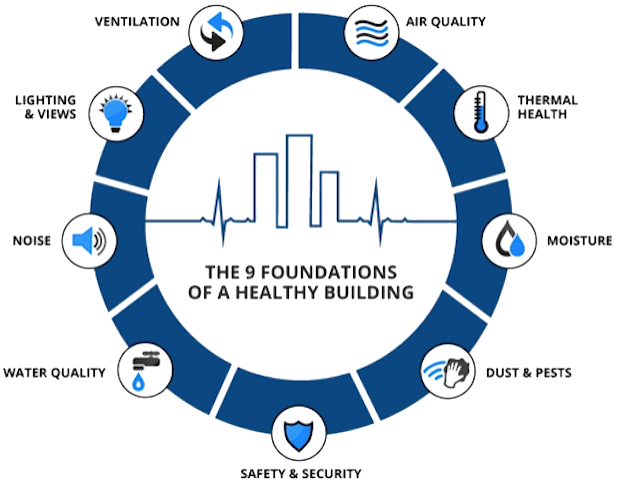
We have known buildings can make people sick for quite some time. The World Health Organization (WHO) coined the term Sick Building Syndrome or SBS in 1986. SBS occurs when occupants experience headaches, allergy-like symptoms, or feel dizzy after spending time indoors. Poorly maintained office buildings are estimated to impact 20 percent of workers. Improvements to air quality, reductions in air pollutants, and better ventilation can reduce symptoms by 70 percent.

SBS is not just a ventilation issue. A building’s stored supply of fresh water can reach unsafe levels of bacteria if the water system is not well maintained, leading to illness and even Legionnaire’s disease.1 Professor Joe Allen’s book, Healthy Buildings, identifies the nine foundations of a healthy building — ventilation, air quality, health, moisture, dust and pests, safety and security, water quality, noise, lighting and views. They are derived from 40 years of scientific evidence on the factors that drive better health and performance for a buildings’ occupants.

9 Foundations of a Healthy Building-VERT Asset Mgmt.2

People, Planet, or Profit?

Buildings consume 40 percent of global energy and create 30 percent of global energy-related greenhouse gas emissions.2 Being the energy hogs that they are, it was perhaps logical for the early focus of ESG investors to be on energy use reduction. It was also an easy return on investment. Reduce the energy use, reduce the utility bill. That’s good for the planet, and good for profit too. But what about the people?

A healthy workforce is a more profitable one. Healthier workplaces see less employee absenteeism, less sick days, and less employee turnover. Improving workspaces so people are more productive isn’t as easy as changing an incandescent light bulb to LED. But it’s not as hard as we might imagine.

The 3-30-300 rule

This rule of thumb describes a company’s costs for utilities, rent and payroll — all measured per square foot, per year.

A company renting office space for $30 a square foot can typically expect the utility bill to be a tenth of that, or $3. The payroll for the employees occupying that space is on the order of $300 per square foot.

Where then to focus effort?

  • 10% saving on utilities nets 30 cents.
  • 10% drop in rent saves 3 dollars.
  • 10% boost in worker productivity adds $30 dollars of value.

Companies are now beginning to focus more on the potential gains from investing in worker productivity.

The World Green Building Council published reports in 20143 and 20164 that summarize the dozens of studies that link sustainable workplace design to employee health, well-being and productivity. Case studies highlight the increases in productivity from various improvements:

  • Individual temperature control: +3%
  • Improved ventilation: +11%
  • Better lighting: +23%
  • Access to natural environment: +18%

WELL and Fitwel Building Certifications

Traditional green building certifications like LEED and BREEAM have been around for over 25 years with a primary objective to reduce environmental impacts. WELL and Fitwel are newer certifications—both less than ten years old—that focus on occupant health and well-being. Both certifications complement the requirements in a LEED or BREEAM certification, but include more health-focused requirements such as active workstations, proper lighting, low VOC materials, and layouts that promote worker interaction and even hydration. The Fitwel certification process is less onerous than the WELL version — it is both cheaper and an easier to attain. The WELL certification requires on-site verification and is more globally recognized. Building owners pursue the different certifications for different types of projects.

In June 2020 the International WELL Building Institute (IWBI), administrator of the WELL certification, created the specialized WELL Health-Safety rating in response to the COVID-19 crisis. Just 9 months later, over one billion square feet of space had enrolled to be rated. The rapid adoption of this safety rating illustrates how companies are committing to healthier spaces all around the world.

Investing in Health and Well-Being

Forward-thinking real estate companies are investing in upgrades and certifications to make their buildings more attractive to tenants looking for health and wellness. They are banking on employers choosing healthier spaces for their next office lease, and that residents will be looking for these features in their living spaces. Leaders include:

  • Empire State Realty5, owner 10 million square feet of rentable space across 14 office properties including the iconic Empire State Building, is the first commercial portfolio in the US to achieve the WELL Health-Safety rating across its entire portfolio. They have also Fitwel certified 6 of their NYC properties to date.
  • Kilroy Realty6 owns 55 properties up and down the West Coast and have more Fitwel certified projects than any other firm in the world, totaling over 43% of their portfolio. They also achieved the world’s first Well certification of a residential rental project, for Columbia Square in Hollywood, CA.
  • Dream Office REIT7 in Canada, has earned the WELL Health-Safety rating for 25 of its buildings, representing 87% of their gross leasable space.
  • Australia’s Charter Hall Group8 was one of the first organizations in the world to achieve a WELL Portfolio Score by certifying properties across their organization.
  • “Fitwel Champions” are companies using Fitwel at a portfolio scale. Real Estate Investment Trusts (REITs) making the grade include Alexandria Real Estate Equities9, Boston Properties10, Vornado11, and AvalonBay12.

The Covid-19 crisis has focused the attention of ESG investors on the S pillar (social) more so than ever before. The green building movement is routinely classified under the environment pillar because of the attention paid to energy efficiency. While green building certifications always required health and safety for occupants, the emergence of these new specialized wellness ratings demonstrate the elevation of S toward equal partner in the E, S, and G triumvirate.


Article by Sam Adams, CEO and co-founder of Vert Asset Management. He also chairs the Investment Research Group. Sam leads the development of new products to help make sustainable investing easier for investors. He has been a featured speaker on sustainable investing at financial advisor conferences in the US, UK, Europe, and Australia. Prior to launching Vert, Sam spent almost 20 years working at Dimensional Fund Advisors. He started Dimensional’s European Financial Advisor Services business and led it for 10 years. Sam was part of the team that created Dimensional’s first ESG strategies, the Sustainability Core funds that are offered in the US. He also led the development and launch of Dimensional’s Global Sustainability Core Fund in Europe.

Sam has a BA in Philosophy from the University of Colorado, Boulder and an MBA in Finance from the University of California, Davis. Sam is an avid mountaineer and cyclist, and is very passionate about the environment. He lives in Mill Valley, CA with his wife and three children.


Footnotes and Sources:
[1] Centers for Disease Control and Prevention (2021). Legionella. Retrieved from: https://www.cdc.gov/legionella/about/causes-transmission.html
[2] United Nations Environmental Programme (2015). The Sustainable Buildings and Construction Programme.
[3] World Green Building Council (2014). Health, Wellbeing & Productivity in Offices: The Next Chapter.
[4] World Green Building Council (2016). Building the Business Case: Health, Wellbeing and Productivity in the Green Offices.
[5] Empire State Realty is 0.18% of the Vert Global Sustainable Real Estate Fund (VGSRX) as of March 31, 2021.
[6] Kilroy Realty is 0.78% of the Vert Global Sustainable Real Estate Fund (VGSRX) as of March 31, 2021.
[7] Dream Office REIT is 0.04% of the Vert Global Sustainable Real Estate Fund (VGSRX) as of March 31, 2021.
[8] Charter Hall Group REIT is 0.16% of the Vert Global Sustainable Real Estate Fund (VGSRX) as of March 31, 2021.
[9] Alexandria Real Estate Equities  is 3.57% of the Vert Global Sustainable Real Estate Fund (VGSRX) as of March 31, 2021.
[10] Boston Properties is 1.80% of the Vert Global Sustainable Real Estate Fund (VGSRX) as of March 31, 2021.
[11] Vornado is 0.85% of the Vert Global Sustainable Real Estate Fund (VGSRX) as of March 31, 2021.
[12] AvalonBay Communities is 3.02% of the Vert Global Sustainable Real Estate Fund (VGSRX) as of March 31, 2021.


The Vert Global Sustainable Real Estate Fund only holds publicly traded REITs. Fund holdings and sectors are subject to change at any time and should not be considered a recommendation to buy or sell any security.

Mutual fund investments involve risk. Principal loss is possible. Investors should be aware of the risks involved with investing in a fund concentrating in REITs and real estate securities, such as declines in the value of real estate and increased susceptibility to adverse economic or regulatory developments. Investments in foreign securities involve political, economic and currency risks, greater volatility and differences in accounting methods. A REIT’s share price may decline because of adverse developments affecting the real estate industry. REITs may be subject to special tax rules and may not qualify for favorable federal tax treatment, which could have adverse tax consequences. The Fund’s focus on sustainability may limit the number of investment opportunities available to the fund and at time the fund may under perform funds that are not subject to similar investment considerations.

The Vert Global Sustainable Real Estate Fund’s investment objectives, risks, charges, and expenses must be considered carefully before investing. The statutory and summary prospectuses contain this and other important information about the investment company, and may be obtained by calling 1-844-740-VERT or visiting www.vertfunds.com . Read carefully before investing.

The Vert Global Sustainable Real Estate Fund is distributed by Quasar Distributors, LLC.

Energy & Climate, Featured Articles, Impact Investing, Sustainable Business

Why a Cooperative Model for Clean Energy Financing Couldn’t Miss

By Blake Jones, Clean Energy Credit Union

(above) The Howard Family and their solar PV system

Blake Jones-Clean Energy CUIn 2017, Clean Energy Credit Union (“Clean Energy CU”) received its federal charter and became the first “thematic,” online-only, federally insured depository institution with an exclusive focus on clean energy lending. Since then, Clean Energy CU has experienced tremendous success and is influencing both the banking and clean energy sectors. To say that “the time was right” for Clean Energy CU would be an understatement. Understanding its right-out-of-the-gate success requires a look at the underlying market conditions that necessitated its launch.

In the early 2000s, growth in the clean energy sector was driven by improvements in costs, technological innovation, government policy, and public opinion. This growth, however, was outpacing the availability of financing that many consumers and homeowners needed to pursue their clean energy projects. For example, upfront costs for residential solar electric systems, residential geothermal systems, and other green home improvements would typically land in the $10,000 to $50,000 range.

Of the 5,000+ credit unions and 5,000+ banks in the USA, only a handful were paying any attention to the sector. As a result, consumer financing options were typically limited to, and dominated by, VC-backed “fintech” companies such as Mosaic, Sungage Financial, and Dividend Finance, resulting in a dearth of competition to drive down borrowing costs. In contrast, all other segments of the clean energy value chain were laser-focused on reducing costs as rapidly as possible. Financing was the weak link that needed to catch up, and the cheapest form of consumer financing generally comes from federally insured depository institutions (i.e. banks and credit unions), so their entrance into the sector was sorely needed.

Against the backdrop of the clean energy economy were burgeoning concepts like impact investing, conscientious consumerism, and purposeful careers. In that evolving, impact-economy landscape, the need for an “impact banking” or “sustainable banking” option was plain to see. Even so, there were a surprisingly limited number of options for consumers to choose from such as Self-Help Credit Union, Amalgamated Bank, and Beneficial State Bank. Widespread awareness had yet to be raised that where you deposit your money was as important as how you earned, invested, and spent it.

By 2014, there was high, unmet demand for affordable clean energy loans juxtaposed with the dire needed to spark an “impact banking” movement. It was then that a group of volunteers, comprised mostly of clean energy professionals and cooperative enthusiasts, convened to address these needs. Upon learning that credit unions are, by definition, not-for-profit and member-owned cooperatives, they saw that the path forward was not actually a stockholder-beholden bank model whose mission would be subordinated to profit-maximization motives, but rather what would become Clean Energy CU.

The operating model is built entirely around the belief that everyone should be able to participate in the clean energy movement—whether as a user, an investor/depositor, or both.  Clean Energy CU offers a much-needed value proposition: member deposits will earn a competitive interest rate, be federally insured, and be used exclusively to help others pursue their clean energy or energy-saving projects via market-leading, custom-tailored loan terms.

In early 2018, after a three-year federal charter application process, Clean Energy CU opened its virtual doors. As a federally chartered credit union, it is tax exempt and deposits are federally insured, thereby giving it the lowest possible cost of capital. As a cooperative, it is democratically owned and governed by its members, and the primary reason for its existence is to serve its mission and members. An online/mobile-only services platform eliminates the need for expensive brick-and-mortar branches – and their associated overhead – and helps lower operating costs. Its focus on clean energy lending enables critically important market expertise, awareness, and adaptability.

Thapa family solar PV system
The Thapa Family and their solar PV system

Services were initially limited to savings accounts, clean energy CDs, and an array of clean energy loan products (e.g. e-bikes, EVs, solar electric systems, and geothermal systems). Philanthropic support that included a $1M grant from the William and Flora Hewlett Foundation in 2019 provided a substantial springboard. To date, over 4,500 clean energy loans totaling over $70M have been funded for members throughout the country without a single delinquency or default. Clean Energy CU continues to grow rapidly, and its services now include checking accounts, debit cards, IRAs, and Money Market accounts. Next, Clean Energy CU is planning to offer green home mortgages, credit cards, and clean energy loans to businesses and nonprofits.

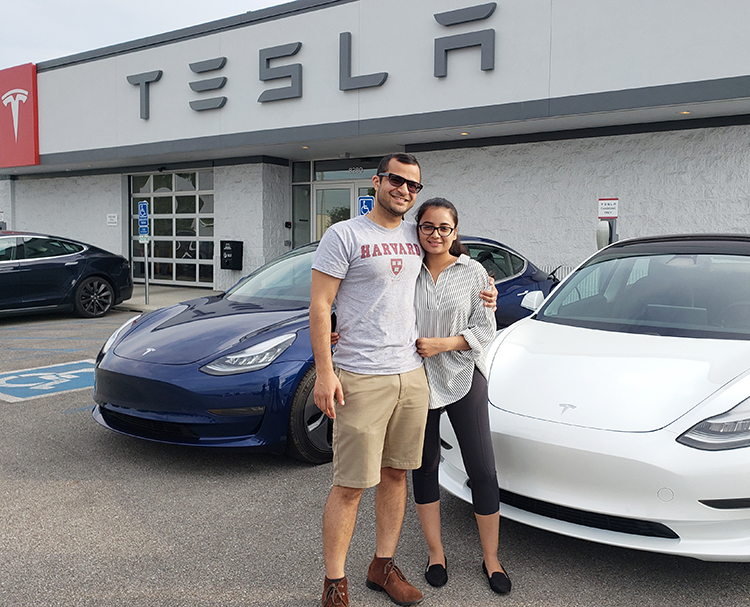
Nida and Shahaan and their Tesla EV-Clean Energy CU
Nida and Shahaan with their Tesla EV

Clean Energy CU is also helping 45+ other credit unions learn about clean energy lending via “loan participations.” By selling portions of its loan pools to other credit unions, Clean Energy CU is able to lend far beyond what its start-up balance sheet would allow. Participating credit unions are able to invest their excess cash, diversify their loan portfolios, and gain experience with an exciting new asset class. Seeing firsthand how well these loans perform on their own books helps other credit unions to convince their own boards and regulators that clean energy loans are more valuable and less risky than previously thought, partly because they inherently save borrowers money (e.g. in the form of lower utility bills and fuel costs) which then increases the borrower’s ability and motivation to make their loan payments. In turn, this encourages more credit unions to do their own clean energy lending, thereby spurring competition and driving down financing costs to fund the rapidly growing clean energy movement.

Importantly, Clean Energy CU is committed to JEDI (Justice, Equity, Diversity, and Inclusion). With over half of its members from low-income census tracts, the National Credit Union Administration recognized it as a “low-income designated credit union” in 2020. Loan programs are under development to favor underserved demographics by offering discounted loan terms to low-to-moderate income borrowers and prioritizing both BIPOC populations and those vulnerable to pollution. As a precursor to these new loan programs, Clean Energy CU recently announced a new program with fellow cooperative, Organic Valley, to offer discounted loan terms to help its membership of organic family farms use clean energy, save energy, and save money.

Clean Energy CU may be the first of its kind, but it won’t be the last. New fintech companies and banks with similar goals are popping up like Aspiration, Climate First Bank, and Atmos. Clean Energy CU aims to help grow the clean energy movement and disrupt the entire retail banking sector which is receiving increased pressure to stop its fossil fuel lending and help finance climate change mitigation. With all that it has achieved in just its first three years of operation, we’re incredibly excited about what Clean Energy CU will accomplish next.


Article by Blake Jones, co-founder and volunteer board chair of Clean Energy Credit Union. Blake is also a co-founder of three other cooperatives: (1) Namasté Solar, an employee-owned cooperative; (2) Amicus Solar Cooperative, a purchasing cooperative; and (3) Kachuwa Impact Fund, an investment cooperative and impact investing fund.

Energy & Climate, Featured Articles, Impact Investing, Sustainable Business

Signup to receive GreenMoney's monthly eJournal

Privacy Policy
Copyright © GreenMoney Journal 2025

Website design & development by BrandNature

Global Events Calendar

View All Events

april

21aprAll Day232026 Sustainable Packaging Coalition: SPC Impact – Nashville

27aprAll Day30Women Deliver 2026 Conference (WD2026) – Melbourne

X