Tag: Impact Investing

Guided by Wonder: A Reflection on the Stewardship of Creation

By Chris Meyer, Praxis Mutual Funds

Chris Meyer & Family Praxis Mutual FundsWhile much of the country is shrouded in snow and suffering below-freezing temperatures, Chris Meyer, Stewardship Investing Advocacy and Research Manager at Praxis Mutual Funds®, took a moment to reflect on his passion for Creation care – on behalf of Praxis and his own family. By day, Chris leads the corporate engagement program for Praxis, seeking positive, mutually beneficial change for the planet, people, and companies we all rely on. By night, Chris and his family live in a home they built, off the grid, with lumber from their property in the hills of eastern Ohio. He enjoys growing much of their own food, hunting game in the surrounding woods, and even cleaning the snow off their solar array on frigid winter days so his lights and wireless internet will work. His words in this article remind us how much we all have invested in caring for Creation – and how rarely we stop to bask in its glory.

“The earth is the Lord’s and all that is in it, the world, and those who live in it, for he has founded it on the seas and established it on the rivers.”

– Psalm 24:1-2

When I reflect on what motivates me to care for Creation – many reasons come to mind. But there is one that seems to connect them all: A sense of wonder.

Where I live in the Ohio woodlands, early spring is one of my favorite times to be outside and immersed in nature. The temperature is mild, the undergrowth is minimal, and the mosquitos aren’t yet biting. Forest flowers will soon bloom, taking advantage of the sunlight that reaches the forest floor before the trees leaf out and shade the ground. Morel mushrooms magically sprout out of the soil; hunting for them is one of my favorite pastimes. These rhythms of nature provide a sense of renewal and assurance in uncertain times.

Before we know it, it’ll be April – the time for an amazing annual event that occurs on the swollen oak tree buds ready to burst into leaves. At this stage, for just a few hours, each bud is vulnerable to a particular insect. During this precise time, female gall wasps inject eggs into the oak bud tissue. The process takes only a few minutes. The injections chemically manipulate the bud tissue and cause galls to form as the leaves grow. Galls are the spherical plant growths many of us see on oak tree branches throughout the year. The galls do not harm the oak trees and the wasps are much too small to sting people.

The galls provide both food and protection for the wasp larvae. The larvae pupate inside the gall and emerge as adults in a few months or a year, depending on their type. There are approximately 800 species of gall wasps in North America, each producing unique galls and with their own special adaptations with oak trees. Among other distinct features, some galls secrete sweet substances to attract ants which stay close to the gall and protect the developing larvae from predators. Gall wasps are integral to the lifecycles of many insects and play a vital role in our ecosystem, including as the prey for dozens of arthropods. Who knew?

Chris Meyer and familys off-grid Ohio home
The Meyer family’s off-grid home, they built with lumber harvested from their property in the hills of eastern Ohio

I certainly didn’t until I read The Nature of Oak by Douglas Tallamy. The book is organized by the months of the year – each month is a chapter – and chronicles the various cycles of life that occur in and around oak trees during each period. The level of detail is fascinating. The gall wasp story is only one example of life entwined with oak trees in a book overflowing with them.

Oaks are my favorite type of tree, and I thought I knew a lot about the various species and their attributes and lifecycles. However, Tallamy helped me realize that what I knew only scratched the surface. For instance, I knew virtually nothing about the web of insects sustained by oaks, the insects’ relationships with birds or the centrality of birds to oak regeneration. With each layer I uncovered, my sense of wonder increased. My first thought was “Amazing!” But as I neared the end of the book, I was left thinking “What else don’t I know?”

Many people, I’m sure, share my feelings of wonder and humility when encountering the marvels of the natural world, or even upon learning about them in a book. We retreat to nature to experience awe, catharsis, and even spiritual renewal. Maybe on a subconscious level, this is what draws so many of us toward an ethic of Creation care. We’re amazed by what we observe and humbled by what we don’t know. Even the experts only understand a fraction of what there is to know about the natural world.

When we integrate these feelings into our approach to economics, it can have a powerful influence on the world. Perhaps if we view nature as an essential part of God’s Creation worthy of its own existence, rather than simply as a commodity to be exploited for human gain, we can develop a more holistic stewardship approach. When we reduce the natural world to simple inputs for our economies or assets on the balance sheet – or even impediments and obstacles to overcome – we’re selling Creation short. Alternatively, a deep appreciation for our environment encourages a long-term outlook over short-term profits or growth at all costs. It fosters a sense of our interdependence with nature.

At Praxis Mutual Funds, we believe the natural environment is a finite resource, the inheritance of future generations, and a gift from God. Our role is to be stewards of God’s Creation, not just consumers of it. We believe that human flourishing requires thriving ecosystems. This perspective infuses our embrace of impact strategies from company engagement to impact bonds to community development investments. We’re working toward a sustainable planet where our heirs can enjoy the magnificence of Creation and businesses operate profitably without diminishing the earth.

I keep this in mind as I engage companies, as a shareholder representative, on a range of Creation care issues. We embrace our own ecosystem – working together with environmental advocates, corporate leaders, local communities, other investors, and research partners – seeking a more sustainable future for all.

I believe it’s important for us to think of the natural world as interwoven with our own lives – that we’re in this together. So, when it’s time for much-needed perspective, I engross myself in nature and marvel at the wonderous life around me. This provides me with all the necessary motivation to keep caring for Creation. And who knows, maybe this spring I’ll be able to catch a gall wasp in the act of laying eggs in an oak leaf bud.


Article by Chris Meyer, Stewardship Investing Advocacy and Research Manager for Praxis Mutual Funds® and Everence Financial®. Chris joined Praxis in 2006. He leads the company’s work in corporate engagement and supports its investment screening and proxy voting functions. He has led shareholder dialogues on many pertinent issues such as climate change, toxic chemicals, child slave labor, and predatory credit card practices with multinational companies. Connect with Chris on LinkedIn.

About Praxis

Praxis Mutual Funds is a leading faith-based, socially responsible family of mutual funds designed to help investors integrate their finances with their values. Praxis is the mutual fund family of Everence Financial®, a comprehensive faith-based financial services organization helping individuals, organizations and congregations. To learn more, visit praxismutualfunds.com and everence.com.

Consider the fund’s investment objectives, risks, charges and expenses carefully before you invest. The fund’s prospectus and summary prospectus contain this and other information. Call 800-977-2947 or visit praxismutualfunds.com for a prospectus, which you should read carefully before you invest.

Praxis Mutual Funds are advised by Everence Capital Management and distributed through Foreside Financial Services, LLC, member FINRA. Investment products offered are not FDIC insured, may lose value, and have no bank guarantee.

 Praxis Mutual Funds

1110 N. Main St., P.O. Box 483, Goshen, IN 46527

Energy & Climate, Featured Articles, Impact Investing, Sustainable Business

2024 Sustainability Trends: looking beyond carbon and new approaches to ESG data

By Sarah Vizard, Raconteur

The need to tackle climate change and environmental degradation is more pressing than ever. As new regulations come into force, businesses need to consider where they invest their money and how they communicate their efforts.

Businesses have faced a difficult operating environment over the past few years. First the Covid-19 pandemic, then war in Ukraine, have caused rising inflation, increased interest rates and high wage growth, meaning many businesses face difficult decisions in order to maintain profitability.

That has meant many companies putting improving sustainability on the backburner. But as record global temperatures in 2023 show, climate change isn’t taking a break. In 2024, businesses will need to find a way to think long-term on sustainability while facing short-term pressure on their top line. That necessitates more robust net-zero plans but also expanding scope beyond carbon, amid new ESG regulations focused around reporting and transparency.

Preparing for new sustainability regulations

Around the world, governments will be introducing and updating sustainability regulations in 2024. There is a huge array set to come into force in the coming years and companies will need to prepare.

Levent Ergin, global chief ESG sustainability strategist at Informatica, says: “We are approaching a tipping point with ESG. Instead of companies operating blindly by accessing ESG data from a black box, new regulation promises greater clarity, and reliability in ESG data – something which is fundamental for informed decision-making and responsible capital allocation.”

Many of these regulations are aimed at making data and progress towards sustainability goals more transparent and standardized. The corporate sustainability reporting directive, for example, aims to standardize non-financial reporting. Applying to all large companies and listed SMEs that operate in the EU, it will require them to publish regular reports on their environmental and social impacts with the aim of helping investors, policymakers and consumers evaluate their performance. 

Adapting to new standards will be a challenge for the organizations that don’t have an intelligent approach to ESG data management and governance

Similarly, the EU corporate sustainability due diligence directive mandates that companies operating in the bloc identify, report on and mitigate the impact of their operations (including those in their supply chains) on human rights and the environment. And in the UK, the Streamlined Electricity and Carbon Reporting regulation requires companies to report on their emissions and energy consumption.

Dana Haiden, chief sustainability officer at Virgin Media O2, says the business is preparing for this increase in reporting and transparency requirements already and this will intensify going into 2024. “The remit of these new regulations is so wide it impacts almost everybody in some way.” 

All these new regulations mean companies will need to provide new data points, KPIs and metrics around sustainability. It also puts the onus on business to understand their ESG data and ensure robust data governance in this area. Those that cannot risk their corporate reputations plus could miss out on sustainable sources of funding or even be fined.

“Adapting to these new standards will be a challenge for the organizations that don’t already have an intelligent approach to ESG data management and governance. These companies will find this process highly complex and resource intensive,” says Ergin. “But those that do have a robust approach to ESG data governance, will have an advantage.”

Moving the sustainability conversation beyond carbon

Much of the focus both among global governments and businesses up to now has been on carbon emissions and reducing them. However, there is a growing realization that while transitioning away from fossil fuels is important, it is just one aspect of dealing with the climate crisis and that efforts need to be more broad-based if we are to stave off the worst effects of climate change. 

“The view of sustainability is broadening from an environmental perspective, but also from a social perspective,” says Haidan. 

At COP 28 in December, a greater emphasis was put on reducing emissions of methane – a greenhouse gas that is 28 times more potent than carbon dioxide in trapping heat in the atmosphere. A move away from fossil fuels will help but a reduction in materials going to landfill by both companies and consumers is needed as well. 

The role of nature and biodiversity is also, finally, under the spotlight. Only around a third of Europe’s biggest companies have set targets that aim to address deforestation and protect biodiversity, according to S&P Global. Yet allowing nature to degrade further poses significant business risks and means companies will be addressing this area more in 2024 and beyond.

The World Economic Forum estimates that, in 2019, more than half of the world’s $44tn (£35tn) economic value was moderately or highly dependent on natural resources. And healthy ecosystems have a key role to play in absorbing greenhouse gas emissions, keeping global temperatures lower and mitigating the effects of, for example, storms and floods.

“One big trend is this connection to nature and biodiversity,” says Haidan. “Up until this point, the biggest focus has been on carbon – tracking, management and reduction – and biodiversity and nature has not been a big focus.

“Now we’re seeing more companies choosing to voluntarily disclose their nature-related financial risks, which is the first time many companies have started to look at the impacts of their business on nature.”


Balancing short-term profit with long-term sustainability investment

In August, a team of researchers from the University of Bath, the University of St. Gallen and the Swiss Finance Institute conducted research into the progress companies make on their ESG initiatives when facing competitive pressures. The research, highlighted by investment strategist Joachim Klement, found that those facing higher pressures in their home market, and therefore lower margins, tended to invest less in ESG. This despite other studies suggesting that strong ESG performance and being a good corporate citizen can be a source of competitive advantage.

The research suggests that when faced with short-term operational challenges, leadership focuses on short-term operational measures to fix them at the expense of longer-term focus areas such as sustainability. But the research also found that at companies with longer-term shareholders or those operating in industries that consider climate action more important, the shift away from ESG was not as great.

Research also suggests that those companies that invest for the long-term outperform those swayed by short-term winds. And those that go on the offence during difficult economic times tend to be rewarded with higher revenue growth and earnings.

The trend in 2024 for businesses, then, is how to balance the long-term need to invest in sustainability efforts with the short-term need to boost earnings. As global temperatures continue to rise and the 2050 deadline for net-zero carbon emissions draws ever closer, 2024 is seen as a pivotal year in whether the world is on track to limit global warming.

No matter what we do in the short term, sustainability is still embedded in the way we plan long-term

But Mette Lykke, CEO of food waste company Too Good to Go, admits it takes a lot of resources and is an area that is increasingly complicated for businesses, especially with the added cost of incoming regulation.

“This is an area that is very complicated and is going to take a lot of resources to figure out,” Lykke explains. “There’s definitely a balance to be found between how much business spends on reporting versus actually doing initiatives that could move the needle.”

Virgin Media O2’s Haidan agrees that this need to think long term around sustainability is “misaligned” with quarterly earnings reporting. However, she believes there will be more companies taking the sustainability agenda seriously and so prioritizing beyond the short term.

“At Virgin Media O2, we get a lot of support from the management team and the organization overall to really embed sustainability in the right intervention points within the system. For instance, sustainability is part of our investment committee review, so any capex investment we make we also review whether it impacts our carbon reduction targets,” she says.

“Embedding that through that process means no matter what we do in the short term, sustainability is still embedded in the way we plan long-term.”

Getting communication right

A final area business leaders and sustainability experts must focus on in 2024 is communication. The Advertising Standards Authority is already clamping down on misleading environmental claims in communications and recently updated its guidance.

Companies now need to follow key principles including ensuring that if an environmental claim relates to a sole product, rather than the whole business, that should be made clear; including ‘balancing information’ if a business has a harmful impact on the environment but is highlighting positive environmental activities; and including information on overall harmful impact if an ad refers to lower-carbon activities.

Companies also need to be wary of using imagery of the natural world, using absolute claims such as ‘sustainable’ or ‘environmentally friendly’ and suggesting its negative impact is a thing of the past if it is not. 

Brands that fail to adhere to this are likely to fall foul of the advertising code. It could also cause a hit to brand reputation. For Lykke, key to avoiding this is ensuring that communications are sincere and not just done for storytelling purposes.

“There is a lot more scrutiny now (from consumers and policymakers). For example, you need to invest in carbon accounting and then have experts review what you do if you want to make any external claims,” she explains.

For Virgin Media O2’s Haidan, while sustainability is core to its business, it is not something it talks about a lot in communications. It doesn’t not offer products or services with green claims attached to them, except for device recycling whether the link is clear. 

As the Intergovernmental Panel on Climate Change has warned, the world is nearing the threshold where 1.5 ºC of warming above pre-industrial levels, as agreed internationally as part of the Paris Agreement in 2015, won’t be achieved. That could have dire consequences for society, economies and businesses. 

In 2024, companies need to think longer-term, prepare for more robust regulation and look beyond carbon. As Haidan puts it, sustainability must be part of every decision and integrated into every aspect of business.

Source: Raconteur Responsible Business

Additional Articles, Energy & Climate, Impact Investing, Sustainable Business

Whole Foods Market Forecasts Top 10 Food Trends for 2024

By Whole Foods Market’s Trends Council,

Industry experts predict emerging flavors, culinary influences and products poised for the spotlight in the coming year.

In October 2023, Whole Foods Market’s Trends Council unveiled their top 10 anticipated food trends for 2024 in the retailer’s ninth-annual Trends predictions report. Caffeine with added benefits, going back to basics in the plant-based category, complex heat from global peppers, and water conservation and stewardship are all among the food trends expected to rise in popularity across the industry in the next year.

Each year, the Trends Council – a collective of more than 50 Whole Foods Market team members, including foragers, buyers and culinary experts – compile trend predictions based on decades of experience and expertise in product sourcing and studying consumer preferences, as well as in-depth workshopping with emerging and existing brands.

“Our annual food trends predictions list is a way for us to pull back the curtain for customers and share insight into what our buyers and culinary experts are keeping on their radar for the upcoming year,” said Cathy Strange, Ambassador of Food Culture for Whole Foods Market and member of the Trends Council. “From specific product ingredients and flavor trends, to growing movements in the food industry, we can’t wait to see these trends gain momentum in the year ahead.”

Whole Foods Market’s top 10 food trend predictions for 2024:

Put the “Plant” Back in “Plant-Based”

The OGs of plant-based cuisine are making a comeback, putting the “veggie” back in your veggie burger and shrinking labels all over the plant-based category. We’re seeing new and emerging protein-forward products with mushrooms, walnuts, tempeh and legumes in place of complex meat alternatives. Even plant-based milk alternatives are participating, with some brands simplifying labels to just two ingredients — perfect for the vegetarian purist.

Try the Trend: Actual Veggies Green Burger, Meati Carne Asada Steaks, Smallhold Organic Mushrooms Blue Oyster and Lion’s Mane, Abbot’s Butcher Plant-Based Chopped Chick’n (available in select stores), Atlantic Sea Farms Basil Pesto Sea Veggie Burger (launching in November 2023), Three Trees Organic Original Unsweetened Almondmilk

Use the Whole Cacao

Utilizing by-products like cacao pulp has been practiced in other countries for centuries, and now brands like Blue Stripes are spotlighting the whole cacao with their craveable products for even more consumers. At EARTH University in Costa Rica, where student researchers are tackling some of the biggest systemic environmental issues, the typically discarded cacao pulp is being made into jellies and jams. The emergence of cacao fruit powders in 2023 also presents an opportunity for brands seeking a new sugar alternative without compromising on sweet, ambrosial flavor.

Try the Trend: Blue Stripes Urban Cacao Water, Trail Mixes, Granola, Dried Cacao Fruits Chocolate Bars and Chocolate Covered Cacao Beans; and Knoops Cacao Husk Tea (available in UK stores)

Buckle Up for Buckwheat 

Gaining popularity as a cover crop to support soil health, buckwheat is a superfood seed containing protein, carbs and fiber. Plus, it’s naturally gluten free. You may have seen it in the form of soba noodles, but with more brands on a mission to improve agriculture for your favorite products, you may see buckwheat in everything from plant-based milk alternatives to crackers and granola.

Try the Trend: Maine Crisp Buckwheat Crackers Savory Fig & Thyme (available in select stores), Whole Foods Market Sesame Soba Noodle & Mushroom Bowl (launching in 2024), Lil Bucks Clusterbucks Buckwheat Granola Bites Chocolate Sea Salt (available in select stores), Lotus Foods Buckwheat & Brown Rice Soba Noodles, Bob’s Red Mill Buckwheat Pancake & Waffle Mix, Fancy Pants Vegan Chocolate Cardamom Cookies with buckwheat flour (launching in December 2023), Hakubaku Organic Soba Noodles, BAM Buckwheat Milk (part of Whole Foods Market’s 2023 LEAP Early Growth Cohort)

Fancy Faux Fish

With tinned fish and caviar taking off earlier this year, it’s prime time for the fancy fish trend to dip its fins into the vegan pond. Thankfully, some worthy plant-based seafood brands are stepping up and bringing the flavor and texture needed to rival the real thing. Watch out for carrots in place of lox, trumpet mushrooms for scallops, and the root vegetable konjac getting its moment in sushi rolls and poke bowls. Whether you’re fully plant-based or looking to eat less seafood, there’s a faux fish waiting for you.

Try the Trend: Plant-Based Spicy Tuna Roll and Plant-Based Spicy Sno’ Crab Roll at Whole Foods Market sushi venues, Konscious Plant-Based California Roll and Plant-Based Tuna Poke Bowl, Good Catch Plant-Based New England Style Crab Cakes, TMRW Ocean Cakes (available in Canada stores), Save da Sea Plant-Based Smoked Salmon and Tuna Salad (available in Canada stores), Seed to Surf Plant-Based Tinned Seafood (part of Whole Foods Market’s 2023 LEAP Early Growth Cohort)

Clean & Conserve: Water Stewardship  

Brands across the aisles are promoting water conservation, and consumers are listening. New water brands use water from fruit by-products, which would otherwise be discarded. With the growing trend of regenerative agriculture, a Regenerative Organic Certification also requires soil health initiatives that ultimately conserve water. And it doesn’t stop at conservation — non-governmental organizations are showing their support of farmed oysters, leveraging aquaculture to filter water and help restore coastal ecosystems. Lifestyle brands are also pushing water-conscious products like dry shampoos, shampoo bars and laundry detergent sheets. Even household cleaners — like Whole Foods Market’s ingredient-conscious products, developed in part to help keep certain ingredients out of waterways — are making an impact. Whether the story is on cleaning or conserving, consumers and brands alike are rallying to support water movements.

Try the Trend: Lundberg Family Farms Regenerative Organic Certified Basmati Rice, SIMPLi Regenerative Organic Certified Gigante Beans, Garcia de la Cruz Organic Everyday Extra Virgin Olive Oil (available in select stores), Pacha Soap Hydrate Shampoo & Conditioner Bars, Blueland Hand Soap Starter Set (launching in December 2023), Whole Foods Market Regenerative Organic Certified Red and French Green Lentils, Responsibly Farmed Sequoia Kumamoto, Great White and Moondancer Oysters, Gotham Greens Greenhouse Crunch

Complex Heat 

Complex heat continues its evolution with global peppers taking off in every aisle — and the trend is only getting hotter. Specialty varieties like Scorpion Peppers, Guajillo or Hungarian Goathorn Peppers are found fresh, whole, ground or pickled, and a new wave of botana sauces and chili oils are popping up in condiment aisles nationwide. Pepper-infused drinks are going beyond kombuchas, cold-pressed juices and smoothies, with ready-to-drink beverages like canned tepache filling up the fridge with a refreshing kick. Even Tajín is expanding from candies and cocktails to spicing up grocery store sushi, desserts and more.

Try the Trend: Nando’s PERi-PERi XX Hot Sauce, Mama Lil’s Kick Butt Peppers Pickled HOT Hungarian ‘Goathorn’ Peppers in oil (available in select stores), SOMOS Mexican Chili Crisp with Nuts & Seeds, Fly By Jing Sichuan Gold, Mina Spicy Harissa, Whole Foods Market Calabrian Chile Pepper & Garlic Extra Virgin Olive Oil, 365 brand Mango Chili Lime Fruit Bites, 365 brand Thai Curry Cashews, De La Calle Mango Chili Picante Tepache, FILLO’S Bean Salsa Habanero Walking Tamales, Silva Sausage Louisiana Hot Link and Linguiça Portuguese Sausage (available in select stores), GOODLES Down the Hatch Macaroni & Cheese, Divina Chopped Calabrian Peppers, Mango Yuzu California Roll topped with Tajin tempura crisps at Whole Foods Market sushi venues

Noodle News

Shoppers have been finding ways to dress up their instant ramen at home for years now, but as brands step up their game, noodle lovers can take on less of the workload. Even better, brands are creating more gourmet options to rival the classics without certain preservatives and added MSG. As people seek simple and instant meals, noodles are bringing all the ease and comfort of a warm bowl with quality ingredients and tantalizing flavors.

Try the Trend: Momofuku Tingly Chili Wavy Noodles and Spicy Soy Noodle, immi Black Garlic ‘Chicken’ Ramen, Lotus Foods Spicy Kimchi Rice Ramen Noodle Soup, Sun Noodles 1955 Miso Ramen (available in select stores), Omsom Saucy Noodles Chili Sesame and Soy Garlic, Hakubaku Ramen, Soba and Udon Noodles, A-SHA Universtar Noodle with Galaxy Spicy Sauce, Lazy Food Co. Italian pasta meals (part of Whole Foods Market’s 2023 LEAP Early Growth Cohort)

Little Luxuries

TikTok creators have brought “Little Treat Culture” into the zeitgeist, and we’re on board. We know firsthand the power of a treat, like an impulse macaron buy or a fizzy, functional and flavor-forward beverage. Brands are getting in on the trend by considering both cost and format — like individual serving packages that add joy without breaking a budget, and outlets like The Kitchn regularly dish out lists of “Little Luxuries” found for $10 or less. Whether it’s a daily ritual like having a milk tea on your commute home or a spontaneous reward like a bath bomb in your grocery cart, get ready to make room for those little luxuries.

Try the Trend: Petit Pot Crème Brûlée and Strawberry Cheesecake, Fishwife Tinned Seafood Co. Sardines with Preserved Lemon and Sardines with Hot Peppers (currently available in select stores, launching in all stores in 2024), Whole Foods Market’s Self-Serve Macarons, 365 brand Blueberry Lavender Kombucha, Mayawell Prebiotic Beverage Sparkling Pineapple Turmeric (available in select stores), Whole Foods Market Caviar, Whole Foods Market Brown Butter Latte, Funky Mello Marshmallow Cremes, Kinship Milk Tea (part of Whole Foods Market’s 2023 LEAP Early Growth Cohort)

Women’s Health: from Taboo to Top of Mind

This year on social media, we’ve seen hormonal remedy recipes go viral, including raw carrot salad for estrogen management, seed cycling energy bites for each cycle phase and “sleepy girl mocktails.” We’re seeing more brands making products to support periods, pregnancy, postpartum, menopause and even sleep that address life stages and symptoms previously swept under the rug. Food innovators are introducing specially formulated bars and snacks for cycle health, like menopause energy bars, at industry trade shows and conferences. Plus, brands are supporting women’s health in other ways — female care brand Here We Flo makes monthly donations to menstrual charities.

Try the Trend:  Wile Perimenopause Support Supplement, MaryRuth’s 3-in-1 Daily Vaginal Support Probiotic, Gaia Herbs Women’s Libido, Gaia Herbs Nighttime Comfort for Menopause, New Chapter 35+ Prenatal, Ritual Postnatal Multivitamin, Herbal Cup’s Ayurvedic Balanced Women’s Tea (in select stores), Traditional Medicinals Mother’s Milk Lactation Tea, 365 brand Organic Tart Cherry Juice, 365 brand Organic Whole Flaxseed, 365 brand Organic Pumpkin Seeds, 365 brand Sesame Seed

A Better Boost  

Whatever your go-to source of caffeine, there are new ways to get the absolute most out of your morning or afternoon pick-me-up. Combining a boost with benefits has never been easier, thanks to new coffee and energy drinks with added mushrooms, probiotics and more. There’s never been a better time to search the “clean caffeine” space for your next obsession.

Try the Trend: Four Sigmatic Think Organic Coffee with Lion’s Mane Mushroom, Halfday Prebiotic Green Tea with Honey and Ginseng (available in select stores), GORGIE Energy Drink Sparkling Electric Berry and Peachy Keen (available in select stores), Bulletproof Enhanced Coffee Pods, NuRange Cold Brew with Benefits (available in select stores), Ardor Mexican Lime Energy Sparkling Water


Source: Whole Foods Market Newsroom

Additional Articles, Food & Farming, Impact Investing, Sustainable Business

2024 Market Outlook: Forget About Predictions

By Dr. Sylvia Kwan, Ellevest

A couple of weeks ago, an industry colleague asked about my market predictions for 2024, and whether I thought the US economy was going toward a recession or a soft landing. Anyone who knows me well knows I don’t make market predictions. Why? Because markets are impossible to predict and even experts get it wrong. And for 2023, they were dead wrong. My inbox is filled with articles with headlines like “Economists Had a Dreadful 2023,” or “Everyone Got Burned: Wall Street Missed the Great Stock Rally of 2023,” and “How I, and Everyone Else, Got 2023 So Wrong.”

At the beginning of last year, experts predicted that the speed of the Federal Reserve’s rate hikes would help lower inflation but slow down the economy and throw it into a recession. The advice was to sell US stocks and buy US Treasuries. If you acted on that advice, and moved to all Treasuries, you would have ended the year roughly flat.

The US economy proved to be stronger and far more resilient than ?experts predicted. The S&P 500 ended the year up 24.2%, the DJIA up 13.7% to hit a new record, and the Magnificent Seven fueled NASDAQ up a whopping 43.4%. 

I don’t fault the economists and Wall Street experts for getting it wrong. Their predictions were made on the basis of information they had at the time, plus research and analyses, historical context, and troves of data. Predictions are interesting (and fun) but for long-term investors, like we are at Ellevest, they simply don’t matter. Predictions only matter if you use them to take action. If your investment horizon spans many years, what happens in any given year isn’t that important or relevant. What matters is making sure you’re invested in a diversified portfolio of investments that together have the ability to perform regardless of whether predictions are right or wrong. As 2023 demonstrates, being wrong can be very costly to your portfolio.  

So, what can we expect in 2024? 

I won’t try and predict where stocks or bonds or crypto will end up. I’ll leave that to the experts. I even posed the question to ChatGPT, because what could be more 2024 than that? Here’s the bot’s answer:

I’m sorry, but I cannot predict future market movements. The stock and bond markets are influenced by a wide range of factors, including economic indicators, geopolitical events, and market sentiment, which are highly unpredictable. Investment decisions should be based on thorough research and analysis, and it’s often recommended to consult with a financial advisor for personalized advice.

Prudent advice indeed. 

On a more practical note, here are a few things to look forward to in 2024:

Lower rates

The Fed has signaled at least three rate cuts in 2024. Markets are already pricing in at least five 25 basis point (0.25%) cuts next year. Decreasing rates are generally good for stocks, bonds, housing, and a multitude of other asset classes. But if what the Fed actually does isn’t as frequent or extensive as what’s expected (and priced into the markets), that could be a negative surprise.

Tapering inflation

Inflation is heading closer to the Fed’s 2% target. The core personal consumption expenditures price index (PCE) rose by an annual 2.6% in November, a little lower than predicted.

AI everything everywhere

The potential of AI to revolutionize how we work, manage our finances, and monitor our health, and to pretty much integrate into nearly every aspect of our lives, is no longer the stuff of science fiction. Companies are racing to adopt AI to cut costs, increase efficiencies, and generate better outcomes. Investment dollars, particularly in venture, will continue to pour into AI and AI-related technologies and services, despite concerns around safety and abuse.

Accelerating energy transition 

Solar and wind power are now the cheapest sources of electricity generation, making renewable energy assets and investments not just environmentally friendly but economically compelling as well. The Inflation Reduction Act (IRA) is driving record investments in clean energy through a number of tax and other incentives. Add in federal and state mandated policies and corporate goals, and you have a recipe for a boom in renewable energy investments.

Easing US-China tensions

US-China tensions will improve when new pandas — those adorable envoys of friendship — are sent from China to the US. (OK, this one is more wishful thinking.)

Now, what about that soft landing? 

The answer I gave when asked was that I didn’t think the economy would have a fluffy-feather-filled-marshmallowy-pillow-soft landing. Rather, I think it might be closer to a memory-foam-pillow landing, one that adapts firmly to match the pressures against it and conforms to whatever is on it. It’s not soft or hard, but flexible and yielding. That’s my nod to the resiliency of the US economy, its workforce, its consumers, the markets, and the innovation economy. 

Whatever pressures lie ahead — and there’s no way to predict what those will be — the economy can adjust, perhaps with some help from the Fed, or even new technologies like AI that increase productivity and lower costs. It might feel uncomfortable, maybe even a little painful, but with time the economy will adapt and carry on.  

Wishing you a healthy, happy, resilient 2024.


Sylvia Kwan, PhD, CFA, CAIA is Chief Investment Officer, Ellevest

Dr. Kwan is a CFA® charterholder with a PhD in engineering economic systems from Stanford and a BS in computer science and applied math from Brown. With more than 30 years of experience, she’s held positions at Charles Schwab and Financial Engines.

Connect with our all-women team of Ellevest Private Wealth Management financial advisors at Ellevest Investing.

Additional Articles, Energy & Climate, Impact Investing, Sustainable Business

24 Predictions for 2024

By Staff Writers, GRIST

Plastics, taxes, and expensive desserts: Grist reporters weigh in on the climate trends that will shape the year ahead.

Last year, climate change came into sharp relief for much of the world: The planet experienced its hottest 12-month period in 125,000 years. Flooding events inundated communities from California to East Africa to India. A heat wave in South America caused temperatures to spike above 100 degrees Fahrenheit in the middle of winter, and a heat dome across much of the southern United States spurred a 31-day streak in Phoenix of 110 degree-plus temperatures. The formation of an El Niño, the natural phenomenon that raises temperatures globally, intensified extreme weather already strengthened by climate change. The U.S. alone counted 25 billion-dollar weather disasters in 2023 — more than any other year. 

Yet this devastation was met by some of the largest gains in climate action to date. World leaders agreed for the first time to “transition away” from oil and gas at the annual United Nations climate summit, hosted last month by the United Arab Emirates. Funds and incentives from President Joe Biden’s signature climate law, the Inflation Reduction Act, started to roll out to companies and municipalities. Electric vehicle sales skyrocketed, thousands of young people signed up for the first-ever American Climate Corps, and companies agreed to pay billions of dollars to remove harmful chemicals called PFAS from drinking water supplies.

As we enter a new year, we asked Grist reporters what big stories they’re watching on their beats, 24 predictions for 2024. Their forecasts depict a world on the cusp of change in regard to climate — both good and bad, and often in tandem. Here’s what we’re keeping an eye on, from hard-won international financial commitments, to battles over mining in-demand minerals like lithium, to the expansion of renewable energy.

Politics & Policy

1 – A new climate corps will turn young people’s anxiety into action

The American Climate Corps will officially kick off in the summer of 2024, sending 20,000 18- to 26-year-olds across the country to install solar projects, mitigate wildfire risk, and make homes more energy-efficient. President Biden’s New Deal-inspired program is modeled after Franklin D. Roosevelt’s Climate Conservation Corps and attracted 100,000 applicants. As it rolls out, the climate corps will continue to draw criticism from the left for low wages and ageism, and from the right for being a “made-up government work program … for young liberal activists.” Yet the program will remain popular with the public, bolstering towns’ resilience to weather disasters and training thousands of young people to help fill the country’s shortage of skilled workers needed for decarbonization.

Kate Yoder, Staff writer examining the intersections of climate, language, history, culture, and accountability

2 – Despite rising temperatures, climate change takes a backseat during the 2024 election

Although more than a decade of surveys and polls show that a growing proportion of Americans are concerned about climate change, it has never been a defining issue in a general election — and will likely remain that way in 2024, at least on the main stage. Put simply, there are too many immediate concerns that will dominate the campaign trail as President Joe Biden faces off against the Republican nominee — most likely former President Donald Trump: Russia’s ongoing war in Ukraine, Israel’s war against Hamas, the overturning of Roe v. Wade and the fight for abortion rights, new charges against Biden’s son, Hunter, and, of course, the numerous criminal charges against Trump. Biden may herald his signature climate law, the Inflation Reduction Act, in his own messaging, but climate change is unlikely to cross party lines.

Zoya Teirstein, Staff writer covering politics and the intersection between climate change and health

3 – A climate reparations fund gets off the ground

During COP28, the U.N. climate conference that took place in Dubai last year, countries agreed to set up a climate reparations fund on an interim basis at the World Bank. The fund was a longtime priority of developing countries and climate justice advocates who argued that nations that had contributed negligibly to a warming planet were facing the consequences. This year, the World Bank is expected to set up the fund and begin disbursing money to poor nations. Board members will be selected, an executive director will be appointed, decisions about how countries can access the money will be made, and money will begin flowing to those in need. During COP28, wealthy countries chipped in more than $650 million to the fund. More money will also fill the coffers this year.

Naveena Sadasivam, Senior staff writer covering environmental justice and accountability

4 – ‘Greenhushing’ spreads as companies seek to dodge lawsuits

Just a few years ago, splashy corporate climate promises were everywhere. Even oil companies promised to cut their emissions. But there won’t be as many misleading advertisements touting companies’ climate progress in 2024. Amid regulations against false environmental marketing and a pileup of greenwashing lawsuits, more corporations will join in hiding their climate commitments to avoid scrutiny. This trend of “greenhushing” ramped up in 2023, when 1 in 5 companies declined to publicly release their sustainability targets, a threefold increase from the prior year. While this makes it harder to see what companies are doing, California’s new “anti-greenwashing” law, which went into effect on January 1, will tackle the transparency problem by requiring companies to disclose their carbon emissions.

Kate Yoder, Staff writer examining the intersections of climate, language, history, culture, and accountability

5 – A global treaty to end plastic pollution faces delays

Delegates from around the world have been working to finalize a U.N. treaty by the end of 2024 that will “end plastic pollution.” They’ve had three negotiating sessions so far, and two more are scheduled for later this year. Despite signs of progress, petrochemical industry interests have resisted the most ambitious proposals to limit plastic production — they’d prefer a treaty focused on cleaning up plastic litter and improving plastic recycling rates. After countries failed to make significant headway at the most recent round of talks, it’s now possible that an extended deadline will be needed to deliver the final treaty. To some involved in the talks, that’s OK if it’ll mean a stronger agreement. But the pressure is still on, as every year without a treaty means more unchecked plastic pollution.  

Joseph Winters, Staff writer covering plastics, pollution, and the circular economy

Energy

6 – Expect a deluge of new household electrification and efficiency rebates

When the Inflation Reduction Act passed in 2022, some decarbonization incentives were quickly accessible — such as tax credits for solar and heat pump installation — but others have taken longer to kick in. The wait, however, is almost over, and 2024 is set to see a slew of new, or expanded, opportunities come online. The Inflation Reduction Act earmarked $8.8 billion for residential electrification and energy-use reduction, especially in low-income households. Think things like induction cooktops and energy-efficient clothes dryers, which don’t currently have federally funded rebates. The Department of Energy is in the process of allocating funding to participating states, which will be in charge of getting the money into Americans’ pockets.

Tik Root, Senior staff writer focusing on the clean energy transition

7 – A push for public power takes root in communities nationwide

Across the country, close to a dozen communities are exploring ways to replace their investor-owned electric utilities with publicly owned ones. Advocates say they want to lower electricity costs, improve reliability, and speed up a clean energy transition. While a referendum in Maine to create a statewide publicly owned utility failed this past November, supporters elsewhere are just getting started. Next year, a group in San Diego could succeed in getting a vote for a municipal utility on the ballot. Decorah, Iowa, is contemplating a similar vote, and ongoing efforts could gain traction in San Francisco, the South San Joaquin Irrigation District in California, New Mexico, and Rochester, New York.

Akielly Hu, News and politics reporting fellow

8 – Puerto Rico becomes be a U.S. leader in residential-solar energy adoption

While the nationwide rate of residential-solar installations is expected to shrink by more than 10 percent next year, due to interest rates and changes in California’s net-metering rules, installations show no sign of slowing down in Puerto Rico. The archipelago of 1.2 million households already installs 3,400 residential rooftop solar and battery-storage systems per month. In spring 2024, the Energy Department will begin deploying $440 million in residential-solar funding, which they say will be enough for about 30,000 homes. Analysts predict that by 2030, one-quarter of Puerto Rico households will have photovoltaic systems, though that depends in part on whether Puerto Rico passes a pending bill that would protect net metering until then.

Gabriela Aoun Anguerira, Climate solutions reporter who helms The Beacon, Grist’s solutions-oriented newsletter

Business & Technology

9 – Changes to the federal tax credit will improve EV access for lower-income drivers

As of January 1, consumers can redeem the Inflation Reduction Act’s clean-vehicle tax credit directly at car dealerships. Last year, the $7,500 incentive for new electric vehicles and $4,000 for previously owned ones were only available as a credit, meaning that car buyers had to wait until they filed their taxes to get any benefit. The point-of-sale rebate will make getting a clean vehicle more accessible to buyers who can’t afford a hefty down payment, or whose income is too low to owe taxes. But their model options will also shrink — the Treasury Department just proposed rules disqualifying cars with battery components or minerals that come from countries deemed hostile to the U.S.

Gabriela Aoun Anguerira, Climate solutions reporter who helms The Beacon, Grist’s solutions-oriented newsletter

10 – Carbon-capture tech will continue to boom (and be controversial)

In some ways, it was a mixed year for carbon capture. While the world’s largest carbon-capture plant broke ground in Texas, the builders of a major carbon dioxide pipeline — which would be used to transport captive emissions to their final destination underground — canceled the project in the face of regulatory pushback. Climate activists have also long been skeptical of carbon capture as an industry ruse to keep burning fossil fuels. Overall, though, the carbon-capture market is surging on the tailwinds of largely favorable government policies in recent years. The use of the technology is also spreading beyond traditional sectors, such as natural gas facilities, into other industrial arenas, including cement, steel, and iron manufacturing. Next year will bring some continued hiccups but, overwhelmingly, continued growth.

Tik Root, Senior staff writer focusing on the clean energy transition

11 – Republicans ramp up their war on “woke” ESG investing

An ongoing Republican crusade against ESG investing— shorthand for the environmental, social, and governance criteria investors use to evaluate companies — could end up costing retirees and insurers millions in lost returns next year. GOP lawmakers claim that considering climate risks while making investments imposes “woke” values and limits investment returns. Yet anti-ESG laws passed in Kansas, Oklahoma, and Texas last year were estimated to have cost taxpayers up to hundreds of millions of dollars. That’s partly because most Wall Street banks and businesses still employ ESG strategies. The backlash could continue through next year’s election — presidential candidates Ron DeSantis and Vivek Ramaswamy have both taken strong anti-ESG positions.

Akielly Hu, News and politics reporting fellow

12 – Unions expand their fight for electric vehicle worker protections

United Auto Workers recently won provisions for electric vehicle employees after a sweeping strike at Detroit’s Big Three carmakers — Ford, Stellantis, and General Motors. Now, the union has launched organizing campaigns at 13 non-union shops, including at EV leaders like Tesla and at other companies just getting into the EV space, such as Volkswagen and Hyundai. Next year, these campaigns will begin to go public, with resulting walkouts, negotiations, and expected union-busting tactics. Such efforts have failed in the past, and some companies have announced wage increases to entice workers away from a potential union drive, but UAW has already announced thousands of new member sign-ups and filed labor grievances against several companies, signaling a hard-headed approach that may win new contracts to protect workers as the auto industry increasingly shifts toward EVs.

Katie Myers, Climate solutions reporting fellow

Environmental Justice

13 – The EPA will back away from using civil rights law to protect residents

In 2020, a federal judge ordered the Environmental Protection Agency to start investigating the complaints it receives under Title VI of the Civil Rights Act, which prohibits discrimination on the basis of race or national origin in any program that gets funding from the federal government. Since then, communities around the country have attempted to use the law to achieve environmental justice in their backyards. But after the agency dropped its highest profile civil rights case in Louisiana’s “Cancer Alley” following a lawsuit from the state attorney general, advocates worry that the legal avenue won’t fulfill its promise. In 2024, it’s likely that the EPA will pursue Title VI complaints in states with cooperative environment agencies, but shy away from pressuring industry-friendly states like Louisiana and Texas to make big changes based on the law.

Lylia Younes, Senior staff writer covering chemical pollution, regulation, and frontline communities

14 – Additional testing will reveal the true scope of “forever chemical” pollution 

Major chemical manufacturers like 3M, DuPont, and Chemours were forced to strike multibillion-dollar settlements last year with coalitions of states, cities, and townships over PFAS — the deadly “forever chemicals” these companies knowingly spewed into the environment for decades. 2024 will be a big year for determining just how pervasive this problem is in U.S. water supplies. New hotspots are likely to emerge as the EPA conducts additional testing across the country, particularly in areas where little data on the chemicals currently exists. New fights over forever chemicals will also unfold in places like Minnesota, where lawmakers have introduced a bill that would require 3M and other large chemical corporations to pay for medical testing for PFAS-exposed communities, and in North Carolina, where the United Nations just declared PFAS pollution a human rights violation.

Zoya Teirstein, Staff writer covering politics and the intersection between climate change and health

15 – A booming liquefied natural gas industry goes bust … maybe

The liquefied natural gas industry is booming on the U.S. Gulf Coast as companies export huge amounts of fracked gas to Europe and Asia, but the buildout of liquefaction facilities in the South has stumbled in recent months. A federal court revoked one facility’s permit in Texas, and the federal Department of Energy denied another company seeking an extension to build a facility in Louisiana. The coming year will be a big test for the nascent business: If courts and regulators delay more of these expensive projects, the companies behind them may abandon them and instead try building smaller, cheaper terminals elsewhere in the United States or even offshore.

Jake Bittle, Staff writer focusing on climate impacts and adaptation

16 – Polluting countries could be legally liable to vulnerable ones

At COP28, negotiators from small island states sought to hold larger countries financially accountable for their outsize role in fueling carbon emissions. In 2024, that issue could be decided in international courts: As soon as March, the International Court of Justice will weigh arguments regarding countries’ obligations under international law to protect current and future generations from the harmful effects of climate change. The case brought by Vanuatu raises the question of how much big polluters owe island nations, with Vanuatu and other Pacific island communities particularly affected by rising sea levels and worsening storms.

Anita Hofschneider, Senior staff writer focusing on Indigenous affairs 

Land Use

17 – Mining for critical minerals takes off, as new discoveries and investments are made

Discoveries of major new deposits of rare earths and other minerals critical to the expansion of renewable energy will continue to explode in the western and southeastern U.S. — places like the Salton Sea in California and a lithium belt in North Carolina — as well as in Alaska. These developments, alongside incentives from the Inflation Reduction Act, will bolster domestic mining and renewable energy industries in 2024. Many of these discoveries are being made in coalfields and oil fields by fossil fuel companies looking to diversify their portfolios. In response, expect a boom in the efforts to reform laws around the poorly regulated mining industry as well as community-driven activism against places like the Thacker Pass lithium mine in Nevada.

Katie Myers, Climate solutions reporting fellow

18 – Congress doles out funds for unproven “climate-smart” agriculture

2024 could be the biggest year yet for “climate-smart” agriculture. Billions of dollars that Congress earmarked a year and a half ago in the Inflation Reduction Act are farmers planting trees and cover crops that sequester carbon. Lawmakers will have the chance to carve out even more funds in the farm bill, the sprawling legislative package that will be up for renewal next year. But climate advocates won’t be satisfied with all of the results: The fight over what counts as “climate smart” will heat up as subsidies go to tools like methane digesters, which some advocates blame for propping up big polluters.

Max Graham, Food and agriculture reporting fellow

19 – More renewable energy comes to public lands

The Bureau of Land Management controls a tenth of the land base in the U.S. — some 245 million acres. The Biden administration has been trying to utilize that public land for renewable energy projects and infrastructure, with the Department of Interior recently announcing 15 such initiatives. The department is also aiming to reduce fees to promote solar and wind development. These efforts have run into roadblocks in the past, including from Indigenous nations. For example, the Tohono O’odham Nation and San Carlos Apache Tribe challenged a transmission line in southern Arizona because of its potential to harm cultural sites. But with the goal of permitting 25 gigawatts of renewable energy on BLM land by 2025, expect the federal government to continue pushing its buildout next year.

Tik Root, Senior staff writer focusing on the clean energy transition

Climate Impacts

20 – El Niño peaks, bringing a preview of life in the 2030s

Last year brought the onset of the latest cycle of El Niño, a natural phenomenon that spurs the formation of a band of warm water in the Pacific Ocean and fuels above-average temperatures globally. In fact, the cycle has already nudged the world over 1.5 degrees Celsius (2.7 degrees Fahrenheit) of warming for the first time

Because these systems tend to peak from December to April, the worst impacts will likely hit in the first half of 2024. Scientists predict the world will experience its hottest summer on record, giving us a preview of what life will look like in the 2030s. El Niño has already spurred an onslaught of knock-on effects, including heat waves in South America, flooding in East Africa, and infectious disease outbreaks in the Americas and the Caribbean. This year, researchers expect El Niño will lead to an unusually strong hurricane season in the Pacific, impact agricultural production and food security, lead to more explosions of vector-borne diseases, and depress the global economy. In some places, this is already happening.

Zoya Teirstein, Staff writer covering politics and the intersection between climate change and health

21 – To migrate or not: Pacific islanders weigh their options

Last year, a proposed treaty between Australia and Tuvalu made international headlines for a unique provision: migration rights for climate refugees from the Pacific island country, which is at particular risk of rising seas. Now, Tuvalu’s general election, set for later this month, may serve as a de facto referendum on the agreement. But the country’s voters aren’t the only ones weighing their options as their islands slowly sink. The coming year will bring more attention to the plight of Pacific Islanders who are confronting a future of forced migration and grappling with the question of where their communities will go, what rights they’ll have, and how their sovereignty will persist.

Anita Hofschneider, Senior staff writer focusing on Indigenous affairs

22 – Insurers flee more disaster-prone states

CaliforniaLouisianaFlorida. Who’s next? The insurance markets in these hurricane- and fire-prone states have descended into turmoil over the past few years as private companies drop policyholders and flee local markets after expensive disasters. State regulators are stepping in to stop this downward spiral, but stable insurance markets will mean higher prices for homeowners, especially in places like low-lying Miami, where the average insurance premium is already around $300 a month. The next year will see the same kind of insurance crisis pop up in other states such as Hawai?i, Oregon, and South Carolina, as private carriers try to stem their climate-induced losses.

Jake Bittle, Staff writer focusing on climate impacts and adaptation

23 – Despite barriers, workplace heat standards make slow progress

Earlier this year, Miami-Dade County in Florida — where the region’s humidity makes outdoor workers especially vulnerable to extreme heat — was poised to pass one of the most comprehensive and thoughtful workplace heat standards in the country. Instead, county commissioners bowed to pressure from industry groups, and the vote was deferred. On the national level, OSHA, the agency responsible for workplace safety, has been in the process of creating a federal heat standard for over two years. That work is far from over, and it seems unlikely that the agency will announce a finalized rule next year, despite record-breaking heat. That leaves states and municipalities to lead the way in 2024 for worker-heat protections, but as was the case in Miami-Dade, local officials will likely face obstacles from powerful industry groups as they do so.

Siri Chilukuri, Environmental justice reporting fellow

24 – “Heatflation” comes for desserts 

Heatflation came for condiments like olive oil and sriracha in 2023. This year, it’ll strike desserts. Unusually dry weather and a poor sugar cane harvest in India and Thailand — two of the world’s biggest producers — have driven global sugar prices to their highest level in more than a decade. Heavy rainfall in West Africa has led to widespread rot on the region’s prolific cocoa farms, causing chocolate prices to soar and snack companies like Mondel?z, which makes Oreos, to warn of more expensive products in 2024. And an extra-hot year fueled by a strong El Niño could be a rough one for wheat growers and flour prices. So, now’s the time to indulge in chocolate cake — before it’s too late.

Max Graham, Food and agriculture reporting fellow

Additional Articles, Energy & Climate, Food & Farming, Impact Investing, Sustainable Business

Strategic Intelligence Outlook: climate litigation, economic strains and more in store for 2024

By Abhinav Chugh, Tarika Lall, Sargun Kaur Lalia, World Economic Forum

  • While the world faces crises such as an uneven economic recovery and geopolitical instability, other threats also lurk on the horizon.
  • The World Economic Forum’s Strategic Intelligence Outlook saw experts from different fields explore anticipated trends for 2024.
  • Here’s what some of the event’s participants had to say on the outlook for issues such as climate, geopolitics and global business.

The world faces a multitude of interconnected crises – a spiraling climate emergency and the collapse of natural ecosystems, increased fragility and lack of trust in the global order, an uneven economic recovery, geopolitical instability and conflict. 

Other threats also lurk on the horizon, such as the profound societal disruption from rapidly evolving artificial intelligence (AI) and evolved health risks from growing antimicrobial resistance and climate change triggers.

At the same time, the mass mobilization and implementation of commitments necessary to address global challenges gather pace, aided by rapid progress in many technological domains that offer promising opportunities for business, government and wider society to build a more prosperous and sustainable future within planetary and social boundaries.

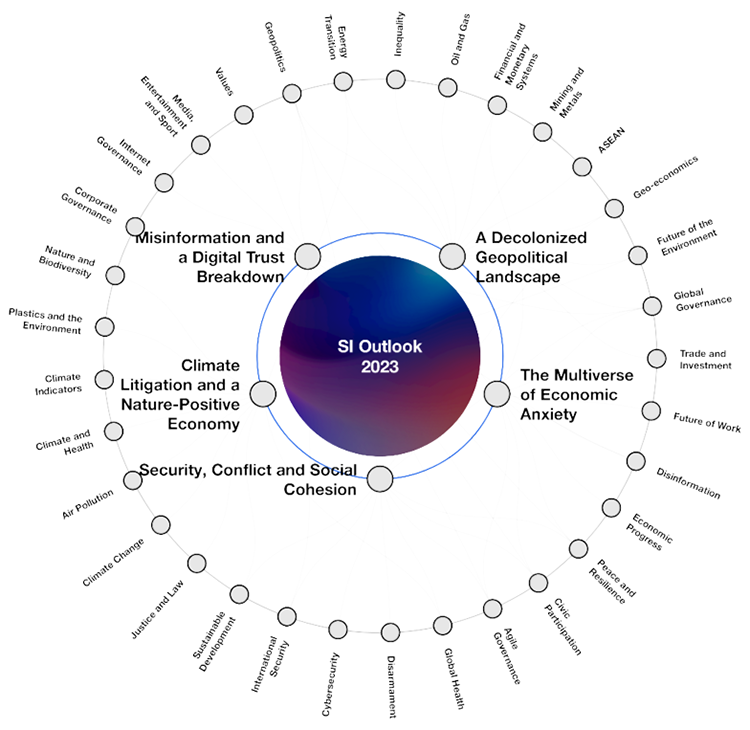
Strategic Intelligence Outlook 2023

The World Economic Forum recently organized the Strategic Intelligence Outlook 2023 event in Geneva, which gathered experts from industries, academia, international organizations and think-tanks, along with a virtual audience of the Forum’s digital members, to explore the trends they anticipate will become increasingly prominent in 2024.

They also contributed to building a transformation map, a dynamic knowledge tool that enables users to explore and make sense of the complex and interlinked forces that are transforming economies, industries and global issues.

Strategic Intelligence Outlook 2023 transformation map - WEF
Strategic Intelligence Outlook 2023 transformation map

The Strategic Intelligence Outlook 2023 featured a series of sessions providing a strategic outlook on the global business trends, climate risk, artificial intelligence, and geopolitics, enabling participants to understand how to build foresight and future preparedness capabilities. 

Here are some highlights from leaders who joined:

Outlook on geopolitics

“What the war in Gaza illustrates is that we are facing a very serious crisis in peace-making. Diplomatic efforts and economic tools like sanctions to end wars are failing and the deal making is getting a lot harder, leading to a distrust in the international system. 

“The other trend line is another set of fresh conflicts where no region has been spared. Not only are there more wars, the wars are lasting a lot longer along with human suffering and catastrophe. ” 

– Comfort Ero, President and CEO, International Crisis Group

“War is once again an acceptable grammar of negotiation. The reluctance nations had over many decades to use conflicts as a means of dialogue is over. Countries with the power to impose themselves are not holding back anymore.”

– Samir Saran, President, Observer Research Foundation

Outlook on artificial intelligence

“Customers are really curious about how generative AI, and more broadly artificial intelligence, can help them with their business growth and many organizations are now looking at areas within their business which can be supported by this technology and in some cases even undertaking proof of concepts and programmes. 

I expect that trend to continue with more use cases for this technology coming to the fore and more organizations looking at opportunities within their businesses for these sorts of technologies.” 

– Amit Sinha, App Innovation, Microsoft

Global business outlook

“There are five provocations that I would put out for corporate strategy making in companies. First, companies are not very good at understanding what policy means and how that impacts their business model. Second, few companies have fully designed their base scenario, and I think its de-risking. 

Third, global companies have not been trained in synthesized multi-polar views on the world. Fourth, companies are trying to use new capabilities, like trade compliance or supply chain analytics. And finally, companies need to track the foreign policy strategy of the country where their headquarters are situated and what quality of relationships it has with the US, China and other players.” 

– Markus Herrmann, Co-Founder and Managing Director, China Macro Group

Outlook on climate risk

“When something is too obvious, we don’t talk about it and we don’t value it. Everything that we depend on – clean air, water, food, our mere existence – is about nature, but we never think about valuing it because we always took it for granted and at a very conceptual level, as an economy, we should start valuing what nature gives us.

If we think about the economy, over 50% of GDP comes from nature; if we start losing nature, so many businesses are dependent on it if not directly, then indirectly through their supply chains and clients, it’s an important thing but such an obvious one that we don’t talk about it enough.”

– Sung-Ah Lee, Deputy Director General, Corporate Services, International Union for Conservation of Nature (IUCN)

HORIZON SCANS

A series of sessions also helped thought leaders expand their perspectives on the challenges facing the world.

“The coming surge in demand for quantum-safe ecosystem solutions will be propelled by new standards and regulation. We will start to see regulations and regulators acknowledging ‘quantum’ as a new risk category, and companies will be expected to have plans to keep customers and data safe with the latest practices and technologies.”

– Michele Mosca, CEO, EvolutionQ, Canada

“A shift towards regenerative development models is crucial for mitigating environmental damage, addressing social inequality, and building the resilience needed for ecosystems and communities to evolve and adapt harmoniously. A positive relationship between people and the planet can be achieved through circular and ethical practices.”

– Özge Aydogan, Director, SDG Lab, Switzerland

“Disinformation is deepening polarization and division around the world – and much of it is focused on migration. Disinformation and hate speech about migrants can stoke xenophobia and direct hostility and discrimination at innocent victims, which in turn can lead to the legitimization of anti-migrant policy by government authorities. These links between disinformation and policy are, however, frequently overlooked and unmeasured.”

– Marie McAuliffe, Head, Migration Research, International Organization for Migration (IOM), Geneva

Future preparedness

Other session explored themes to help business, government and society prepare for the future and enhance their future-preparedness and resilience. 

Building strategic intelligence

“We should describe an augmented intelligence, rather than an artificial intelligence, where the practitioner is still the centre of innovation and creativity, and they leverage these technologies as an augmentation and a force multiplier.” 

 Igor Jablokov, Chief Executive Officer, Pryon Inc Business in the Digital Age

Business in the digital age

“The small to medium enterprise segment has historically been underserved by banks. Globally, SMEs need financing to the tune of $5 trillion in developing countries alone. 

In the UK alone, there are 5.5 million SMEs that make 99% of the businesses and provide 60% of the employment. […] This makes SMEs a very crucial sector and their development is a top priority for governments.”

– Kanika Hope, Chief Strategy Officer, Temenos

Mastering foresight for organizational transformation

“We are not building foresight to predict the future, we are doing this to understand the present, to understand the forces and factors likely to shape our long-term future but also to understand the choices, the options, and the policies which can help bring one of those potential solutions to life.”

– Maria Langan-Riekhof, Director, Strategic Futures Group, National Intelligence Council (NIC) of the US

“Foresight is not something some people should do all the time but something all people should do some of the time…

We must be engaging the general public in conversations around the future so that they can feel that the future is not happening to them but is something they are engaging with […] and that they can play an active role in it. […] We must be including people in designing futures that they want to feel, touch and be part of.” 

– Abdulaziz AlJaziri, Deputy Chief Executive Officer and Chief Operations Officer, Dubai Futures Foundation


Source: World Economic Forum  

Energy & Climate, features, Impact Investing, Sustainable Business

COP28 Presidency, United Nations Climate Change and Bloomberg Philanthropies Launch New Industrial Transition Accelerator for Heavy-Emitting Industries

Backed by $30M from Bloomberg Philanthropies and the COP28 Presidency, the Accelerator will turbocharge implementation across energy, heavy industry and transport sectors, finance, and public policy in the world’s largest decarbonization effort to date

On December 2, 2023, COP28 President Dr. Sultan Al Jaber, UN Climate Change Executive Secretary Simon Stiell, UN Secretary-General’s Special Envoy on Climate Ambition and Solutions Michael R. Bloomberg, and UN Secretary-General’s Special Envoy on Climate Action and Finance Mark Carney launched the Industrial Transition Accelerator (ITA), to catalyze decarbonization across heavy-emitting sectors, including energy, industry, and transportation, and accelerate the delivery of Paris-aligned targets. The ITA Secretariat, which will be hosted by the Mission Possible Partnership (MPP), brings global industry leaders together with policymakers, finance, and technical experts to unlock investment and rapidly scale implementation and delivery of projects needed to cut emissions, consistent with credible 2030 1.5°C pathway targets as determined by the International Energy Agency (IEA).

The announcement took place at the COP28 World Climate Action Summit where the ITA co-chairs were joined by heads of state, CEOs, and climate leaders across civil society. The ITA is one component of the Global Decarbonization Accelerator (GDA), a series of landmark initiatives designed to speed up the energy transition and drastically reduce global emissions. 

COP28 President Dr. Al Jaber said, “Today we welcome a historic new era of energy action. We have presented solutions to drive a full scale and full speed transition of the global energy system, and I welcome all efforts and collaboration that will drive deep emissions cuts and improved efficiencies. Today’s historic announcement, across the entire energy ecosystem is something to be welcomed and celebrated, but we must recognise this is a first step towards a transformation that we all require.”

Michael R. Bloomberg, UN Special Envoy on Climate Ambition and Solutions and founder of Bloomberg LP and Bloomberg Philanthropies, said, “Reducing emissions from heavy emitting sectors like industry and transportation is one of the biggest obstacles we face in tackling climate change. This new partnership will bring together industry leaders, financial institutions, policymakers, and technical experts. Together, the coalition will work to help companies cut carbon emissions and develop public policies that incentivize those cuts – and to do so in ways that will help industries continue to grow and raise living standards around the world.”

Mark Carney, UN Secretary-General’s Special Envoy on Climate Action and GFANZ Co-Chair, said, “The rapid decarbonization of heavy-emitting industries is essential if we are to remain within our global carbon budget. These industries are currently in transition traps. They know what they need to do but struggle to get the investment they need to meaningfully cut emissions. The Industrial Transition Accelerator will go where the emissions are and drive decarbonizations in heavy-emitting industries by bringing new technologies to maturity, dismantling regulatory barriers and boosting the demand for sustainable products.”

Simon Stiell, Executive Secretary of the United Nations Framework Convention on Climate Change (UNFCCC), said, “The ITA represents a strategic convergence of policy, finance, technology, and collaborative efforts, to make significant strides in various sectors including heavy industry, energy, and transport to keep 1.5°C within reach. From the UNFCCC perspective, a key aspect of ITA is the policy connection. This initiative can play a crucial role by annually feeding back the progress and challenges faced across industries, to the COP process.”

The ITA will focus on decarbonization solutions across industry, transport and energy, focusing on sub-sectors that generate a third of global emissions, including steel, aluminum, cement, chemicals, shipping, aviation and parts of the energy supply chain.1 Without rapid action, carbon emissions from these sectors alone are likely to increase by more than 30% by 2050 2 – making it impossible for the world to meet the goals of the Paris Agreement. Given the interconnections between heavy-emitting sectors, slow progress in one sector delays action in another.

Dr. Fatih Birol, Executive Director of the IEA, said, “Accelerating the clean energy transition in sectors where emissions are hard to reduce, such as heavy industry and long-distance transport, requires collaboration among many stakeholders. Stepping up efforts by businesses and financial institutions is particularly important at this critical time to ensure that projects currently underway reach final investment decisions as soon as possible. I welcome the objective and efforts of the Industrial Transition Accelerator to catalyze collaboration in this regard.”

Francesco La Camera, Director-General at IRENA, said, “Keeping the 1.5°C target alive requires all hands on deck. IRENA’s World Energy Transitions Outlook calls for radical action to overcome the deeply entrenched barriers across grid and physical infrastructure, legal and policies, institutional capacity and skilled workforce stemming from the systems and structures created for the fossil-fuel era. Hard-to-decarbonize industry sectors require a range of solutions to become aligned with the 1.5°C target. Through our global membership, we at IRENA will contribute to the ITA goals by leveraging international collaboration in technology transfer and investments prioritizing the industrial decarbonizations in developing countries.”

Faustine Delasalle, Chief Executive Officer of the Mission Possible Partnership and Executive Director of the ITA Secretariat said, “We have clarity on what we need to do and where we need to be by 2030 to decarbonize the heavy emitting sectors in line with the Paris Agreement. But time is not on our side, and the pipeline of necessary near-zero projects is falling short because industry can’t do it alone. The ITA gives us the breadth and scale to create a flywheel of collaboration that can create the exponential change that we need. I am thrilled to see the COP28 Presidency and UN prioritizing this challenge and delighted that MPP is hosting the secretariat.”

Adair Turner, Chair of the Energy Transitions Commission, said, “The work of the Mission Possible Partnership has shown clearly how to decarbonize all the supposedly “hard” sectors of the economy – from steel, cement and chemicals to shipping and aviation.  We know the technologies and we know that net zero by 2050 is possible. But we must now turbocharge the pace of progress, with public policies and private financial support to drive the investment needed. The Industrial Transition Accelerator will play a key role in galvanizing action across the world.” 

While progress has been made, a critical mass of projects must reach their Financial Investment Decision (FID) phase in the next two years and be brought online by 2030 to keep alive the goal of limiting warming to 1.5°C.

Analysis from MPP shows that delivering the global emissions reductions needed will require 300 sustainable aviation fuel (SAF) plants, 200 ships using zero-emissions fuel, 70 zero-emissions steel plants, 40 new low-carbon smelting and refinery plants and over 40 commercial-scale carbon capture, utilization, and storage (CCUS) plants. 3

Heavy-emitting sectors will require a wide range of technologies to be commercialized and deployed to cut emissions at scale, including green hydrogen, long duration energy storage, and CCUS. 

This unprecedented, collaborative effort will connect and elevate existing decarbonization initiatives within the public and private sectors to unlock investment and deliver emissions reduction projects that help new technologies reach commercial scale. Importantly, the ITA will connect companies in developed and developing countries to relevant existing initiatives and engage international policymakers and international organizations to address cross-sectoral challenges. 

Recognizing the importance of cooperation with national governments, the ITA will work closely with partner countries. After the launch, Governments will be invited to engage with its efforts through participation in multi stakeholder workstreams and high level dialogues. The ITA will also offer practical implementation support to partner countries, with the goal of ensuring that the Accelerator supports delivery of on-the-ground projects. 

Rodrigo Rollemberg, Secretary of Green Economy, Decarbonization and Bioindustry, Ministry of Development, Industry, Commerce and Services, Brazil, said, “The Secretariat for Green Economy, Decarbonization and Bioindustry, of the Ministry of Development of Industry, Commerce and Services of Brazil recognizes the importance of bringing together industry, finance and policymakers to help achieve the accelerated emissions reductions necessary to achieve our goals in 2030 and 2050. As the new president of the G20 next year and COP30 in two years’ time, we look forward to playing a leading role at ITA to help accelerate the implementation of projects both nationally and internationally.”

Mr. Izuru Kobayashi, Deputy Director-General for Technology and Environment, Ministry of Economy, Trade and Industry, Japan, said: “We welcome the launch of the Industrial Transition Accelerator to support the scaling of collective efforts to decarbonise high emitting industries. The Japanese Government recognises the importance of bringing policymakers, industry and finance together to solve these challenges and is willing to contribute to the ITA to achieve these goals together.”

Dr. Salisu Dahiru, Director General of the National Council on Climate Change, Nigeria, said, “The Industrial Transition Accelerator (ITA) will help to accelerate the decarbonization of high emitting industries, globally. The Federal Government of Nigeria welcomes the launch of the ITA and looks forward to working with other policymakers, industry and finance to solve these collective challenges.”

Agnès Panier-Runacher, Minister for Energy Transition, France, said, “Through participation and leadership in the Climate Club and the Breakthrough Agenda, the French Government recognises the importance of bringing together existing efforts to accelerate the decarbonisation of heavy emitting industries. We look forward to working with the ITA ecosystem of policymakers, industry and finance providers to scale decarbonisation projects in line with 1.5 degree pathways.”

Steven Guilbeault, Minister of Environment and Climate Change, Canada, said, “The launch of the Industrial Transition Accelerator can help lower emissions from hard to abate sectors. Canada also faces similar challenges from heavy emitting industries and understands there are no quick and easy fixes, but together we can share solutions and help mobilize the financial capital we need to succeed and build a cleaner future for all.”

Under the leadership of the COP28 Presidency, UN Climate Change, and Bloomberg Philanthropies, the ITA will help address the critical challenges to significantly expand the number of approved decarbonization projects that secure investment approval by 2026.

It will bring together producers, their customers and suppliers, financial institutions, and governments to improve project economics by significantly increasing demand for sustainable products, ensuring the right policy settings are in place, and supporting the development of new financial instruments needed by heavy-emitting sectors to fund their transition.  

Mary Schapiro, Vice Chair of the Glasgow Financial Alliance for Net Zero (GFANZ), said, “Delivering the emissions reductions necessary to avoid the worst impacts of climate change requires an economy-wide effort. Our collaborative work to create solutions to decarbonize heavy-emitting sectors is crucial to this transition. GFANZ looks forward to supporting this important initiative, bringing private finance to the table to help boost investment where it is needed to foster development and accelerate the transition.”

Building on important groundwork already laid by businesses, financial institutions, and other leading net-zero initiatives, the ITA will focus on addressing the critical challenges that are holding up existing projects from reaching their FID in the next 2-3 years. These focus areas may include: 

  • Decarbonization solutions: Reaching economies of scale in energy technologies – such as green hydrogen, CCUS, sustainable fuels, and long-duration energy storage.  
  • Green demand: Mobilizing governments, financial institutions, and companies to boost demand for sustainable products, such as through the First Movers Coalition, and facilitate investment in green industrial projects.
  • Policy environment: Identifying, tracking, and promoting policy levers proven to have successfully accelerated decarbonization efforts.
  • Financing solutions: Creating financing solutions, such as the use of concessional finance, to help bridge investment today with demand for green products in the years ahead. 
  • Sector-tipping points: Elevating and accelerating progress of existing sector-specific projects that nudge us over tipping points to mass deployment of decarbonization solutions in each sector.

The ITA’s progress will be measured by emissions reductions achieved across the sectors of focus, relative to the credible net-zero pathways of the IEA and MPP, and how it supports countries in achieving and raising their NDCs towards 2030 milestones.

The ITA Secretariat calculates that heavy-emitting sub-sectors, including steel, aluminum, cement, chemicals, shipping, aviation and parts of the energy supply chain could plausibly cut emissions by 5.7GT (over a third of their emissions) by 2030 to get on a 1.5C pathway. The ITA will support projects that contribute to that transition.

Peter Bakker, President and CEO World Business Council for Sustainable Development (WBCSD), said, “I am thrilled that WBCSD will be a key partner in the Industrial Transition Accelerator announced today, an essential catalyst to unlock investments and get green industrialization solutions to scale. WBCSD’s members, together with our unique global network alliance of more than 60 independent business-led organizations worldwide, are working in every sector throughout the value chain and will play a major role by building green industrial plants, buying green products and developing the skilled workforce needed for a just transition.”

Dr. Ilham Kadri, Chair of WBCSD, added, “In our world, which is running full speed well beyond 2°C, the ITA creates the scale-up conditions and the momentum for key industries to change the trajectory now and to keep 1.5°C as a viable target. Bringing together global industry leaders with policymakers, finance, and technical experts towards this goal is now an urgent necessity.”

Børge Brende, President of the World Economic Forum, said, “Effectively addressing industry decarbonization is a systemic issue and as such requires systemic thinking and action. It is encouraging to see many organizations stepping up their efforts individually and they should continue to do so. However, accelerating the global pace of industrial emissions reductions requires coordinated collective action across all stakeholder groups. These issues are too complex, interrelated and quickly evolving. The World Economic Forum stands ready to work with the Industrial Transition Accelerator for scale and impact.”

UK Minister for Energy Security and Net Zero Graham Stuart, as a co-lead of the Breakthrough Agenda, said, “Industrial sectors are some of the world’s biggest polluters, so speeding up the green transition will require a concerted and focused effort. That’s why the UK is committed to working through the Breakthrough Agenda, in partnership with other governments and businesses, to focus on particular sectors and deliver transformational results at COP28 and beyond. We see real potential for the Industrial Transition Accelerator to unlock investment in a wave of first mover green industrial projects around the world. By decarbonizing heavy industries, we are safeguarding not just the environment but those industrial jobs which are at risk from the rising cost of carbon.”

The ITA will be driven by leading companies and sector initiatives, working in partnership with leaders from the real economy, financial sector, technical experts, and the policymaking community. To demonstrate this support, companies participating in the ITA’s work agree to:

  • Set out a Paris-aligned net-zero target
  • Develop a net-zero transition plan to achieve this target, ideally within two years, utilising a credible third-party framework and including a Paris-aligned 2030 interim target
  • Demonstrate acceleration of decarbonization efforts, through capital expenditure and technology deployment plans
  • Disclose on emissions and progress against targets, ideally within two years of joining, through key disclosure initiatives such as partners of Net Zero Data Public Utility (NZDPU) integrated with the UNFCCC Global Climate Action Portal (GCAP)

Hosted by MPP, the ITA Secretariat will actively facilitate collaboration, engagement, and implementation with partners in policy, finance, infrastructure, and technology. Founding partners include the Glasgow Financial Alliance for Net Zero (GFANZ), the Sustainable Markets Initiative (SMI), the World Business Council for Sustainable Development (WBCSD), and the World Economic Forum (WEF). MPP will lead the Secretariat and technical work alongside key industry-specific initiatives.  

The ITA builds on the ambitious work being done by MPP, which was founded in 2019 to trigger a net-zero transformation of seven industrial sectors, leveraging the convening power, talent, and expertise of world-leading climate action organizations. At COP26 in Glasgow, MPP and its partners put the decarbonization of heavy-emitting sectors firmly on the climate action agenda. They then published industry-backed Sector Transitions Strategies for reduction pathways?in the heaviest emitting sectors. At COP27 in Sharm el-Sheikh, MPP worked on turning pledges into action, galvanizing stakeholders on real economy milestones for 2030. Now, at COP28, the ITA will turbocharge this progress to unlock the investment needed in energy, industry, and heavy transportation to implement decarbonization solutions at scale to meet?these?ambitious 2030 objectives. 

“At a critical moment for the future of our planet, the IMO welcomes the timely announcement of the Industrial Transition Accelerator, which aligns closely with the net zero future of global shipping as defined in IMO’s 2023 Greenhouse Gas Strategy,” said Arsenio Dominguez, incoming Secretary General of the International Maritime Organization. “The maritime industry faces a confluence of challenges, opportunities, and changes ahead – the ITA can help bridge the gap by enhancing cross-sectoral cooperation and collaboration across the UN-family.”


READ FULL PRESS RELEASE HERE

Footnotes:

1 ITA Secretariat calculations. Scope 1 & 2 greenhouse gas emissions of steel (3.6Gt), aluminium (0.9Gt), cement (2.5Gt), chemicals (1.8Gt), aviation (0.8Gt), shipping (0.9Gt) and oil & gas (5.1Gt) totalling 15.6Gt

2 IPCC Sixth Assessment Report, Chapter 2 (2023): CO2 emissions from industry increase by 30% in 2050 compared to 2010 in baseline scenarios

3 missionpossiblepartnership.org/sector-transition-strategies/

++

About Bloomberg Philanthropies:
Bloomberg Philanthropies invests in 700 cities and 150 countries around the world to ensure better, longer lives for the greatest number of people. The organization focuses on five key areas for creating lasting change: the Arts, Education, Environment, Government Innovation, and Public Health. Bloomberg Philanthropies encompasses all of Michael R. Bloomberg’s giving, including his foundation, corporate, and personal philanthropy as well as Bloomberg Associates, a pro bono consultancy that works in cities around the world. In 2022, Bloomberg Philanthropies distributed $1.7 billion. For more information, please visit bloomberg.org or follow us on FacebookInstagramYouTubeTwitter, and LinkedIn.

Media Contact: Daphne Wang, daphne@bloomberg.org 


About COP28 UAE:

  • COP28 UAE is taking place at Expo City Dubai from November 30-December 12, 2023. The Conference is expected to convene over 70,000 participants, including heads of state, government officials, international industry leaders, private sector representatives, academics, experts, youth, and non-state actors.  
  • As mandated by the Paris Climate Agreement, COP28 UAE is delivering the first ever Global Stocktake – a comprehensive evaluation of progress against climate goals.  
  • The UAE is leading a process for all parties to agree upon a clear roadmap to accelerate progress through a pragmatic global energy transition and a “leave no one behind” approach to inclusive climate action.

About UNFCCC:
With 198 Parties, the United Nations Framework Convention on Climate Change (UNFCCC) has near universal membership and is the parent treaty of the 2015 Paris Climate Change Agreement. The main aim of the Paris Agreement is to keep a global average temperature rise this century well below 2 degrees Celsius and to drive efforts to limit the temperature increase even further to 1.5 degrees Celsius above pre-industrial levels. The UNFCCC is also the parent treaty of the 1997 Kyoto Protocol. The ultimate objective of all agreements under the UNFCCC is to stabilize greenhouse gas concentrations in the atmosphere at a level that will prevent dangerous human interference with the climate system, in a time frame which allows ecosystems to adapt naturally and enables sustainable development.


Energy & Climate, features, Impact Investing, Sustainable Business

The year ahead in ESG: assurance, transition finance and natural capital

By Nico McCrossan, GreenFin Weekly, GreenBiz Group

Above: Image via Shutterstock/Deemerwha studio

3 hot topics for 2024: regulations for ESG assurance; international agreements for transition finance; and new ways to measure investment in nature and biodiversity.

Is it officially too late to wish you a Happy New Year? As we return to work, here are three sustainable finance trends that are top of mind for me, along with three themes that sustainable finance and ESG community members say they would like prioritized in 2024. 

My hot topics for 2024 build on progress made in 2023: regulations for ESG assurance; international agreements for transition finance; and the development of standards and instruments to monitor investment in nature and biodiversity. Here’s where I see things headed.

Corporations are prepping for ESG assurance mandates 

What was once a voluntary exercise for disclosing climate and social goals has evolved into a full-fledged industry of ESG reporting. Up next: the introduction of third-party assurance requirements for certain ESG disclosures. 

California and the European Union are leading the way with the Golden State’s Climate Corporate Data Accountability Act, which requires large companies doing business in the state to get third-party assurance for Scope 1 and 2 emissions starting in 2026. (Companies will need to collect 2025 metrics, and file them in 2026). 

That means 2024 will be a big prep year: Companies will need systems to collect and manage data to meet those assurance requirements, and that means businesses must establish and test their ESG controllership strategy this year. 

How? Some companies are building internal teams to oversee ESG data collection and management for regulatory reporting. That includes hiring for the newly created position of ESG controller. Many large banks have added this role. Expect to see more companies hiring an ESG controller this year to manage regulatory demands. 

Transition finance will take the wheel 

An estimated $4 trillion in clean energy investment will be needed each year between now and 2030 to reach net-zero emissions by 2050, according to the International Energy Agency. 

That’s why climate finance was a key agenda item at COP28. More than $85 billion in new commitments were made, with the host country, the United Arab Emirates, launching a $30 billion global finance solutions fund that will allocate $5 billion to spur additional investment in the Global South. 

This year, we can expect the Inflation Reduction Act and Bipartisan Infrastructure Law to continue providing funding opportunities. An example is the $97 billion available through the Department of Energy for clean energy projects. The IRA has also contributed to an increase in cleantech investments, which totaled $176 billion in the first three quarters of 2023, or $50 billion more than the same period in 2022. 

Another key IRA provision to watch this year is for transferable clean energy tax credits. Through this facility, developers can monetize credits they receive for clean energy projects by selling them at a slight discount to companies that face large tax bills. This provides a much-needed source of capital for financing clean energy project development. 

Finally, better data for navigating natural capital 

The EU’s Corporate Sustainability Reporting Directive took effect Jan. 1. It requires large and publicly traded companies to disclose environmental and social risks. The Taskforce on Nature-related Financial Disclosures released its recommendations for doing so in September, guiding how companies should discuss nature-related dependencies, impacts, risks and opportunities. 

As companies embrace digital technologies to collect these nature-related metrics, we’ll see the development of the “planet economy,” predicts Lucas Joppa, the former Microsoft chief environmental officer turned private equity investor. Those insights and data pools will give investors more of the tools and infrastructure needed to invest in nature at scale, he said. 

What 3 sustainable finance leaders see on the horizon 

What ESG accounting or sustainable finance challenge would sustainable finance and ESG experts like to see prioritized in 2024? Why? I put that question to subject matter experts late last year. Here are three of their responses. 

Marina Severinovsky; Head of Sustainability, North America, Schroders 

“The future of fossil fuels, which was a focus of COP 28, should remain a priority in 2024, as reaching net zero will require a wholesale transformation of energy systems. Energy is an important part of many portfolios, and investors need to assess whether companies can adapt and transition their business models at a pace that can be profitable on their path to lower emissions. Given the demands on the energy system over the next 10-30 years, without significant investment, we will be short energy. Conventional energy companies are an important part of the investment in the energy transition sector and are needed to provide the transition fuels for the global clean energy transition. We expect that they will adapt their business model to capitalize on the growth in new energy transition technologies. Many of the major oil companies are already starting to change where they allocate capital and are already invested in hydrogen, carbon capture, biofuels, and wind and solar. Sustainable finance investment and engagement should focus on encouraging and accelerating this transition.” 

Andrew Behar; CEO, As You Sow 

“There are 100 million people with $10 trillion in retirement accounts invested in an unlivable planet they can’t retire on. This is the year for every individual to realize that the person who earns the money has the right to invest it aligned with their values and to vote their proxies to shape a company’s trajectory toward justice, sustainability and financial outperformance. Click your heels together, Dorothy, it’s your money — use your power wisely.” 

Jeff Mindlin; Chief Investment Officer, ASU Foundation 

“At the ASU Foundation, our viewpoint has always been that we are fiduciaries first and want to avoid politicizing the endowment. To that end, in 2024, my hope is that we will have passed the greenwashing and greenhushing phases to make actual progress on the matter at hand. I also would want to see standardization of reporting at the company and fund level become a priority.” 


Subscribe to GreenFin Weekly

Nico McCrossan is Manager of Sustainable Finance & ESG at GreenBiz Group

Energy & Climate, features, Impact Investing, Sustainable Business

Six predictions for ESG in 2024: The year ESG emerged from fad to essential business

By Natalie Runyon, Thomson Reuters Institute

As ESG breaks through into the mainstream despite the challenges it faces, here are some predictions for 2024 on what we’re likely to see in this area

This year, 2024, will be the one in which companies will begin to take environmental, social & governance (ESG) activities seriously, proving once and for all that ESG is here to stay. While it is true that this trend started as the result of the need to comply with regulations and risk management, by this year, companies will fundamentally overhaul their business structures. ESG issues will transition from being optional extras to integral elements of corporate strategy, essential for generating sustained value.

Here are six of the most important ways that ESG will play an impactful role in 2024:

1. ESG gets f(in)ancy
In 2024, sustainability will become deeply embedded in the financial foundations of companies. Already, nearly one-third of CFOs are examining the potential effects of climate change scenarios on financial outcomes in 2023, according to PwC. Indeed, finance professionals’ consideration of sustainability on the valuation of tangible assets and the valuation of goodwill and other intangible assets were some of the ways that the integration of ESG was already occurring. In addition, more organizations are creating ESG controller positions, a role that oversees and manages the integration of ESG issues into an organization’s operations and financial reporting protocols.

The amalgamation of sustainability, finance, and business strategy reflects growing recognition that sustainability and financial stability are not opposing goals but are fundamentally intertwined. As a result, closer integration of finances and sustainability will grow as a priority in the domain of CFOs, financial controllers, and corporate finance and accounting professionals.

2. ESG goes private
Sustainability reporting will expand to include private firms because of Scope 3 rules, which require reporting companies to monitor all indirect emissions that occur throughout the supply chain and among third-party vendors, particularly as the result of California and European Union regulations. This means that regardless of public disclosure, private firms of all sizes that supply to major public or private corporations will probably need to initiate or improve their greenhouse gas accounting methods.

Scope 3 requirements will drive significant transformations across all sectors, as every company in a field strives to meet the standards set by the largest players in their industry. For example, managing partners of law firms have begun mentioning for the first time their need to calculate their carbon footprint.

3. Politicized environment around ESG will remain
Like throughout much of 2023, ESG will remain a partisan topic this coming year. Companies will need to remain cautious about how they discuss sustainability externally amid presidential and congressional elections and expectations for an increase in pro- and anti-ESG legislation in the United States, and in the wake of 50 countries and regional bodies experiencing elections in 2024. There are several potential solutions available for companies on how to approach those officials with polarized pro- and anti-ESG viewpoints, which include using stakeholder mapping on divisive issues and focusing on (or even rebranding) individual initiatives that fall underneath the ESG umbrella that may be less polarizing than the term ESG.

4. Biodiversity will emerge as a mainstream ESG topic
While the topic of biodiversity loss was gaining steam last year, that trend continues. Indeed, nature and land use were included as a 2030 global deforestation goal at the global environmental conference Cop28 in December. In addition, investment funds that focus on biodiversity and nature are rapidly increasing in number and assets, as evidenced by a four-fold growth in assets under management in European funds dedicated to biodiversity.

Further, the Task Force on Nature-related Financial Disclosures (TNFD), which finalized its disclosure recommendations in September, has highlighted evolving nature-related dependencies, impacts, risks, and opportunities that are aligned around four pillars. Now, many governments are considering the adoption of these standards, which are consistent with other frameworks and standards to enable corporate reporting. In 2024, many more governments are likely to follow.

5. Supply chains at the center of the “E” and “S”
Several recent laws mandating Scope 3 reporting — including new laws in California and the EU’s Corporate Sustainability Reporting Directive, combined with evolving expectations of stakeholders — are driving companies to prioritize ethical material sourcing, adherence to fair labor standards, and initiatives aimed at reducing environmental damage across the entire supply chain.

In fact, supply chains are where the intersection of environmental and social concerns are taking shape, a development that is likely to accelerate in 2024. Indeed, another pending EU regulation — the Corporate Sustainability Due Diligence Directive — if passed, would require EU and non-EU companies to conduct environmental and human rights due diligence across their operations, subsidiaries, and supply chains.

In the coming year, we are likely to see the integration of environmental and social parts of ESG — the E and the S — converge on how company supply chains can impact both water and nature because of TNFD’s inclusion of nature-related reporting in relation to both upstream and downstream supply chains.

6. Increase sophistication of greenwashing claims
Moving forward into 2024 and beyond, the notion of greenwashing — a term frequently employed to call out insufficient or misleading sustainability efforts and disclosures by corporations — is expected to be more clearly defined legally and carry weightier repercussions.

Greenwashing carries with it reputational, regulatory, and litigation risks; and with no consistent legal definition, the concept of greenwashing will vary by product, service, regulator, and jurisdiction. The EU, meanwhile, is making considerable progress in eradicating greenwashing, encompassing the development of new rules designed to limit false advertising and to offer consumers enhanced information about products.

In 2024, businesses are expected to embrace ESG criteria not just for compliance or risk management, but as a chance to fundamentally transform their business models with the full understanding and acceptance of the need to account for increasingly complex external risks that may be occurring simultaneously.

This shift will make mainstream a thorough revision of design processes, procurement strategies, financial management, and marketing and communication practices across a number of ESG-related issues, but opponents will remain vocal. While at the same time, ESG will transition from being a peripheral element to a central component of overall corporate business strategies.

Energy & Climate, features, Impact Investing, Sustainable Business

ImpactAssets Surpasses $3B AUM, Building on Momentum in new 2023 Impact Report

Above photo courtesy of OWEESTA, an ImpactAssets racial equity portfolio investment

Annual report captures the transformative progress produced by the firm’s current investment portfolio of 886 companies and funds, with a key focus on climate solutions, gender equality, and racial equity.

ImpactAssets 2023 ReportImpactAssets, the impact investing trailblazer with a decade-plus track record of mobilizing capital for good, surpassed $3 billion in total assets under management this year, according to its newly-released 2023 Impact Report. The report also reveals that the firm directed a total of $458 million in investments and $224 million in grants towards funds, companies, and nonprofits advancing a more equitable, net-zero world in 2022 alone.

With the goal of igniting, accelerating, and amplifying lasting transformation, ImpactAssets has identified key areas of focus within the persistent, inter-connected issues of climate, race, and gender where impact investment and philanthropic capital can have its greatest reach. The new report presents those focus areas, which are all presently underfunded, with examples of the real-world impact the firm’s work has supported. ImpactAssets currently has 886 private-market portfolio positions according to the report, and last year, it launched ImpactAssets Capital Partners as a registered investment advisor to further support institutional clients.

Among the firm’s primary impact areas, ImpactAssets’ work on the climate emergency stands out: The firm has a portfolio of 282 companies and impact funds, and climbing — targeting climate solutions, according to the report. The portfolio reflects ImpactAssets’ priority on changing the trajectory of our planet’s future while centering the communities most impacted by the changing climate. The report highlights the energy transition, deep decarbonization, nature-based solutions, and climate justice as the most critical focus areas for impact-minded climate investors.

“We are urgently focused on tackling the climate emergency and supporting our planet’s most impacted people,” said ImpactAssets CEO and Chief Investment Officer Margret Trilli. “Our 2023 Impact Report showcases our work to channel impact-minded capital toward innovative climate solutions for low income and disadvantaged communities. Addressing and closing acute equity gaps will require committed and flexible investment. We recognize the role of the climate crisis as a ‘threat multiplier’ for existing inequalities, so our investments are made to generate lasting impact and equity for all.”

In addition to the notable climate solutions impact showcased in the 2023 Impact Report, other key highlights include the following: 

  • AUM Growth: ImpactAssets crested $3 billion in total portfolio assets this year, a sum that reflects growing traction for the firm’s deeply held commitment to mobilizing capital for good.
  • Gender Equality: ImpactAssets has a current portfolio of 94 companies and impact funds focused on improving the lives and outcomes of women and girls. Within this group, 69% of the investments are women-led.
  • Racial Equity: To tackle the $10 trillion racial equity gap in the U.S., ImpactAssets has channeled capital to 148 portfolio companies and funds, including Community Development Financial Institutions (CDFIs), affordable and supportive housing funds and funds managed by underrepresented groups.
  • Grantmaking Milestone: ImpactAssets surpassed $1 billion in funding granted to date, supporting more than 80,000 grant recipients.

“Our clients and partners are deeply committed to charting new frontiers in impact and to catalyzing targeted action in areas of urgent need,” said Dana Cotter, Managing Director of Impact at ImpactAssets. “In a year when increasing urgency is being met by renewed federal climate commitments, especially the Environmental Protection Agency’s Greenhouse Gas Reduction Fund, ImpactAssets is taking advantage of partnerships with the public sector and private companies to drive broad, unified, and just climate action.”


About ImpactAssets

ImpactAssets is an impact investing trailblazer, dedicated to changing the trajectory of our planet’s future and improving the lives of all people. As a leading impact investing firm, we offer deep strategic expertise to help our clients define and execute on their impact goals. Founded in 2010, ImpactAssets increases flows of money to impact investing in partnership with our clients through our impact investment platform, philanthropic solutions and field-building initiatives, including the IA 50 database of private debt and equity impact fund managers. ImpactAssets has more than $3 billion in assets, working with purpose-driven individuals and their wealth managers, family offices, foundations and corporations. ImpactAssets is an independent 501(c)(3) organization.

Additional Articles, Energy & Climate, Food & Farming, Impact Investing, Sustainable Business

Signup to receive GreenMoney's monthly eJournal

Privacy Policy
Copyright © GreenMoney Journal 2025

Website design & development by BrandNature

Global Events Calendar

View All Events

april

21aprAll Day232026 Sustainable Packaging Coalition: SPC Impact – Nashville

27aprAll Day30Women Deliver 2026 Conference (WD2026) – Melbourne

X