Tag: Impact Investing

MSCI’s 2018 ESG Trends to Watch

By Linda-Eling Lee and Matt Moscardi, MSCI


Bigger, faster, more. Whether due to policy, technological or climatic changes, companies face an onslaught of challenges that are happening sooner and more dramatically than many could have anticipated. Investors in turn are looking for ways to position their portfolios to best navigate the uncertainty. In 2018, these are the major ESG trends that we think will shape how investors approach the risks and opportunities on the horizon. In 2018, investors will…

  • SIFTING FOR MANAGEMENT QUALITY IN EMERGING MARKETS
    …use ESG signals to help navigate the evolving size and shape of the Emerging Markets investment universe. More than 15% of Emerging Markets domiciled constituents of the MSCI ACWI Index have ESG Ratings that eclipse their country’s ESG Sovereign Ratings, making them country outperformers worth watching.
  • FIRST STEPS IN SCENARIO TESTING CLIMATE CHANGE
    …expand their view of portfolio climate risk from company carbon footprint to macro exposures across asset classes. We found that at least 40% of each major asset class is exposed to countries at high risk to irreparable physical damage under a high warming scenario.
  • ACCELERATION OF ESG INTO FIXED INCOME INVESTING
    …be catalyzed to adopt ESG factors in fixed income investments, as demand from leading asset owners to align their ESG frameworks across asset classes coincides with interest in how ESG factors can add value to credit analysis. Recent research on ESG and equity performance suggests that a company’s ESG Rating could signal a form of ‘unmatured’ event risk.
  • LOOKING BEYOND SUSTAINABILITY DISCLOSURE
    …look to alternative data sources to balance the growing volume of corporate sustainability disclosure. In our own ESG Ratings, 65% of a company’s rating on average is driven by data sources beyond voluntary disclosure.

  • THE YEAR OF THE HUMAN
    …increasingly seek opportunities to invest in talent quality, as Artificial Intelligence (AI) redefines work tasks to require higher skilled human input. While good workforce data is hard to come by, we find evidence that companies with stronger human capital practices had better productivity growth than industry peers.


Download the full 2018 ESG Trends Report here – https://www.msci.com/www/research-paper/2018-esg-trends-to-watch/0829057769

You can also listen to Linda-Eling Lee and Matt Moscardi of MSCI discuss how the five ESG trends may play out over the coming year and beyond, and discuss the potential risks and opportunities for institutional investors here – https://www.msci.com/2018-esg-trends-to-watch

Additional Articles, Energy & Climate, Food & Farming, Impact Investing, Sustainable Business

The Business of Planting Trees: A Growing Investment Opportunity

New research finds businesses are making money from planting trees and growing sales as rapidly as 10 times per year

The Business of Planting Trees - GreenMoneyJournal.com

Many investors don t know what restoration is or realize the extent of its potential. A new report by World Resources Institute (WRI – www.wri.org) and The Nature Conservancy (TNC – www.nature.org) reveals that businesses around the world are making money by planting trees, unleashing a growth opportunity for venture capital, private equity and impact investors. The research indicates the restoration economy is at a tipping point.

The new report released in January 2018, The Business of Planting Trees: A Growing Investment Opportunity, shows that restoring degraded and deforested lands is not only a boon for the environment, but a lucrative opportunity for investors and entrepreneurs. WRI and TNC looked at hundreds of companies — tech startups, consumer goods companies, timber producers, etc. — and selected 14 enterprises to highlight from around the world. The publication finds that the sector is growing rapidly, with some businesses poised to grow revenues up to 10 times per year.

“The long-term growth outlook is positive as technology lowers the costs of tree-planting, consumers reward companies who restore forests, governments make large commitments to rehabilitate their land, and business model innovation continues,” said Sofia Faruqi, Manager at WRI and report co-author. “The confluence of these factors signals that now’s the time to invest in restoration.”

The report identifies four emerging themes in the restoration economy: technology, consumer products, project management and commercial forestry. To help investor and entrepreneurs gain insight from real-world examples of companies, the report profiles the following 14 businesses: BioCarbon Engineering, Brinkman, EcoPlanet Bamboo, Ecosia, F3 Life, Fresh Coast Capital, Guayaki, Komaza, Land Life Company, Lyme Timber, New Forests, Symbiosis Investimentos, Tentree, and Terviva. (See the 14 company websites below)

A range of investors have financed the businesses featured in the report, from venture capitalists to development banks to foundations. Investments include debt, equity and grants. Several companies have recently raised millions of dollars in growth capital.

“If we are to be serious about climate change, we have to get serious about investing in nature,” said Justin Adams, Managing Director Global Lands for The Nature Conservancy. “The way we manage lands in the future could cost effectively deliver over a third of greenhouse gas emissions reductions required to prevent dangerous levels of global warming.”

Recent technologies have paved the way for faster, cheaper, more efficient tree planting, allowing rapid reforestation of broad areas of land. From seed-planting drones to companies enabling credit access for small farmers, technology is changing the face of restoration. Many of these innovations were unavailable even five years ago. As technology brings down the costs of restoration, demand will rise, similar to solar energy.

Consumer goods companies are also integrating restoration in innovative ways, from selling yerba mate grown in restored forests, to using their profits to plant trees. As trendy consumers become more engaged in conservation, many companies see a big opportunity to market forest-friendly products that differentiate them in the marketplace.

Bruno Mariani, founder of Symbiosis Investimentos – a company profiled in the report – said “Large-scale reforestation is lucrative. Forests give us wood, water, oxygen, food, fauna, jobs and a return on investment. Mainstream finance will inevitably tag along but when you rebuild a forest, you create much more than financial value. You protect a healthy environment for future generations to inherit.”

There is also a large market for companies to support the millions of hectares of public land being restored by countries. The political momentum for restoration continues as countries seek to meet their commitments to the Paris Climate Agreement[1], Bonn Challenge[2], Initiative 20×20[3], AFR100[4] and more. With 160 million hectares of land committed for restoration, these pledges present a growth pathway for the companies that design, manage and implement the projects.

April Mendez, co-founder of Fresh Coast Capital — a company profiled in the report — said, “We re offering investors the opportunity to earn a return from urban green spaces. Private investment can accelerate cutting-edge green infrastructure that improves air quality, health and community cohesion, while providing cost-effective stormwater management for cities.”

Although the timber industry has been around for decades, sustainably managed timber that improves land quality has been a bright spot for innovation. From institutional timber funds that set aside large amounts of land for conservation to business models that incorporate smallholder farmers or focus on extinct species, recent developments indicate that sustainable timber has a rising role to play in the growth story of restoration.

More entrepreneurs continue to enter the restoration economy, finding new ways to make money while restoring degraded land. Read the full report here – www.wri.org/publication/business-of-planting-trees


Article Notes:

[1] http://www.wri.org/blog/2015/12/paris-agreement-turning-point-climate-solution

[2] http://www.bonnchallenge.org/content/challenge

[3] http://www.wri.org/our-work/project/initiative-20×20

[4] http://afr100.org/

Company Websites:

BioCarbon Engineering – https://www.biocarbonengineering.com

Brinkman – http://www.brinkmanreforestation.ca

EcoPlanet Bamboo – http://www.ecoplanetbamboo.com

Ecosia – https://info.ecosia.org

F3 Life – http://www.f3-life.com

Fresh Coast Capital – https://www.freshcoastcapital.com

Guayaki – http://guayaki.com

Komaza – http://www.komaza.com

Land Life Company – http://www.landlifecompany.com

Lyme Timber – http://www.lymetimber.com

New Forests – https://www.newforests.com.au

Symbiosis Investimentos

Tentree – https://www.tentree.com

Terviva – http://www.terviva.com

Additional Articles, Energy & Climate, Food & Farming, Impact Investing, Sustainable Business

Should Your Investment Strategy Incorporate a Climate Risk Discount?

By Cyrus Lotfipour, Vice President, MSCI and MSCI ESG Research

Consider these three recent developments: California emerged from drought in April 2017, fewer companies reported impacts associated with water scarcity[1], and the average freshwater intensity of companies in the MSCI ACWI Index dropped by 15 percent between 2015 and 2016[2]. While these are positive short term signals for investors concerned with water scarcity, 2017 was also the most costly in U.S. history for natural disasters[3]. This underscored the thinking behind a key trend that MSCI ESG Research identified in the beginning of 2017[4]: institutional investors are shifting their portfolio analysis from the measurement of regulatory risks, such as the U.S. withdrawal from the Paris Agreement, to physical risks, such as exposure to coastal flooding along the U.S. Gulf Coast.

Measuring Water Risk at the Company and Fund Level

MSCI ESG Research assesses risk from water scarcity based on two key variables: how much water a company needs, and how secure is the supply. By way of example, consider two U.S. utilities: Ameren Corporation and Xcel Energy. In 2016, both companies required more than 200,000 cubic meters of freshwater for every USD $1 million in revenue (as of June 30, 2017 based on MSCI ESG Research analysis). While both Ameren and Xcel need large volumes of water to produce power, they face different physical limitations based on the location of their operations. Ameren mostly draws water from states with a relatively high level of water security, such as Missouri and Illinois. Xcel, on the other hand, has most of its operations located in Texas and Colorado, where water resources are already stressed and competition for water is likely to intensify between industrial and agricultural users[5].

A similar level of scrutiny can be applied at the portfolio level. Consider two U.S. funds with similar investment objectives: the PowerShares High Yield Equity Dividend Achievers Portfolio (PEY) and the WisdomTree US Dividend ex-Financials Fund (DTN). On average, holdings in these funds require more than 65,000 cubic meters of water per dollar of sales to operate, ranking in the top 10 percent of all funds in our coverage of over 26,000 mutual funds and ETFs (as of June 30, 2017 based on MSCI analysis). However, based on the geographic distribution of each fund’s underlying holdings, DTN has approximately 60 percent of its asset value invested in high risk regions, while for PEY, the allocation to high risk geographies is 45 percent. Without measuring the potential water risk of an income-focused strategy, investors may run the risk of higher than anticipated exposure to an event such as a severe drought across a portfolio.

FIGURE 1: Measuring Water Dependency and Security in Global Equity Fund Holdings, as of Dec 2017

High Water Dependency_Chart- GreenMoneyJournal.com
Source: MSCI ESG Research, WRI Aqueduct


Shifting the Analysis From Scarcity to Flood Risk

While the costs associated with drought in the U.S. declined from USD $4.7 billion to USD $2.5 billion over the last two years, 2017 was one of the most tumultuous years for climate events. According to the National Oceanic and Atmospheric Administration (NOAA), 2017 was the most costly for natural disasters in U.S. history and exceeded the previous record set in 2005 by 42 percent[6]. Approximately 86 percent of the total economic cost was attributed to three hurricanes that exceeded USD $50 billion in costs, all of which made landfall within a one month timespan. The severity of these events served as a wake-up call for investors: not all water-related risk revolves around scarcity. Some investors may question the possible impact of climate change on their portfolios, but the 2017 U.S. hurricane season likely left little doubt about the financial costs that can result from events such as flooding and severe storms.

In one example, Hurricane Harvey resulted in USD $300 million in lost sales and related storm costs for the petrochemical producer, LyondellBasell[7]. The company has four large crackers, four polyethylene plants, and more than 2,000 miles of pipeline concentrated in a region that is prone to tropical storms. The impact of severe weather and flooding has also extended beyond operating assets. In Lake Charles, Louisiana, the South African chemical producer, Sasol, is building a USD $11 billion chemical complex that overlaps with a high risk flood zone. The project, already well over the initial USD $8 billion budget, in part due to weather delays and poorer-than-anticipated subsurface conditions, incurred an additional USD $130 million in costs related to the same storm[8]. As the frequency of severe weather events increases, investors may want to consider whether the projected return on investment adequately considers a discount for future climate risk.

FIGURE 2: Facilities Owned by Companies Held in Two Exchange Traded Funds: PEY and DTN

Water Risk US Map_msci

Facilities shown on map are limited to those owned by companies in the MSCI ACWI IMI as of Sept 2017. Fund holdings are updated as of Dec 2017. Source: MSCI ESG Research, US Federal Emergency Management Agency, US EPA Greenhouse Gas Reporting Program; Gassert, F., P. Reig, T. Luo, and A. Maddocks. 2013. “Aqueduct country and river basin rankings: a weighted aggregation of spatially distinct hydrological indicators.” Working paper. Washington, DC: World Resources Institute, December 2013.  Available here online.


To compensate for the fact that not all companies consistently report on the location of their assets, MSCI utilizes facility location and greenhouse emissions data reported to the EPA as a means of filling the disclosure gap. Of the approximately 3,900 facilities that report to the EPA’s Greenhouse Gas Reporting Program and are owned by companies in the MSCI ACWI Investable Market Index (IMI), 35 percent are located in counties that face a high level of water stress, based on the World Resources Institute’s Aqueduct water risk tool[9]. Accordingly, these facilities may face constraints on access to freshwater resources during periods of drought, a higher likelihood of community conflict, or greater operating costs as a result of shifting to alternative water supplies.

Using this same underlying data, we can map company assets to flood hazard zones designated by the US Federal Emergency Management Agency (FEMA). Although the National Flood Hazard Layer has deficiencies – chief among them is the failure to consider land use change in a timely manner[10] – the maps provide a useful overview of the key regions that are at risk. Among facilities located in hurricane-prone states[11], approximately 7.5 percent are located in regions that face a 1 percent annual flood probability.

Following a year of unprecedented costs attributed to hurricanes and flooding, more investors may seek out ways to improve their analysis of physical risks. This not only reflects the growing frequency of catastrophic climate events, but also the emergence of climate-related financial risk disclosure standards[12]. However, investors seeking to measure their portfolio exposure to water risk, let alone mitigate their exposure, face a significant challenge: location is critical, and not all data is created equal. Until companies are required to systematically report on the location of assets, the burden will fall on investors to integrate alternative data sources into their assessment of physical risk.


Article by Cyrus Lotfipour, CFA, Vice President and Head of the North American ESG analyst team for MSCI ESG Research. He spearheads MSCI’s water risk mapping initiatives and conducts research on the integration of water risks in the investment process. He also leads the Chemicals and Capital Goods industries at MSCI ESG Research, where he is responsible for the development of ratings methodology and thematic research in these industries. Based in New York City, Cyrus joined MSCI in 2009 and holds a dual degree in economics and biology from Bates College. He is also a CFA charterholder and a member of the CFA Society New York.


Article Notes:

[1] MSCI ESG Research analysis of quarterly earnings transcripts from companies in the MSCI US Investable Market Index (IMI) between 2015 and 2017 (-54% reduction in mentions of drought). Source: seekingalpha.com

[2] Calculated based on estimated and disclosed freshwater withdrawals per million USD sales in 2015 and 2016, data updated as of Jan 25 2018

[3] https://www.ncdc.noaa.gov/billions/

[4] “ESG Trends in 2017: A Fundamental Rethink?” Moscardi, Matt and Lee, Linda-Eling, MSCI ESG Research. https://www.msci.com/www/blog-posts/esg-trends-in-2017-a/0556760275 For our 2018 ESG Trends to Watch Report, visit https://www.msci.com/www/blog-posts/2018-esg-trends-to-watch/0828969046

[5] http://www.wri.org/our-work/project/aqueduct

[6] https://www.ncdc.noaa.gov/billions/

[7] USD $200 million was associated with lost sales and storm-related costs in Q3 2017 and an impact of USD $100 million was forecasted for Q4 2017. Source: LyondellBasell Q3 2017 Earnings Transcript. www.seekingalpha.com

[8] https://www.bloomberg.com/news/articles/2017-11-23/south-africa-s-sasol-tightens-purse-strings-for-new-projects

[9] http://www.wri.org/our-work/project/aqueduct

[10 Approximately 22% of community maps are based on data that is more than 10 years old (https://www.bloomberg.com/graphics/2017-fema-faulty-flood-maps/)

[11] Texas, Louisiana, Mississippi, Alabama, Florida, Georgia, South Carolina, and North Carolina accounted for 85% of hurricane landfalls between 1851 and 2015 (NOAA Hurricane Research Division http://www.aoml.noaa.gov/hrd/tcfaq/E19.html)

[12] https://www.fsb-tcfd.org/publications/final-recommendations-report/

Energy & Climate, Featured Articles, Impact Investing, Sustainable Business

Water and Investing: Is Your Portfolio on the Growth Side of Disruption?

By Lydia Miller, Senior Vice President, Dana Investment Advisors

Water is a systemic risk to investors, as in many parts of the United States and other areas of the world this precious resource is in danger. Investors and market players should be deepening their research and investment process to tackle water risks, often hidden in holdings across all asset classes. As investors, how do we first protect our clients from these risks, and how do we position these same clients to benefit from the growth opportunities in companies that are providing innovative systems, products and services to solve water quantity, quality and resilience issues?

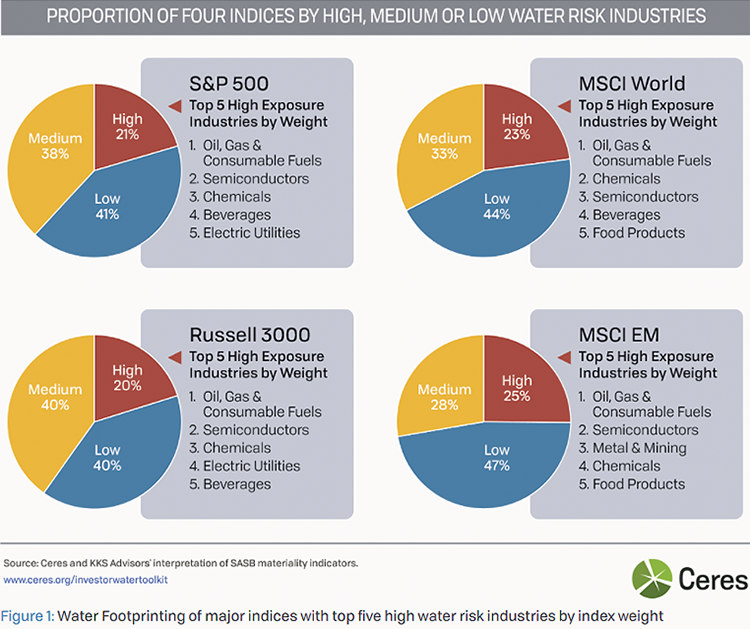
Several approaches seek the upside first and target water investments directly, mostly via infrastructure projects. In public equity markets, investments are often made in water utilities and industrial companies with water solutions business lines. Both of these approaches are examples of very worthy endeavors, but they are simply not enough by themselves to protect and grow the assets of most investors. Indeed some of the industrial holdings may be exposed to water risks in other parts of their businesses. Whether you are a universal owner, such as a major pension plan, a smaller institution or an individual, you are probably holding much of your assets in public equities and fixed income products. Particularly on the equity side, we’ve seen a huge move from active to passive approaches, thus the average investor is quite exposed to water risks embedded in various indexes. A recent study using SASB data highlights this exposure for the S&P 500, Russell 3000, MSCI World and EM Indexes. Using water footprinting, this study demonstrated that between 20 and 25 percent of these indexes had “high” water risk exposed industries by weight, and over 50 percent in high and medium risk categories. Divestment is not the answer, nor is targeted solution investing the entire answer in addressing water risk exposure.

We need a systemic approach to solutions and a more holistic approach to risk management and analysis. At Dana Investment Advisors, we are deploying several methodologies within our core ESG (Environmental, Social and Governance) strategies to tackle this widespread challenge on behalf of our clients. This comprehensive approach includes quantitative factor modeling, fundamental analysis including assessment of innovative solutions, advocacy efforts and partnering with other like-minded entities, many of which are non-profits or universities.

Quantitative analysis involves gathering and aggregating a variety of data sources to track water exposure on a company basis and portfolio level. Greater corporate disclosure of such information is still needed, but we applaud the efforts made thus far by forward-looking corporate entities and nonprofits such as CDP that have gathered and disseminated information to investors. We utilize a variety of data providers for “raw” metrics and combine these in a proprietary ESG model. These include Trucost, ISS, MSCI, Bloomberg, Sustainalytics and more. While we have several metrics on water, we also have one that combines water and carbon intensities, as water and energy are inextricably linked. This can mean additional risks for companies setting carbon emission reduction targets that depend upon the continued availability of water. This modeling helps direct attention to those industries and specific companies that require a deeper analytic dive. We are collaborating with Peter Adriaens, Professor of Engineering, Finance and Entrepreneurship at the University of Michigan, and Director of the Center for Smart Infrastructure Finance. The objective of the project, which engages MBA students of the highly ranked Ross School of Business, is to tease out value-at-risk based stock volatility metrics that reflect water exposure risks for companies across food and beverage, semiconductor, energy and consumer products companies.


While we have several metrics on water, we also have one that combines water and carbon intensities, as water and energy are inextricably linked. This can mean additional risks for companies setting carbon emission reduction targets that depend upon the continued availability of water.


Fundamental analysis gets to the heart of what is meant by “disruption.” Say the word “disruption” to mainstream investors and one hears about Amazon and its disruptive impact on brick and mortar retailers. To a sustainability or ESG-focused audience, disruption is often focused on renewable, clean energy coupled with storage and the negative impact or “stranding” of fossil fuel assets. Our fundamental work leads us to believe there is disruption across all sectors, as industries and companies embrace or react to technological convergences and resource constraints. Differentiating between the growth sides of disruption and avoiding or mitigating the disrupted sides is and will be a growing source of risk and return for active managers. While we’ve focused on the risk side of water, there is the solutions side that holds much promise, and has critical knowledge of innovative products and services in understanding the playing field.

Water is often said to be a global factor, yet unlike carbon, risks are highly localized. At Dana, we couldn’t agree more with this assessment. Our firm is headquartered in the suburbs of Milwaukee, a city within the Great Lakes Region. According to the EPA, the Great Lakes are the largest surface freshwater system on the Earth (only the polar ice caps contain more fresh water), providing 21 percent of the world’s supply of surface freshwater. We are fortunate to be members of and have access to The Water Council, an organization raising the bar in water technology. We believe The Water Council is fast becoming a center for excellence in freshwater technology, systems and solutions. Such ready access to experts, new technologies and major corporations investing in these water solutions gives us a bird’s eye view or the ability to “plug and play” in this rapidly changing ecosystem of water stakeholders.

Lastly, education and advocacy, both corporate and government, play a huge part in this effort to make our planet and portfolios more resilient. Advocacy involves voting proxies on behalf of client assets in favor of water disclosure, including supply chains, partnering with other like-minded entities, such as Ceres and UNPRI, on policy issues, and directly engaging corporate managements on water issues and sustainable practices. Education and resources are critical to preventing the disruptive effects on water scarcity and quality. Here we would highlight Ceres, a well-known organization dedicated to building a more sustainable economy. The Ceres Investor Network, and specifically its Water Hub, a subgroup of members of which we are a part, recently released an online tool, The Investor Water Toolkit – www.ceres.org/investorwatertoolkit . This not only provides a framework and resources to assess water risks, but is an excellent example of investors – and competitors – recognizing the need to work collaboratively on issues in order to make an impact.

As we write, Cape Town, a city of four million people, is on the verge of running out of water after years of drought. Last year saw horrific impacts of drought and flooding in the U.S. and many other countries. Water is a precious resource, and we can and should rise to meet the challenges ahead. When it comes to investing, there is no avoiding this systemic risk, but there are ways to address it long term and ways to manage the risks and avail ourselves of innovative opportunities as we transition to a more sustainable economy.


Article by Lydia Miller, a Senior Vice President and Portfolio Specialist with Dana Investment Advisors (www.danainvestment.com), based in the Great Lakes area, just west of Milwaukee. She specializes in ESG Equity and Fixed Income Strategies. Prior to joining Dana, Lydia was Managing Director of Big Path Capital (formerly Watershed Capital Group, a Certified B Corporation™). Lydia was a Managing Director and Global Portfolio Manager at UBS Global Asset Management where she managed a global sustainability equity fund. Lydia graduated summa cum laude from the Pennsylvania State University with a BS in Education and has an MBA in Finance and International Business from the University of Chicago.

For more from Ceres visit – www.ceres.org/resources/toolkits/investor-water-toolkit/details#off-canvas-1292

Energy & Climate, Featured Articles, Impact Investing, Sustainable Business

Top 10 Sustainability Trends for 2018 from The Centre for Sustainability and Excellence

By Nikos Avlonas, President, The Centre for Sustainability and Excellence

Over the past decade, the term sustainability has caught on in the boardroom, courtroom and living room. While the concept has reached the mainstream, opportunities abound for implementation.

Ten trends to watch for and prepare in 2018:

1) Role of technology – Between smart grids, smart supply chains and smart transport, i.e., electric trucks, trains and cars, reliance on AI will increase. This can be good or bad, depending on whether programmers KNOW to code for sustainability. Unfortunately, research shows Silicon Valley is behind the curve[1]. Other tech centers will step up.

2) Cities planning for climate change – Now that the insurance sector acknowledges the risks of climate change, increasingly local governments will prepare themselves[2]. Coastal cities planning for sea-level rise or any town planning for the disaster du jour – hurricanes, sinkholes, tornadoes, blizzards, fires – must put sustainability plans in place or face uninsurable liability.

3) Cultural divide – Besides the haves and have nots, expect a divide between those who do and those who don’t: do recycle, don’t eat meat; don’t stave off vampire electrics, do use plastic bags; don’t drive big cars, do carpool. Reduce/reuse from the Thrift Store or shop new at the Box Store? Fortunately, retailers will offer more sustainable products to attract both.

4) Corporate breakdown of silos – Corporations will increasingly value integrating sustainability across departments, product lines, R&D, manufacturing, infrastructure, everything! Up and down the supply chain, as imperative for international trade or a method of risk abatement – assimilating sustainability will become essential to ameliorate corporate woes and increase profitability.

5) Fake news driving real news – With so little trust in media, companies, NGOs and governments will increasingly depend on externally assured self-reporting of their sustainability successes and challenges. As stakeholders become disillusioned and distrustful, sustainability reporting must prove itself – real metrics, no green or blue washing, with quantifiable goals. And, all of it must be verified by an outside source.

6) Cross-Company collaboration – Many of today’s pressing issues are simply too complex to solve alone. An even bigger traction of companies – and competitors – will partner to advance whole-scale change, like for example Danone and Nestle did to form the NaturALL Bottle Alliance[3].

7) Sector-wide collaboration with consumers – Acknowledging the power of strength in numbers, companies in specific industries will continue to band together to accelerate progress on shared issues. For example, the Food and Beverage industry has aggressively tackled transparency, with major players like Hershey and Panera arming consumers with additional information, not only nutrition but also production (organic, non-GMO), shipping and handling (human rights), and sustainability efforts.

8) Generation Z influence – Generation Z will hold companies to high standards. Much like their Millennial counterparts, Generation Z is focused on the impact companies have on the world. In a study by i4cp, 93% of Gen Zs said that a company’s impact on society affects their decision to work at or purchase from the company[4].

9) Companies aligning initiatives around United Nations SDGs – The Sustainable Development Goals call for action by all UN member states to promote prosperity while protecting the planet. By aligning around the 17 Goals, and their smaller targets, corporations will take on major sustainability initiatives specific to company values. The SDGs are also going to change and enhance the future of Sustainability Reports[5].

10) More Sustainability related jobs – Sustainability related jobs will be created, not only in large companies but also including benefit corporations and green startups. To get advanced knowledge in this field and earn qualifications, go to www.sustainability-academy.org

Based on a collective 100-plus years of experience among our leadership and advisors, extrapolating from our annual research, we at CSE know the challenges are surmountable. With awareness, education and determination – ever forward!


The Centre for Sustainability and Excellence (CSE) (www.cse-net.org) specializes in global sustainability consulting, training and research. CSE has trained over 5,000 professionals, many from the Fortune 500. CSE’s Sustainability Academy offers affordable, online education in corporate responsibility. Accredited by CMI (Chartered Management Institute), CSE is a GRI-certified training provider.

Upcoming in-person Certified Sustainability (CSR) Practitioner Programs (2018 Advanced Edition) include London, March 1-2; Atlanta, March 8-9; Toronto, April 26-27; New York, June 7-8, and other dates globally.


Article Notes:

[1] https://www.greenbiz.com/article/silicon-valleys-sustainability-problem

[2] http://www.naic.org/cipr_topics/topic_climate_risk_disclosure.htm

[3] https://www.nestleusa.com/media/pressreleases/nestle-waters-launch-alliance-naturall-bio-based-bottles

[4] https://www.i4cp.com/productivity-blog/2015/12/16/new-i4cp-research-93-of-gen-z-says-societal-impact-affects-where-they-work

[5] https://www.sustainability-academy.org/eight-8-surprising-trends-sustainability-reporting

Rosalinda Sanquiche, ISSP-SA, Owner, Well Written Consulting contributed to this article

Additional Articles, Energy & Climate, Food & Farming, Impact Investing, Sustainable Business

Pat Miguel Tomaino of Zevin AM Named to Bloomberg’s Ones to Watch List

We are pleased to announce that Pat Miguel Tomaino, Associate Director of Socially Responsible Investing at Zevin Asset Management LLC, has been honored in Bloomberg Businessweek’s inaugural Bloomberg 50 issue. The issue highlights 50 figures who have changed global business in 2017. Mr. Tomaino is featured as one of 25 “Ones to Watch”, rising stars in business and innovation who were nominated by Bloomberg Businessweek editors and by the Bloomberg 50 honorees. Find out more.

Mr. Tomaino leads Zevin Asset Management’s approach to socially responsible investing — channeling investor voices to change corporate behavior and create positive impact. He uses shareholder activism, high-level dialogue with executives, and keen research to push Zevin’s portfolio companies to address critical environmental, social, and governance risks. Zevin’s approach to impact investing helps to reduce risk in client portfolios while improving our world. Prior to his role at Zevin, Mr. Tomaino was a Senior Analyst on the responsible investment team of F&C Asset Management, where he led the U.K. firm’s work in Latin America and Canada. Mr. Tomaino is a graduate of Harvard College.

Mr. Tomaino spearheaded Zevin’s work on 50 social and environmental engagements in 2016, including more than 20 shareholder proposals that went to votes at company shareholder meetings. Efforts last year and into 2017 focused on three areas: economic justice, civil rights, and climate change, including:

• Zevin’s first-ever investor campaign focused on paid family leave at Starbucks which convinced the company to extend benefits to barista workers who adopt children.

• Ongoing dialogue with Apple on workforce diversity which built pressure on the company to appoint its first ever VP of diversity. This led to a new campaign to challenge other tech companies like Apple, Amazon, and Alphabet to tie racial and gender equity goals to CEO pay.

• Recurring meetings led by Zevin with UPS on climate change strategy helped convince the company to set a quantitative target for sourcing renewable electricity and more sustainable fuels.

President Sonia Kowal said “We are incredibly proud of Pat’s accomplishments and thrilled that he is receiving this recognition for his ongoing efforts on behalf of our clients by Bloomberg Businessweek.”


About Zevin Asset Management Zevin Asset Management, LLC (www.zevin.com) is an independent socially responsible investment manager based in Boston. The firm manages customized global SRI/ESG portfolios of public equities and bonds for individuals, non-profits, and advisors with a focus on capital preservation. For both social and investment reasons, Zevin centers its stock selection on well-managed companies with sustainable business practices. The firm also engages in shareholder advocacy on behalf of its clients. Zevin is a B-corporation and a 100% employee-owned, majority women-owned firm.

Disclosures:

1) Registration with the SEC should not be construed as an endorsement or an indicator of investment skill, acumen or experience.

2) Investments in securities are not insured, protected or guaranteed and may result in loss of income and/or principal.

Additional Articles, Impact Investing

Eleven Online Platforms where you can make Socially Responsible Investments

By Lena Backe, Social Impact Analyst, Pacific Community Ventures

A quick guide to the minimums, fees, investment types and impact of leading online advisors for retail investors.

As the socially responsible, ESG (environmental, social and governance), and impact investing[1] movements have gained steam, so has the number of companies offering products aligned with investors’ values

Providing low-cost, low-effort personal investment options, U.S. robo-advisors currently have more than $100 billion in assets, and are estimated to reach $2.2 trillion by 2020. To differentiate themselves within the market, and attract the 63 percent of millennials who have invested or intend to put money into socially responsible investments, socially conscious platforms and investment options are rapidly expanding.

It’s no wonder why — socially responsible investments are an $8 trillion category that’s expected to continue to grow — especially as baby boomers pass on their wealth to millennials.

With an increasing number of players, it can be daunting for investors who want to align their portfolios with their values to decide which platform is best suited to their financial, environmental, and social impact objectives.

Here, we’ve laid out a number of the most prevalent socially responsible investment online investment platforms to give you the basics of what you need to know — from an impact perspective, given our expertise in this arena — when choosing a platform.

For each platform, you can get the quick and basic details about minimums, fees, and types of investment, but also gain insight into how each advisor thinks about what it means to “invest with impact” and the degree of transparency each offers regarding their socially responsible investment products.

For those looking for the quick takeaway:

• Of impact-only online investment platforms, OpenInvest and Swell shine by enabling investors to mix and match among impact themes and providing clear insight into how companies are selected for each.

• Of traditional online investment platforms with SRI options, Hedgeable and Wealthsimple offer investors the most transparent and customizable variety of impact-driven investment options.

This piece is not intended to endorse any specific platform, nor provide an analysis regarding the financial performance of different products. Although there is limited transparency about financial performance, we encourage you to do additional research into the expected return of each provider when selecting your investment platform.


Read the full article to find out more on all eleven platforms: Betterment, Earthfolio, Hedgeable, Motif, OpenInvest, Prophecy, Stash, Swell, TIAA Personal Portfolio, Wealthfront, Wealthsimple here –

https://news.impactalpha.com/eleven-online-platforms-that-let-you-yes-you-make-socially-responsible-investments-right-now-d150e781fe46

Article Note:

[1] https://www.investopedia.com/articles/investing/111816/how-esg-sri-and-impact-funds-differ.asp

=====

Additional Articles, Impact Investing

The 2018 Forbes 30 Under 30 List includes Twenty Industries

What never grows old? The burning desire of youth to reinvent the world. That ambition and impatience is on full display in Forbes 2018 edition of the Forbes 30 Under 30, our annual encyclopedia of creative disruption featuring 600 young stars in 20 different industries. Selecting these youthful visionaries is a year-round obsession: We vet thousands of nominations, leaning on the collective wisdom of our online community, ace reporters and a panel of A-list judges.

Now in our seventh year, with a 4,000-strong alumni network that spans the globe, this list continues to spotlight the impressive, the inspiring and the (genuinely) enviable.

Categories include:

CONSUMER TECHNOLOGY – Seizing the moment of a personalized digital revolution

EDUCATION – Bringing access and opportunity to the classroom and beyond

BIG MONEY – Building startups with $15 million+ funding

SOCIAL ENTREPRENEURS – Leveraging business smarts to save the world

VENTURE CAPITAL – Investing in the next great tech companies

ENERGY – Fueling a more sustainable future

MANUFACTURING & INDUSTRY – Creating the products, methods and materials of tomorrow

HEALTHCARE – Getting personal to fix the system

ART & STYLE – Creating and designing the future of fashion and the arts

SCIENCE – Inventing the future from the atom up


Find the full list of categories and all the winners here:

https://www.forbes.com/30-under-30/2018/#1c90faf01aaf

Additional Articles, Energy & Climate, Food & Farming, Impact Investing, Sustainable Business

Millennials are Leading the Charge to Social Impact Investments

From UBS Intellectual Capital (Dec 2017)

Technological advancements are not only enabling increased automation and connection across many businesses, potentially transforming business models, but also enabling greater awareness of global economic and social issues. These global problems are making people of all age groups increasingly keen to find innovative solutions.

Businesses and other institutions have committed significant financial and non-financial resources to tackling issues of unsustainable growth and international inequality. Yet looking forward, millennials (aged 19–35 years today) appear particularly willing and able, as the next guardians of global capital, to use their private wealth for the public good. We would argue that millennials’ lead in promoting a more sustainable and equal world is likely to spread across cohorts, demanding coordinated efforts from more stakeholders to marshal capital into projects with positive social and environmental returns.

Today, 47% of the world’s population has access to the Internet (and almost instantaneous communication), according to United Nations estimates. Smartphone users, with a portable camera and recording capability, are their “own correspondents.” And news flow is constant, digital and real-time. More readily available information on trends around the world, made possible by this extreme connection, means that people today are arguably more aware of global economic and societal issues.

Meanwhile, despite the recent synchronized upswing in economic growth around many parts of the globe, the international economy is still growing in an unsustainable way. Average consumption patterns and lifestyles demand the resources of 1.6 planet Earths, according to data from the Global Footprint Network. According to estimates from the UN World Food Program, 795 million people remained chronically undernourished in 2014. And in 29 developing countries between 2002 and 2011, there was no available data on measurable poverty trends at all according to a 2016 report from the UN Association – UK.

In response to these challenges, bodies like the United Nations have created formal programs to tackle such problems, such as the 2030 Agenda for Sustainable Development. Initiatives like the UN Sustainable Development Goals (SDGs) are designed specifically to recognize the most pressing international issues affecting people of all ages, and provide 17 specific goals with solutions that present a critical opportunity to promote sustainable growth for all.

Current initiatives to support investment in the SDGs appear to be bearing fruit. There is already broad interest in including sustainability criteria in key decision making. Global financial assets managed according to responsible investment principles stood at $22.9 trillion in 2016, up by a quarter since 2014 and representing around 26% of all global professionally managed financial assets, according to the 2016 Global Sustainable Investment Review from the Global Sustainable Investment Alliance (GSIA).

Additionally, firms representing $62 trillion of assets under management are preparing to incorporate environmental, social and corporate governance (ESG) factors into their investment decisions (whether through negative screening, integrative approaches or active ownership), based on the 2016 Responsible Investment Market Update from the UN Principles for Responsible Investing.

Millennials have a particular affinity for incorporating sustainability criteria into their consumption and investment behavior. However, more broadly, demand has grown across age cohorts for sustainable and impact investments (financial solutions that exhibit a “dual bottom line” of positive societal and financial returns).

Impact investment assets increased to $77 billion in 2016 from $10.3 billion in 2013, based upon a survey of 158 investors undertaken by the Global Impact Investing Network (GIIN). Our analysis suggests the appeal of impact investing is growing for ultra-high net worth investors, too. For example, the 2016 Global Family Office Report, a UBS and Campden Wealth joint publication, finds that 32% of surveyed family offices are already either somewhat or highly active in impact investing, while a further 30% of family offices are likely to become more active in this field over the coming years.

Governments, non-governmental organizations and private bodies are working hard to funnel even more capital toward the promotion of a more sustainable world economy. That said, few initiatives focus on drawing private wealth capital into funding sustainable and impact investment projects, as private investors often feel hindered from doing so.

The imperative to break down these barriers to investment could grow stronger, given that the millennial generation is poised to control considerable sums of wealth and is particularly desirous to deploy this wealth in projects that have a positive impact on society.


(This post was written by UBS Wealth Management’s Chief Investment Office (CIO) and is based on published CIO research.)

Additional Articles, Impact Investing

Amalgamated Bank Agrees to Acquire New Resource Bank

Amalgamated Bank (“Amalgamated”) and New Resource Bancorp, the parent company of New Resource Bank (OTC: NRBC; together, “New Resource”) announced in mid-December 2017 the signing of a definitive merger agreement by which Amalgamated will acquire New Resource for a total consideration of approximately $58.5 million, in a 100% stock consideration transaction for New Resource shareholders and the cash out of existing New Resource stock options. Under the terms of the agreement, New Resource shareholders will receive 0.0315 shares of Amalgamated common stock for each share of New Resource, or a purchase price of $9.67 per share. The acquisition of New Resource represents the opportunity to expand Amalgamated’s geographic presence to the San Francisco Bay Area as well as deepen its model of impact banking.

The combined bank will create the largest values-based bank in the U.S., offering significant expansion in products and services, greater geographic scope, and increased financial resources which will together enhance the experience for the customer, communities, and employees of both institutions. Together, Amalgamated and New Resource, both certified B Corps and Global Alliance for Banking on Values (GABV) banks, are scaling sustainable banking across the nation to confront the serious climate and social inequities of our time and restore the financial system to its proper role in support of people and the planet.

“The combination of Amalgamated and New Resource will create a platform for a nationwide, values-based financial institution that can serve the interests of changemakers around the country,” said Keith Mestrich, President and CEO of Amalgamated Bank. “The transaction brings together two complementary and like-minded organizations who share a mission-driven orientation. I believe that, with the addition of New Resource, our bank can become the go-to financial resource and partner for the people, companies, and organizations dedicated to creating a better world.”

President and CEO of New Resource Bank, Vincent Siciliano, commented, “We are excited about the ability to grow our impact with a bank that shares our values. From the very beginning, we have sought to build a bank with a strong commitment to the triple-bottom-line of people, planet and prosperity – a commitment that is shared by Amalgamated. Our combination is a testament to what we have built at New Resource over the years. Our deep expertise in sustainable operations and lending, together with our network of values-based clients, complements Amalgamated’s offerings and capabilities. We look forward to continuing to serve the sustainable business and nonprofit community at a larger scope and scale together with Amalgamated.”

Through the transaction, Amalgamated will build on New Resource’s successes in the western U.S. to have a significant impact for the companies’ respective communities. The combined bank will have strong footholds in four key communities where changemaking organizations are concentrated – New York City, Washington, D.C., San Francisco, and Boulder. The Bank intends in the future to continue to expand in values-aligned cities throughout the country.

Amalgamated’s size and product offerings will enable New Resource founding mission to be realized much sooner and with national impact. The combined entity will boast a highly complementary customer base and segment expertise as well as a robust financial profile, with a healthy balance sheet and substantially stronger future earning potential. The acquisition will allow Amalgamated to scale their mission to serve progressive and social causes by expanding into new product lines, new geographies, and absorb risks to help a diversity of organizations working to make a positive difference in their communities.

The Boards of Directors of both companies have unanimously approved the transaction. The acquisition is subject to customary closing conditions, including New Resource shareholder approval of the merger agreement and receipt of required regulatory approvals, including by the FDIC and the New York State Department of Financial Services. The companies expect to complete the transaction in the second quarter of 2018. Following the close of the transaction, Keith Mestrich will continue in his role as President and CEO of the newly combined entity.

FinPro Capital Advisors served as financial advisor and Nelson Mullins Riley & Scarborough LLP served as legal counsel to Amalgamated. Vining Sparks IBG LP served as financial advisor and Gary Steven Findley & Associates served as legal counsel to New Resource.


About Amalgamated Bank

For nearly a century, Amalgamated Bank (www.amalgamatedbank.com) has been the most trusted financial institution for progressive people and organizations. By helping those who do good do better, we work to help make the world more just, compassionate and sustainable. Our extensive experience, financial resources and community of like-minded customers offers labor unions, philanthropies, political campaigns, socially and environmentally responsible corporations, as well as individuals, a unique set of financial services enabling them to lead the charge to improve our communities and our country.

About New Resource Bank

New Resource Bank (www.newresourcebank.com) is a triple-bottom-line bank serving values-driven businesses and nonprofits that are building a more sustainable world. We see money as an agent of positive social, environmental and economic change. We use banking to transform the economy into one that serves all people and the planet. We put deposits to work for good by lending to organizations that benefit our communities and protect our planet. By using banking to promote well-being, we aim to have an impact in four key areas: environmental protection; health & wellness; education & community empowerment; and sustainable commerce.


FORWARD-LOOKING STATEMENTS

This news release contains certain forward-looking statements, including certain plans, expectations, goals, and projections, and including statements about the potential benefits of the merger between Amalgamated and New Resource, which are subject to numerous assumptions, risks, and uncertainties. Forward-looking statements are generally identifiable by the use of words such as “will, “ “believe,” “expect,” “anticipate,” “should,” “could,” “would,” “plans,” “intend,” “project,” “estimate,” “goals,” “forecast,” “may” or similar expressions. Actual results could differ materially from those anticipated by such forward-looking statements as a result of a variety of risks, uncertainties and other factors including, without limitation: the businesses of Amalgamated and New Resource may not be integrated successfully or such integration may take longer to accomplish than expected; the expected cost savings and any revenue synergies from the merger may not be fully realized within the expected timeframes or at all; disruption from the merger may make it more difficult to maintain relationships with clients, associates, or suppliers; the required governmental approvals of the merger may not be obtained on the anticipated proposed terms and schedule or at all; New Resource shareholders may not approve the merger; changes in economic conditions; movements in interest rates; competitive pressures on product pricing, services and customer acquisition and retention; the degree of success and the timing of various business strategies; the nature, extent, and timing of governmental actions and reforms; and extended disruption of vital infrastructure. All forward-looking statements included in this news release are based on information available at the time of this release. Neither Amalgamated nor New Resource assumes any obligation to update any forward-looking statement.


ADDITIONAL INFORMATION ABOUT THE MERGER AND WHERE TO FIND IT

In connection with the merger, New Resource will mail the final proxy statement/prospectus to its shareholders. BEFORE MAKING ANY INVESTMENT OR VOTING DECISION, NEW RESOURCE SHAREHOLDERS ARE URGED TO READ THE PROXY STATEMENT/ PROSPECTUS REGARDING THE MERGER AND ANY OTHER RELEVANT DOCUMENTS CAREFULLY IN THEIR ENTIRETY WHEN THEY BECOME AVAILABLE BECAUSE THEY WILL CONTAIN IMPORTANT INFORMATION ABOUT THE MERGER. Copies of the proxy statement/prospectus can be obtained, without charge, by directing a request to New Resource Bank, 255 California Street, Suite 600, San Francisco, CA, 94111, Attention: Stephen A. Rossi.

This communication shall not constitute an offer to sell or the solicitation of an offer to buy, nor shall there be any sale of securities in any jurisdiction in which such offer, solicitation or sale would be unlawful under the securities laws of any such jurisdiction.

Article Source: Amalgamated Bank website

Additional Articles, Impact Investing, Sustainable Business

Signup to receive GreenMoney's monthly eJournal

Privacy Policy
Copyright © GreenMoney Journal 2025

Website design & development by BrandNature

Global Events Calendar

View All Events

april

21aprAll Day232026 Sustainable Packaging Coalition: SPC Impact – Nashville

27aprAll Day30Women Deliver 2026 Conference (WD2026) – Melbourne

X