Category: July-August 2016 – The Future of Energy

Energy: Change or Be Changed

By Carole Laible, chief executive officer, Domini Social Investments

energy-change-or-be-changedHuman nature often resists change. We struggle with moving from familiar surroundings to new, unknown territories. Yet, when it comes to the greatest single challenge we face today, our resistance to change will surely cause massive, uncontrollable, and unforeseeable changes.

Climate change is upon us. We know with certainty that our behavior is impacting the planet we inhabit. The last time atmospheric concentrations of carbon dioxide were this high was millions of years ago, long before Homo sapiens appeared. This places us in an entirely new era of risk, for which we have no precedent or reliable benchmark.

The increasing reality of climate change attributable to the burning of fossil fuels and the speed of changes to our planet has been well documented. The level of carbon dioxide in the atmosphere is now increasing rapidly and has grown from 315 parts per million in 1960 to 402 as of January 2016. Moreover, the annual growth rate of carbon dioxide concentrations in the atmosphere is increasing, from approximately 1 percent in the 1960s to about 2 percent since 2010.[1]

Because the oceans absorb carbon dioxide from the atmosphere, their chemical make-up is also altering. The oceans absorb 24 million metric tons of carbon dioxide each day, which has resulted in an overall 26 percent increase in the acidity of their waters since preindustrial times. Acidification of the oceans is currently increasing at ten times the rate of any period of time in the past 55 million years.[2]

The increasing levels of carbon dioxide and other greenhouse gases in the atmosphere are resulting in a warming of the Earth. Since 1901 the average temperature in the 48 contiguous United States has increased at the rate of 0.14 degrees Fahrenheit per decade. Since the 1970s this rate has increased to 0.46. Seven of the 10 warmest years on record have occurred since 1998.[3] Globally, 2015 was the warmest year on record.[4]

According to the Intergovernmental Panel on Climate Change, these changes are due to human activity and in large part due to the burning of fossil fuels. These climate changes have made our current consumption levels of fossil fuels unsustainable. One hundred and ninety five nations gathered in Paris to establish a 2 degree Celsius ceiling on global warming, with an aspirational goal of 1.5 degrees. Plans are underway to reduce carbon emissions as soon as possible. The shift away from fossil fuels is underway. And we must act with haste.

Climate change is the ultimate systemic risk. Its potential impacts will be global and will be disproportionately afflicted on the most vulnerable members of our civilization. Its profound disruptions will result in the indiscriminate extinction of species.[5] Those who are most vulnerable to the changes brought on by climate change will be those who have least contributed to it.[6]

Sociologist C. Wright Mills believed that we are not destined by inevitable fate, but rather, by individual actions and that although each of these actions may seem of small consequence, in total, they result in “a way no man intended.” But, we are not passive pawns on a global stage of inevitable fate. We must purposefully use our individual actions for collective good, rather than allow ourselves to drift along, or more frighteningly barrel along, into unintended consequences. Our actions can be of both large and small scales. We can support the decision-makers of the 195 nations that have vowed to cut carbon emissions as expeditiously as possible while at the same time limiting our own personal consumption. We can encourage utility companies to seek renewable energy sources while we investigate whether solar power is a viable option for our own homes. We can call for a carbon tax while considering an electric vehicle for our next automobile purchase. And we can harness the power of our investment accounts to help advance the changes needed in the energy sector.

Many individuals and organizations are considering divestment of fossil fuel companies in their investment portfolios. New York State Senator Liz Krueger proposed legislation for divestment of fossil fuel companies from its public pension funds, the Rockefeller Foundation announced their intention to divest, and more than 500 institutions and individuals with assets in excess of $3.4 trillion have taken steps towards fossil fuel divestment.[7]

As a registered investment adviser, for many years, we at Domini Social Investments have incorporated concerns about the environmental risks of fossil fuel production into our investment decisions, our shareholder advocacy and our public policy work. Since the inception of our first mutual fund in 1991 (Domini Social Equity Fund), we have never held coal-mining companies. In the past, we approved few major integrated oil companies, and we now exclude all owners and producers of oil, natural gas or coal reserves from our funds. We made these decisions in light of the financial, environmental, and moral concerns associated with fossil fuels and in recognition that an increasing portion of the responsible investment community has found divestment a productive avenue to further debate on climate change.

Among the most powerful arguments for the effectiveness of divestment campaigns is the promotion of the public debate and resulting influence on public policy. This was particularly true in the South Africa divestment campaign of the 1970s and 1980s. The short-term goal was to improve corporations’ race relations under apartheid, but its ultimate goal was the orderly dismantling of the apartheid legal system itself. The debates that this divestment provoked were particularly high profile, receiving wide press coverage, and decisions to divest contributed to a general global pressure upon the South African government to reform. It is the role of orderly debate that leads to change, despite entrenched interests or long-standing opposition; that is one of divestment’s greatest virtues.

The unique nature of the climate change threat requires us all to think differently. We must not continue down the “business as usual” path. To ensure a safe, healthy planet, roughly 80 percent of current fossil fuel reserves must stay in the ground. Owning fossil fuel companies in our investment portfolios implies that we are hopeful these companies will prosper in the future. However, the oil majors have told us they are committed to an imprudent path. Both Exxon Mobil and Shell deny that their reserves, that is, the fuel they’ve discovered but is still in the ground, will be stranded. According to Carbon Tracker, “Exxon has come clean that they are betting on 6 degrees of warming….” As investors, we must reject such behavior; our portfolios and our planet depend on it.

As a registered investment adviser, for many years, we at Domini Social Investments have incorporated concerns about the environmental risks of fossil fuel production into our investment decisions, our shareholder advocacy and our public policy work. Since the inception of our first mutual fund in 1991 (Domini Social Equity Fund), we have never held coal-mining companies. In the past, we approved few major integrated oil companies, and we now exclude all owners and producers of oil, natural gas or coal reserves from our funds. We made these decisions in light of the financial, environmental, and moral concerns associated with fossil fuels and in recognition that an increasing portion of the responsible investment community has found divestment a productive avenue to further debate on climate change.

Among the most powerful arguments for the effectiveness of divestment campaigns is the promotion of the public debate and resulting influence on public policy. This was particularly true in the South Africa divestment campaign of the 1970s and 1980s. The short-term goal was to improve corporations’ race relations under apartheid, but its ultimate goal was the orderly dismantling of the apartheid legal system itself. The debates that this divestment provoked were particularly high profile, receiving wide press coverage, and decisions to divest contributed to a general global pressure upon the South African government to reform. It is the role of orderly debate that leads to change, despite entrenched interests or long-standing opposition; that is one of divestment’s greatest virtues.

The unique nature of the climate change threat requires us all to think differently. We must not continue down the “business as usual” path. To ensure a safe, healthy planet, roughly 80 percent of current fossil fuel reserves must stay in the ground. Owning fossil fuel companies in our investment portfolios implies that we are hopeful these companies will prosper in the future. However, the oil majors have told us they are committed to an imprudent path. Both Exxon Mobil and Shell deny that their reserves, that is, the fuel they’ve discovered but is still in the ground, will be stranded. According to Carbon Tracker, “Exxon has come clean that they are betting on 6 degrees of warming….” As investors, we must reject such behavior; our portfolios and our planet depend on it.

Although our instinct is to resist change, life often teaches us that change.


Article by Carol Laible, CEO of Domini Social Investments (www.domini.com)

Carole M. Laible is responsible for the overall operations of Domini Social Investments, including both research and mutual fund operations. She serves on the Domini Standards Committee to define, clarify, and implement Domini’s Global Investment Standards. In addition, she maintains a non-voting seat on Domini’s ESG investment committee. She plans, organizes, and is responsible for the implementation of day-to-day activities of Domini, and collaborates with Amy Domini, Chair, in the development of overall business strategy and business plan implementation. Ms. Laible played a key role in the launch of the Domini International Social Equity Fund, as well as, the current investment strategy and sub-manager selection for the Domini Social Bond Fund and the Domini Social Equity Fund.

Ms. Laible joined the company at its inception in November 1997, after more than ten years of experience in the mutual fund industry. After serving for several years as Domini’s Director of Finance and Compliance, Ms. Laible became Chief Operating Officer and then President. Ms. Laible holds a B.S. in accountancy from St. John’s University and is a Certified Public Accountant.

ARTICLE NOTES:

1 Measurements by the National Oceanic & Atmospheric Administration, available at http://www.esrl.noaa.gov/gmd/ccgg/trends/

2 See the National Oceanic & Atmospheric Administration’s webpage at http://www.pmel.noaa.gov/co2/story/New+OA+website+launched

3 See the Environmental Protection Agency’s webpage “Climate Change Indicators in the United States” for further details at http://www.epa.gov/climatechange/science/indicators/weather-climate/temperature.html . Also Karl Ritter, “UN Agency Refutes Notion that Global Warming Has Stopped” Boston Globe December 4, 2014: A4.

4 See the website of the National Oceanic and Atmospheric Administration’s National Centers for Environmental Information at http://www.ncdc.noaa.gov/sotc/global/201512

5 See Elizabeth Kolbert, The Sixth Extinction: An Unnatural History (New York: Henry Holt & Co.) 2014.

6 See McKenzie Funk, Windfall: The Booming Business of Global Warming (New York: Penguin Press) 2014.

7 See the website of GoFossilFree.org at http://gofossilfree.org/in-the-space-of-just-10-weeks/

The World Nears Peak Fossil Fuels for Electricity

Coal and gas will begin their terminal decline in less than a decade, according to a new BNEF analysis.

by Tom Randall, Bloomberg New Energy Finance (BNEF)


The way we get electricity is about to change dramatically, as the era of ever-expanding demand for fossil fuels comes to an end—in less than a decade. That’s according to a new forecast by Bloomberg New Energy Finance [1] that plots out global power markets for the next 25 years.

Call it peak fossil fuels, a turnabout that’s happening not because we’re running out of coal and gas, but because we’re finding cheaper alternatives. Demand is peaking ahead of schedule because electric cars and affordable battery storage for renewable power are arriving faster than expected [2], as are changes in China’s energy mix.

Here are Eight massive shifts coming soon to power markets:

1. There Will Be No Golden Age of Gas

Since 2008, the single most important force in U.S. power markets has been the abundance of cheap natural gas brought about by fracking. Cheap gas has ravaged the U.S. coal industry and inspired talk of a “bridge fuel” that moves the world from coal to renewable energy. It doesn’t look like that’s going to happen.

The costs of wind and solar power are falling too quickly for gas ever to dominate on a global scale, according to BNEF. The analysts reduced their long-term forecasts for coal and natural gas prices by a third for this year’s report, but even rock-bottom prices won’t be enough to derail a rapid global transition toward renewable energy.

“You can’t fight the future,” said Seb Henbest, the report’s lead author. “The economics are increasingly locked in.” The peak year for coal, gas, and oil: 2025.

2. Renewables Attract $7.8 Trillion

Humanity’s demand for electricity is still rising, and investments in fossil fuels will add up to $2.1 trillion through 2040. But that will be dwarfed by $7.8 trillion invested in renewables, including $3.4 trillion for solar, $3.1 trillion for wind, and $911 billion for hydro power.

Already, in many regions, the lifetime cost of wind and solar is less than the cost of building new fossil fuel plants, and that trend will continue. But by 2027, something remarkable happens. At that point, building new wind farms and solar fields will often be cheaper than running the existing coal and gas generators. “This is a tipping point that results in rapid and widespread renewables development,” according to BNEF.

The pink stuff on the top of this chart is new this year. It represents flexible capacity—technology, primarily large batteries for the home and grid, that smooths out the peaks and valleys inherent in wind and solar power. By 2028, batteries will be as ubiquitous as rooftop solar is today.

3. Electric Cars Rescue Power Markets

In this discussion of peak fossil fuels, the focus is on electricity generation, not transportation fuels. For cars, peak oil demand will take a bit more time. But the sudden rise of electric cars is on the verge of disrupting oil markets as well, and that has profound implications for electricity markets as more cars plug in.

In fact, electric cars couldn’t come at a better time for developed economies. Take Germany, where increases in efficiency mean that without electric cars, demand for electricity would be headed toward a prolonged and destabilizing decline. Electric vehicles will reverse that trend, according to BNEF.

The charts below show the soaring demand for battery capacity for cars and the difference that EVs will make to power demand worldwide. The adoption of electric cars will vary by country and continent, but overall they’ll add 8 percent to humanity’s total electricity use by 2040, BNEF found.

4. Batteries Join the Grid

Renewable energy and electric cars create a virtuous cycle of demand growth. Unlike fossil fuels—where a surge of demand leads to higher prices—with new energy technologies more demand begets more scale, and that drives prices lower.

The scale-up of electric cars increases demand for renewable energy and drives down the cost of batteries. And as those costs fall, batteries can increasingly be used to store solar power.

Read the full article that includes all Eight massive shifts coming soon to power markets with charts and graphs at this link – http://www.bloomberg.com/news/articles/2016-06-13/we-ve-almost-reached-peak-fossil-fuels-for-electricity


Article Notes:

[1] http://about.bnef.com/press-releases/coal-and-gas-to-stay-cheap-but-renewables-still-win-race-on-costs
[2] http://www.bloomberg.com/features/2016-ev-oil-crisis

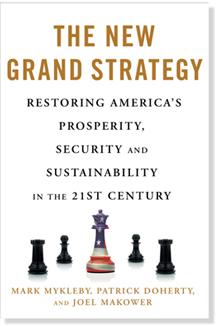
The New Grand Strategy: Restoring America’s Prosperity, Security and Sustainability in the 21st Century

A new book by Mark Mykleby, Patrick Doherty, and Joel Makower


Book_GrandStrategyThe New Grand Strategy describes a business plan for America, born at the Pentagon, that embeds sustainability as a strategic national imperative.

It tells how a discipline called “grand strategy” has been used in the past to align our economy, foreign policy and governance structures to take on the big challenges of the day, such as fighting fascism or containing communism.

Today’s big challenge is global unsustainability — things like rapid economic inclusion of three billion people, addressing climate change and natural resource depletion, strengthening weak national economies and strengthening America’s brittle infrastructure and supply chains.

The book lays out a plan that leverages the economy to do the heavy lifting, tapping trillion-dollar demand for walkable communities, regenerative agriculture and resource productivity. It proposes how to fund it without taxpayer dollars, and to deal with stranded assets like unburnable carbon without wrecking the economy.

And it shows how all of this together can restore America’s prosperity, security, and sustainability. In short, it is an inspiring vision of what’s possible when Americans hold a collective view of the future and come together to bring it to reality.

The plan combines the best of the Left and Right — a progressive agenda with a conservative approach, led by the private sector for profit, tapping local business and political leadership — and Washington can lead, follow or get out of the way.

The New Grand Strategy — the product of a military strategist, a policy strategist and a sustainable business strategist — details America’s path forward. It tells stories from the trenches — about the farmers, mayors, entrepreneurs, business executives, community leaders, and countless others who are finding their way — and weaves through this narrative the story of how a new business plan for America connects with America’s history, its economic success, and its role in the global community in the 21st century.


For more on the book and to order it go to-https://thenewgrandstrategy.com

State of Responsible Business: Good Progress with Lots of Room for Improvement

Ethical Corporation’s second State of Responsible Business report shows that corporate social responsibility has been boosted by the Paris Agreement but sustainability is far from business as usual

by Giles Constantine, Ethical Corporation


After the historic events of 2015 – from the highs of the Sustainable Development Goals (SDGs) and the outcome from the COP21 summit in Paris, to the lows of the Volkswagen emissions scandal – there has never been more of an imperative for global brands to take stock of their contributions to sustainable development. Ethical Corporation’s second annual State of Responsible Business report attempts to do just that.

This year’s report tracks the progress that has been made since our first survey, conducted last year to paint a comprehensive picture of how sustainability is being practiced by a wide range of organizations and stakeholders around the world.

Our second survey, conducted earlier this year, received responses from more than 2,000 members of our corporate social responsibility community, with respondents from a range of businesses, NGOs, government and academic backgrounds. They answered a series of questions concerning the meaning of sustainability to their organizations, the way sustainability is organized throughout their businesses, and their verdict on some of the most important talking points around responsible business practice.

From Theory to Practice

The main lesson that can be taken from this year’s State of Responsible Business report is that the value of incorporating responsible business practice and sustainability into all sides of the business is increasingly recognised, accepted, and acted upon. Those first two points – recognition and acceptance of the business case for sustainability – shouldn’t come as too much of a surprise: as our results show, there are very few people left in the world of corporate responsibility and sustainability who remain unsold on the idea. What is especially welcome, though, is the finding that a growing number of businesses are indicating that they are moving beyond the theory and putting business responsibility into practice, and with commendable success.

Among respondents who work in companies, 71% say that their CEO is convinced of the value of sustainability – three percentage points higher than in our 2015 survey – and only 7% say this wasn’t the case (the remaining 22% were unsure). An even higher proportion, 86%, say sustainability is increasingly becoming an important part of their companies’ overall business strategy, although this does represent a three percentage point fall from last year.

Asked to what extent sustainability has been embedded across the entire business, 51% of corporate respondents say sustainability is driving revenue for their business, and 70% say it is driving savings. Furthermore, 78.5% say that their corporate sustainability strategy is having an impact on internal structures, departmental organization and responsibilities, an increase of more than 5 points from our 2015 report.

This impact is most keenly felt in the marketing and communications, and supply chain and procurement departments, with 74% claiming that their sustainability strategy directly affects these departments. However, when asked if they felt confident they were accurately measuring the impact and return-on-investment of their sustainability activities, fewer than half of our corporate respondents agreed, suggesting that businesses have yet to establish foolproof ways of determining exactly how, where and why sustainability is transforming the way the entire business operates.

Baked In?

Two questions gauged whether respondents believe their business is getting the most out of sustainability, and while there has been a shift in the right direction from last year, there is great scope for improvement in the future. Just over half (51%) now say that sustainability activity is integrated tightly enough into their broader business strategy (up from 42%), while 31% claim that their company is leveraging the potential of sustainability as fully as possible (up from 21%).

For businesses to go further on sustainability, they will be looking closely at the issues that present the greatest opportunities. Our survey asked respondents to identify areas that hold the greatest potential for 2016, and over the next five years. Using sustainability as a source of competitive advantage was the single biggest opportunity area, identified by 22% for the year ahead and 34% over the next five years. Other topics cited included the act of embedding sustainability throughout the business, harnessing the potential of sustainable innovation, creating a culture of sustainability and communicating success in sustainable projects.

For corporate sustainability teams to make the most of these opportunities and hit their targets, though, they will need all the resources and backing they can get. We asked our respondents about their sustainability teams’ budget outlooks for the year ahead: 14% of corporate respondents told us that their company has an annual sustainability budget in excess of $1m, with 8% having a budget of $2.5m or more. However, only 29% say they expect their sustainability budget to increase over 2016, while 32% expected it to either shrink or remain static (39% either didn’t know or declined to say). This is down slightly from last year, when 33% expected their budgets to rise through 2015.

However, the rises were expected to be higher this year, with 50% of respondents saying their team was in line for an increase in excess of 5% (up from 43% in 2015), and more than 4% saying their department was due to receive an increase of more than 100%, compared with none last year.

Global Events

One of the core underlying factors behind many of the issues studied throughout our survey – from CEO engagement to budget allocation and the overall influence of sustainability on the rest of the business – has been the way in which major global events have put sustainability in the spotlight. The COP21 climate change summit in Paris last December, which resulted in the landmark Paris Agreement, and the launch of the SDGs have been two of the most important events, and in this year’s survey we asked a few specific questions to track the impact that they have had on corporate sustainability teams.

All in all, 46% of corporate respondents told us that their organization would be engaging in the SDGs, with 36% saying they wouldn’t and 18% unsure. Out of those that said they would be engaging in the goals as a whole, 63% said they would engage specifically in SDG goal 13 (climate action) while other high priorities included goal 8 (decent work and economic growth), attracting 52% engagement; goal 12 (responsible consumption and production), with 51% engagement; and goal 9 (industry, innovation and infrastructure), with 49% engagement.

Asked to judge the success of the COP21 summit, there was a mixed reception, with just under half (44% of all respondents and 49% of corporate respondents) agreeing that the summit managed to deliver an agreement that will truly tackle the risk posed by climate change, and around 30% saying they disagreed. Respondents from Europe and North America were the least likely to give the agreement a positive assessment, while those from Asia, Africa and Latin America were more prepared to give the Paris deal the thumbs-up.

Impact of Paris

We also asked our respondents an open-ended question about how the Paris agreement would impact their roles as sustainability professionals. For many, the context and certainty that an official Paris Agreement brings will help increase the number of opportunities for them and their sustainability teams, as businesses compete and collaborate to bring about low-carbon innovation. Respondents also cited the role that the Paris summit played in boosting awareness of climate change among key stakeholder groups, including among CEOs who would subsequently be more likely to be engaged in sustainability, both as an issue and as a core side of the business they lead. However, some respondents suggest that the deal will have little bearing on their organization’s sustainability and climate-related activities, either because they are committed to these initiatives already or because the scope of their company’s ambition goes far beyond that written into the Paris Agreement.

The responses from the State of Responsible Business 2016 report back up and build on those that we received last year: Organizations and businesses are increasingly seeing the value of being both responsible and sustainable in the way that they conduct business, and this is feeding into a greater and more positive influence by sustainability teams on the central strategy of the business. However, while corporate social responsibility and sustainability are increasingly ingrained in mainstream business, there is also plenty of evidence to suggest that there’s a long way to go yet. A majority of corporate respondents say they are still struggling to accurately measure the ROI of sustainability activities, or to make full use of the opportunities presented by sustainability, while there is still room for improvement on areas such as communication channels between corporate social responsibility and sustainability teams and their CEOs, marketing and communications teams, and indeed their customers.

Nevertheless, there has unquestionably been progress on a number of critical issues, and the key now will be to see if these positive trends continue in the months and years ahead.

Solar Energy Could Meet up to 13% of Global Power Needs by 2030

Dramatic cost reductions could drive sharp increase in global solar PV capacity


A New Report from International Renewable Energy Agency

The share of global electricity generated by solar photovoltaics (PV) could increase from 2 per cent today to as much as 13 per cent by 2030, according to a new report from the International Renewable Energy Agency (IRENA). Released in late June 2016 at InterSolar Europe, Letting in the Light: How Solar Photovoltaics Will Revolutionize the Electricity System finds the solar industry is poised for massive expansion, driven primarily by cost reductions. It estimates that solar PV capacity could reach between 1,760 and 2,500 gigawatts (GW) by 2030, up from 227 GW today.

“Recent analysis from IRENA finds that cost reductions for solar and wind will continue into the future, with further declines of up to 59 per cent possible for solar PV in the next ten years,” said IRENA Director-General Adnan Z. Amin. “This comprehensive overview of the solar industry finds that these cost reductions, in combination with other enabling factors, can create a dramatic expansion of solar power globally. The renewable energy transition is well underway, with solar playing a central role.”

Focusing on technology, economics, applications, infrastructure, policy and impacts, the report gives an overview of the global solar PV industry and its prospects for the future. It includes data and statistics on:

Capacity: Solar PV is the most widely owned electricity source in the world in terms of number of installations, and its uptake is accelerating. It accounted for 20 per cent of all new power generation capacity in 2015. In the last five years, global installed capacity has grown from 40 GW to 227 GW. By comparison, the entire generation capacity of Africa is 175 GW.

Costs: Solar PV regularly costs just 5 to 10 US cents per kilowatt-hour (kWh) in Europe, China, India, South Africa and the United States. In 2015, record low prices were set in the United Arab Emirates (5.84 cents/kWh), Peru (4.8 cents/kWh) and Mexico (4.8 cents/kWh). In May 2016, a solar PV auction in Dubai attracted a bid of 3 cents/kWh. These record lows indicate a continued trend and potential for further cost reduction.

Investment: Solar PV now represents more than half of all investment in the renewable energy sector. In 2015, global investment reached USD 67 billion for rooftop solar PV, USD 92 billion for utility-scale systems, and USD 267 million for off-grid applications.

Jobs: The solar PV value chain today employs 2.8 million people in manufacturing, installation and maintenance, the largest number of any renewable energy.

Environment: Solar PV generation has already reduced carbon dioxide (CO2) emissions by up to 300 million tons per year. This can increase to up to three gigatons of CO2 per year in 2030.

“World electricity demand is expected to grow by more than 50 per cent by 2030, mostly in developing and emerging economies,” said Mr. Amin. “To meet this demand while also realizing global development and sustainability goals, governments must implement policies that enable solar to achieve its full potential.”

Reaching a 13 per cent share of global electricity by 2030 will require average annual capacity additions to more than double for the next 14 years. The report highlights five recommendations that can help achieve this increase including: updated policies based on the latest innovations; government support of continued research and development activities; creation of a global standards framework; market structure changes; and the adoption of enabling technologies like smart grids and storage.

Letting in the Light is the third solar-focused publication released by IRENA this summer. Last week, IRENA released The Power to Change, which predicts that average costs for electricity generated by solar and wind technologies could decrease by between 26 and 59 per cent by 2025. Earlier this week, IRENA released End-of-Life Management: Solar Photovoltaic, which found that the technical potential of materials recovered from retired solar PV panels could exceed USD 15 billion by 2050, presenting a compelling business opportunity.


About the International Renewable Energy Agency (IRENA)

IRENA is mandated to be the global hub for renewable energy cooperation and information exchange by 148 Members (147 States and the European Union). Roughly 28 additional countries are in the accession process and actively engaged. IRENA promotes the widespread adoption and sustainable use of all forms of renewable energy, in the pursuit of sustainable development, energy access, energy security and low-carbon economic growth and prosperity. More information at- www.irena.org

Contact Person:
Hillary McBride, Communications Officer, IRENA, hmcbride@irena.org

John Hancock Investments launches two ESG funds

Trillium Asset Management to manage John Hancock ESG All Cap Core Fund and John Hancock ESG Large Cap Core Fund

John Hancock Investments announced in early June 2016 the addition of two new funds focused on integrating environmental, social, and governance (ESG) issues with fundamental stock research. John Hancock ESG All Cap Core Fund and John Hancock ESG Large Cap Core Fund are both managed by Trillium Asset Management, LLC, the country’s oldest investment advisor exclusively focused on sustainable and responsible investing.

The announcement follows the observance of World Environment Day, which is promoted annually by the United Nations Environment Programme and is intended to raise global awareness of the need to take positive environmental action to protect nature and the planet.

“This is an exciting new direction for John Hancock Investments,” said Andrew G. Arnott, president and CEO. “While younger investors have traditionally been one of the driving forces behind the growth in ESG funds, investors of all ages are now recognizing how ESG funds can play an important role in their portfolios. We’re proud to be able to offer portfolios that seek to influence positive change by investing in companies that meet a high bar for environmental, social, and governance characteristics. We are also pleased to be working with Trillium Asset Management in this new venture, as the firm has been at the forefront of socially responsible investing for nearly 35 years.”

Trillium CEO Matthew W. Patsky, CFA, added, “We are very excited to combine the trusted brand of John Hancock Investments with our history and expertise in ESG investing. John Hancock Investments has one of the most stringent due diligence processes in the industry, and we are proud to have been selected as the manager for these funds.”

The new ESG portfolios offer a well-diversified core exposure. John Hancock ESG Large Cap Core Fund invests predominantly in large-capitalization companies, while John Hancock ESG All Cap Core Fund invests in companies across the market capitalization spectrum. Trillium seeks out companies with high-quality characteristics from financial, strategic, and ESG points of view, such as strong workplace practices, product safety, and environmental protection. Neither fund will include companies with material exposure to agricultural biotechnology, coal mining, hard rock mining, nuclear power, tar sands, tobacco, or weapons/firearms, nor will they include companies with major recent or ongoing controversies related to animal welfare, the environment, corporate governance, human rights, product safety, or workplace practices.

Trillium Asset Management, LLC is an employee-owned firm founded in 1982, and has a long history of using its voice as a shareholder to push America’s largest companies to improve on key issues of ESG materiality, an approach that will be reflected in the new funds. The portfolio management team for the John Hancock Investments ESG funds includes Cheryl I. Smith, Ph.D., CFA, managing partner, economist, and investment manager; Elizabeth R. Levy, CFA, senior vice president, portfolio manager, and research analyst; and Stephanie R. Leighton, CFA, partner, portfolio manager, and research analyst.

John Hancock ESG All Cap Core Fund is available in the following share classes: Class A: JHKAX; Class C: JHKCX; Class I: JHKIX; and Class R6: JHKRX.

John Hancock ESG Large Cap Core Fund is available in the following share classes: Class A: JHJAX; Class C: JHJCX; Class I: JHJIX; and Class R6: JHJRX.

The new ESG funds are the latest product offerings from John Hancock Investments, which earlier this year launched John Hancock Global Focused Strategies Fund, managed by Standard Life Investments; three target-date 2060 retirement funds; and five new sector exchange-traded funds, with underlying indexes designed by Dimensional Fund Advisors.

A fund’s investment objectives, risks, charges, and expenses should be considered carefully before investing. The prospectus contains this and other important information about the fund. To obtain a prospectus, contact your financial professional, call John Hancock Investments at 800-225-5291, or visit www.jhinvestments.com . Please read the prospectus carefully before investing or sending money.


About John Hancock Investments

John Hancock has helped individuals and institutions build and protect wealth since 1862. Today, we are one of America’s strongest and most-recognized brands. As a manager of managers, John Hancock Investments searches the world to find proven portfolio teams with specialized expertise for every fund we offer, then we apply vigorous investment oversight to ensure they continue to meet our uncompromising standards and serve the best interests of our shareholders. Our unique approach to asset management has led to a diverse set of investments deeply rooted in investor needs, along with strong risk-adjusted returns across asset classes.

About John Hancock Financial and Manulife

John Hancock Financial is a division of Manulife, a leading Canada-based financial services group with principal operations in Asia, Canada, and the United States. Operating as Manulife in Canada and Asia, and primarily as John Hancock in the United States, our group of companies offers clients a diverse range of financial protection products and wealth management services through its extensive network of employees, agents, and distribution partners. Assets under management and administration by Manulife and its subsidiaries were $904 billion (US $697 billion) as of March 31, 2016. Manulife Financial Corporation trades as MFC on the TSX, NYSE, and PSE, and under 945 on the SEHK. Manulife can be found at manulife.com.

The John Hancock unit, through its insurance companies, comprises one of the largest life insurers in the United States. John Hancock offers and administers a broad range of financial products, including life insurance, annuities, investments, 401(k) plans, long-term care insurance, college savings, and other forms of business insurance. Additional information about John Hancock may be found at www.johnhancock.com

Investing involves risks, including the potential loss of principal. There is no guarantee that a fund’s investment strategies will be successful. Large company stocks could fall out of favor. The stock prices of midsize and small companies can change more frequently and dramatically than those of large companies. Foreign investing, especially in emerging markets, has additional risks, such as currency and market volatility and political and social instability. A portfolio concentrated in one sector or that holds a limited number of securities may fluctuate more than a diversified portfolio. Hedging and other strategic transactions may increase volatility and result in losses if not successful. Illiquid securities may be difficult to sell at a price approximating their value. The fund’s ESG policy could cause it to perform differently than similar funds that do not have such a policy. Please see the fund’s prospectus for additional risks.

This release was originally published by John Hancock Investments which is solely responsible for its content.

Environmental and Energy Study Institute Moves 100% of Stock Holdings to Socially Responsible Funds

Investments to Focus on Clean Energy, Exclude Fossil Fuels

The Environmental and Energy Study Institute (EESI), a not-for-profit organization dedicated to promoting environmentally sustainable societies, will complete moving its stock holdings to socially responsible funds by December 2016. Half of EESI’s holdings are already in such funds.

“Aligning our investments with our mission is essential to walk our talk,” said EESI board member Claudine Schneider, a former Republican Member of Congress (RI, 1980-1990) who spearheaded EESI’s move to socially responsible investing. “Making investment decisions on the basis of environmental, social, and governance criteria helps EESI continue its work advancing clean energy and addressing climate change.”

EESI’s commitment extends beyond mere avoidance of companies whose policies conflict with our mission statement: it emphasizes a positive search for companies that are in line with our organizational values and vision. In particular, EESI will preferentially invest in companies that have demonstrated a commitment to environmental stewardship, energy efficiency, and clean renewable energy; EESI will also divest from companies that extract energy from fossil fuels.

The decision to divest from fossil fuels was driven by both mission-related and financial considerations. Because of EESI’s longtime work on climate change, it understands that holding fossil fuel stocks carries significant risk, as many fossil fuels assets will likely remain in the ground, becoming stranded [1] and worthless.

To mark its fossil-free commitment, EESI signed the Divest Invest Pledge (http://divestinvest.org), joining more than 500 organizations with more than $3.4 trillion in assets. These organizations have all agreed to stop investing in the top 200 fossil fuel producers, and to instead direct at least 5 percent of their portfolios to renewable energy, energy efficiency, or clean energy access.

EESI’s Board of Directors made the unanimous decision to invest 100 percent of EESI’s stock holdings in a socially responsible manner at its May meeting. The Board had previously decided to move a portion of EESI’s stock holdings to socially responsible investing (SRI) in August 2013. This phased approach allowed EESI to explore its options and make sure socially responsible investments provided acceptable rates of return. In fact, EESI’s initial SRI fund has outperformed its benchmark, the MSCI EAFE, by 2.6 percent on an annualized basis.

“The Board is concerned with our fiduciary responsibilities: EESI’s investments contribute to our operating budget, enabling us to fulfill our mission,” explained EESI Board Chair Jared Blum. “Confirming our initial research, we found that investing in socially responsible funds was a sound investment. We are also thrilled to be investing in renewable energy and energy efficiency; moving to an economy based on clean energy is an important part of our mission.”

Several studies have confirmed that socially responsible investing does not mean foregoing returns and may in fact reduce investment risk [2]. Divesting from fossil fuel companies, for instance, helps EESI avoid oil and gas sector volatility. It also helps avoid climate risk, which is the risk that companies face from climate change and policies to address climate change. Oil and coal companies are especially vulnerable: the upcoming implementation of the Paris Climate agreement means the international community is expected to clamp down on harmful carbon emissions; nations throughout the world are expected to promote energy efficiency and clean energy sources, making these a better investment.

EESI’s move has helped spur the ever-burgeoning market for socially responsible funds. “In 2013, we expressed our commitment to socially responsible and fossil fuel-free investing to one of our long-time fund managers. In response, the firm established an environmental fund that not only meets our goals—an investment product that is socially responsible and fossil fuel-free—but that is also open to other institutional investors,” said EESI Executive Director Carol Werner. “It’s exciting that we were able to drive change to help grow the market of investment options for sustainable, socially responsible, and fossil fuel free investing.”

Werner noted that “EESI has offered SRI funds for the staff retirement plan for many years, and in July 2013, we began to provide employees with the option to invest in fossil-free funds. For so many of us, workplace retirement plans are the primary way we invest, so it was important for us to offer sustainable investment options to our staff, since we all are working for sustainability at EESI.”

Socially Responsible Investing has become a large market, accounting for more than one out of every six dollars under professional management in the United States, according to the Forum for Sustainable and Responsible Investment (www.ussif.org/trends). Not all SRI funds are fossil-free, however. Several organizations can help investors identify fossil-free, socially responsible funds, including Fossil Free Funds (https://fossilfreefunds.org) and the US SIF – the Forum for Sustainable and Responsible Investment (http://charts.ussif.org/mfpc)

EESI developed a Policy for Socially Responsible Investment to guide its investments when it began shifting them in 2013. In addition to traditional financial analysis, EESI considers environmental criteria, employment and workplace practices, workforce diversity, community relations, human rights, and corporate governance. One of EESI’s goals is to invest in companies that have demonstrated a commitment to sustainability by either minimizing their environmental and carbon footprint or by producing products and services that have a direct environmental benefit (such as renewable energy). EESI’s policy excludes companies that extract or generate energy from fossil fuels. EESI also emphasizes investments in companies with exceptional workplace safety records; innovative programs promoting diversity in the workplace; positive relations with their communities; strong policies protecting human rights; and transparent corporate governance structures—among many other criteria.

EESI is proud to further its mission through its investments, as part of a broader trend toward socially responsible and sustainable investing.

More information at- http://www.eesi.org


Article Notes:

[1] https://en.wikipedia.org/wiki/Stranded_asset

[2] https://www.msci.com/resources/factsheets/MSCI_ESG_Research_FAQ_on_Fossil-Free_Investing.pdf

Op-Ed: A Green Economy Is a Fair Economy

Creating employment opportunities and economic hope in New Mexico and beyond with renewable energy

by Regina Wheeler, a seasoned executive manager, is the CEO and an employee-owner of SunPower by Positive Energy Solar.

This article was reprinted with permission. Originally published in the June 2016 of the Green Fire Times (www.greenfiretimes.com)


With global temperatures revising the record books, droughts and wildfires threatening homes and food production, and people across the nation and world demanding urgent climate action, there’s no longer any doubt: We need to transition to renewable energy (RE). Moving from polluting fossil fuels to clean solar and wind is essential for adequately reducing greenhouse gas emissions and saving the planet from catastrophic warming.

But, when it comes to the case for renewables, the environment is only part of the equation. Moving to a green economy is not only a way to contribute to the cleanliness and sustainability of our planet; it can also create career opportunities, reduce unemployment and lay the foundations for a more inclusive and equitable economy.

In New Mexico, we’re already seeing the economic advantages of the renewable revolution.

Start with jobs. At a time when unemployment is still painfully high in our state, the solar industry alone has created at least 1,900 high-quality jobs. These new solar opportunities support families across the state, and the income they generate feeds back into local economies, creating additional, new employment opportunities in other industries from healthcare to food services. Across the country, the number of solar jobs has doubled over the last five years, and there are now more Americans working in solar than in oil and gas. [1]

Unlike many industries that simply ship wealth away to Wall Street or faraway investors, New Mexico’s solar industry tends to keep income local. That’s because many of our solar firms are local businesses. Some—like SunPower by Positive Energy Solar—are actually employee-owned businesses and certified “B-Corps”: enterprises that share profits with workers and support broader social missions to enhance the environment and contribute to community development.

Regardless of the shape that green industry takes, the growth of renewables means opportunity. It means new workforce-training programs and lifelong career prospects for young people or folks transitioning into new lines of work. For homeowners across the state and the nation, the growth of solar means other economic advantages like more predictable electricity prices and increased property values.

The environmental and economic cases for a renewable transition are crystal clear. Nonetheless, we still have our work cut out for us.

We need to preserve the policies that enable people to generate their own power, like state solar tax credits and net-metering laws that allow people to sell energy to the grid at a fair price. These laws level the playing field between renewables and older fossil fuels that receive massive government subsidies. Without action this year, the popular and cost-effective state tax credits will expire.

We also need to pave the way for “community solar”; that is, shared arrays that serve multiple buildings and make it possible for renters to access the benefits of clean and affordable energy. While this approach should be common sense, outdated rules prevent New Mexicans from taking advantage of such opportunities.

We also need to set ambitious targets for RE. While some states—California, Oregon, Hawaii and Vermont—have taken action to eliminate coal or drastically increase their renewable portfolios, New Mexico is falling behind. We currently get just 4 percent of our electricity from solar, despite the fact that we receive enough sunlight to meet all our energy needs. Santa Fe’s proposed Verde Fund—an idea for expanding RE championed by Mayor Javier Gonzales—is an important and exciting local-level step, but we also need state-level leadership. This means that we need to elect people who understand the environmental and the economic case for green energy to the Public Regulation Commission, the Statehouse and the Governor’s Mansion.

This crucial election year coincides with a moment of truth on climate change and a moment of urgent need on unemployment and the economy. In addition to installing RE, increasing household energy and water efficiency and spreading the word about green energy’s potential, there’s another simple, straightforward and effective action that each and every New Mexican can take: Demand that election candidates champion clean power.

Climate change is an urgent crisis, but it also presents an important opportunity: By going green, we can build a more prosperous and equitable economy.


Article by Regina Wheeler, a seasoned executive manager, is the CEO and an employee-owner of SunPower by Positive Energy Solar.

Article Note:

[1] http://money.cnn.com/2016/01/12/news/economy/solar-energy-job-growth-us-economy/


Facts on the New Mexico Solar IndustryFrom the Solar Energy Industries Association (www.seia.org)

• There are currently more than 102 solar companies at work throughout the value chain in New Mexico, employing 1,900 people.
• In 2015, New Mexico installed 41 MW of solar electric capacity, ranking it 17th nationally.
• The 365 MW of solar energy currently installed in New Mexico ranks the state 12th in the country in installed solar capacity. That is enough solar energy installed to power 83,000 homes.
• In 2015, $86 million was invested on solar installations.
• Installed solar photovoltaic system prices in the U.S. have dropped steadily — by 6 percent from last year and 48 percent from 2010.

Notable Installations in New Mexico

• Cimarron Solar Facility was completed in 2010 by developer First Solar. This photovoltaic project has the capacity to generate 30 MW of electricity – enough to power over 6,900 homes.
• Several large retailers in New Mexico have gone solar, including Costco, Walmart and Intel. U.S. Foods has installed one of the largest corporate photovoltaic systems in the state with 426 kW of solar capacity at their location in Albuquerque.
• At 50 MW, Macho Springs Solar Project in Deming is among the largest solar installations in New Mexico. Completed in 2014 by First Solar, this photovoltaic project has enough electric capacity to power more than 11,400 homes.

Solar Companies in New Mexico

New Mexico solar companies provide a wide variety of solar products and services, ranging from solar system installations to the manufacturing of components used in photovoltaic panels. These companies can be broken down across the following categories: 13 manufacturers, 10 manufacturing facilities, 55 contractor/installers, seven project developers, nine distributors and 18 engaged in other solar activities, including financing, engineering and legal support.

How Much do Solar Panels Cost in New Mexico?

Solar panel costs have fallen significantly in the last 5 years (www.solar-estimate.org/solar-costs). Installing solar panels can now be one of the best investments you can make for your home. There are also now a lot of products on the market utilizing sophisticated financing vehicles to make solar panels affordable. Solar incentives are offered at the utility, county, state and federal levels. These can take various forms, including solar tax credits (www.solar-estimate.org/?page=taxcredit), up-front solar rebates, premium feed-in tariffs (net metering) or solar production incentives.

The Future of Energy: It’s the Developing World’s Turn to Shine

by Nancy E. Pfund, Founder and Managing Partner, DBL (Double Bottom Line) Partners*


 A Changing Climate

headshot-article3By 2050, the world will consume 61 percent more energy than it does today. This should be good news, for, as access to reliable, affordable energy increases, so does the quality of life for hundreds of millions of people. Energy keeps schools and businesses running, computers working, cities shining, and cars moving. Without the availability of energy, the global poverty rate could not have dropped by more than half since 1990, allowing the opportunity to improve lives across a wide sphere. And yet, in a skewed parallel, 1.3 billion people lack access to the most basic energy services and the economic, environmental and health benefits they provide. Furthermore, many are at a disproportionate risk to the world’s most pressing climate change threats.1 For example, The Carteret Islanders of Papua New Guinea have become the world’s first entire community to be displaced by climate change, recently packing up their lives to move out of the way of ever-rising waters that threaten to overtake their homes, their crops, and their history.

Extending Progress to the Developing World

The developed world has seen great progress in renewable energy. Today, in the United States, virtually all new additions to power capacity come from sustainable sources. However, much of the future energy demand in the world will come from developing countries as they continue to grow and add more citizens to the middle class. This is perhaps one of the most difficult challenges that we face today. How can we ensure that the most threatening climate change consequences are avoided, but also ensure equitable access to energy? The answer, of course, is renewable energy, and the attendant electrification of products and services once serviced by fossil fuels.2

Affordable and clean renewable energy would help millions of people escape poverty and become more self-sufficient. It would ease international tensions and increase global security by making more countries less dependent on oil. It would unlock new economic opportunities in a growing trillion-dollar industry. It would attract more foreign investment to the regions that need it most. It would lessen the problems caused by the expensive and sometimes dangerous work of extracting fossil fuels. It would reduce air pollution, which kills millions of people every year. And it would stabilize energy prices by eliminating the volatility of natural gas and oil, which will have an even bigger impact on the global economy as more people come to rely on energy in their daily lives.

The question that remains, however, is how do we economically provide clean energy to the billions of those who need it? In 11 countries, all in Africa, more than 90 percent of people go without electricity. In six of these countries, only three to five percent of people can readily obtain electric power.3

Fortunately, there is good news. The price of solar panels has decreased dramatically in the last decade by 70 percent. Solar installations have also grown exponentially, accounting for more than one percent of global electricity demand in 2015 and 22.5 percent of all new generation sources in the same year. Advances in storage and software have allowed us to push the boundaries on creating a smarter and cleaner grid. From streetlights to kitchen-top appliances, more devices and services are being connected in previously unimaginable ways; allowing a more sophisticated and efficient approach to managing demand and grid operations. With the growth of renewables, — some 13 percent of electricity consumption in the US in 20154, — and the increase in electrified fleets of cars entering the transportation sector, the traditional use and distribution are changing before our eyes. We are moving from a centralized energy system to one that integrates distributed energy resources, creative microgrid solutions, and, soon, vehicle to grid energy flows. It is truly staggering to see how much progress has been made in the energy industry in the last decade. Electric vehicle growth presents one of the most robust statistics in this regard, globally, from below 30,000 in 2010, to 720,000 in 2015, to one million today.

The-Carteret-Islanders-of-Papua
The Carteret Islanders of Papua New Guinea

The Leapfrog Effect

Unlike the United States, many developing countries do not have a centralized energy infrastructure. In sub-Saharan Africa alone, almost 600 million people lack access to electricity and rely on burning biomass and fossil fuels such as kerosene. Although this notion seems outmoded, it actually presents a unique opportunity. Due to the special economic and geographic nature of many of these countries, they have the ability to completely skip primary dependency on the centralized grid and instead develop stand-alone solar storage systems and microgrids.

Examining the African continent’s progression through phones today, we can see that Internet browsing via phones now stands at 40 percent across these markets. We are at a pivotal moment where a similar explosion can occur in electricity use. Increasingly, economic, technological and financial advancements pioneered in the developed world can be applied in the countries that need them most in an efficient, local, and cost-effective manner.5

Although significant progress has been made in technologies such as wind, solar and electric vehicles, the scale of the most pressing climate change challenges requires the exploration of different and innovative approaches. Tech moguls have risen to the challenge. One of the most famous of these techno-philanthropists, Microsoft founder Bill Gates, with other technology leaders, has founded the Breakthrough Energy Coalition6 which has committed to dramatically scaling up the public research pipeline to develop the technologies that will make up the world’s new energy mix. Additionally, Mission Innovation7, which is an initiative driven by 18 countries, aims to reinvigorate and accelerate global clean energy innovation with the objective to make clean energy widely affordable on a global basis.

These technology gurus are one path to a low-carbon future, but they are by no means the only one. Given the scale of this challenge and the fact that we are running out of time, leaders should be exploring all potential avenues. Doing so is a job for both the public and private sectors. Partnerships will be key here: governments play an indispensable role in supporting energy research and early market development, helping private firms amass the funding and related resources to scale a multi trillion-dollar market.

Entrepreneurship has also played and will continue to play a critical role, especially in scaling innovations to create large markets. Entrepreneurship helps to catalyze action today, while we still have time to turn back the clock on the adverse effects of climate change.

Walking the Walk… to Africa

As a Founder at DBL Partners, I have been involved with many companies working on promising energy solutions. I only wish there were many more to choose from. Given the scope of this huge problem, there should be hundreds if not thousands of companies around the world exploring different approaches. Here at DBL, we’re walking the walk when it comes to stepping up and doing more. After 10 years of impact investing in the U.S., last year we took the plunge and made our first international investment in a Tanzanian company called Off Grid Electric (OGE)8. Having been at the forefront of investing in the American solar industry, DBL mitigated the risks on this African Investment by using lessons gained from over 15 years of experience in the space.

OGE is focused on providing clean solar-powered light, appliances and electricity to the bottom of the pyramid and beyond. OGE has developed a solar and storage system that takes advantage of the large penetration of the mobile payment market in Africa. Instead of paying for an expensive system upfront with cash, customers are able to make payments for lighting and a series of follow-on appliances with their cellphones to access the energy produced by their panels over a time period that suits their circumstances. By generating renewable power from the sun, OGE’s systems are helping introduce cleaner forms of energy into many households. As previously mentioned, many homes in Tanzania are still reliant on burning kerosene for lighting. According to the World Bank, this is equivalent to smoking almost two packs of cigarettes a day. Replacing all kerosene lamps worldwide with solar lights would dramatically improve the health of many throughout the world and would be the equivalent to a five percent reduction in the U.S’s annual carbon emissions. OGE has already reached over 100,000 customers and hopes to provide power to millions throughout Africa over the next five to ten years. A fringe benefit of these systems is that better lighting will help build the ranks of Africa’s middle class as darkness will no longer hold people back from pursuing education, entrepreneurship and at home-based employment.

The business model of OGE is designed in such a way that customers can maintain current spending on energy, but with cleaner and often times more powerful electronics. Starting with simple LED lighting and phone chargers, OGE also offers upgrades to radios and TVs that can enable customers to have modern devices at accessible prices. In many cases, in addition to modernizing home life, OGE is also helping create the advent of “solarpreneurs” by enabling people to start phone charging businesses or other companies with their new systems. Once this happens, regional investment will increase, jobs will be created, and an entire continent will light up not only with clean energy but also with a burgeoning middle class ready to put Africa on the 21st century map in a new, powerful way.

Going forward, we see a fantastic opportunity to build on the work that OGE and others in the off-grid sector are doing. Of course, unmistakable challenges exist and there is always the looming threat of going backward to a centralized fossil fuel dominated economy rather than forward to a clean energy one. Yet, in 2016, we cannot and should not sit back and watch massive income and energy inequality persist as though we were still living in the 19th or 20th century. Distributed renewables, investments in storage and scalable EVs offer a proven path toward a world with greater equality. The whole world is watching, and we don’t have time to wait. The time is now.


Article by Nancy E. Pfund, Founder and Managing Partner of DBL Partners (www.dblpartners.vc), located in San Francisco and Palo Alto. DBL Partners is a venture capital firm whose goal is to combine top-tier financial returns with meaningful social, economic and environmental returns in the regions and sectors in which it invests. As a leading player in the growing field of “impact investing”, DBL has helped to reveal the power of venture capital to promote social change and environmental improvement, and Ms. Pfund writes and speaks frequently on the field of impact investing. She sponsors or sits on the board of directors of several companies, including; SolarCity (NASDAQ: SCTY) on both the audit and compensation committees, and is chair of the corporate governance committee; Farmer’s Business Network, Advanced Microgrid Solutions, Off-Grid Electric, Primus Power, The Muse, and, prior to their public offerings, Tesla Motors and Pandora.

Ms. Pfund was recently featured in 2016 Fast Company’s 100 Most Creative People in Business list; featured #17 in the 2014 FORTUNE Inaugural World’s Top 25 Eco-Innovators; is Chair of the Advisory Council of the Bill Lane Center for the American West at Stanford University; a member of the Advisory Board of: the Lawrence Berkeley National Laboratory (Berkeley Lab); and the UC Davis Center for Energy Efficiency, and a Trustee of the National Geographic Society. She has been a Lecturer in Management at the Stanford Graduate School of Business and the Yale School of Management; and is a C3E Ambassador to the U.S. Clean Energy Education and Empowerment Program, led by the U.S. Department of Energy. She is also a founding officer and director of ABC2, a foundation aimed at accelerating a cure for brain cancer. Ms. Pfund received her BA and MA in anthropology from Stanford University, and her MBA from the Yale School of Management.

* The author would like to thanks DBL’s Summer Associate, Anjuli Koshal, for her assistance in writing this article.

Article Notes:

1 – World Energy Scenarios, Composing Energy Futures to 2050 – https://www.worldenergy.org/wp-content/uploads/2013/09/World-Energy-Scenarios_Composing-energy-futures-to-2050_Full-report.pdf

2 – Short Term Energy Outlook – https://www.eia.gov/forecasts/steo/report/renew_co2.cfm

3 – One-Quarter of World’s Population Lacks Electricity – http://www.scientificamerican.com/article/electricity-gap-developing-countries-energy-wood-charcoal/

4 – Electric Power Monthly – http://www.eia.gov/electricity/monthly/pdf/epm.pdf

5 – Study Reveals African Mobile Phone Usage Stats – http://www.itnewsafrica.com/2015/04/study-reveals-african-mobile-phone-usage-stats/

6- Breakthrough Energy Coalition – http://www.breakthroughenergycoalition.com/en/index.html

7 – Mission Innovation – http://mission-innovation.net

8 – Off Grid Electric – http://offgrid-electric.com

The Structural (and Possibly Abrupt) Decline of Fossil Fuels

by Garvin Jabusch, cofounder and chief investment officer, Green Alpha Advisors

 

feature2It has been a tough couple years for fossil fuels companies. In the immediate term, new drilling techniques and the lifting of the Iran economic embargo have opened up new supplies of oil and gas, and subsequently there has been a lot of damage to the oil price over the last year and a half. So much so, that according to The Economist, at $45 a barrel, oil is cheaper than it’s been since the first OPEC oil embargo in 1973[1]. In real economic terms, this is about as cheap as oil has been in decades, the result of a supply/demand imbalance of nearly two million barrels a day, over about the last two years. It’s important to remember that two million barrels a day is only a shade over two percent of the daily global oil production function, showing that prices have been very sensitive to relatively minor increases in supply relative to the demand.

So today and in the recent past, times have been hard for producers and their investors, but what’s going to happen going forward?

Some, such as Chevron and OPEC’s Secretary-General, rest their thesis on the low price of oil slowing production investment, therefore causing base production to go down.[2]Meanwhile, in their projection, demand goes up, and the two effects together lead to a $200 barrel of oil over the next decade and a half. In the short and near-medium term, this could be wrong. OPEC infighting and Iran regaining their four million barrels per day market share could conspire to keep supply on the high side. Or projections could be right, with production decreases resulting in more expensive oil.

Past that modicum of agreement, Green Alpha’s thesis is the opposite of Chevron’s.

We believe that fossil fuels are in the early stages (perhaps not so early in the case of coal) of a structural decline in demand that will ultimately result in coal, oil and gas no longer representing a meaningful percentage of the global economy’s energy mix by 2050, with investment and growth in the sector reversing long before that.

Fossil fuels may not be abandoned completely, but there is no credible scenario in which they are able to resume growth, economic superiority or a reliable pattern of risk-adjusted or even absolute returns. The two reasons for this are: 1. Renewable energies have become too economically competitive for fossil fuels to contend with, and 2. It is now widely understood that fossil fuels present systemic risks too great to be allowed to continue.

Rather than another long list of the economic advantages of renewables and the existential threats presented by extracting and burning fossil fuels, perhaps it’s more interesting to illustrate our thesis by responding to the most frequent objections that we hear. In no particular order, they go like this:

Solar and wind still aren’t cost competitive, and if they are, it’s only because of subsidies. Wrong. We now see electricity being contracted for sale at just under three pennies per kilowatt-hour on an unsubsidized basis from large-scale solar power generating plants. That’s $0.0299 per kilowatt-hour (kWh) in Dubai,[3] which is admittedly one of the sunnier places in the world and therefore particularly advantageous for solar, but we also see right here in the United States that we are not far behind; San Jose, California, for example, has recently signed a solar power purchase agreement for 3.7 cents per kWw,[4] which is competitive with any form of fossil electricity and cheaper than most. Wind, although not declining in price as rapidly as solar, is for now even cheaper. A 2015 report[5] from analysts at Lazard Freres, as cited by Politifact, shows “the cost of wind production in Texas, not counting government subsidies, runs from $36 to $51 per megawatt-hour (Mwh) while an average national cost for coal-fired electricity ranges from $65 to $150 per MWh and for gas, depending on the type of plant, from $52/MWh to $218/MWh.”[6]

Related: but solar isn’t growing very fast. You’re kidding, right? Solar is one of the world’s fastest growing industries. In a record-breaking year, the solar industry in the United States installed 7.3 gigawatt (GW) of solar PV (Photovoltaic) in 2015,[7] and is poised to grow 119 percent in 2016, with installations to reach 16 GW.[8] Entirely eclipsing this achievement, China just added 7.1 GW of new solar PV capacity in Q1 2016 alone.[9]

Envision_solar-carport

Oil producers don’t agree that there is a decline going on. Right and wrong. Chevron and Exxon Mobil both do see oil demand going up in the next couple of decades, but the Deputy Crown Price of Saudi Arabia thinks the oil era will end, and is working hard on a transition plan to make his country much less dependent on fossil fuels revenues.[10] He also has Bloomberg writing about “The $2 Trillion Project to Get Saudi Arabia’s Economy Off Oil.”[11]

But if fossil fuels companies continue to do poorly, the economy will tank. Right and wrong, but mostly wrong. Yes, oil and gas firms have gone from boosting U.S. GDP (Gross Domestic Product) growth to reducing it, and recent GDP-by-industry numbers show that the oil and gas industry has continued to drag down GDP.[12] Meanwhile, though, cheap oil and gas prices, combined with inexpensive renewables, are making most everything else in the economy far more productive and inexpensive. It’s important to keep in mind, as Jeremy Grantham has written, “The consumers of both oil and natural gas account for far more of U.S. economic activity than the producers do. For consumers, cheap energy is good. So eventually, whatever drag the oil and gas industry’s troubles exert on the economy should be more than compensated for by gains in other sectors.”[13]Indeed, according to Bloomberg, “Bank of America Merrill Lynch…puts the oil move into a much bigger perspective, arguing that a sustained price plunge “will push back $3 trillion a year from oil producers to global consumers, setting the stage for one of the largest transfers of wealth in human history.”[14] For context, again, Grantham: “Could there be a better financial input than this to the group that has been hurting for 30 years – the median wage earner? Not easily.”

Natural gas releases fewer greenhouse gasses than coal and can therefore be used indefinitely. Wrong. Yes, burning natural gas to make electricity releases less CO2 into the atmosphere than burning coal does, but the process of extracting, transporting and using natural gas releases far more methane into the atmosphere than does coal (which mainly releases CO2), — and methane is a far more powerful trapper of heat than CO2. In fact, many scientists think natural gas is worse than coal in global warming terms. Methane has a shorter life-span in the atmosphere than CO2, so the debate about which is worse in long-haul warming terms is difficult to resolve, but in the short term – meaning under a Century — “methane emissions from fracked shale gas are horrendously high; so yes, it’s unequivocally worse for the climate than is coal,” says Cornell University’s Robert W. Howarth, as quoted by Politifact, in a solid summary[15] of points trying to get to the bottom of this issue. So natural gas is at least as bad as coal in terms of warming, and maybe much worse. Of course, both fuels present other risks as well, like mercury and soot pollution in the case of coal, and groundwater and aquifer contamination in the case of natural gas fracking.

But natural gas is the fastest growing energy in America. Nope, it’s being outpaced by renewables 2-to-1. In 2015, solar and wind together represented 69 percent of new electricity generation capacity additions in the U.S[16] New U.S. electrical capacity from wind and solar in January 2016? One hundred percent. According to data cited by Joe Romm, “in the first three months of 2016, the U.S. grid added 18 MW (Megawatts) of new natural gas capacity. It added a whopping 1,291 MW of new wind and solar.”[17]

Global warming isn’t real. Wrong. It’s all too real. Everyone knows it. There are now even meta-studies confirming consensus among studies revealing overwhelming consensus among scientists.[18] Grow up.

We’re presently in a cooling phase. No. It’s hotter than ever. Keep up. It’s actually hard to avoid news about it right now. Here’s a May 16, 2016 summary from the Washington Post, selected at random from a Google search for “record warm:” “The planet’s torrid streak of record-warm months ballooned to seven in April, NASA data released over the weekend reveals. The average temperature of the planet was 2.0 degrees Fahrenheit (1.11 degrees Celsius) above the long-term average in April, shattering the old record from 2010 by 0.4 degrees (0.24 degrees Celsius). NASA data now indicates Earth has set record highs in every month since October 2015 and, in each instance, by a substantial margin.”[19] If a few months seems like too short a time frame to worry about, consider NOAA’s revelation that “to date, including 2015, 15 of the 16 warmest years on record have occurred during the 21st century.” Note here that it is presently 2016, meaning all but one of the warmest 16 years ever recorded have occurred this century. That one outlier record year not in the 21st century? 1998.[20]

Serious institutions don’t agree that greenhouse gases and warming are threats to the economy. Yes they do. In fact, warming and climate change are now cited both as being and causing the most serious global economic risks we face by such groups as the World Economic Forum at Davos, Switzerland.[21] The European Systemic Risk Board goes so far as to warn of a global economic “contagion” if the move to a low carbon economy happens too slowly or too late.[22]

Serious institutions don’t agree that the global economy will soon evolve past fossil fuels. On the contrary, they very much do. MSSB Research summed up the positions of many banks on the subject when they recently wrote: “Investors cannot assume economic growth will continue to rely heavily on an energy sector powered predominantly by fossil fuels.”[23]

Electric vehicles will not displace internal combustion, and therefore oil demand will remain robust. Only true in the short term. To assume that the changes we are now seeing emerge around the electrification of transportation and the subsequent ability of renewables to provide the energy required for transport is to ignore now obvious developments in technology and also in current events. For example, the Dutch Parliament has recently passed legislation seeking to prohibit the sale of internal combustion engine cars in Holland after 2025.[24] Prime Minister Modi and others in India are working toward similar policy that would ban the sale of gas and diesel burning cars in India after 2030.[25] According to The Independent, “Norway will ban the sale of all fossil fuel-based cars in the next decade, continuing its trend towards becoming one of the most ecologically progressive countries on the planet.”[26] Bloomberg has written that they think there will be enough electric vehicles on the road by 2022 to have displaced 2 million barrels of oil per day worth of demand, with demand displacement of 5, 10, and 15 million barrels not far behind.[27] Last year in China, we saw a 223 percent increase in sales of electric vehicles.[28] In the U.S., it wasn’t quite as dramatic as in China, and yet we have seen in 2015 a 70 percent increase in EV (Electric Vehicle) demand,[29] with growth of electric vehicles in both nations of course directly displacing oil. The Energy Collective has written that they don’t see any scenario where electric vehicles are not the majority of cars on the road by 2050.[30]The Financial Times has gone as far as to print that fossil fuels must now accept that they are entering terminal decline.[31]

Related: batteries are too expensive. Battery cost has been the primary factor keeping prices of electric vehicles high relative to internal combustion cars. However, Lithium Ion batteries that cost as much as $400 per kWh of storage when Tesla started making electric cars have now fallen to $160/kWh, and according to Greentech Media, “GM sees its battery cell cost hitting $100 per kilowatt-hour in 2022. Tesla could reach its <$100 per kilowatt-hour target in the intermediate term as Gigafactory production ramps, by 2018.”[32] This will result in electric cars being very economically competitive, if not overwhelming, with internal combustion cars.

Related: lithium is too scarce to supply battery demand. Apparently, not so much. “Lithium, for example, is widely distributed and plentiful, takes little energy to produce, leaves no nasty waste behind, and faces predictable (steadily rising) demand,” according to Proceedings of the National Academy of Sciences, as reported by High Country News. HCN goes on, “Other countries, especially Chile, Argentina and Bolivia, have vast lithium-rich brine sources, low labor costs and political and regulatory regimes that favor maximum production. They don’t need hype. And they set the price.”[33]

Corporations don’t care about using renewables. Apple and Google/Alphabet, the world’s two largest publicly traded companies by market capitalization, have both committed to power all their operations with renewable energies, and have already made remarkable progress. Currently, 93 percent of Apple’s facilities worldwide run on renewable energy, well on the path to CEO Tim Cook’s stated 100 percent goal. Google purchases the same volume of renewable energy that it consumes for operations, in addition to generating from solar and wind assets it owns.[34], [35], [36] Many firms large and small are following the lead of the world’s largest, starting with some in the Fortune 500.[37] Some major corporate electricity users are now choosing to get a divorce from their utility, where laws allow, in order to speed up their renewable power use goals. MGM Mirage, for example, is leaving Nevada Energy because that utility has been too slow to implement renewable energies that MGM desires. Even though MGM will be required to pay an $80 million penalty to quit NV Energy, they are moving forward for three key reasons: 1. They will pay far less over time for electricity from their own solar generating facilities, 2. They want to meet corporate climate change mitigation goals, and 3. Perhaps most importantly, they can thus achieve something they never before dreamed possible: 20 to 40 years of locked-in, non-variable costs for their power.[38], [39]

Renewables aren’t adding jobs. In fact, renewables destroy jobs. No. According to Bloomberg, “the number of U.S. jobs in solar energy overtook those in oil and natural gas extraction for the first time last year, helping drive a global surge in employment in the clean-energy business as fossil-fuel companies faltered. Employment in the U.S. solar business grew 12 times faster than overall job creation.”[40] And, as reported by The Hill, “2.5 million people in the U.S. work in renewable energy, energy efficiency, clean vehicles and fuels, more than coal mining, petroleum extraction, pipeline and railroad industries combined,” and “in the US, solar jobs grew 22 percent and wind jobs grew 21 percent over the past year.”[41] It’s safe to say that far from hurting the economy, renewables are adding tremendously to GDP, and might even be said to be dragging the rest of the economy along into positive territory.

A nation can’t transition to renewable energies while simultaneously growing its GDP. Obviously, this one is complicated and each nation faces its own intricacies on the road to fossil free energy standards. What we do know for now is that since 2000, there are at least 21 countries that have reduced their annual greenhouse gas emissions while simultaneously growing their economies as measured by GDP.[42] In these 21 nations, economic growth and CO2 emissions have increasingly diverged, meaning economic growth has been decoupled from growth in carbon dioxide emissions. Given that these economies are growing, the most likely explanation is a structural shift of economies away from emissions-intensive electric power and transportation to renewable or at least zero Greenhouse Gas (GHG) emissions energies. Thanks to the results achieved by these 21, the aggregate global economy is growing, but global carbon emissions aren’t. According to analysis by the International Energy Agency (IEA), the surge in wind and solar energies, particularly over the last two years, combined with improvements in energy efficiencies have led to the ability of the global economy for the first time since the dawn of the industrial revolution to see a reduction in GHG emissions not caused by a recession or depression. “We now have seen two straight years of greenhouse gas emissions decoupling from economic growth,” concludes IEA Executive Director Fatih Birol.[43]

The electricity grid can’t handle renewables. Here again we have a complicated issue. Some regions that historically have invested exclusively in hub and spoke grid architecture centered on burning fossil fuels may face difficulty adapting to widespread or large-scale renewables, at least without some upgrades. However, for the most part, most U.S. grids and areas are already capable of assimilating large percentages of solar and wind energy. The National Renewable Energy Lab, perhaps America’s leading authority on the subject, reports that “renewable electricity generation from technologies that are commercially available today, in combination with a more flexible electric system, is more than adequate to supply 80 percent of total U.S. electricity generation in 2050 while meeting electricity demand on an hourly basis in every region of the country.”[44]

Carbon Capture and Storage (CCS) can solve everything. The argument that ‘we can keep burning all the fossil fuels we like, we just need to invest in technology to capture the carbon emissions’ is dubious on many levels. First, it amounts to a capitulation that emissions are indeed dangerous. Second, it’s not clear to me that CCS can capture every power plant and every vehicle’s emissions in a way that works technologically, and even if it could, where would we store all that carbon? And if you could capture and store all those GHGs, how could you do it in a way that is economically competitive with a solar panel that’s now already very competitive with fossil generated electricity that can today dump its emissions into the sky for free? As I’ve written elsewhere,[45] there’s really no way.

Wrapping Up

With utilities, transportation and the corporate world making the transition to renewables, it’s hard for me to see where an increase in demand for fossil fuels can come from. As investment managers, even if sustainability wasn’t part of our thesis, we couldn’t possibly have any investment interest in the shrinking global prospects for fossil fuels companies. The transition to a global economy powered by wind and solar is no longer a theoretical revolution, it is now demonstrably well underway. For investors, it has become dangerous to think of fossil fuel stocks as the same old source of safe risk-adjusted returns that they have been in past decades, and perhaps equally dangerous to assume that the stranding of fossil reserves is a process that will take decades into the future. Jeremy Grantham thinks that before 2030, investment growth in fossil fuels will have stopped.[46] I personally think it will be long before that.


Article by Garvin Jabusch, cofounder and chief investment officer of Green Alpha® Advisors LLC (www.greenalphaadvisors.com). He is co-manager of the Shelton Green Alpha Fund [NEXTX] (http://sheltoncap.com/mutual-funds/domestic-equity/shelton-green-alpha-fund-fossil-free-investing) and of the Green Alpha Next Economy Index and of the Sierra Club Green Alpha Portfolio.

Article Notes:

1 The Economist, “Who’s afraid of cheap oil?,” The Economist, Jan 23rd 2016, www.economist.com/news/leaders/21688854-low-energy-prices-ought-be-shot-arm-economy-think-again-whos-afraid-cheap

2 DiLallo, Matt, “OPEC leader: Oil could shoot back to $200,” CNN Money, February 3, 2015, http://money.cnn.com/2015/02/03/investing/oil-price-rebound-opec-200/index.html

3 Borgmann, Moritz, “Dubai Shatters All Records for Cost of Solar with Earth’s Largest Solar Power Plant,” www.renewableenergyworld.com May 2, 2016

4 Ayre, James, “Palo Alto, California, Approves Solar PPA With Hecate Energy At $36.76/MWh! (Record Low),” Clean Technica, February 23rd, 2016, http://cleantechnica.com/2016/02/23/palo-alto-california-approves-solar-ppa-hecate-energy-36-76mwh-record-low/

5 Lazard Freres, “Lazard’s Levelized Cost of Energy Analysis, Version 9.0,” November 2015

6 Selby, W. Gardner, “Barack Obama says wind power cheaper in Texas than power from ‘dirty fossil fuels,’” Politifact, April 12th, 2016, http://www.politifact.com/texas/statements/2016/apr/12/barack-obama/barack-obama-says-wind-power-cheaper-texas-power-d/

7 SEIA, “U.S. Solar Market Sets New Record, Installing 7.3 GW of Solar PV in 2015,” February 22, 2016, http://www.seia.org/news/us-solar-market-sets-new-record-installing-73-gw-solar-pv-2015

8 Munsell, Mike, “US Solar Market Set to Grow 119% in 2016, Installations to Reach 16GW,” Greentech Media, March 09, 2016, http://www.greentechmedia.com/articles/read/us-solar-market-set-to-grow-119-in-2016-installations-to-reach-16-gw

9 Publicover, Brian, “China installed 7.1GW of solar in Q1,” Recharge, April 25 2016, http://www.rechargenews.com/solar/1430563/china-installed-71gw-of-solar-in-q1

10 Al-Dakhil, Turki, “Mohammad bin Salman and the end of the oil era,” Al Arabiya, 27 April 2016, http://english.alarabiya.net/en/views/news/middle-east/2016/04/27/Mohammad-bin-Salman-and-the-end-of-the-oil-era.html

11 Waldman, Peter, “The $2 Trillion Project to Get Saudi Arabia’s Economy Off Oil,” Bloomberg, April 21, 2016, http://www.bloomberg.com/news/features/2016-04-21/the-2-trillion-project-to-get-saudi-arabia-s-economy-off-oil

12 Fox, Justin, “Oil’s Plunge Won’t Drag Down the U.S. Economy,” Bloomberg View, January 29, 2016, https://www.bloomberg.com/view/articles/2016-01-29/oil-s-plunge-won-t-drag-down-the-u-s-economy

13 Grantham, Jeremy, “Part II: 2015 and 2016, U.S. Equity Bubble Update, and Yet More on Oil,” GMO Quarterly Letter, 4Q 2015, March 2016.

14 Weisenthal, Joe, “BofA: The Oil Crash Is Kicking Off One of the Largest Wealth Transfers in Human History,” Bloomberg, January 31, 2016, http://www.bloomberg.com/news/articles/2016-02-01/bofa-the-oil-crash-is-kicking-off-one-of-the-largest-wealth-transfers-in-human-history

15 Reynolds, Mark, “Could fracking be worse for the climate than coal?,” Politifact, January 24th, 2016, http://www.politifact.com/rhode-island/statements/2016/jan/24/environmental-justice-league-ri-environmental-just/could-fracking-be-worse-climate-coal

16 Shahan, Zachary, “Renewables = 69% of New US Electricity Capacity in 2015,” Clean Technica, February 15th, 2016, http://cleantechnica.com/2016/02/15/renewables-69-of-new-us-electricity-capacity-in-2015

17 Romm, Joe, “Renewables Are Leaving Natural Gas In The Dust This Year,” ClimateProgress, May 16, 2016, http://thinkprogress.org/climate/2016/05/16/3778542/grid-70-times-renewables-natural-gas

18 Cook, John, The University of Queensland, “New ‘Meta’ Study Confirms Consensus: 97% of Publishing Climate Scientists Agree We are Causing Global Warming,” DESMOG, Saturday, April 16, 2016, http://www.desmogblog.com/2016/04/14/new-meta-study-confirms-consensus-97-publishing-climate-scientists-agree-we-causing-global-warming

19 Samenow, Jason, “Earth’s relentless streak of record-warm months expands to seven,” The Washington Post, May 16th, 2016, https://www.washingtonpost.com/news/capital-weather-gang/wp/2016/05/16/earths-relentless-streak-of-record-warm-months-expands-to-seven/

20 NOAA, Global Analysis – Annual 2015, January, 2016. https://www.ncdc.noaa.gov/sotc/global/201513

21 Reyes, Cicilia, “Why climate change adaptation is key to managing global risks,” World Economic Forum Agenda, 14 January 2016, https://www.weforum.org/agenda/2016/01/climate-adaptation-is-key-to-managing-interconnected-global-risks

22 A group of the ESRB Advisory Scientific Committee, “Too late, too sudden: Transition to a low-carbon economy and systemic risk,” Reports of the Advisory Scientific Committee, No 6, February 2016, https://www.esrb.europa.eu/pub/pdf/asc/Reports_ASC_6_1602.pdf?829a1b407eb1e9d82ef45228a4884536

23 Morgan Stanley, “Climate Change and Fossil Fuel Aware Investing, MSSB Research, January, 2016, http://www.morganstanley.com/pub/content/dam/msdotcom/articles/fossil-fuels/Climate-Change-Fossil-Fuel-Aware-Investing_Primer.pdf

24 Hern, Alex, “Netherlands moots electric car future with petrol and diesel ban by 2025,” The Guardian, 18 April 2016, https://www.theguardian.com/technology/2016/apr/18/netherlands-parliament-electric-car-petrol-diesel-ban-by-2025

25 Rakshit, Pratik, “India to become 100 per cent E-vehicle nation by 2030, says Piyush Goyal,” India Today, March 25, 2016, http://indiatoday.intoday.in/auto/story/india-to-become-100-per-cent-e-vehicle-nation-by-2030-says-piyush-goyal/1/627358.html

26 Staufenberg, Jeff, “Norway to ‘completely ban petrol powered cars by 2025’,” The Independent, 6 June 2016, http://www.independent.co.uk/environment/climate-change/norway-to-ban-the-sale-of-all-fossil-fuel-based-cars-by-2025-and-replace-with-electric-vehicles-a7065616.html

27 Randall, Tom, “Here’s How Electric Cars Will Cause the Next Oil Crisis,” Bloomberg, Feb. 25, 2016, http://www.bloomberg.com/features/2016-ev-oil-crisis/

28 Ayre, James, “China Electric Car Sales Increased 223% In 2015,” Clean Technica, March 8th, 2016, http://cleantechnica.com/2016/03/08/china-electric-car-sales-increased-223-in-2015/

29 Ayre, James, “Global Electric Car Sales Surpasses Half A Million In 2015,” Clean Technica, March 8th, 2016, http://cleantechnica.com/2016/03/08/global-electric-car-sales-surpasses-half-a-million-in-2015/

30 Whitmore, Adam, “How Fast Could the Market for Electric Vehicles Grow?’” The Energy Collective, May 24, 2016, http://www.theenergycollective.com/onclimatechangepolicy/2379061/how-fast-could-the-market-for-electric-vehicles-grow

31 Rowell, Andy, “Business Model of Big Oil “Fundamentally Flawed”,” Oil Change International, February 15, 2016, http://priceofoil.org/2016/02/15/business-model-of-big-oil-fundamentally-flawed/

32 Wesoff, Eric, “How Soon Can Tesla Get Battery Cell Costs Below $100 per Kilowatt-Hour?,” Greentech Media, March 15, 2016, http://www.greentechmedia.com/articles/read/How-Soon-Can-Tesla-Get-Battery-Cell-Cost-Below-100-per-Kilowatt-Hour

33 Heffernan, Tim, “Why rare-earth mining in the West is a bust,” High Country News, June 16, 2015, https://www.hcn.org/issues/47.11/why-rare-earth-mining-in-the-west-is-a-bust

34 Gallucci, Maria, “Apple Inc. And Google Inc. Sign Major Renewable Energy Deals As Wind And Solar Energy Costs Plunge,” International Business Times, February 12, 2015, http://www.ibtimes.com/apple-inc-google-inc-sign-major-renewable-energy-deals-wind-solar-energy-costs-plunge-1814778

35 Apple Inc., “Climate change is real. So is what we’re doing about it,” from Apple’s website, ongoing, http://www.apple.com/environment/climate-change/

36 Alphabet Inc, “Renewable energy,” “Using green power at Google,” “Investing in a clean energy future,” from Alphabet’s website, ongoing, http://www.google.com/green/energy/

37 The Climate Group, “Fortune 500 Listed Companies Pledge to Use 100% Renewable Electricity,” September 23, 2015

38 Hernandez, Daniel, “Las Vegas Utilities Really Don’t Want the Strip to Go Solar,” Wired, March 9, 2016, http://www.wired.com/2016/03/las-vegas-utilities-really-dont-want-strip-go-solar

39 Lacey, Stephen, “Big Corporations Are Starting to Ditch Their Power Providers. A Sign of the Utility Death Spiral?” Greentech Media, May 26, 2016, and from Greentech Media’s podcast, The Energy Gang, of May 25, 2016, https://www.greentechmedia.com/articles/read/big-corporations-are-starting-to-ditch-their-power-providers and https://www.greentechmedia.com/podcast/the-energy-gang

40 Hirtenstein, Anna, “Clean-Energy Jobs Surpass Oil Drilling for First Time in U.S.,” Bloomberg, May 25, 2016, http://www.bloomberg.com/news/articles/2016-05-25/clean-energy-jobs-surpass-oil-drilling-for-first-time-in-u-s

41 Fried, Rona, “2016 is a breakthrough year for solar,” The Hill, June 01, 2016, http://thehill.com/blogs/pundits-blog/energy-environment/281878-2016-is-a-breakthrough-year-for-solar

42 Aden, Nate, “The Roads to Decoupling: 21 Countries Are Reducing Carbon Emissions While Growing GDP,” World Resources Institute, April 05, 2016, http://www.wri.org/blog/2016/04/roads-decoupling-21-countries-are-reducing-carbon-emissions-while-growing-gdp

43 Mooney, Chris, “The economy is growing, but carbon emissions aren’t. That’s a really big deal,” The Washington Post, March 16, 2016, www.washingtonpost.com/news/energy-environment/wp/2016/03/16/this-key-rule-of-economics-and-the-environment-just-failed-again

44 National Renewable Energy Laboratory, Renewable Electricity Futures Study, ongoing.

45 Jabusch, Garvin, “Clean Coal via CCS Is Still a Terrible Investment,” Green Alpha’s Next Economy, June 9, 2015

46 Grantham, Jeremy, “The Beginning of the End of the Fossil Fuel Revolution(From Golden Goose to Cooked Goose),” GMO Quarterly Letter, Third Quarter 2014, November 2014.

  • 1
  • 2
Signup to receive GreenMoney's monthly eJournal

Privacy Policy
Copyright © GreenMoney Journal 2025

Website design & development by BrandNature

Global Events Calendar

View All Events

april

21aprAll Day232026 Sustainable Packaging Coalition: SPC Impact – Nashville

27aprAll Day30Women Deliver 2026 Conference (WD2026) – Melbourne

X