Category: July-August 2016 – The Future of Energy

Thomson Reuters and TruValue Labs Deliver Real-Time ESG Intelligence on Eikon Platform

Dynamic ESG Data Used To Assess Portfolios for Long-Term Sustainability

TruValue Labs and Thomson Reuters announced in late June the availability of Insight360 real-time Environmental, Social and Corporate Governance (ESG) data on Thomson Reuters’ Eikon. Insight360 answers financial professionals’ need for real-time and material content and analysis regarding corporate risk and public companies’ extra financial performance – also called sustainability, or ESG performance. Thomson Reuters’ Eikon subscribers can add Insight360 to their portfolio instantly and at low cost to support investment decision-making. “The integration of TruValue Labs’ Insight360 on Eikon provides current, comprehensive, user-directed ESG information about a wide universe of companies, information that is critical to our subscribers,” said Susan Lundquist, head of product strategy, asset management, Thomson Reuters. “This collaboration further demonstrates our ongoing pledge to partner with innovative companies to offer powerful solutions that drive informed investment decision-making for our clients.” Insight360 is the first ESG solution to extract unstructured data comprehensively, accurately, and in real time about regulatory concerns, social/cultural backlash, product liabilities, intellectual property portfolios and development, employee actions, political risk, and more. “TruValue Labs fundamentally changes the research and analysis paradigm with the first technology platform to make sense of vast amounts of unstructured investment data,” said Andreas Feiner, Head of ESG Research and Advisory, Partner, Arabesque Partners. “Instant access to accurate, real-time ESG data is a critical factor to investors and capital market players looking for a competitive edge.” “Thomson Reuters shares our commitment to providing comprehensive and actionable insights and information to financial professionals,” said Hendrik Bartel, co-founder and CEO, TruValue Labs. “ESG issues affect financial performance and having access to real-time data reduces risk and reveals opportunities.”

How Insight360 works

Insight360 mines unstructured data from more than 75,000 sources in real-time to deliver the most current and objective ESG data to Eikon subscribers. A cognitive computing engine at the core of Insight360 searches for and categorizes corporate information relevant to sustainability and ESG. The system is designed to capture, filter, and assess important events and controversies and deliver both qualitative and quantitative results. Subscribers can configure filters to improve accuracy and relevancy on the events and information they care about most.

Availability
Insight360 is available immediately in the Thomson Reuters Eikon App Studio as an annual subscription. The cost to Eikon subscribers is $1,800.00 US a year.


About Thomson Reuters Eikon

Thomson Reuters Eikon is a powerful and intuitive next-generation solution for consuming real-time and historical data, enabling financial markets transactions and connecting with the financial markets community. Its award-winning news, analytics and data visualization tools help its users make more efficient trading and investment decisions across asset classes and instruments including commodities, derivatives, equities, fixed income and foreign exchange. Eikon is an open platform, customizable to the individual needs of a financial professional or institution. For more information, visit- http://financial.thomsonreuters.com/en/products/tools-applications/trading-investment-tools/eikon-trading-software.html

About Thomson Reuters
Thomson Reuters is the world’s leading source of news and information for professional markets. Our customers rely on us to deliver the intelligence, technology and expertise they need to find trusted answers. The business has operated in more than 100 countries for more than 100 years. Thomson Reuters shares are listed on the Toronto and New York Stock Exchanges. For more information, visit- http://thomsonreuters.com/

About TruValue Labs
TruValue Labs is the first technology company to apply artificial intelligence (AI) and machine learning to the 80% or more of financial information about public companies obscured in unstructured data. TruValue Labs’ flagship product, Insight360, makes Environmental, Social, & Governance (ESG) characteristics easy to understand and communicate. Offered as SaaS and data API products, Insight360 monitors thousands of public companies in tens of thousands of sources and analyzes ESG data to provide actionable investment insights in real-time.

States that are Leading the Transition to a Clean Energy Economy

California Metro Areas also Top Annual U.S. Clean Tech Leadership Index Rankings from Clean Edge

by Clint Wilder, Senior Editor, Clean Edge
 

feature-5-headshotAt a time of notable acceleration in the nation’s transition to a clean energy economy, California leads all states in clean tech leadership for the seventh consecutive year, according to annual rankings released in May 2016 by Clean Edge, a leading clean tech research and advisory firm.

Based in Portland, Oregon, and the San Francisco Bay Area, Clean Edge annually benchmarks all 50 states and the 50 largest U.S. metro areas on dozens of metrics covering clean energy, clean transportation deployment, policy leadership, financial investments in the clean tech sector, and relevant human and intellectual capital. In the 2016 U.S. Clean Tech Leadership Index, California retained its seven-year hold on the #1 ranking in the Technology category, while swapping places with Massachusetts in the other two categories: Policy and Capital. The solar power capital of the U.S. in both industry presence and deployment, California generated more than 15,000 utility-scale Gwh (Gigawatt hours) and more than 5,000 distributed GWh of power from the sun in 2015, both the most in the nation by far.

California captured the best score in the Policy category for the first time, spearheaded by its aggressive RPS (Renewable Portfolio Standard) increase to 50 percent renewables by 2030 (from 33 percent in 2020, which the state’s investor-owned utilities say they are on track to meet). California ceded the top spot in Capital to its cross-country rival, Massachusetts; the two states have occupied the top two places in Capital in every edition of the Index back to 2010. All quantified indicators in the Clean Edge rankings are normalized for population.

1_Top-10-states
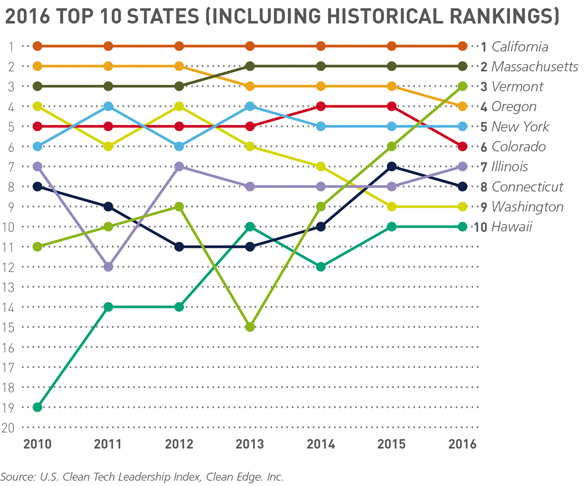
But Vermont is arguably the big story of the top 10, making a three-place jump from the previous year to #3, an unprecedented surge at that level of the rankings. Vermont knocked Oregon down one spot to fourth, while New York held onto to the #5 ranking for the third straight year. The rest of the top 10 are closely bunched; just 5.4 points separate the sixth and tenth place states. Colorado dropped two places to sixth, while #7 Illinois and #8 Connecticut swapped places from 2015. Washington State (after three straight years of declining rankings) and Hawaii held steady at ninth and 10th, respectively. Just missing the top 10 were Maryland and Rhode Island, which each improved by five places to #11 and #12, respectively.
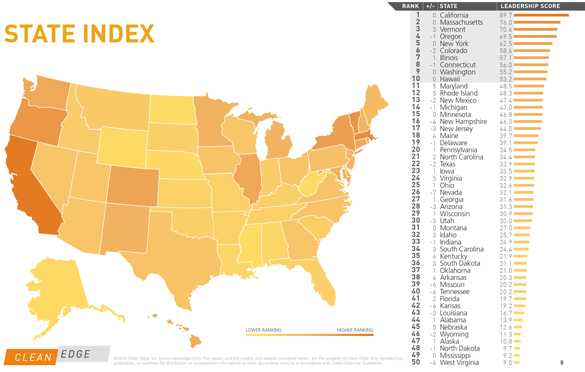
2_States-Overall585

Accelerating Transition

The 2016 Index results come at a time of notable acceleration in the nation’s transition to a clean energy economy, where an increasing number of cities, states, and companies are raising their renewable energy targets, green buildings are becoming the standard, and energy storage and EVs are moving into the mainstream.

At the state level, the transition to a clean energy economy over the past seven years has been remarkable. In 2015, 14 states exceeded 10 percent in-state generation from non-hydro renewables (up from just one state in 2010). The top three states (Iowa, South Dakota, and Kansas) were at 31 percent, 25 percent, and 24 percent respectively. And it’s not just wind generation – in this year’s Index, California became the first state to generate 10 percent of its in-state electricity from utility-scale and distributed solar, with Hawaii not far behind at 7 percent.
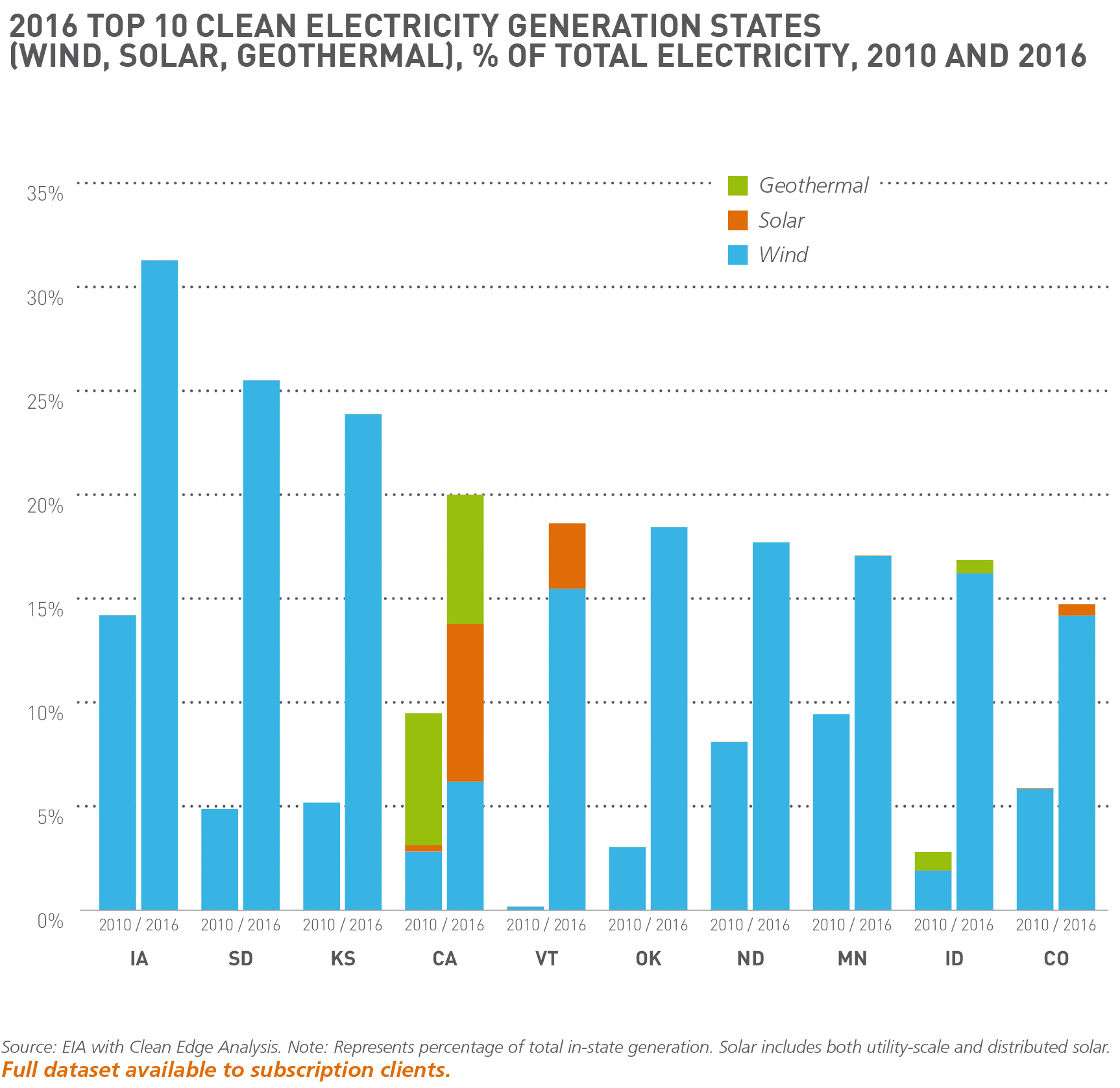
 

3_Top Clean Electric


This dramatic shift (more than 60 percent of all new U.S. electricity generating capacity additions last year came from solar and wind) represents both the maturation of the clean-energy sector and a deployment landscape that seemingly transcends politics. Among the top 10 states for utility-scale clean electricity generation (not including hydro), half were red states during the last presidential election (Idaho, Kansas, North Dakota, Oklahoma, and South Dakota) and half were blue (California, Colorado, Iowa, Minnesota, and Vermont).

And it’s not just utility-scale renewables that pierce the myth of a red-blue divide when it comes to clean energy deployment. This year’s Top 10 states for EV – Electric Vehicle registrations (normalized for population) include three red states (Arizona, Georgia, and Utah) and two that are purple (swing) states in the current election cycle (Colorado and Nevada). For smart meter penetration, red states represent half of the Top 10 spots: Georgia (87 percent), Arizona (74 percent), Alabama (72 percent), Idaho (71 percent), and Texas (70 percent). In some indicators, such as LEED green building deployment, coastal and left-leaning states dominate the Top 10, while in others, such as demand response peak demand shaved, more red states lead.

California Cities Lead, as Well

California also dominates the 2016 Metro Clean Tech Leadership Index, with its largest cities capturing the top three places and four of the top six. The San Francisco Bay Area’s leadership continues into its fifth year: San Francisco and San Jose have finished in the top two for each year the Index has been run, with San Francisco leading the pack for the last four years. However, San Francisco’s lead has narrowed considerably, going from nearly 15 points in the 2014 Index to just 2.5 points in 2016. That being said, the two neighboring metros remain head and shoulders above the rest of the field, with #3 San Diego finishing more than 30 points behind San Jose.
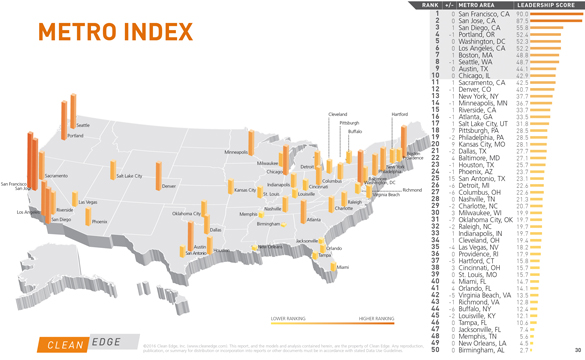
4_Metro-Leadership585

The top 10 metros returned intact this year from the 2015 Index, while their order changed only slightly. San Diego snagged the third spot from fourth-place Portland, Ore., with Washington, DC (#5), and Los Angeles (#6) following, but the difference between #4 Portland and #6 Los Angeles is only .15 points. Boston (#7) and Seattle (#8) change places, though they are virtually tied with only .03 points between them. Austin and Chicago round out the top 10, as they did in last year’s Index.
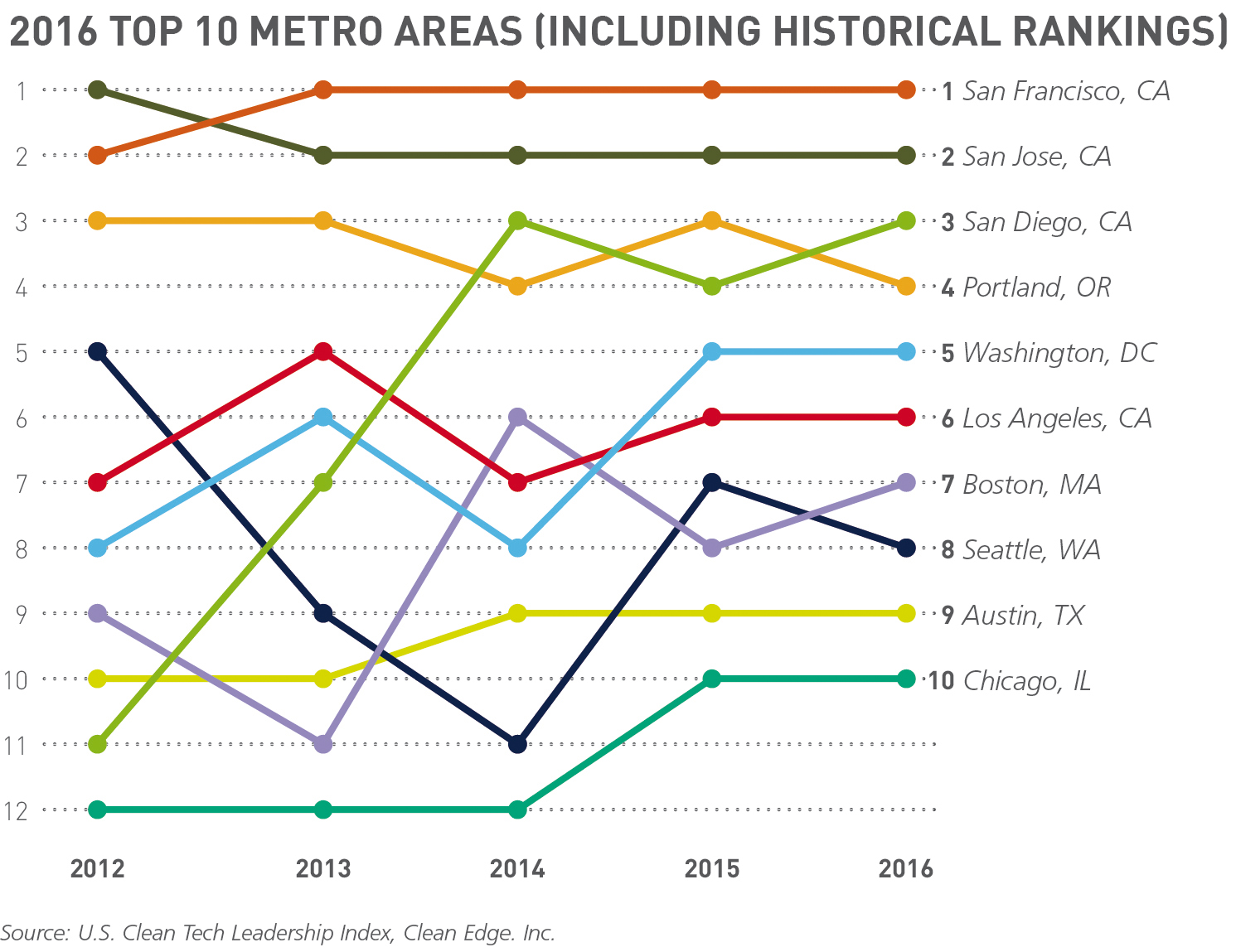
 

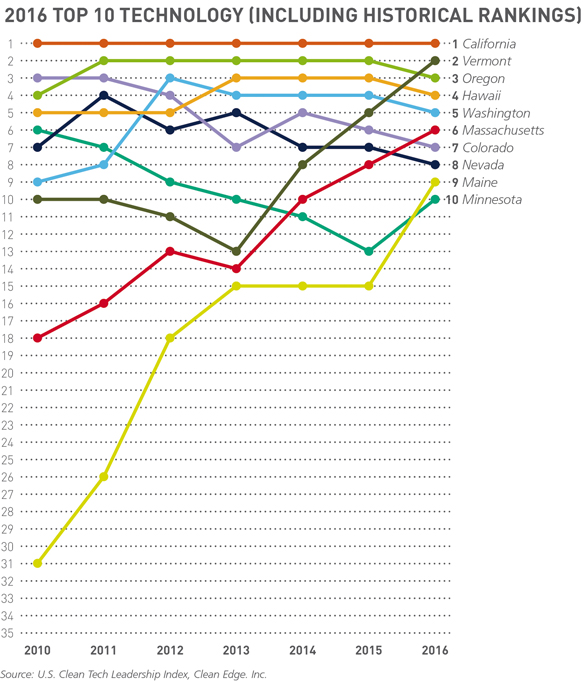
5_Top 10 MetrosAmong states, the Technology category tracks the progress of states’ deployment across three subcategories: Clean Electricity (renewable energy generation, energy storage, fuel cell deployment), Clean Transportation (use of electric vehicles, hybrids, plug-in hybrids, biofuels, natural gas vehicles, charging/fueling infrastructure), and Energy Intelligence & Green Building (green building projects, smart grid deployment). For the seventh straight year, California leads the Technology category in 2016 by a substantial margin.
 

6_Top-10-Technology585

But the historical trajectories of the top 10 Technology states over the Index’s seven years show two New England states – Massachusetts and Maine – moving from also-rans to national leaders alongside Vermont and the traditional resource-rich clean-energy deployment champions from the West and Midwest. Massachusetts, #18 in 2010, has improved its ranking every year but one and claimed its highest-ever place of sixth in 2016. The Bay State jumped four places in utility-scale generation, and ranks in the top 10 in utility-scale solar, distributed solar, energy storage (#1), hybrid and plug-in hybrid vehicles, and EV charging stations. Maine, the national leader in biomass generation, joined the top 10 for the first time this year at #9 after three years at 15th; back in 2010, the state was a lowly 31st. Nevada (26th in the overall Index), Maine (18th) and Minnesota (15th) are the three Technology top 10 states ranking lowest overall in the Leadership Index.

Vermont’s Remarkable Rise

Although helped by the “law of small numbers” – Vermont’s population is 49th in the nation, about 1/60th that of California’s – its rise to the top is nonetheless remarkable. With its Vermont Yankee nuclear plant shuttered in late 2014, the tiny state has significantly increased both renewables and efficiency. Vermont jumped 11 places in the Index’s utility-scale clean electricity generation indicator (solar, wind, and geothermal as a percentage of total generation) from 16th to fifth, with 18.6 percent. Add in the state’s notable hydro and biomass generation, and the state was virtually 100 percent clean energy-powered in 2015, at 99.8 percent. And this snowy winter paradise in northern New England is #3 in the nation in its share of electrons from both utility-scale solar (behind California and Nevada) and distributed PV – Photovoltaic (behind Hawaii and California).

Other Findings

Wind power remains the biggest contributor of clean electrons in most states with significant percentages of in-state clean electricity generation. A dozen states generated at least 10 percent of their power from wind in 2015 (with Texas’s 9.98 percent rounded up); perennial leader Iowa topped the field once again, this time exceeding the historic 30 percent threshold at 31.3 percent. South Dakota and Kansas surpassed 20 percent. Vermont impresses here too, ranking #8 in the indicator (a 12-place jump from the previous year) at 15.5 percent; it’s the only Eastern state in the top 10.

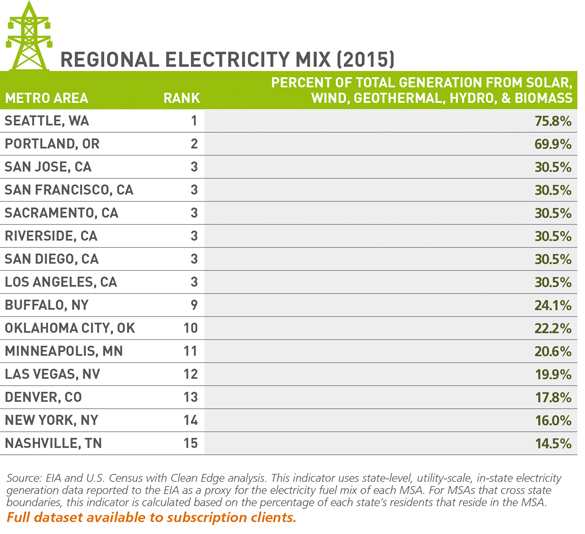
In the Metro Index, the Clean Electricity and Carbon Management category ranks metro areas based on the extent to which they use renewable electricity and have, or are committed to having, low carbon emissions. The West Coast has almost completely taken over leadership in this category, with all six California cities and the two Pacific Northwest metros appearing in the top 10. San Jose (up four spots to #1), San Francisco, San Diego, and Los Angeles give the Golden State a top-four sweep, with 2015 category leader Portland, Sacramento, and Seattle filling the 5-7 slots and Riverside coming in ninth. Austin (#8) and Boston (#10) are the only top 10 metros not located on the West Coast.

This category consists of a mixture of qualitative and quantitative measures. The quantitative indicators include two that use state-level electricity generation data as a proxy for local clean electricity; one that measures carbon emissions from large industrial and power-producing facilities; and a new indicator measuring installed solar power in each metro’s principal city. The qualitative measures have increased this year, with new indicators giving credit for reporting and reducing carbon emissions, and for setting high renewable electricity goals.
7_Regional-Electricity

The regional electricity mix indicator leaders are virtually unchanged from 2015. Metros in leading solar states such as California and Nevada mix with wind-dominant places like Oklahoma City, Minneapolis, and Denver to set the pace in the indicator that includes only wind, solar, and geothermal. The equation changes when adding hydro and biomass: Seattle and Portland vault to the top of the charts, followed by the California metros.


Article by Clint Wilder, senior editor at leading clean-tech research and advisory firm Clean Edge (www.cleanedge.com). He has been writing and speaking about the clean-tech industry for more than a decade. He is co-author of two books, Clean Tech Nation: How the U.S. Can Lead in the New Global Economy (HarperCollins, 2012) and The Clean Tech Revolution (HarperCollins, 2007). Clint is a frequent speaker at clean-tech and green business events in the U.S. and overseas, a blogger for the Green section of The Huffington Post, and has been a facilitator in the Energy and Climate Change track of the Clinton Global Initiative. Clint is also a board member of RE-volv, a San Francisco non-profit using crowdfunding to finance solar power on community-based organizations.

Uncommon Cacao Raises Impact Investment Capital From Acumen Fund, PI Investments

Uncommon Cacao, an industry-leading premium cacao supply chain operation, announced in late June 2016 the closing of its Series A impact investment capital raise led by Pi Investments as lead investor and Acumen as the largest investor in the round.

Founded in 2010, Uncommon Cacao (www.uncommoncacao.com) works directly with smallholder farmers in Central America to source, produce and export high-quality cacao and supplies to more than 90 chocolate makers in the U.S. and abroad through a sales operation based in Oakland, CA. The public benefit corporation creates meaningful market access for smallholder cacao farmers, revolutionizing local economies by linking farmers to the specialty cacao industry through a focus on consistently delivering quality beans. The company has built a transparent supply chain that drives significant value to farmers, and creates meaningful impact for communities at origin.

Cacao, also called cocoa, is the raw material for making chocolate, a food product which has been experiencing rapid growth in the premium sector and transforming towards a focus on “craft” or “bean-to-bar” chocolate. When Uncommon Cacao first began operations in Belize in 2010, through its farmer-focused export operation Maya Mountain Cacao, there were only a handful of bean-to-bar chocolate makers in the U.S. There are currently over 300 such makers in the market today.

“It is time for a sea change in the chocolate supply chain towards decommoditization of cacao, as we have seen in coffee and other crops. Uncommon Cacao’s model is a supply chain focused on quality and transparency, which farmers and chocolate makers are proud to form part of,” says Emily Stone, CEO of Uncommon Cacao, Inc.

Uncommon Cacao had previously raised variable payment obligation debt, known as the Demand Dividend, through a syndicate led by the Eleos Foundation in 2013. Eleos and the syndicate converted the debt alongside the incoming Series A investors, and a number of investors from the original Demand Dividend group, including Wealth Plus, Inc. and Pi Investments out of California, re-upped to participate in the Series A.

“We are thrilled to deepen our work with Uncommon Cacao, and under such terms that will catalyze even greater and deeper impact at scale for the communities with which the company works,” says Morgan Simon, Managing Director of Pi Investments. “Applying an equitable and impact-focused lens on each term, the deal codified worker and farmer ownership, and a margin cap to ensure a fair distribution of benefit.”

Additionally, just prior to the closing of the Series A, Uncommon Cacao acquired Cacao Vivo, the direct sales brokerage division of Taza Chocolate. Rebranded as Uncommon Cacao Source + Trade after the acquisition, this business division will serve as a platform for scaling farmer impact and cacao sourcing beyond Uncommon Cacao’s existing operations in Central America with the goal of reaching 10,000 farmers across the tropical belt within the next five years.

Other innovative aspects of the deal include the establishment of a non-profit Farmer Fund which will hold equity in Uncommon Cacao, Inc. and receive a profit share from sales of cacao, and the reorganization of the company from a Massachusetts LLC into a Delaware Public Benefit Corporation.

“We are extremely excited to partner with Uncommon Cacao and all its stakeholders to collectively build an industry leading enterprise that is deeply committed to product quality, supply chain transparency, and meaningful social impact for farming communities at origin,” says Sean Moore, Associate Director and deal lead at Acumen.

Hogan Lovells US LLP provided invaluable legal assistance to Uncommon Cacao in connection with the investment and acquisition. Stone notes, “The high-level and high-touch professional support of Hogan Lovells throughout the 11 month-plus process of this Series A round was invaluable. We simply couldn’t have done it without them.”


For more information please contact Emily Stone, CEO of Uncommon Cacao, Inc., at emily@uncommoncacao.com or (857) 389-1627.

UMass Becomes First Major Public University to Divest From Direct Fossil Fuel Holdings

The University of Massachusetts in late May 2016 became the first major public university to divest its endowment from direct holdings in fossil fuels. The decision was made by a unanimous vote of the Board of Directors of the UMass Foundation, a separate not-for-profit corporation that oversees an endowment whose value was $770 million at the end of the last fiscal year.

The decision followed a series of developments that signaled the University community’s desire to fight climate change. Last year, the Foundation voted to divest from direct holdings in coal companies in response to a petition from the UMass Fossil Fuel Divestment Campaign, a student group. The UMass Board of Trustees later endorsed the Foundation’s decision and described climate change as “a serious threat to the planet.” Last month, the Campaign staged a series of demonstrations at UMass Amherst to call for divestment from all fossil fuels.

“This action is consistent with the principals that have guided our university since its Land Grant inception and reflects our commitment to take on the environmental challenges that confront us all,” said UMass President Marty Meehan. “Important societal change often begins on college campuses and it often begins with students. I’m proud of the students and the entire University community for putting UMass at the forefront of a vital movement, one that has been important to me throughout my professional life.”

During last month’s protest at UMass Amherst, Meehan met with two representatives of the UMass Fossil Fuel Divestment Campaign, Sarah Jacqz and Kristie Herman. After that meeting, he said he was prepared to recommend that UMass build on its coal divestment by removing from its endowment direct investments in fossil fuel companies and making additional investments in clean/sustainable energy.

To accomplish the latter, Meehan also announced today that he planned to tap the President’s Science and Technology Initiative Fund, which last year provided more than $900,000 in grants to UMass faculty researchers, to ensure future funding for sustainability/green technology projects. He said that UMass is also set to boost its academic and financial involvement in offshore wind energy.

“The Foundation’s action today makes a powerful statement about UMass’s commitment to combatting climate change and protecting our environment,” said UMass Amherst Chancellor Kumble Subbaswamy. “It also speaks volumes about our students’ passionate commitment to social justice and the environment. It is largely due to their advocacy that that this important issue has received the attention that it deserves.”

UMass Board of Trustees Chairman Victor Woolridge said he would ask the Board to endorse the Foundation’s decision when it meets on June 15.

“With this vote, the UMass Foundation adopts a divestment position that is among the most aggressive established for any major university – public or private – in the United States,” said Woolridge. “We do so, in part, because members of the UMass community have urged us to consider divestment in moral terms. Since we acknowledge the moral imperative, we are willing to go beyond last year’s action and take this additional step, but we’re also mindful of our moral and fiduciary obligation to safeguard the University’s endowment, which provides critical funding for faculty research and student scholarships, and must be protected against losses. We believe this conclusive action balances those two priorities.”

“Divesting from investments in any particular sector is not done lightly and we have done so rarely,” said Foundation Treasurer and Investment Committee Chairman Edward H. D’Alelio. “The Foundation’s primary responsibility is a fiduciary one. Its primary mission is overseeing the endowment in an effort to maximize returns on funds donated for research, academic programs, financial aid and other purposes. That we took this step reflects not just our comfort as fiduciaries but the seriousness with which we see climate change.”

In addition to its divestment moves, the Foundation has taken a series of other steps to promote socially responsible investing. These include:

• Becoming a founding member of the Intentional Endowment Network, which supports colleges, universities, and other mission-driven tax-exempt organizations in aligning their endowment investment practices with their mission, values, and sustainability goals without sacrificing financial returns.

• Formally incorporating into its investment policies Environmental, Social and Governance (ESG) criteria.

• Establishing a Social Choice Endowment option for donors.

• Becoming a signatory to the Carbon Disclosure Project (CDP), which provides a global system for organizations to measure, disclose, manage and share environmental information.

The Foundation’s efforts are part of a broader University commitment to sustainability – grounded in its origins as a Land-Grant university and its original mission as an agricultural school – that is reflected in the following achievements and initiatives:

• UMass conducts more than $20 million in environmental science research annually, and is recognized as a leader in areas including wind energy, climate science, marine science and biofuels.

• UMass Amherst ranked 21st in the 2015 edition of The Princeton Review’s Guide to 353 Green Colleges.

• UMass Boston launched the world’s first doctoral program in Green Chemistry.

• At UMass Dartmouth, researchers are developing technology to generate power from ocean and tidal currents.

• UMass Lowell’s National Science Foundation-supported research center brings together wind-energy industry and research experts to create next-generation thinking and technology.

• UMass Medical’s Albert Sherman Center, a LEED Gold research and education center that opened in 2013, employed an energy-efficient design and advanced technologies that make it 25 percent more efficient than similar buildings.

• Since 2007, the UMass system has reduced greenhouse gas emissions by about 17 percent, with UMass Amherst reducing its emissions by 23 percent.

• The University has aggressively increased the use of renewable energy, entering into 15 separate solar contracts with 10 different solar developers, with the vast majority already operational. When all fully on line, they will generate 59 million kilowatt hours and help the state’s electric grid avoid 28,500 metric tons of CO2. Over 20 years, UMass solar operations will allow the grid to avoid more than 544,000 metric tons of CO2.

• The University is a founding member of the Massachusetts Green High Performance Computing Center in Holyoke, a data center that supports the computing needs of the state’s five most research-intensive universities. The facility is the first university data center in the U.S. to be LEED platinum certified.


About the UMass Foundation

The UMass Foundation is a private, non-profit corporation founded in 1950 to foster and promote the growth, progress and general welfare of the University of Massachusetts, recently ranked as the No. 1 public university in New England in the World University Rankings. The Foundation provides a depository for charitable contributions to UMass, manages the University’s endowment, promotes private support of public higher education, and supports the fundraising efforts of the five UMass campuses – UMass Amherst, UMass Boston, UMass Dartmouth, UMass Lowell and UMass Medical School.

$100 Million Impact Investment Collaboration to Benefit Chicago

The Chicago Community Trust, MacArthur Foundation, and Calvert Foundation Announce New Way to Boost Social Sector’s Impact

In late April 2016, The Chicago Community Trust, the John D. and Catherine T. MacArthur Foundation and Calvert Foundation announce Benefit Chicago, an innovative collaboration that aims to mobilize $100 million in impact investments for nonprofits and social enterprises in Chicago.

This significant infusion of much-needed capital will provide low-interest loans and other investments to accelerate the efforts of local social sector organizations working to address key priorities throughout the Chicago region, such as education and child care, access to healthy food, quality affordable housing, energy conservation, job creation and training and more.

Breaking new ground, Benefit Chicago draws on the complementary experience and capabilities of a private foundation, a community foundation managing substantial donor advised fund assets, and a nonprofit financial institution.

“Our goal is to provide a simple yet powerful way for everyone to make investments which, ultimately, benefit the dynamic, diverse city we love — making it a better place for all,” said MacArthur President Julia Stasch. “We view this as an idea with universal appeal. MacArthur looks forward to sharing Benefit Chicago’s fresh approach with those who may want to replicate it elsewhere, and to applying it in other ways so that the social sector benefits more fully from rising interest in impact investing around the world.”

A new report, summarizing research commissioned by MacArthur and The Chicago Community Trust, finds a significant unmet need for financial capital throughout Chicago’s social sector. This need totals more than $100 million and could rise to as much as $400 million over the next five years, with the caveat that determining when specific organizations are investment-ready always requires rigorous vetting.

At the same time, this research reveals an increasing number of individuals and institutions looking for simpler ways to make local investments that have potential to deliver meaningful social, economic and environmental impact.

Benefit Chicago bridges the gap between these two sides of the region’s nascent impact investment marketplace, unlocking new financial resources for organizations whose work benefits the communities and people that need them most.

How It Works

Benefit Chicago is designed to allow everyone – individuals, businesses, and institutions – to help make a positive impact in their home community.

Investors who wish to participate in Benefit Chicago can purchase Chicago-targeted Community Investment Notes®. Calvert Foundation has committed to issue up to $50 million of these fixed- income securities, which offer principal maturities ranging from one to 15 years, with interest payable annually.

The Notes are available directly through Calvert Foundation, through more than 100 brokerage firms nationwide, and as a standing option for eligible donor advised funds at The Chicago Community Trust. The Trust has committed to invest $15 million in a 15-year Chicago-targeted Note, using a portion of donor-advised funds that it manages.

“As The Chicago Community Trust enters its second century of work, we are thrilled to introduce Benefit Chicago to our donors, providing them with a straightforward yet transformational way to invest for impact in tandem with their traditional grant-making and philanthropy,” said Terry Mazany, president and CEO of The Trust.

Calvert Foundation will loan all proceeds of its Chicago-targeted Notes to a new charitable fund that MacArthur has established specifically to advance the mission of Benefit Chicago. The MacArthur Foundation is investing $50 million of its own assets in this new special-purpose fund, which will use the combined pool of capital to make patient, low-cost loans and other investments that boost the impact of Chicago’s social sector.

To catalyze Benefit Chicago’s scale-up and future success, eligible donor-advised fund account holders at The Chicago Community Trust are pre-approved to allocate additional fund assets for investment in Chicago-targeted Notes. The Trust also will chair a Community Advisory Committee to help inform investment and other activities related to Benefit Chicago.

“Calvert Foundation has been connecting investors to the causes and places they care about since 1995. We’re pleased to collaborate in this new way with such deeply-rooted and committed philanthropies by offering a Chicago-targeted impact investment option,” said Jennifer Pryce, president and CEO of Calvert Foundation.

Individuals or institutions interested in purchasing a Chicago-targeted Note should visit benefitCHI.org to learn about different investment options and read the prospectus. Applications for financing that will be available in connection with Benefit Chicago will be considered on an ongoing basis beginning in July. To learn about basic eligibility and sign up for informational updates and webinars, visit- https://benefitchicago.org/


About the Organizations that Created Benefit Chicago

The Chicago Community Trust has been serving the people of metropolitan Chicago for more than 100 years to bring about conditions for a thriving region where all residents enjoy a high quality of life and opportunities for a better future in a prosperous and inclusive community.

The John D. and Catherine T. MacArthur Foundation supports creative people, effective institutions, and influential networks building a more just, verdant, and peaceful world. The Foundation has a 30-year track record in impact investing and has dedicated $500 million of its investment assets solely to this purpose. The Foundation also is deeply committed to its hometown community, Chicago, where it has provided nearly $1.1 billion in grants and impact investments since 1978.

Calvert Foundation is an international impact investing intermediary that connects investors with the causes and places they care about through its Community Investment Note®. Since 1995, Calvert Foundation has helped investors create measurable social impact in communities, with a 100 percent repayment rate of principal and interest to its investors.*

Note to Investors: Community Investment Notes. Any such offer or solicitation will be made only by Calvert Foundation in accordance with its prospectus and all other applicable securities and other laws. None of the information or analyses presented are intended to form the basis for any investment decision, and no specific recommendations are intended. Calvert Social Investment Foundation, a 501(c)(3) nonprofit, offers the Community Investment Note, which is subject to certain risks, is not a mutual fund, is not FDIC or SIPC insured, and should not be confused with any Calvert Investments-sponsored investment product. Any decision to invest in these securities through this Site should only be made after reading the prospectus or by calling 800.248.0337. Due to Blue Sky regulations, the current offering of the Community Investment Note may not be available in all states.

*Past performance is no guarantee of future results. As with all investments, there is risk. Please read the prospectus before investing.

Information Contact:
Justin Conway. Vice President, Investment Partnerships, Calvert Foundation
justin.conway@calvertfoundation.org or Phone: 301-280-6006

After Paris, the Smart Bet is on a Clean Energy Future

by Doug Arent, Executive Director, Joint Institute for Strategic Energy Analysis

feature4-headshotPower systems and the investment landscape are changing. Both at home and around the world, the ways that we produce and consume electricity and arrange fuel transportation are evolving.

The many drivers of this transformation include public policy, consumer trends and demands, business models, and technological innovation. The ultimate outcome of the changes remains to be seen, but a clear direction is apparent. A clean energy future is here and poised for rapid growth. Clean energy attracted a record $329 billion global investment in 2015 despite low oil and gas prices. That record was due to investment all over the world – the United States, China, Africa, Latin America, India, and elsewhere.

The energy marketplace is and will remain dynamic. Fossil energies are poised for moderate growth overall, particularly in non-OECD economies in transition, but these traditional energy sources may also lose market share in many more mature markets. Renewable energy technologies are the major growth story coming out of Paris, making prudent investment in the clean energy space a seemingly smart bet.

Why Now?

In December 2015, 174 nations and the European Union struck a landmark climate agreement in France. The Paris Accords include binding commitments in the form of Intended Nationally Determined Contributions, or INDCs, to hold the increase in the global average temperature to well below 2° Celsius above pre-industrial levels and to pursue efforts to limit the temperature increase to 1.5° Celsius above pre-industrial levels. Preliminary analysis of the INDCs indicates that achieving them will require a 50 percent growth in renewable energy by 2040. Achieving the more ambitious goals would likely mean even more growth in the clean energy marketplace.

The Paris commitments seem likely to strengthen an established trend toward cleaner electricity and transportation systems.

• From 2004 to 2015, global investment in clean energy rose from $60B to more than $320B – more than a five-fold increase.

•  In the United States alone, since 2009:

– Wind power production has tripled to more than 70GW (Gigawatt)

– Solar power costs have dropped by more than 60 percent and solar installations have increased by a factor of more than 20; solar now provides more than 20GW of electricity

– Battery costs have dropped more than 70 percent and today we have more than 400,000 plug-in electric vehicles (EV) on America’s roads.

– Highly efficient LED lighting has dropped in cost by more than 90 percent, with LED deployment growing by more than 200 times to more than 80 million installed light bulbs today.

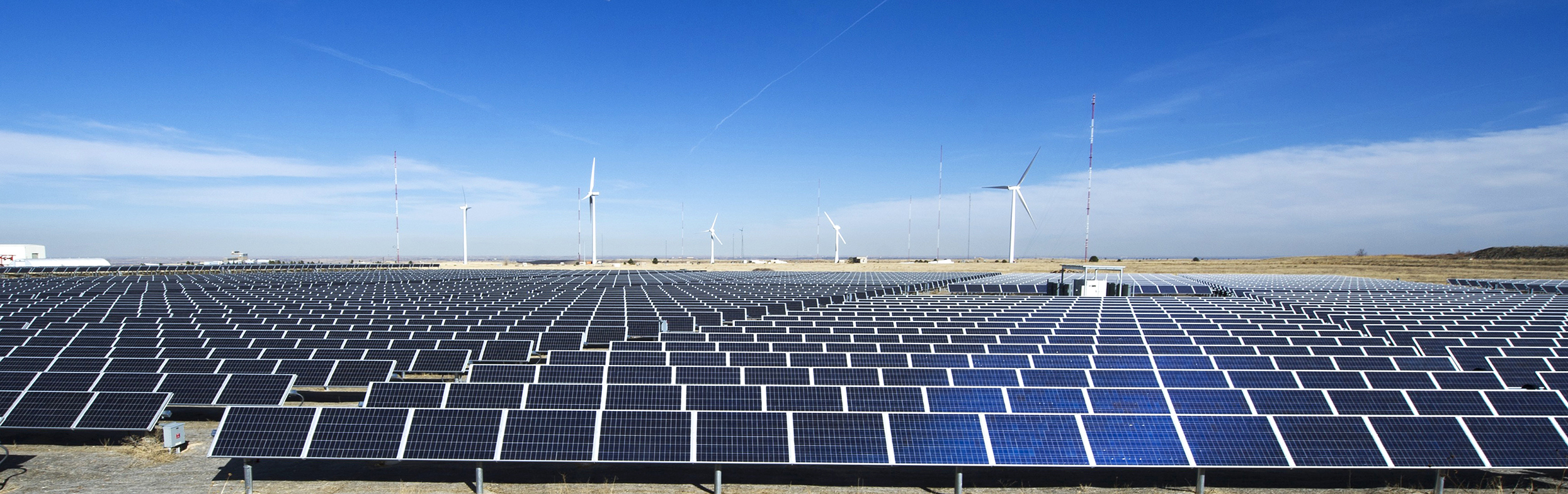
The 1 MW solar array at the National Wind Technology Center. It was installed in February of 2010. ©Dennis Schroeder

Solar and wind power prices have reached all-time lows—raising eyebrows of many who thought renewables would always be more expensive than “traditional power” like coal, nuclear or natural gas. For example, in early 2016, Dubai Electricity and Water Authority received a 2.99 US cents/kWh (kilowatt hour) bid for the 800MW (Megawatt) solar electricity plant it plans to build. Just in the last few weeks, Enel Green Power managed to set new record lows for wind (3 US cents/kWh – Morocco) and solar (3.6 US cents/kWh – Mexico). These prices are unsubsidized and do not account for the environmental externalities that would make clean energy even more economically attractive.

These statistics only hint at the scope of opportunity this clean energy revolution offers for investors. A broad portfolio of new technologies is emerging as technically and economically viable. These include ‘smart’ and traditional solutions, and options for centralized and decentralized power systems.

What does the future hold? Jedi master Yoda noted that the “future is always in motion and difficult to see,” and that’s certainly true of the energy marketplace. The heterogeneous policy and regulatory environments of power systems make the swirling mists of the marketplace difficult to read, but likely categories of ‘next big things’ include electrified transportation, energy storage at all scales, integrated energy service providers, and smart data applications.

State of Play in the ‘Green’ Investment Market

The appeal of clean energy technologies has not gone unnoticed. As noted at the beginning of this article, clean energy attracted a record $329 billion in financing in 2015. And while China’s economic slowdown has cooled investment somewhat in 2016, the overall trend toward cleaner energy is expected to continue.

And that investment is flowing into the market through varied channels, both traditional and innovative. Green bonds, crowdsource funding, real estate investment trusts (REITs), master limited partnerships (MLPs), and other channels are providing investors with many paths into the clean energy marketplace. And the innovations in finance are helping to bridge traditional financing gaps.

Filling the growing demand for clean energy solutions is anticipated to spur increased growth across the industry and new innovation, particularly with new ambitious targets to double clean energy research and development (http://mission-innovation.net) by 20 leading countries to more than $20 billion per year. These innovative solutions will not only help achieve the bold climate mitigation targets, but will also represent unprecedented opportunities for smart investors. Bringing new clean energy solutions to the market, and providing an attractive set of investment opportunities, historically has been challenged by two financing gaps. These gaps are sometimes called the technological and commercialization valleys of death, so named because financing dries up and the innovations wither. The technological valley of death occurs in the innovation and development stages, as entrepreneurs seek capital to develop, test, and refine technologies. A second financing gap emerges as technologies move from demonstration to commercialization. Venture capital and angel investors may have gotten the technology to this stage, but the entrepreneurs have not yet reached the oasis of traditional project financiers and investors.

Creative financing models are emerging to bridge these gaps. For example, the U.S. Energy Department’s National Renewable Energy Laboratory, where I work, has teamed with the foundation arm of U.S. financial services leader Wells Fargo & Company to create the Innovation Incubator (IN2) program. IN2 offers tailored financial and technical assistance to support startups at critical stages. As an investment vehicle, IN2 represents a unique partnership between a philanthropic organization and industry partners. It is one financing program among many that are creatively expanding opportunities for investment in clean energy technologies.

Of course, not all investments in clean energy are good investments, and not all investment vehicles are good either. A word of caution: Yieldcos. This once-promising financing model, which sought to provide utilities with an investment vehicle similar to MLPs or REITs and lower cost of capital for renewable energy projects, now appears endangered. Some have called it ‘broken.’

As with any investment, prudence is important in assessing opportunities in the energy market. Smart investors will weigh carefully the dynamics of the clean energy markets with the soundness of investment opportunities. The anticipated growth of clean energy to more than 50 percent of world power represents a marked shift in energy markets, strong commitments to climate mitigation, and an unprecedented investment landscape.

photo caption: Apple built the largest non-utility biogas fuel cell installation in the United States to help power their data center in North Carolina with 100 percent renewable energy. Source: http://www.apple.com/environment/climate-change/ 


Article by Doug Arent, MBA, Ph.D.

Doug Arent is Executive Director of the Joint Institute for Strategic Energy Analysis (http://www.jisea.org) at the U.S. Energy Department’s National Renewable Energy Laboratory. In addition, Mr. Arent is Senior Visiting Fellow at the Center for Strategic and International Studies, serves on the American Academy of Arts and Sciences Steering Committee on Social Science and the Alternative Energy Future, is a member of the National Research Council Committee to Advise to U.S. Global Change Research Program (USGCRP), is a Member of the Keystone Energy Board, and is Associate Editor for the journal Renewable and Sustainable Energy Reviews.

Arent was recently invited to serve on the World Economic Forum Future of Electricity Working Group, and is a member of the International Advisory Board for the journal Energy Policy.

Mr. Arent was a Coordinating Lead Author for the 5th Assessment Report of the Intergovernmental Panel on Climate Change (IPCC). He has been a member of Policy Subcommittee of the National Petroleum Council Study on Prudent Development of North America Natural Gas and Oil Resources, served from 2008 to 2010 on the National Academy of Sciences Panel on Limiting the Magnitude of Future Climate Change, and also served on the Executive Council of the U.S. Association of Energy Economists.

His research interests are centered in energy and sustainability, where he has been active for more than 30 years. He has published extensively on topics of clean energy, renewable energy, power systems, natural gas, and the intersection of science and public policy. Mr. Arent has a Ph.D. from Princeton University, an MBA from Regis University, and a bachelor’s of science from Harvey Mudd College in California.

  • 1
  • 2
Signup to receive GreenMoney's monthly eJournal

Privacy Policy
Copyright © GreenMoney Journal 2025

Website design & development by BrandNature

Global Events Calendar

View All Events

april

21aprAll Day232026 Sustainable Packaging Coalition: SPC Impact – Nashville

27aprAll Day30Women Deliver 2026 Conference (WD2026) – Melbourne

X