Tag: Impact Investing

Praxis Investment Mgmt. Launches New ETFs and Releases Research on Faith-based Investing

Praxis Investment ManagementTM, a company of Everence® and a leading investment manager serving values and faith-based investors, has launched its first two exchange-traded funds (ETFs) — Praxis Impact Large Cap Growth ETF (PRXG) and Praxis Impact Large Cap Value ETF (PRXV). Both funds began trading on the NYSE on April 8.

“Our new active ETFs are designed to meet the demand of values and faith-based investors,” said Chad Horning, President of Praxis FundsTM. “Investors want competitive, values-driven investment options and they want to talk with their financial advisors about investing with their faith in mind, and these products facilitate that conversation.”

PRXG and PRXV deploy quantitative equity strategies similar to those used in the Praxis Growth Index Fund (MMDEX) and the Praxis Value Index Fund (MVIIX).

Praxis built its reputation on delivering competitive, benchmark-level returns in core, mutual fund portfolio holdings, integrating shared values and a set of impact strategies designed to promote real-world change. MMDEX (2007) and MVIIX (2001) have been an important part of that history for almost 20 years. Praxis has now brought that optimized, index-like investment approach into the ETF arena in both the large cap growth (PRXG) and large cap value (PRXV) space. The ETFs and mutual funds are similar in many ways. For example, the ETFs are technically “non-diversified” funds, which may help them track their benchmarks even more closely in situations when the largest names in a benchmark exceed limitations for “diversified” funds. The Praxis ETFs also bring the unique application of Praxis ImpactX strategies in an ETF product.

“Praxis has been a leader in faith-based mutual funds for more than 30 years,” said Mark Regier, Vice President of Stewardship Investing. “For much of that time, shareholders preferred to work with financial advisors who typically used mutual funds to build portfolios. In recent years, investors and their advisors have been choosing ETFs to access the markets because of their ease of purchase, and for taxable accounts, more favorable tax treatment. This broader market trend has also influenced the way faith-based investors want to invest. While Praxis is not the first faith-based firm to issue ETFs, we think our approach to investing will appeal to investors who want real world impact and who desire practical solutions to their investment objectives.”

The funds seek capital appreciation and performance similar to the CRSP US Large Cap Growth Index and CRSP US Large Cap Value Index respectively. Praxis applies equity screens consistent with its core values and utilizes optimization techniques to attempt to limit benchmark tracking error. The funds are meant to serve as core allocations – “the heart of your portfolio.”

“All Praxis funds embody our stewardship investing core values and use our ImpactX framework to create real-world impact,” said Benjamin Bailey, Vice President of Investments. “Research shows that investors want advisors who understand and engage with their faith-based investing preferences. Our new ETFs provide practical solutions for advisors looking for lower cost, liquid, tax-efficient, values-driven investment options to serve these clients.”

Bailey heads the team managing PRXG and PRXV. Bailey has over 20 years of investment management experience and has managed Praxis portfolios since 2005.

The expense ratios for both funds are 0.36%.

Concurrent with the ETF launches, Praxis released the results of research highlighting a largely untapped opportunity for financial advisors to strengthen their understanding of and service to their clients. The findings are based on a survey of 1,001 individual investors controlled for age, region and gender, and 403 financial advisors across multiple distribution channels.

Whether and how faith may be considered in investment portfolios is a conversation that 75% of investors want to have with their financial advisor, according to the research report “Faith-based Investing: The conversation clients seek, The value advisors can add.” However, just 9% of advisors are willing to initiate such a conversation.

“This disconnect suggests that advisors run the risk of underestimating or ignoring what’s important to clients,” said Horning. “But the research also explains why: Advisors are uncomfortable with the topic, have relatively low levels of awareness of solutions available, and lack confidence in the efficacy of those solutions. In short, they’re reluctant to engage clients on a topic they fear will not produce good results.”

Highlights from the Research:

  • 65% of advisors perceive a lack of client demand, interest and/or awareness.
  • Only 59% of advisors are aware of faith-based investments.
  • Advisors report a lack of product availability, doubt that investment performance results can be competitive, and believe that screening processes can be counterproductive to strong returns.
  • Despite the barriers and misconceptions identified, advisors and investors who are aware of faith-based investing share positive views on its benefits. There’s consensus in the data that faith-based investing empowers investors to feel a sense of purpose and fulfillment.
  • Many expect faith-based investing to gain popularity over the next decade.

“Clients want to align their faith with their investments in order to create real impact,” said Regier. “The broader availability of lower cost, liquid, tax-efficient faith-based ETFs can help raise awareness and prompt advisors to explore their options for serving these values-driven investors.”

“Now is the time to ask your clients about their thoughts on faith-based investing,” Regier encourages financial advisors. “Engaging clients about their values has the potential to build stronger connections, create a deeper understanding of the client, and demonstrate value by introducing them to an investing approach they may never have considered.”

The research was conducted by Bellomy Research in the fall of 2024.

To download a copy, visit https://www.praxisinvests.com/research.


About Praxis Investment Management

Since 1994, Praxis has offered investment products designed to meet practical needs for everyday investors seeking to steward their assets consistent with their desire to promote positive social and environmental impacts. Praxis brings a faith-based approach to ETFs, mutual funds, multi-fund portfolio solutions and money market accounts. Based in Goshen, Indiana, Praxis is a company of Everence Financial. Learn more at praxisinvests.com.

CRSP US Large Cap Growth Index: Represents the Growth Style for companies covering top 85% of cumulative capitalization of CRSP US Total Market. It is not possible to invest in an index. 

CRSP US Large Cap Value Index: Represents the Value Style for companies covering top 85% of cumulative capitalization of CRSP US Total Market. It is not possible to invest in an index. 

An investor should consider the investment objectives, risks, and charges and expenses of the fund carefully before investing. A prospectus and a summary prospectus which contains this and other information about the fund may be obtained by visiting praxisinvests.com/prospectus. The prospectus and the summary prospectus should be read carefully before investing.

Investing involves risk. Principal loss is possible.

ETFs are subject to additional risks that do not apply to conventional mutual funds, including the risks that the market price of an ETF’s shares may trade at a premium or discount to its net asset value, an active secondary trading market may not develop or be maintained, or trading may be halted by the exchange in which they trade, which may impact an ETF’s ability to sell its shares. Shares of any ETF are bought and sold at market price (not NAV) and are not individually redeemed from the ETF. Brokerage commissions will reduce returns.

Praxis Mutual Funds® and Praxis ETFsTM are distributed by Foreside Financial Services, LLC.

Additional Articles, Energy & Climate, Impact Investing, Sustainable Business

A Perfect Storm for US Agriculture Threatens 34 Million Jobs

By John Howell, Climate & Capital Media

Extreme weather, tariffs, DOGE, frozen funds, and inflation threaten America’s beleaguered farmers

Climate and Capital Media Featured NewsAmerican farmers face a financial cliff as tariffs and severe storms take a wrecking ball to spring planting and market prices.

It’s planting time in America’s rural heartland, those states in the Midwest, the Great Plains, and the Mid-South Delta that are the “breadbasket” of the country’s agricultural economy. But the usual spring optimism that fuels farmers is subdued this year by the implications of extreme weather — and a new world trade order of reciprocal tariffs that threatens U.S. agriculture exports. This threatens more than $21 billion worth of soybeans and corn produced last year for Mexico, Canada, and China, the top three American markets. That’s more than half of the total $49 billion worth of both commodities that were exported.

To make matters even worse, money that in the past has been used to bail out farmers may not be available. The coffers of the Commodity Credit Corporation (CCC), a wholly owned U.S. government corporation, used to finance farm price and income support, is depleted. At stake are the dozens of commodity programs, commodity export credit guarantees, and agricultural export subsidies. The beauty of CCC relief is that it can make payments quickly and to provide financial support to America’s producers and farmers immediately. The catch: The CCC account is currently depleted due to the large payouts of recent years. And Congress has to authorize funds for the CCC to make payments.

Finally, farmers face the threat of frozen funds and another potential bout of debilitating inflation.

The Weather Report: Severe Spring Storms Due to Climate Change

For the past several years, the ag production season in Mid-America has been swamped by torrential rains that have drowned freshly planted crops and delayed planting due to submerged farm fields. These spring deluges, often more than a foot at a time, have created “generational” flooding and been accompanied by more frequent and more powerful tornadoes that have damage everything from barns and irrigation equipment.

These catastrophic storm events have been followed by severe droughts during the summer growing season. In the Bootheel area of Missouri where my family owns farmland, from June to mid-July 2022 we recorded not one drop of moisture — a first, according to local farmers. In the fall, record-low levels of the Mississippi River, the primary transportation channel for the mid-country’s agricultural production, have delayed shipping at harvest for the past three years, adding extra costs.

Ironically, last year’s “normal” weather (moderate and timely rains, average-size storms, and good fall harvest weather) was considered “abnormal” by farmers who have now become inured to the past decade’s radical changes in weather patterns.

Weather at this year’s spring planting time which began in March saw multiple severe storm systems that generated torrential rainfalls, hail, and record numbers of tornadoes. Some early planted corn was drowned and had to be re-planted. And flooded fields meant that farmers couldn’t get onto the soggy land; delayed planting usually means lower yields.

New Tariffs Have Slowed Sales of Key Ag Exports

A new layer of financial storm clouds on the American agricultural horizon threatens to add that proverbial last straw to the already formidable pile of obstacles now facing producers: the sweeping tariffs applied to global trade. As 20 percent of all U.S. agricultural products are exported, the financial stakes are enormous.

American farmers are bracing for a repeat of 2018-2019, when trade wars with China, the largest buyer of U.S. agricultural products, cratered prices for agricultural commodities due to reduced purchases of soybeans and corn. Those prices have not recovered and now hover at four-year lows.

In addition, overseas markets for U.S. products have dropped as the Chinese have increasingly switched to other providers, notably Argentina and Brazil, which have surpassed the U.S. as a supplier of soybeans to China. After many years in which the U.S. was the leading trade partner, Brazil provided 69% of China’s soybean imports while the U.S. share shrank to 25%.

Now, the forecast for this year’s ag export business is even more dire. Tariffs with America’s largest trade partners, Canada and Mexico, are currently undecided, and there’s a virtual trade embargo currently in place with China. New Chinese tariffs of 15% on corn and 10% on soybeans add prohibitive costs to importing American products. Those three countries buy nearly half of all U.S. ag exports. (In 2024, Mexico became the top destination, with China sinking to the number three spot after Canada.) While China made some buys of U.S. soybeans earlier this year in anticipation of trade disputes, purchases of American ag commodities have paused. Instead, China is buying from Brazil, alternative sources with rapidly rising production rates.

The United States sells more soybeans to China, by value, than any other single product. Last year, that amounted to more than 27 million metric tons, worth $12.8 billion. A drop in this trade is bad news for American farmers and good news for the nation ready to step in: Brazil.

More Problems at Play: No Farm Bill, DOGE Cuts to USDA

There are other pressures this year. There has been no new farm bill since 2018; a new one is typically passed by Congress every five years. The 2018 bill has simply been extended since 2023 on a year-to-year basis through 2025, with no adjustment in its calibration of economic support for farmers to reflect current conditions.

In addition, at the direction of DOGE, $2 billion worth of American agricultural products, annually included in the now-eliminated USAID program, are in limbo. Also, a program that funded $1 billion in local food provided to schools has been cut. And as of today, plans are to close over 100 USDA offices and cut an estimated 10- 20% of the USDA’s 100,000 personnel.

Meanwhile, on top of several years of sagging market prices and shrinking market share, costs (seeds, fertilizer, diesel fuel, farm equipment) have risen, driven by several years of inflation and now, by tariffs. For example, 80% of potash, a crucial fertilizer for corn, used on U.S. farms comes from Canada and now carries a tariff of 10% on top of its usual price.

The Bottom Line: A Looming “Bust” in the American Ag Economy

Farming has never been more precarious. Family farm bankruptcies increased by 55% last year, compared to 2023, and at the start of 2025, the number of bankruptcies is already exceeding the same time last year, according to a new report by Bloomberg Law. The report notes “Unpredictable tariffs, immigration overhauls, federal program cuts, and frozen Agriculture Department funding are now part of the discussions farmers are having as they seek financial help.” The last time farm bankruptcy filings rose was in 2019, during the previous trade war with China. Eventually, the previous Trump administration sent farmers more than $20 billion in Market Facilitation Program payments (MFP) to help cover export losses.

Biden-era Payments Offer Limited Immediate Support

To date this year, the only federal support has come from a Biden-era program, the Emergency Commodity Assistance Program, part of the American Relief Act of 2025, which was passed by Congress in December 2024. The program authorized $10 billion for ECAP payments to help offset losses that growers incurred during the 2024 crop year, and these are being dispersed now.

Many other Biden-era agricultural-related programs have been frozen in place, as the current administration seeks to eliminate them while recouping funds already appropriated by Congress. These include the Rural Energy for American Program which promised to re-pay farmers and ranchers 50% of the costs of sustainable improvements, such as switching irrigation motors from diesel to electric power. Those who have fronted the investment and submitted their invoices for the 50% rebate are now being told that those reimbursements are frozen. This comes at a time when producers are taking on the annual hefty loans to put spring crops in the ground.

Where’s the Trump Administration Relief?

So far, comments on this dire situation by the administration and its allies have been as vague as its constantly changing tariff policies. Senator Jon Husted (R-OH), addressing the Ohio Farmers Bureau, noted that retaliatory tariffs on corn and soybeans would present yet another financial burden for Ohio farmers, who have lost market share of international corn and soybean exports to other countries during Trump’s first U.S.-China trade war. Ohio soybean exports have never recovered, sinking 60% from 2019 to 2023. As to any tariff-driven relief from the federal government, he said “I think the president is going to help work through those things. I think it remains to be seen what those impacts are. And once we see what those impacts are, then we’ll talk with the president about how to respond.”

You’d expect a more detailed, forceful statement from even a Republican senator in a state where one in eight workers in Ohio is engaged in agriculture, a business sector worth $124 billion annually, according to the Ohio Department of Agriculture, and where he state’s top crops are corn and soybeans.

“Trump Dollars” for Farmers, 2025-6

Given the scale of uncertain weather conditions that affect yields and even more uncertain tariff policies, which have roiled export markets, it is likely that the price tag to keep Mid-American farms in business would be a multiple of the $28 billion shelled out to farmers during the first round of geopolitical trade disputes in 2019. That amount was estimated to account for one-third of all farm income, given the significant impact on collapsed export markets.

Back then, payments in the form of checks signed by the president were issued by the Commodity Credit Corporation (CCC), a wholly owned U.S. government corporation, which served as a financing institution for the USDA’s farm price and income support commodity programs, commodity export credit guarantees, and agricultural export subsidies. The beauty of CCC relief is that it can make payments quickly and provide financial support to America’s producers and farmers immediately. The catch: The CCC account is currently depleted due to the large payouts of recent years. Congress has to authorize funds for the CCC to make payments.

The Numbers are Big

The economic impact is huge. Agriculture, food, and related industries contributed roughly $1.537 trillion to U.S. gross domestic product (GDP) in 2023, a 5.5 percent share, according to data from the Bureau of Economic Analysis. The output of America’s farms contributed $222.3 billion of this sum — about 0.8 percent of U.S. GDP. The overall contribution of agriculture to GDP is larger than 0.8 percent because sectors related to agriculture rely on agricultural inputs to contribute added value to the economy.

The climate and capital story on America’s agricultural economy is a developing story.


Article by John Howell, Finance Editor for Climate & Capital Media and a partner in his family agri-business firm in Missouri.

Article reprinted with Permission as part of GreenMoney’s ongoing collaboration with Climate and Capital Media.

Additional Articles, Energy & Climate, Food & Farming, Impact Investing, Sustainable Business
Investing in the Earth: Natural, Organic and Regenerative Food and Ag Surges in Popularity

By Steve Hoffman, Compass Natural Marketing

Steve Hoffman, Compass NaturalThe market for organic food and agriculture has grown significantly since the National Organic Program was first established in 2001, placing the USDA Certified Organic seal on products that qualify for this distinction. Today, it’s a $70-billion market that’s been growing an average of 8% per year. And while it may be maturing, younger consumers, including new parents and their babies, are eating it up. And now, in the post-pandemic era, investors are once again paying attention to the potential of organic and regenerative products and brands that take into account health and the environment, and how the way we produce our food and consumer products affects climate change.

A survey released in February 2025 by the Organic Trade Association (OTA), the industry’s leading trade group, found that organic’s benefits to personal health and nutrition are resonating deeply with Millennials and Gen Zer’s, making them the most committed organic consumers of any generation. Also, a February 2025 study by the Acosta Group, one of the nation’s top natural and organic products sales firms, reflected that 75% of all shoppers purchased at least one natural or organic product in the six months prior to the survey, with 59% responding that they think it’s important that their groceries and/or household products are natural and organic because they “are better for them” and “they tend to have fewer synthetic chemicals and additives.”

Natural and Organic Industry is a Force

Overall, the natural and organic products industry combined has more than tripled in size since 2007, growing from $97 billion in sales in 2007 to over $325 billion in 2024, according to data compiled by New Hope Network, SPINS (a division of Nielsen), Whipstitch Capital and others. The data was presented at this year’s State of Natural & Organic keynote presentation at Natural Products Expo West, the world’s largest trade exhibition for the natural, organic, regenerative, nutritional and eco-friendly consumer products industry, held in March 2025.

“Wow, this industry is a force,” said Jessica Rubino, VP of Content & Summits for New Hope Network, at the keynote presentation. “That is a tremendous amount of growth. Today, we’re defining the industry as the natural, organic and functional food and beverage space, dietary supplements and personal care.” According to Rubino, the industry grew 5.7% in 2024, exceeding expectations. “The biggest piece of the pie is food and beverage, followed by dietary supplements and then personal care.” Rubino also said that while personal care is the smallest segment, it is the fastest growing and a category to watch.

“Natural products are absolutely continuing to accelerate again. Of course, they’re all outpacing non-natural products, and that’s even with not a whole lot of new items coming through,” said Kathryn Peters, Head of Industry Relations for SPINS and one of this year’s keynote presenters. “We’re also seeing more buyers coming in. This is being driven across many areas of the store, whether it’s refrigerated, grocery or vitamins and supplements. So, it’s just a resilient, wonderful story of growth we see in the industry. And really importantly, the game is continuing to be all about smart, profitable growth.”

In addition, “Organic is still very solid and strong, moving about the same pace as natural,” Peters said. “Consumers obviously have a strong awareness more than a lot of other certifications and a confidence in organic.” Certified regenerative products, too, showed significant growth of 20% in 2024, the panel noted.

“In just a little over two decades, the USDA Organic label has earned deep trust among consumers and has become one of the most identifiable food labels in our grocery stores,” said Matthew Dillon, Co-CEO of the OTA.

According to OTA’s survey, more than half of U.S. consumers bought an organic fruit or vegetable in the last year. Consumers surveyed bought more bread in the last six months than any other food item, and 27% said they chose organic bread. For those surveyed consumers buying baby food, a whopping 93% chose organic. The USDA Organic label is particularly important for younger consumers, with over two-thirds seeking out the organic label in almost every food purchase. The Organic label was most valued in fresh food categories including fruits, vegetables, meat/poultry, baby food, eggs and dairy, and these items were the most likely products to be purchased as organic over the last 12 months. 

Regenerative Agriculture Draws Investor Interest

In addition, regenerative agriculture — a system of farming that seeks to sequester carbon by rebuilding healthy soil — is among the sectors attracting more interest from impact investors, despite being an underfunded sector. However, there is growing consensus that the increasing threat to biodiversity is unsustainable and regenerative agriculture urgently needs to scale up. Now, groups such as Regenerative Food Systems Investors Forum and Impact Investor are drawing investor’s interest to the space.

One of the primary challenges to investing in regenerative food and farming is due to the fact that it requires significant upfront investment to transition from conventional farming. As such, many institutional investors remain hesitant due to uncertain returns and long payback periods. “This transition to regenerative farming is a long term one. That’s why intensive agriculture is so widespread, because it’s a very quick win. This is why you need investors to be patient and be willing to take some of the first loss and risk. This then accelerates the amount of private capital that will come in, because risk is protected,” said Harriet Jackson of responsAbility, a Swiss impact investing firm, speaking at Impact Investor’s 2024 conference in The Hague.

“Today…we are at what appears to be a crucial point in the transformation of agriculture and food systems. The momentum for regeneration is distinct,” said Sarah Day Levesque, Managing Director of  Regenerative Food Systems Investment Forum, an investor’s organization seeking to build a more resilient food system. “There’s an increasing number of farmers pioneering the transition on the farm and increasing acreage. We can also see it in the incredible growth of organizations like EARA — the European Alliance for Regenerative Agriculture – designed to give rise to the voices of farmers in transition. Governments and public policy makers are acknowledging the very real risk presented by climate change and degradation of nature, including that caused by extractive agricultural practices. We are increasingly seeing policies and public sector investment that seeks to address these risks and support transition. Businesses and asset owners are starting to see and feel the importance of investing in nature and climate positive land use – seeing how critical investments in natural capital will de-risk production and create resilience in business models and investment outcomes.”

One organization seeking to foster investment in regenerative agriculture is the Boulder, CO-based Mad Agriculture, which in March 2024 launched Mad Capital, a $50 million investment fund aiming to de-risk regenerative and organic farming. With commitments from The Rockefeller Foundation, Schmidt Family Foundation and more, Mad Capital established its Perennial Fund II to provide loans to U.S. farmers to help them transition to regenerative and/or organic agriculture. The fund has made two closes and is “actively deploying capital to farmers,” said Mad Capital Cofounder and CEO Brandon Welch.

Natural and Organic Brands are Outperforming

From an investor’s perspective, the overall natural, organic and regenerative products industry is looking better than it has in some time, asserted Nick McCoy, Managing Director and Cofounder of Whipstitch Capital, at the State of Natural & Organic keynote at Natural Products Expo West. “Over the last couple of years there’s been a lot of talk and a lot of pain for the lack of liquidity in this industry. It’s been very difficult for founders to find money compared to pre-Covid. Right now, we’re sitting in a very similar point as we were in 2010 or 2011 facing the millennial launch and emerging from the great recession…when it was very difficult to raise small checks. So, what’s the hand of cards that we’re playing in this industry now? Well, we have natural products that are very attractive. They’re outperforming…consumers are running to them. We have positive ROI in cash invested. Cash invested is resulting in big revenue gains right now, and ultimately dollars chase dollars,” McCoy said.

“We may not have had as much M&A or fundings over the last two years, but…we’ve built a tremendous amount of value in this industry. And when you see more consumers spending more money in wellness, investment in M&A and other dollars eventually catch up and that’s what’s going to happen. CPG investors right now are sitting on a very large pool of illiquid but very attractive assets. There’s a lot of viable brands that are growing faster than basically the broader market… Interest rates are starting to stabilize. We’re seeing more fund closings and more investors getting more liquid money and the amount of illiquid value locked up is going up.”

According to McCoy, it’s not just the “big strategics” buying natural food brands. The natural products industry itself is seeing companies growing large enough to potentially become buyers themselves. “We’re seeing lots of talk about the IPO market starting again. Before 2021, I could probably count on one hand the number of brands that IPO’d in this industry. Now it sounds like it’s going to come back,” McCoy shared.

“There’re a lot of different ways that people get to liquidity,” McCoy added. “And once it does get liquid, then basically the money will flow from the bigger funds to the smaller funds, and the longer it takes, the more money these individual investors are going to get — surprising amounts. They thought they were going to get five times their money or 10 times their money investing in the company in 2015, and now it’s grown so large they get 50X when it sells. And that’s a true case of some that recently sold.”

According to McCoy, the $100-$300 million in revenue independent natural CPG brands — a group showing “tremendous growth” — represent major M&A and consolidation opportunity. “If we look at some of these recent high-profile deals, two, two and a half, three times revenue are where some of these things are trading. So, if we apply a two and a half times revenue multiple using SPINS sell-through data, you can see that this kind of locked up illiquid value that was $13 billion two years ago is up to $19 billion now. And when you think about a number like that, when that money starts to go back to investors, if you’re an investor and you put $25,000 into a company expecting to get $250,000 and suddenly you get $1.5 million, you’re going to be investing a lot more than $25,000 into other companies and that’s going to bring the liquidity back over these next few years. It’s really exciting to me.”

Article Resources:

  • The State of Natural & Organic — Keynote Presentation recorded at Natural Products Expo West 2025; watch here.
  • Nutrition Capital Network — With news, resources, and events, NCN brings together active investors and innovative companies in health, nutrition and wellness, www.nutritioncapital.com
  • Whipstitch Capital — A leading investment bank tracking the food & beverage and health & wellness space, www.whipstitchcapital.com
  • Big Path Capital — A leading investment bank and annual conference for impact investing and “Impact CEOs,” www.bigpathcapital.com
  • MAD Capital — An investment fund for regenerative and organic ranchers and farmers, www.madcapital.com
  • Regenerative Food Systems Investment Forum — An investor’s organization seeking to build a more resilient food system, www.rfsi-forum.com


Article by Steven Hoffman is Managing Director of Compass Natural, providing public relations, brand marketing, social media and strategic business development services to natural, organic, regenerative and sustainable products businesses. Contact him at- steve@compassnaturalmarketing.com.

Featured Articles, Food & Farming, Impact Investing, Sustainable Business

Why I Started a Food Innovation ETF: A Journey from Personal Conviction to Growth Investing

By Elysabeth Alfano, VegTech Invest

Elysabeth Alfano VegTech InvestA Childhood Realization

Not eating meat is one of my earliest memories. As a child, I simply couldn’t stomach it. The texture, the fat, the gristle—it all felt unnatural to me. I remember explaining to my parents that it just wasn’t appealing, but they were convinced I needed it to survive. So, under their watchful eyes, I tried to comply, but when they weren’t looking, I hid pieces of meat in my pockets, under the radiator—anywhere to avoid eating it. Of course, I was caught and grounded. In my young mind, I learned that eating meat wasn’t a choice; it was a societal expectation.

Confronting the Reality of Factory Farming

Fast forward to my 20s and 30s, and I had come to understand the realities of factory farming. I would mention to friends, “Do we really need pepperoni on that pizza?” The backlash was swift. “Oh, you’re such a tree hugger,” they’d say. I realized that everyone around me was participating in something they knew wasn’t right. Yet, because it was the norm, questioning it was met with resistance. It was a strange contradiction: people were aware of the problem but unwilling to acknowledge it openly.

A Turning Point in My Investment Journey

As I continued my career in finance, serving as Chief Investment Officer for a small family office, my perspective broadened. My focus shifted beyond personal choices to the broader implications of our food system. A turning point came during a Thanksgiving dinner with my nephew, a member of the University of Oregon football team. He told me that his team’s nutrition coach had banned meat and dairy during the season. This revelation struck a deep chord. I had known all along that my body rejected these foods, and now, science and performance nutrition were affirming what I had always felt instinctively. That day, I made a decision: I would no longer let societal pressure dictate my choices. I changed my diet on the spot. 

The Business Case for Food Systems Transformation

Once my diet changed, my business instincts kicked in. I started analyzing the food industry through an investment lens, and what I discovered was staggering. The inefficiencies in the food supply chain were glaring. Factory farming was not just environmentally disastrous — it was a poor business model. The numbers were irrefutable: 32% of the world’s methane emissions come from animal agriculture, primarily cows. Deforestation, biodiversity loss, food insecurity — all traced back to the same source. Our current system consumes vast amounts of land and water to produce a fraction of the calories needed to sustain the world’s population. With global demand for meat projected to rise by 50%, and no corresponding increase in land or water, the consequences of inaction were clear: food could become a privilege of the wealthy, leading to geopolitical instability. 

The Need for an Investment Solution

Where there is inefficiency, there is innovation. Thus, I saw a massive investment opportunity in food system transformation, a total addressable market estimated at $9 trillion to $14 trillion. Just as we transitioned from landlines to mobile phones, from horse-drawn carriages to automobiles, our food system is on the cusp of a transformation. Investing in companies pioneering sustainable food solutions wasn’t just ethical — it was financially sound. The U.S. Department of Defense is now allocating significant funds to food innovation as a matter of national security, a strong market indicator that more global investment is to come and that de-risking these innovations from government is highly likely.

Further, the World Bank projects that $450 billion to $650 billion will need to be invested annually in food system transformation over the next decade, a massive opportunity for investors. As far as impact, The Boston Consulting Group found that investing in diversified proteins was up to 40 times more effective at reducing greenhouse gas emissions than investments in other green technologies.

It seemed logical to me that I would invest for the small family fund in this opportunity as part of an overall growth and impact strategy. Investing in private opportunities is much too risky with no liquidity so that wasn’t an option. When I looked for an investment vehicle in the public markets that focused on sustainable food systems transformation, I found nothing. There were ESG funds that excluded certain companies, but exclusion alone doesn’t drive innovation. The growth opportunity is investing in the companies actively creating the solutions — the innovators in AgTech, biotech, fermentation technologies, regenerative ingredients, diversified supply chain innovations, and sustainable materials.

Creating VegTech™ Invest

Dr Sasha Goodman, CIO for VegTech InvestI didn’t want to invest in high-risk private equity or tiny startups that lacked scale and distribution. I wanted to invest in the companies large enough to drive real impact, with the supply chain infrastructure to transform the global food system. Since no ETF met these criteria, I considered building one myself. This became a reality when I met my VegTech™ Invest business partner and Chief Investment Officer, Dr. Sasha Goodman who, for the same business reasons, had also been on a path to investing in food system transformation in the public markets. This serendipity is how our food innovation ETF was born.

Today, our ETF is the first US thematic to focus on sustainable food system transformation, investing in companies leading the way toward a resilient food future. We are proud that Ethos ESG has recognized our fund as carbon neutral without buying offsets. The companies in our fund have a global warming potential of just 1.18 degrees Celsius — well below the Paris Accord’s 1.5-degree target and significantly lower than the S&P 500’s projected 2.86-degree impact. We believe we have firmly captured the growth and impactful large-scale opportunity of food system transformation.

Investing in the Future of Food

By investing in the innovators redefining how we feed the world, we are investing in a more sustainable, resilient, and secure future. For investors seeking both high-growth potential financial returns and meaningful impact, our fund provides an opportunity to participate in a transformation that is already underway.

What started as a personal journey has become a professional mission. Food systems transformation isn’t just an investment thesis — it’s an investment in the future of our planet and its people. And for those of us willing to embrace this change, the potential rewards—both financial and societal — will be profound.

You can learn more at VegTechInvest.com.

Read Elysabeth’s November 2024 GreenMoney articleThe Growth and Impact Potential of Investing in Food System Transformation”.


Article by Elysabeth Alfano, CEO of VegTech™ Invest, Advisor to the Food Innovation ETF, and the voice of sustainability for Advisorpedia magazine, hosting the Upside & Impact: Investing for Change podcast.

Energy & Climate, Featured Articles, Food & Farming, Impact Investing, Sustainable Business

15 Years After its Launch, GIIN Examines the Future of a $1.5 Trillion Market

Elizabeth Yee of the Rockefeller Foundation (left) and Dr. Chelsea Clinton of the Clinton Foundation stands with Sapna Shah and Amit Bouri of the GIIN to mark 15 years of impact investing at the GIIN’s 15 Year Anniversary Reception. (Courtesy of The GIIN)

The Global Impact Investing Network (GIIN) was launched at Clinton Global Initiative 2009 Annual Meeting.

Over the past 15 years, impact investing has grown to advance global solutions for climate resilience, global healthcare, housing, energy, and more.

Partnerships with CGI and The Rockefeller Foundation will continue to be critical to the future of impact investing.

In 2009, on the main stage of the Clinton Global Initiative Annual Meeting, President Bill Clinton stood next to Amit Bouri and his founding partners as they launched a new idea: the Global Impact Investing Network (GIIN). The GIIN started as a 22-member community of investors committed to using their investing power not only to produce financial gains, but also to produce social and environmental benefits.

Bouri, CEO of the GIIN, recalled President Clinton going slightly off-script during his remarks to say, “This is one of those ideas that you’re not really sure if it’s going to work…but if it does, it can really change the world.”

Recently, at The Rockefeller Foundation, the GIIN marked 15 years as a global champion for impact investing, and leader of a movement that continues to leverage capital to advance global solutions in the fields of sustainable agriculture, energy, healthcare, and more. Dr. Chelsea Clinton, Vice Chair of the Clinton Foundation, joined Bouri and cross-sector colleagues to discuss the current state of impact investing and look ahead to the next 15 years.

For an anniversary event, the focus was squarely on the future.

“People are excited about leveraging capital to solve these social problems. It’s not just about return, so many institutions are now prioritizing impact investing funds and seeing that change in the world is really remarkable,” said Elizabeth Yee, Executive Vice President of Programs at The Rockefeller Foundation.

“But as funding gaps widen and Sustainable Development Goals (SDGs) go unmet, now is the time to take the work further and faster,” she said.

According to Clinton, the future of impact investment must include more cross-sector perspectives at the table, more investments in proven solutions, all while remaining aligned on an equitable mission to make tangible impacts.

“CGI will celebrate its 20th anniversary this year,” Clinton said, as she described President Clinton’s work to make AIDS drugs more accessible through the Clinton Health Access Initiative or CHAI, which informed the creation of CGI. For both the GIIN and CGI, partnerships played a pivotal role in the creation and sustainability of their work and will continue to be a key to success in the future.

“There’s real power in the diversity of perspective,” Bouri said, “and a real potential in helping unlock new solutions, new thinking, and also build bridges and understanding. And that continues to be necessary today.”

“We all can bear witness to the power of partnership in our own lives, particularly when we have partners from across the different sectors because we understand that different actors have different kinds of fluency with starting something versus scaling something versus sustaining something,” Clinton said.

They also discussed the importance of amplifying what’s working. Today, Clinton said, we know how to dramatically improve outcomes for global healthcare, climate resilience, and more, so in the next 15 years, it’s imperative to pour into those solutions while also developing innovative models for capital to facilitate and sustain progress.

For the next 15 years of the GIIN, Clinton hoped to see more multi-sectoral perspectives within the impact investing community – not only banks, insurers, and university endowments, but also individual investors who share the GIIN’s vision for building a better world. She hoped to use the lessons from what is working to reshape systems for a lasting impact. She also imagined a future where high school and college students are able to see the possibilities of impact investing to build the future they want to see.


Learn more at Global Impact Investing Network

Additional Articles, Energy & Climate, Food & Farming, Impact Investing, Sustainable Business

Carbon Clean Companies Financially Outperform Fossil Fuel and Benchmarks

By Andy Behar and Toby Heabs, As You Sow and Corporate Knights

12th Clean200 list shows global sustainable clean energy economy is experiencing exponential growth around the world

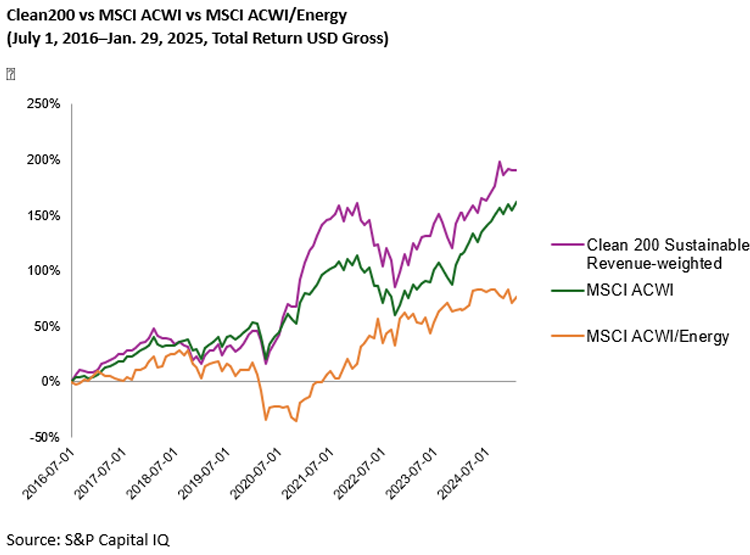
As You Sow and Corporate Knights recently released the 12th cohort of the Carbon Clean200™, a global list of 200 publicly traded companies leading the global sustainable clean energy economy. Together, these industry-leading companies generated $2.5 trillion in revenue from services and products that reduce demand for fossil fuels and water, while offering investors more than double the returns of the fossil-fuel-heavy MSCI ACWI Energy Index. They also beat the global benchmark MSCI ACWI by 30% from July 1, 2016, to January 29, 2025.
The latest Clean200 list is available to the public. Clean200 data shows that for the large companies that make up 80% of global market capitalization, sustainable revenues and capital expenditures are growing more than twice as fast as everything else. This trend holds across sectors and regions and puts sustainable companies on a path to dominate the global economy by the end of the next decade, despite political attacks.


Clean200 companies by sector
Clean200 Companies by Sector

Key Findings Include:

• The top 10 companies on the list by revenue include Apple, Contemporary Amperex Technology, Microsoft, Tesla, TSMC, and Volkswagen.

• Thirty-five countries are represented in the Clean200, including the U.S. (41), China (21), Japan (18), Germany (14), and France and Canada (11 each).

• Clean200 companies earned over $2.5 trillion in sustainable revenue during 2023 (the most recent year for which full year results are available).

• Clean200 companies generated a total return of 190.9% on a sustainable revenue-weighted basis outperforming the MSCI ACWI index (162.0%) and the MSCI ACWI/Energy Index of fossil fuel companies (76.7%) on Total Return Gross — USD Basis from the Clean200 inception of July 1, 2016, to Jan. 29, 2025.

• $10,000 invested in the Clean200 on July 1, 2016, would have grown to $29,090 by Jan. 29, 2025, versus $17,670 for the MSCI ACWI/Energy benchmark for fossil fuel.

• The industrial sector accounts for 52 companies on the list, followed by the Information Technology (32), and consumer discretionary and materials (29 each). IT companies had the highest total sustainable revenue, a cumulative total of over $687 billion.

The top 10 companies that contributed the most to the Clean200’s performance over the past year were from China (3), the U.S. (2), France (2), Taiwan (1), Germany (1) and the U.K. (1). They include sustainably-certified tech hardware, electric vehicles, and electric rail equipment.

“In 2016, we created the Clean200 in response to investors saying, ‘If we divest fossil fuels, there is nothing to invest in,’” said Andrew Behar, CEO of As You Sow and report co-author. “The Clean200 has consistently demonstrated that the ‘clean energy’ future of eight years ago is now the clean energy present. This year, the scale and global diversity of leading companies continue to expand and redefine the term ‘cleantech’ to be any company with products and services that will reduce demand for fossil fuels and water.”

“It is telling that clean energy stocks generated more than double the returns of fossil fuel stocks since 2016, despite political headwinds, underlining that stock markets care more about economic materiality of the parabolic growth in clean energy than the political leanings of the day,” said Toby Heaps, CEO of Corporate Knights and report co-author.

The Clean200 utilizes the Corporate Knights Sustainable Revenue database, which tracks the percentage of revenue companies earn from sustainable economy themes ranging from green power to electric vehicles to plant protein and smart buildings.

The list excludes companies that are flagged on Corporate Knights Red Flag Companies List and As You Sow’s Invest Your Values suite of mutual fund transparency tools that identify companies involved in fossil fuels, deforestation, the prison industrial complex, weapons, and tobacco, as well as Corporate Knights’ exclusionary screens which form part of its Global 100 methodology.

“We will continue to track and share the emergence of the clean energy economic powerhouse,” Behar continued. “There is clear financial evidence showing a broad spectrum of companies defining this economic transformation away from an extractive economy and into a regenerative economy based on justice and sustainability. The job growth and resilience demonstrated by these companies are our greatest hope in controlling climate change and achieving a safe, just, and sustainable world that benefits all.”


About As You Sow
As You Sow is the nation’s leading shareholder representative, with a 30-year track record promoting environmental and social corporate responsibility and advancing values-aligned investing. Its issue areas include climate change, ocean plastics, pesticides, racial justice, workplace diversity, and executive compensation.

About Corporate Knights
Founded in 2002, Corporate Knights is an independent media and research company committed to advancing a sustainable economy. Corporate Knights maintains the Sustainable Economy Intelligence Database, which is the research engine behind its flagship ranking of The Global 100 Most Sustainable Corporations in the World, and was recently selected by Climate Arc to provide green revenue and CapEx data for the companies being targeted by Climate Action 100+.

** As You Sow and Corporate Knights are not investment advisors, nor do we provide financial planning, legal, or tax advice. Nothing in the Carbon Clean200 Report shall constitute or be construed as an offering of financial instruments or as investment advice or investment recommendations. **

Additional Articles, Energy & Climate, Food & Farming, Impact Investing, Sustainable Business

Women are Transforming Business and Philanthropy: CNBC Changemakers 2025

By Julia Boorstin, CNBC

Key Points

• The second annual CNBC Changemakers list of women transforming business and philanthropy recognizes leaders whose accomplishments span many fields and innovations.

• Companies on the list, from the latest startups to large multinationals, are valued by the market at a total near $400 billion.

• Some of the names are well known, but doing new things, like Jennifer Garner and Paris Hilton. Some who are not household names are solving major problems in women’s health and with AI.

The second annual CNBC Changemakers list of women who are transforming business and philanthropy, which was launched in late February 2025, recognizes leaders whose accomplishments span many fields and innovations: biotech breakthroughs, AI advances, women’s health, and new products and services, many focused on female consumers. Each has accomplished a meaningful achievement in 2024, propelling a major business to a new level of growth or tackling an essential societal issue.

This group of women includes a dozen startup founders leading companies with a total combined valuation of more than $11 billion, and they’ve raised more than $2 billion from investors. The nine public company CEOs on the list run organizations with a combined market capitalization of about $385 billion.

In all, the companies span fourteen sectors, including nine women in the broader umbrella of media, entertainment and sports, six in the financial services industry, and six in the business of food and restaurants. Aerospace/defense, construction, real estate, and pharma/biotech are also represented. Three women on the list are running philanthropic organizations, and there are two women recognized for their achievements in government.

Since November, we’ve been gathering nominations and, with guidance from the Changemakers Advisory Board, evaluated the applicants’ impact through both quantitative and qualitative lenses. Our nominees submitted information about the size and scope of their nominees’ impact. Then, with our team of advisors, and reporters from across CNBC, we assessed the degree to which each candidate has driven change — in their companies and beyond. There are so many accomplished women; our list is differentiated by focusing on their particular impact in the past year.

In putting together this list, CNBC identified a couple of key trends. Like last year’s inaugural list, these leaders are pursuing purpose along with profits, creating businesses whose success is aligned with social or environmental good.

Toyin Ajayi, CEO of Cityblock Health, co-founded the health-care provider to improve the health of lower-income communities, by offering not just medical care, but also mental health, and help navigating social services.

Honest Company CEO Carla Vernón is pursuing the company’s mission to make sustainably-designed and cleanly-formulated products accessible to parents.

Cassandra Morales Thurswell created plastic-free shampoo bars to make affordable hair care, also sustainable.

And Emma Grede, founding partner and chief product officer of Skims, co-founded Good American, a size-inclusive brand, to give an underserved market more options, and she’s using her platform to drive change. She’s chairman of The Fifteen Percent Pledge, a nonprofit working with retailers to dedicate 15% of their shelf space to Black-owned businesses.

Another key trend: Women tackling health-care needs, often their own. Stripes Beauty founder and chief creative officer Naomi Watts is leading a transformation in the way women talk about and treat menopause. Joanna Strober’s startup, Midi Health, offers a virtual clinic, including hormonal and non-hormonal medications, along with supplements and lifestyle coaching, for women aged 40-plus. These two women are tapping a market with enormous potential.

Other Changemakers are focusing on giving consumers more information about their bodies. Katherine Stueland is CEO of GeneDX, which provides genomics testing to help with diagnosis, treatment, and drug discovery, while Michal Mor and Merav Mor, twin sisters and triathletes, co-founded Lumen to measure and track metabolism to provide personalized nutrition.

While most leaders are focused on AI, this group of Changemakers is on the cutting edge, not just of AI development, but also its safe and practical implementation. Lila Ibrahim, chief operating officer of Google DeepMind, is working to ensure that AI is deployed, not just responsibly, but as a force for good, to find medical breakthroughs. Meanwhile Aily Labs’ Bianca Anghelina is building tools to improve corporate decision-making, and Accenture’s chief AI officer, Lan Guan, helps the firm’s thousands of clients develop customized AI strategies. In 2024, Guan led the fastest growth in an emerging technology in Accenture’s history, booking $3 billion in generative AI-related business for the firm.

Our goal in launching the Changemakers list last year was to highlight leaders who have defied the odds. Women comprise 11% of Fortune 500 CEOs, and that’s a record high. As a result, nearly all of the women on the list come from Fortune 500 industries or sectors where women are severely underrepresented in CEO roles. Some, such as Taylor Morrison CEO Sheryl Palmer, are the only female CEOs in their sector. Palmer has embraced the distinction, leveraging her position to create opportunities for other women. Taylor Morrison says the company’s female workforce reached 44% in March of 2024, four times the construction industry average.

Palmer’s employee base illustrates a trend: female leaders are more likely to have more women reporting to them in leadership roles and a diverse workforce. And this is true of this year’s Changemakers: 29 other women on the list say at least half their workforce is female. And 30 say at least half their direct reports are women.

Outside of the Fortune 500, women face an uphill climb as well. Venture capital funding to female-founded companies has actually declined, to 2% last year, while companies with female and male co-founders drew nearly 21%. (That means all-male founding teams drew over 77% of all VC dollars last year). And there is data showing that the progress women are making to close gender gaps in leadership is “fragile,” as Sheryl Sandberg warned after the LeanIn/McKinsey report found a weak pipeline into CEO roles.

The women who succeed, despite those odds, are by definition, exceptional, and their stories, which reveal grit, perseverance, and creativity, are an inspiration. We will be celebrating these Changemakers on April 8 in Los Angeles. Please join me there for a series of interviews and conversations about leadership, innovation, understanding consumers, how to lead culture, and strategize for the future.

Our lineup for the April 8 Summit includes some of this year’s Changemakers: Donna Langley, chairman of NBCUniversal Entertainment & Studios; Paris Hilton, founder, CEO 11:11 media; Chelsea Hirschhorn, founder and CEO of baby, pregnancy and fertility product company Frida; TIAA’s CEO of Retirement Solutions, Kourtney Gibson; education company Guild’s CEO Bijal Shah, and Merav and Michal Mor, the co-founders and inventors of Lumen.

The 2025 CNBC Changemakers – Here’s the full list of women transforming business


Article by Julia Boorstin, CNBC’s Senior Media & Tech Correspondent based at the network’s Los Angeles Bureau. She covers media and tech with a focus on their intersection and technological innovation, and delivers reporting, analysis, and interviews for the network. Boorstin also leads CNBC’s “Fast Forward,” a franchise focused on where media and tech companies are heading in the future, and the “AI Impact” series, which examines the risks and opportunities in the AI technological race.

Additional Articles, Energy & Climate, Food & Farming, Impact Investing, Sustainable Business

Uncovering the Wonderful World of Fixed Income Bonds

By Elizabeth Alm, Saturna Capital

Elizabeth Alm Saturna Capital

Elizabeth and an Egyptian man in the Valley of the Nobels in Egypt

Twenty years ago, I was standing inside a tomb near Luxor, Egypt, watching as the lid of a sarcophagus was opened. The lead archaeologist on our team was leaning over a mummy that no one had seen for millennia, delicately cleaning off sand with a small brush. I’ll never forget the dusty air that made the light feel almost solid, or the feeling of wonder as the lid was lifted. Beyond the exit of the tomb lay an expansive vista of the Nile, a slice of vibrant green cutting through the rolling sunbaked mountains of the desert.

There are moments in life that change your perspective forever, and at that moment I felt like all of us gathered in that tomb were connected to this person who lived thousands of years ago. History was made tangible. Everyone on the team came from different walks of life, perspectives, and religions, but our shared goal connected us to each other. Borders and preconceptions fell away in the face of a larger goal.

In my weeks working on the dig, we unearthed an incredible story spanning from ancient to modern times, collecting disparate pieces of information to understand events. I came to appreciate that uncovering layers and looking deeper isn’t exclusive to archaeology. I saw a tapestry where people, place, culture, context, and planet were essential for true understanding — not only of the past, but of the present and the future.

Theban Necropolis in Egypt - courtesy of Saturna Capital
Theban Necropolis in Egypt

While far from the traditional path, the transition from archaeology to bonds may not be as radical as it first appears. Many aspects of the bond market, especially in inefficient or emerging markets, require a lot of digging. I feel like a detective in my work, gathering information from various sources and perspectives to construct a narrative. I often get sideways, skeptical glances when I exclaim, with passion, that I love bonds.

I still have the same sense of wonder I had in that tomb halfway across the world, but now it’s directed toward investing with a global perspective and a sustainable lens. With 17 years in the world of fixed income, I am part of the 12.5% of portfolio managers who are women, working every day to gain a deeper understanding of our world and the systems that function within it.

Journey to Finance

Some people know finance is their future. For me, the decision was based on need. The looming specter of six-figure student loans cast a dark shadow on my plans to be an archaeologist. I wanted a career that had the intellectual feeling of archaeology, but with more hope of digging myself out of debt. I found sustainable finance by pure chance. A roommate connected me with a venture capital firm specializing in green energy.

Graduating college, it took more than 50 interviews to find a firm that appreciated my non-traditional background and gave me a chance in a rotational investment management program. I started from scratch, opening Excel for the first time in my life on my first day of work and learned bond basics on the job. Taking night classes and studying for the CFA exam led me to the municipal bond market where I finally found my ideal fit. Bond analysis is a complex puzzle, perfect for curious minds seeking connections between financial markets and real-world outcomes.

A decade later, I transitioned to global bonds and sustainable debt investing. Bonds, though often overlooked, are uniquely tangible and integral to our daily lives. They finance the infrastructure we use every day — the schools we attend, the roads we drive — and can direct money toward specific projects. These properties make them vulnerable to climate risks, yet crucial to financing a sustainable economy.

Unearthing Climate Risks and Opportunities

Climate change poses significant challenges to our globalized world, demanding innovative research for evaluation. The human and economic toll of climate change is already evident, with rising temperatures causing increasing deaths, and climate disasters claiming the lives of more than 12,000 people globally in 2023. Food scarcity, wildfire smoke, water shortages, and flooding are impacting the quality of life for millions.

The challenge for investors has always been how to navigate these risks and incorporate their analysis into the investment process. There is still no consensus on the potential impact to financial markets or how much risk is currently priced into the markets. Academic journals largely ignored climate-related financial risk until about 2010.

However, a there is growing body of literature on asset pricing not reflecting the risk and we could see global gross domestic product losses up to 12% for every degree of warming. Under this scenario, a 3 C temperature increase could cause declines in output, capital, and consumption that exceed 50% by 2100 — a material risk for investors. Even today, we see that sovereign debt issued by countries with very high physical risk from climate change have a default probability more than 18% higher than countries with low risk.

This highlights why investing with a global perspective is critical. The emerging markets and developing economies account for 95% of the increase in global greenhouse gas emissions. Despite this, they only account for 14% of global climate finance. There is a massive funding gap, and the bond market will be an important tool going forward in filling it. The growing market for green, blue, and sustainable bonds offers unique opportunities, but also requires critical evaluation of each project.

One of the reasons I have chosen my current firm is because values-based investing is at Saturna’s core and has been for since the company’s inception more than 30 years ago. Our approach to assessing climate resilience is comprehensive, examining carbon emissions trends, sector-specific risks, governance, and opportunities in the low-carbon transition. We also look to an investment’s ability to effect positive change, including bond issuers’ potential positive impact.

Looking Toward the Future

As we face an uncertain future, the need for sustainable debt investing grows. My work reminds me daily of the important connections between people, planet, and investments. When I stepped out of that tomb in Egypt and felt the blazing sun on my skin, I had no idea that my current job even existed in the world. My hope is that future investors look beyond traditional boundaries and uncover unexpected opportunities in the world of finance.

We need people with diverse backgrounds and intellectual curiosity to forge the way ahead in the fixed income market. There has never been so much opportunity for change, nor risk if change is not realized.


Article by Elizabeth Alm, Senior Investment Analyst and Portfolio Manager focused on integrating sustainability into fixed-income investment strategies at Saturna Capital. She has been at Saturna since 2018 and is a portfolio manager on several fixed-income mutual funds with strategies in global and emerging market sustainable bonds and US domestic markets.

Prior to joining Saturna, Ms. Alm spent 11 years at Wells Fargo Asset Management as a senior research analyst, focusing on high-yield and investment-grade municipal bonds. As part of her previous role, she also worked on the management of several municipal SMA strategies. Ms. Alm is a Chartered Financial Analyst® (CFA®) charter holder. Originally from Connecticut, she graduated from New York University with degrees in Economics and Anthropology, including field work completed in Luxor, Egypt.

Energy & Climate, Featured Articles, Impact Investing, Sustainable Business

The Power of Women and Collective Action in Investing for Change

By Janine Firpo, Invest for Better

Above: Invest for Better’s gathering in San Francisco to bring together women for a night of fun and conversation on their shared passion of making a difference with their money.

Janine Firpo-Invest for Better co-founderIn 1995, I set off on a solo backpacking trip through Sub-Saharan Africa, where I witnessed poverty on a scale I had never seen before. That journey altered the course of my life. At the time, I had just left my job as a VP at a technology startup. When I returned, I knew I wanted to dedicate my career to building a more equitable and sustainable world. What I didn’t realize then was that this decision would eventually lead me to rethink how I invested my money — and to uncover the power of collective action.

Breaking Barriers in Values-Aligned Investing

When I first explored values-aligned investing, the concept was still emerging. Conversations about impact investing largely revolved around institutions and high-net-worth individuals. But what about the rest of us? Could someone like me — without formal financial credentials — learn to align my investments with my values? The journey wasn’t easy. I trusted financial advisors who mismanaged my money, navigated unfamiliar financial landscapes, and experimented repeatedly before gaining confidence in managing my finances.

Eventually, I realized I wasn’t alone. Many brilliant, capable women had been excluded from financial conversations. That realization led me to write Activate Your Money: Invest to Grow Your Wealth and Build a Better World. The book wasn’t just mine — it was shaped by certified financial planners, financial leaders, and women who shared their insights as thought leaders and reviewers. It was a collective effort, just like the movement itself.

At the same time, I co-founded Invest for Better, a nonprofit equipping women with the tools and confidence to align their money with their values. Through Invest for Better, I’ve experienced firsthand the extraordinary impact women can have when they come together, share knowledge, and take action. This movement isn’t about going it alone—we are in this together.

Women as a Financial Force

Women are poised to become a financial force like never before. By 2030, women are expected to control $34 trillion, or 38%, of the wealth in the United States — a dramatic increase from $7.3 trillion just a decade ago.1 Yet the financial industry has been slow to recognize and adapt to this shift.

Historically, women have been excluded from financial decision-making. It was only in 1974 — just 50 years ago — that the Equal Credit Opportunity Act guaranteed women the right to access credit without a male co-signer. Despite these barriers, when women do invest, they often outperform men. A Fidelity analysis of over 5 million accounts found that women’s portfolios earned 0.4% more annually, largely because they traded less and made more strategic decisions.2

Women also invest differently. Studies by BNY Mellon show that women are more likely to prioritize investments with positive societal and environmental impacts.3 Yet, over half of women say they would invest, or invest more, if their portfolios reflected their values. This is where organizations like Invest for Better come in — creating spaces for women to gain financial confidence and take meaningful action.

Janine Firpo with Philly's Invest for Better members and ImpactPHL
Janine Firpo with Philly’s Invest for Better Circle members and ImpactPHL to discuss impact in Philly area and beyond

The Ripple Effect of Collective Action

Research shows if women had participated in the economy identically to men, it would have added up to $28 trillion, or 26 percent, to annual global GDP by 2025, this year, compared with a business-as-usual scenario.4 Additional research shows that if women invested at the same rate as men, that would translate to an additional $1.87 trillion flowing into socially responsible investments.

Investing with purpose isn’t just about numbers — it’s about real impact in our communities and for our planet. Imagine investing in affordable housing developments that provide stable homes for families, or in businesses that prioritize fair wages and worker well-being. Consider the potential of funding regenerative agriculture, which rebuilds soil health while supporting small farmers. Across all asset classes — stocks, bonds, cash, real estate, and alternative investments — there are opportunities to direct capital toward solutions that improve lives and protect our environment.

This is why we’re launching a national campaign to reframe how women view their financial potential. We don’t have to wait for change; we are the change. At Invest for Better, we’ve built a community where women support one another in learning, investing, and growing. We offer free events, resources, and our Circles program — small groups of women who come together to learn how to align their wealth with their priorities.

The results have been inspiring. One woman who joined our Circle program went on to create a fund with her husband focused on charitable grants and impact investments addressing poverty, financial inclusion, and racial justice. Another woman, a finance influencer, rebalanced her portfolio after participating in one of our deep-dive courses.

Collective Action Includes Everyone

While this movement highlights the power of women’s financial engagement, it’s not just about women. Men have a vital role to play in advancing values-aligned investing and ensuring financial decision-making is more inclusive. When men actively support women’s participation in investing, they help unlock a greater flow of capital into initiatives that create sustainable, equitable change.

Many of the most effective investment strategies involve collaboration across genders. Families, partners, business leaders, and financial professionals can all work together to make investment choices that align with shared values. By engaging men in this conversation, we amplify our collective ability to drive systemic change. We need all hands on deck — this is a movement for everyone who believes in leveraging money as a force for good.

Your Money, Your Values

If there’s one thing my journey has taught me, it’s this: our individual actions create powerful ripple effects. Every decision we make — whether aligning our investments with our values or helping others do the same — can contribute to solving the global challenges we face.

Values-aligned investing isn’t just about making money; it’s about making capital markets work for people and the planet. It’s about addressing systemic inequities, improving quality of life, and ensuring a better future for the next generation. These are not abstract ideas; they are urgent human concerns that demand action today.

The future is in our hands. Together, we can shape it. Let’s harness our collective power and take bold steps toward a more just and sustainable world. We hope you’ll join us.


Article by Janine Firpo, who is a values-aligned investor and social innovator. In 2017 she left a successful 35+ year career in technology and international development to focus on how women can create a more just and equitable society through their financial investments. Her book, Activate Your Money, was published in May 2021. Later that year, Janine co-founded Invest for Better, a non-profit organization that helps women invest their money in ways that align with their values. In 2024, Forbes named Janine one of “50 Over 50” female leaders who continue to make impact later in life.

Footnotes:

[1]  https://www.bnnbloomberg.ca/business/economics/2024/12/09/massive-wealth-transfer-will-give-women-us34-trillion-by-2030/

[2] https://www.bankrate.com/investing/women-and-investing/#women-and-investing-by-the-numbers

[3] https://www.bankrate.com/investing/women-and-investing/#women-and-investing-by-the-numbers

[4] https://www.mckinsey.com/featured-insights/employment-and-growth/how-advancing-womens-equality-can-add-12-trillion-to-global-growth`

Featured Articles, Impact Investing, Sustainable Business

Investing in Diverse Founders is Good for the World and Your Portfolio

By Laurel Mintz, Fabric VC

Above image courtesy of Fabric VC

Laurel Mintz Fabric VCChange isn’t coming – it’s already here. Venture capital is undergoing a seismic shift, and if you’re not investing in women-led and diverse startups, consider this your wake-up call. Investors who aren’t yet looking at the untapped potential of these founders are missing out on some of the most exciting and profitable return opportunities in today’s financial markets.

At Fabric VC, we’ve seen first-hand how shifting the landscape to investing in diverse founders isn’t just the right thing to do – it’s a winning strategy towards creating stronger returns and sustainable businesses. This is where opportunity meets impact, and the results speak for themselves.

The Power of Diverse Leadership: A Market Advantage

Here’s the thing: diversity isn’t just a buzzword – it’s the key to better business outcomes. The days of the old boys’ club running the show are numbered, and as the world of business evolves, so too does the understanding that diversity – whether gender, racial, or socio-economic – is directly correlated to better business outcomes. Studies show that companies with more women in leadership positions perform better financially, are more innovative, and are able to navigate change with agility. These aren’t just feel-good facts – they’re statistics that should make any investor sit up and take notice.

Diverse leadership isn’t a ‘nice-to-have.’ It’s a competitive edge. When you invest in founders who bring unique perspectives to the table, you unlock untapped markets and innovative solutions that others might overlook. That’s a pretty solid argument for why diversity is more than just a buzzword – it’s the future of investment.

Closing the Inequality Gap: The Business Case

Let’s address the elephant in the room – the venture capital industry has a diversity problem. A staggeringly small percentage of funding goes to women and minority founders. This isn’t just a moral failure – it’s a missed financial opportunity. Diverse teams don’t just create products – they create solutions that resonate with a global audience with trillions in buying power. At Fabric VC, we’re actively seeking out these opportunities and providing them with the resources and mentorship they need to succeed.

But the true value of supporting these founders goes beyond equality – it’s about the immense potential for growth. Diverse teams are more likely to create products and services that cater to a broader audience, better positioned for success in a global marketplace. This isn’t just philanthropy – it’s smart business.

The venture capital industry has a diversity problem - Laurel Mintz

Fabric VC’s Model: More Than Just Investment

At Fabric VC, we don’t just write checks and hope for the best. We’re in the trenches with our portfolio companies with our sleeves rolled up ready to help them scale, strategize and succeed because we’re dedicated to helping diverse founders break through the barriers that have traditionally kept them from accessing capital.

What sets us apart? We don’t just look for great ideas – we look for founders who are committed to building companies that will make a lasting impact on the world. Whether creating jobs, solving pressing social issues, or transforming industries, these founders are not just changing the fabric of venture capital – they’re changing the fabric of society. This mission is personal to me. With a J.D and M.B.A. from Rutgers University and over sixteen years of running the award-winning marketing agency Elevate My Brand, I’ve had the privilege of working with more than 400 companies from global brands like Facebook, Verizon Digital Media, Geico, PAW Patrol, and Zendesk. I’ve seen firsthand what it takes to build something meaningful and enduring. There’s something that just hits different as the kids would say, when you’re an operator turned investor. The deep understanding of what it takes to successfully launch and sustain a company is one that most GPs frankly have never had and, we believe, one of the many things that sets us apart and sets us up for providing true value to our portfolio companies.

The ROI of Impact: Why Diversity Drives Returns

Let’s talk numbers, because at the end of the day? ROI Matters. Here’s the truth: Investors who support diverse founders aren’t just championing equality – they’re investing in some of the highest-potential businesses in the market. As food for thought; in 2023, female founders secured almost 28% of total U.S. deal value, surpassing All Raise’s 2030 goal of 23% years ahead of schedule. This momentum isn’t limited to women founders either, in 2021, Black-led venture funds also announced record raises of capital to over $100 million for the first time. The data speaks for itself; startups led by women and underrepresented minorities often outperform those with traditional, homogenous leadership teams.

Diverse-led teams are a force to be reckoned with, they’re the top talent, powerhouses of innovation and masters of scalability. Investors who see the business opportunity here aren’t just championing for a cause, no; they’re making strategic financial decisions that position them for a larger pool of high-growth opportunities.

How You Can Get Involved

At Fabric VC, we are always on the lookout for forward-thinking investors who want to be part of this change. Whether you’re a seasoned venture capitalist or a newcomer to the space, there are countless ways to get involved and make an impact.

We offer a unique opportunity to partner with us in identifying and nurturing diverse, high-potential companies. By supporting these founders, you’re not just investing in a company – you’re investing in the future. And with our proven track record of success, we’re confident that the returns on this investment will speak for themselves.

What’s Next For “ESG” Investing

The Future Is Diverse, and So Is the Market. The venture capital landscape is evolving, and investors who aren’t adapting will find themselves left behind because the future isn’t shaped by outdated and homogenous teams. The future is shaped by leaders who solve problems creatively and innovate fearlessly – those who are rethinking what it means to create, scale, and succeed.

At Fabric VC, we’re proud to be at the forefront of this revolution. We believe that by investing in diverse founders, we’re not just helping to close the inequality gap – we’re setting the stage for a more prosperous, inclusive, and innovative future. And for investors, that’s the ultimate opportunity.

Interested in learning more about how you can get involved and start investing in diverse founders today? Visit Fabric VC to explore opportunities and join us in reshaping the future of venture capital.


Article by Laurel Mintz J.D., M.B.A. is the CEO and Founder of award-winning, Los Angeles-based marketing agency Elevate My Brand serving both startups and blue chip global brands like Facebook, Verizon Digital Media Group, PAW Patrol, and Zendesk. Using her experience working with more than 400 companies in the CPG and technology spaces, Laurel launched Fabric VC, in 2022, to provide alpha returns while doing good by investing in diverse founders who have proven to outperform. She is the General Partner and Founder of Fabric VC

Featured Articles, Impact Investing, Sustainable Business

Signup to receive GreenMoney's monthly eJournal

Privacy Policy
Copyright © GreenMoney Journal 2025

Website design & development by BrandNature

Global Events Calendar

View All Events

april

21aprAll Day232026 Sustainable Packaging Coalition: SPC Impact – Nashville

27aprAll Day30Women Deliver 2026 Conference (WD2026) – Melbourne

X